Key takeaways
- The six best naturalisers are daffodils, crocus, snowdrops, camassia, snake's head fritillary and Tulipa sylvestris
- Plant most bulbs in autumn, September to November; snowdrops go in green in February or March
- Bury each bulb at two to three times its own height: daffodils 10-15cm, crocus 7-10cm, small bulbs 5cm
- Never mow for at least six weeks after flowering, or you starve next year's bulbs and cause blindness
- Scatter bulbs by hand and plant where they fall for natural drifts, never straight rows
- A full drift needs 50-100 daffodils or 100-plus crocus per square metre; bulbs cost 10p to £1 each
- Choose rough grass, orchards and tree bases, not a fine striped lawn you want to keep tidy
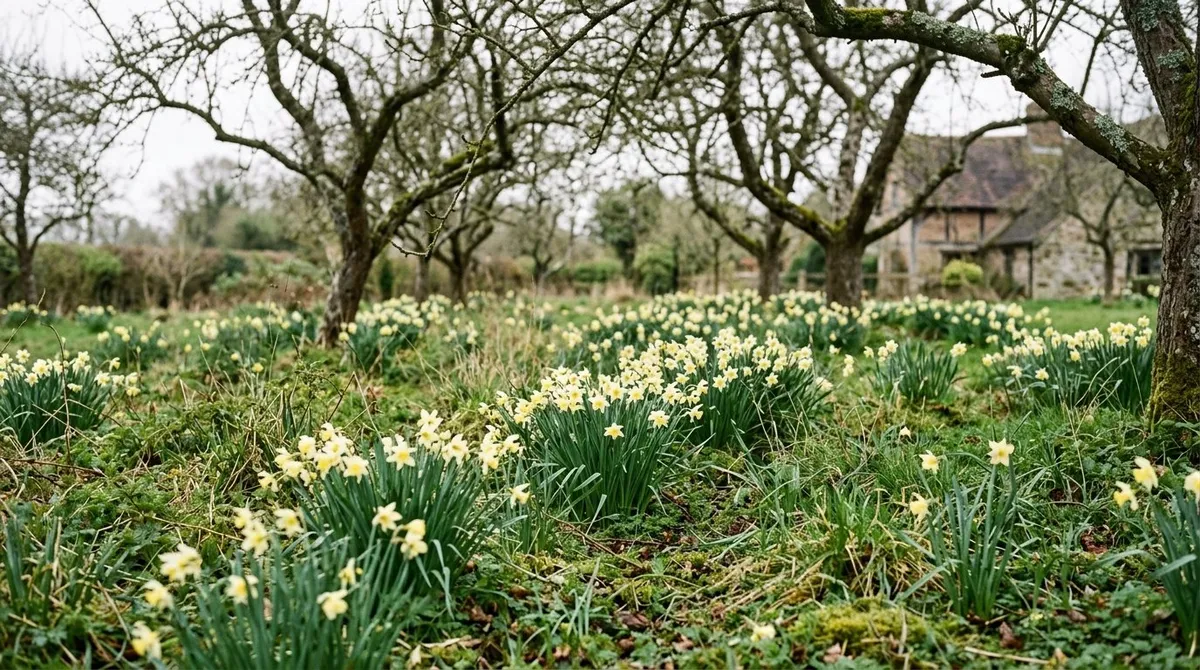
Naturalising bulbs in grass is the oldest trick for turning a flat, dull lawn into a spring spectacle. You plant once, then the bulbs settle in, multiply, and return stronger every year. Done well, a patch of rough grass fills with daffodils, crocus and chequered fritillaries for almost no upkeep.
The method rewards a little thought. The wrong bulbs fade out within three seasons. The wrong mowing habit kills next year’s flowers before they even form. This guide covers the six species that truly thrive, how deep to plant them, the throw-and-plant drift trick, and the single rule that matters most.
Which bulbs naturalise best in grass?
The best bulbs for naturalising are daffodils, crocus, snowdrops, camassia, snake’s head fritillary and the wild tulip. All six multiply on their own and shrug off competition from grass roots. Pick from these and the patch improves every year rather than thinning out.
Daffodils are the backbone of naturalised grass. Smaller and species types beat the fat show hybrids, because they push through turf more easily and multiply faster. ‘February Gold’, ‘Jetfire’ and the native Lent lily, Narcissus pseudonarcissus, are all reliable. Our guide to how to grow daffodils covers cultivar choice in full.
Crocus give the earliest colour, often by late February. Crocus tommasinianus, the woodland crocus, is the champion naturaliser and seeds itself freely through short grass. The larger Dutch crocus works too, though squirrels dig up more of the corms. See how to grow crocus for the detail.
Snowdrops carpet damp grass under trees. The common Galanthus nivalis spreads into fat clumps over the years. Read how to grow snowdrops before you buy, because timing is everything with this one.
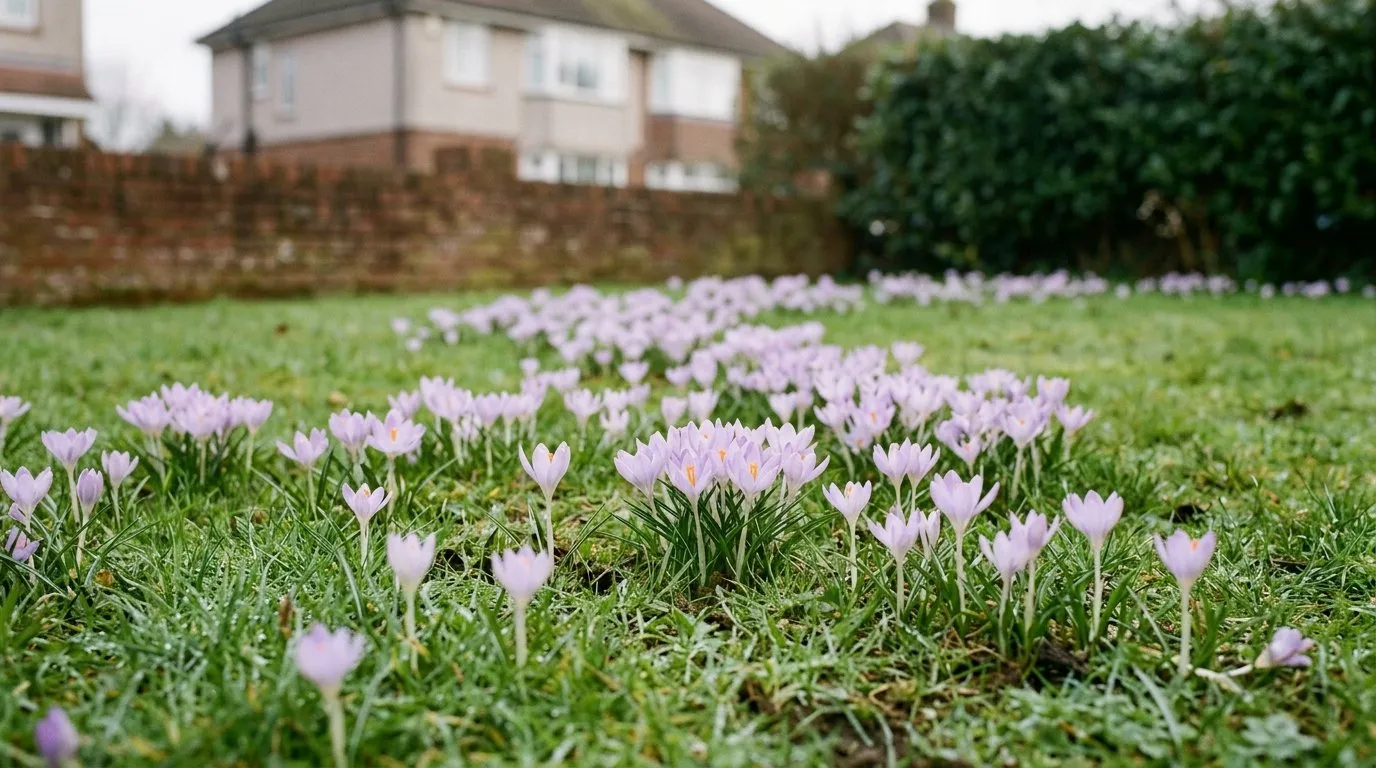 Crocus tommasinianus naturalised in a suburban front lawn. It opens by late February and seeds itself through short grass.
Camassia carries the display into May, long after the daffodils fade. Tall blue or white spikes reach 90cm and thrive on the heavy, damp clay that defeats most bulbs. It suits longer meadow grass beautifully, as our guide to how to grow camassia explains.
Snake’s head fritillary is the native jewel of damp meadows. Fritillaria meleagris hangs chequered purple and white bells in April, exactly the plant that fills Oxford’s water meadows. It needs moisture and hates drying out, so plant promptly. Our how to grow fritillaria guide has the full method.
Wild tulip is the honest exception among tulips. Most garden hybrids fade after one grassy spring, but Tulipa sylvestris naturalises, spreading scented yellow stars through rough grass over the years.
The six best naturalising bulbs compared
| Bulb | Flowers | Plant depth | Best soil and site | Rough cost each |
|---|---|---|---|---|
| Daffodil (species types) | March-April | 10-15cm | Sun or light shade, most soils | 20-50p |
| Crocus tommasinianus | Feb-March | 7-10cm | Sun, free-draining short grass | 10-15p |
| Snowdrop | Jan-March | 8-10cm | Damp shade under trees | 15-30p |
| Camassia | May | 10-15cm | Damp, heavy clay, sun | 60p-£1 |
| Snake’s head fritillary | April | 8-10cm | Damp meadow grass, sun | 30-50p |
| Tulipa sylvestris | April | 12-15cm | Free-draining, warm, sunny | 30-60p |
When should you plant bulbs for naturalising?
Plant most naturalising bulbs in autumn, from September to November. That gives the roots time to establish before winter and a cold spell to trigger flowering. The soil is still warm in early autumn but the grass has stopped growing hard, which makes planting easier.
Daffodils go in first, September or October. They root early and resent sitting around dry. Crocus, camassia and fritillary follow in October. Snake’s head fritillary bulbs dry out fast on the shelf, so buy them fresh and plant the day they arrive.
Tulips wait until November, once the soil has cooled below about 10C. Cold soil helps them avoid the fungal disease tulip fire. For the full month-by-month timing across every spring bulb, see when to plant spring bulbs.
Snowdrops break the autumn rule. Dry snowdrop bulbs establish poorly, so the trade sells them “in the green”, as growing plants lifted just after flowering in February or March. Plant them then, at the same depth they were growing, and they take far better.
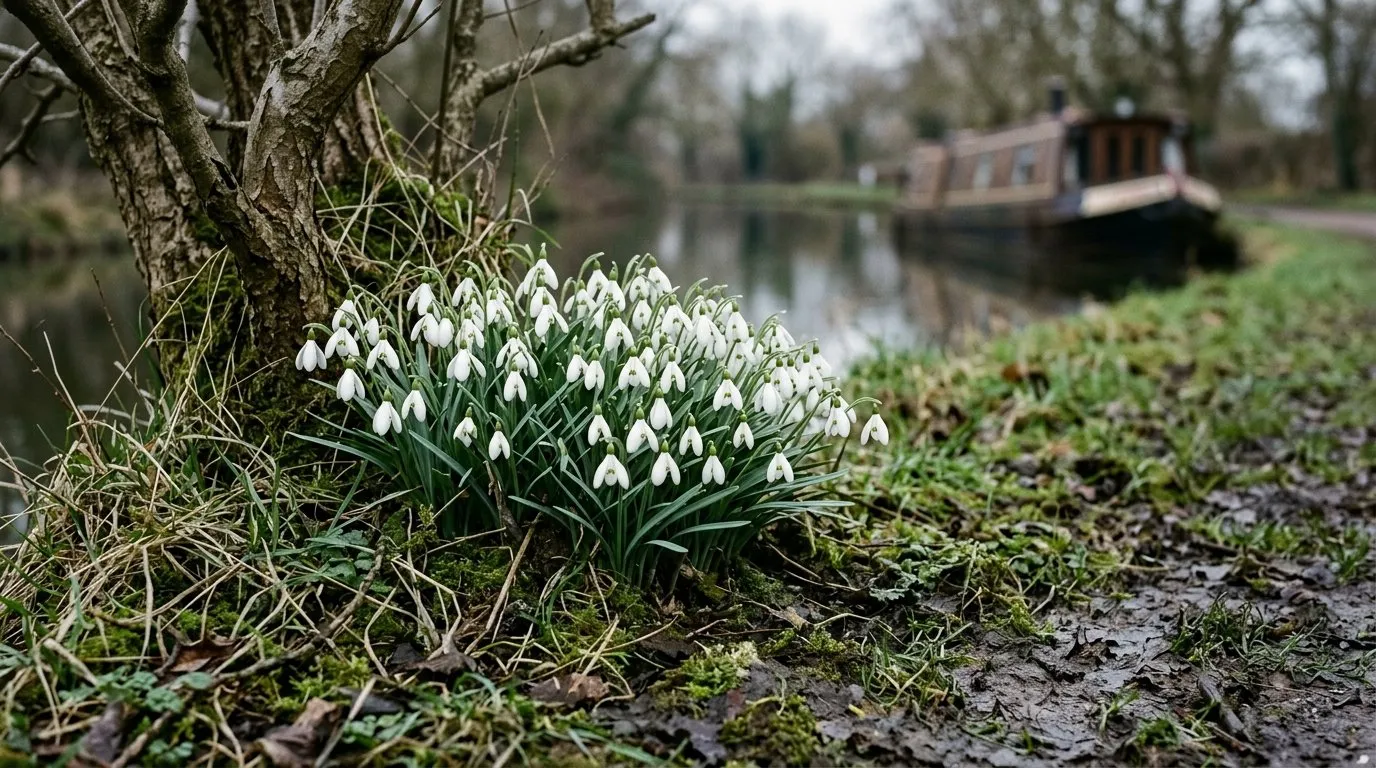 Snowdrops naturalised under a canal-side tree. They establish far better planted in the green after flowering than as dry autumn bulbs.
How deep do you plant naturalising bulbs?
In practice that means daffodils at 10-15cm deep, crocus and snowdrops at 7-10cm, and small bulbs like scilla or chionodoxa at about 5cm. Camassia and wild tulips sit at 12-15cm. A big daffodil bulb 5cm tall wants a hole roughly 12cm deep.
Depth matters more in grass than in a border. Grass roots dry the top few centimetres of soil hard in summer. Bulbs planted too shallow bake, shrink, and skip flowering. When in doubt, go a little deeper rather than shallower.
Gardener’s tip: Deep planting is the single best defence against squirrels and premature mowing. Squirrels rarely dig past 10cm, and a bulb sitting 12cm down survives an accidental early cut that would scalp a shallow one. If you naturalise nothing else deep, plant your crocus at a full 10cm. It is worth the extra minute per hole.
The throw-and-plant method for natural drifts
Scatter the bulbs by hand across the grass and plant each one exactly where it falls. This is the throw-and-plant method, and it is the difference between a natural drift and a stiff, gardened block. Nature never plants in rows.
Take a handful of bulbs and toss them gently over the area. Let them land where they will. Plant the ones that cluster and the ones that stray alike, without tidying the pattern. Denser in the middle, thinning to singles at the edges, mimics how bulbs seed themselves in the wild.
Work in generous numbers for impact. A mean scatter of a dozen bulbs looks like an accident. Aim for at least 25 to 50 bulbs per small drift, and let separate species overlap at their edges so one flowers as the last fades.
Avoid straight lines, grids and even spacing. A row of daffodils down a lawn edge shouts “planted by hand” every spring. The whole charm of naturalising is that it should look as if it happened by itself.
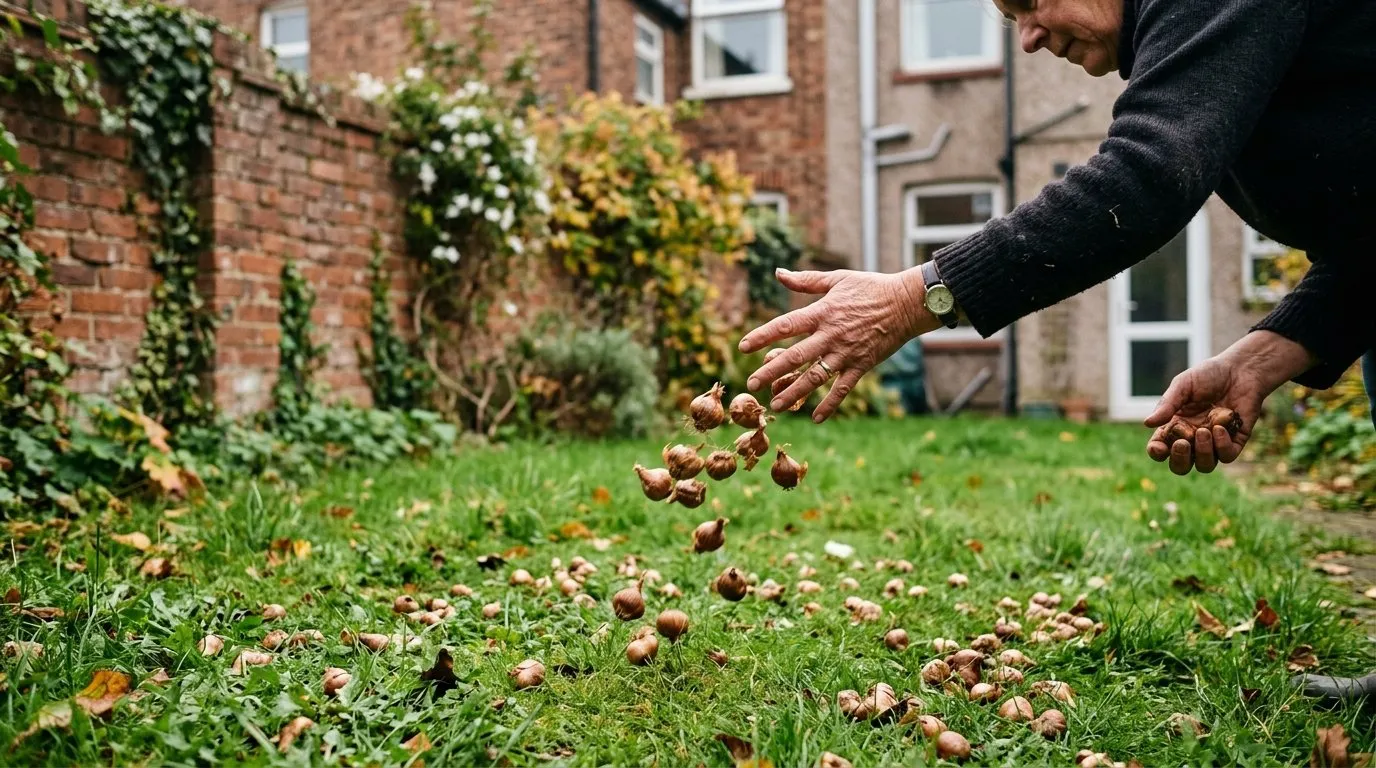 The throw-and-plant method in a city terraced garden. Scatter the bulbs and plant where they land for a natural, unforced drift.
Bulb planter or lifting turf: which is better?
For large bulbs in grass, a bulb planter is quicker, but lifting a flap of turf beats it for small bulbs and dense drifts. The right tool depends on the bulb size and how many you are planting.
A bulb planter cuts a plug of turf and soil so you can drop a bulb in and replace the plug. A short-handled planter costs about £8 to £15; a long-handled, foot-operated one runs £25 to £40 and saves your back over a big planting. It suits daffodils and other fat bulbs planted as scattered singles.
For crocus, snowdrops and other small bulbs, lift a flap of turf instead. Cut an H-shape with a spade, peel back the two flaps, loosen the soil, and press in a dozen bulbs at once. Fold the turf back and firm it down. It is far faster than making 12 separate holes.
For tiny bulbs in short grass, a long screwdriver or a narrow dibber makes a quick hole. Push, drop, and heel closed. Whatever the tool, firm the grass back down afterwards so the bulbs are not left in an air pocket.
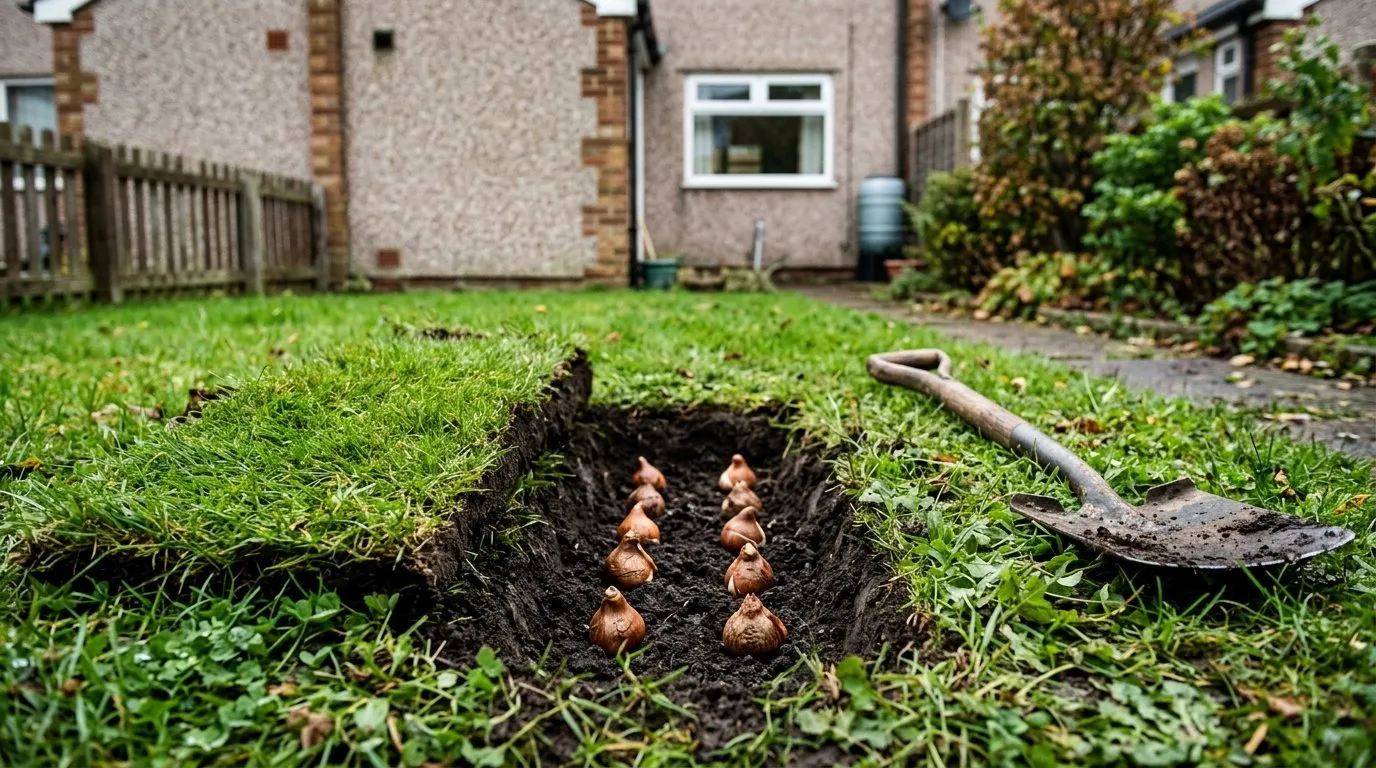 Lifting an H-flap of turf to plant a cluster of bulbs at once. Far quicker than digging a dozen separate holes.
The golden rule: never mow for six weeks after flowering
Never mow naturalised grass for at least six weeks after the flowers fade. This is the golden rule, and breaking it is the commonest reason naturalised bulbs stop flowering. The leaves are working the whole time.
After a bulb flowers, its leaves photosynthesise and pump sugars back down to build next year’s flower inside the bulb. Cut those leaves off early and the bulb cannot recharge. The result is a season of leaves and no blooms, a problem covered in our guide to daffodil blindness.
So leave the grass and the dying foliage alone. For crocus, that means no mowing until about mid-April. For daffodils, hold off until early to mid June, roughly six weeks after the last flower drops. Let the leaves yellow and flop before the first cut.
Do not knot, plait or tie down daffodil leaves either. It was once fashionable, but folding the leaves cuts the light they catch and weakens the bulb. Just let them collapse naturally. For the wider aftercare routine, see spring bulb care after flowering.
When you do cut, set the blade high for the first pass and drop it over the following weeks. Rake off the clippings rather than leaving a thick mat. This is also why naturalised bulbs belong in grass you can afford to leave long, not a lawn you want striped by Easter.
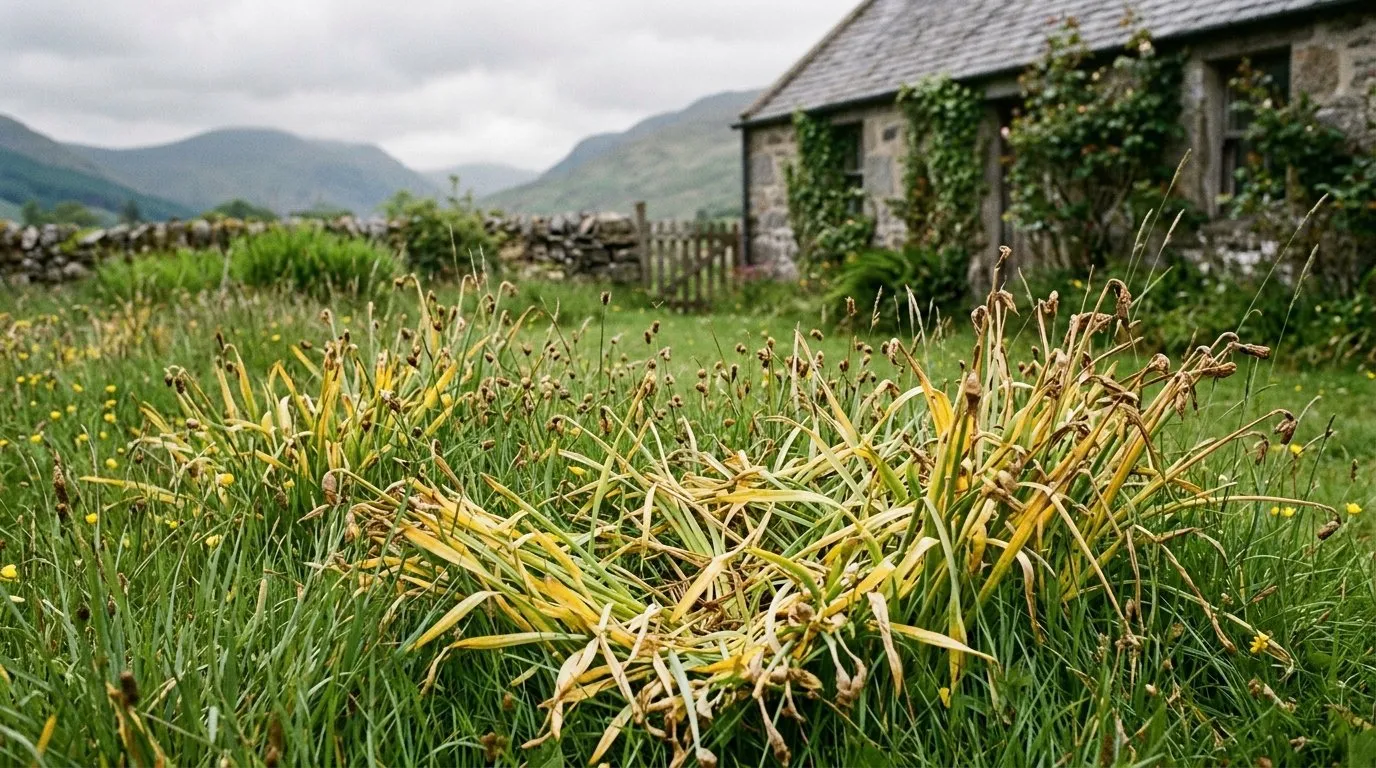 Yellowing daffodil leaves left uncut in a Scottish garden. The foliage feeds next year’s flowers for a full six weeks after blooming.
How many bulbs per square metre, and what does it cost?
For a full drift, plan on 50 to 100 daffodils or 100-plus crocus per square metre. Density is what turns a scatter into a sheet of colour. Thin planting reads as accidental; generous planting reads as a spring meadow.
The numbers scale with bulb size. Daffodils at 50 to 100 per square metre, crocus and snowdrops at 100 to 150, camassia at 25 to 40 because the plants are large. For a lighter, more natural meadow effect, simply halve those figures and let the bulbs seed inwards over time. Our guide to bulb planting density breaks this down bulb by bulb.
Cost is where naturalising shines, because bulk bulbs are cheap. Bought in bags of 50 or 100, daffodils cost 20 to 50p each, crocus 10 to 15p, and snowdrops in the green 15 to 30p. Camassia and fritillary run dearer, at 30p to £1.
Put together, a decent 3 square metre drift of mixed daffodils and crocus costs roughly £30 to £60 and lasts for decades. That is a one-off outlay for a display that returns and multiplies every spring, with no feeding, watering or replanting.
Where naturalising bulbs work, and where they do not
Naturalising works best in rough grass, orchards, verges and tree bases, and worst in a fine formal lawn. Matching the bulb to the spot decides whether the display thrives or sulks.
Under deciduous trees is ideal. Snowdrops, crocus and daffodils flower and feed before the leaf canopy closes over them in late spring. Orchard grass is the classic setting, and the grass under fruit trees is rarely fussy anyway. Camassia and snake’s head fritillary want the damp, heavier ground near ditches or in low-lying grass.
The one place to think twice is a fine striped lawn. The six-week no-mow rule leaves it long and shaggy right through spring. Keep naturalised bulbs to a defined drift you can mow around, or move them to rougher grass entirely. The same logic underpins a full no mow May lawn, where relaxed mowing lets both bulbs and wildflowers flower.
There is a wildlife payoff too. Early crocus and snowdrops are among the first nectar sources for queen bumblebees waking in February, and the Wildlife Trusts rate spring bulbs highly for pollinators. Leaving the grass long a while longer feeds insects as well as bulbs. For the full autumn planting routine across bulbs and grass, the RHS bulb growing guide is a sound reference.
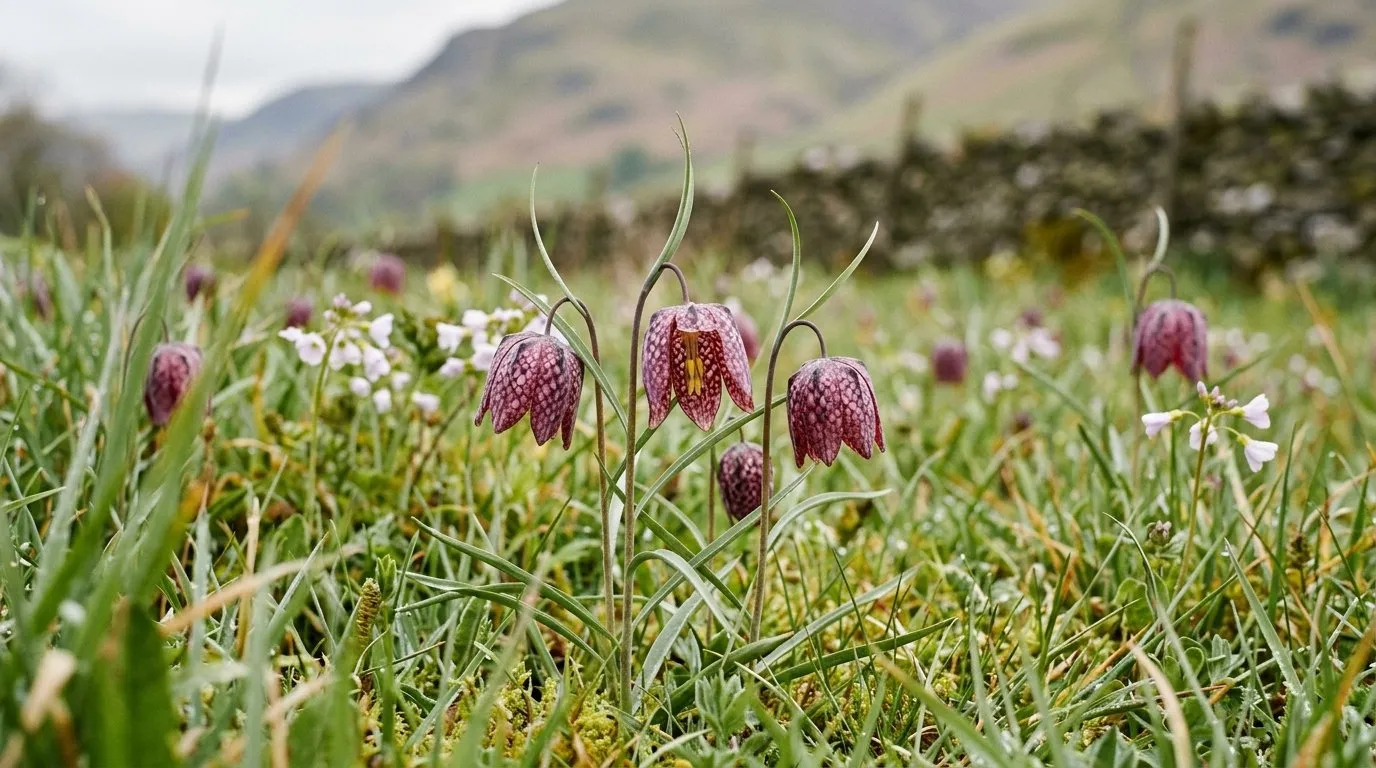 Snake’s head fritillary naturalised in a damp Lake District meadow. It needs moisture and rewards you with chequered April bells.
Related reading: Snowdrops take far better moved in leaf, as our guide to planting bulbs in the green shows.
Frequently asked questions
Which bulbs are best for naturalising in grass?
Daffodils, crocus, snowdrops, camassia and snake’s head fritillary naturalise best in UK grass. All five multiply on their own and cope with competition from grass roots. Smaller species daffodils such as ‘February Gold’ outperform fat show varieties. For the only tulip that reliably returns, choose the wild Tulipa sylvestris rather than garden hybrids, which fade after a season or two.
How deep do you plant bulbs in a lawn?
Plant each bulb at two to three times its own height. That means daffodils at 10-15cm, crocus and snowdrops at 7-10cm, and tiny bulbs like scilla at about 5cm. Measure from the base of the bulb, not the tip. Too shallow and the bulbs dry out, heave in frost, or get sliced by the mower.
When can I mow a lawn with naturalised bulbs?
Wait at least six weeks after the flowers fade before you mow. The leaves spend that time feeding next year’s flower inside the bulb. Cut too early and you get blind bulbs with no blooms the following spring. For daffodils that usually means holding off until early to mid June.
When should I plant naturalising bulbs?
Plant most naturalising bulbs in autumn, from September to November. Daffodils go in early, September or October, while tulips prefer November once the soil is cold. Snowdrops are the exception. They establish far better planted in the green just after flowering, in February or March, rather than as dry autumn bulbs.
How many bulbs do I need per square metre?
For a full drift, plan on 50 to 100 daffodils or 100-plus crocus per square metre. Snowdrops and small bulbs go denser still. For a lighter, more scattered meadow look, halve those numbers. Buy in bulk, since naturalising bulbs cost far less per bulb bought in bags of 50 or 100.
Do naturalised bulbs come back every year?
Yes, that is the whole point of naturalising. Chosen well and left unmown for six weeks after flowering, the bulbs return and multiply for decades. Species and smaller cultivars spread by seed and offsets. Large modern hybrid tulips are the main exception, as most decline after their first spring in grass.
Can you naturalise bulbs in a normal lawn?
You can, but the six-week no-mow rule leaves the grass long and scruffy through spring. That suits an orchard, a verge or a tree base far better than a fine striped lawn. If you want naturalised bulbs in a formal lawn, keep them to defined drifts you can mow around until the leaves die down.
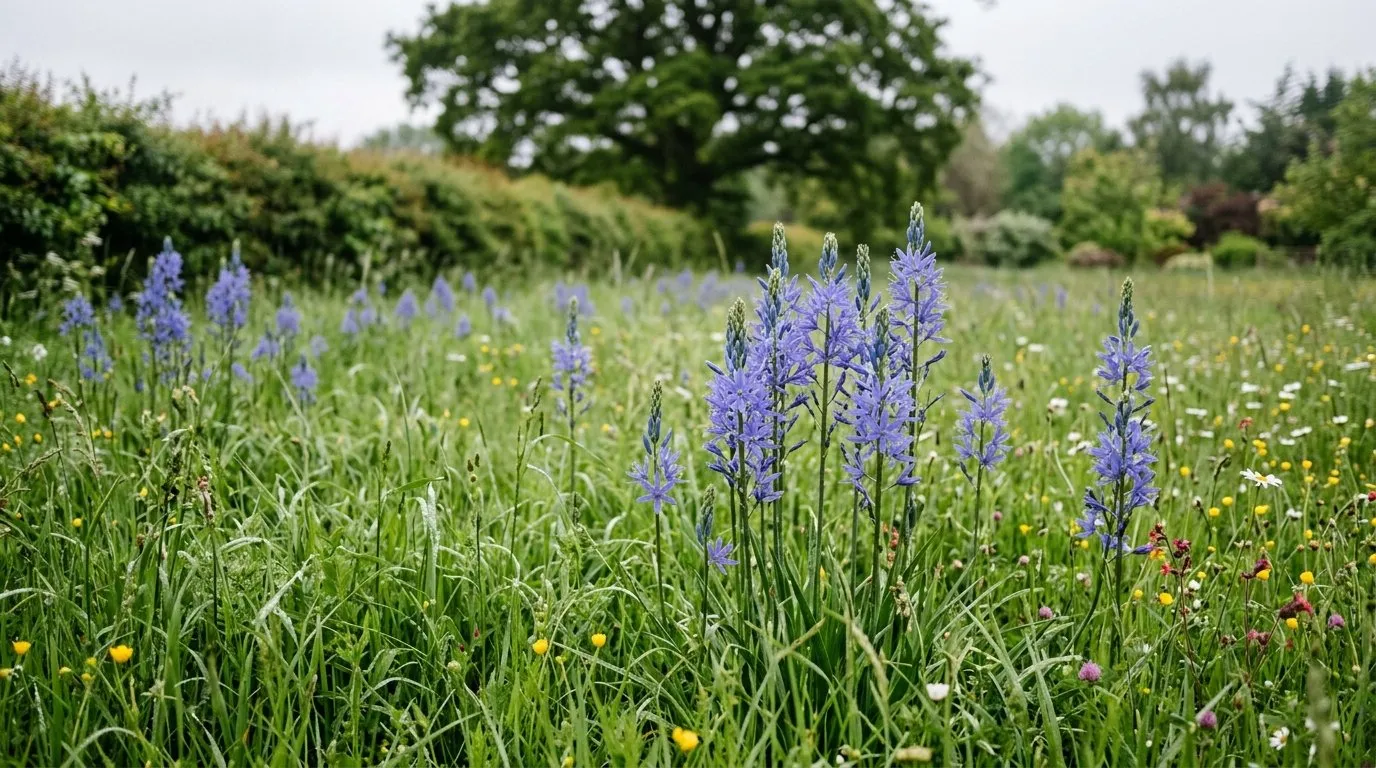 Camassia naturalised in long grass in a Welsh cottage garden. It carries the display into May and thrives on damp, heavy clay.
Our team produces practical UK gardening guidance from source research, contributor records and established horticultural practice. Editorial standards are overseen by Matt W.