Key takeaways
- Silvery stippling plus tiny black faecal specks and no webbing means thrips, not red spider mite
- Eggs are inserted inside leaf tissue and pupae drop to the compost, so leaf sprays miss 50-70% of the population
- Egg to adult takes about 13 days at 25C but stretches to 35 days at 15C, which sets your treatment interval
- Western flower thrips carries tomato spotted wilt virus and is resistant to most amateur insecticides
- Amblyseius cucumeris sachets plus Steinernema feltiae soil drench is the combination that works under glass
- Blue sticky traps catch adults only, roughly 10% of the population, so treat them as monitoring not control
Thrips are the greenhouse pest people treat hardest and beat least often. The silvering appears on a pepper leaf, out comes the spray, the adults die, and everything looks fixed. Ten days later the damage is worse. Glasshouse thrips are not hard to kill, but two of their life stages sit somewhere no spray can reach, and that single fact explains almost every failed control attempt in a UK greenhouse.
This guide covers how to separate thrips from red spider mite in ten seconds, the lifecycle that decides your treatment timing, and which controls actually earn their place. The short version: the compost surface matters as much as the leaf.
How to tell thrips from red spider mite
Both pests bleach the leaf, so people mix them up constantly. The split takes one look.
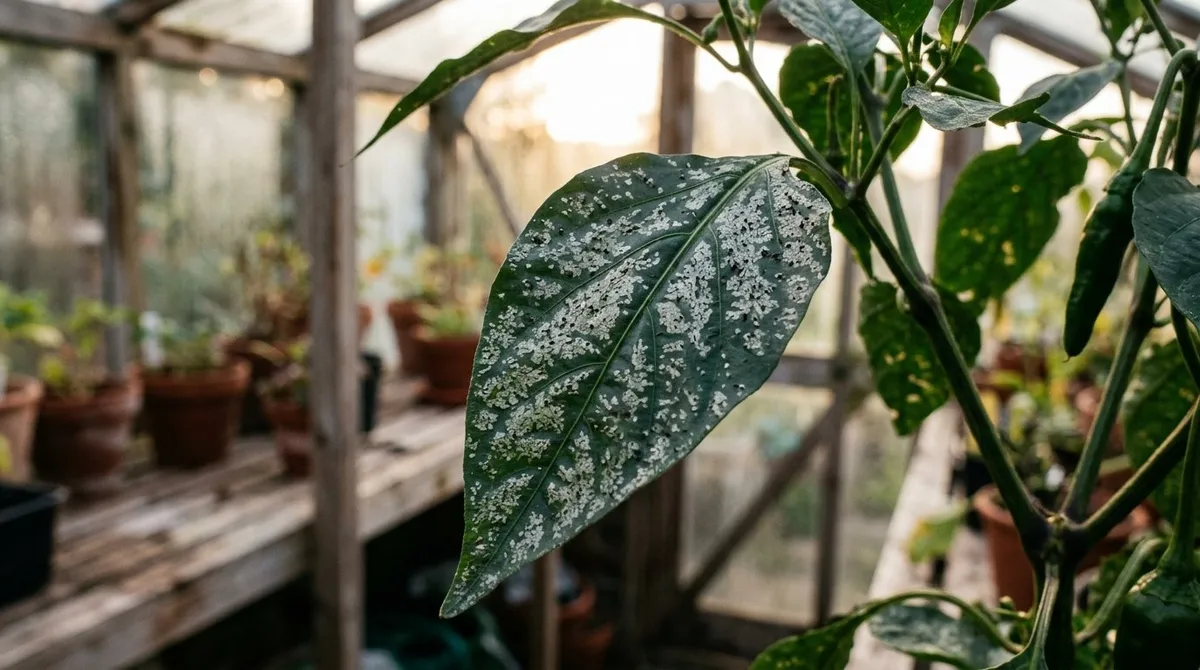
Thrips rasp open the surface cells and drink what leaks out. The emptied cells fill with air, which is why the damage reads as silvery or metallic stippling on the upper leaf surface, brightest when a low sun catches it. Alongside that silvering you get tiny black faecal specks, like ground pepper scattered across the leaf. Those specks are the diagnostic. Red spider mite never leaves them.
Red spider mite produces a finer, yellower speckling, works mainly from the underside, and in any real infestation leaves fine webbing across the growing tips. Thrips produce no silk at all.
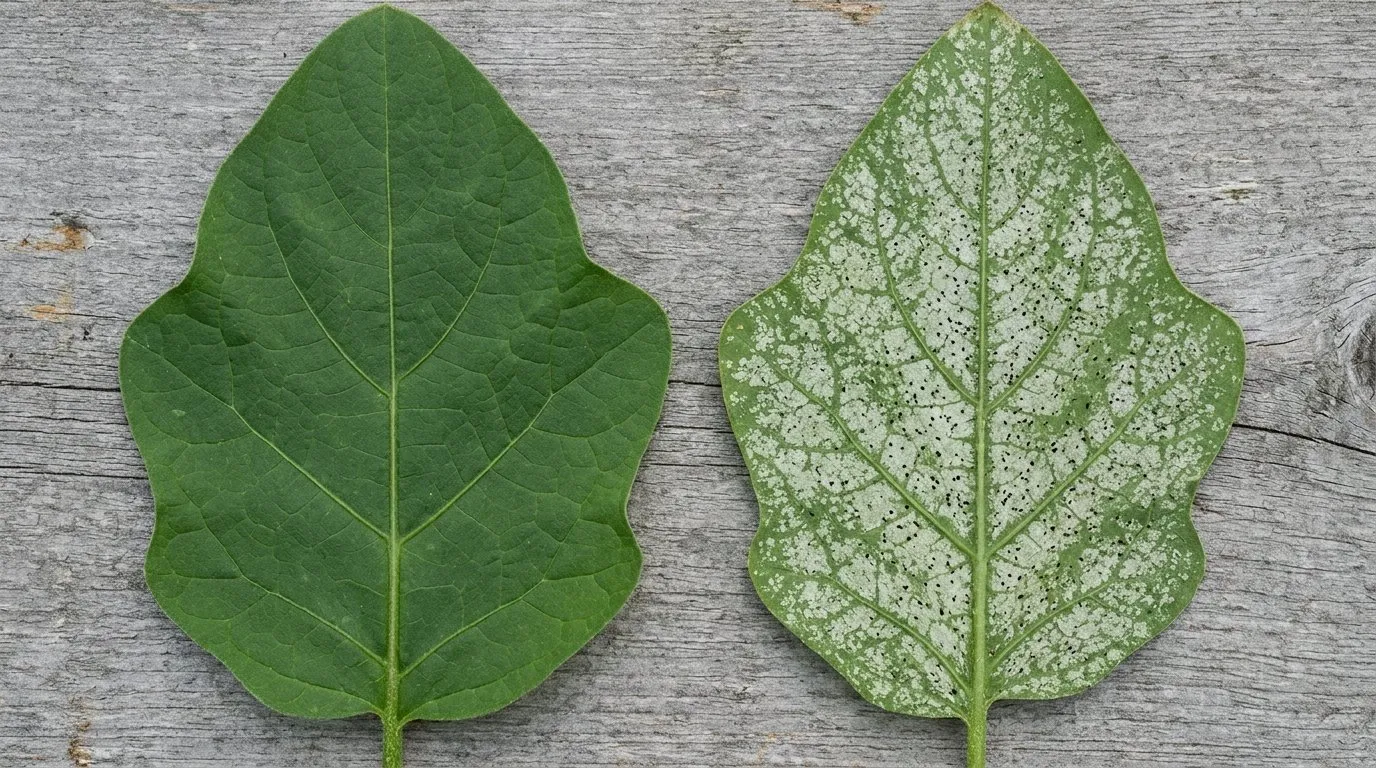 The diagnostic split. Silvery stippling with scattered black faecal specks on the upper surface is thrips. No webbing anywhere.
So: specks and no webbing means thrips. Webbing and no specks means mite. If you find both, you have both, which is common in a hot dry August. Our guide to spider mite control in greenhouses covers that side of the split in detail.
The other thrips signs are worth knowing. New growth comes through distorted and puckered, because the growing point was fed on while the leaf was still forming. Flower petals show pale scarring and brown streaks, which is the first thing you notice on streptocarpus, orchids and roses under glass.
Which thrips is actually in your greenhouse
Two species matter to UK growers, and they are not equally bad news.
Glasshouse thrips (Heliothrips haemorrhoidalis) is the classic one. Adults are 1.2 to 1.5mm, dark brown to black, with a distinctly paler abdomen tip and a slow, reluctant crawl. They rarely fly far. They tend to stay on the leaf they hatched on, which is why the silvering on an infested plant often spreads outward from one patch. Bay, azalea, ferns, citrus and orchids are favourites. It breeds slowly, taking roughly 5 weeks from egg to adult at 23C.
Western flower thrips (Frankliniella occidentalis) is the one that ruins seasons. Adults are 1.2 to 1.9mm, pale yellow through to brown, and they fly readily between plants. It arrived in the UK in 1986 and is now the default thrips on imported ornamentals. It breeds roughly three times faster than glasshouse thrips, it is resistant to most insecticides available to UK amateurs, and it transmits plant viruses.
Warning: Western flower thrips carries tomato spotted wilt virus (TSWV) and impatiens necrotic spot virus (INSV). Only the larvae can acquire the virus by feeding on an infected plant. The adults then carry it for life and spread it as they fly. There is no treatment. Bin infected plants, do not compost them, and never take cuttings from one.
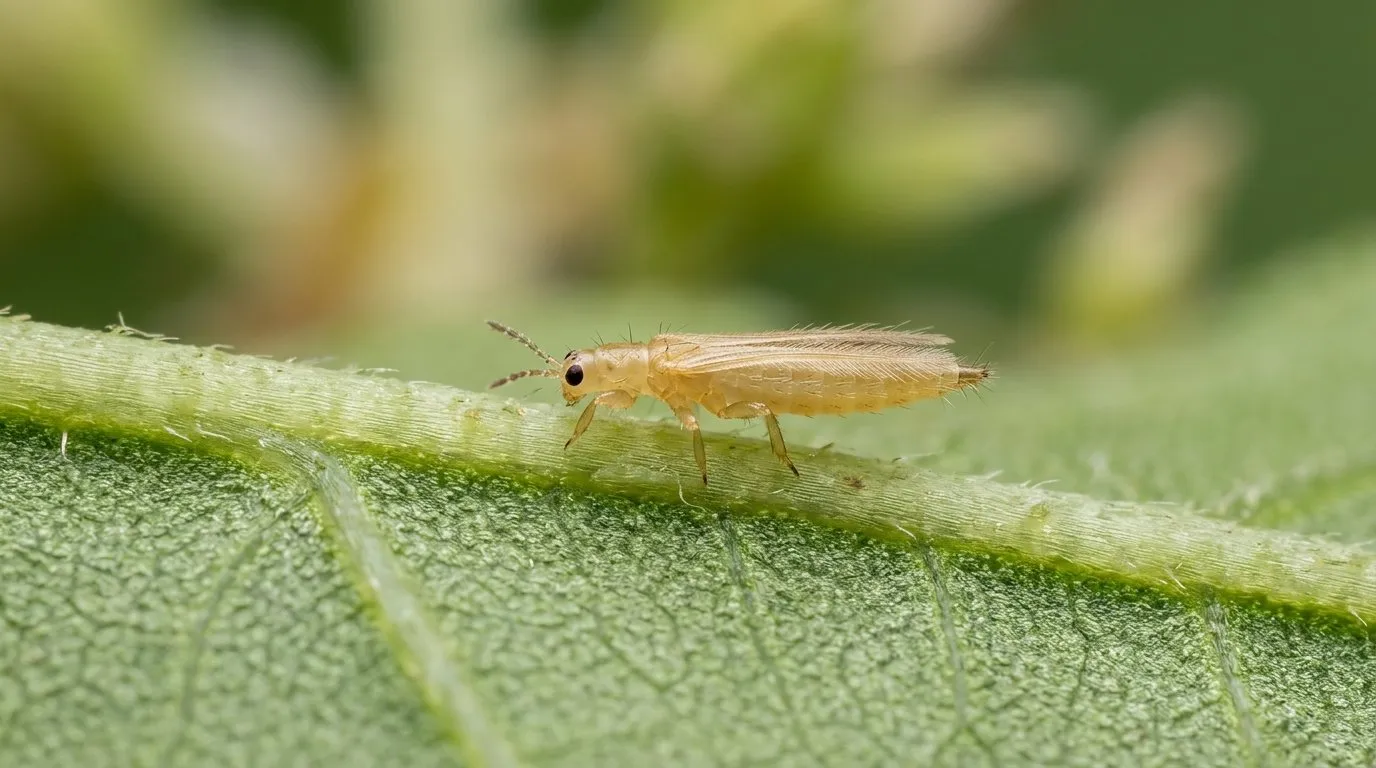 An adult thrips is 1.2 to 1.9mm long. At this size the black faecal specks are usually easier to spot than the insect.
That larvae-acquire, adults-transmit split is why virus spreads even in greenhouses where the grower kills adults regularly. Killing the adult after it has fed is too late.
The thrips lifecycle that beats leaf sprays
This is the whole control story, so it earns a proper look. Thrips run through five stages, and only two of them are on the leaf where your spray lands.
- Egg (3-5 days at 25C). The female uses a saw-like ovipositor to cut a slit and insert the egg inside the leaf tissue. It is not on the surface. It is under it. No contact spray, soap, oil or invigorator can reach it, and no amateur systemic on the UK market reliably does either.
- First-stage larva (1-2 days). Hatches out and starts feeding immediately. Tiny, pale yellow, roughly 0.4mm. This is the only stage most predatory mites will eat.
- Second-stage larva (2-4 days). Larger, around 0.8 to 1mm, feeding hard. This stage does most of the visible silvering.
- Prepupa and pupa (3-5 days). The larva stops feeding and drops off the leaf into the compost or onto the greenhouse floor. It does not feed and it does not move much. Your leaf spray never touches it.
- Adult (lives 30-45 days). Emerges from the compost, flies up, and a female lays 40 to 100 eggs over her life. Back to stage one.
Count the stages a leaf spray can hit: two out of five. At any point in a running infestation, eggs inside the leaf plus pupae in the compost typically account for 50 to 70% of the total population. You can achieve a perfect kill on everything you can see and still leave the majority untouched.
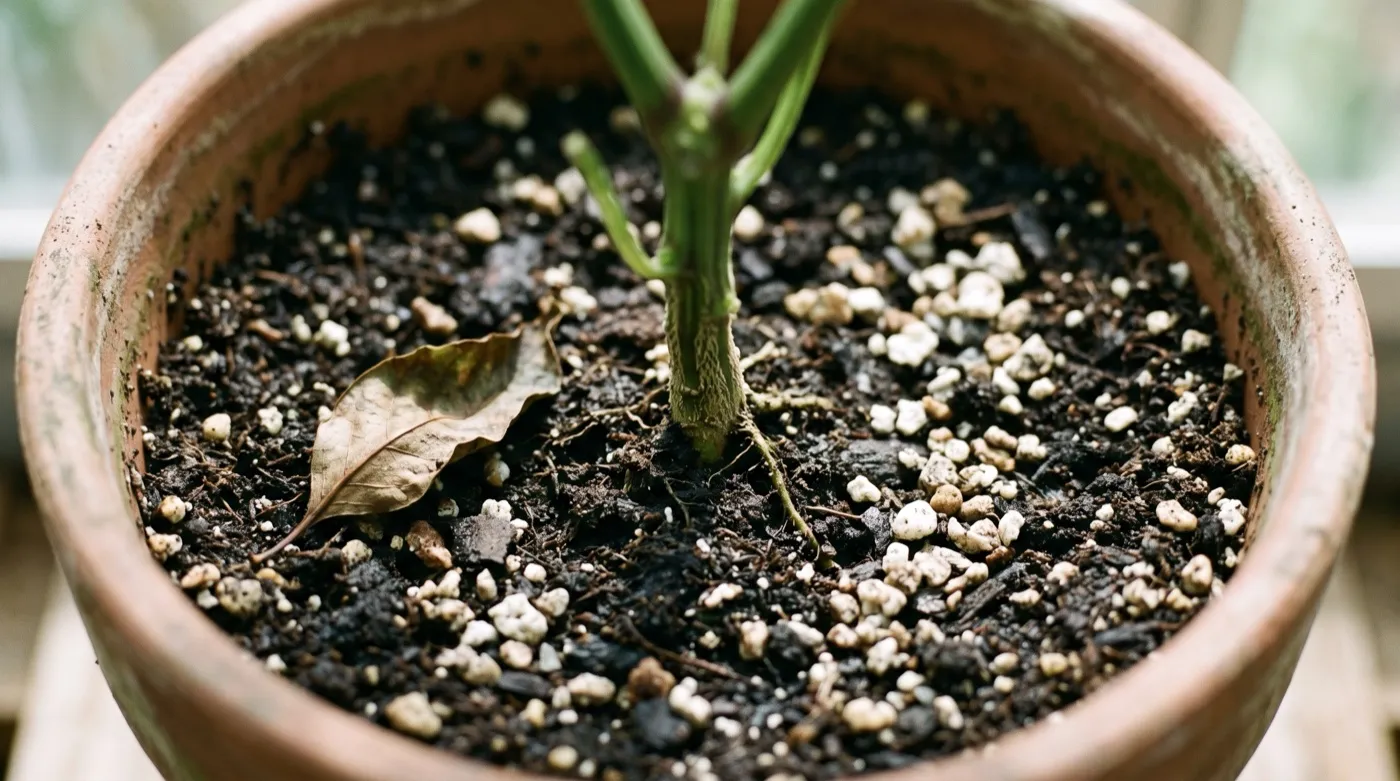 The top 20mm of compost is where stages four and five happen. Nothing you spray on the leaf reaches this layer.
Temperature sets the clock
| Greenhouse temperature | Egg to adult | New generation every | What it means for you |
|---|---|---|---|
| 15C | 32-38 days | ~5 weeks | Slow build; April and October |
| 20C | 18-22 days | ~3 weeks | Typical UK May and September |
| 25C | 12-15 days | ~2 weeks | Peak UK summer; numbers double fast |
| 28C+ | 10-12 days | ~10 days | Outruns most spray programmes |
If you spray at all, you must repeat every 5 to 7 days for at least three weeks to intercept each new hatch. Miss one interval at 25C and you have handed the population a free generation.
Thrips treatments ranked by what actually works
Not all options are equal, and the marketing does not match the results. Ordered by effectiveness in a real UK greenhouse.
| Method | Effectiveness | Role | What it cannot do | Rough cost |
|---|---|---|---|---|
| Amblyseius cucumeris + Steinernema feltiae together | 85-95% | Primary (gold standard) | Cannot rescue a heavy outbreak fast; needs 4-6 weeks | £45-55 per season |
| Amblyseius swirskii sachets | 70-85% above 22C | Primary in high summer | Poor below 18C; will not touch pupae in compost | £25-35 |
| Amblyseius cucumeris sachets alone | 60-75% | Primary on leaf | Eats first-stage larvae only, not adults or pupae | £20-30 |
| Steinernema feltiae drench alone | 50-65% | Primary in compost | Nothing on the leaf; needs soil above 12C | £25-30 |
| Orius laevigatus | 70-80% May-Sept | Supplementary knockdown | Goes dormant under 16 hours daylight; useless Oct-March | £30-40 |
| SB Plant Invigorator / fatty acid sprays | 30-45% | Maintenance | Contact only; misses eggs and pupae entirely | £12-15 |
| Blue sticky traps | 5-10% | Monitoring only | Catches flying adults; removes no eggs, larvae or pupae | £8 per 10 |
| Ultrasonic or electronic devices | 0% | None | Does nothing whatsoever | Avoid |
The gold standard is the combination, not any single product. Predatory mites cover the leaf, nematodes cover the compost, and between them they close both gaps in the lifecycle. Neither one alone gets there, which is why so many growers try biological control once, get a partial result, and write it off.
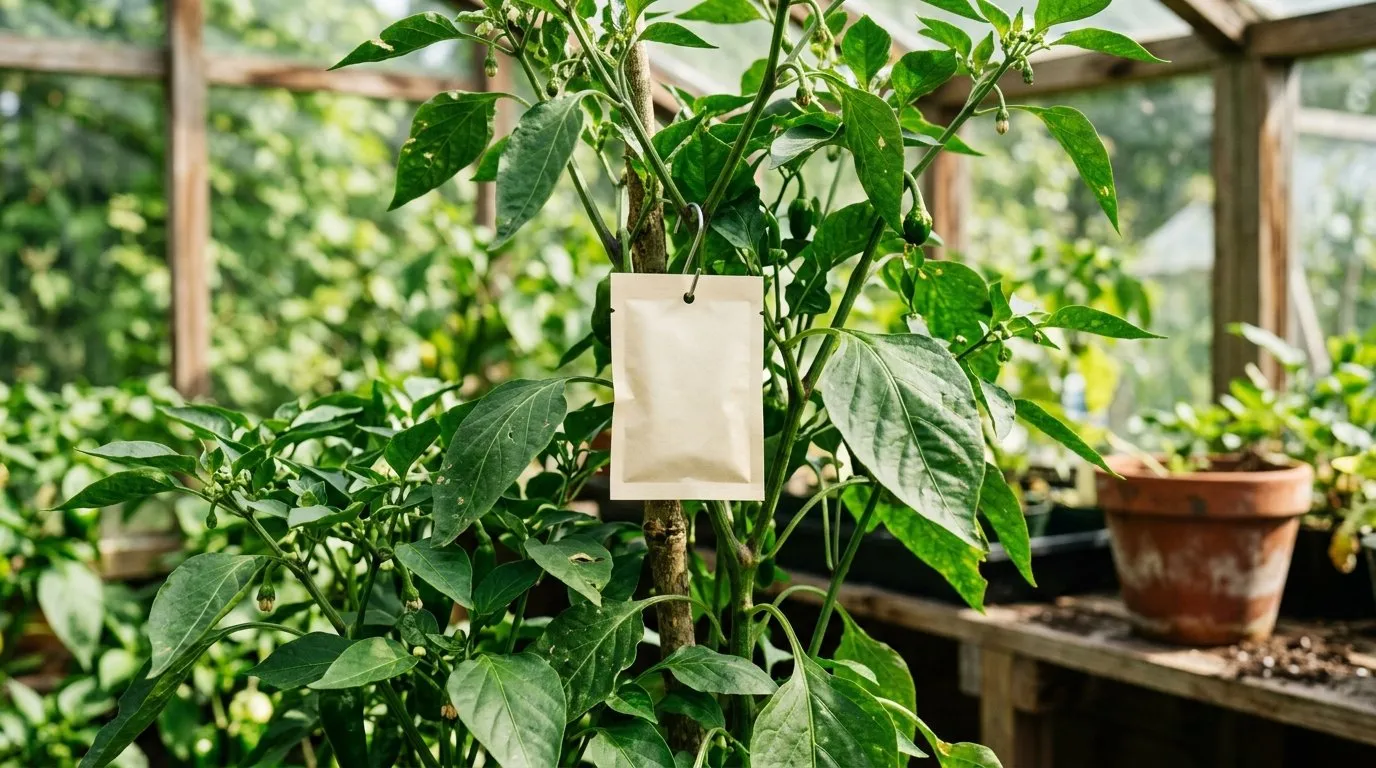 An Amblyseius cucumeris sachet on a pepper stem in mid-May. Each one releases mites steadily for 4 to 6 weeks.
Details worth knowing before you buy. Amblyseius cucumeris eats first-stage larvae only. It will not touch an adult or a second-stage larva, which is why it prevents build-ups rather than clearing outbreaks. Sachets release mites steadily over 4 to 6 weeks and want greenhouse temperatures above 18C. Amblyseius swirskii is stronger but needs 22C plus, so it suits July and August rather than a cold May. Orius laevigatus, a predatory bug, eats adults and larvae both, but it needs more than 16 hours of daylight or it goes into diapause, which limits it to roughly May to early September in the UK.
Getting the nematode drench right
Steinernema feltiae is the piece almost everyone skips, and it is the piece that covers the compost. These microscopic nematodes hunt down the prepupae and pupae that dropped off the leaf, plus any thrips larvae in the top layer.
Mix the pack into water and drench the compost surface of every pot, not the leaves. Do the greenhouse floor and staging too if you have gravel or capillary matting, because pupae end up there as well. Rates are usually 500,000 nematodes per square metre, so a 50 million pack covers 100 square metres, which is far more greenhouse than most of us have. Split it and refrigerate the rest.
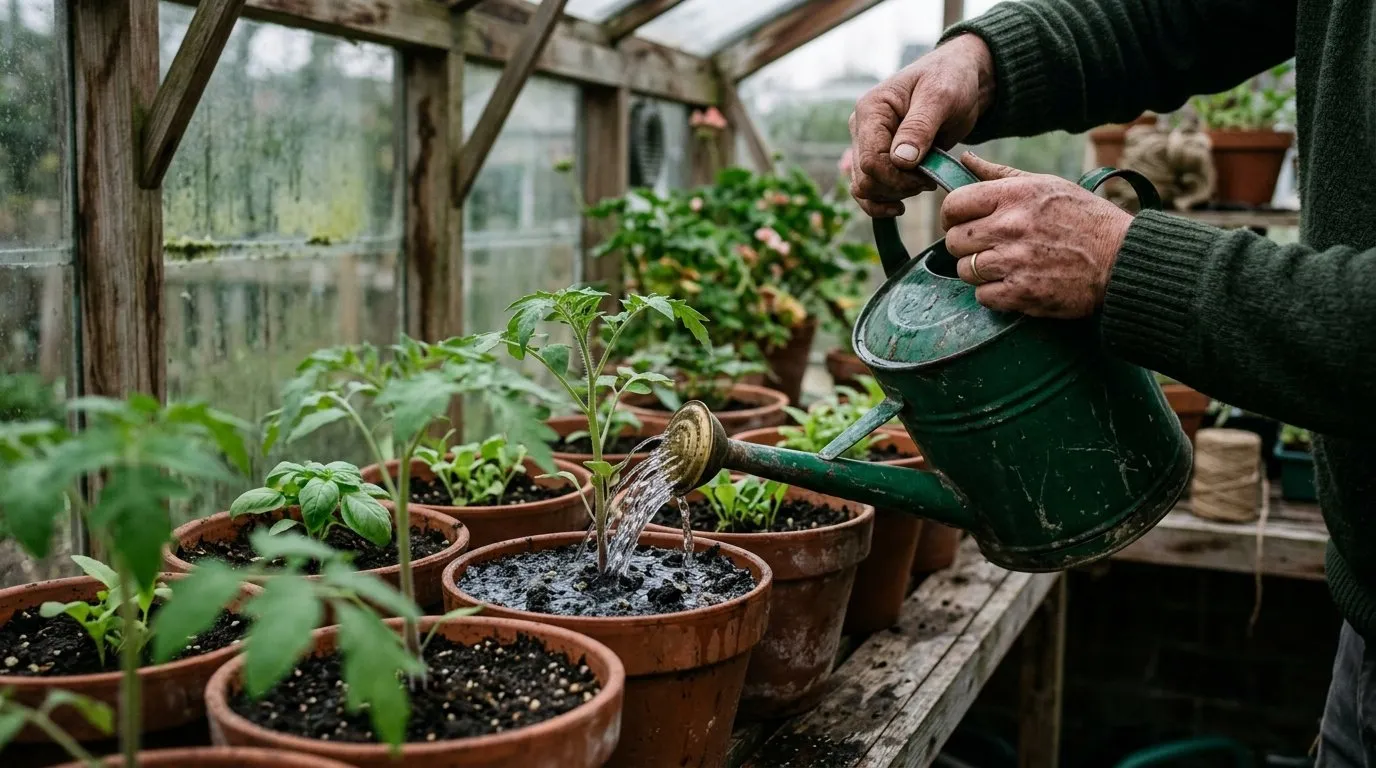 Drench the compost, not the foliage. The nematodes are hunting the pupal stage in the top 20mm.
Three conditions decide whether it works. The compost must stay moist for 14 days afterwards, because nematodes swim through the water film between particles. Soil temperature must be above 12C, which in an unheated UK greenhouse means late April at the earliest. And they die in direct sunlight, so apply in the evening or on a dull day. Repeat every 3 to 4 weeks through the season.
If you have used nematodes before against sciarid fly larvae the method is identical. Our guide to biological pest control with nematodes covers storage, mixing and shelf life, which trips people up more than the application does.
What the UK amateur can actually buy
This is where a lot of online advice is years out of date, so here is the honest position as it stands.
Systemic insecticides have largely gone. The neonicotinoids that once made thrips control simple are no longer available to UK amateur gardeners for this use. What remains on garden centre shelves is mostly contact-acting, and western flower thrips is resistant to the pyrethroid group after decades of use under glass. Spraying a pyrethroid at WFT frequently kills the predators and leaves the thrips.
Physical-action products are the sensible spray choice because resistance cannot develop against them. SB Plant Invigorator and fatty-acid soaps work by contact, blocking or desiccating what they physically wet. That means full coverage of the undersides and growing tips, every 5 to 7 days, and it still does nothing about eggs or pupae. Treat them as maintenance between biological introductions, not as the plan.
Spinosad appears constantly in American advice and in older UK articles. Amateur approvals in the UK have narrowed considerably, so check the current product label before assuming you can buy it for ornamentals under glass. Approvals change every year and a product that was legal for your use in 2022 may not be now.
Nothing here is a criticism of sprays as such. It is that the two stages you most need to hit are the two stages a spray physically cannot. For the wider organic toolkit under glass, our organic greenhouse pest control methods guide sets out what pairs well with a predator programme.
What blue sticky traps tell you and what they do not
Blue sticky traps are sold as control. They are not. They are the best monitoring tool you have, and that is a different job.
Thrips are drawn to blue more strongly than to yellow, which is the reverse of whitefly. Hang one trap per 10 square metres, at the height of the growing tips, and move them up as the plants grow. Count them weekly and write the number down. That number is the whole point.
 Blue traps out-pull yellow for thrips. Hang one per 10 square metres at growing-tip height and count weekly.
What they cannot do is control. They catch flying adults only, which is roughly 10% of a population at any one time. Glasshouse thrips barely fly at all, so traps under-report that species badly. No egg inside a leaf and no pupa in the compost has ever landed on a sticky trap.
Yellow traps in the same greenhouse will catch whitefly, and the two pests often run together in a warm summer. If you are seeing both, our guide to greenhouse whitefly identification and control covers that overlap.
The root cause: why thrips keep coming back
Treating thrips as an outbreak to be fixed is the underlying error. In a UK greenhouse they are a recurring annual entry problem, and they arrive by three routes.
New plants bring them in. This is by far the biggest one. Western flower thrips travels on imported ornamentals, and a single infested plant from a garden centre in April seeds the whole greenhouse by June. The eggs are inside the leaves, so the plant looks clean when you buy it.
Adults fly in through open vents from June onwards, especially where oilseed rape or long grass sits nearby. Pupae overwinter in the greenhouse itself, in old compost, under staging, in gravel and in the debris in the corners. Around 5-10C they simply sit still and wait for spring.
Why is this missed? Because the symptom shows up on the leaf, so people treat the leaf. The cause is quarantine, sanitation and timing.
Permanent prevention runs on three habits. Quarantine every new plant for three weeks on a windowsill away from the greenhouse, with a small blue trap beside it. Clear the greenhouse out each autumn: bin spent compost rather than reusing it, sweep the floor and staging, and wash down the glazing bars where debris lodges. And introduce predatory mites in mid-May, before you see a thrips, because prevention is what mites are actually for.
Humidity plays a quiet part too. Thrips do well in hot, dry air, and a greenhouse that runs at 30C with the vents shut is close to ideal for them. Keeping air moving and humidity moderate suits your plants and inconveniences the pest. Our guide to greenhouse ventilation and humidity control covers the settings.
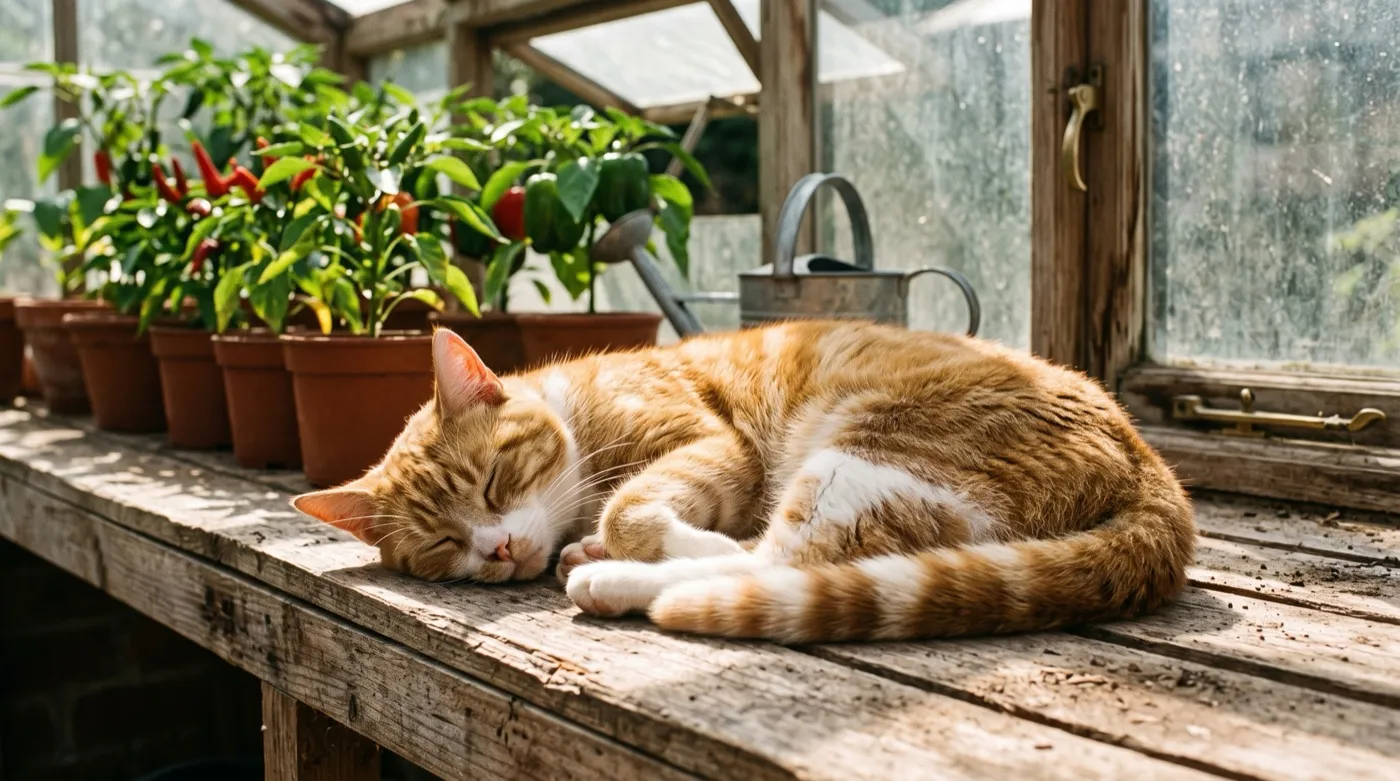 The cat has found the still, baking corner with the vents shut. So have the thrips. Hot dry air suits both of them.
Month-by-month thrips calendar for a UK greenhouse
| Month | What to do |
|---|---|
| January | Greenhouse empty or near it. Bin old compost. Scrub staging and glazing bars. |
| February | Check overwintering plants weekly for silvering. Quarantine anything new. |
| March | Hang one blue trap per 10 square metres. Start weekly counts as a baseline. |
| April | Quarantine every bought-in plant for 3 weeks. Nematodes once soil passes 12C. |
| May | Introduce Amblyseius cucumeris sachets mid-month, before thrips appear. First feltiae drench. |
| June | Add Amblyseius swirskii if the house is holding 22C+. Add Orius if counts climb. |
| July | Peak breeding at 25C+. Refresh sachets every 4-6 weeks. Drench again. |
| August | Keep counting. Ventilate hard; hot dry air favours thrips. Refresh sachets. |
| September | Orius stops working as daylight drops under 16 hours. Final nematode drench. |
| October | Clear crop debris. Pupae overwinter in it. Sweep the floor properly. |
| November | Empty and bin spent compost. Wash down the whole house. |
| December | Inspect any overwintering plants monthly. Silvering now means a spring problem. |
Common mistakes with thrips control
- Stopping when the adults die. The classic. Eggs inside the leaf and pupae in the compost are untouched, so you get a rebound in about ten days. Either commit to a spray every 5 to 7 days for three weeks, or use biological control that covers all five stages.
- Treating only the leaves. The compost surface holds the prepupae and pupae. Skip the nematode drench and you leave a reservoir that refills the plant every fortnight, whatever you do above.
- Introducing predatory mites too late. Mites prevent build-ups; they do not rescue outbreaks. Ordering sachets in July because the plants look silvered is starting the race two months behind.
- Trusting sticky traps as control. They catch about 10% of the population, all of it adult, and glasshouse thrips barely flies. A low trap count on a silvered plant means the traps are lying to you, not that the thrips have gone.
- Skipping quarantine on new plants. Eggs sit inside the leaf tissue of a plant that looks perfectly clean on the bench. Three weeks on a windowsill with a blue trap catches it before it reaches your crop.
If you are working out which greenhouse insects are worth killing at all, good bugs versus bad bugs in your garden is a useful sorting exercise before you reach for anything.
Where thrips sit among greenhouse pests
Thrips reward understanding more than effort. Aphids you can squash, whitefly you can trap, red spider mite you can beat with humidity. Thrips ignore all of that because most of the population is somewhere you are not treating.
The Royal Horticultural Society makes the same broad point about natural pest control under glass: a resident predator population beats a reactive spray, because the predator is already there when the pest arrives. That is exactly why mid-May sachets outperform an August panic.
Frequently asked questions
How do I tell thrips from red spider mite?
Thrips leave black faecal specks and no webbing; spider mites leave webbing. Both cause pale stippling on leaves, so the specks are the reliable split. Thrips damage often looks silvery and metallic under a low sun, while spider mite damage reads as a finer yellow speckling. Turn the leaf over: spider mites cluster on the underside with visible silk.
Why do thrips come back ten days after I spray?
Because the eggs are inside the leaf and the pupae are in the compost. A contact spray only kills the adults and larvae it physically touches. Eggs hatch 3 to 5 days later and pupae emerge as fresh adults, so the population rebuilds on roughly a ten-day cycle. Any spray programme needs repeating every 5 to 7 days for at least three weeks to catch each new hatch.
What kills thrips in a greenhouse?
Predatory mites plus Steinernema feltiae nematodes clear thrips more reliably than any spray. Amblyseius cucumeris eats first-stage larvae on the leaf, and the nematode drench kills prepupae and pupae in the compost. Between them they cover the two stages a spray cannot reach. Introduce both before the population is visible for the best result.
Are blue sticky traps enough to control thrips?
No. They catch adults only, which is around 10% of the population. Traps are a monitoring tool that tells you when numbers are rising and whether a treatment is working. They cannot remove eggs inside the leaf, larvae feeding on it, or pupae in the compost. Use one trap per 10 square metres and count weekly.
Do thrips spread plant viruses?
Yes. Western flower thrips transmits tomato spotted wilt virus and impatiens necrotic spot virus. Only the larvae can pick the virus up, and the adults then spread it as they fly between plants. There is no cure once a plant is infected, so remove and bin affected plants rather than compost them.
Can I use nematodes for thrips on houseplants?
Yes. Steinernema feltiae works as a compost drench in pots exactly as it does under glass. Keep the compost moist for two weeks after applying and the soil above 12C. It targets the prepupal and pupal stages that drop off the leaf, so pair it with a leaf treatment for full cover.
When should I introduce predatory mites for thrips?
Introduce them in mid-May, before you see any thrips. Predatory mites work by preventing a build-up, not by clearing an outbreak. Amblyseius cucumeris needs greenhouse temperatures above 18C to breed properly, and a sachet releases mites for 4 to 6 weeks. Starting late means playing catch-up all summer.
Our team produces practical UK gardening guidance from source research, contributor records and established horticultural practice. Editorial standards are overseen by Matt W.