Key takeaways
- Shanking is physiological, not a fungus or pest; the berry stalk (pedicel) dies and the berry starves
- Affected berries stay green or red, never colour up, then shrivel to sour raisins on the bunch
- Overcropping is the biggest single cause; thin to one bunch per 30cm of rod
- Waterlogged, compacted or bone-dry borders wreck the roots that feed the fruit
- Low magnesium and potash worsen it; feed high-potash and spray Epsom salts as a foliar feed
- Cut out shanked berries with narrow scissors so the rest of the bunch ripens clean
That disorder is called shanking, and it catches out more greenhouse grape growers than any disease does. The frustrating part is that it looks like an infection but is nothing of the sort. It is the vine telling you it cannot feed the crop you have asked it to carry. Once you understand that, the fix is straightforward and permanent.
What grape shanking actually is
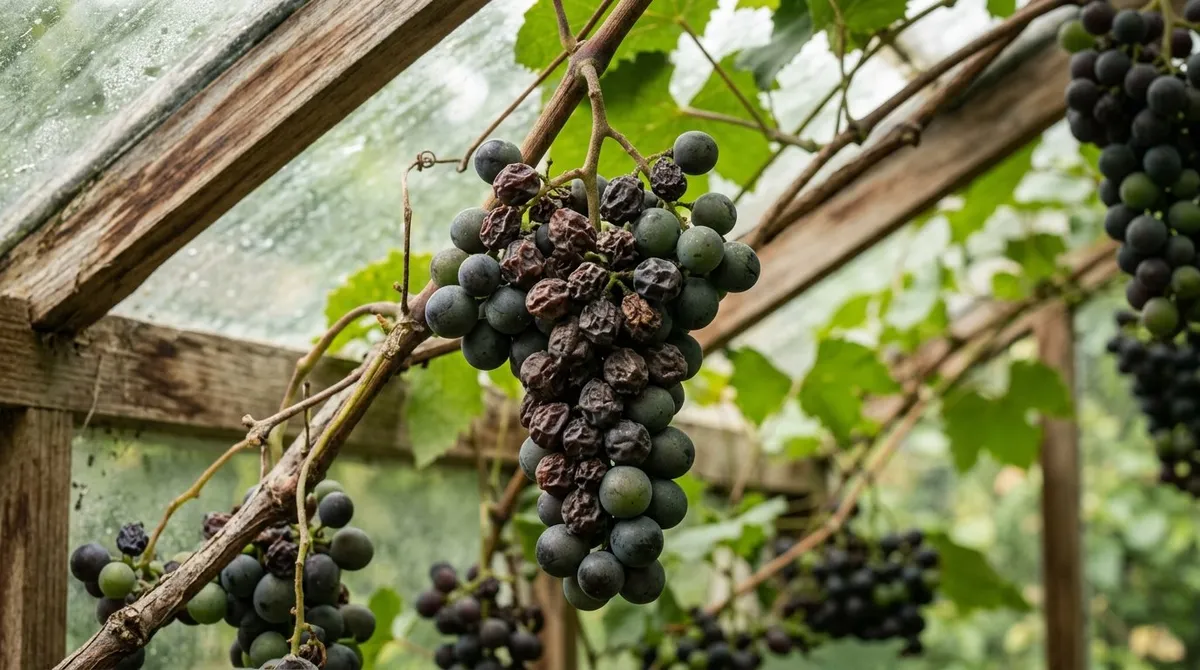
Shanking is a physiological disorder, not a pest or a fungus. The berry stalk, the short green stem called the pedicel that connects each grape to the bunch, dies and turns brown. When that stalk fails, it cuts off the flow of water and sugar into the berry. The grape then stops developing. Black varieties stay red, white varieties stay translucent, and the abandoned berry slowly shrivels to a sour, watery raisin while the bunch around it ripens normally.
The tell-tale sign is that single berries are affected, not whole bunches, and the little stalk browns first. Pick off a shanked grape and you will see the pedicel has gone dark and dry right at the point where it meets the fruit. There is no mould, no webbing, no soft rot. The berry is simply starved. Because it is a feeding failure rather than an infection, spraying achieves nothing. The Royal Horticultural Society classes it as a growing problem tied to roots, cropping and nutrition (rhs.org.uk).
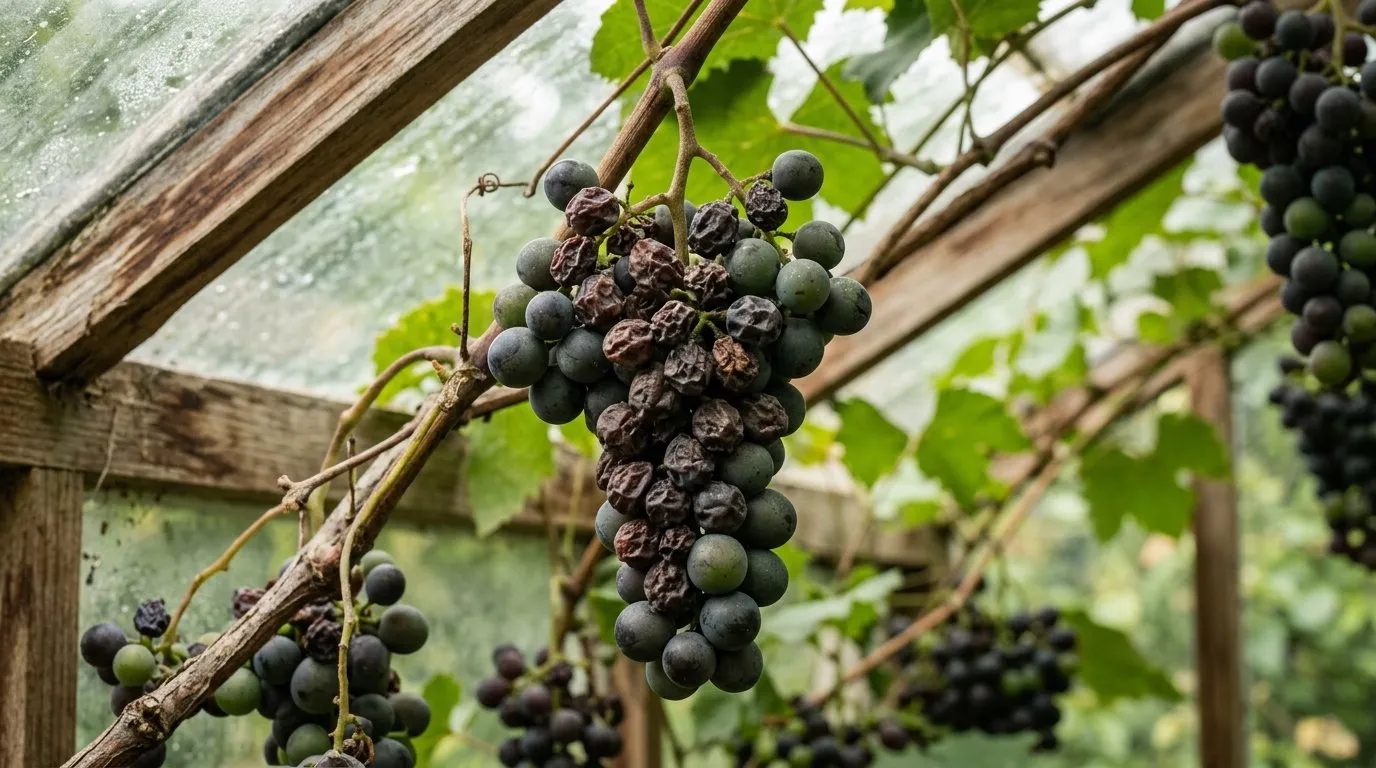 A single bunch part-ruined by shanking. The shrivelled berries never coloured, while their neighbours ripened normally.
Why grapes shank in the greenhouse
The root cause is almost always that the vine cannot supply every berry it is carrying. Overcropping sits at the top of the list. A vine has a finite root system and a finite ability to move water and sugar. Load it with too many bunches and, at the moment of ripening, some berries lose the competition for resources. Their pedicels are the weak link, and they die back first.
The roots themselves are the next big factor. Grape borders that stay waterlogged drown the fine feeder roots that do the real work. Compacted, airless soil does the same. So does a border that dries to dust in July, then gets flooded, then dries again. That swing between saturation and drought is a reliable way to trigger shanking. Poor nutrition compounds it: a vine short of potash cannot ripen fruit properly, and one short of magnesium is already stressed before the crop load piles on.
Two more triggers catch people out. Cold snaps in spring, especially in an unheated greenhouse, chill the roots when the vine is trying to push growth, and that check shows up later as shanking. Heavy pruning during active summer growth removes leaf area the vine needs to feed the fruit, so cutting back too hard in July makes matters worse, not better.
Gardener’s tip: Shanking is a delayed signal. What you see in August was set up in May and June, when the vine was carrying too much and the border was too wet or too dry. Fix those things early and the results show the following season, not overnight.
How to tell shanking from mildew, botrytis and underwatering
Getting the diagnosis right matters, because the fixes are completely different. Reach for a fungicide when the problem is actually shanking and you waste time and money while the real cause carries on. Use the table below to work out what you are looking at.
| Symptom | Shanking | Powdery mildew | Botrytis (grey mould) | Simple underwatering |
|---|---|---|---|---|
| What you see | Single berries shrivel to raisins | White dusty coating on leaves and fruit | Fuzzy grey mould on berries | Whole bunches wilt and soften evenly |
| The berry stalk | Browns and dies first | Normal | Can rot through | Normal, just limp |
| Spread pattern | Scattered single berries | Spreads leaf to leaf | Spreads berry to berry in damp air | Affects the whole vine at once |
| Mould present | None | Yes, white | Yes, grey and furry | None |
| Cause | Roots, cropping, nutrition | Fungus in dry, still air | Fungus in humid, still air | Dry border |
| The fix | Thin crop, feed, fix roots | Airflow plus fungicide or sulphur | Airflow, remove infected fruit | Water the border deeply |
The clearest test is the pedicel. Shanking always browns the individual berry stalk while leaving the surrounding berries plump and healthy. Mildew and botrytis leave visible mould. Underwatering wilts the whole vine together, and a good soak revives it within a day. If single berries are shrivelling with no mould and the little stalk has gone brown, it is shanking, and no spray will help.
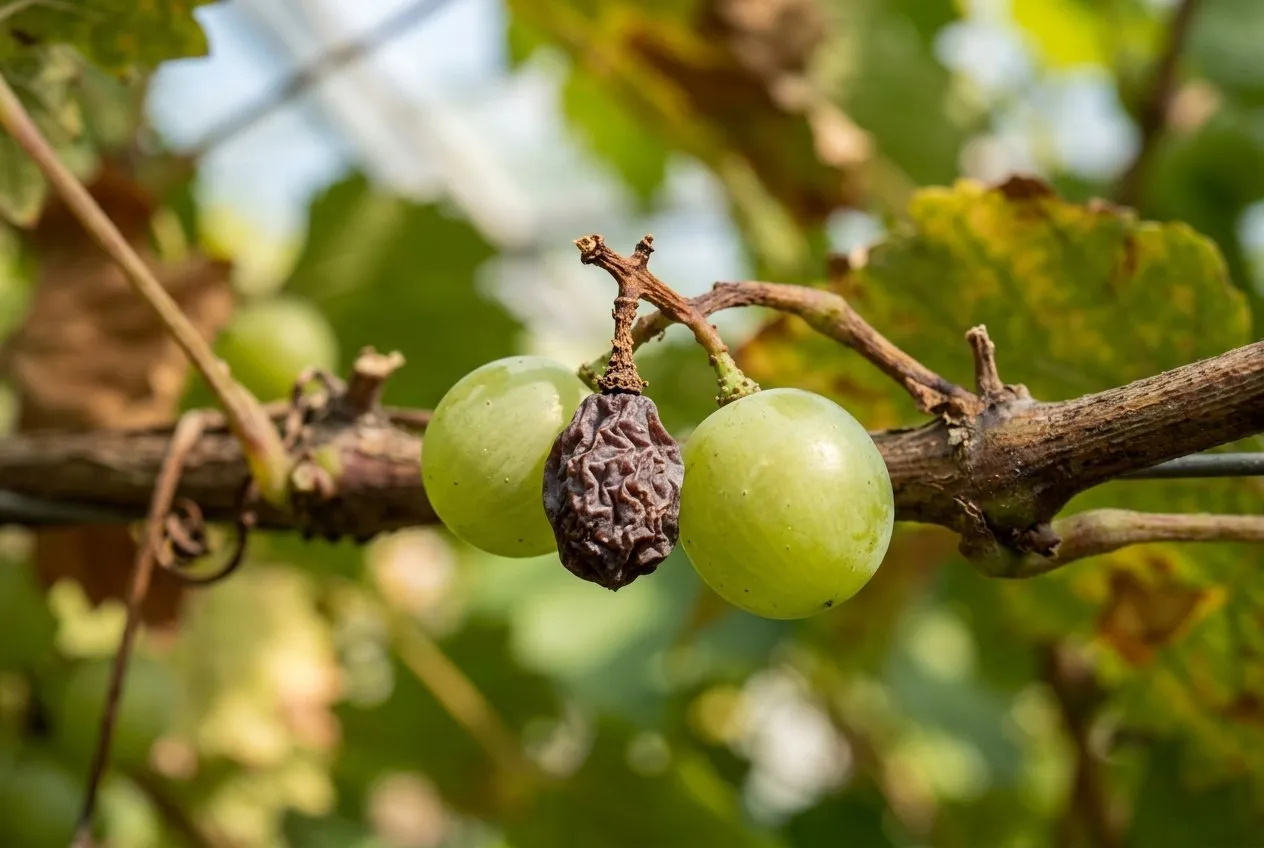 The diagnosis is in the stalk. A shanked berry has a brown, dead pedicel while its neighbours stay green and firm.
The fix programme: thin the crop hard
The single most effective thing you can do is take fewer bunches. This feels wrong when the vine is loaded with promising trusses, but restraint is the whole game. Aim for one bunch per 30cm of rod on an established vine. On a young vine, take no crop at all for the first two years after planting, then allow only three or four bunches in the third year while the root system builds.
Do not stop at bunch thinning. Thin the berries within each retained bunch too, using long narrow scissors, or vine scissors if you have them. Take out the small inner berries so the bunch has room to swell and air can move through it. A well-thinned bunch of 60 to 80 large berries beats a crowded bunch of 150 small ones that shanks and rots. Snip out any berries that have already shanked as soon as you see the brown stalk, so they do not drag on the bunch.
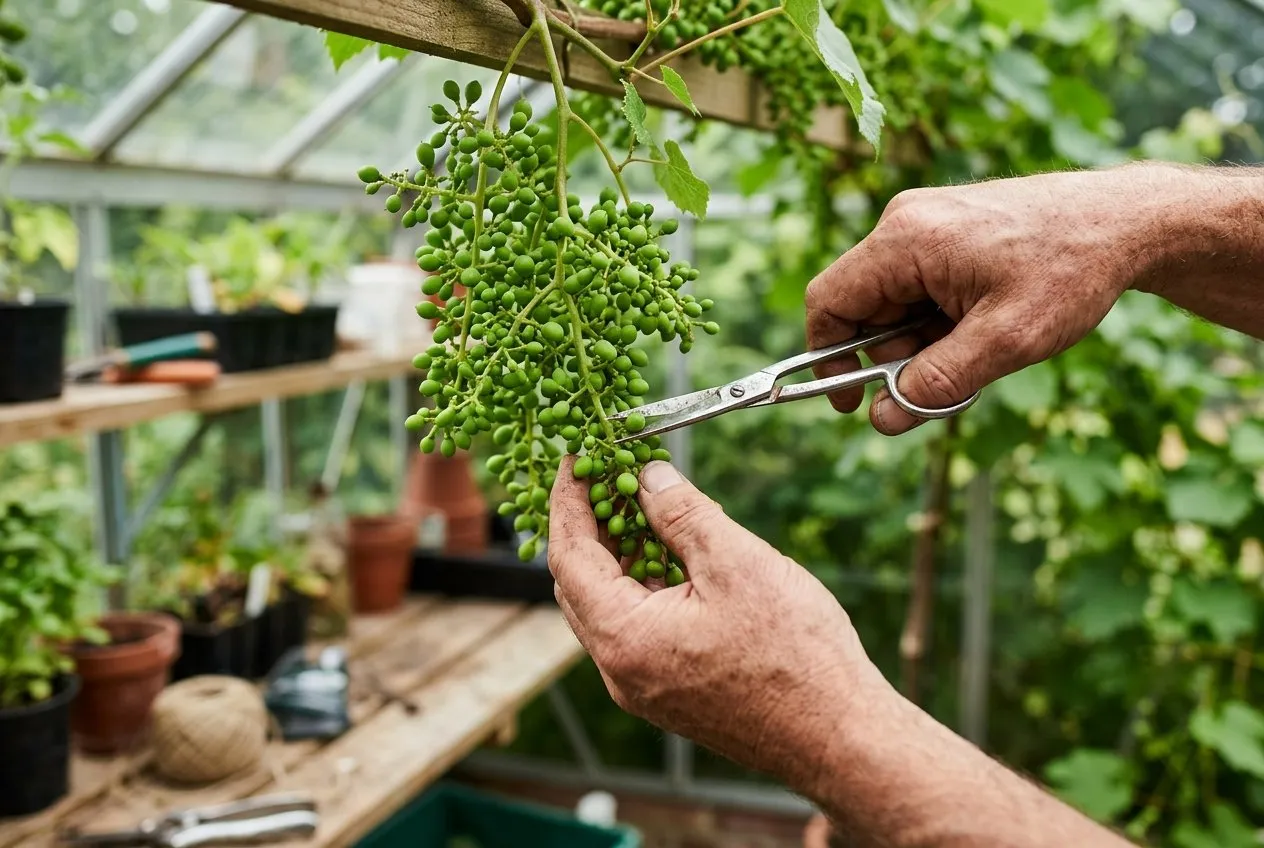 Thinning berries within the bunch with narrow scissors. Space lets each grape swell and air move through.
Fixing the border: drainage, mulch and feed
The vine feeds through its roots, so the border is where shanking is won or lost. Start with drainage. If water sits on the surface after watering, or the soil smells sour and airless, the roots are struggling. Fork in coarse grit to open heavy soil, and in bad cases dig a soakaway or lay a land drain to carry water away. A greenhouse border that stays evenly moist, never flooded and never bone dry, is the target.
Watering should be steady and deep rather than little and often. Through the growing season, give the border a proper soak once or twice a week depending on the weather, enough to wet the full root depth, then let the surface dry slightly before the next. Avoid the boom-and-bust swings that stress the roots. A mulch helps enormously here. Lay 5cm of well-rotted manure or garden compost over the border in early spring, kept clear of the main stem, to hold moisture and feed the soil slowly. If you make your own leaf mould, a layer of that over the roots keeps the border cool and damp through summer.
Warning: Do not overfeed with high-nitrogen fertiliser to try to green up a struggling vine. Excess nitrogen pushes soft leafy growth at the expense of fruit and can make shanking worse. Lean, steady feeding with plenty of potash beats a nitrogen binge every time.
Magnesium, potash and the Epsom salt spray
A vine short of magnesium is a vine primed to shank. Magnesium sits at the centre of the chlorophyll molecule, so a shortage shows first as yellowing between the veins on older leaves while the veins themselves stay green. A stressed, yellowing vine cannot ripen a heavy crop, and shanking follows. Heavy potash feeding can actually lock up magnesium, so the two need balancing rather than piling one on blindly.
The quickest correction is a foliar spray of Epsom salts, which is magnesium sulphate. Dissolve 20g of Epsom salts per litre of water, add a drop of washing-up liquid so it sticks, and spray the foliage thoroughly on a dull day or in the evening, never in hot sun. The leaves take the magnesium up directly, bypassing any lock-up in the soil. Repeat every two to three weeks from June through to ripening if the interveinal yellowing persists.
Longer term, correct the soil rather than relying on sprays. Work a handful of ground magnesian limestone, dolomite, into the border in winter if your soil is short of magnesium, and keep the potash feed steady rather than excessive. Magnesium and potash are covered in more depth in our guide to calcium, sulphur and magnesium, the three nutrients most gardeners overlook.
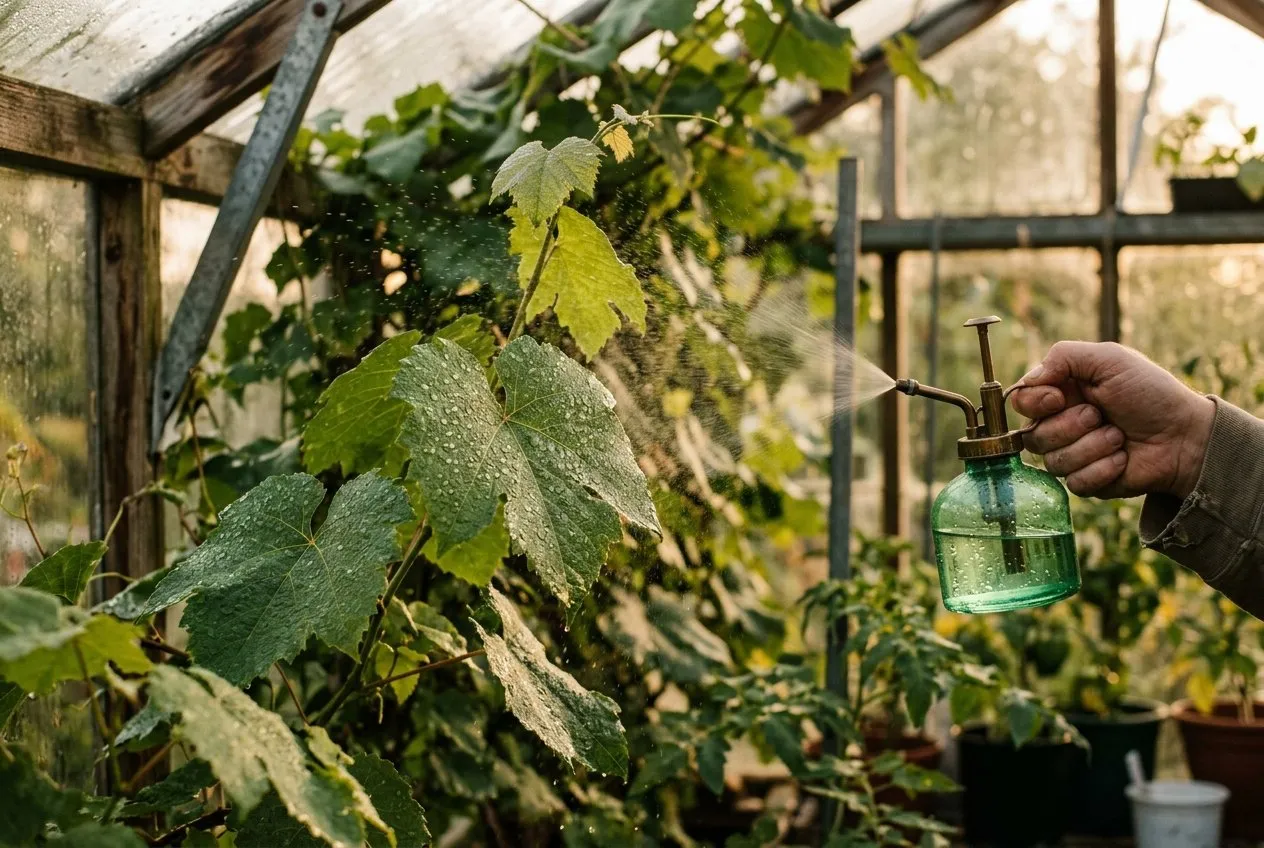 A magnesium foliar spray of Epsom salts corrects interveinal yellowing that leaves a vine prone to shanking.
Which UK greenhouse grapes suffer most
Some varieties shank more readily than others, and the ones grown most in British greenhouses are among the more prone. Black Hamburg, the classic sweetwater grape that fills most UK vineries and is the variety of the famous Hampton Court vine, shanks fairly easily if overcropped or grown in a poor border. It is still the best all-round choice for an unheated greenhouse, but it needs disciplined thinning.
Muscat of Alexandria, the finest-flavoured dessert grape, is more demanding again and shanks if the border dries out or the crop is too heavy. It really wants a little heat and careful watering. Buckland Sweetwater and Foster’s Seedling, both early white sweetwaters, are a touch more forgiving but still respond to hard thinning. Wine and hardier hybrid grapes grown outdoors, such as those in our guide to growing grape vines in the UK, shank far less because they carry lighter crops in cooler, airier conditions.
The pattern is clear. The richer and sweeter the dessert grape, the more it depends on a strong root run and a light, well-fed crop. Choose Black Hamburg for a first greenhouse vine, thin it hard, and you will rarely see shanking. Reach for Muscat only once you have the watering and feeding under control.
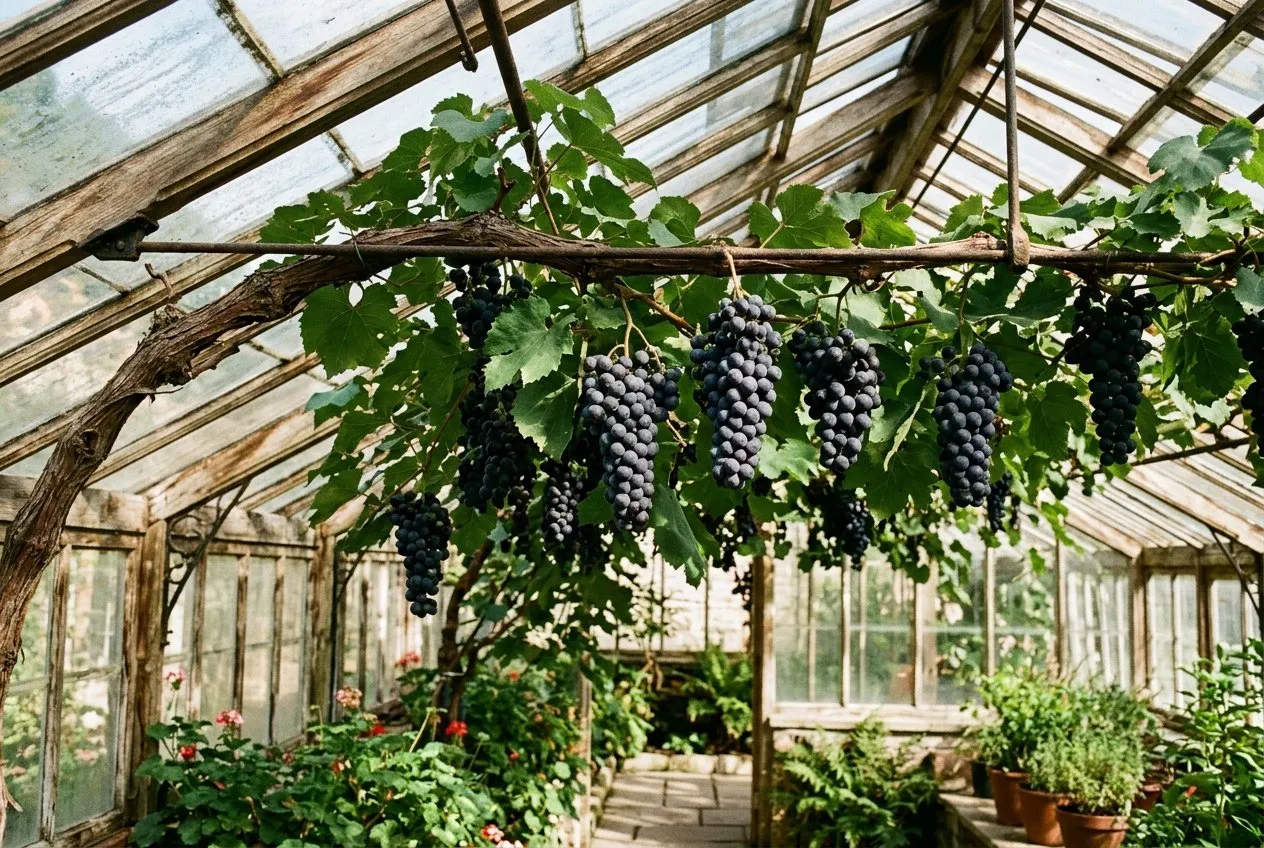 Black Hamburg under glass, the classic UK greenhouse grape. Disciplined thinning keeps it free of shanking.
Month-by-month greenhouse vine care calendar
Pruning to rebalance an overloaded vine
Winter pruning is where you set next year’s crop and stop shanking before it starts. Grapes fruit on the current season’s growth, which comes from spurs along a permanent rod. The rod and spur system keeps the vine to a manageable framework: one main rod with short fruiting spurs every 25 to 30cm along it. Prune every spur back hard to one or two buds while the vine is fully dormant in December or January, never later, because a vine pruned in spring bleeds sap heavily from the cuts. The RHS sets out the full method in its guide to rod and spur pruning.
An overloaded vine that has been shanking usually has too many spurs crammed too close, or too many rods fighting each other. Thin the framework itself. Remove crowded or weak spurs so the survivors are properly spaced. If the vine has grown into a tangle of multiple rods, cut back to one or two strong rods and rebuild from there over a couple of seasons. A leaner framework carries a lighter, healthier crop that the roots can actually feed.
Avoid the temptation to prune hard in summer to control a leafy vine. Removing large amounts of leaf during the growing season strips away the very engine that ripens the fruit and makes shanking more likely. Pinch and tidy in summer, but save the real cutting for the dormant season.
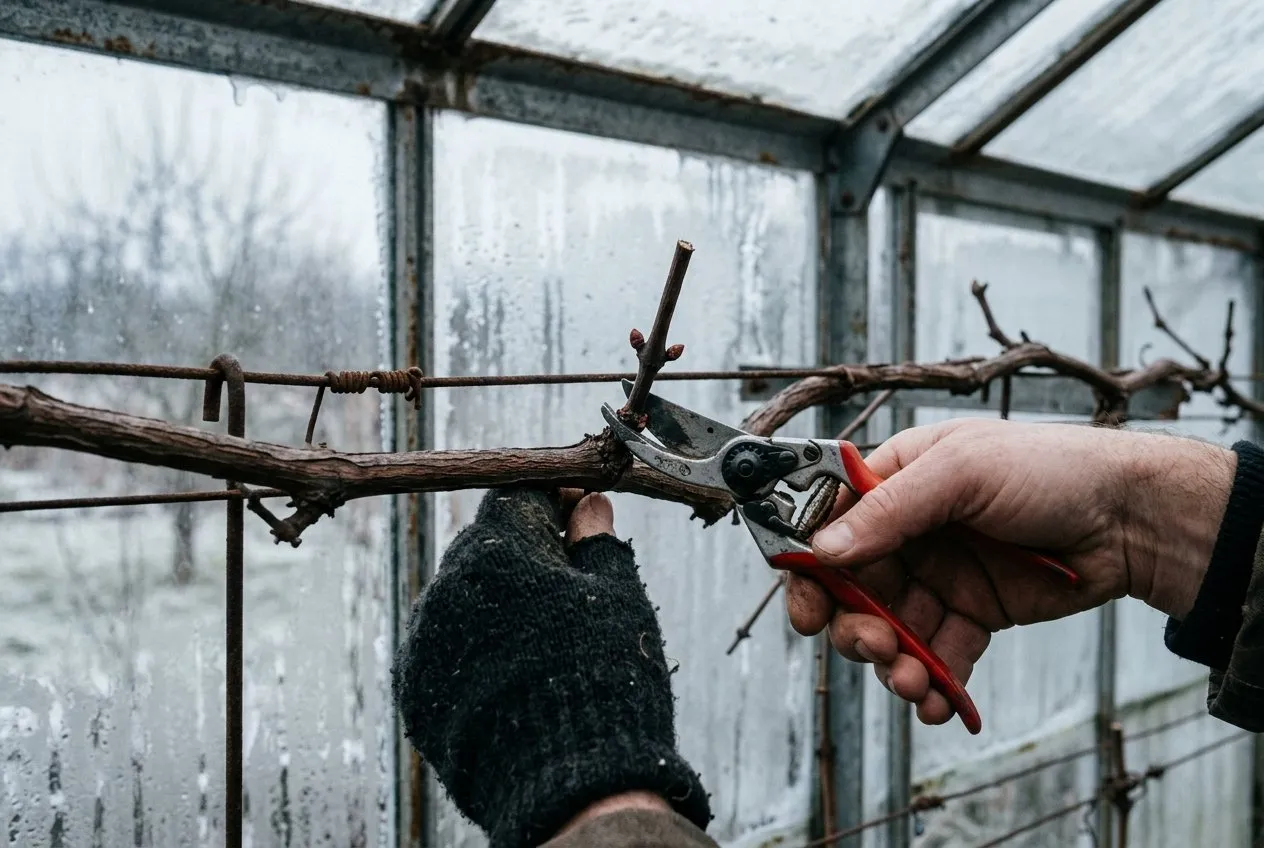 Dormant winter pruning sets the crop. Cut each spur to one or two buds and keep spurs 25 to 30cm apart.
Common mistakes that keep a vine shanking
Most people who fight shanking year after year are making one of a handful of repeatable errors. Correct these and the disorder usually clears within a season or two.
Leaving too many bunches on
This is the big one. A vine loaded with 20 or more bunches per rod simply cannot ripen them all, and shanking is the result. Thin to one bunch per 30cm of rod in June. Fewer, larger, cleaner bunches always beat a heavy crop full of raisins.
Letting the border swing from flood to drought
Roots hate extremes. A border that is soaked, then baked, then soaked again keeps stressing the feeder roots that supply the fruit. Water deeply and steadily, mulch to hold moisture, and fix any drainage that leaves water standing.
Feeding nitrogen instead of potash
A yellowing vine tempts people into a high-nitrogen feed, which pushes soft leaves and starves the fruit of ripening power. Switch to a high-potash tomato feed from berry-set onwards and keep nitrogen for early leaf growth only.
Ignoring magnesium
Interveinal yellowing on older leaves is a magnesium warning. Left alone, a magnesium-short vine shanks more. A monthly Epsom salt foliar spray at 20g per litre is cheap and quick, so there is no excuse for missing it.
Pruning hard in summer
Cutting away lots of leaf in July removes the foliage the vine needs to feed its grapes. Restrict summer work to pinching laterals and tidying. Do the serious cutting when the vine is dormant in winter.
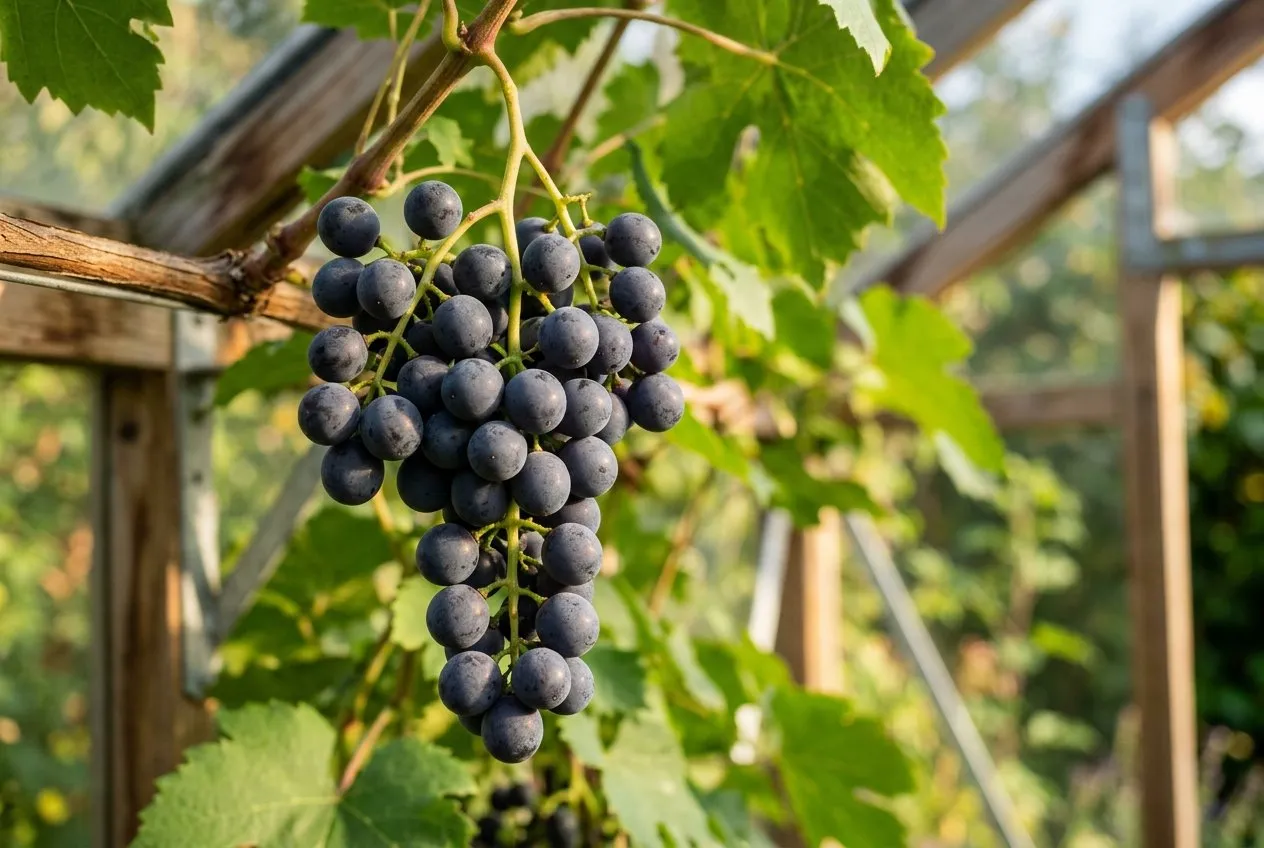 The goal: an evenly coloured, well-spaced bunch. Hard thinning and steady feeding get you here.
When to give up on a border and replant
Sometimes the roots are simply beyond saving. If you have thinned hard, corrected feeding, fixed drainage and sprayed magnesium for two full seasons and still lose most of the crop to shanking, the border itself is likely the problem. Very old vines with exhausted, woody root systems, or borders that stay waterlogged despite drainage work, will keep shanking whatever you do above ground.
At that point, start again. In late autumn or winter, dig out the tired vine and remove as much of the old border soil as you can, at least a spade and a half deep across the whole bed. Replace it with fresh loam-based soil enriched with rotted manure and a base dressing of bonemeal. Good drainage underneath is worth the effort, so break up the subsoil and add grit or rubble in the base if water has been sitting.
Plant a fresh young vine, ideally a reliable variety like Black Hamburg, and resist all temptation to crop it for the first two years. Let it build the strong root system that the old one had lost. A vine given a proper root run from the start rarely shanks. It is a bigger job than any spray, but it fixes the cause rather than the symptom, and a new vine will crop cleanly for decades.
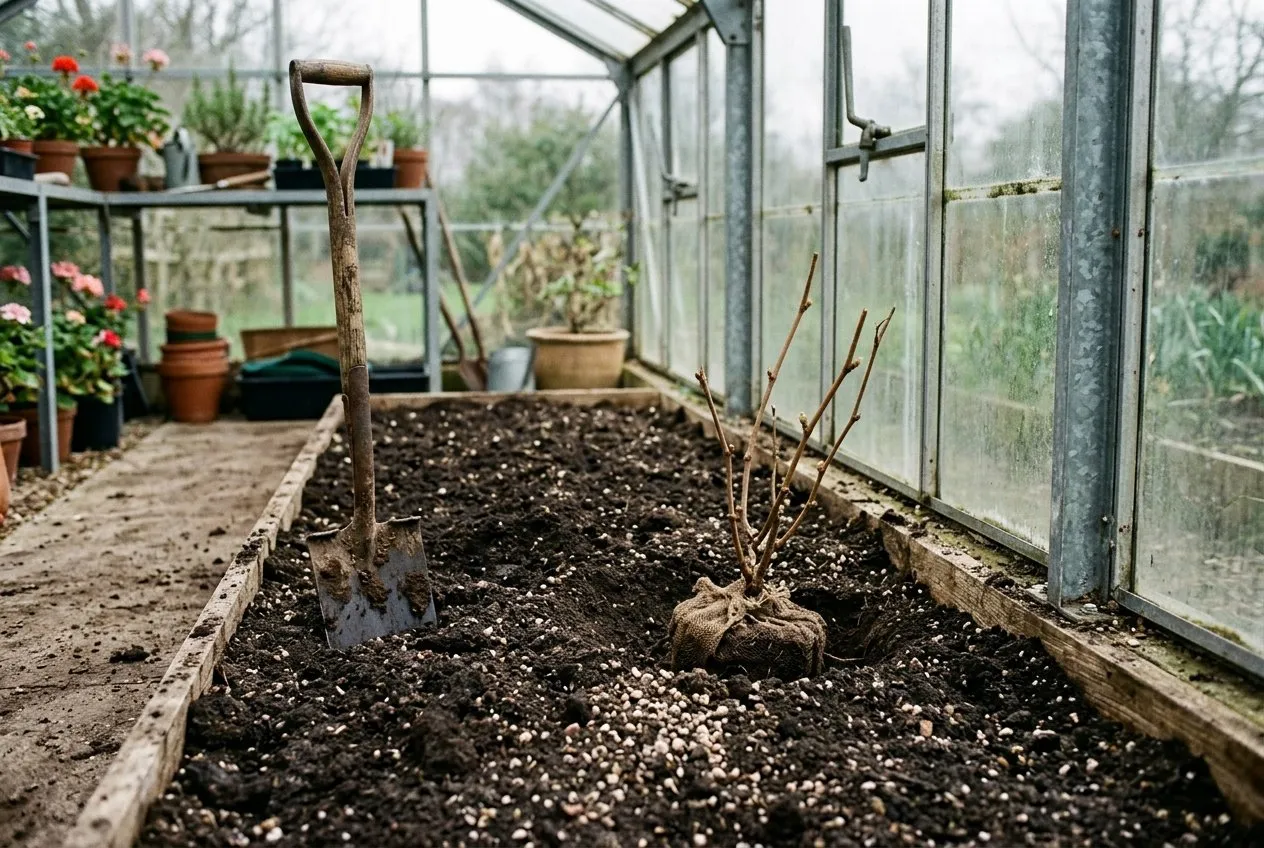 A renewed border with fresh loam and grit for drainage. A strong root run is the long-term cure for shanking.
Keeping other greenhouse crops healthy alongside the vine
A vine rarely grows alone under glass, and the same discipline that beats shanking helps the whole greenhouse. Even watering, good airflow and steady feeding keep the whole crop out of trouble. Greenhouse air that stays hot, still and humid invites botrytis on the grapes and other problems on your other plants, so ventilate hard, especially as the fruit ripens.
Tomatoes share the vine’s love of potash and its dislike of erratic watering, and they suffer their own disorders from the same swings, as our guide to tomatoes splitting on the vine explains. Keeping the humidity and temperature steady also cuts pest pressure, which is covered in our greenhouse pest control guide. And because still, damp air is the enemy of fruit under glass, our notes on greenhouse ventilation and humidity control are worth reading before the summer heat builds.
Frequently asked questions
What is grape shanking?
Shanking is a physiological disorder where the berry stalk dies. The stalk, called the pedicel, browns and shrivels, cutting off water and sugar to the berry. The berry then fails to colour, stays sour and watery, and dries to a raisin on the bunch. It is not caused by a fungus or a pest.
What causes grapes to shank?
Overcropping and poor roots are the main causes. A vine carrying too many bunches cannot feed them all. Waterlogged, compacted or dry borders damage the roots, and low magnesium or potash makes it worse. Sudden spring chilling in an unheated greenhouse and heavy summer pruning also trigger it.
How do I stop grape shanking?
Thin the crop hard and fix the roots. Cut bunches back to one per 30cm of rod, keep the border evenly moist, and feed with a high-potash tomato feed through summer. Improve border drainage if water sits, and give a monthly Epsom salts foliar spray to correct magnesium. Remove shanked berries with scissors.
Can you eat shanked grapes?
No, shanked grapes are not worth eating. They stay sour, watery and thin-skinned because the berry never received its sugar. Snip them out with narrow scissors as soon as you spot them. Removing them lets the healthy berries on the same bunch ripen properly and keeps the bunch clean.
Is shanking the same as grape mildew or botrytis?
No, shanking is a physiological disorder, not a fungal disease. Powdery mildew shows white dust on leaves and berries. Botrytis grows fuzzy grey mould on the fruit. Shanking has no mould at all; the berry stalk simply browns and the single berry shrivels while its neighbours stay healthy.
Does magnesium deficiency cause shanking?
Low magnesium and potash make shanking worse. Magnesium shortage shows as yellowing between leaf veins, and a stressed, underfed vine shanks more readily. A high-potash feed plus a foliar spray of Epsom salts at 20g per litre corrects the imbalance. It is one factor among several, not the sole cause.
When should I give up on a shanking grape vine?
Only after two full seasons of correct care fail. If you have thinned hard, fixed drainage, fed properly and still lose most berries, the root run is likely exhausted or waterlogged beyond repair. Dig out the old border soil, replace it, and replant a fresh young vine in autumn or winter.
Now you can tell shanking from the diseases it mimics, get the border and the crop load right and your greenhouse vine will reward you with clean bunches for years, so plan the rest of the season with our greenhouse growing calendar.
Our team produces practical UK gardening guidance from source research, contributor records and established horticultural practice. Editorial standards are overseen by Matt W.