Key takeaways
- Calcium: gypsum at 50g per m² treats blossom end rot in 21 days
- Sulphur: peat-free composts often need 10-20g per m² top-up
- Magnesium: Epsom salts at 20g per litre as 14-day foliar feed
- Symptoms appear in 14-30 days; routine soil tests can miss them
- UK acid rain leaches calcium 20-40kg per hectare per year
- Lime adds calcium; dolomite adds magnesium; gypsum adds calcium plus sulphur
Most UK gardeners can name nitrogen, phosphorus and potassium. Few can explain what calcium, sulphur and magnesium do, why they go short on UK soils, and which crops crash first. These three secondary nutrients are not optional add-ons. They are structural components of every plant: calcium in cell walls, sulphur in proteins, magnesium at the heart of every chlorophyll molecule.
Why Calcium, Sulphur and Magnesium Matter
All three nutrients are classed as secondary macronutrients. Plants need them in smaller quantities than NPK but in larger quantities than trace elements like boron or zinc.
| Nutrient | Plant role | Typical leaf content | Soil reservoir |
|---|---|---|---|
| Calcium (Ca) | Cell wall structure, root tip growth | 0.5-2.0% dry weight | 500-5000 kg per hectare |
| Sulphur (S) | Protein and chlorophyll synthesis | 0.1-0.5% dry weight | 200-1000 kg per hectare |
| Magnesium (Mg) | Centre of every chlorophyll molecule | 0.1-0.5% dry weight | 100-500 kg per hectare |
Calcium is the structural mortar of every plant cell. Cell walls are reinforced with calcium pectate. Without enough calcium, new growth fails first: blossom end rot on tomatoes, tip burn on lettuce, bitter pit on apples, internal browning on Brussels sprouts. Calcium does not move freely through the plant, so a single low-calcium event during fruit set affects that fruit for life.
Sulphur is part of the amino acids cysteine and methionine. Brassicas, alliums and legumes need more sulphur than most other crops because their characteristic flavours come from sulphur-based compounds. UK clean-air legislation since 1990 has cut atmospheric sulphur deposition by 80%, leaving many gardens running deficient.
Magnesium sits at the centre of every chlorophyll molecule. No magnesium means no photosynthesis. Magnesium also activates over 300 enzymes inside the plant. UK greenhouse tomatoes use 4-6 times more magnesium than outdoor crops because their growth rate is so fast.
A bed deficient in any of the three drops yield by 30-60% even when N, P and K are at full rates. This is why a properly fertilised plot can still produce small, pale or rotting crops if the secondary nutrients are short.
Calcium: Signs, Sources, Application Rates
Calcium deficiency shows first on young tissue because calcium does not redistribute within the plant. Old leaves stay green while new leaves and fruit fail.
Common symptoms in UK gardens:
- Blossom end rot on tomatoes, peppers and aubergines (dark, sunken patches on the base of fruit)
- Tip burn on lettuce and Chinese cabbage (brown crisp edges on inner leaves)
- Bitter pit on apples (small brown spots under the skin)
- Internal browning in Brussels sprouts and cabbage
- Hollow heart in potatoes
- Cracking in tomatoes and stone fruits
Sources of calcium for UK gardens:
| Source | Calcium content | Best use | Application rate |
|---|---|---|---|
| Ground limestone (CaCO3) | 38% Ca | Routine liming, raises pH | 150-300g per m² |
| Dolomite lime | 22% Ca + 12% Mg | Magnesium-low soils | 150-250g per m² |
| Gypsum (CaSO4) | 23% Ca + 18% S | Calcium without pH rise | 50-100g per m² |
| Crushed eggshells | 35% Ca | Slow-release tomato beds | 200-400g per m² |
| Bonemeal | 22% Ca + 8% P | Phosphate plus calcium | 70-100g per m² |
| Wood ash | 5% Ca | Light alkaline boost | 50-100g per m² |
| Foliar calcium nitrate | Soluble | Emergency fruit rescue | 10g per litre, 14-day spray |
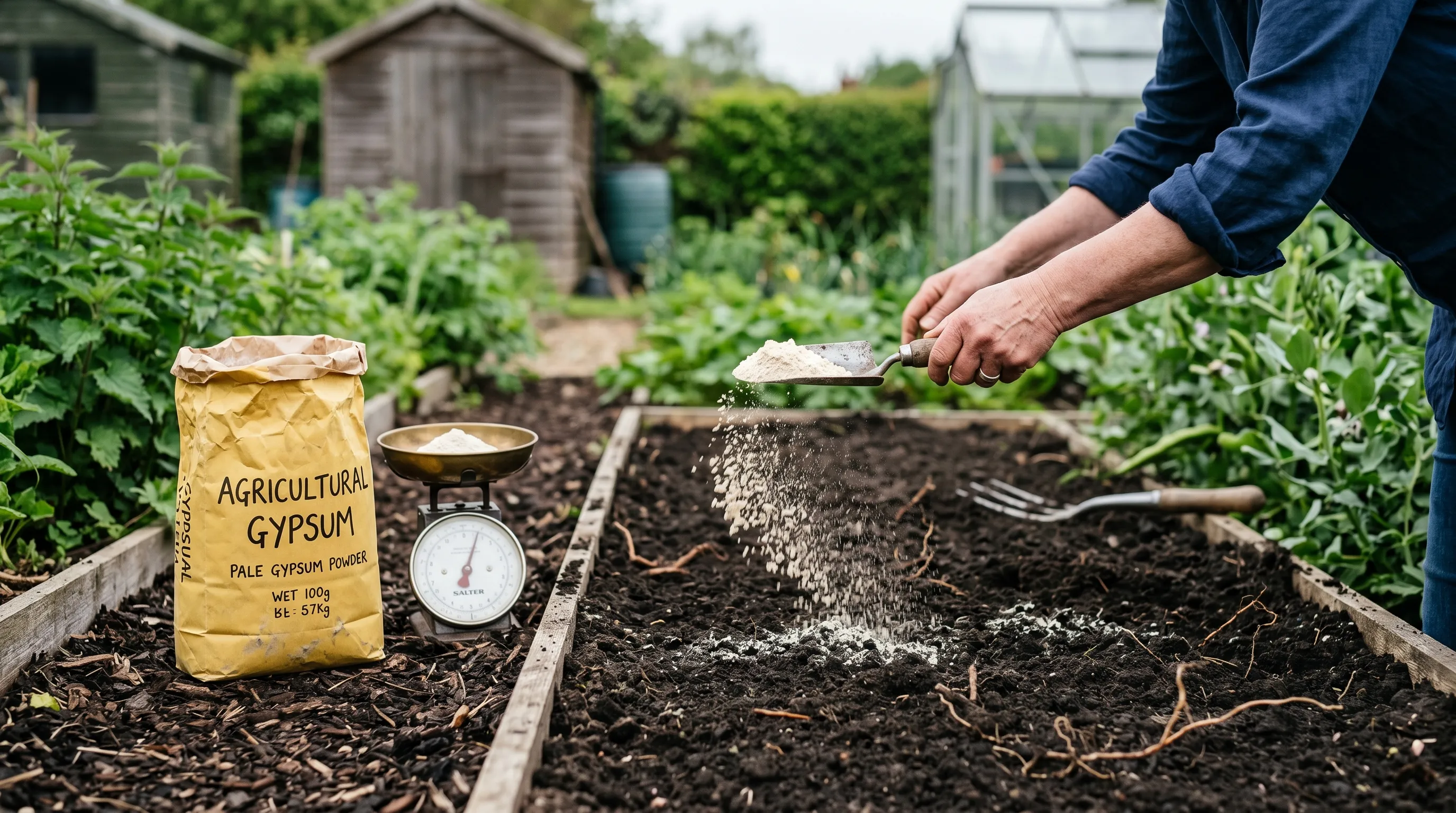
Gypsum is the underused tool for UK tomato growers. Apply 50g per square metre in autumn or just before planting. The calcium plus sulphur fights blossom end rot without raising pH (which would invite potato scab in the rotation). Cost: £8-£12 per 25kg bag from a UK builders merchant or agricultural supplier.
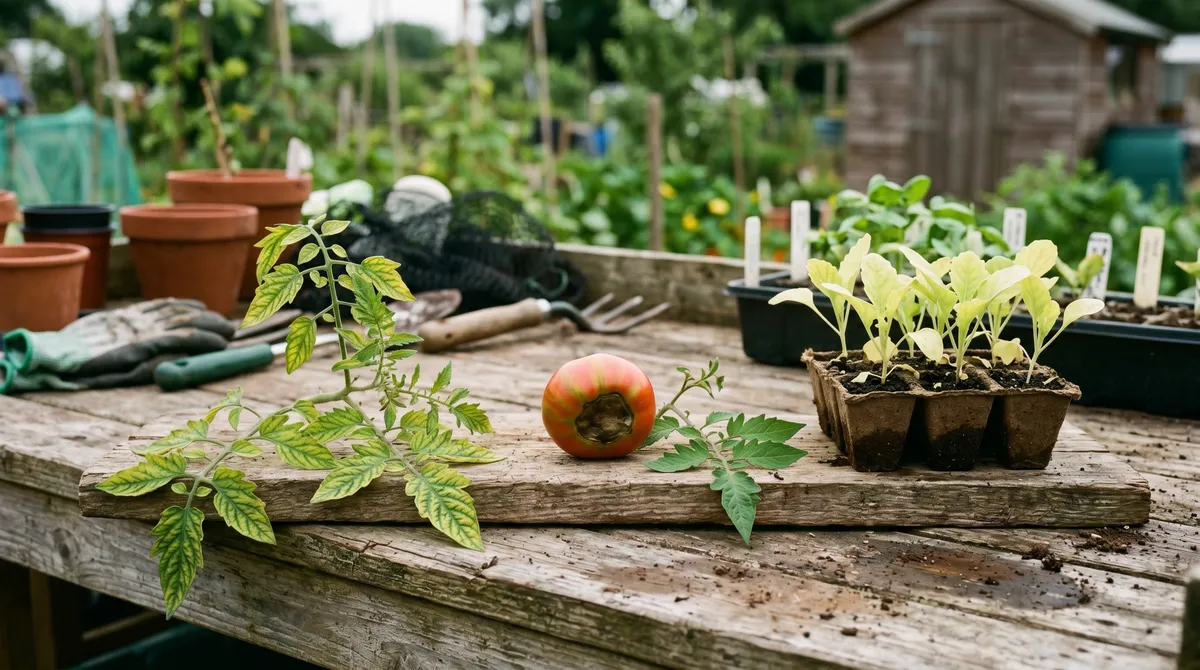
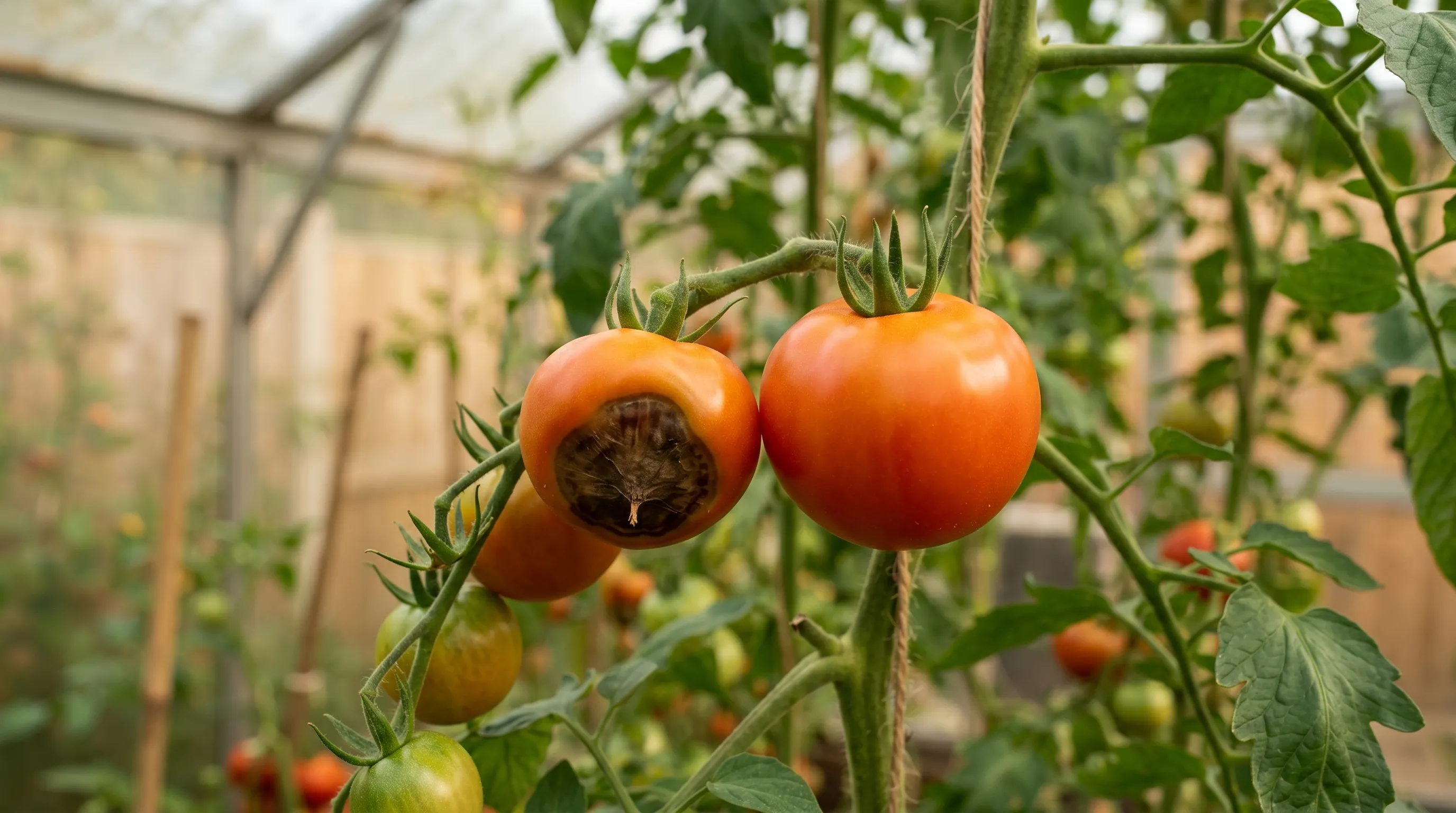 Classic blossom end rot from calcium deficiency. The dark sunken patch starts in the fruit base and spreads upward. Caused by inconsistent watering disrupting calcium uptake during fruit set.
Sulphur: The Forgotten Brassica Nutrient
Sulphur deficiency in UK gardens has risen sharply since 1990. Atmospheric sulphur deposition was 25-40 kg per hectare per year in the 1980s, dropping to 4-8 kg per hectare per year by 2020 as coal power closed and acid rain was tackled. UK soil sulphur reserves have been drawn down over 30 years.
Common symptoms:
- Pale lettuce and brassicas with uniform yellowing of young leaves (different from nitrogen, which yellows old leaves first)
- Weak protein crops: small beans, sparse pea pods
- Mild aromas in onions and garlic (the volatile sulphur compounds depend on soil sulphur)
- Slow brassica establishment in spring
- Yellow seedlings in peat-free compost
The diagnostic test: spray suspected sulphur-deficient brassicas with 10g of Epsom salts per litre (which is 9.8% magnesium and 13% sulphur). If only the parts that received the spray turn green within 7-10 days, sulphur is the issue. If the whole plant greens slowly, magnesium is the issue.
Sources of sulphur for UK gardens:
| Source | Sulphur content | Best use | Application rate |
|---|---|---|---|
| Gypsum (CaSO4) | 18% S | Calcium plus sulphur on tomato/brassica | 50-100g per m² |
| Sulphate of ammonia | 24% S | Quick nitrogen plus sulphur on brassicas | 30-50g per m² |
| Sulphate of potash | 18% S | Tomato and fruit feed | 30-50g per m² |
| Epsom salts (MgSO4) | 13% S | Foliar magnesium plus sulphur | 20g per litre spray |
| Elemental sulphur | 90% S | Lowering soil pH | 25-50g per m² |
| Manure (well-rotted) | 0.3% S | Slow-release on vegetable beds | 4-6 kg per m² |
Use sulphate of ammonia at 30-50g per m² 2-3 weeks before brassica planting. Cost: £10-£15 per 20kg bag. One bag treats 400-600m² of brassica beds. The same product can correct sulphur and provide a small nitrogen boost in one step.
Elemental sulphur is the right choice when you also want to lower soil pH for blueberries, rhododendrons or potato beds. It oxidises in soil to sulphuric acid over 6-12 months, dropping pH by 0.3-0.5 units at 25-50g per m².
Magnesium: The Heart of Every Chlorophyll Molecule
Magnesium deficiency shows the most dramatic visual symptoms of any UK garden nutrient problem.
Diagnostic symptoms:
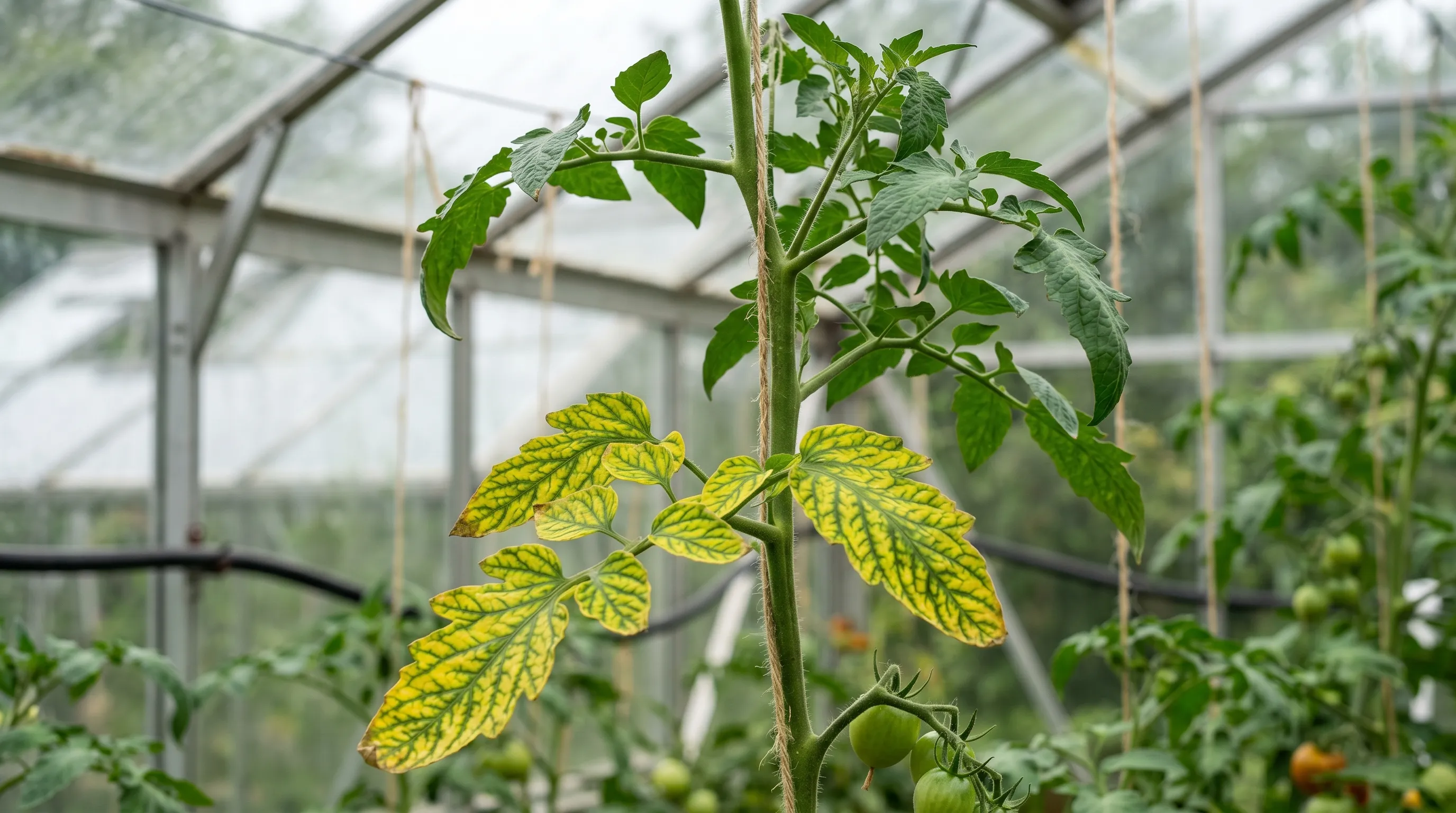
- Interveinal chlorosis on older leaves first (yellow patches between dark green veins)
- Marginal yellowing on tomato lower leaves
- Red or purple flushes on stems and leaf undersides
- Reduced flower count on roses, dahlias and bedding plants
- Pale fruit cuttings on apples and pears
- Bronze patches on conifer needles
Sources of magnesium for UK gardens:
| Source | Magnesium content | Best use | Application rate |
|---|---|---|---|
| Epsom salts (MgSO4) | 9.8% Mg | Foliar spray for fast green-up | 20g per litre |
| Dolomite lime | 12% Mg | Combined lime plus magnesium | 150-250g per m² |
| Kieserite | 16% Mg | Soluble Mg on sandy soil | 40-80g per m² |
| Wood ash | 0.6% Mg | Light all-round mineral | 50-100g per m² |
| Manure (well-rotted) | 0.1% Mg | Slow-release on veg beds | 4-6kg per m² |
| Tomato feed (most brands) | 0.1-0.3% Mg | Mineral top-up via routine feed | Per label |
The fastest fix is Epsom salts foliar spray at 20g per litre, sprayed on leaf undersides early morning. Magnesium absorbs through the cuticle within 4-6 hours. Visible green return: 48-96 hours. Full recovery: 7-10 days.
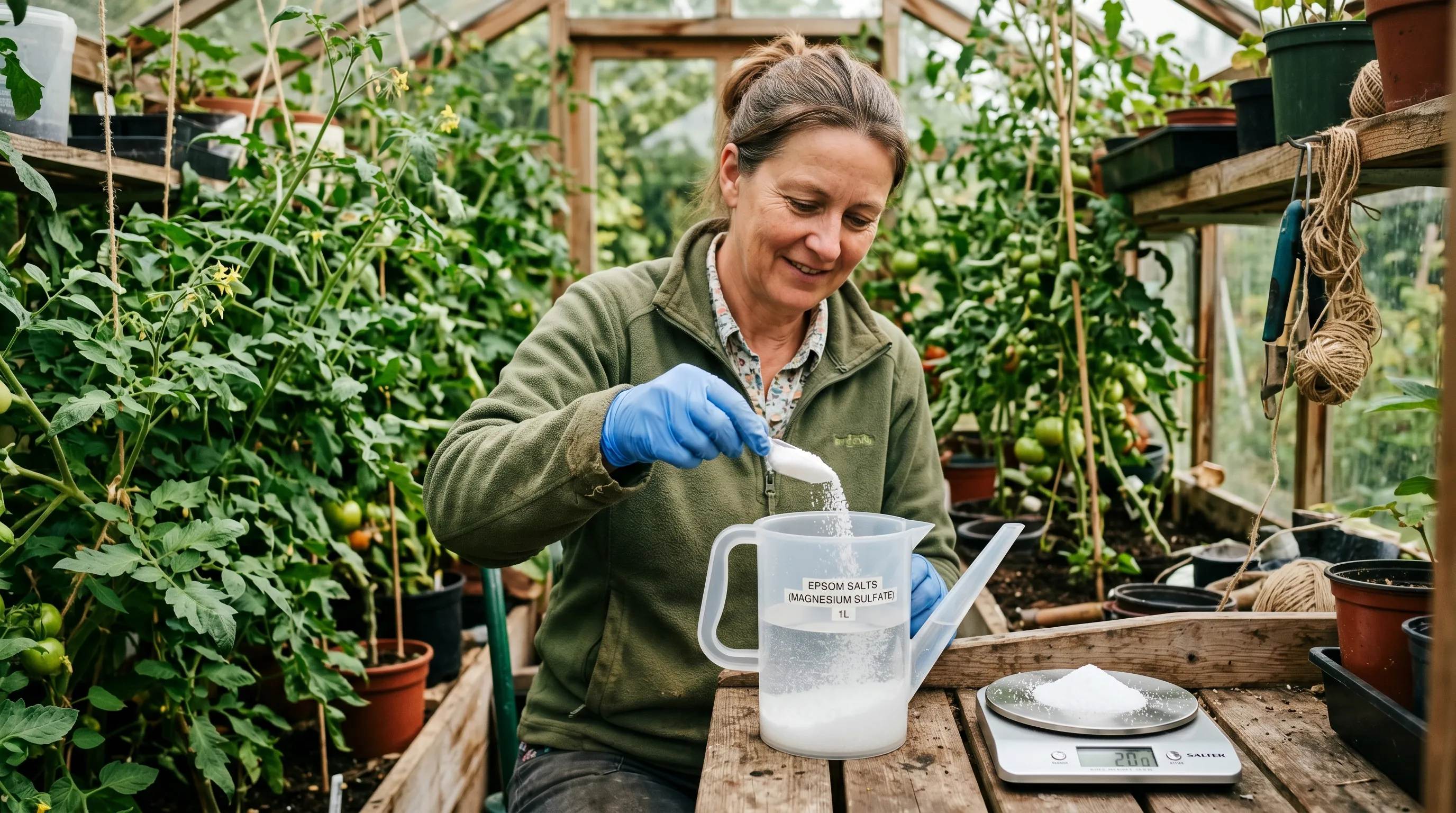 Mixing the standard 20g of Epsom salts in 1 litre of water foliar spray. Apply on a cool morning to leaf undersides. Magnesium absorbs through the cuticle within 4-6 hours, returning yellowed leaves to green in 7-10 days.
How to Tell Which Nutrient Is Short
Three nutrients, similar symptoms. The wrong diagnosis costs a season.
| Symptom | Most likely cause | Confirming test |
|---|---|---|
| Yellow on young leaves only | Calcium | Check fruit for blossom end rot |
| Yellow whole plant uniformly | Sulphur | Spray Epsom salts on one patch |
| Yellow on old leaves, green veins | Magnesium | Spray Epsom salts; greens in 7-10 days |
| Yellow on old leaves, no green vein pattern | Nitrogen | Apply soluble N feed; greens in 3-5 days |
| Pale plant overall, normal pattern | Light/temperature | Check growing conditions first |
| Yellow with brown leaf edges | Potassium | Apply tomato feed; greens in 7-14 days |
| Yellow with purple stems | Phosphorus | Soil test for available P |
The single most useful diagnostic is the Epsom salts spray patch test. Mix 20g of Epsom salts in 1 litre of water. Spray only one half of the affected plant. If the sprayed half greens within 7-10 days, magnesium is the issue. If both halves stay yellow, look elsewhere.
Pair the spray test with a lab soil analysis for any garden where multiple deficiencies appear. UK labs charge £20-£40 per sample and return calcium, magnesium, sulphur, phosphorus, potassium and pH readings within 7-14 days. NRM Laboratories and Eurofins Agro both serve UK home gardeners.
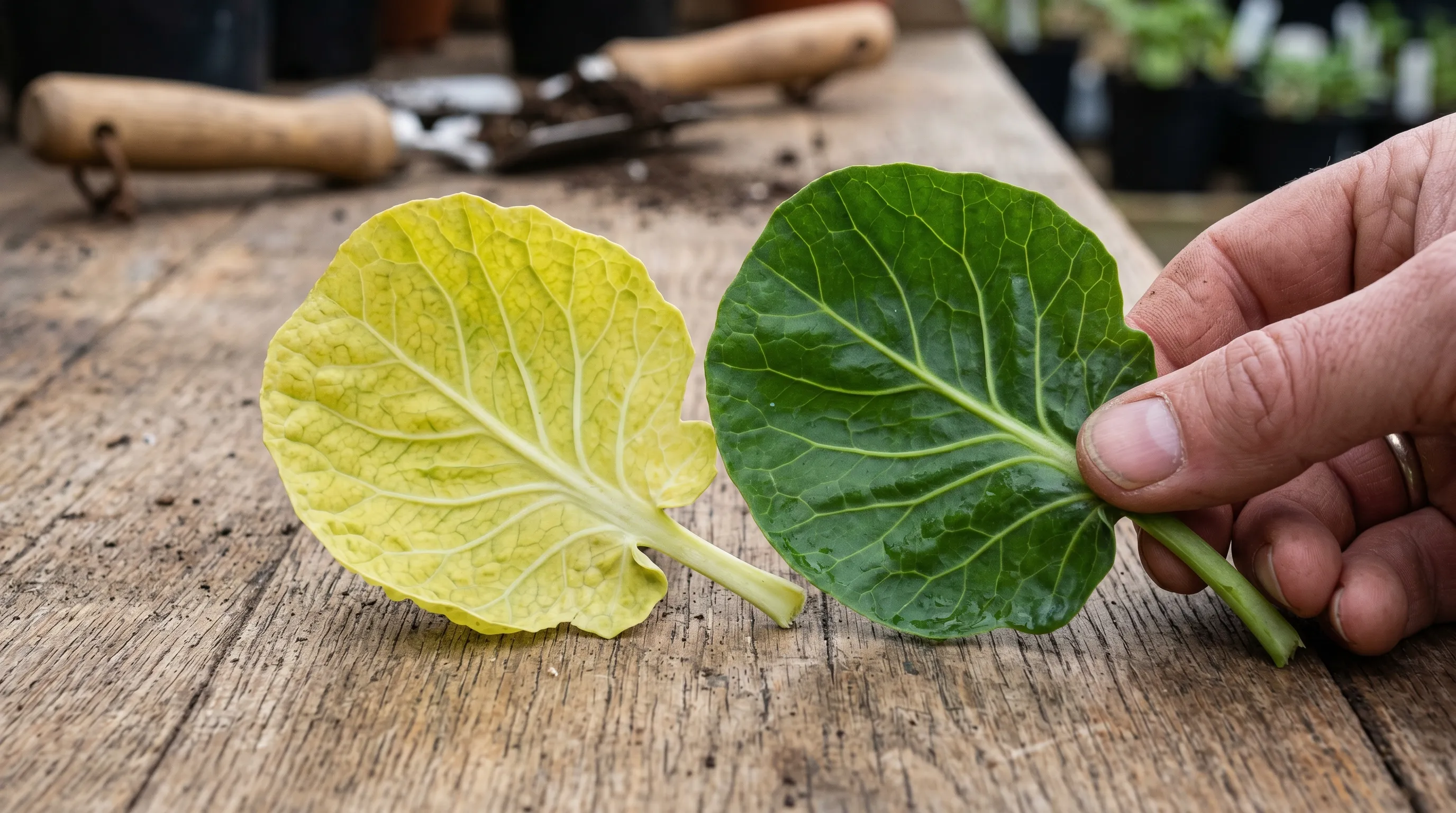 Sulphur-deficient Brussels sprout upper leaf (left) showing the uniform pale yellowing. The healthy lower leaf (right) shows the normal dark green. Sulphur deficiency affects young growth first, unlike magnesium which affects old growth first.
For routine annual soil management, our NPK explained guide covers the three primary macronutrients alongside their secondary partners. The soil pH explained guide covers how pH affects which nutrients become available.
Common Mistakes With Secondary Nutrients
Mistake 1: applying lime when the problem is magnesium. Ground limestone adds calcium and raises pH but no magnesium. On magnesium-deficient soils, liming alone makes the problem worse because the new calcium competes with magnesium at the root. Use dolomite lime when magnesium is short.
Mistake 2: treating magnesium deficiency with nitrogen feed. Yellow leaves trigger many gardeners to reach for general fertiliser. High nitrogen and high potassium compete with magnesium uptake. Address the magnesium first.
Mistake 3: ignoring blossom end rot as “just one bad year”. Repeated blossom end rot indicates a chronic calcium uptake problem. Either the soil is short on calcium or watering is inconsistent during fruit set. Both fix in one season with gypsum plus mulch.
Mistake 4: assuming peat-free compost is balanced. Many peat-free composts based on green waste are low in sulphur. Pale seedlings in peat-free compost almost always respond to 5g of Epsom salts in 1 litre of water as a top-up.
Mistake 5: over-using Epsom salts. Epsom salts are safe at recommended rates but excessive use disrupts potassium uptake. Stick to 20g per litre as a foliar spray, applied no more than every 14 days during active growth.
For the wider feed plan that puts gypsum alongside organic feeds, our best fertilisers for UK gardens guide covers the bagged and bulk feeds that complete a UK plot.
Secondary Nutrients Month-by-Month Calendar UK
| Month | Calcium | Sulphur | Magnesium |
|---|---|---|---|
| January | Order gypsum for spring | Order sulphate of ammonia | Order Epsom salts |
| February | Apply gypsum to tomato beds | Apply sulphate to brassica beds | No application needed |
| March | Top-dress raspberries | No application | No application |
| April | Continue spring gypsum | Side-dress brassicas | Begin Epsom foliar feeds on seedlings |
| May | Plant out tomatoes into limed beds | Apply before sowing legumes | Foliar feed every 14 days |
| June | Monitor for blossom end rot | Pale brassicas: top up | Tomato foliar feed weekly |
| July | Continue mulch and steady watering | Onions and garlic ripening | Continue weekly foliar |
| August | Watch for tip burn on lettuce | Cabbage and kale yellowing | Watch for late-season chlorosis |
| September | Apply gypsum to autumn-cleared beds | Light top-dress for autumn brassicas | Reduce foliar feeds |
| October | Main gypsum application window | Apply sulphate of ammonia | Apply dolomite if needed |
| November | Final autumn application | Final application | No application |
| December | Plan next year’s rotation | Order seeds with sulphur in mind | Stock supply for spring |
The February-March and October application windows are the cornerstones of UK secondary nutrient management. Soil moisture is high, microbes are active, and the nutrients move into the rootzone before peak demand.
Frequently asked questions
What do calcium, sulphur and magnesium do in plants?
Calcium builds cell walls. Sulphur builds proteins and chlorophyll. Magnesium is the central atom of every chlorophyll molecule. Without these three, photosynthesis fails, cell division stops and growth stalls. Yields drop 30-60% on deficient soils.
Why is magnesium deficiency common in UK greenhouses?
How do I add calcium to garden soil without raising pH?
Use gypsum (calcium sulphate). Unlike lime, gypsum adds calcium without raising pH. Apply 50g per square metre in autumn or spring. Useful for tomato beds where you want calcium for fruit but pH must stay below 7.0 to avoid scab on potatoes.
Are Epsom salts a real plant feed or a garden myth?
Will peat-free compost give me sulphur deficiency?
Possibly. Many peat-free composts based on green waste and bark are low in sulphur. UK air pollution rules have also cut atmospheric sulphur deposition by 80% since 1990. Brassica yellowing and pale lettuces are common signs. Top up with 10-20g of sulphate of ammonia or gypsum per m².
Now plan the full feed programme
Calcium, sulphur and magnesium round out the NPK plan. Now you’ve sorted the secondary three, read our NPK explained guide for the primary macronutrients. To check pH before applying any of these, our soil pH explained guide shows how acidity locks out nutrients regardless of soil reserves. For the lime side of the calcium and magnesium story, the garden lime guide covers ground limestone vs dolomite selection. And for the full bagged-feed catalogue, our best fertilisers for UK gardens guide lists the products that fit each gap.
Our team produces practical UK gardening guidance from source research, contributor records and established horticultural practice. Editorial standards are overseen by Matt W.