Key takeaways
- Growing most of these plants at home is legal; planting or spreading them in the wild is a Section 14 offence
- Japanese knotweed roots spread up to 7m and 3m deep, and devalue homes by 5-15%
- Giant hogweed sap causes burns that can blister in sunlight for years afterwards
- Five aquatic plants including floating pennywort have been banned from sale in England since April 2014
- Knotweed and contaminated soil are controlled waste under the Environmental Protection Act 1990
- Report sightings to your local authority or via the GB Non-Native Species Secretariat
Banned plants in UK gardens are not as simple as a list of plants you cannot own. The law turns on what you do with them. It is not illegal to grow most of these species in your own garden, but it is an offence under Section 14 of the Wildlife and Countryside Act 1981 to plant them or let them spread into the wild. A handful of aquatic plants are banned from sale outright. This guide sets out the actual law, names the plants that matter, explains which is the most serious and why, and tells you what to do if you find one on your land.
The confusion costs people money and, in the case of giant hogweed, skin. Get the distinction between growing and spreading right, and you stay on the correct side of the law while protecting your neighbours and local waterways.
What the law actually says about banned plants
The headline rule sits in Section 14 of the Wildlife and Countryside Act 1981. It is an offence to plant or otherwise cause to grow in the wild any plant listed in Schedule 9, Part 2 of that Act. That covers Japanese knotweed, giant hogweed, Himalayan balsam, Rhododendron ponticum and dozens more. The penalty on conviction can be a fine or up to two years in prison.
Note the precise wording. The offence is causing the plant to grow in the wild, not keeping it in a pot or border. So a Japanese knotweed stand already in your garden is not, by itself, illegal. The moment you dump cuttings on a verge, let it creep under a fence, or move contaminated soil, you risk an offence. Gunnera joined the restricted list in 2023 under separate invasive species regulations; our gunnera ban guide sets out what owners must now do.
Two other legal layers apply. Under the Environmental Protection Act 1990, knotweed and any soil containing it count as controlled waste, so disposal is regulated. And under the Anti-social Behaviour, Crime and Policing Act 2014, councils can serve a community protection notice on anyone who lets knotweed run wild and affect a neighbour. For an accurate guide to the rules and current Schedule 9 list, the GOV.UK guidance on preventing the spread of invasive plants is the authoritative source.
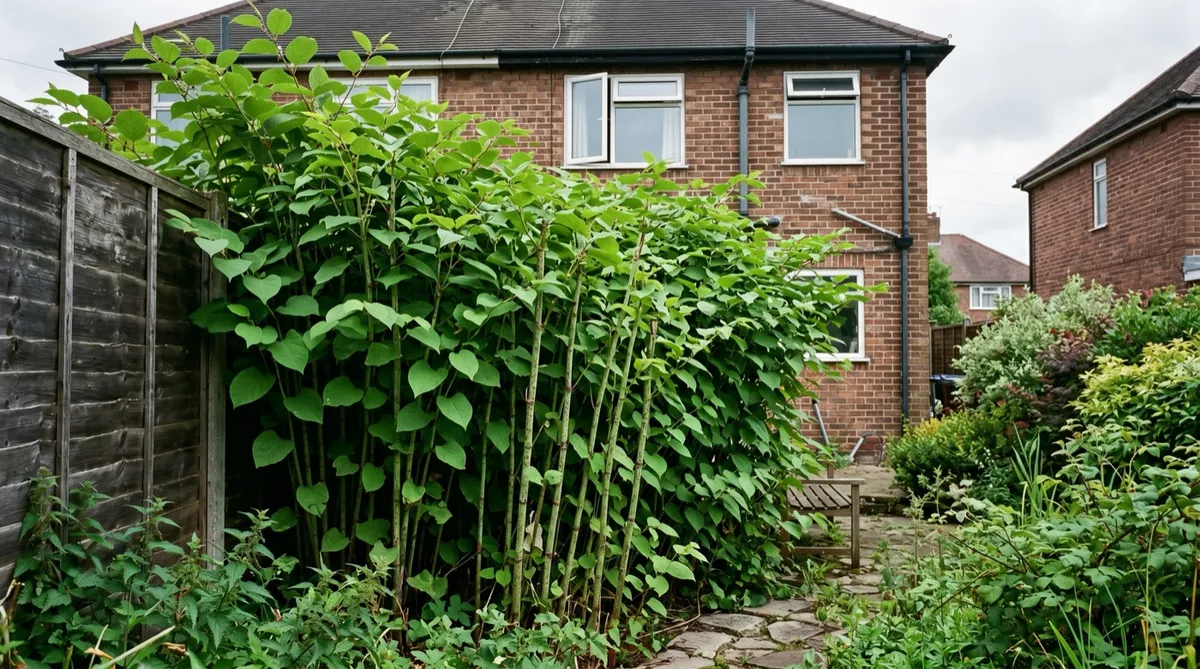
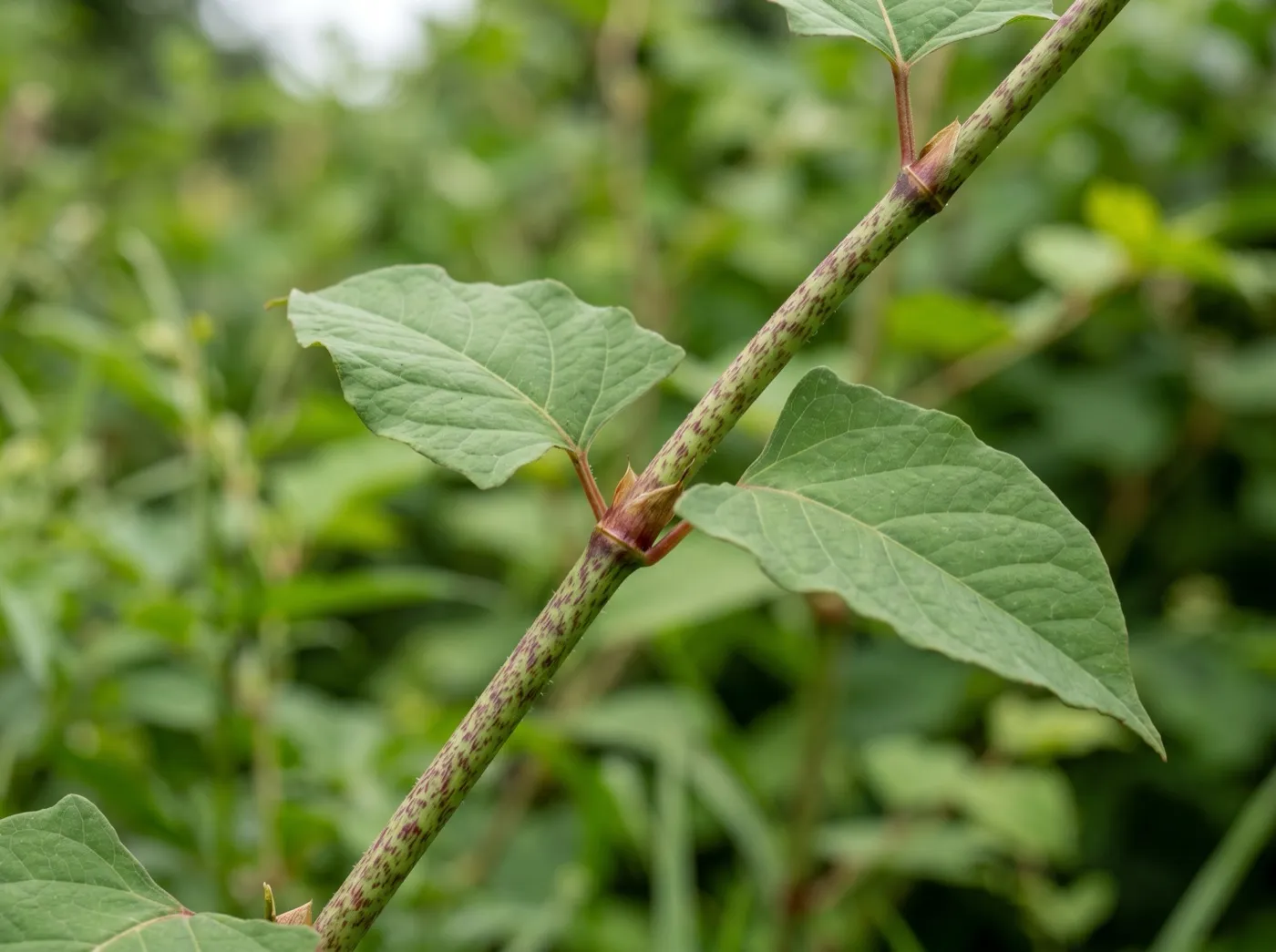 The zigzag stem and flat-based, shield-shaped leaves of Japanese knotweed. Mature canes look bamboo-like with purple speckling.
Grow versus spread: the distinction that trips people up
The single most misunderstood point is the difference between growing a controlled plant and spreading it. This catches homeowners out constantly, so it is worth pinning down.
Growing a Schedule 9 plant in your own garden is lawful. There is no requirement to remove existing knotweed, balsam or rhododendron from your land. You will not be prosecuted simply for having it.
Spreading it is the offence. Causing it to grow in the wild covers planting it on land you do not control, fly-tipping cuttings, and allowing it to encroach beyond your boundary through neglect. Even moving soil that contains a knotweed rhizome fragment can count, because that fragment will grow.
Warning: Never strim, mow or flail Japanese knotweed or Himalayan balsam. Cutting equipment flings viable fragments and seeds across the garden and into watercourses, turning one plant into a colony and potentially creating a Section 14 offence.
The banned and controlled plants you need to know
The list below covers the species most likely to turn up in or near a UK garden. The legal status column shows the key distinction: most are a spread offence under Schedule 9, while five aquatics are banned from sale entirely.
| Plant | Botanical name | Why controlled | Legal status | What to do |
|---|---|---|---|---|
| Japanese knotweed | Reynoutria japonica | Roots crack foundations, blocks mortgages | Schedule 9 spread offence; controlled waste | Professional treatment, licensed disposal |
| Giant hogweed | Heracleum mantegazzianum | Sap causes severe sunlight burns | Schedule 9 spread offence | Cover up, report, contractor removal |
| Himalayan balsam | Impatiens glandulifera | Smothers riverbanks, fires seeds 7m | Schedule 9 spread offence | Pull before flowering, repeat 3 years |
| Rhododendron ponticum | Rhododendron ponticum | Shades out woodland, carries disease | Schedule 9 spread offence | Cut and treat stumps, do not plant |
| Three-cornered leek | Allium triquetrum | Crowds out natives, hard to clear | Schedule 9 spread offence (E and W) | Dig out bulbs, never compost |
| Floating pennywort | Hydrocotyle ranunculoides | Chokes ponds and canals | Banned from sale since 2014 | Remove, bin as controlled waste |
| Parrot’s feather | Myriophyllum aquaticum | Blankets still water | Banned from sale since 2014 | Remove, do not release |
| Australian swamp stonecrop | Crassula helmsii | Forms dense mats in ponds | Banned from sale since 2014 | Remove, dry out, dispose |
| New Zealand pigmyweed | Crassula helmsii | Same plant, alternate name | Banned from sale since 2014 | Remove, dry out, dispose |
| American skunk cabbage | Lysichiton americanus | Invades wet woodland | Banned from sale; Union concern list | Dig out, do not plant near water |
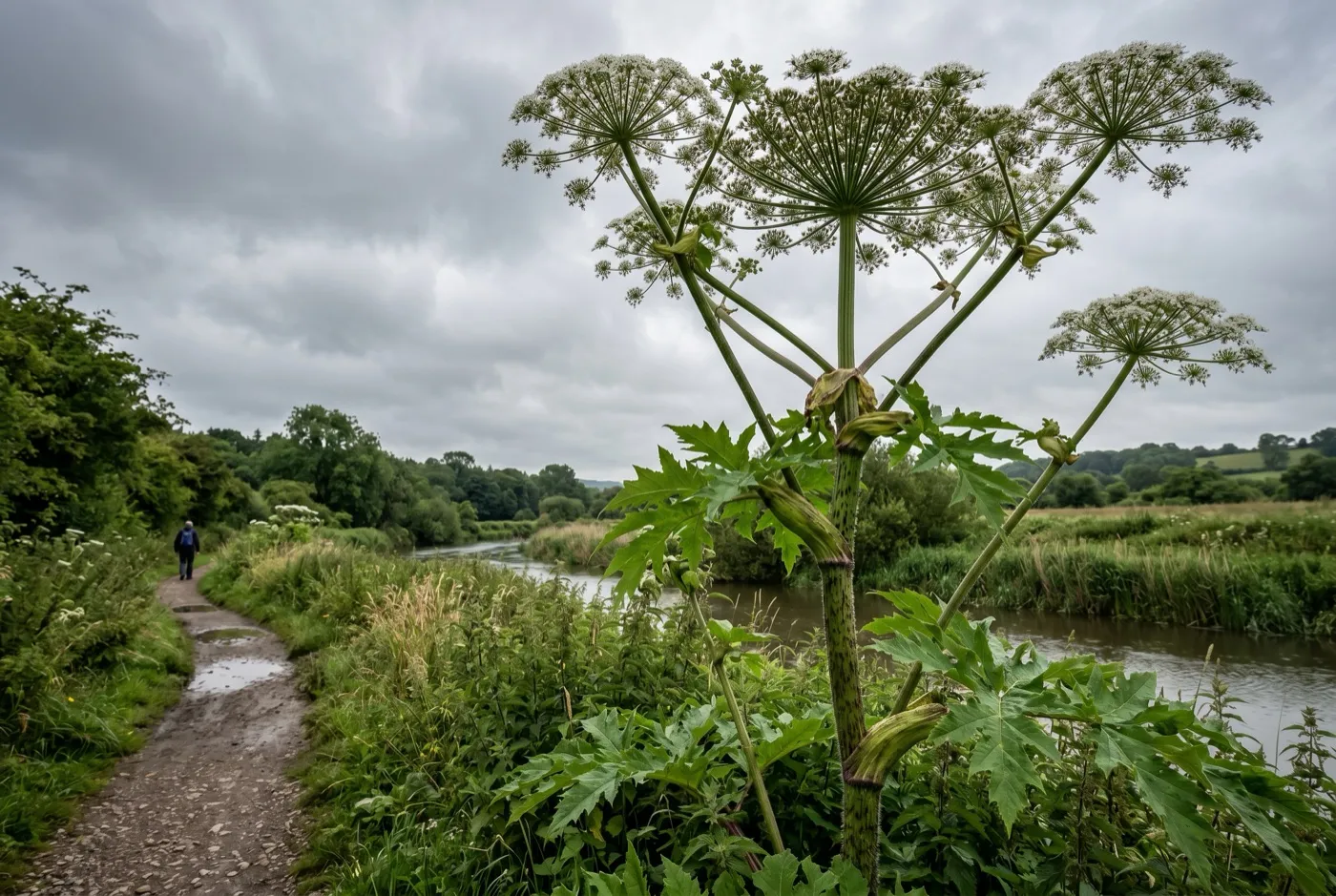 Giant hogweed can reach 3-5m tall with flower heads up to 60cm across. Never brush past it: the sap reacts with sunlight on skin.
Why Japanese knotweed is the most serious of all
Of every plant here, Japanese knotweed does the most lasting harm to property and finances, which is why it dominates the headlines and the courts.
The damage comes from its rhizome, the underground stem network. It spreads up to 7m horizontally from a visible stand and reaches around 3m deep. It exploits cracks in tarmac, drains and old mortar, widening them as it grows. A fragment of rhizome the size of a fingernail, under 10mm, can regrow into a new plant. That is why moving soil is so risky.
The financial hit is real. Mortgage lenders treat knotweed as a material defect. A 2023 review by the surveying bodies kept it on the list of issues that can block lending, and infested homes typically lose 5-15% of value until treated with a documented management plan and insurance-backed guarantee. Treatment by glyphosate stem-injection usually runs across three to four years and costs roughly £2,000 to £6,000 for a domestic plot, with excavation removal far higher.
How to tell knotweed apart from look-alikes
Several harmless garden plants get mistaken for Japanese knotweed, which causes needless panic and the odd unnecessary survey. Use these features to tell them apart before you call anyone.
Knotweed has a zigzag stem, with leaves coming off alternately at each node. The leaves are shield-shaped with a flat base and a pointed tip, up to 14cm long. Mature canes are hollow, bamboo-like and speckled purple, reaching 2-3m by midsummer. Creamy-white flower sprays appear in late summer. New spring shoots are red or purple, asparagus-like, pushing through bare ground in March.
| Feature | Japanese knotweed | Bindweed | Bamboo | Houttuynia |
|---|---|---|---|---|
| Stem | Zigzag, hollow, speckled | Twining, thin | Woody, jointed | Soft, reddish |
| Leaf shape | Shield, flat base, 14cm | Arrowhead | Long and narrow | Heart-shaped |
| Growth | Clumps from crown | Climbs and twines | Upright canes | Low ground cover |
| Spring shoots | Red asparagus tips | Pale twining stems | Thick canes emerge | Red-edged leaves |
If your plant climbs and twines, it is almost certainly bindweed, not knotweed. If it spreads as low ground cover with heart-shaped leaves, it is likely Houttuynia, another garden thug but not a controlled species. When in doubt, photograph the stem and leaf join and send it to your local authority or a specialist before spending on a survey.
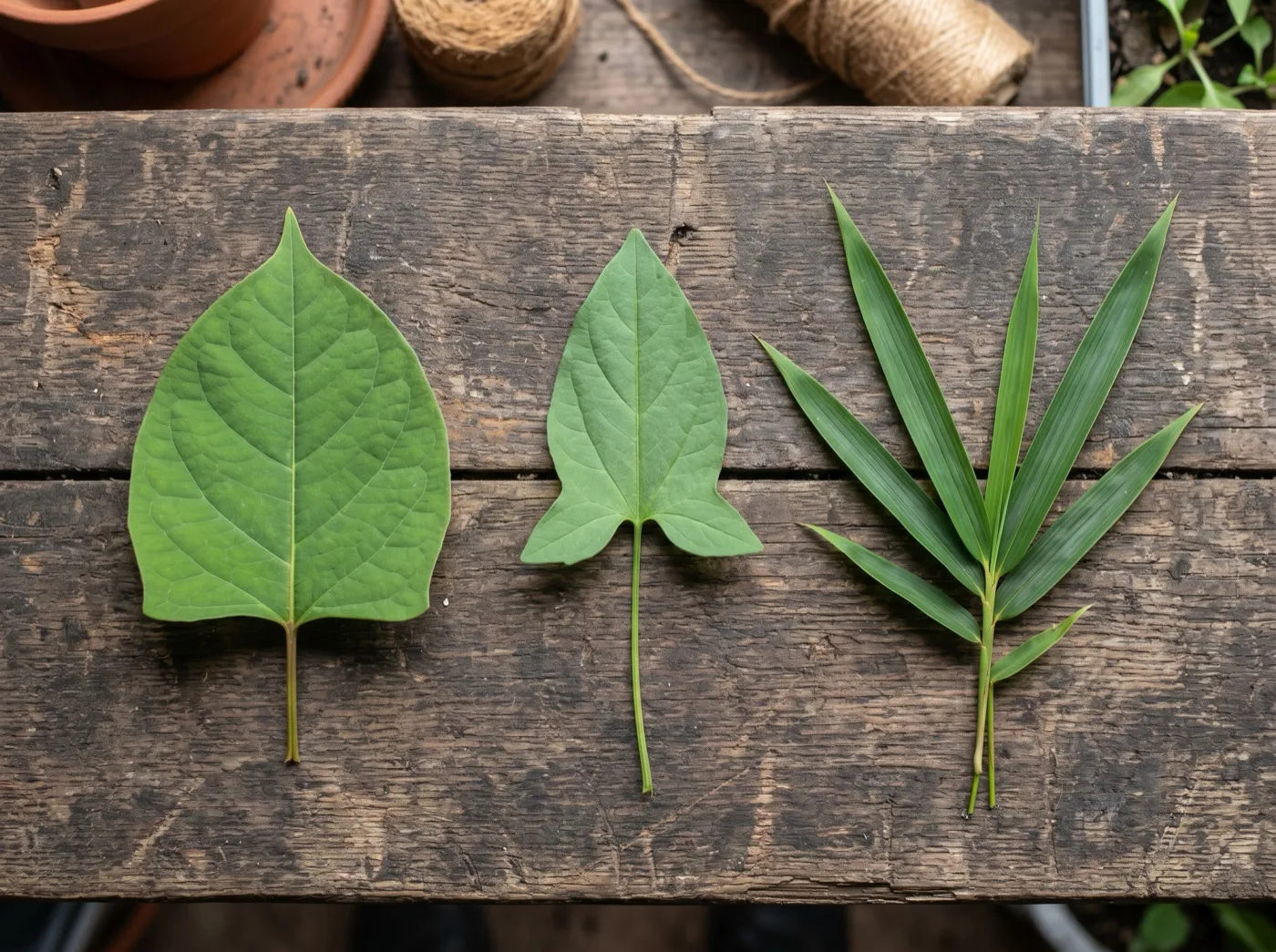 Left to right: knotweed’s shield leaves, bindweed’s arrowhead leaves, bamboo’s narrow blades. The stem tells you more than the leaf.
Banned aquatic plants and why ponds are high risk
Garden ponds are the back door through which several of the worst invaders escape, which is why five aquatic plants were banned from sale in England in April 2014.
The banned five are floating pennywort, parrot’s feather, water fern (Azolla filiculoides), Australian swamp stonecrop (Crassula helmsii, also sold as New Zealand pigmyweed) and water primrose. Each forms dense mats that block light, strip oxygen and choke out native life. Crassula in particular can regrow from a fragment under 5mm, so it spreads on boots, nets and bird feet.
The risk is escape, not the pond itself. Heavy rain washes pond plants into ditches and streams, and from there into rivers and canals where they cost millions to clear. The Environment Agency spends large sums every year on floating pennywort alone, which can grow 20cm a day in summer.
Gardener’s tip: Never tip unwanted pond plants or water into a drain, ditch or stream. Compost them dry on an impermeable surface until they are crisp, or bin them as garden waste. One bucket of Crassula can seed a whole watercourse.
A month-by-month plan for tackling invasive plants
Timing decides whether you win or waste a year. Each species has a window when treatment works best, so plan the calendar rather than reacting in a panic.
| Month | Action |
|---|---|
| March | Spot red knotweed shoots; map every stand before growth hides them |
| April | Pull young Himalayan balsam seedlings while soft and shallow-rooted |
| May | Cut and treat Rhododendron ponticum stumps; balsam pulling continues |
| June | Pull balsam before flowers set; report giant hogweed to the council |
| July | Last chance to pull balsam before seed pods explode and scatter 7m |
| August | Monitor knotweed at full height; prepare for autumn treatment |
| September | Begin glyphosate stem-injection on knotweed as growth slows |
| October | Continue knotweed treatment while sap draws chemical into the rhizome |
| November | Cut and bag dead knotweed canes; dispose as controlled waste |
| December | Plan next year; book a specialist survey if a sale is coming |
The principle behind the calendar is simple. Attack seed-spreaders like balsam before they flower, and attack rhizome-spreaders like knotweed in autumn when the plant is moving energy and chemical downward. Treat at the wrong time and you cut the top while the engine underground survives.
How to dispose of banned plants without breaking the law
Disposal is where good intentions become offences, because knotweed and contaminated soil are controlled waste under the Environmental Protection Act 1990.
You have three lawful routes. First, take treated material to a licensed landfill that accepts it, with the right waste transfer documentation. Second, bury it on site at least 5m deep, capped with a root-barrier membrane, which usually needs Environment Agency notification. Third, dry and burn knotweed canes on your own land where local rules allow, then bin the ash.
| Plant | Safe disposal route | Never do this |
|---|---|---|
| Japanese knotweed | Licensed landfill or on-site burial under membrane | Home compost, green-waste bin, fly-tip |
| Giant hogweed | Bag while wearing cover, dispose as garden waste | Strim, burn green, touch bare-skinned |
| Himalayan balsam | Compost dry once pulled, before seeds form | Compost in seed, leave near water |
| Aquatic invaders | Dry on hard standing, bin as garden waste | Tip into drain, ditch or watercourse |
Giant hogweed sap is the immediate hazard. If it touches skin, wash with soapy water at once, keep the area out of sunlight for 48 hours, and see a pharmacist or GP if blistering starts. The reaction, phytophotodermatitis, can leave skin sensitive to sunlight for years. This is the same caution we urge for plants toxic to dogs in the UK and plants toxic to cats in the UK: know the hazard before you handle the plant. For identification photos and a safe removal method, see our giant hogweed guide.
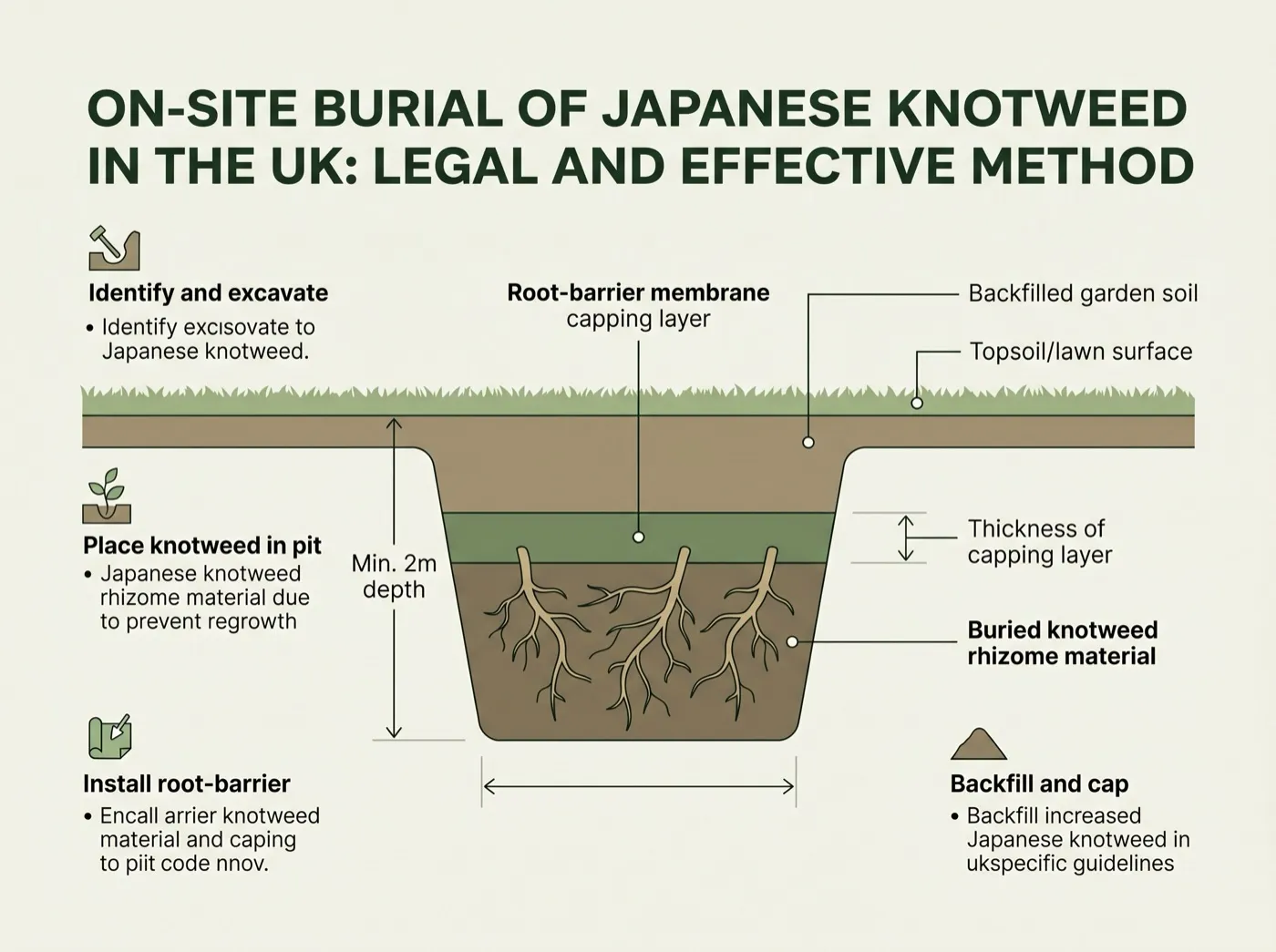 Japanese knotweed is controlled waste. Bury it on site under a root barrier or send it to a licensed landfill, never the home compost or green bin.
Common mistakes that turn one plant into a problem
- Strimming or mowing knotweed and balsam. This is the classic blunder. Cutting flings live fragments and ripe seeds for metres, creating new colonies and a possible Section 14 offence. Pull or inject, never cut and scatter.
- Composting the wrong material. A knotweed rhizome or a balsam seed pod survives a home heap. Only compost balsam pulled before it flowers, and never compost knotweed at all.
- Treating knotweed in spring. Spraying in spring kills the visible cane while the rhizome regrows. Autumn injection works because the plant carries the chemical down to the roots.
- Moving contaminated soil. Soil with a 10mm rhizome fragment will grow elsewhere. Builders and gardeners spread knotweed this way more than any other route. Test before you dig.
- Ignoring a neighbour’s stand. If knotweed is creeping under your fence from next door, raise it early in writing. Left alone it becomes your problem too, and the civil claims run both ways.
Where to report invasive plants and find help
Reporting matters because early sightings stop a single plant becoming a regional cost. Several routes exist, and using them is free.
Report giant hogweed, knotweed and aquatic invaders to your local authority first, especially on public land, verges and waterways. For nationwide recording, the GB Non-Native Species Secretariat runs identification guides and a recording scheme. Its site, the GB Non-Native Species Secretariat, lists every species of concern with photographs and the current legal position.
For your own garden, three steps cover most situations. Identify the plant accurately using stem and leaf features. Contain it by halting any spread across boundaries or into water. Treat or remove it on the right calendar window, calling a specialist for knotweed if a sale or mortgage is involved. Spend time on identification before money on treatment, because look-alikes are common and surveys are not cheap.
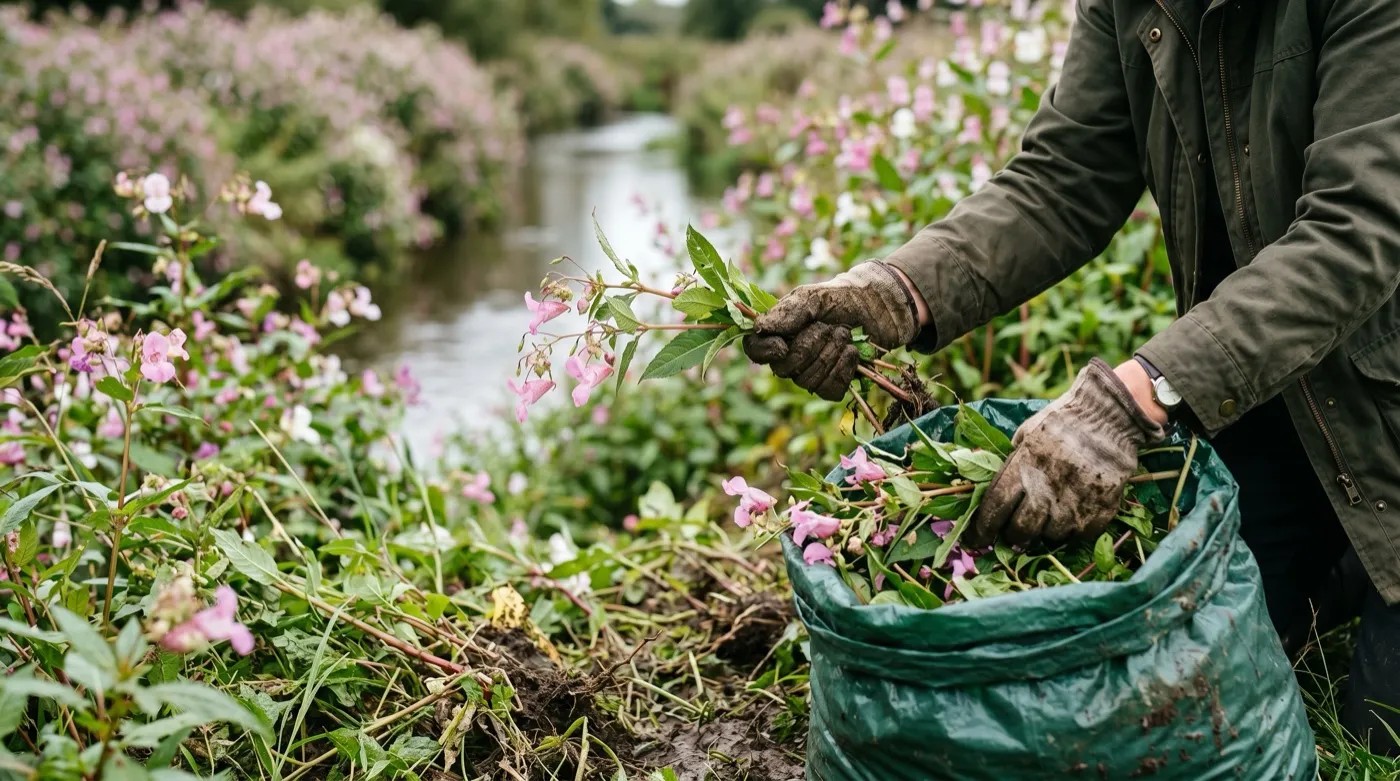 Pulling Himalayan balsam by hand before the seed pods form is the only reliable control. Bag it and compost it dry, never near water.
Frequently asked questions
Is it illegal to grow Japanese knotweed in your garden?
No, growing it on your own land is not illegal. But Section 14 of the Wildlife and Countryside Act 1981 makes it an offence to plant it or cause it to grow in the wild. Allowing it to spread onto a neighbour’s land can bring civil liability and an anti-social behaviour notice.
What is the most dangerous banned plant in the UK?
Giant hogweed is the most physically dangerous to people. Its sap causes phytophotodermatitis, severe blistering burns triggered by sunlight. Japanese knotweed is the most legally and financially damaging, capable of cracking foundations and blocking mortgages on affected homes.
Which plants are banned from sale in the UK?
Five aquatic plants were banned from sale in England in 2014. They are floating pennywort, parrot’s feather, water fern, Australian swamp stonecrop, and water primrose. Many other Schedule 9 species are legal to sell but illegal to release into the wild.
What should I do if I find giant hogweed?
Do not touch it with bare skin. Wash any contact immediately with soapy water and keep it out of sunlight. Report the location to your local council. Removal needs protective clothing and is best left to a contractor for large stands.
Can I be prosecuted for spreading invasive plants?
Yes, under Section 14 of the Wildlife and Countryside Act 1981. Causing a Schedule 9 plant to grow in the wild carries a fine or up to two years in prison. Letting knotweed encroach on a neighbour also risks a civil claim and an ASB notice.
How do I dispose of Japanese knotweed legally?
Treat it as controlled waste under the Environmental Protection Act 1990. It must go to a licensed landfill site that accepts it, or be buried on site under a 5m membrane with permission. Never put it in household or green-waste bins.
Our team produces practical UK gardening guidance from source research, contributor records and established horticultural practice. Editorial standards are overseen by Matt W.