Key takeaways
- Waterlogging and Phytophthora root rot is the single most common laurel killer
- Phytophthora browns from the base up, with dark, foul-smelling roots
- Drought scorch crisps leaf edges on new hedges but recovers with water
- Honey fungus: white sheets under bark, black bootlaces in soil, sudden death
- Frost and wind scorch browns leaves but usually reshoots by June
- Shothole, mildew and leaf spot are cosmetic, not fatal
A browning laurel hedge sends most UK gardeners straight for the hose. That instinct is often what kills it. Cherry laurel (Prunus laurocerasus) and Portuguese laurel (P. lusitanica) are the most planted evergreen hedges in Britain, and when they fail there is no single cause, so guessing wrong wastes a hedge. This guide is a diagnostic decision key: how to tell waterlogging, Phytophthora root rot, drought, honey fungus, frost scorch and the cosmetic leaf problems apart, what is fatal, and how to save the ones that can be saved. One quick check first: if your “laurel” is the yellow-speckled kind, that is spotted laurel (Aucuba japonica), a different shrub whose leaves blacken for other reasons, covered in our guide to aucuba blackening.
After 6 years diagnosing failing laurel on heavy Staffordshire clay, three rules hold. Check the roots before you water. Base-up browning means drainage. White sheets under the bark mean replace, not rescue.
Start With the Browning Pattern
Where the brown starts tells you most of what you need.
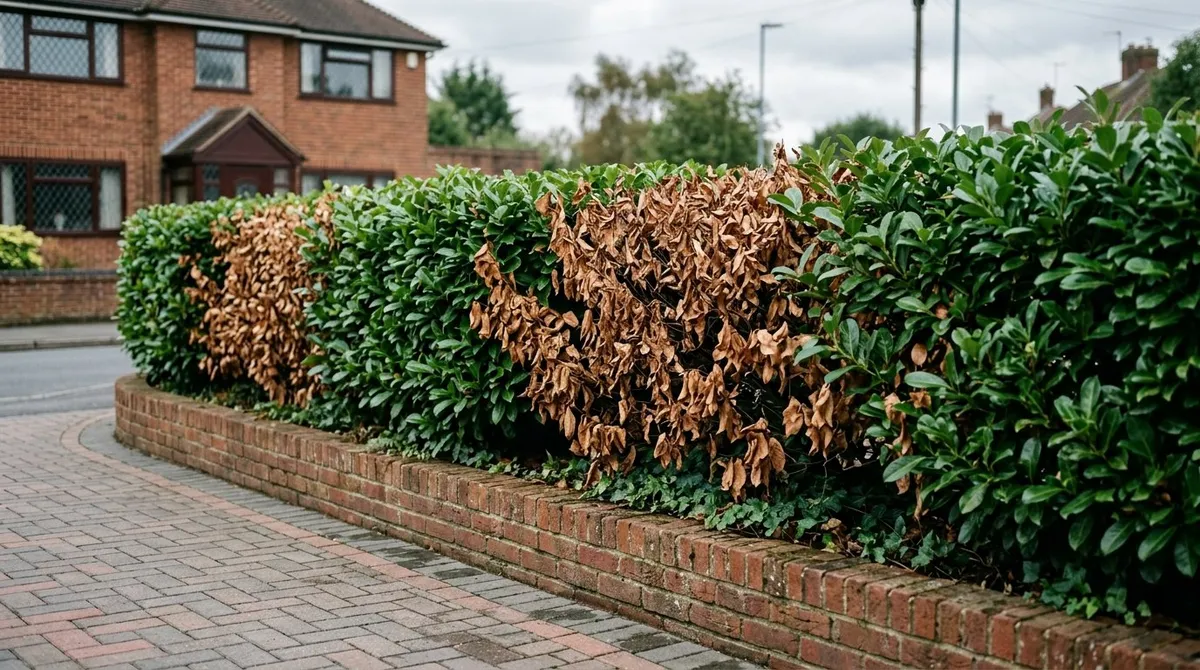
The direction of dieback is the first clue. A hedge dying from the base upward, with whole plants yellowing then going brown, points to the roots. A hedge browning at the leaf tips and edges, with the centre still green, points to water stress or wind. Sudden death of a whole plant overnight, with leaves still hanging on brown, points to honey fungus.
Quick read of the pattern:
- Base up, whole plants, on wet ground: waterlogging or Phytophthora root rot
- Tips and edges crisp, new hedge, dry summer: drought or transplant stress
- One plant dead suddenly, leaves clinging: honey fungus
- All-over brown after a hard winter: frost or cold-wind scorch
- Small holes peppering otherwise green leaves: shothole, cosmetic
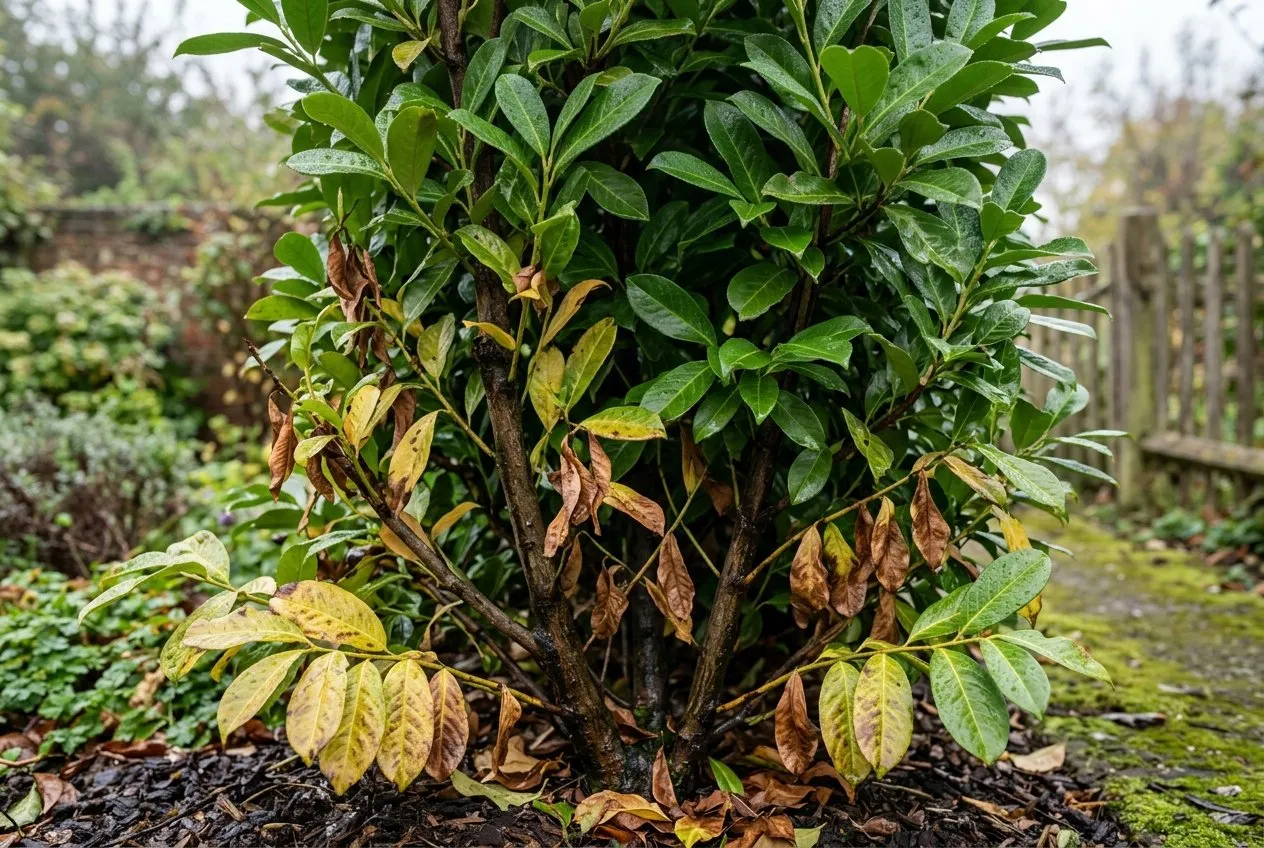 Yellowing then browning from the base upward on a Staffordshire cherry laurel. This base-up pattern is the signature of waterlogging and Phytophthora root rot, not drought. The lower stems go first because the roots are drowning.
Waterlogging and Phytophthora Root Rot
This is the single most common killer of UK laurel hedges. Heavy, wet clay and newly planted hedges are most at risk.
Cherry laurel hates wet feet. On clay that sits waterlogged through winter, the fine roots suffocate, then the water mould Phytophthora moves in and rots them. The plant yellows, browns from the base, and dies back stem by stem. Dig down 200mm beside a failing plant and the diagnosis is clear: the soil is wet and sour, and the roots are dark brown or black, soft, and smell stale rather than earthy. Healthy laurel roots are firm and pale.
Confirming Phytophthora root rot:
- Dig a 200mm hole beside a dying plant
- Check if it fills with water or stays saturated
- Scrape a main root with a thumbnail; healthy is white-green underneath, rotted is brown
- Smell the roots; a sour, stagnant smell confirms rot
- Look for dieback spreading plant to plant along the wettest part of the run
The Royal Horticultural Society has detailed identification notes worth checking against your own plants on the RHS website. The treatment is drainage, not chemicals. There is no garden fungicide that cures Phytophthora.
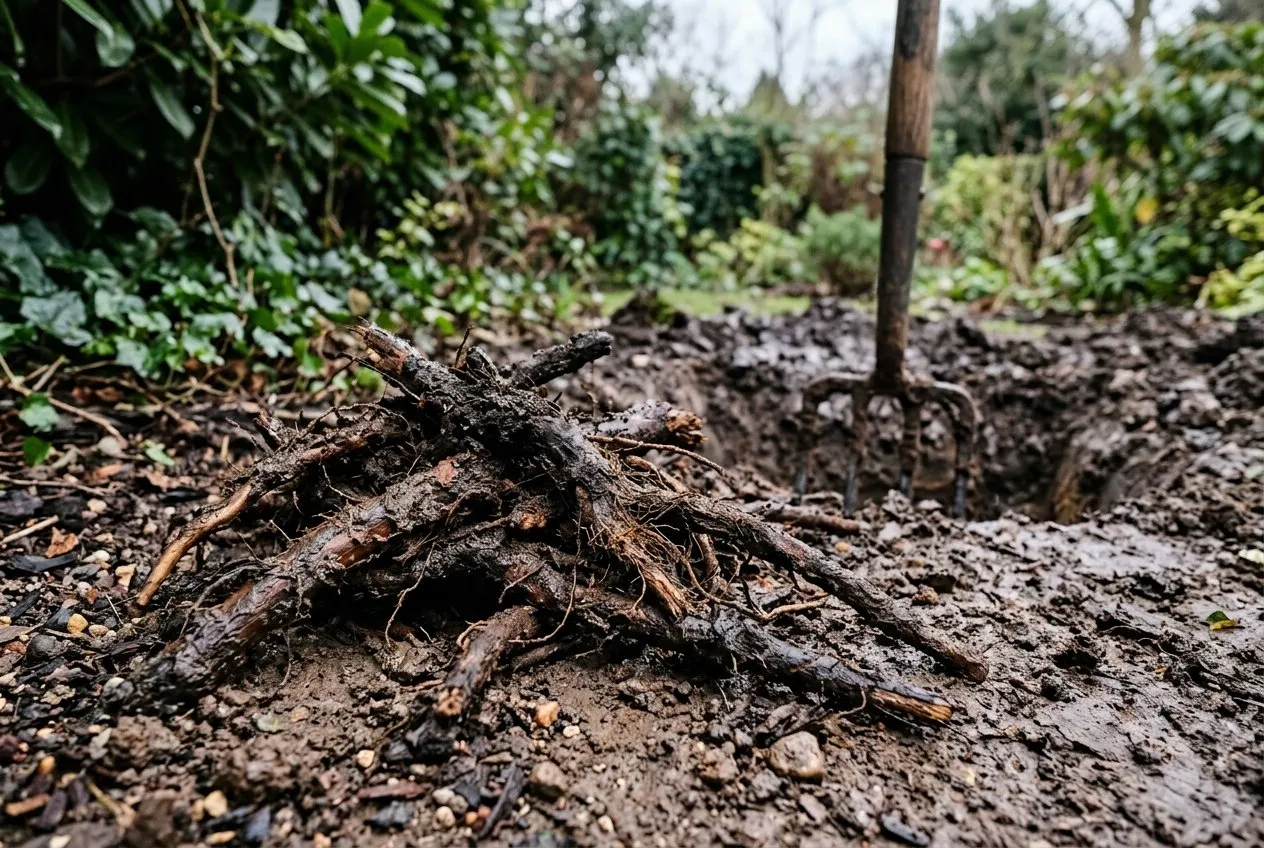 Rotted cherry laurel roots lifted from a waterlogged corner at Staffordshire. Firm pale roots are healthy; these are dark, soft and sour-smelling. Once the main roots go like this, the plant cannot be saved and the soil drainage must be fixed before replanting.
Drought and Transplant Stress
New laurel hedges browning in their first summer are usually thirsty, not rotting. This is the opposite problem to waterlogging, and it confuses people because the brown looks the same from a distance.
Drought scorch crisps the edges and tips of leaves first, often on the sunniest, most exposed side of the hedge. The centre stays green longer. Newly planted whips put in over winter have small root systems and cannot keep up in a dry June or July. Dig down and the soil is dry and dusty, the roots firm and pale. That firm, pale root is the giveaway: drought, not rot. A drought-stressed laurel recovers fast once watered properly. A waterlogged one dies faster if you water it.
Watering a new laurel hedge correctly:
- Soak the root zone, not the leaves, 2-3 times a week in dry spells
- Aim for 10 litres per plant per soak, not a daily sprinkle
- Mulch 75mm deep with bark or compost to hold moisture
- Keep this up through the first two summers after planting
Our hedge planting guide for UK gardens covers spacing and aftercare that prevents most first-year losses.
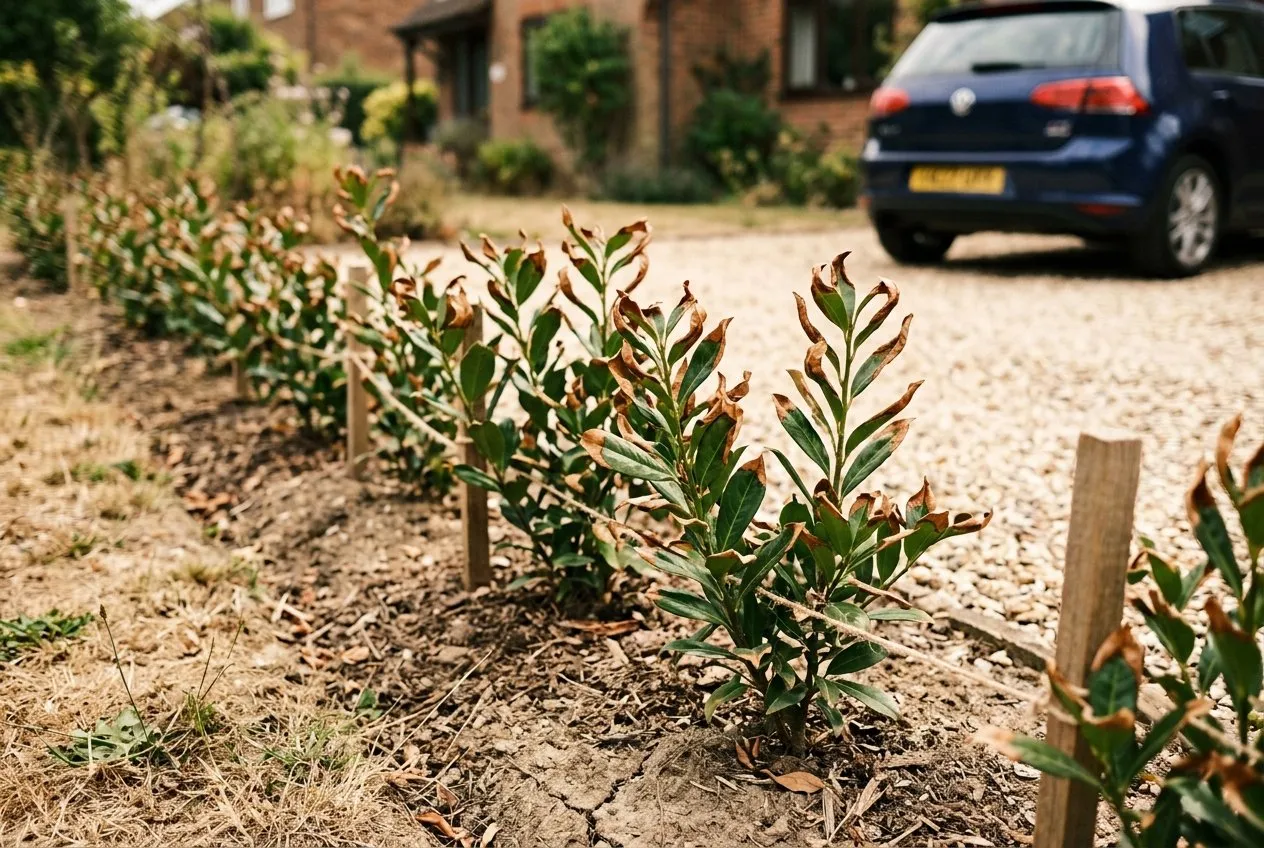 Drought scorch on a first-year laurel hedge beside a Cheshire driveway. The leaf edges crisp brown while the centres stay green. The roots underneath were firm and pale, so a fortnight of deep weekly soaks brought it back.
Honey Fungus: The Fatal One
Honey fungus (Armillaria) kills laurel suddenly and cannot be cured. It is the diagnosis you most want to rule out, because it changes everything you do next.
A laurel hit by honey fungus often dies fast, sometimes one plant collapsing while neighbours look fine, with brown leaves still clinging to the stems. The proof is under the bark. Peel back the bark at the base of a dead or dying plant and you find creamy-white, fan-shaped fungal sheets that smell strongly of mushrooms. In the surrounding soil, black or dark-brown strands like bootlaces run between plants; these are the rhizomorphs that spread the disease. Honey fungus also produces honey-coloured toadstools at the base in autumn.
Honey fungus checklist:
- White fan-shaped sheets under the bark at the stem base
- Strong mushroom smell when you peel the bark
- Black bootlace rhizomorphs in the soil nearby
- Sudden death rather than slow decline
- Honey-coloured toadstools clustered at the base in autumn
There is no chemical cure. Dig out the dead plant and as much root as you can, and avoid replanting susceptible species in the same spot. Our guide on how to deal with honey fungus sets out containment and resistant replacements in detail.
Frost, Wind and the Cosmetic Problems
Several laurel problems look alarming but are not fatal. Telling them apart from the killers saves you from digging out a hedge that would have recovered on its own.
Frost and cold-wind scorch browns laurel leaves after a hard winter, worst on exposed sides and recently planted hedges. The leaves go brown and brittle, but the wood and roots are unharmed. Laurel almost always reshoots by late spring. Wait until June, then clip out the dead tips once fresh green growth appears.
Shothole peppers the leaves with small round holes, as if hit by tiny shotgun pellets. It is caused by bacteria or fungi and looks dramatic, but it is mostly cosmetic and rarely harms an established hedge. Powdery mildew and leaf spot cause white dusting or brown blotches on leaves, again cosmetic on a healthy plant.
Weedkiller and road-salt damage show as twisted, distorted, or one-sided browning, often on the boundary nearest a path, drive, or sprayed border. The pattern usually traces back to the source.
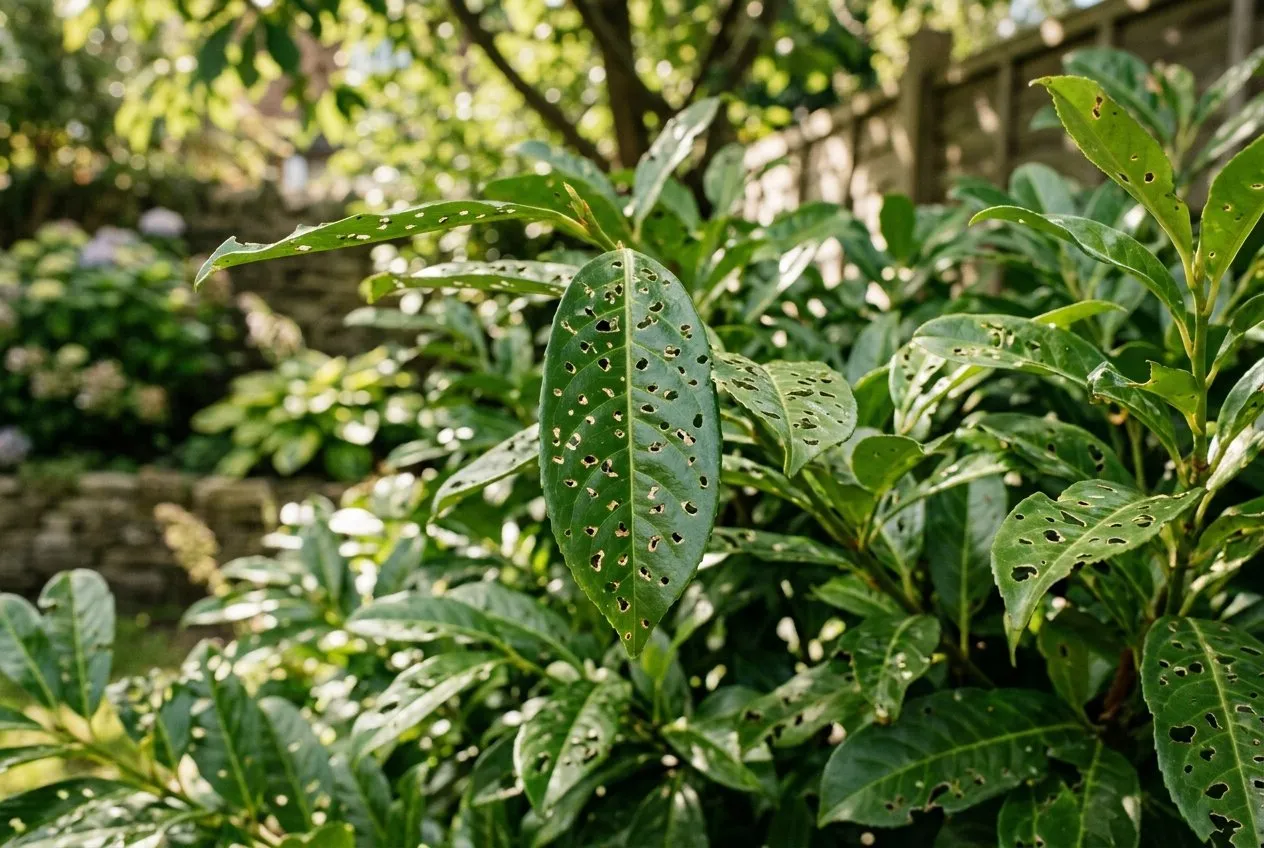 Shothole on cherry laurel in a town terrace garden. The leaves look peppered with tiny holes, but this is cosmetic. An established hedge shrugs it off. New leaves emerge clean once the plant is growing well.
The Laurel Diagnosis Table
This symptom-to-cause table is the quick reference. Match what you see, then check whether it is fatal.
| Symptom you see | Most likely cause | Fatal? |
|---|---|---|
| Yellowing then browning from the base up, on wet clay | Waterlogging / Phytophthora root rot | Often fatal |
| Crisp brown leaf edges on a new hedge in summer | Drought / transplant stress | Saveable with water |
| One plant dead suddenly, leaves still clinging | Honey fungus | Fatal |
| White sheets under bark, black bootlaces in soil | Honey fungus | Fatal |
| All-over brown after a hard winter, wood still green | Frost / cold-wind scorch | Recovers, reshoots |
| Leaves peppered with small round holes | Shothole | Cosmetic |
| White dusting or brown blotches on leaves | Powdery mildew / leaf spot | Cosmetic |
| Yellow leaves with green veins, waterlogged ground | Nutrient lock-up from waterlogging | Saveable, fix drainage |
| Twisted, one-sided browning near a path or drive | Weedkiller / road-salt | Depends on dose |
The browning issues that grade as cosmetic almost never need action. The base-up root rot and honey fungus are the two that end hedges.
Saving a Salvageable Laurel Hedge
If the roots are still firm and the wood under the bark is green, the hedge can usually be saved. Laurel reshoots readily from old wood, which makes it forgiving.
Rescue steps in order:
- Fix drainage first if waterlogging is the cause; dig a soakaway or add grit and organic matter
- Cut every brown, dead stem back to live green wood, even hard back to bare main stems
- Feed in spring with a balanced fertiliser, then mulch 75mm deep with compost
- Water deeply in dry spells while the hedge regrows, but never on soggy ground
- Give it a full season; laurel often looks bare in spring and green again by late summer
For the wider job of cutting an overgrown hedge, our hedge-cutting guide with the legal UK dates covers timing around the bird-nesting season.
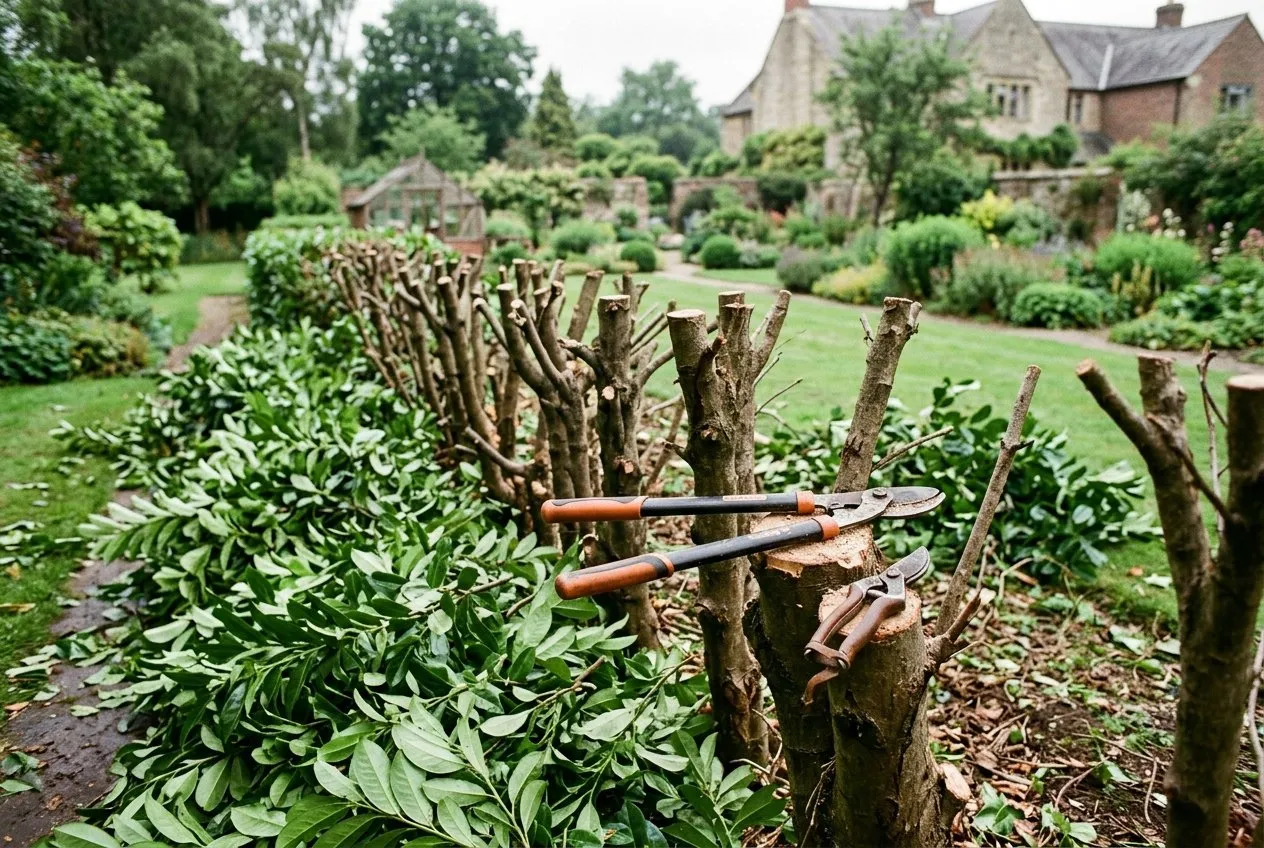 Renovating a laurel by cutting back to live green wood at Staffordshire. It looks brutal, but laurel reshoots from old stems. This 12-metre run was bare in April and fully green again by September after feeding and mulching.
When to Replace, and What With
Some hedges are past saving. Replace when the main roots are rotted, when honey fungus is confirmed, or when more than two-thirds of a long run is dead.
If you replace, fix the cause first. On wet clay, raise the bed or improve drainage before replanting, because a new laurel will rot in the same spot. Portuguese laurel (P. lusitanica) copes better with drier, sharper-drained soil than cherry laurel and is worth considering on lighter ground. On honey fungus sites, avoid laurel and other susceptible shrubs entirely.
A laurel browning at the base on wet clay is a different problem from one browning at the tips in a dry June, and the wrong fix kills the wrong one.
Frequently asked questions
Why is my laurel hedge going brown and dying?
Usually waterlogging and Phytophthora root rot, the commonest UK laurel killer. It yellows then browns the hedge from the base upward, worst on heavy wet clay and on new plantings. Drought, honey fungus and frost cause browning too, but the root-rot pattern is the one to rule out first. Dig down beside a dying plant and check the roots before doing anything else.
Can a dying laurel hedge be saved?
Often yes, if the roots are still firm and pale. Cut every brown stem back to live green wood, improve drainage, then feed and mulch. Laurel reshoots readily from old wood. A hedge killed by honey fungus or fully rotted roots cannot be saved and must be replaced.
How do I tell drought from waterlogging on laurel?
Dig down 200mm beside the plant and check the soil. Wet, sour-smelling soil with dark roots means waterlogging. Dry, dusty soil with firm pale roots and crisp leaf edges means drought. The two look similar above ground but need opposite treatment, so the dig is worth doing.
What are the white sheets under the bark of my laurel?
That is honey fungus (Armillaria), a fatal root disease. Peel back bark at the base and you find creamy-white fan-shaped fungal sheets that smell of mushrooms. Black bootlace strands run through nearby soil. There is no cure; remove the plant and as much root as possible.
Does laurel grow back after frost damage?
Yes, frost-scorched laurel almost always reshoots by late spring. Hard winters brown the leaves, especially on exposed and recently planted hedges. Wait until June before cutting; clip out the dead tips once new growth appears. The roots are unharmed, so recovery is reliable.
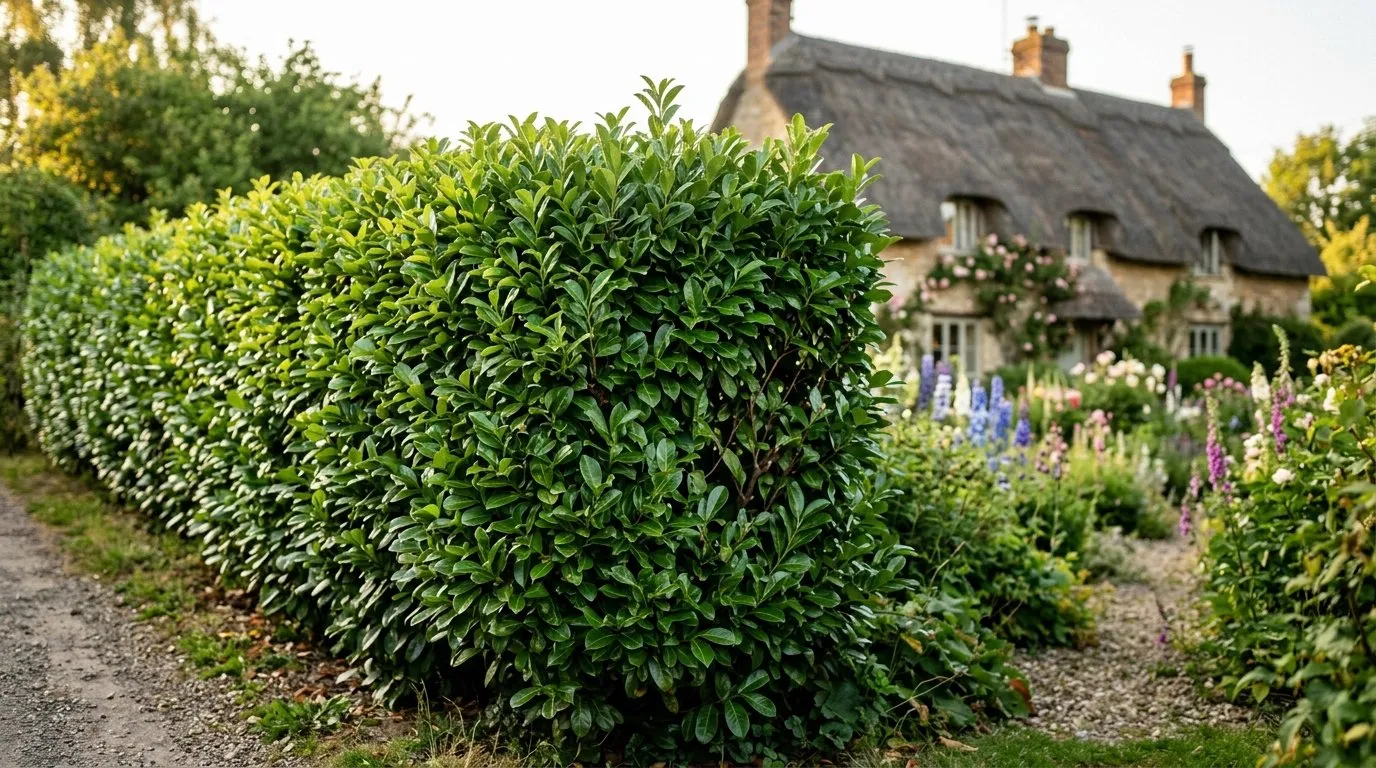 A thriving cherry laurel hedge on free-draining ground beside a Staffordshire cottage. Glossy, dark-green and dense from base to top. This is the target: get the drainage right and laurel is one of the toughest evergreen hedges in Britain.
Now diagnose, then act
Work the cause out before you reach for the hose or the secateurs. To plant or replace correctly, start with our hedge planting guide for UK gardens. If a neighbouring conifer screen is also failing, our conifer hedge browning guide covers a different but related diagnosis. For a wildlife-friendly alternative on ground where laurel keeps dying, the native hedgerow species guide is the place to start. And if your hedge troubles run to pests as well as disease, our box tree moth treatment guide covers the other big evergreen-hedge problem in UK gardens.
Our team produces practical UK gardening guidance from source research, contributor records and established horticultural practice. Editorial standards are overseen by Matt W.