Key takeaways
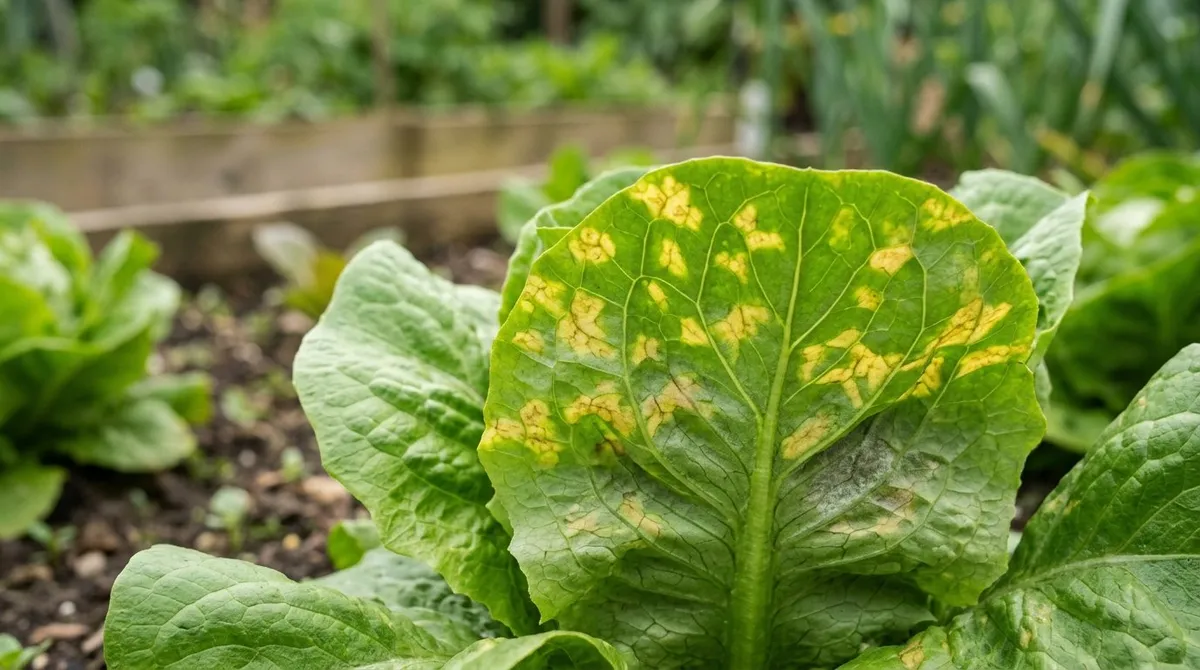
- Angular pale yellow patches on upper leaves with white downy growth underneath are the diagnostic signs of lettuce downy mildew
- Bremia lactucae is an oomycete, not a true fungus, and over 38 identified races (Bl:1 to Bl:38+) can overcome resistant varieties
- Cool temperatures (10-15C) combined with leaf wetness lasting 3-4 hours are the primary infection triggers
- Wide spacing (25-30cm) and bottom watering reduce infection rates by 40-60% compared to crowded, overhead-watered crops
- Cos and loose-leaf lettuces show greater tolerance than butterhead and iceberg types in UK growing conditions
- Lettuce with mild downy mildew is safe to eat after removing affected outer leaves
Lettuce downy mildew is the most common disease of lettuce in UK gardens. It thrives in exactly the cool, damp conditions that define British springs and autumns. It can ruin an entire salad bed within two weeks when humidity stays high and temperatures sit between 10C and 15C. Every lettuce grower in the UK will encounter it sooner or later.
The disease is caused by Bremia lactucae, an oomycete (water mould) rather than a true fungus. This distinction matters because many fungicides designed for true fungi do not work against oomycetes. Understanding how the pathogen operates, which conditions favour it, and which lettuce types resist it best gives you a genuine advantage. This guide covers identification, causes and prevention. Compare seasonal choices in our guide to the best lettuce varieties.
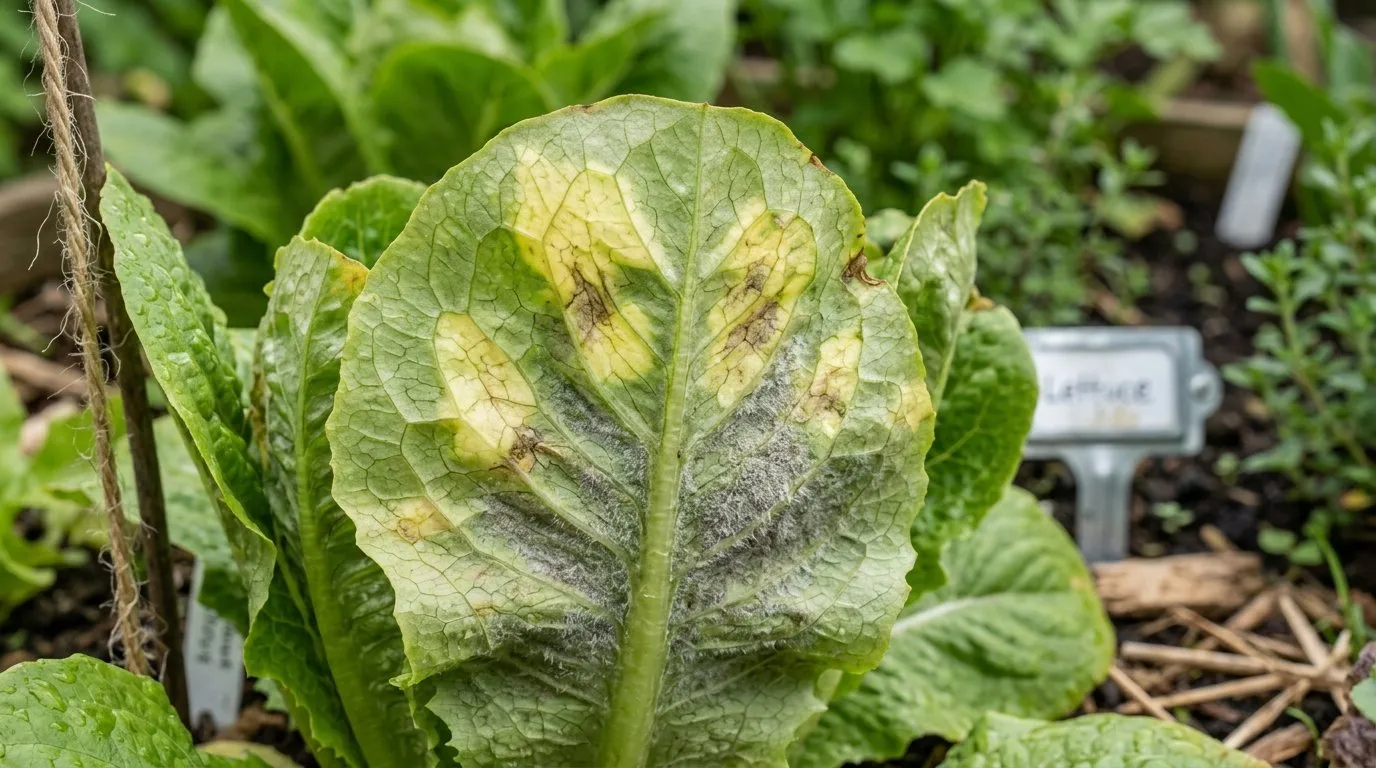
What does lettuce downy mildew look like?
Angular pale yellow patches on the upper leaf surface, bounded by leaf veins, are the hallmark of lettuce downy mildew. The patches range from 5mm to 25mm across and follow the vein network, giving them a distinctive angular rather than circular outline. This angular shape is the key feature that separates downy mildew from other lettuce diseases.
Turn an affected leaf over and you will see a white to greyish downy growth on the underside, directly beneath each yellow patch. This downy layer consists of sporangiophores, the spore-bearing structures of Bremia lactucae. The sporulation is most visible in the morning when humidity is highest.
On mature plants, outer leaves show symptoms first. The infection works inward towards the heart if conditions remain damp. As patches age, they turn brown and papery. Severely affected outer leaves curl downward and the plant looks ragged and unappetising. Secondary bacteria often colonise the dead tissue, causing a wet rot that accelerates the damage.
| Symptom | Location | Description |
|---|---|---|
| Angular yellow patches | Upper leaf surface | 5-25mm, bounded by veins |
| White downy growth | Lower leaf surface | Sporulation layer, worst in morning |
| Yellow-green cotyledons | Seedlings | First sign on young plants, rapid collapse |
| Brown papery lesions | Older infections | Dead tissue replaces yellow patches |
| Wet rot | Severe cases | Secondary bacteria follow downy mildew damage |
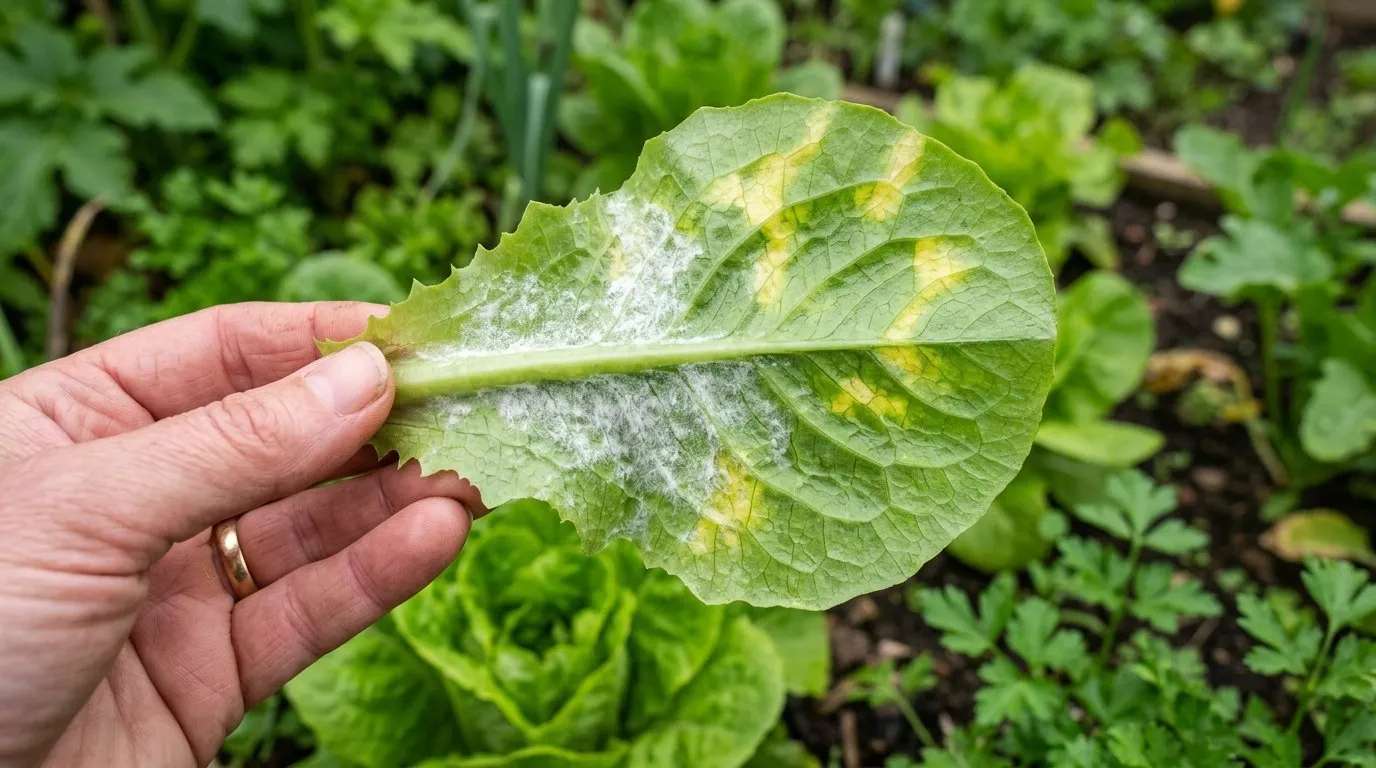
What causes lettuce downy mildew?
Bremia lactucae, an oomycete pathogen with over 38 identified races, causes lettuce downy mildew. It is not a true fungus. Oomycetes belong to a group more closely related to brown algae than to the moulds that cause powdery mildew. This biological distinction explains why traditional fungicides often fail against it.
The pathogen reproduces in two ways. Airborne sporangia are produced on the downy growth beneath infected leaves. These tiny spore-like structures are released in the morning as humidity drops. Wind carries them to neighbouring plants, where they germinate on wet leaf surfaces within 3-4 hours. A single infected leaf can release thousands of sporangia in one morning.
Oospores are thick-walled survival structures produced inside infected leaf tissue. When the leaf decomposes, oospores are released into the soil. They survive for up to 3 years. The following season, oospores germinate in wet soil and infect the roots of new lettuce seedlings from below. This is why crop rotation is part of the prevention strategy, though it cannot stop airborne spread.
Seed-borne transmission is also possible. Contaminated seed carries the pathogen into clean growing areas. Buy seed from reputable suppliers and consider using pelleted or treated seed for high-value crops. Wild lettuce (Lactuca serosa) and prickly lettuce (Lactuca virosa) can also harbour the pathogen and act as local sources of airborne spores.
The race system: Bl:1 to Bl:38+
The most challenging aspect of Bremia lactucae is its race diversity. Lettuce breeders have identified over 38 distinct races, designated Bl:1 through Bl:38 and beyond. Each race is defined by which resistance genes it can overcome.
When a breeder releases a new lettuce variety with resistance to Bl:16, for example, that variety performs well until a new race (perhaps Bl:33 or Bl:35) emerges that can bypass that resistance gene. This arms race between pathogen and plant has been ongoing since the 1980s. New races typically appear within 3-5 years of a new resistance gene being deployed widely.
The International Bremia Evaluation Board (IBEB) monitors new races across Europe. UK conditions favour certain races that differ from those dominant in Mediterranean lettuce-growing regions. This is why a variety performing well in Spanish trials may still fail in a British garden.
For home gardeners, the practical lesson is simple: do not rely on varietal resistance alone. Combine resistant varieties with cultural controls for the best results.
How to prevent downy mildew on lettuce
Spacing plants at 25-30cm, watering at soil level, and maximising airflow are the three most effective prevention measures. No fungicides are approved for amateur use against lettuce downy mildew in the UK. Cultural controls are your only practical defence.
Bottom watering: Overhead watering deposits water on leaves, creating the surface moisture film that sporangia need to germinate. Switch to drip lines, seep hoses, or watering at the base of each plant. In a cold frame or greenhouse, water trays from below or use capillary matting. Avoid watering in the late afternoon or evening when leaves will stay wet overnight.
Ventilation: Greenhouse and cold frame lettuce face the highest risk because enclosed spaces trap humid air. Open vents and doors whenever temperature allows. Even a 5cm gap in a cold frame lid during mild autumn days reduces humidity around the leaves significantly. Our cold frame lettuce had zero downy mildew in spring 2025 after we propped the lid open 10cm on all days above 5C.
Remove infected leaves immediately: As soon as you spot angular yellow patches, strip the affected leaves and bag them for household waste. Do not compost them. Every sporulating leaf releases thousands of sporangia that will infect neighbouring plants within hours. Early removal of the first few affected leaves can stop an outbreak before it spreads along the row.
Sow successionally: Rather than planting an entire bed of lettuce at once, sow small batches every 2-3 weeks. If downy mildew hits one batch, the next batch may escape because conditions have changed. This approach also spreads your harvest across the season, complementing strategies from our winter salad guide.
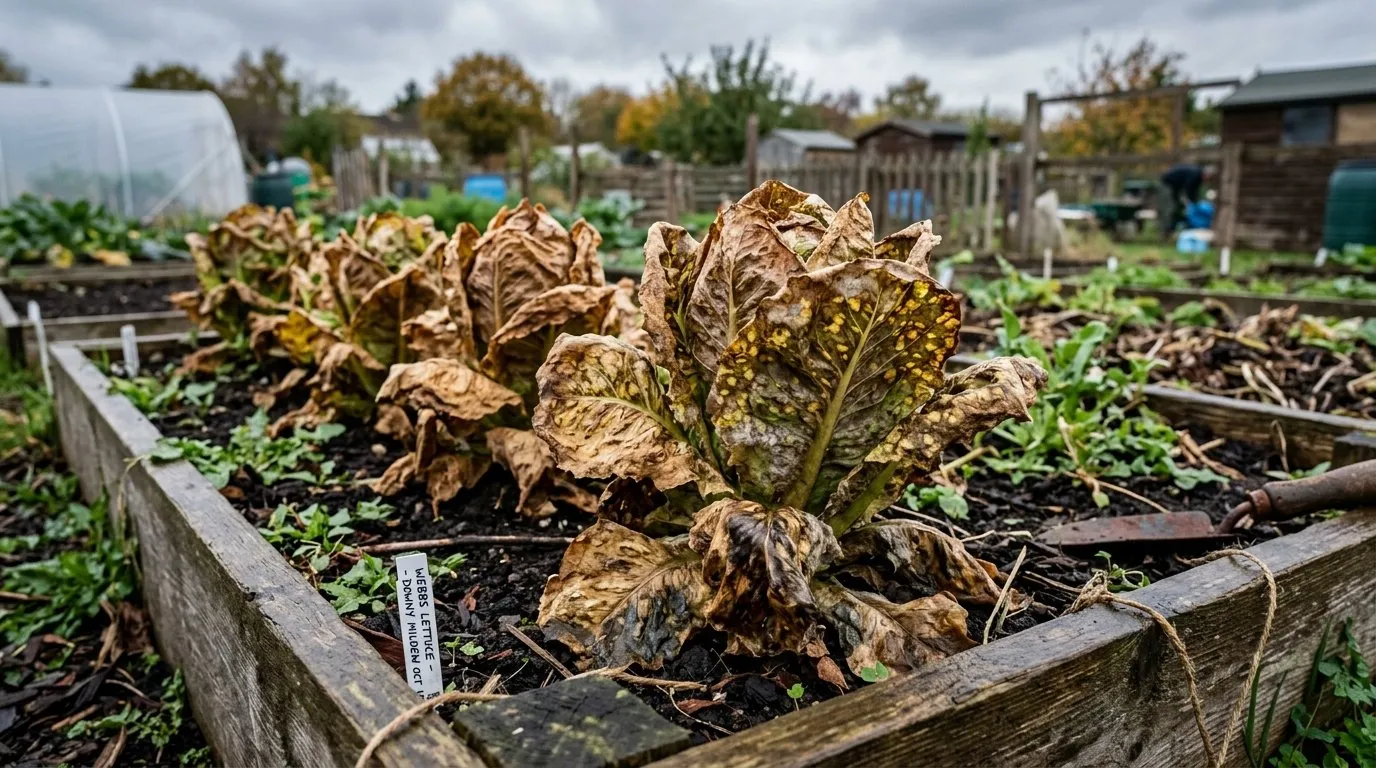
Can you eat lettuce with downy mildew?
Yes, lettuce with mild downy mildew is safe to eat. Bremia lactucae is specific to lettuce and closely related plants. It poses no risk to human health. Remove and discard the affected outer leaves until you reach clean, undamaged tissue. Wash the remaining leaves as you normally would.
Heavily infected leaves taste bitter due to stress compounds the plant produces in response to infection. If a leaf looks discoloured, wilted, or has a musty smell, discard it. The inner heart of a cos or butterhead is usually unaffected even when outer leaves show significant symptoms.
Lettuce with secondary bacterial rot on top of downy mildew damage should not be eaten. If the damaged areas are slimy, dark, or have an unpleasant odour, the bacterial decomposition makes the leaves unpalatable and potentially harmful. In these cases, discard the entire head.
For commercial growers, downy mildew is a serious quality issue because consumers will not buy lettuce with visible yellow patches. For home gardeners, the flexibility to peel away outer leaves and eat the clean inner portions means the disease is more of an inconvenience than a total loss, provided you catch it early.
Resistant lettuce varieties for UK gardens
Cos and loose-leaf varieties show greater tolerance to downy mildew than butterhead and iceberg types, though no variety is permanently immune. The race system (Bl:1 to Bl:38+) means that resistance genes are continually being outpaced by new pathogen variants.
When choosing varieties, look for seed catalogue descriptions mentioning resistance to multiple Bl races. A variety with resistance to Bl:1-33 will cover more of the currently circulating UK races than one resistant only to Bl:1-16. However, even multi-race resistance can be overcome when new races emerge.
| Lettuce type | Susceptibility | Recommended resistant cultivars | Notes |
|---|---|---|---|
| Butterhead | High | ’Sylvesta’, ‘Analena’ | Dense heads trap moisture; worst affected type |
| Cos (romaine) | Low-moderate | ’Lobjoits Green Cos’, ‘Maureen’, ‘Xiomara’ | Upright habit promotes airflow; best tolerance |
| Iceberg (crisphead) | High | ’Saladin’, ‘Barcelona’ | Tight heads hide internal infection until severe |
| Loose-leaf | Low-moderate | ’Lollo Rossa’, ‘Red Salad Bowl’, ‘Navara’ | Open structure dries fast; red types slightly better |
| Little Gem | Moderate | ’Amaze’, ‘Maureen’ | Small heads, quick maturity, often harvested before damage |
| Batavia | Moderate | ’Grenobloise’, ‘Leny’ | Thicker leaves resist penetration; moderate tolerance |
Red-pigmented varieties have a slight edge. The anthocyanins in red lettuce leaves provide a mild antifungal effect, and research from Warwick Crop Centre suggests red loose-leaf types show 15-20% less downy mildew than equivalent green varieties in UK field trials.
Little Gem types deserve special mention. Their compact size means they mature fast (50-60 days from transplant) and can often be harvested before a serious outbreak develops. Successional sowing of Little Gem every 3 weeks is one of the most reliable strategies for getting clean lettuce through a damp British autumn.
Check the RHS lettuce downy mildew guidance for current variety recommendations. Garden Organic also maintains variety trial data relevant to UK organic growing conditions.
Growing conditions that reduce downy mildew
Reducing leaf wetness duration below 3 hours, maintaining temperatures above 18C, and ensuring good air movement around each plant are the three conditions that suppress lettuce downy mildew most effectively. The pathogen needs cool, still, damp air to thrive. Remove any one of those three factors and infection risk drops sharply.
Temperature: Sporangia germinate fastest between 10C and 15C. Above 18C, germination slows considerably. Above 22C, the pathogen is largely inactive. This means summer lettuce (June-August) in the UK faces less pressure than spring and autumn crops. Midsummer sowings benefit from natural heat suppression of the pathogen.
Leaf wetness: Sporangia need a continuous film of water on the leaf surface for 3-4 hours to germinate and penetrate the plant. Morning dew that dries by mid-morning is less dangerous than persistent fog or drizzle that keeps leaves wet all day. Choose a growing position with morning sun exposure so dew dries early. Avoid planting against north-facing walls or under tree canopy where shade extends leaf wetness duration.
Airflow: Sheltered, enclosed positions trap humid air around plants. Choose an open position with natural air movement. In a greenhouse or cold frame, use fans or natural ventilation to keep air circulating. Companion planting with taller crops can provide partial shade that reduces heat stress, but avoid placing dense companion plants upwind of lettuce beds where they block airflow.
| Growing condition | Higher risk | Lower risk |
|---|---|---|
| Temperature | 10-15C | Above 18C |
| Leaf wetness | 3+ hours continuous | Under 2 hours |
| Watering | Overhead | Drip or seep hose at soil level |
| Position | Sheltered, shaded, north-facing | Open, south-facing, morning sun |
| Spacing | Under 20cm | 25-30cm |
| Growing system | Ground level, heavy soil | Raised beds, free-draining |
| Season | March-May, September-November | June-August |
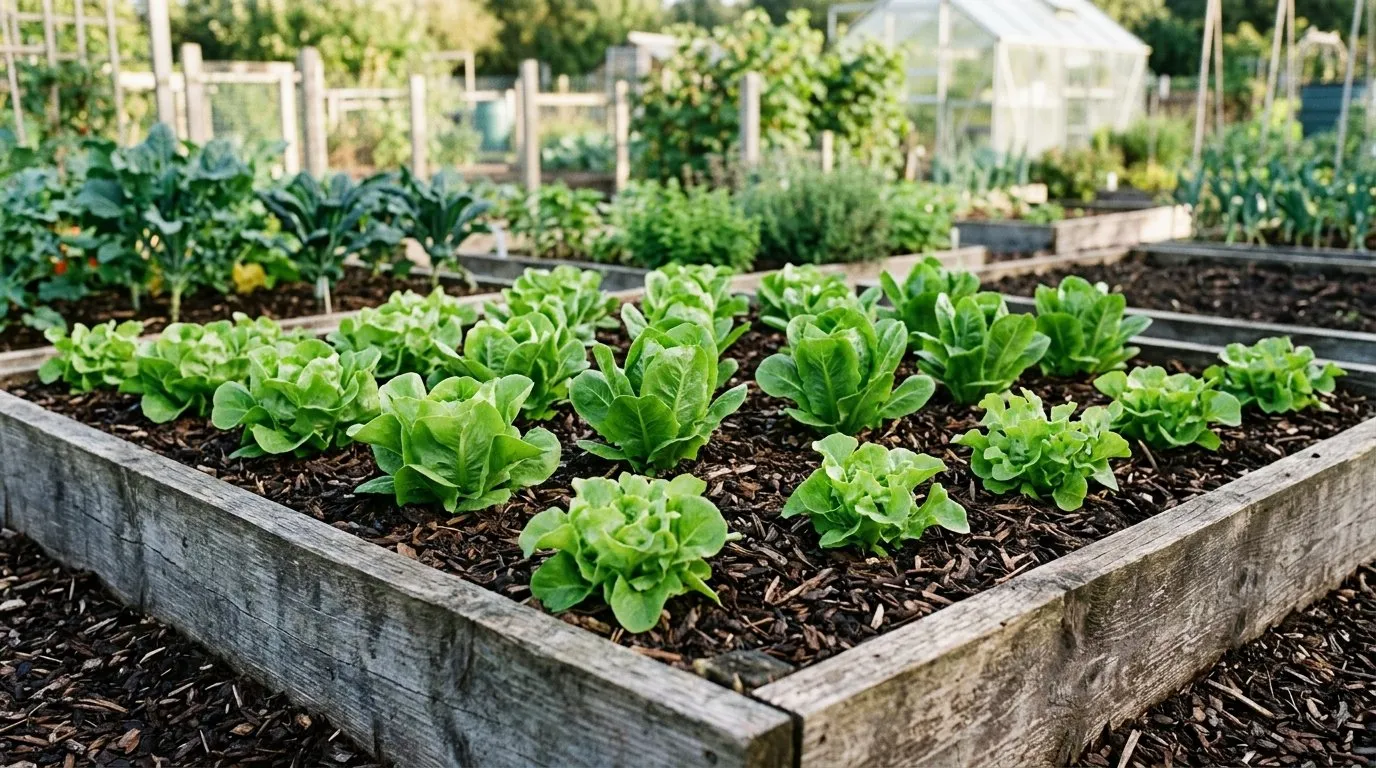
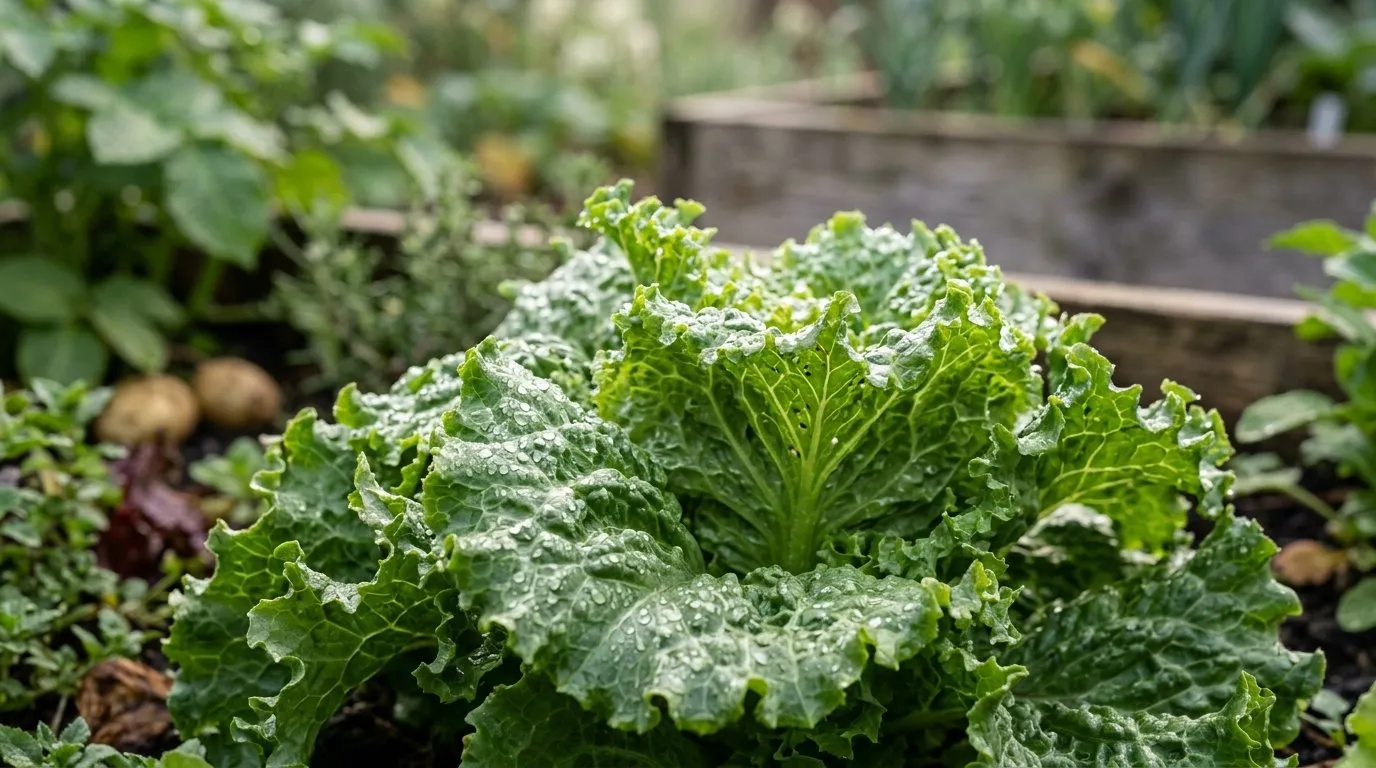 Morning dew on lettuce leaves. Three or more hours of leaf wetness at 10-15C is all downy mildew needs to spread — good airflow and base watering break this cycle.
Downy mildew on other salad crops
Lettuce downy mildew (Bremia lactucae) is specific to lettuce and does not infect other salad crops, but other salad plants have their own downy mildew species. Each pathogen is host-specific, meaning the downy mildew on your lettuce cannot jump to your spinach or rocket. However, conditions that favour one downy mildew species favour them all.
Spinach downy mildew (Peronospora effusa) produces similar angular yellow patches and is an increasing problem in UK autumn crops. It has its own race system, with new races emerging regularly. Resistant spinach varieties are available but face the same arms-race problem as lettuce.
Rocket downy mildew (Hyaloperonospora brassicae, the same species that attacks brassicas) is common in autumn-sown rocket under cover. Rocket is exceptionally susceptible and repeated cut-and-come-again harvesting weakens the plant further. Sow small batches and discard affected plants rather than continuing to harvest from infected stands.
Onion downy mildew (Peronospora destructor) does not affect salad crops but often coincides with lettuce downy mildew outbreaks because both pathogens favour the same cool, damp weather. If you see downy mildew on your onions, check your lettuce immediately.
The overarching lesson for managing all downy mildews in a vegetable garden is the same: maximise airflow, avoid overhead watering, space plants generously, and remove infected tissue promptly. A garden designed with good air circulation and free-draining soil will have less trouble with every downy mildew species.
For greenhouse growers, the enclosed environment creates a particular challenge. Lettuce, spinach, and rocket grown under cover in autumn and spring are all at elevated risk. Ventilate whenever conditions allow, even if it means slightly cooler temperatures inside.
Frequently asked questions
What does lettuce downy mildew look like?
Angular pale yellow patches appear on upper leaf surfaces, bounded by leaf veins. Turn the leaf over and you will see white to greyish downy growth on the underside, directly below the patches. On young seedlings, cotyledons develop yellow-green discolouration and wilt rapidly. Older infections turn brown and papery as the affected tissue dies.
Is lettuce downy mildew caused by a fungus?
No, it is caused by Bremia lactucae, an oomycete or water mould. Oomycetes are genetically closer to brown algae than true fungi. This matters because many conventional fungicides designed for true fungi are ineffective against oomycetes. The pathogen needs free water on leaf surfaces to infect, which is why damp conditions trigger outbreaks.
Can you eat lettuce with downy mildew?
Yes, lettuce with mild downy mildew is safe to eat. Remove and discard affected outer leaves until you reach clean, undamaged tissue. The pathogen is specific to lettuce and related plants and poses no risk to human health. Heavily infected leaves taste bitter due to stress compounds, so discard any that look or taste unpleasant.
Why do resistant lettuce varieties still get downy mildew?
New races of Bremia lactucae evolve rapidly and overcome existing resistance genes. Over 38 races (Bl:1 to Bl:38+) have been identified since monitoring began. A variety resistant to Bl:16 may be fully susceptible to Bl:33 or newer races. This arms race between pathogen and plant means no single variety stays resistant indefinitely.
When is lettuce downy mildew worst in the UK?
Spring (March-May) and autumn (September-November) are the peak risk periods. These seasons provide the cool temperatures (10-15C) and persistent humidity that Bremia lactucae needs. Greenhouse lettuce in late autumn and early spring faces the highest risk because enclosed spaces trap humid air around the leaves.
Does crop rotation prevent lettuce downy mildew?
Rotation helps reduce soil-borne oospore levels but cannot prevent airborne infection. Bremia lactucae produces oospores that survive in soil and debris for up to 3 years. A 3-year rotation breaks this cycle. However, sporangia also travel on wind from neighbouring gardens and wild lettuce populations, so rotation alone is not sufficient.
What is the best spacing for lettuce to prevent downy mildew?
Our team produces practical UK gardening guidance from source research, contributor records and established horticultural practice. Editorial standards are overseen by Matt W.