Key takeaways
- A circular lawn softens a square plot and makes a small garden feel larger by hiding the boundaries
- It reads best when the diameter is about two-thirds the garden's width, with borders at least 1.2m deep
- Mark a circle with a central peg and a string set to the radius, then scribe the line with sand
- Steel and brick give the crispest edges; a mowing strip lets the mower run without scalping
- Lawn area is the radius squared times 3.14, so a 6m circle needs about 28 square metres of turf
- Mow a circle in concentric rings or a slow spiral, not back and forth, for a clean finish
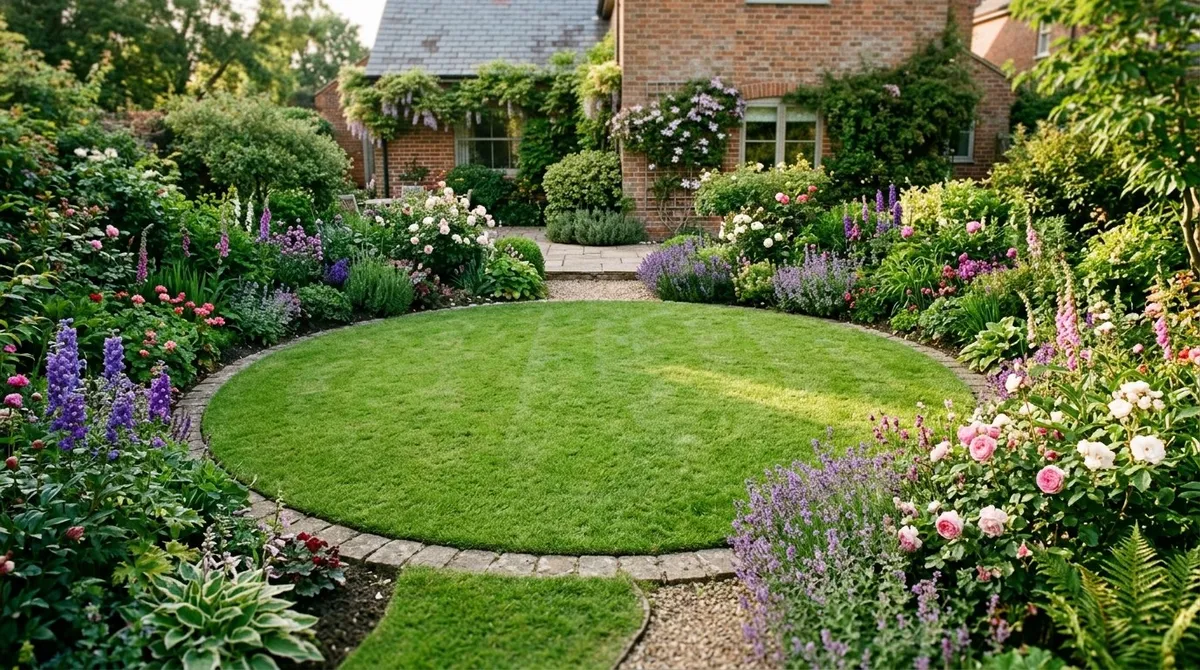
A circular lawn can soften a square garden and create deeper corner beds. It works best when the circle is large enough for practical mowing and positioned around paths, doors and the main view from the house.
Why a circular lawn works in a UK garden
The appeal is more than fashion. A circle changes how a space reads.
A circle is not right for every garden. On a very long, thin plot a single circle can look stranded. There, a chain of circles works better, which we will come to.
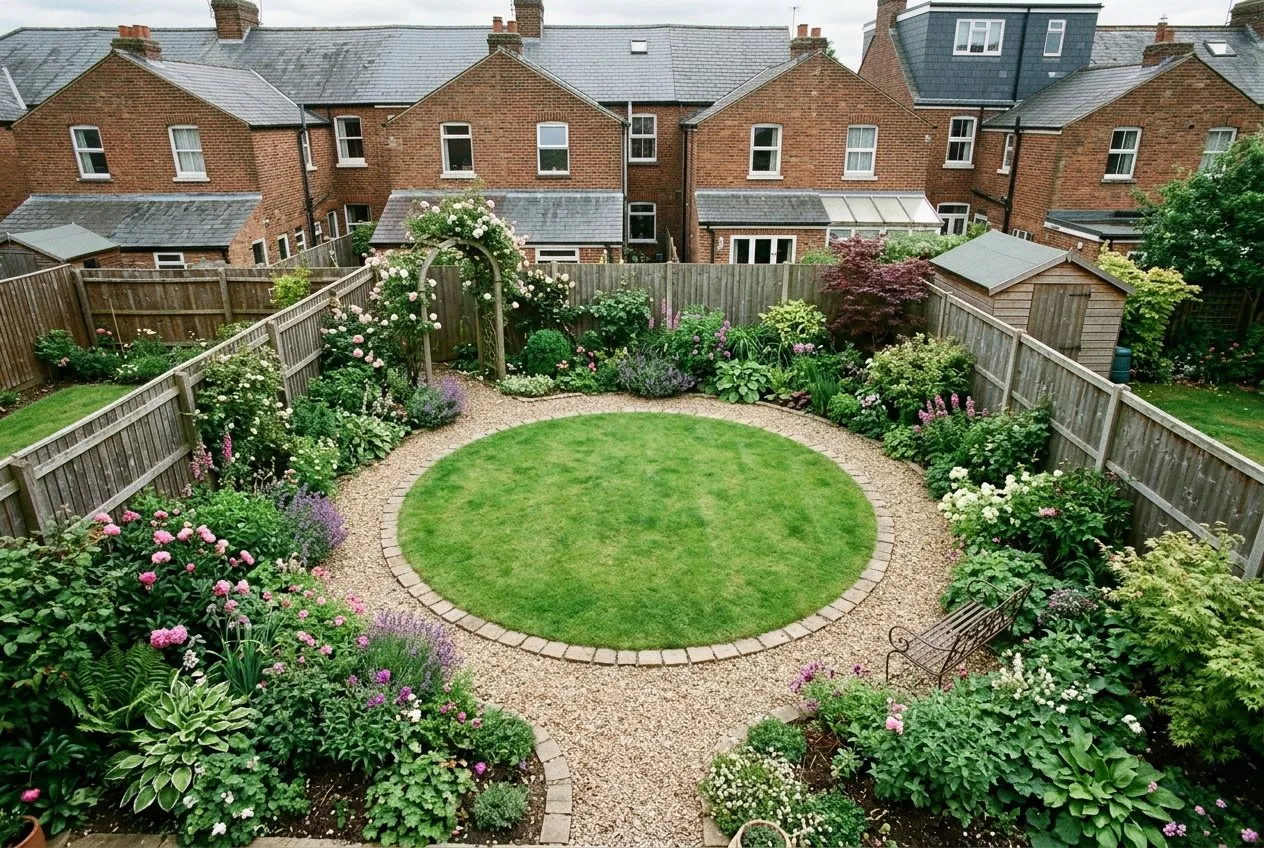 A circle turns the four corners of a square plot into deep, plantable borders and draws the eye away from the boundary fences.
Eight circular lawn ideas
There is more than one way to use a circle. Pick the one that suits your plot.
- The classic central circle. A single circle set in the middle of a square garden, wrapped by borders on all four sides. The simplest and most effective.
- The offset circle. Push the circle to one side or corner. The asymmetry feels modern and leaves one deep bed for a statement tree or seating area.
- Overlapping circles. Two circles meeting in a figure-of-eight suit a larger garden, creating two linked lawn spaces and a pinch-point for an arch or planting.
- The circle as a rug. Set a turf circle into paving or gravel, like a green rug on a hard floor. Works well in a courtyard or city garden.
- A chain of circles. Two or three circles down a long thin garden break the corridor effect and slow the journey down the plot.
- The circle with a focal centre. Place a sundial, birdbath, urn or single specimen tree dead centre so the lawn frames it.
- The sunken or raised circle. Drop or lift the circle a step to add a sense of a separate room, useful on a sloped garden.
- The keyhole circle. A circle with a narrow grass or paved path leading into it, framing the lawn like a secret space.
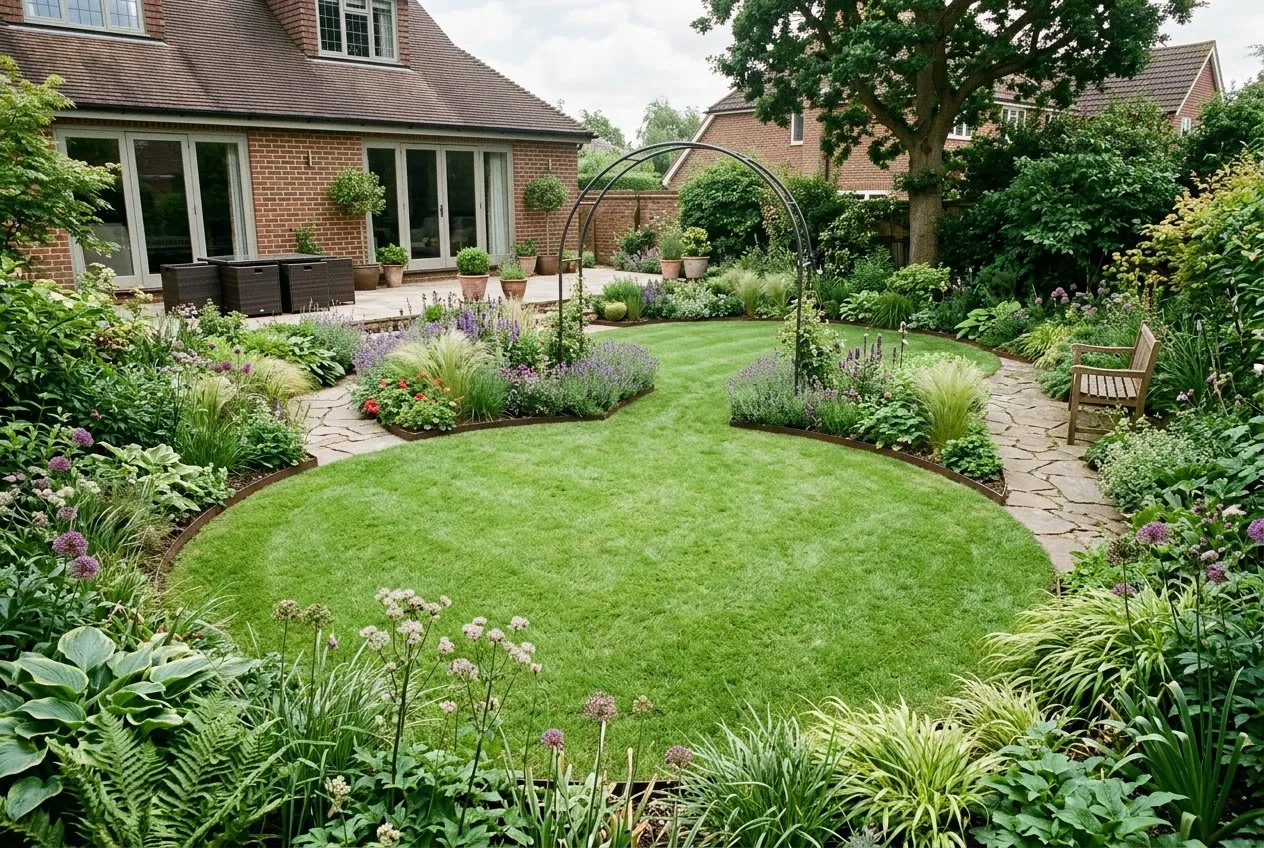 Overlapping circles suit a larger plot, making two linked grass spaces with a natural pinch-point for an arch or specimen planting.
Getting the proportions right
A circle only works if it sits comfortably in the space. Two numbers matter.
The diameter should be roughly two-thirds the width of the garden. In a 9m-wide plot, that is a 6m circle. Smaller than half the width and the lawn looks mean; much bigger and the borders vanish.
The border depth around the circle should be at least 1.2m, and 1.5m is better. Deep borders are what make the design sing, because they hold real planting that hides the fences. Thin borders leave you with a circle marooned in bare edges. This is the single most common mistake, and it is easy to avoid at the marking-out stage.
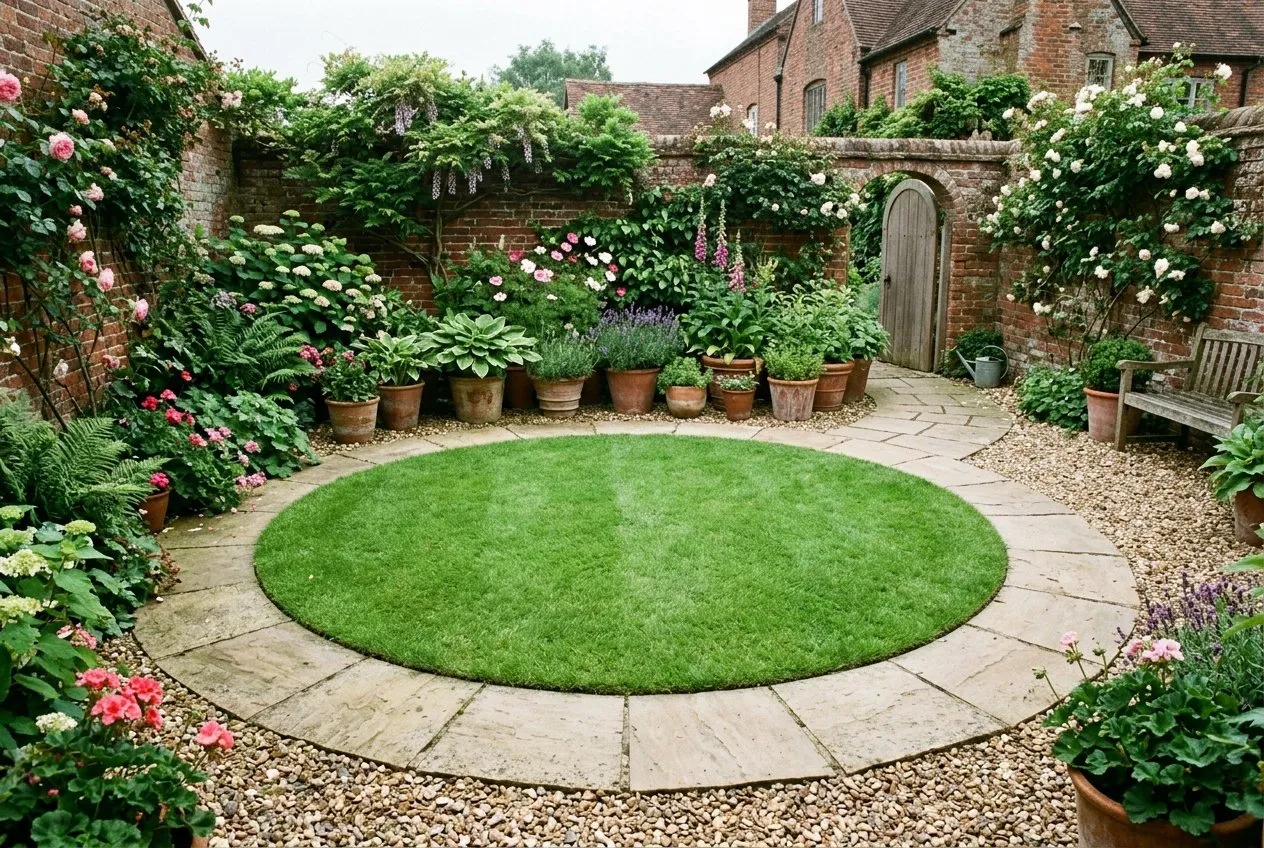 In a courtyard, a turf circle set into paving works like a green rug. The hard surround does the framing the borders would do in a larger plot.
How to mark out a circular lawn
You need a peg, a length of string, a bag of dry sand and a half-moon edging iron. The method is the same one used to scribe a circle with a compass, scaled up.
- Find the centre. Decide where the middle of the circle sits and drive a peg in firmly.
- Set the radius. The radius is half the diameter. For a 6m circle, that is 3m. Tie a loop of string to the peg exactly 3m out.
- Scribe the circle. Hold a bottle of dry sand or a marker at the taut string end and walk slowly around the peg, trickling sand to mark the line. Keep the string tight throughout.
- Cut the line. Cut along the sand line with the half-moon iron, then lift the turf outside (to make beds) or lay fresh turf inside, as our guide to laying turf explains.
- For irregular shapes, lay a garden hose on the ground first and adjust it by eye until the curve looks right, then mark along it. Use this for offset and overlapping designs.
To work out how much turf you need, multiply the radius squared by 3.14. A 3m radius gives about 28 square metres. Add 5% for the curved trimming.
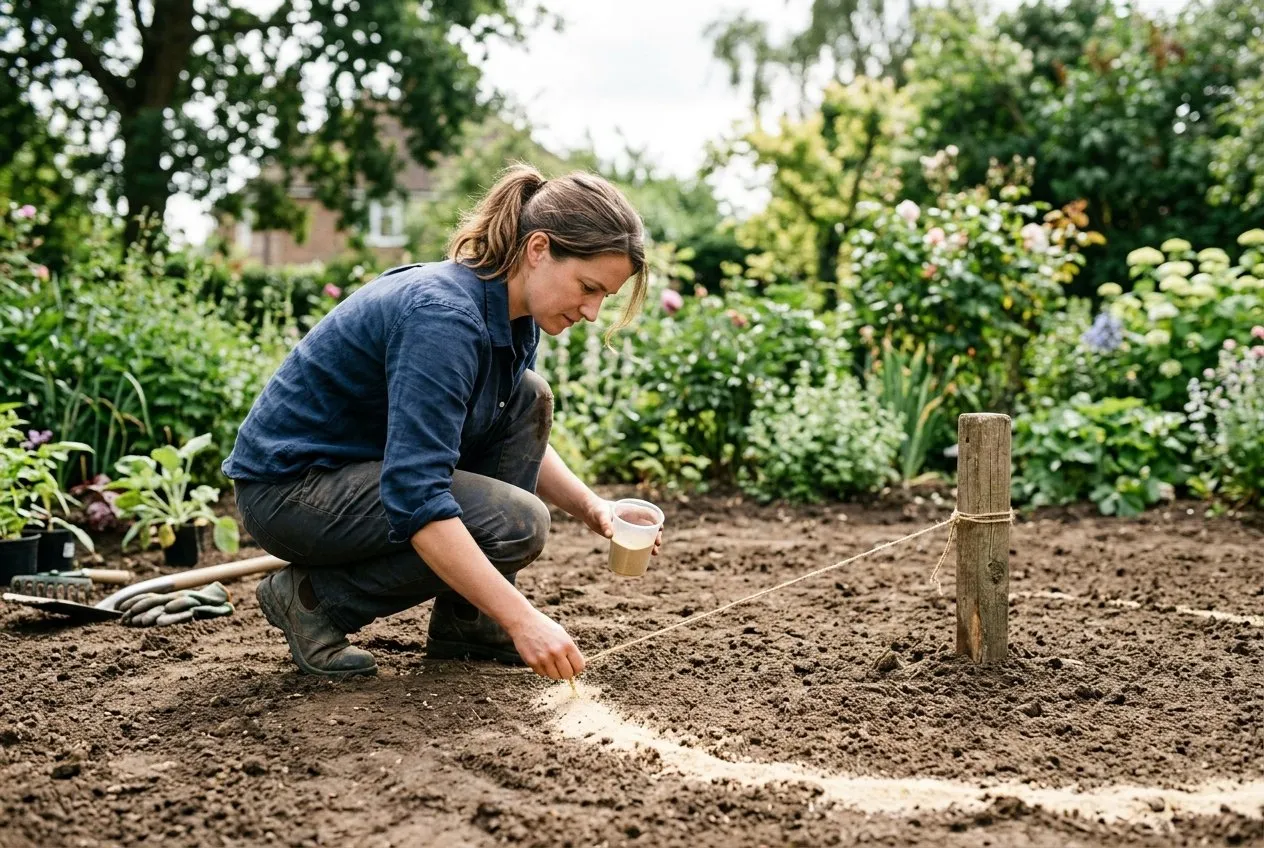 The peg-and-string method scribes a perfect circle. Keep the string taut and trickle sand to mark the line before cutting.
Choosing the edging
The edge is what separates a smart circle from a scruffy one. These are the options, ranked for a crisp, low-maintenance result.
| Edging | Look | Durability | Rough cost | Mowing |
|---|---|---|---|---|
| Steel or Corten edging | Clean, modern, bends to a true curve | 20 years plus | £18-40 per m | Run mower wheel along it |
| Brick on edge | Traditional, warm | 25 years plus | £15-30 per m | Flush mowing strip, no trim |
| Granite setts | Characterful, period | 30 years plus | £25-45 per m | Flush, occasional weed |
| Timber or log roll | Cheap, rustic | 5-8 years | £8-15 per m | Hard to curve tightly |
| No edge, cut turf only | Natural, free | Needs re-cutting | Free | Re-cut the edge each spring |
Why a flush mowing strip helps: A brick, stone or steel edge set level with the turf gives the mower wheel a firm route around the curve. It also makes the circle easier to keep crisp without frequent re-cutting.
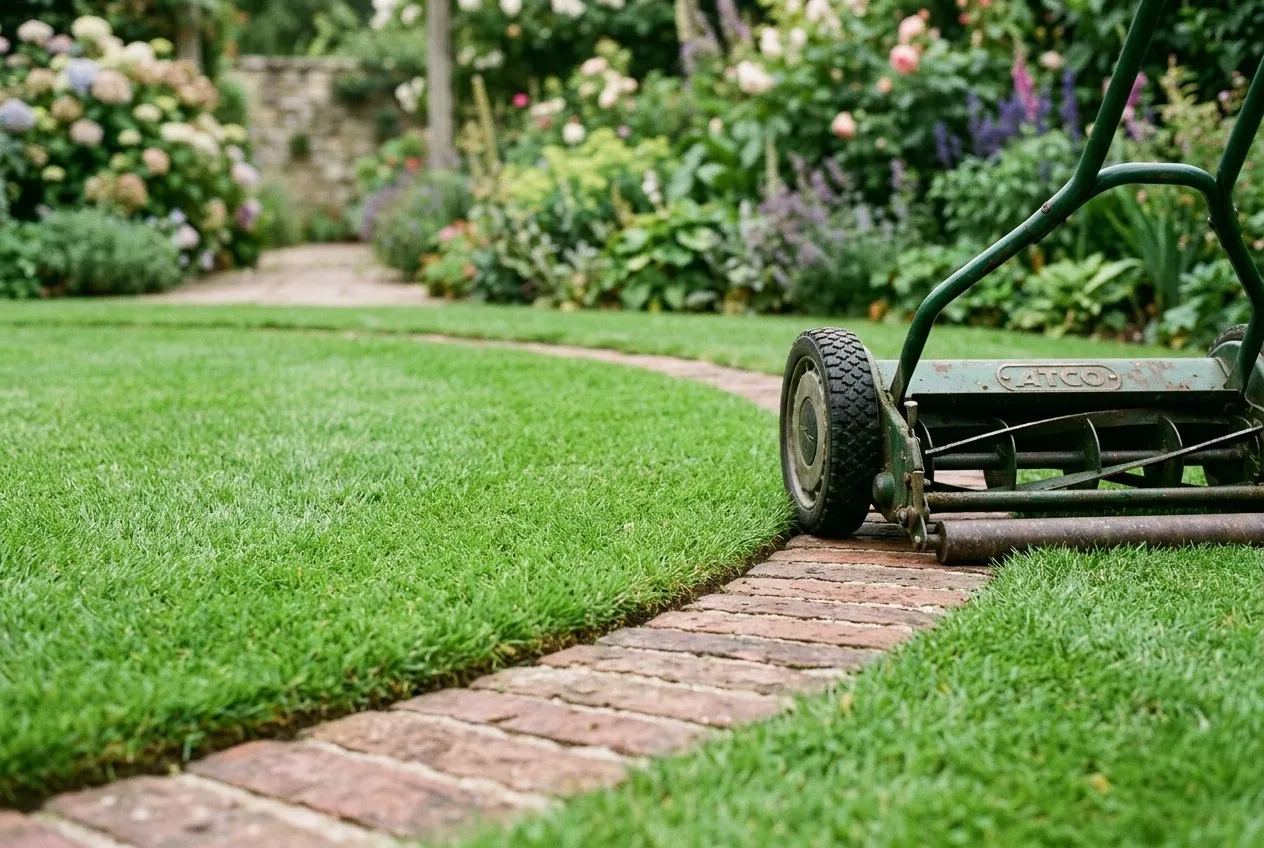 A brick or steel strip set flush with the turf lets the mower wheel run along the rim, so the curved edge never needs hand-trimming.
Mowing and maintaining a circular lawn
A circle is mown differently from a rectangle. Forget back-and-forth stripes; they leave ragged scallops where the straight passes meet the curve.
Instead, mow in concentric rings, starting at the outer edge and working in, or run one slow continuous spiral from the rim to the centre. Both follow the curve and give a clean finish. You can still get a striped effect of sorts, in rings rather than lines, and our guide to lawn stripes without a roller shows how. Keep the lawn edging crisp and the whole design stays sharp. The RHS lawns advice is a good general reference for keeping the grass itself healthy.
A circular lawn project timeline
| Stage | Job |
|---|---|
| Plan | Measure the plot; set diameter at two-thirds the width; sketch on paper |
| Mark out | Peg and string the circle; check border depth is 1.2m or more |
| Edge | Install steel or brick mowing strip to the marked line |
| Lay or cut | Lay turf inside the circle, or cut the existing lawn to shape |
| Plant | Fill the deep corner borders to hide the boundaries |
| Maintain | Mow in rings, re-cut or weed the edge, feed the grass in spring |
Common circular lawn mistakes
- Borders too thin. A circle crammed against the fences leaves no room to plant. Keep borders at least 1.2m.
- No edging strip. A cut-turf edge looks ragged by midsummer and needs constant re-trimming.
- Wrong proportion. A circle under half the garden’s width looks lost. Aim for two-thirds.
- Mowing in straight lines. This scallops the curve. Mow in rings or a spiral instead.
- An empty centre with nothing else. A circle wants either a clear focal point or rich surrounding borders, ideally both.
Get the proportions and the edge right and a circular lawn is one of the most transformative, low-cost changes you can make to a square garden.
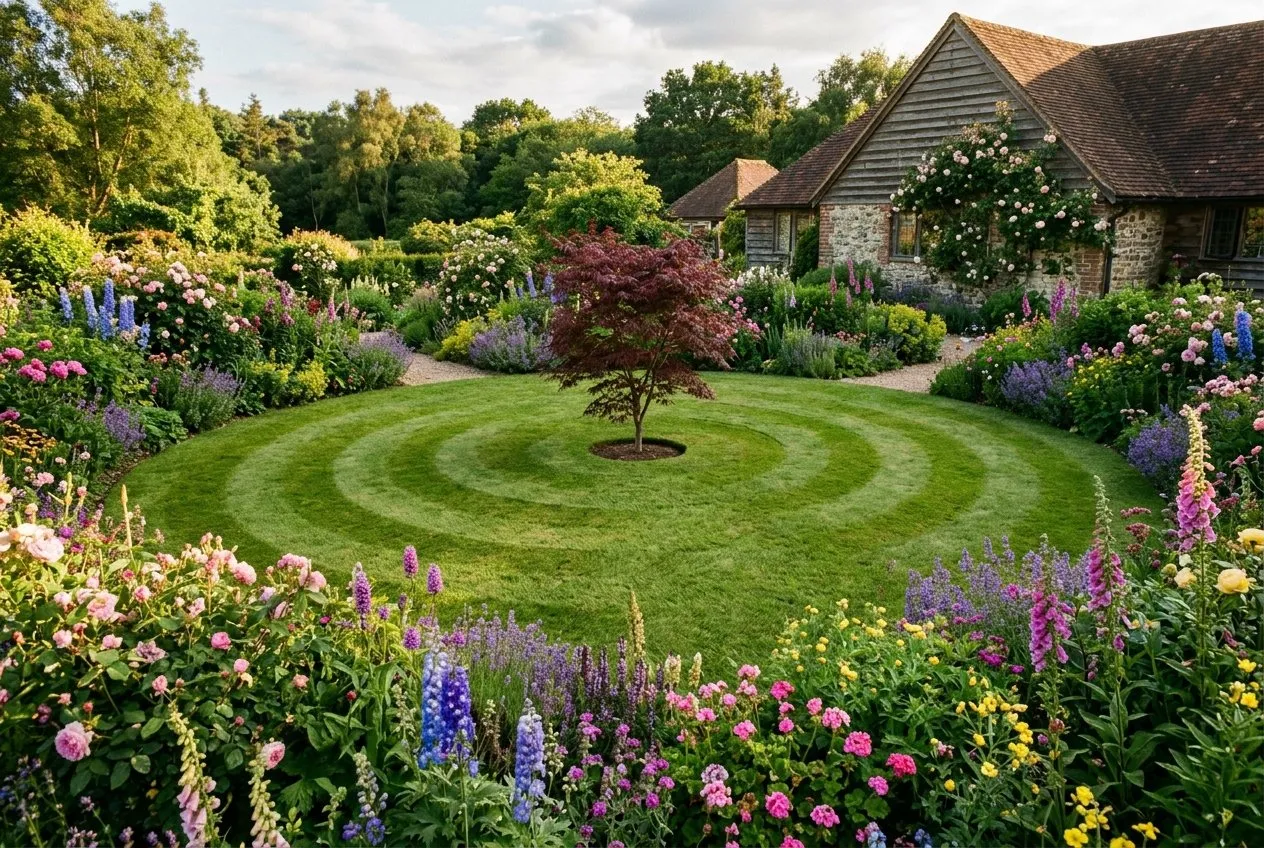 The finished result: a circle mown in rings, framed by deep planting, with a focal tree at the centre drawing the eye in.
Now you have the shape, browse more small garden design ideas to plan the borders around it, and read our guide on how to cut a flower bed into a lawn for the neatest way to carve out the curves.
Frequently asked questions
Why choose a circular lawn over a rectangular one?
A circular lawn softens a square or boxy garden and makes it feel larger. The curve hides the straight boundaries, draws the eye to a central focal point, and turns the corners into deep planting beds. It suits small and awkward plots especially well.
How big should a circular lawn be?
Make the diameter about two-thirds of the garden’s width. In a 9m-wide plot that is roughly a 6m circle, leaving borders about 1.5m deep. A circle squeezed too close to the fences leaves borders too thin to plant well.
How do you mark out a circular lawn?
Drive a peg at the centre and attach string cut to the radius. Keep the string taut while marking the circumference with dry sand. Use a hose first if you want to compare several positions before cutting turf.
How much turf does a circular lawn need?
Multiply the radius squared by 3.14. A 6m diameter circle has a 3m radius, so it needs about 28 square metres of turf. Add 5% for trimming and shaping the curved edge. Turf costs roughly £3 to £7 per square metre.
What is the best edging for a circular lawn?
Steel edging and brick on edge give the crispest, longest-lasting curves. Set them flush as a mowing strip so the mower wheel runs along the edge. Flexible steel bends to a smooth circle; bricks need a haunching of mortar to hold the curve.
Our team produces practical UK gardening guidance from source research, contributor records and established horticultural practice. Editorial standards are overseen by Matt W.