Key takeaways
- Use two or three colour movements across a border, not one of every flower colour
- Repeat plants in groups of three, five or seven so the design reads as connected
- Plan three height layers, but break the pattern with a few upright accents
- Give spring bulbs, summer perennials and autumn seedheads separate jobs
- Match plants to the soil and light before choosing them for colour
- A 2m x 4m border can hold about 24 perennials plus 50 bulbs
Gertrude Jekyll made borders feel generous without letting them become muddled. Her method was planned, but it never looked stiff. Colour moved through the planting. Shapes repeated. Different areas took their turn across the year.
That approach still works in an ordinary UK garden. You do not need a historic estate or a long double border. You need a clear sequence, plants suited to the site and enough repetition to hold everything together.
The seven lessons below turn Jekyll’s documented ideas into a practical 2m x 4m border. The images are modern editorial illustrations. They show the principles, not Munstead Wood or another historic garden.
Who was Gertrude Jekyll?
Gertrude Jekyll was an artist, craftswoman, writer, plantswoman and garden designer. She was born in 1843 and began studying art in 1861. Her visual training shaped the way she handled colour and composition in gardens.
Her own garden at Munstead Wood in Surrey became a working place for ideas, plant selection and nursery stock. Jekyll also collaborated with architect Edwin Lutyens. Formal paths, walls and buildings gave her loose planting a strong frame.
The National Trust’s record of the garden at Munstead Wood describes 11 surviving acres. They contain original features, restored areas and recreated planting. The Trust is careful to distinguish what remains from later restoration.
Jekyll’s own writing is equally useful. A digitised edition of her colour book shows how closely she observed plants, neighbouring colours and the garden year.
This article borrows the method, not a fixed historic plant list. Modern gardens have different sizes, soils and maintenance limits.
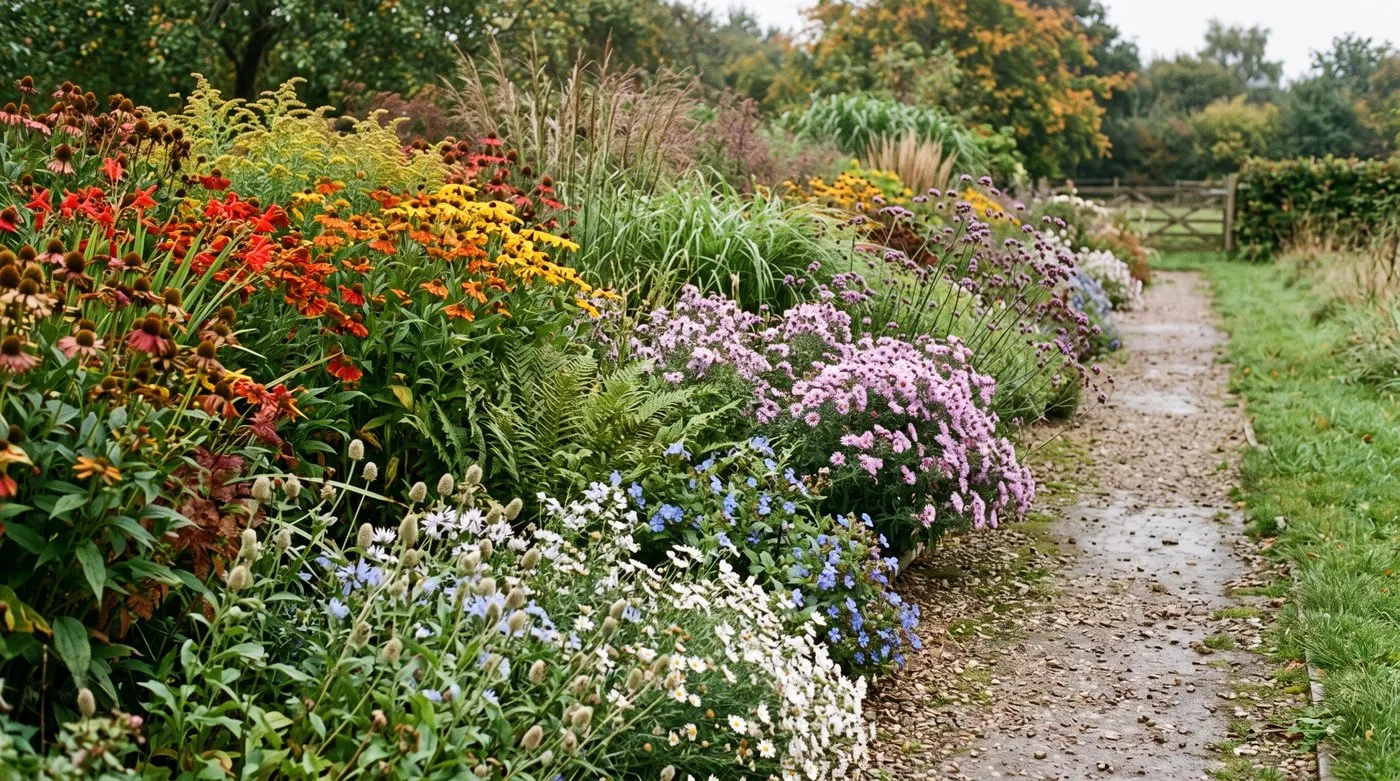 Editorial illustration: warm flowers move towards cooler mauves, blues and whites along a modern border.
Lesson 1: plan colour as a journey
Jekyll used colour as movement rather than decoration. At Munstead Wood, the main border shifted from cool whites and blues towards stronger reds, oranges and yellows. A visitor experienced changing effects while walking beside it.
The important idea is not the exact palette. It is the journey. A small border might move from white to blue, then mauve. Another might keep cooler ends around a warm central group.
Begin with three colour zones on paper. For a 4m border, give each outer zone about 1.2m. Reserve the middle 1.6m for the strongest colour. Let one or two plants cross the boundaries. This stops each zone looking like a separate block.
Foliage must join the sequence. Grey leaves soften a move from white to blue. Deep green steadies orange and red. Purple foliage can connect pink flowers with a darker central area.
Our guide to using colour in garden design explains harmony, contrast and how light changes colour. Choose one method and repeat it. Six competing colour ideas rarely improve a 4m border.
Gardener’s tip: Photograph the empty border in black and white. Strong shapes should still read when flower colour disappears.
Lesson 2: repeat plants in drifts
Repeated plants make a mixed border feel intentional. Jekyll used bold strokes and drifts, much as a painter repeats colour across a canvas. One plant appearing once cannot create that rhythm.
For a compact border, groups of three, five or seven usually read well. The right number depends on mature spread. A perennial reaching 60cm across needs fewer plants than one reaching 25cm.
Place the first group near one end. Repeat it two-thirds of the way along. A third, smaller echo can sit near the opposite edge. Avoid placing every repeat at equal distances. The result should feel linked, not measured with a ruler.
Use a maximum of eight main perennial types in a 2m x 4m bed. Three structural plants, three flowering drifts and two front-edge plants are enough. Bulbs can weave between them because their foliage disappears later.
This is the useful difference between abundance and clutter. Abundance comes from generous quantities of a limited plant list. Clutter comes from many individual plants fighting for attention.
The same rule supports a cottage garden planting plan. Repeat the plants you love before adding another variety.
| Border length | Main plant types | Useful group size | Colour zones |
|---|---|---|---|
| 2m | 4 to 5 | 3 | 2 |
| 4m | 6 to 8 | 3 to 5 | 3 |
| 6m | 8 to 10 | 5 to 7 | 3 to 4 |
| 10m | 10 to 14 | 5 to 9 | 4 to 5 |
Lesson 3: choose shape before flowers
A border needs shapes that remain visible between flowering peaks. The National Trust notes that Jekyll chose plants for texture, form and habit. Yuccas created upright accents among softer planting at Munstead Wood.
Think in simple silhouettes. Spires pull the eye upwards. Mounds create calm pauses. Fine grasses catch light and movement. Broad leaves stop a planting scheme becoming too wispy.
Use three height layers as a starting point:
- Back layer: plants reaching about 90cm to 150cm.
- Middle layer: plants reaching about 45cm to 90cm.
- Front layer: plants staying near 20cm to 45cm.
Do not turn those measurements into rigid steps. Bring one tall accent forward. Let a low plant travel into the middle. The border will look deeper when layers overlap.
Evergreen or persistent foliage should occupy about one fifth of a small border. That might include a compact shrub, a grass or silver foliage. Check mature size first. One oversized evergreen can swallow a 2m-wide bed.
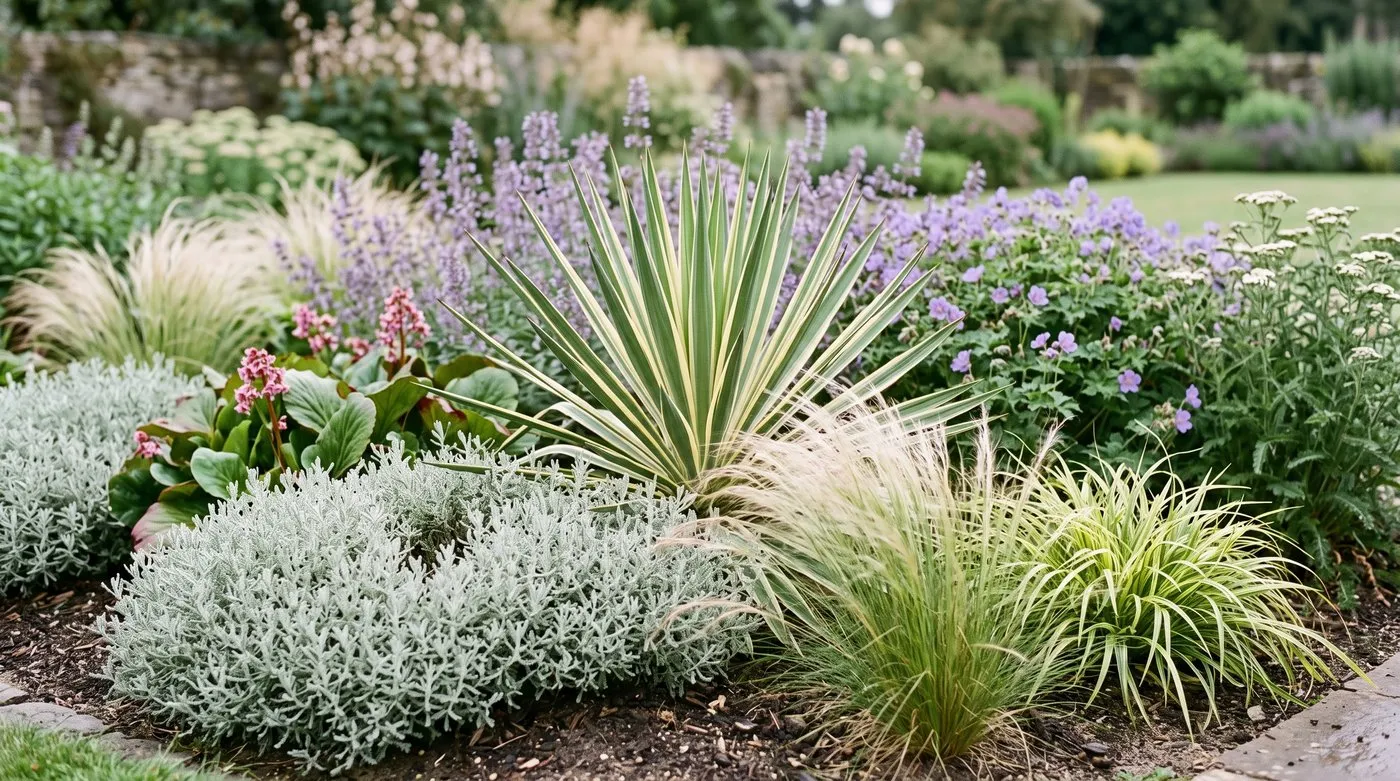 Editorial illustration: one upright accent sits among rounded silver foliage, fine grasses and broad leaves.
Lesson 4: give every season a job
A Jekyll-inspired border should not peak for only two weeks. Munstead Wood was planned as a sequence. Hellebores, daffodils and primroses began the year. Peonies, poppies and lupins followed. Roses and clematis led summer, then michaelmas daisies carried autumn.
Home borders need the same relay. Use bulbs beneath later perennials rather than keeping separate spring and summer areas. Leave selected seedheads for winter shape. A compact evergreen keeps one solid point through every month.
Plan at least two plants for each main season. They do not need to flower together. A spring bulb can disappear beneath a geranium that opens in June. An aster can rise through the same foliage in September.
The year-round interest planting guide helps fill quiet periods without adding random plants. Work from the weakest month, not the fullest nursery display.
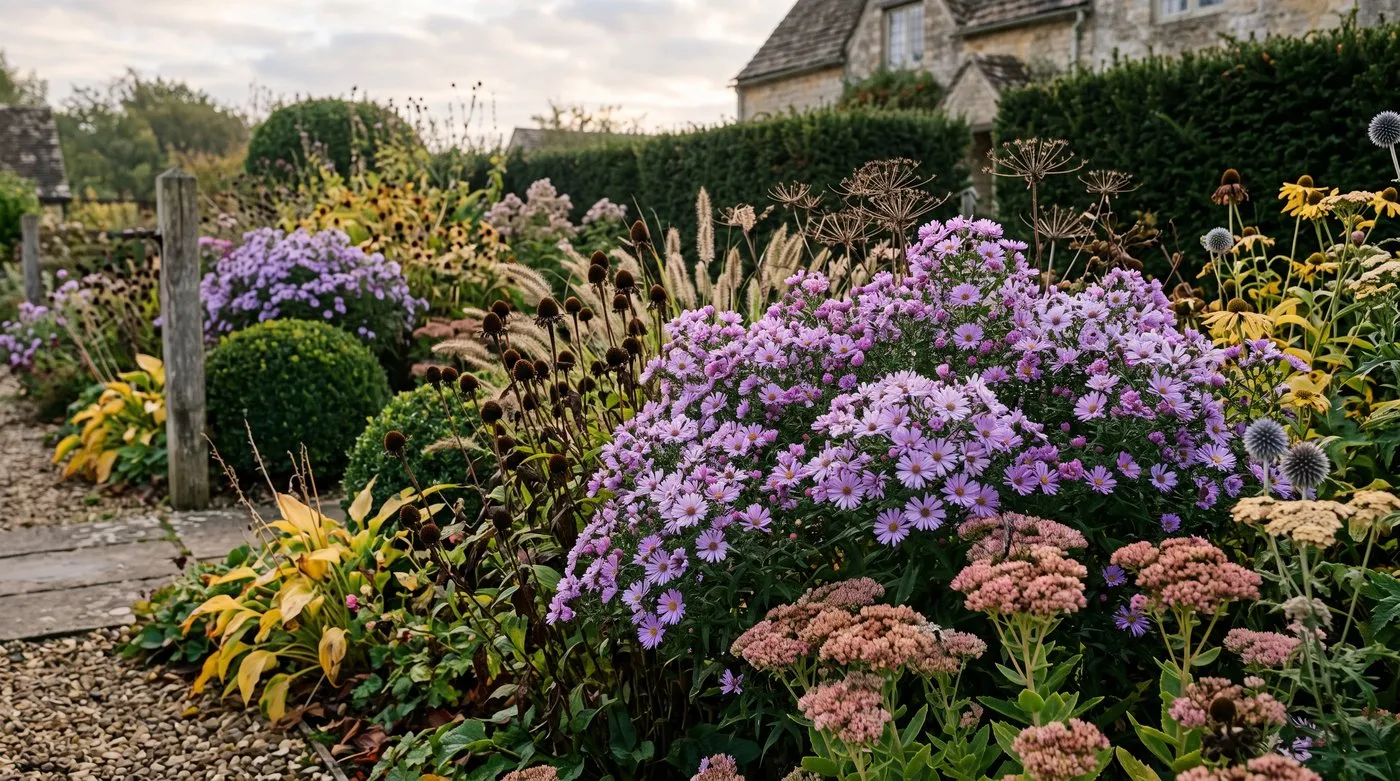 Editorial illustration: late asters, seedheads and clipped evergreens keep an early-autumn border useful.
| Season | Main job | Example plants | Work to plan |
|---|---|---|---|
| Spring | Early colour | Narcissus, tulips, hellebores | Remove damaged leaves and mark bulb gaps |
| Early summer | Build height | Geraniums, salvia, alliums | Support tall stems before they lean |
| Late summer | Carry colour | Helenium, phlox, achillea | Water new plants during dry spells |
| Autumn | Hold the finish | Asters, grasses, sedum | Divide congested clumps when suitable |
| Winter | Show structure | Seedheads, evergreen mounds | Cut only collapsed or diseased growth |
Lesson 5: frame loose planting with structure
Loose planting looks better when paths and edges are clear. Jekyll’s partnership with Lutyens joined informal plants to defined architecture. Pergolas, walls, steps and paths gave visitors a route through changing garden rooms.
You can use the same contrast at home. A straight path can sit beside a soft border. A simple timber arch can support a climbing rose. A clipped hedge can frame billowing perennials without forcing every plant into a neat shape.
One strong boundary is enough. Avoid adding an arch, raised bed, sculpture and three paving materials to the same small view. Structure should make planting easier to read.
Measure working space as well as appearance. A main path needs room for normal access and tools. Keep thorny growth away from narrow routes. Place plants with soft stems where brushing past will not break them.
The approach creates a garden room without copying a period property. Use our garden design guides to connect the border with seating, routes and views.
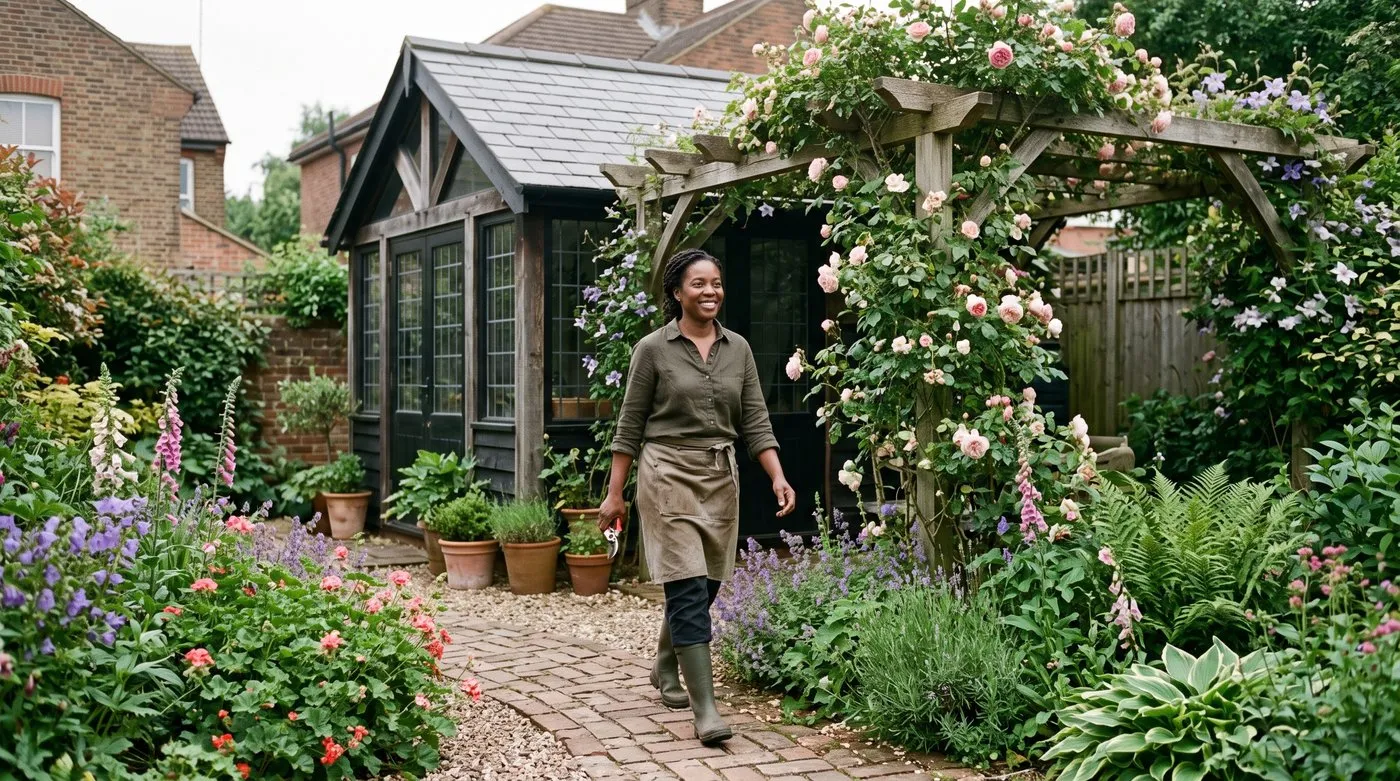 Editorial illustration: a simple pergola and brick path frame loose planting in a modern garden.
Lesson 6: match plants to the place
Jekyll observed what thrived before relying on appearance. The National Trust records her use of local heathland plants and cottage-garden plants. She also grew rosemary, santolina, iris, euphorbias and yuccas in Munstead Wood’s poor sandy soil.
That does not make those plants a universal recipe. Rosemary may struggle in a wet clay hollow. A moisture-loving plant will need constant attention in a dry raised bed.
Record four facts before choosing the palette:
- Daily summer sun exposure, noted in hours.
- Soil texture after rain and during a dry week.
- The border’s exposed or sheltered position.
- Space available at each plant’s mature size.
Then choose a plant family for the conditions. Colour comes afterwards. This order saves replacements and reduces watering.
For free-draining soil, grey foliage and Mediterranean herbs can provide structure. Moist soil may suit astilbe, primula or moisture-tolerant grasses. Shade needs foliage contrast more than a forced blaze of flowers.
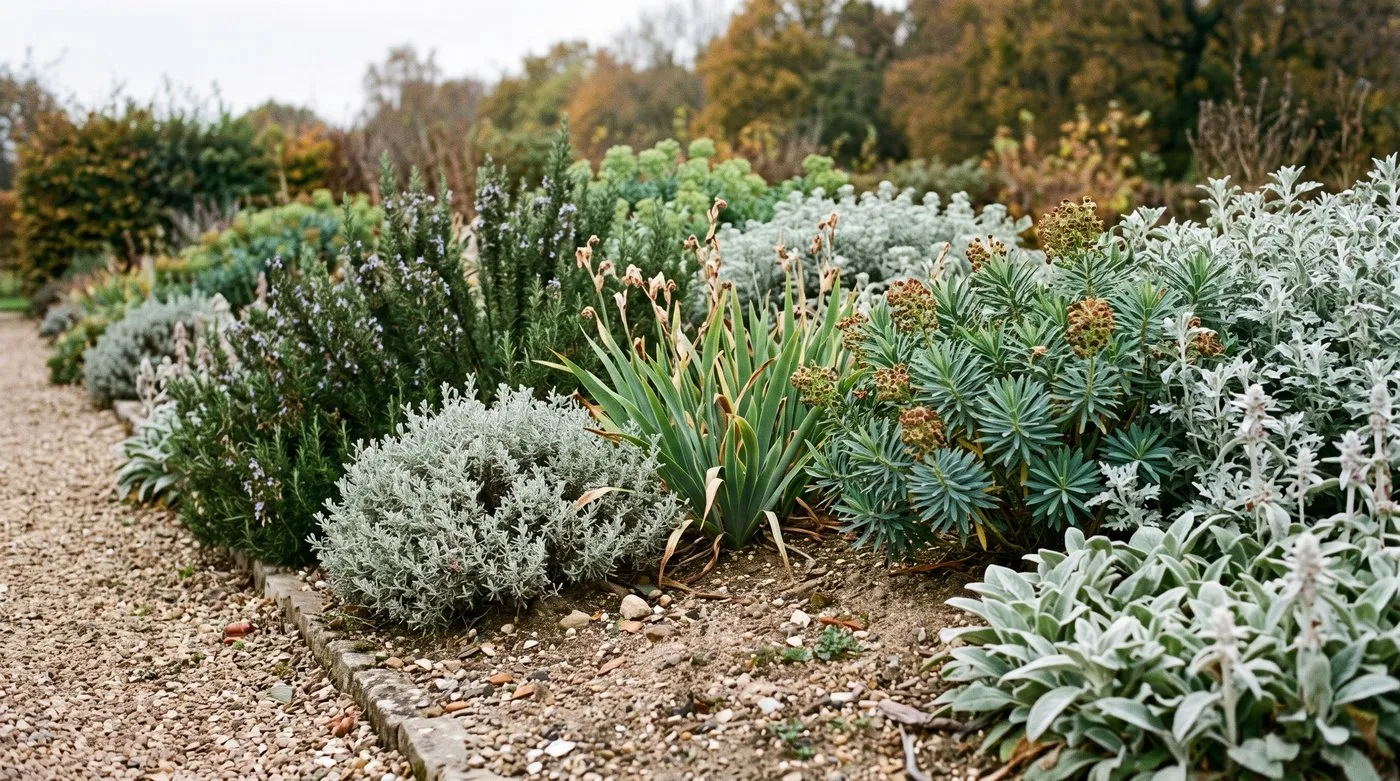 Editorial illustration: rosemary, santolina, iris and euphorbia suit this free-draining modern border.
Lesson 7: edit the border each year
A planted border is a draft, not a finished object. Jekyll compared plants and selected the best performers through patient observation. Home gardeners can do the same without pretending every choice will work first time.
Take four photographs each year. Use the same viewpoint in March, June, September and December. Mark gaps, weak groups and plants hiding their neighbours.
Move one problem at a time. Divide a successful clump and repeat it where the design feels thin. Remove a poor performer only after checking whether the cause is shade, drought or crowding.
Keep a short note beside the plan. Record flowering month, final height and any support needed. Three seasons of notes reveal more than a label written for national conditions.
Do not cut every perennial in October. Remove diseased or collapsed stems. Leave sound seedheads when they add shape or help wildlife. Our guide to plants with winter seedheads gives practical choices.
 Editorial illustration: selective autumn cutting keeps sound stems and removes growth that has finished badly.
A practical 2m x 4m Jekyll-inspired border
This compact plan uses cool ends, a warm centre and repeated shapes. It is a modern interpretation, not a reconstruction of a Jekyll border. It suits a sunny, reasonably well-drained UK bed.
Start with 24 perennials. Add 50 bulbs between them. Keep the plant list short enough for repeated groups.
| Layer | Quantity | Plant role | Example choices |
|---|---|---|---|
| Back | 3 | Upright structure | Calamagrostis or another suitable clump-forming grass |
| Back and middle | 5 | Warm central drift | Helenium or achillea in orange and rust tones |
| Middle | 6 | Cool repeated drift | Blue salvia, catmint or hardy geranium |
| Front | 6 | Soft edge and foliage | Stachys, low geranium or heuchera |
| Accents | 4 | Contrasting shape | Iris, allium or another upright plant |
| Between perennials | 50 bulbs | Spring and early-summer relay | 25 narcissus and 25 alliums in small groups |
Place the three grasses in a loose triangle, not a straight row. Keep the warm plants near the middle. Split the cool plants between both ends and one smaller central echo.
Set the front layer in several linked groups. Do not draw one continuous edging strip. Leave narrow gaps where bulbs can emerge and paths remain visible.
Check every mature spread before planting. The quantities assume average spacing near 35cm to 60cm. A 90cm-wide plant changes the plan.
Water the bed thoroughly after planting. During the first growing season, check new plants during dry weather. Add a 5cm mulch layer once the soil is moist, keeping mulch away from crowns.
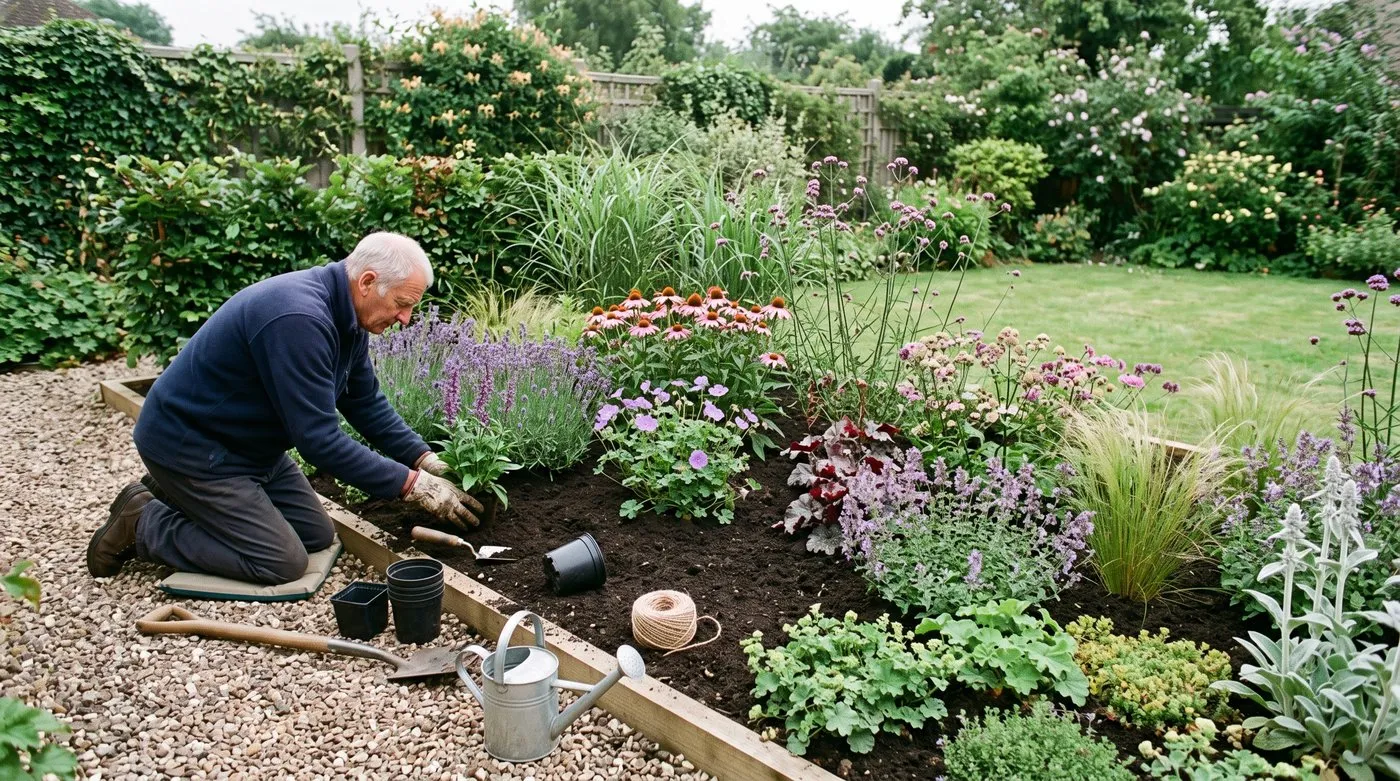 Editorial illustration: a compact border uses repeated groups, overlapping layers and room for plants to mature.
For more pairing ideas, use our guide to plant combinations for UK borders. Match its suggestions to your soil and light.
Common mistakes with a Jekyll-inspired border
The usual mistakes come from copying the look without the discipline. Her borders appeared relaxed because colour, repetition and structure had already been considered.
Buying one of everything
One-off plants create isolated dots. Buy fewer types and repeat them. A group of three modest plants usually reads more clearly than three unrelated specimens.
Choosing colour before conditions
A perfect palette fails if the plants dislike the site. Check sun, drainage and mature size before narrowing the colour range.
Expecting every month to look full
Seasonal succession includes quieter moments. Give each period one useful feature rather than forcing constant peak flower.
Making height bands too rigid
Three neat steps look flat. Let selected tall plants move forward and allow lower plants to travel between larger clumps.
Copying Munstead Wood plant for plant
Historic planting belongs to its soil, setting and management. Borrow the reasoning. Build a plant list for your own garden.
Frequently asked questions
What was Gertrude Jekyll’s garden style?
Her style joined formal structure with loose, carefully planned planting. She used colour movements, repeated drifts, foliage contrast and seasonal succession. The result looked natural without being random.
How did Gertrude Jekyll use colour?
She treated plants like colours on a painter’s palette. At Munstead Wood, cool whites and blues moved towards hotter reds, oranges and yellows in the border’s centre.
Can Gertrude Jekyll’s ideas work in a small garden?
Yes, the method scales down well. Use fewer plant types, repeat each one and create one clear colour movement across a compact border.
Which plants suit a Gertrude Jekyll-style border?
Choose plants that suit your site first. Perennials, bulbs, grasses, small shrubs and one or two upright accents can all fit the method.
How many plants fit in a 2m x 4m border?
About 20 to 28 perennials will usually fit. Final numbers depend on each plant’s mature spread, so check labels before buying.
Start with a measured sketch, then use our low-maintenance planting guide to keep the finished border manageable.
Our team produces practical UK gardening guidance from source research, contributor records and established horticultural practice. Editorial standards are overseen by Matt W.