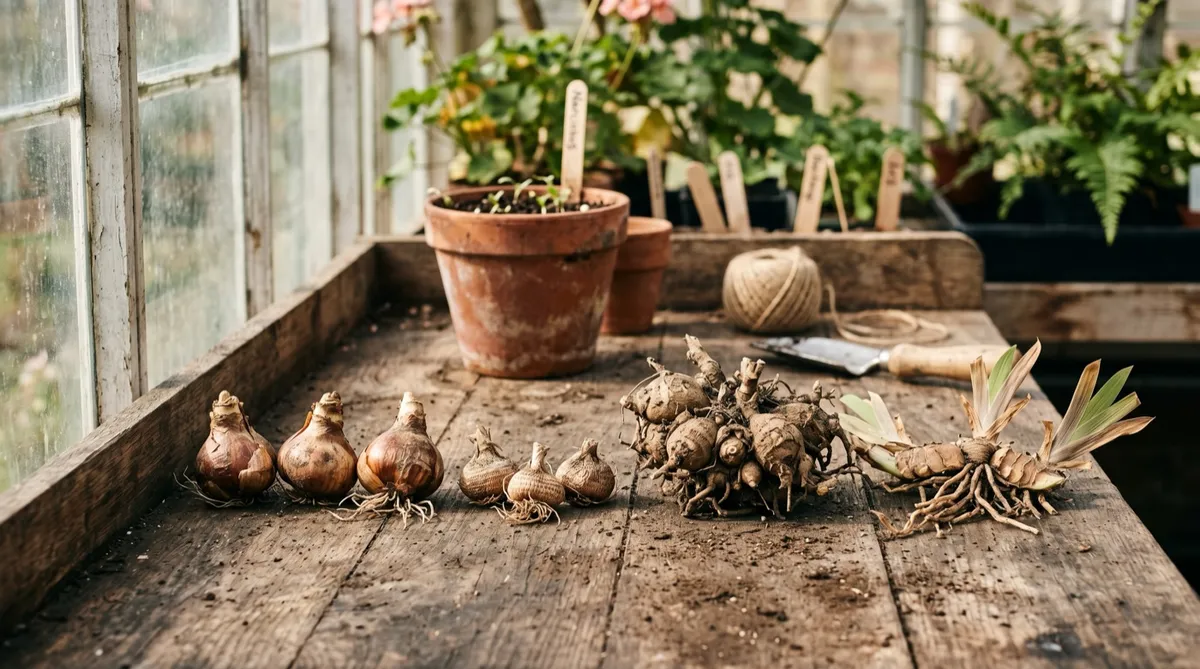
Key takeaways
- All four are geophytes: underground organs storing food for dormancy
- True bulbs have layered scales; corms are solid; tubers have eyes; rhizomes run sideways
- Plant most at 2-3 times the organ's own height, growing point up
- Bearded iris rhizomes are the exception: sit them half-exposed on the surface
- Tender types like dahlias and gladioli need lifting before the first frost, below 5C
- Clumps multiply via offsets, cormels, eyes or division over 2-4 seasons
Bulbs, corms, tubers and rhizomes confuse almost every gardener at some point. They all look like lumpy underground packages, they all get sold loose in net bags, and the planting instructions rarely explain which way up they go. Yet getting them wrong wastes money and a whole season. This guide explains what each one is, how to tell them apart on the potting bench, how deep and which way up to plant them, and how each multiplies so you can split a clump into free plants. Master the four and almost every flowering bulb you will ever buy makes sense.
The shortcut is to look at the structure. A true bulb has visible layers, a corm is solid, a tuber carries eyes, and a rhizome runs sideways. Once you can read the organ in your hand, the planting decisions follow.
What geophytes are and why the type matters
All four organs share one job: they are geophytes, plants that retreat into a swollen underground store to survive heat, cold or drought, then push out fresh growth when conditions improve. The botanical term covers anything that hides its growing point below ground in a food-packed organ. A daffodil dies back in June and lives on as a bulb until autumn roots and a spring shoot break dormancy.
The type matters because it dictates three practical choices: which way up you plant, how deep, and how you propagate. A tulip bulb planted upside down still flowers but wastes energy righting itself. A bearded iris rhizome buried like a bulb rots within a season. Knowing the organ removes the guesswork. The differences also explain why some clumps spread fast and others barely increase, which changes how often you lift and split.
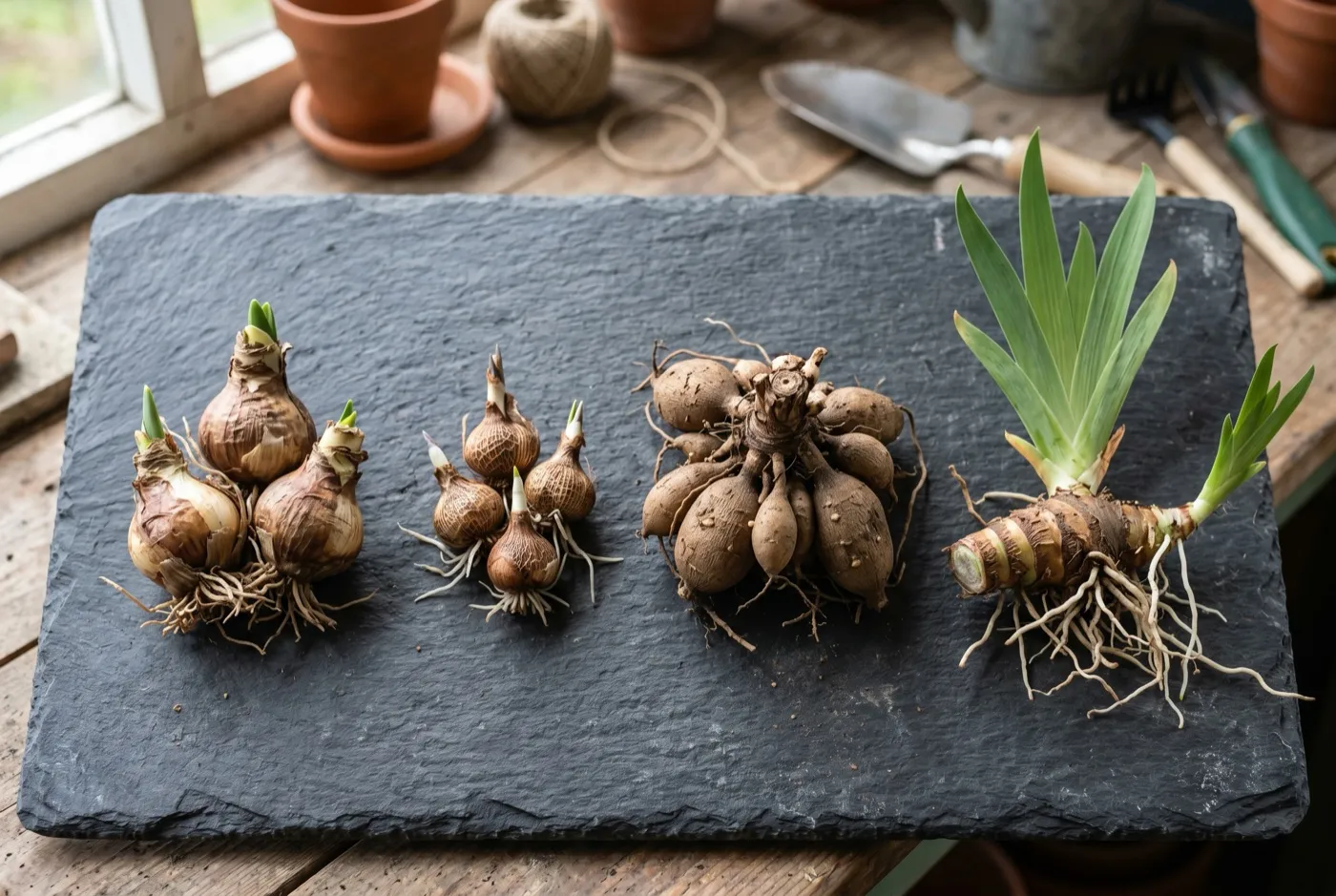 Four geophytes side by side: layered daffodil bulbs, solid crocus corms, a knobbly dahlia tuber clump, and a flat iris rhizome.
How a true bulb is built and which way up it goes
A true bulb is a complete plant in miniature. Slice a daffodil in half and you see concentric scales, which are modified leaves swollen with food, wrapped around a central growing point. They all sit on a flat basal plate at the bottom, the compressed stem from which the roots emerge. The pointed tip at the top is next year’s shoot, which is why bulbs go pointy end up.
Bulbs split into two kinds. Tunicate bulbs wear a dry papery skin, the tunic, that protects them in storage: daffodils, tulips, onions, alliums and hyacinths are all tunicate. Imbricate bulbs, mainly lilies, have no tunic and loose, fleshy scales that you can pull apart like an artichoke. These dry out fast, so lilies are sold and planted promptly rather than stored dry for months.
Gardener’s tip: If a bulb has lost its tunic and feels soft or shows blue mould, do not plant it. A firm, heavy bulb the size of a golf ball flowers; a light, spongy one of the same size has rotted inside and never will.
How to tell a corm from a bulb
A corm looks like a bulb from the outside but is solid all the way through. Cut a crocus corm in half and you find no layers, just a uniform mass of swollen stem tissue. That solid interior is the quickest way to separate a corm from a bulb on the bench. Corms wear a fibrous or netted tunic, with one or more growing points on top.
The clever trick is how a corm renews itself. The plant uses up the old corm entirely through the growing season, then forms a brand new corm directly on top of the spent one, plus a cluster of tiny cormels around the base. Lift a gladiolus in autumn and you find a fat new corm sitting on a shrivelled brown disc, the remains of the one you planted. Those cormels grow on to flowering size in two to three seasons.
Common corms include crocus, gladiolus, freesia and crocosmia. Plant them flattish, growing point up, at two to three times their height. Crocus go in shallow at 5-7cm, while a large gladiolus corm sits at 10-15cm for stability against wind.
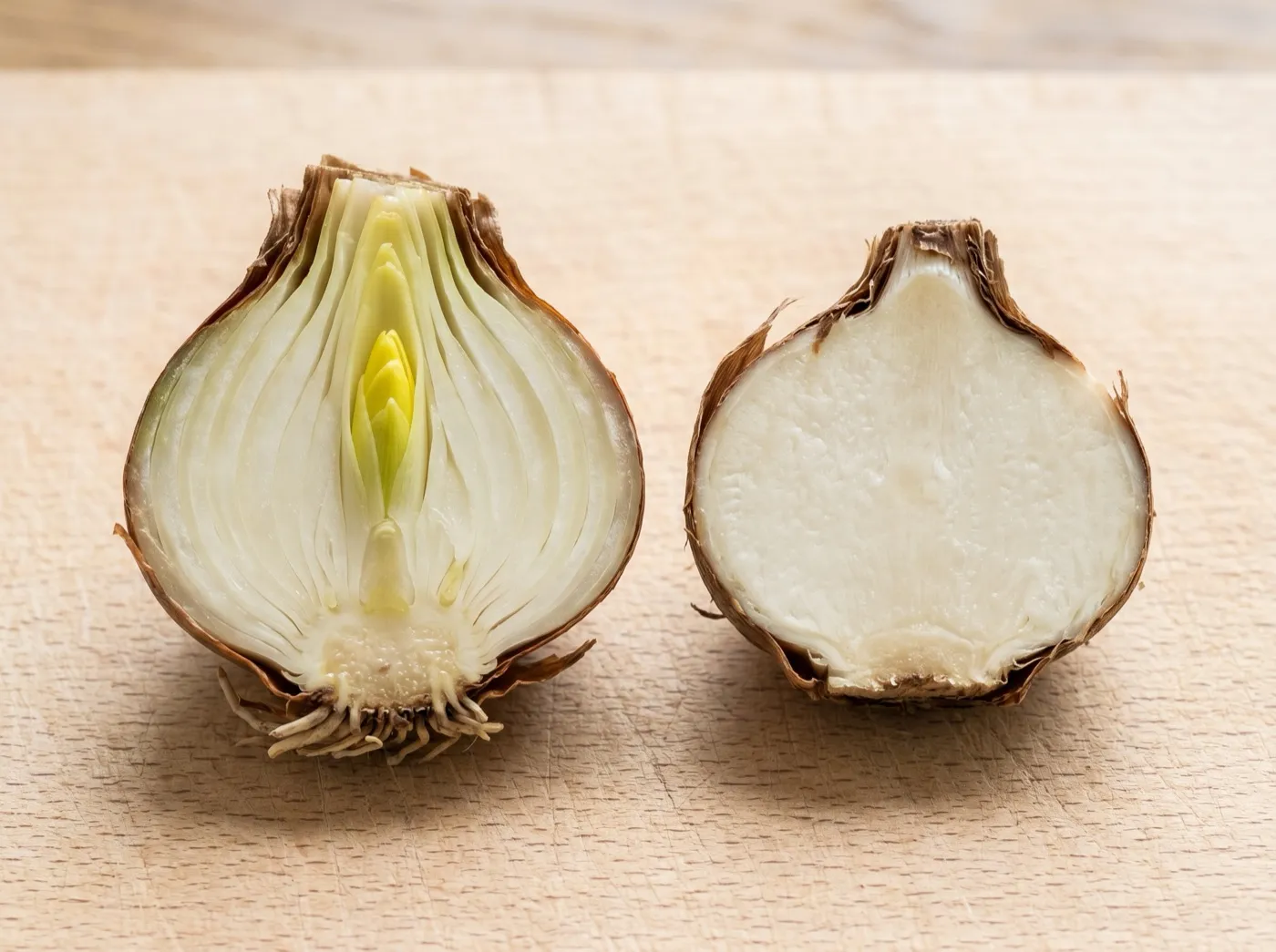 The diagnostic test: a daffodil bulb (left) shows onion-like layers, while a crocus corm (right) is solid stem tissue throughout.
How tubers differ and why dahlia orientation matters
A tuber is a swollen stem or root used for storage, and the key feature is that it carries growing eyes, or buds, scattered over its surface rather than on a single basal plate. A seed potato shows this best: the eyes are the dimples that sprout. Tubers have no tunic and no layers.
Stem tubers form from swollen underground stems and carry eyes across the whole surface. Begonias, cyclamen and anemones fall into this group. Root tubers are swollen roots, and the dahlia is the classic. This is where orientation catches people out. A dahlia tuber only has eyes at the crown, the old stem base, never along the fleshy root. Plant a dahlia with the crown uppermost, 10-15cm deep, and never split off a tuber without a slice of crown attached or it will never shoot.
Anemone and ranunculus corms-tubers confuse everyone because they look like dried twigs. Plant ranunculus claws pointing down. Anemone tubers give no clear clue, so soak them for a few hours and plant on the side. Eremurus is another oddity here: its fleshy roots splay out like a starfish from a central crown, and our guide to growing foxtail lilies shows how to spread them flat on a bed of grit so the crown does not rot. For the spring display they create, our guide on bulb lasagne planting for year-round colour layers tubers and bulbs in one pot.
Warning: Never let dahlia or begonia tubers freeze. They turn to mush at the first hard frost. Lift them once the foliage blackens, dry them off for a week, then store in dry compost at 5-10C until spring.
How a rhizome grows and why iris sits on top
A rhizome is a swollen stem that grows horizontally at or just below the soil surface, not down into it. It pushes sideways through the ground, sending up shoots from nodes along its length and roots from the underside. Mint, lily of the valley, canna, bamboo and bearded iris all spread this way, which is why some of them turn invasive.
The bearded iris is the rhizome that breaks every normal planting rule. It must sit with the top of the rhizome half-exposed on the soil surface, baking in sun, with the roots tucked underneath. Bury a bearded iris rhizome like a bulb and it rots and refuses to flower. The sun on the rhizome top ripens it to set next year’s bloom. Our full guide on how to grow iris covers spacing and the dividing schedule.
Rhizomes multiply simply by spreading and dividing. Each season the rhizome lengthens and branches, so you lift the clump, snap off vigorous outer sections each with a fan of leaves, and discard the woody centre. The Royal Horticultural Society’s advice on bulbs and rhizomes sets out the same surface planting for iris.
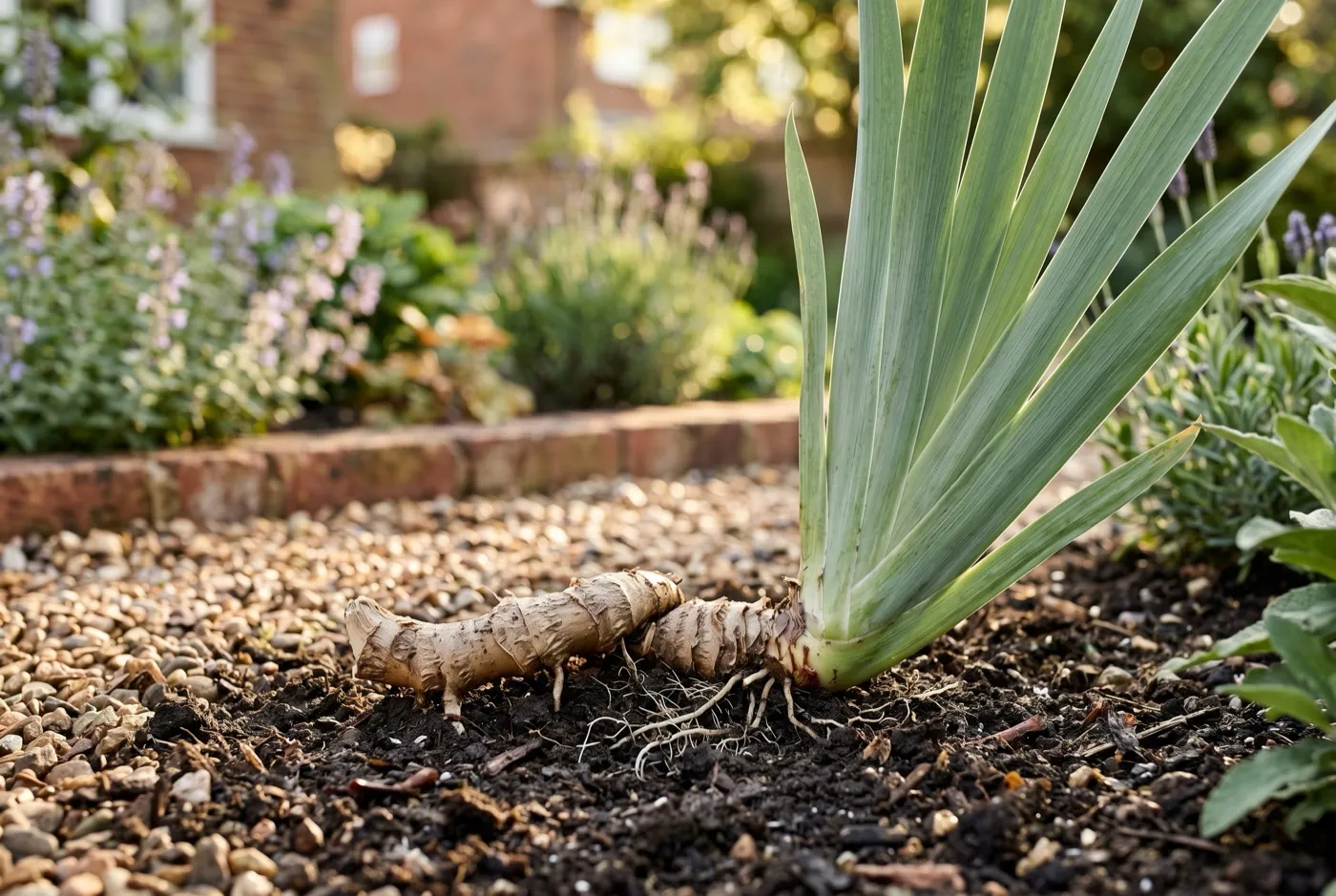 A bearded iris rhizome planted correctly: the top sits exposed to the sun, only the roots go below ground.
Bulb, corm, tuber and rhizome comparison table
Use this table to identify any geophyte in your hand and plant it correctly. The rows are ordered from the most familiar bulb to the most misunderstood rhizome.
| Organ | Structure | How to identify | Examples | Planting depth | Orientation | How it multiplies |
|---|---|---|---|---|---|---|
| True bulb | Layered scales on a basal plate | Onion-like rings when cut | Daffodil, tulip, allium, lily | 2-3x height (10-20cm) | Pointy end up | Offsets / bulblets |
| Corm | Solid swollen stem with a tunic | No layers, solid when cut | Crocus, gladiolus, freesia, crocosmia | 2-3x height (5-15cm) | Growing point up | New corm on top + cormels |
| Tuber | Swollen stem or root with eyes | Eyes or buds over the surface | Dahlia, begonia, cyclamen, anemone | 10-15cm | Crown / eyes up | Division through the crown |
| Rhizome | Horizontal swollen stem with nodes | Runs sideways, fan of leaves | Bearded iris, canna, mint, lily of the valley | At or on the surface | Roots down, top exposed | Spreading + division |
The true bulb is the gold standard for reliability: it carries a complete embryonic flower inside, so a good bulb flowers the first spring with no skill required. What no geophyte can do is recover from rot, so firm, dry, mould-free stock at planting time beats any aftercare.
Planting depth and orientation made simple
The bearded iris rhizome breaks the rule downwards: it sits on the surface, not below it. Get orientation right and most plants forgive a depth error. Get it wrong, plant a dahlia crown-down or an iris buried, and the season is lost.
| Organ | Typical size | Planting depth | Spacing | Orientation |
|---|---|---|---|---|
| Daffodil bulb | 4-6cm | 10-15cm | 10-15cm apart | Pointy tip up |
| Tulip bulb | 4-5cm | 15-20cm | 10cm apart | Pointy tip up |
| Crocus corm | 1-2cm | 5-7cm | 5cm apart | Growing point up |
| Gladiolus corm | 4-6cm | 10-15cm | 12-15cm apart | Flat side down |
| Dahlia tuber | 10-20cm clump | 10-15cm | 60cm apart | Crown up |
| Bearded iris rhizome | 5-10cm | On the surface | 30cm apart | Roots down, top in sun |
 Setting a daffodil bulb pointy end up at 15cm, two to three times its own height, on a suburban Midlands border.
A month-by-month bulb calendar for UK gardens
Planting and lifting fall into a clear seasonal rhythm. Spring-flowering bulbs go in during autumn, summer-flowering tender types go out after the frosts, and the tender ones come back indoors before winter.
| Month | Job |
|---|---|
| January | Order summer bulbs; force prepared hyacinths indoors |
| February | Start dahlia and begonia tubers under cover at 15-18C |
| March | Plant gladioli corms in succession; divide congested snowdrops in the green |
| April | Plant out hardened-off dahlias once frost risk passes; plant lily bulbs |
| May | Plant summer-flowering bulbs; deadhead daffodils, leave foliage 6 weeks |
| June | Lift and divide bearded iris rhizomes after flowering |
| July | Lift and dry tulip bulbs on heavy wet soils; feed dahlias |
| August | Order spring bulbs; plant autumn crocus and colchicum |
| September | Plant daffodils and crocus; plant alliums |
| October | Plant tulips after the first cold snap to reduce disease |
| November | Finish tulip planting; lift dahlias and gladioli after first frost |
| December | Check stored tubers and corms monthly for rot; store at 5-10C |
For the spring display, our guide on forcing bulbs for indoor flowers brings hyacinths and paperwhites into bloom by Christmas.
How each type multiplies into free plants
Every geophyte increases itself, but the method differs, and so does how you split it. True bulbs form offsets against the basal plate. Lift a clump after the leaves yellow, twist off the fat daughter bulbs, and replant. Large offsets flower the next year; small ones take two to three years to reach size.
Corms renew on top of the old corm and shed cormels around the base. Save the cormels, grow them on in a nursery row, and they reach flowering size in two to three seasons. Tubers are divided by cutting through the crown so each piece keeps at least one eye. A dahlia clump lifted in November splits into five or six new plants by spring. Rhizomes simply spread, so you chop the clump into vigorous outer pieces and bin the woody middle.
Most clumps need lifting and dividing every three to four years before they crowd themselves and go blind. After flowering, feed with a high-potassium fertiliser and leave the foliage for at least six weeks so the organ refills, which our guide on spring bulb care after flowering explains in full.
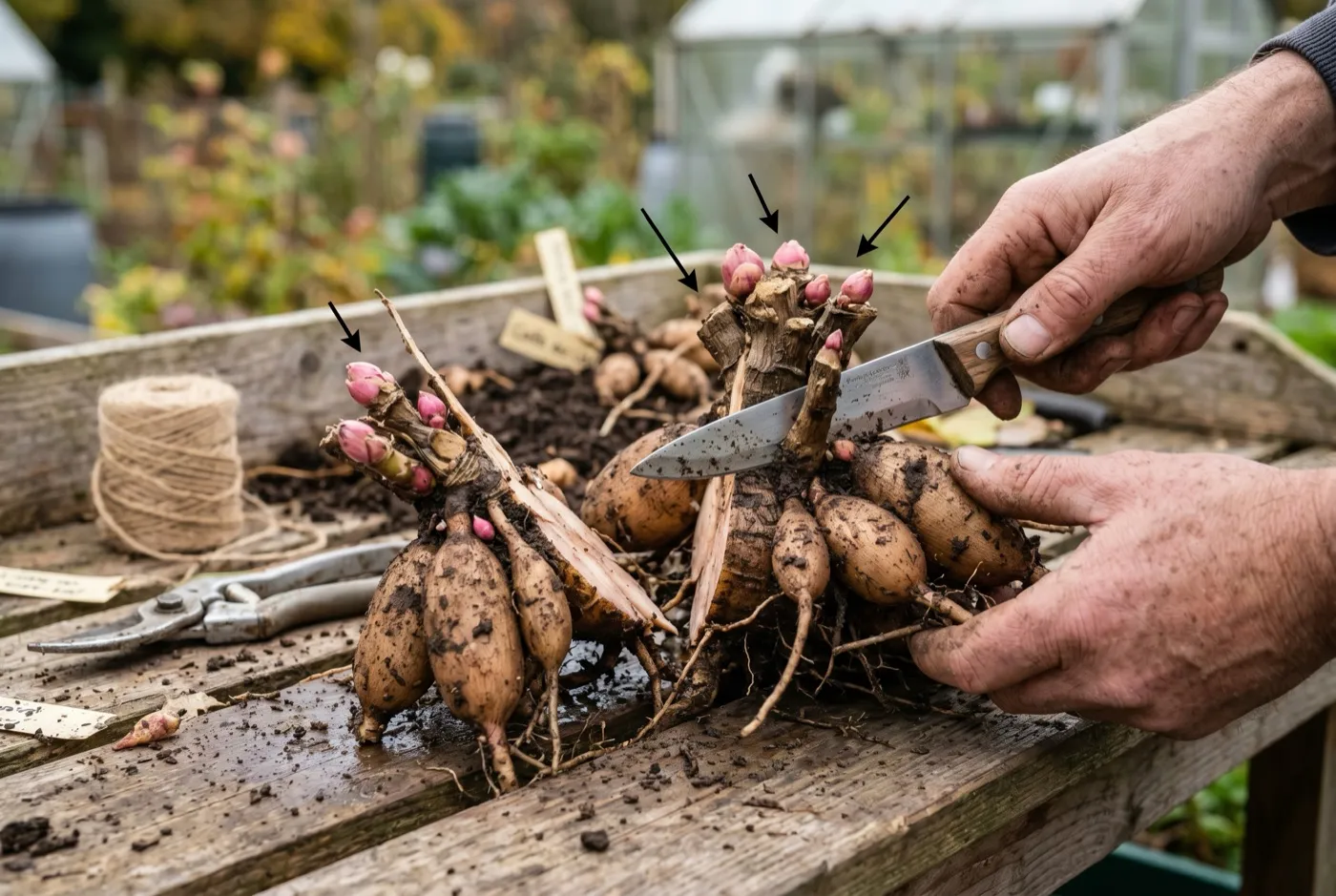 Splitting a dahlia clump through the crown. Each division needs an eye and a section of crown to grow.
A bulb the weight of its size flowers; a light one for its size has used up its store. Always heft a bulb before you buy.
Common mistakes when planting bulbs, corms and tubers
Most failures trace back to a handful of avoidable errors. These are the ones that cost a whole season.
- Planting too shallow. Shallow bulbs split into non-flowering chips and lift out in frost. Plant at two to three times the organ’s height, and tulips deeper still at 15-20cm.
- Burying an iris rhizome. A bearded iris rhizome covered with soil rots and goes blind. It must sit half-exposed on the surface in full sun.
- Splitting a dahlia without a crown. A tuber with no slice of crown has no eye and never shoots. Always divide through the crown so each piece carries a bud.
- Cutting foliage off too soon. Bulbs refill their store through the leaves after flowering. Leave foliage at least six weeks before tidying, and never knot or fold daffodil leaves.
- Leaving tender types out over winter. Dahlias, gladioli and begonias turn to mush below 5C. Lift them before the first frost, dry, and store frost-free.
Frequently asked questions
What is the difference between a bulb, corm, tuber and rhizome?
Structure is the difference. A true bulb has layered scales on a basal plate, a corm is a solid swollen stem, a tuber has growing eyes over its surface, and a rhizome runs sideways underground. All four store food to survive dormancy, but only the bulb has the onion-like layers you see when you cut it in half.
Which way up do you plant bulbs and tubers?
Point or growing tip upwards for most. Daffodil and tulip bulbs go pointy end up, dahlia tubers go crown up with the old stem highest, and bearded iris rhizomes sit flat with roots down. If you genuinely cannot tell, as with anemone corms, plant on the side and the shoot will find its own way up.
How deep should you plant bulbs?
Plant at two to three times the bulb’s own height. A 5cm daffodil bulb goes 10-15cm deep; a small crocus corm only 5-7cm. Tulips do better deeper, at 15-20cm on free-draining soil, which helps them come back year after year rather than fading out.
Are dahlias bulbs or tubers?
Dahlias grow from tubers, not bulbs. The fleshy roots store food, but the growing eyes sit only at the old stem base, called the crown. A lone tuber with no piece of crown attached will never sprout, which is why you split a dahlia clump through the crown and keep an eye on each division.
Do you need to lift bulbs over winter in the UK?
Only the tender ones. Hardy daffodils, crocus, tulips and most alliums stay in the ground all year. Tender dahlias, gladioli, begonias and cannas should be lifted before the first frost, dried, and stored frost-free at 5-10C until spring.
Why did my bulbs come up blind with leaves but no flowers?
Blindness usually means overcrowding or shallow planting. As clumps multiply they compete for food and stop flowering. Lift and divide every three to four years, plant at the right depth, and feed with a high-potassium fertiliser after flowering to build next year’s flower inside the bulb.
Now you can tell every geophyte apart, read our guide on how to grow crocus for an easy first corm, and browse the full growing section for more seasonal planting guides.
Our team produces practical UK gardening guidance from source research, contributor records and established horticultural practice. Editorial standards are overseen by Matt W.