Key takeaways
- Pollination groups run 1 to 5 by flowering time; a partner must be in the same group or one either side
- Two cherries can flower together and still set zero fruit if they share the same S-allele incompatibility group
- Stella (1968) was the first self-fertile sweet cherry; its S4-prime allele makes it a universal pollen donor
- Bing, Lambert and Bigarreau Napoleon are all incompatibility group III: they will never pollinate each other
- Bees stop flying reliably below 12C, so a cold April kills the crop even with a perfect partner
- On Gisela 5 rootstock a cherry stays at 2.5-3m, which decides whether a second tree fits at all
Two cherry trees, planted together, flowering together, and not a cherry between them. It is the most common cherry failure in British gardens, and almost every explanation you will read blames frost or bees. Usually it is neither. Cherry pollination groups tell you when a cultivar flowers, but they say nothing about whether two trees can actually fertilise each other. That second piece of information, the incompatibility group, is the one nurseries leave off the label.
This guide covers both systems: the flowering groups printed on the label, and the S-allele incompatibility groups that decide whether pollen is accepted or destroyed. Get both right and a cherry crops for forty years. Get the second one wrong and you wait four springs for nothing.
What cherry pollination groups actually mean
A pollination group, sometimes printed as a flowering group, is a number from 1 to 5 that ranks a cultivar by when its blossom opens. Group 1 opens earliest, usually in the first week of April in southern England. Group 5 opens latest, often into the second week of May. The gap between one group and the next is roughly three to four days of blossom.
The rule nurseries give you is sound as far as it goes: choose a partner in the same group, or one group either side. A group 3 cherry is pollinated by another group 2, 3 or 4 cherry. The reason is overlap. Cherry blossom on a single tree is receptive for only about four to six days, so two trees flowering nine days apart never share an open flower.
What the group number cannot tell you is whether the pollen will be accepted. That is a separate system entirely, and it is where crops are lost.
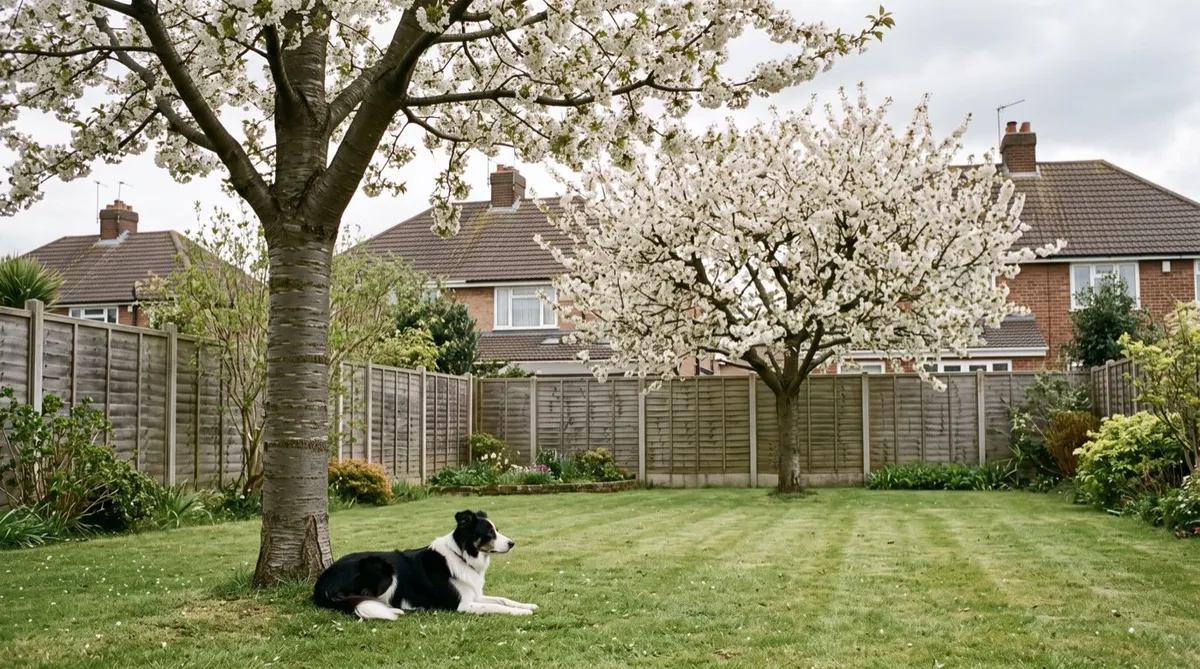
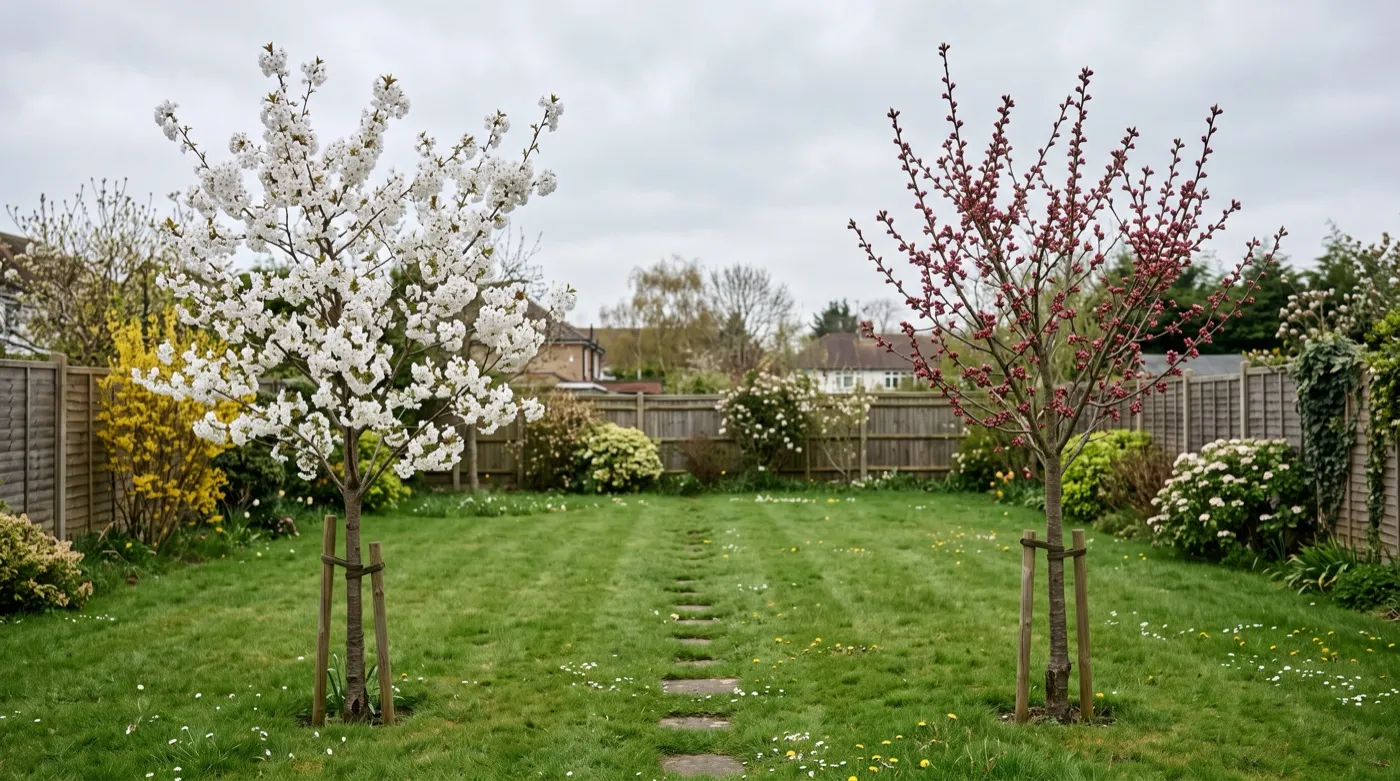 A group mismatch is visible: the left tree is in full flower while the right is still at tight bud. Two trees more than one group apart rarely share an open blossom.
The incompatibility group trap that costs people a crop
Here is the part that gets buried. Sweet cherry (Prunus avium) uses gametophytic self-incompatibility, a rejection system controlled by a single gene called the S-locus. Every cultivar carries two S-alleles, written as a pair: S1S2, S3S4 and so on.
When pollen lands on the stigma, the style produces an enzyme called an S-RNase. If the pollen grain carries an S-allele that the mother tree also carries, that enzyme destroys the growing pollen tube before it reaches the ovule. Share one allele and set is reduced. Share both alleles and set is zero.
Cultivars carrying the same two alleles are grouped into an incompatibility group, written with Roman numerals. The textbook example is group III: Bing, Lambert and Bigarreau Napoleon all carry S3S4. They flower at much the same time. They are the three most famous sweet cherries in the world. And they cannot pollinate each other at all, in any combination, ever.
The trap is that everything looks right. The trees flower together. Bees work the blossom. Petals drop on schedule. Tiny fruitlets even swell for a fortnight before yellowing and dropping in June. Nothing on the outside of the tree tells you the pollen tubes were killed 3mm down the style. If your cherries flower well and drop everything, our guide to cherry fruit drop and what causes it helps you separate this from the other causes.
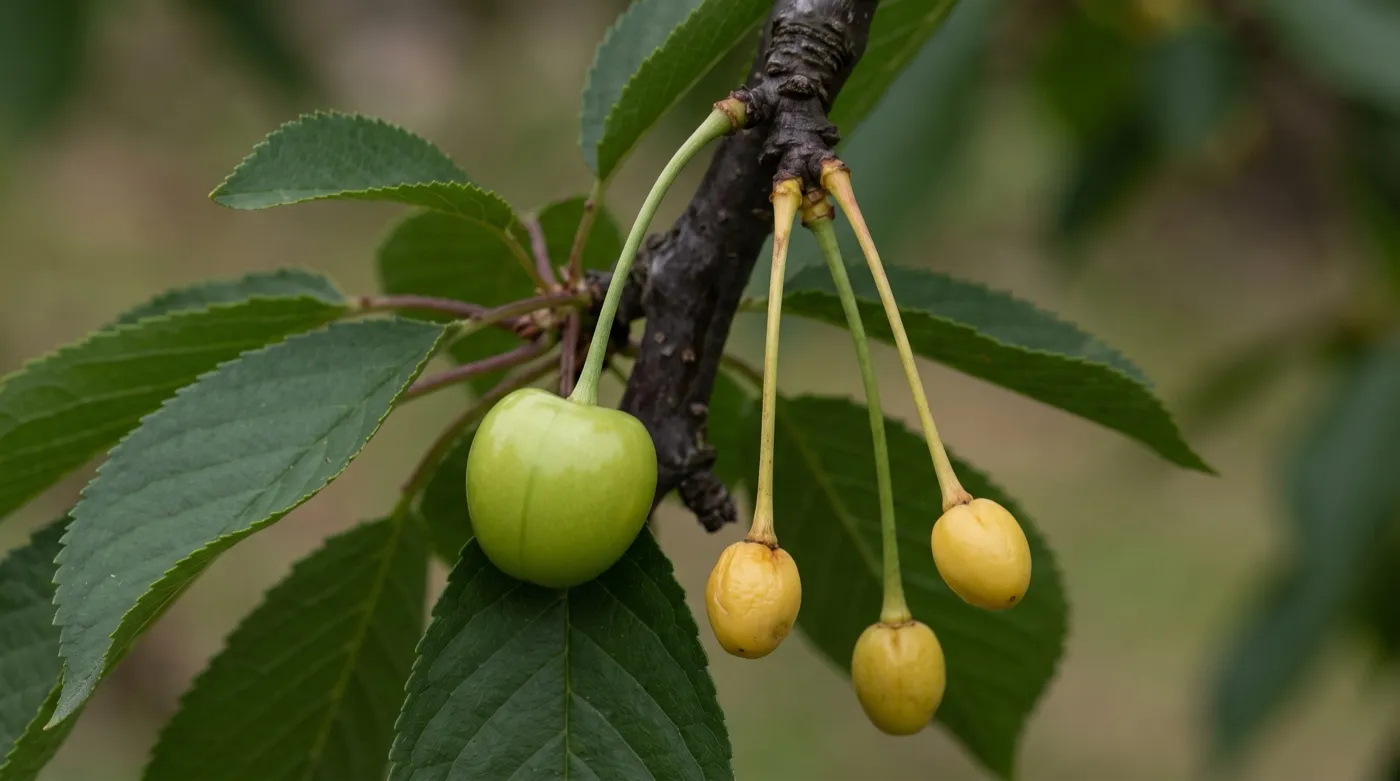 The tell-tale sign of incompatible pollen: fruitlets swell briefly, yellow at the stalk, then drop. A fertilised cherry beside them stays firm and green.
Warning: Buying two trees of the same cultivar guarantees failure in a non-self-fertile cherry. They are clones with identical S-alleles, so they are automatically in the same incompatibility group. This includes the same cultivar sold under two different names. Lapins is widely sold as Cherokee, and a Lapins plus a Cherokee is one clone bought twice.
Self-fertile cherries and the 1968 Stella breakthrough
Stella changed cherry growing permanently. It was raised at the Summerland research station in British Columbia and released in 1968, the first self-fertile sweet cherry ever bred. The mechanism is worth knowing because it explains why Stella and its descendants are so useful.
Breeders irradiated pollen from the cultivar Lambert and produced a mutated allele, S4-prime (S4’). The mutation stops the pollen tube being recognised and destroyed, so the tree fertilises itself. Stella’s genotype is S3S4’. Every self-fertile sweet cherry in the trade descends from that single event and carries S4’.
That gives you a second benefit almost nobody mentions. Because S4’ pollen is never rejected, self-fertile cultivars act as universal pollen donors. A Stella will pollinate almost any other sweet cherry in an overlapping flowering group, whatever its incompatibility group. One self-fertile tree fixes a whole garden of awkward older cultivars.
The main self-fertile sweet cherries in UK nurseries are Stella (group 3), Sunburst (group 3, larger fruit), Lapins (group 4, the best crack resistance), Sweetheart (group 4, picks into August) and Summer Sun (group 3, the hardiest, raised at the John Innes Institute). Sour cherries including Morello are self-fertile as standard.
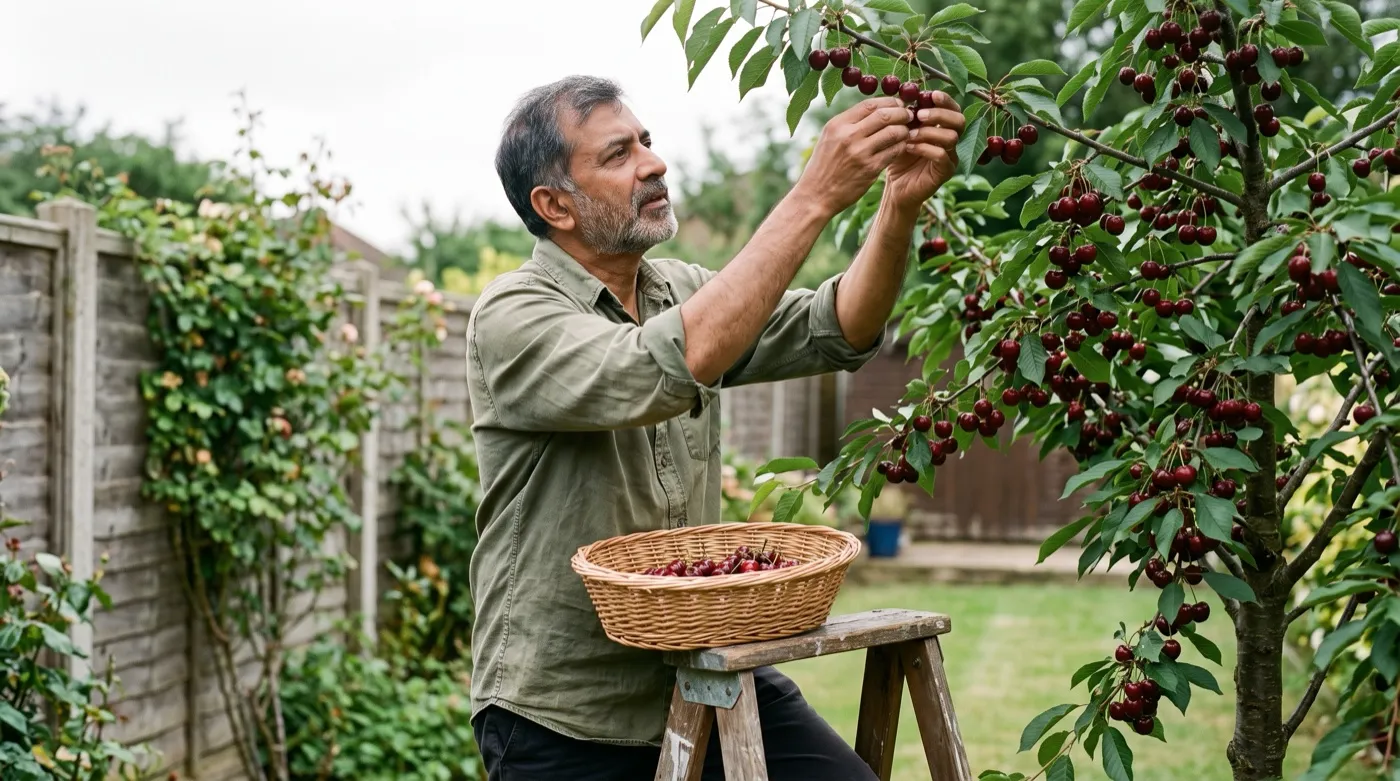 A self-fertile Stella on Gisela 5 stays at 2.5-3m and crops alone. A two-step ladder reaches the top of the tree, which is the whole argument for the rootstock in a small garden.
Sweet and sour cherries pollinate by different rules
The two cherry species are not interchangeable, and their pollination behaviour differs at the chromosome level.
Sweet cherry (Prunus avium) is diploid, carrying 16 chromosomes. It is the species with the S-allele problem described above. Most older sweet cultivars need a partner; modern ones carrying S4’ do not.
Sour or acid cherry (Prunus cerasus) is tetraploid, carrying 32 chromosomes. Sour cherry arose as a natural hybrid between sweet cherry and the ground cherry Prunus fruticosa. That doubled chromosome set disrupts the self-incompatibility system, which is why sour cherries are self-fertile almost without exception.
The ploidy difference also means sweet and sour cherries are poor pollinators for each other. In practice this never matters, because the sour cherries need no help. Morello flowers late, usually group 5, which is another quiet advantage: it opens after most late frosts have passed.
Morello earns its place for a different reason. It is the only fruit tree that genuinely crops on a north-facing wall, fan-trained, in shade that would defeat an apple or a pear. Ours reached 3.4m on Colt rootstock and gives 6 to 8kg a year with no partner and no sun. A blank cold wall and a fan-trained Morello is the most underused pairing in British fruit growing.
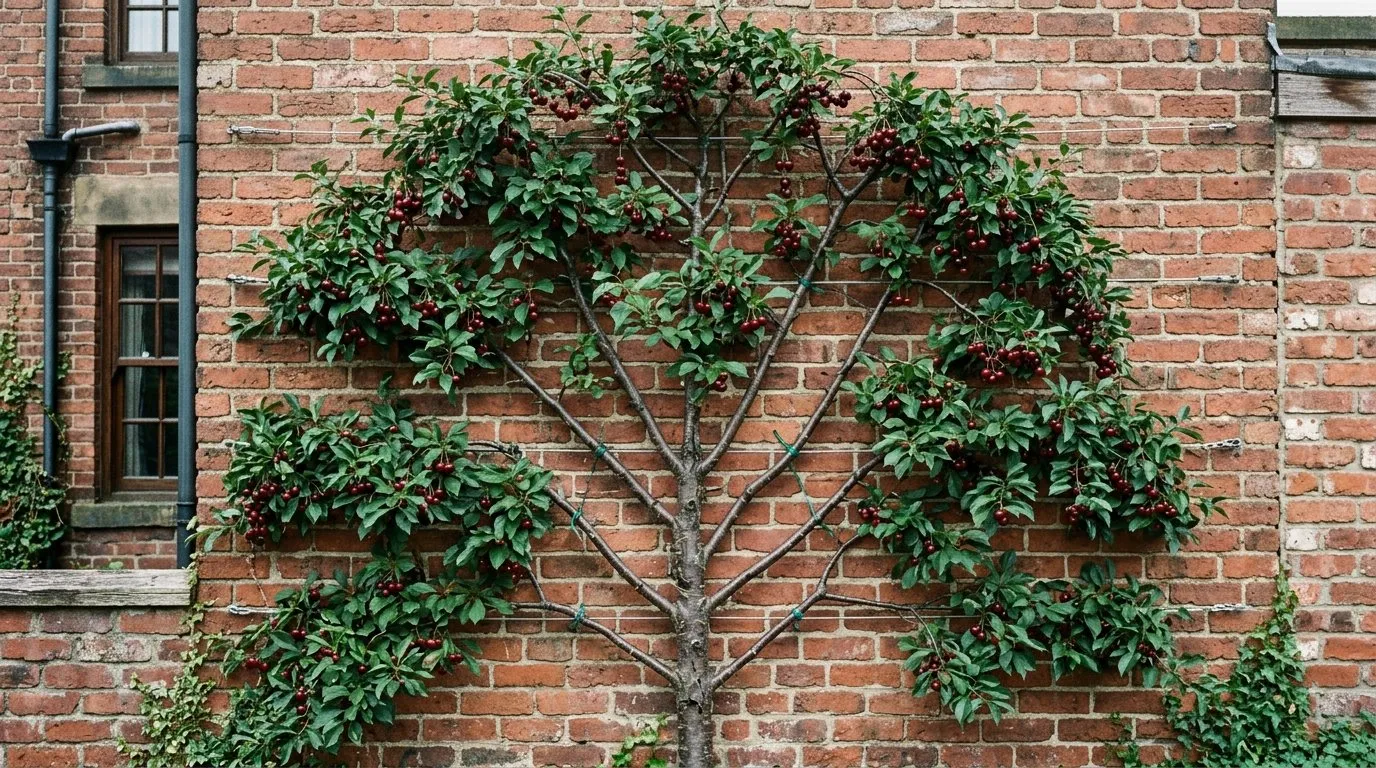 Morello is self-fertile and crops on a north-facing wall. It is the only cherry that turns a cold shaded wall into fruit.
Cherry cultivar pollination table
This is the table to check before you buy. The incompatibility group column is the one that decides whether two trees will work, and it is the column almost no nursery prints.
Read it in two passes. First find cultivars whose flowering groups are within one of each other. Then check that their incompatibility groups differ. A pair must pass both tests. Any self-fertile cultivar in the top block passes the second test automatically against everything. This table deliberately ignores flavour, yield and hardiness. Judge compatibility here first, then choose on eating quality second.
From open blossom to fertilised ovule in seven stages
- Bud swell. Late March, once soil and air average around 7C. Buds fatten and show white.
- Blossom opens. Mid to late April for group 3. Each flower is receptive for 4 to 6 days only.
- Bee visit. Honeybees fly reliably above 12C and work hard above 15C. Below 10C they stay in.
- Pollen germinates on the stigma. Fastest at 15-20C, taking a few hours. At 10C it takes over a day.
- Pollen tube grows down the style. This is the S-allele checkpoint. At 15-20C the tube reaches the ovule in 2 to 3 days. At 10C it needs 8 to 10 days. Incompatible pollen is destroyed here, roughly 3mm down.
- Fertilisation. Must happen while the ovule is alive. Cherry ovules survive about 4 to 6 days after the flower opens.
- Fruit set. Fertilised flowers hold. Unfertilised ones yellow and drop through May and June.
The gap between stage 5 and stage 6 is the effective pollination period, and it is the number that matters. Take ovule longevity and subtract the time the pollen tube needs. At 18C you get roughly 3 days of usable window. At 10C the tube needs 8 to 10 days but the ovule is dead by day 6, so the window is zero, and the tree sets nothing despite perfect blossom and a perfect partner.
The critical mistake is treating a blank crop as a bee problem or a frost problem. Both incompatible pollen and cold weather produce the same picture: full blossom, normal petal fall, then a slow yellow drop. One is fixed by a graft and the other by patience. Diagnosing the wrong one costs years.
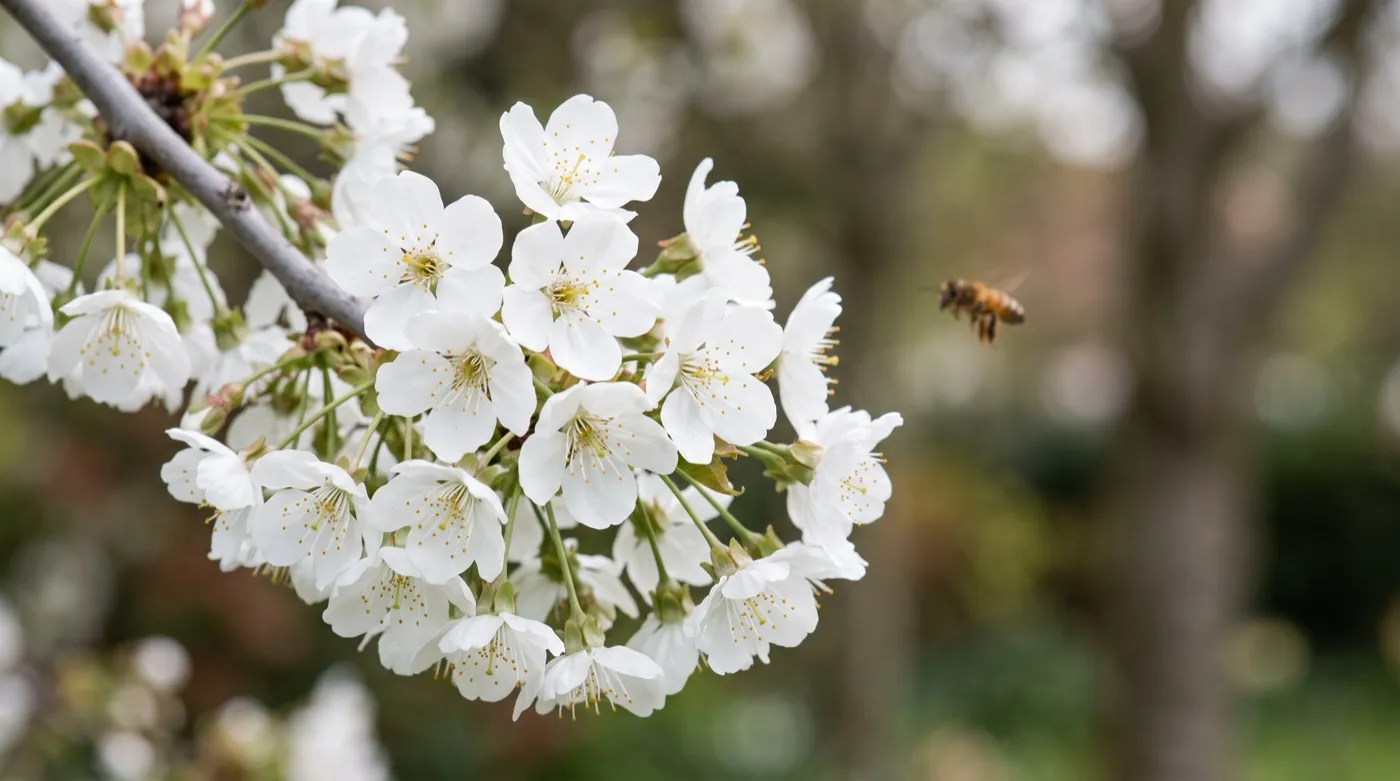 Honeybees fly reliably above 12C. Below that the blossom can be perfect and the pollen still never moves.
Why a cold April beats a perfect partner
Blossom weather decides the crop more than any decision you make at the nursery. This table shows how mean daytime temperature during flowering changes the outcome.
| Mean day temp at blossom | Bee flight | Pollen tube to ovule | Effective pollination period | Likely set |
|---|---|---|---|---|
| 6-9C | Almost none | 10+ days | 0 days | Near zero |
| 10-12C | Brief, midday only | 7-9 days | 0-1 days | Poor |
| 13-15C | Moderate | 4-6 days | 1-2 days | Moderate |
| 16-20C | Strong all day | 2-3 days | 3-4 days | Good |
| 21C+ | Strong | 1.5-2 days | 3 days, ovules age faster | Good |
A cherry needs only 25 to 30% of its flowers to set for a full crop, so the bar is lower than it looks. But in a cold April, a mature tree carrying 20,000 flowers can still finish with a handful of fruit.
You cannot warm up April. You can improve the odds. Plant against a south or west-facing wall where the microclimate typically runs 1.5 to 2C warmer at blossom height. Keep the site sheltered, because bees will not work in wind over about 20mph. Plant early forage nearby so pollinators are already resident and working before the cherry blossom opens.
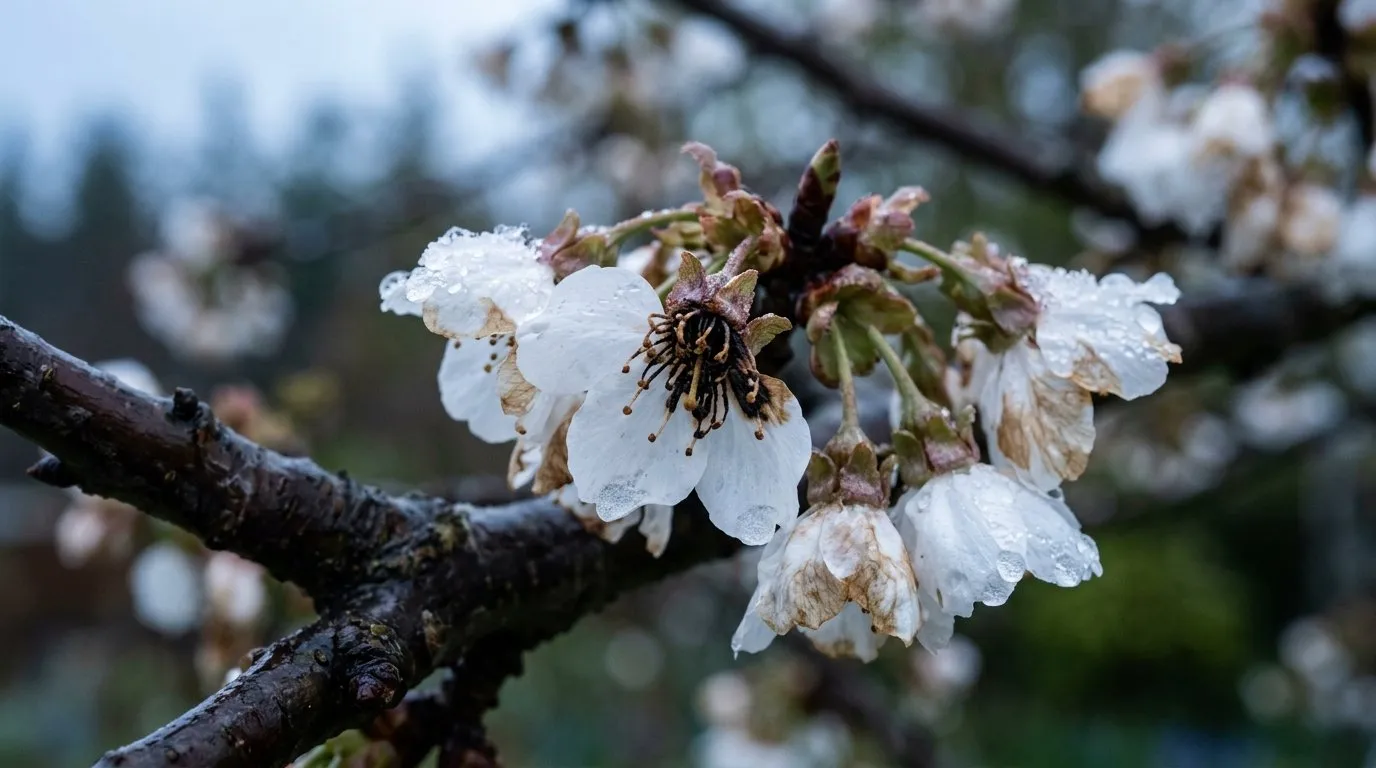 Frosted blossom shows a blackened centre. Cold that stops short of frost damage still stops pollination by keeping bees grounded.
Rootstocks decide whether a partner even fits
Pollination advice is useless if the second tree does not fit the garden. The rootstock controls final size, and it is chosen separately from the cultivar.
Colt, bred at East Malling, is semi-vigorous and produces a tree of 4 to 5m. Two Colt cherries need roughly 7m between them and a garden most people do not have. Gisela 6 is semi-dwarfing at 3 to 4m. Gisela 5, from Giessen in Germany, is properly dwarfing: 2.5 to 3m, croppable in year 3, and nettable with a single roll of netting.
The arithmetic is simple. On Gisela 5 a pair of cherries occupies about 4m of border, which fits a typical suburban plot. On Colt the same pair needs 40 square metres and shades out everything beneath. That is why the self-fertile route wins so often in small gardens: not because partners do not work, but because the space for a partner does not exist. Our guide to fruit tree rootstocks explained covers the full range and how to identify what you have been sold.
Gardener’s tip: Rootstock does not change pollination compatibility at all. A Napoleon on Gisela 5 has exactly the same S-alleles as a Napoleon on Colt. The rootstock changes the size of the problem, never the genetics of it.
Ranked options when there is no room for two trees
Not all fixes are equal. This table ranks them by how reliably they produce fruit, with the role each one plays and, importantly, what each cannot do.
| Method | Effectiveness | Role | What it cannot do |
|---|---|---|---|
| Self-fertile cultivar (Stella, Lapins, Morello) | 90-95% reliable set | Primary: the gold standard | Cannot rescue a cold April |
| Compatible partner, overlapping group, different IG | 80-90% | Primary | Needs 4-7m of extra space |
| Graft a pollinator scion onto the existing tree | 70-85% | Primary for established wrong trees | Takes 2-3 years to flower |
| Family tree, 3 cultivars on one stem | 70-80% | Primary for tiny gardens | Cannot stop one variety dominating |
| Neighbour’s cherry within 30m | 50-80% | Supplementary | You do not control whether it stays |
| Hand pollination with a brush | 60-90% on reachable flowers | Maintenance | Only reaches what you can touch |
| Cut blossom branch in a bucket of water | 40-60% | Emergency, one season | Blossom lasts about 4 days |
| Mason bee nest beside the tree | Improves set 10-20% in cold springs | Supplementary | Cannot fix incompatible pollen |
| Fleece over blossom against frost | Protects buds, 0% pollination gain | Protective | Excludes bees entirely if left on |
The gold standard is a self-fertile cultivar on Gisela 5. It removes the compatibility question, the spacing question and the neighbour question in one purchase. Everything below it in that table is a way of retrofitting a decision that went wrong at the nursery.
If you already own the wrong tree, grafting is the honest answer, not replacement. Three scions of a self-fertile cultivar cost under £15 and take an afternoon. Our guide to grafting fruit trees covers whip-and-tongue technique and timing. Where flowers are within reach, hand pollination with a soft brush will carry a single season while the graft establishes.
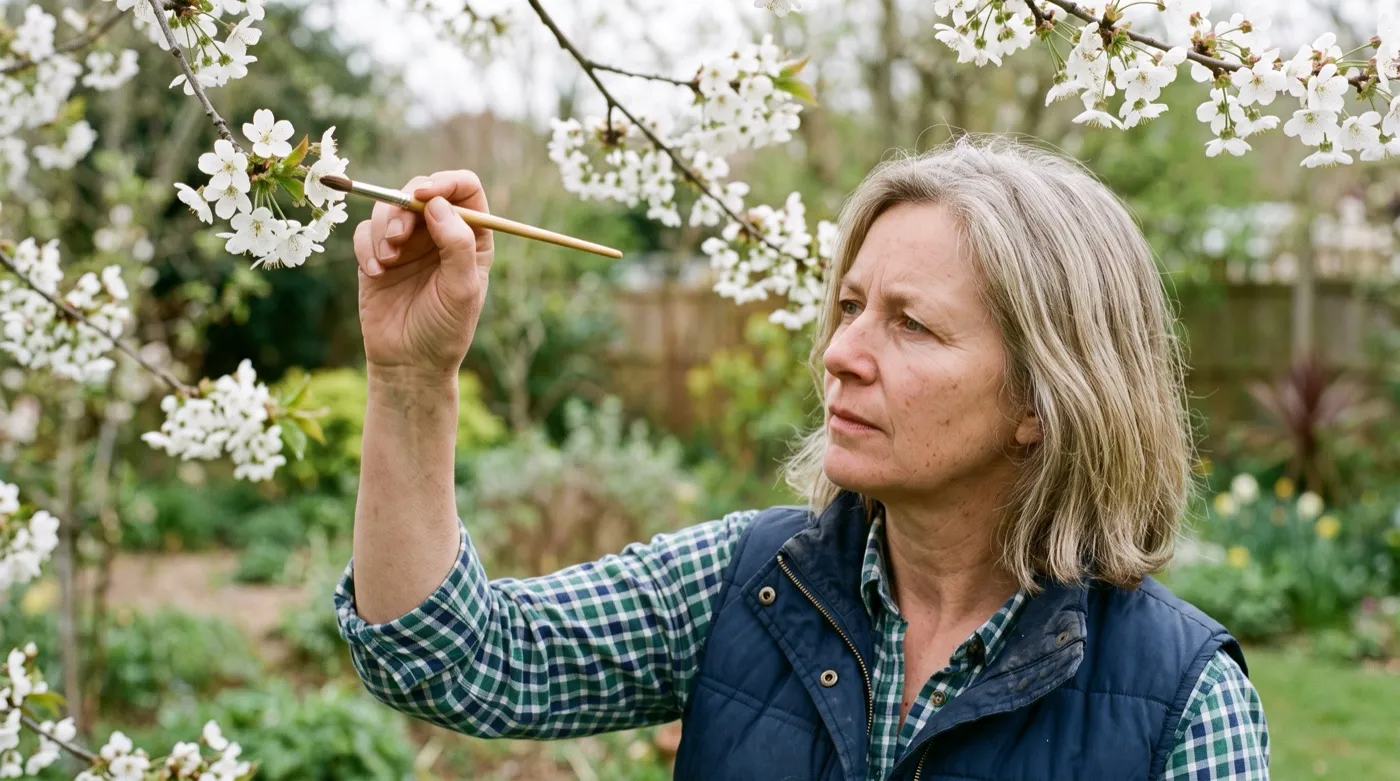 Hand pollination with a soft brush sets 60-90% of the flowers you can actually reach. It carries one season while a grafted pollinator branch establishes.
Cherry blossom and pollination month by month
Cherry pollination is decided in about five weeks. This calendar covers the whole year but the work concentrates hard in spring.
| Month | Task |
|---|---|
| January | Order bare-root trees. Confirm cultivar, rootstock and incompatibility group before paying. |
| February | Plant bare-root cherries while dormant. Watch for bullfinches stripping fruit buds. |
| March | Bud swell around 7C. Graft pollinator scions now, whip-and-tongue onto dormant wood. |
| April | Blossom opens, groups 1 to 4. Log the date. Check bees are flying above 12C. Fleece only on frost nights, off by 9am. |
| May | Morello blossom, group 5. Unfertilised flowers begin yellowing. Do not confuse this with disease. |
| June | Natural June drop. Compare set against your blossom notes to diagnose last month honestly. |
| July | Sweet cherry harvest. Net before the fruit colours, not after. |
| August | Morello and Sweetheart harvest. Summer-prune only, never in winter, to avoid silver leaf. |
| September | Record the season’s yield per tree against April temperatures. |
| October | Plan any new planting. Check what cherries are flowering in neighbouring gardens. |
| November | Bare-root planting season opens. Prepare the planting site. |
| December | Order scion wood for spring grafting while cultivars are still listed. |
Keeping an April blossom diary sounds fussy. It is the single most useful thing we do. Four years of dates turned our Napoleon failure from a mystery into an obvious diagnosis.
The root cause nurseries never print on the label
The underlying cause of most blank cherry crops is not biological. It is an information failure at the point of sale.
Nursery labels almost always print the flowering group, because it is a single tidy number. They almost never print the incompatibility group, because it needs a Roman numeral, an explanation and a table. So buyers do exactly what the label invites: they match flowering times, buy two trees that blossom together, and unknowingly buy two members of group III.
The cause is missed because the failure is invisible and slow. Rejection happens inside the style, out of sight. The tree looks healthy and flowers beautifully every spring, so gardeners blame the weather, the soil, or their own pruning. A cherry on Colt takes 4 to 5 years to reach full flowering, so by the time the pattern is undeniable, five seasons have gone and the receipt is long lost.
Permanent prevention is a two-line check before money changes hands. First, ask the nursery for the incompatibility group or S-genotype of both trees, in writing. Reputable UK fruit specialists hold this data even when it is not on the website. Second, if either answer is vague, buy a self-fertile cultivar carrying S4-prime and make the question irrelevant forever. The National Fruit Collection at Brogdale holds the reference cultivar records that underpin this data, and it is the source worth quoting back at a nursery that shrugs.
That single question, asked before purchase, is worth more than every spray, feed and fleece in this article combined.
Common mistakes with cherry pollination
- Matching flowering groups and stopping there. The group number is about timing only. Two group 3 cherries in the same incompatibility group will never fruit. Check both systems, always.
- Buying two trees of the same cultivar. Clones share every allele, so they are self-incompatible with each other unless the cultivar is self-fertile. Two Napoleons is one Napoleon, twice.
- Falling for a trade name. Lapins is sold as Cherokee. Buying both is buying the same clone under two labels and believing you have a pair.
- Blaming frost for everything. Frosted blossom shows a blackened centre when you open it. Incompatible blossom looks perfect and drops anyway. Cut a few flowers open before you accuse the weather.
- Giving up in year two. A cherry on Colt rootstock is not expected to crop until year 4 or 5. On Gisela 5 expect year 3. Impatience gets more healthy trees dug out than incompatibility does.
For everything beyond pollination, from planting depth to silver leaf and netting, our full guide to growing cherry trees in the UK is the place to start. If it is spring flower rather than fruit you are after, growing flowering cherry covers the ornamental species, none of which need a pollination partner because nobody wants the fruit.
Getting it right before you buy
Cherry pollination looks complicated because two systems are wearing the same word. Pollination group is timing. Incompatibility group is genetics. The trade prints the first and hides the second, and that single omission is responsible for more fruitless cherry trees in British gardens than every pest and disease combined.
The short version fits on a postcard. If you have room for one tree, buy self-fertile and stop thinking about it. If you have room for two, check that their flowering groups are within one of each other and their incompatibility groups are different. If you already own a tree that flowers and never fruits, graft a Stella branch into it and wait two springs. And whatever you plant, remember that a cold April outranks all of it, which is why the Bumblebee Conservation Trust work on early-season forage matters as much to fruit growers as it does to naturalists.
Now you know which cherries can actually pollinate each other, read our guide to the best cherry tree varieties for UK gardens to choose on flavour and yield, or browse everything in our growing section for the rest of the fruit year.
Frequently asked questions
What are cherry pollination groups?
Pollination groups rank cherry cultivars 1 to 5 by flowering time. Group 1 flowers earliest and group 5 latest. A cherry needs a partner flowering in the same group or one group either side, so the blossom overlaps long enough for bees to move pollen. Nurseries print this number on the label. It tells you about timing only, not compatibility.
Why do my two cherry trees not produce fruit?
Most often because both trees share the same incompatibility group. Sweet cherries carry two S-alleles, and a tree rejects pollen carrying alleles it already has. Two cultivars in the same group can flower together perfectly and still set nothing. The other common causes are a cold April stopping bee flight and trees under three years old.
Are cherry trees self-fertile?
Many modern sweet cherries are, and almost all sour cherries. Stella, Sunburst, Lapins, Sweetheart and Summer Sun all carry the S4-prime allele and crop without a partner. Morello and other sour cherries are self-fertile as standard. Older sweet cultivars such as Bigarreau Napoleon, Early Rivers and Merton Glory need a compatible partner nearby.
What is an incompatibility group in cherries?
A group of cultivars sharing the same two S-alleles, which cannot pollinate each other. Sweet cherry uses gametophytic self-incompatibility: the style produces an S-RNase that destroys any pollen tube carrying a matching allele. Group III contains Bing, Lambert and Bigarreau Napoleon. Plant any two of those together and you get flowers but no cherries.
How far apart can cherry pollination partners be?
Up to about 30m, though under 18m is far more reliable. Bees carry cherry pollen much further, but transfer rates fall as distance rises and hedges or buildings break the flight line. A neighbour’s cherry two gardens away can pollinate yours. You just cannot control whether they keep it.
Can a sour cherry pollinate a sweet cherry?
Not reliably, and you rarely need it to. Sour cherries such as Morello are tetraploid with 32 chromosomes, while sweet cherries are diploid with 16. They also flower later, usually group 5. Since Morello is fully self-fertile it needs no partner, so the question is academic in most gardens.
Will one cherry tree fruit on its own?
Yes, if it is a self-fertile cultivar. Stella on Gisela 5 rootstock is the safest single-tree choice and sets 90-95% as reliably alone as with a partner. A non-self-fertile cultivar alone will flower every spring and never crop, unless a compatible cherry grows within about 30m.
Our team produces practical UK gardening guidance from source research, contributor records and established horticultural practice. Editorial standards are overseen by Matt W.