Key takeaways
- Berries ripen in October and November, roughly 6 weeks after autumn raspberries finish
- Rated RHS H4: reliably hardy to about -10C, but wet winter soil kills it well above that
- Needs acid soil at pH 5.0 to 6.5; on chalk or heavy clay it will not survive a wet winter
- A 40 litre container of ericaceous compost is the most reliable route in most of the UK
- Expect to pay £12 to £18 for a 9cm plant; Otter Farm is the established UK source
Chilean guava is the best fruit almost nobody in Britain grows. It ripens in late October, weeks after the autumn raspberries have finished and the apples are already in store. The berries taste of wild strawberry with something aromatic sitting behind it. Ugni molinae has a second advantage too: it is an evergreen shrub, so it earns its place in a border for twelve months rather than eight.
The plant also carries a real piece of Victorian history. It was reputedly Queen Victoria’s favourite fruit, sent up to Windsor by train from Cornwall. Yet walk round any garden centre today and you will not find one for sale. This guide covers what Chilean guava needs, where it fails, and why a large pot beats a border for most of us.
What Chilean guava tastes like, and why the flavour is hard to place
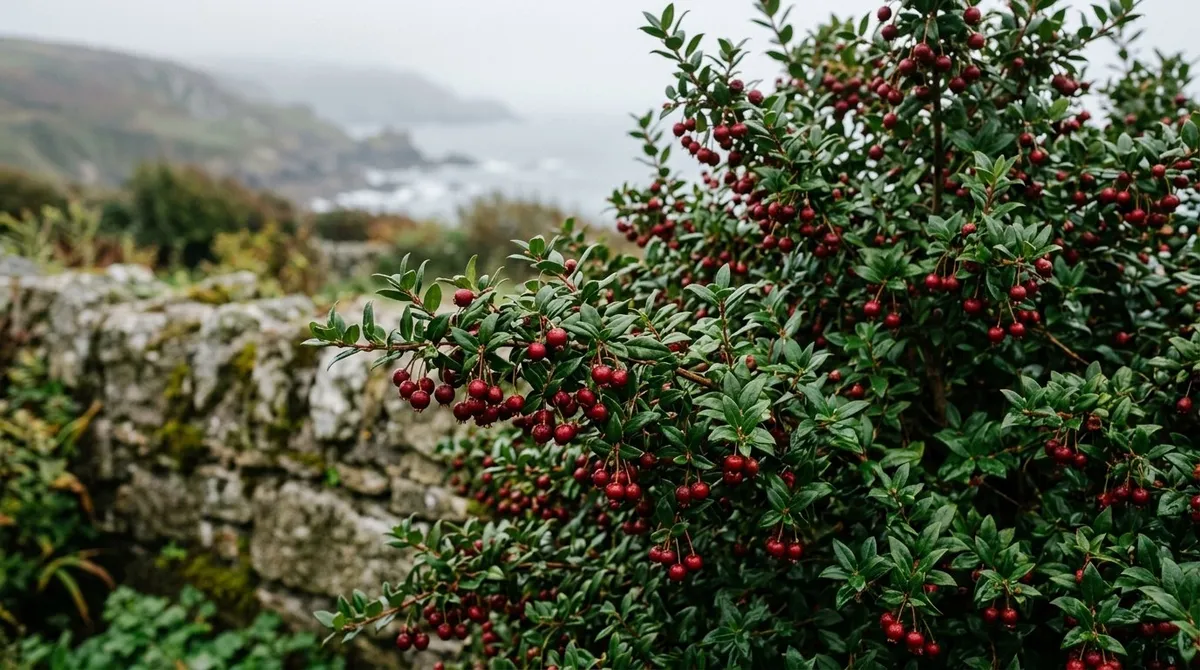
The berries are small, between 8mm and 12mm across, and they ripen to a deep red that darkens almost to maroon. Each one holds a handful of tiny soft seeds that you never notice while eating.
The flavour is the reason to grow it. The base note is wild strawberry, close to an alpine strawberry rather than a supermarket one. Behind that sits an aromatic, faintly perfumed quality that most people reach for the word “guava” to describe. That comparison is really about the scent rather than the taste. Crush a ripe berry between your fingers and the smell is unmistakable.
Texture matters as much as flavour. A properly ripe berry is dense and slightly chewy, not watery. That density is why the fruit works so well cooked: it holds its shape in a tart and makes an intensely flavoured jam from a small quantity.
Picked too early, none of this happens. The berry colours up two to three weeks before the sugars arrive, and an early-picked crop tastes thin with a resinous edge. This single point catches out more first-time growers than any pest or disease, and it is covered in detail below.
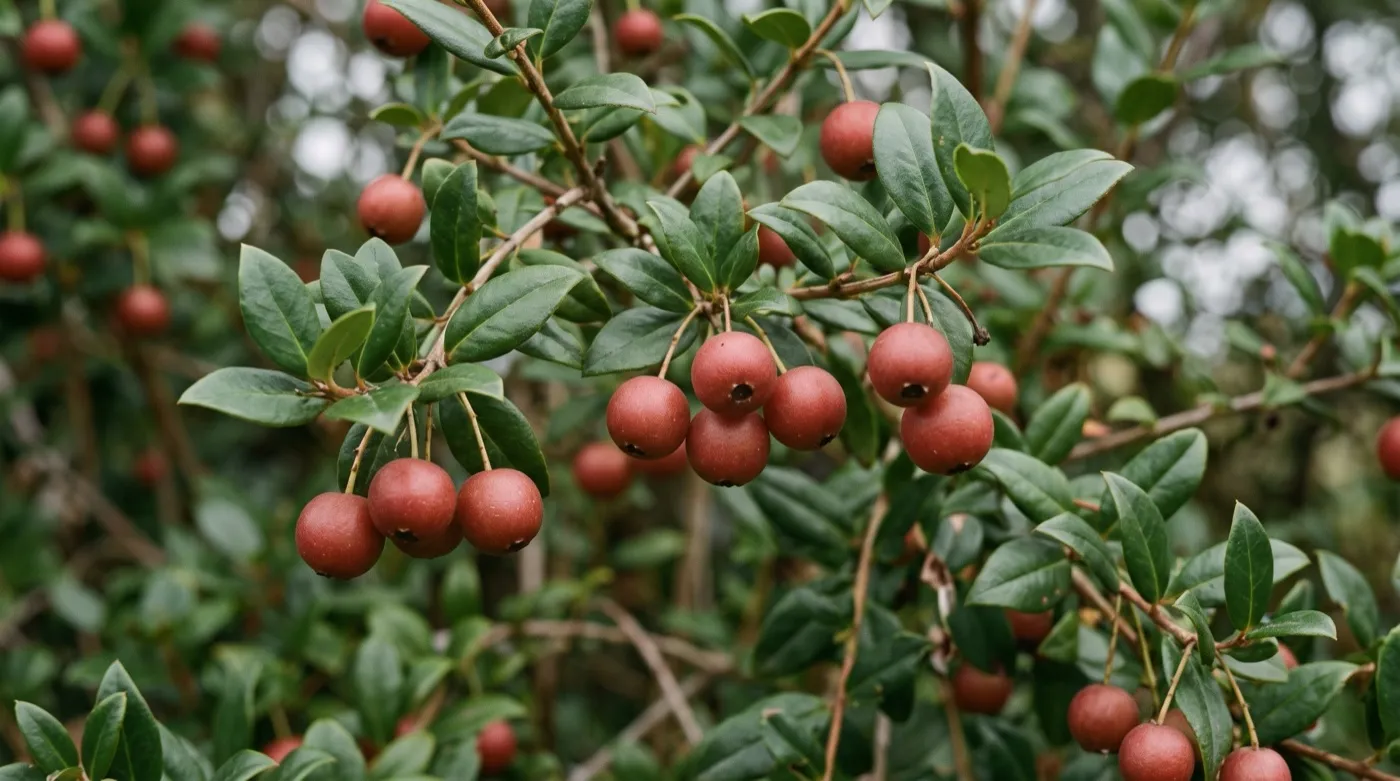 Ripe berries darken to maroon and sit at 8mm to 12mm across. The green fruit on the same stem shows how unevenly a bush ripens.
Queen Victoria and the Cornish berry trade
The Victorian story is not marketing invention, though it has been polished over the years. Ugni molinae was introduced to Britain in 1844 by William Lobb, the Cornish plant hunter collecting in Chile for the Veitch nursery. It arrived alongside a wave of Chilean and Californian introductions that reshaped British gardens.
The fruit found favour with Queen Victoria, and it was reportedly grown for her at Windsor with additional berries sent up from Cornwall by train. The far south west suited it: mild, damp, frost-light and often naturally acid. Those same conditions still make Cornwall, south Devon, west Wales and much of Ireland the easiest places in these islands to grow it in open ground.
So why did it vanish? Partly economics. The berries are small, they ripen late, and they do not travel or store well. Once commercial soft fruit organised itself around strawberries and raspberries with predictable summer harvests, a fiddly October berry from an evergreen shrub had no place in it.
Its survival has been down to enthusiasts. New Zealand growers took it up commercially, where it is sold as NZ cranberry, and that trade is the reason named cultivars exist at all. In Britain it has stayed a specialist plant, which is precisely why so few gardeners have tried it.
How hardy is Chilean guava in the UK?
Chilean guava is rated H4 on the RHS hardiness scale, which means hardy through an average winter across most of the UK. In practice that is around -10C at the bottom end, with H4 formally covering -10C to -5C.
That rating is honest but it is also misleading if you read it on its own. A number on a scale describes air temperature. It says nothing about the thing that actually kills this plant in British gardens, which is water.
Real behaviour varies by region. In Cornwall and coastal Devon, plants shrug off most winters in open ground. In the Midlands and the north, an established plant in free-draining soil usually survives an average winter with some leaf bronzing. In an exposed northern or Scottish garden, open ground is a gamble and a container that can be moved is the sensible answer.
Wind is the underrated factor. Chilean guava is evergreen, so it keeps transpiring through winter. When the soil is frozen and a dry easterly is stripping moisture from the leaves, the plant cannot replace what it loses. The damage looks like frost burn but it is drought. A sheltered spot against a wall or fence solves more winter problems than any amount of fleece.
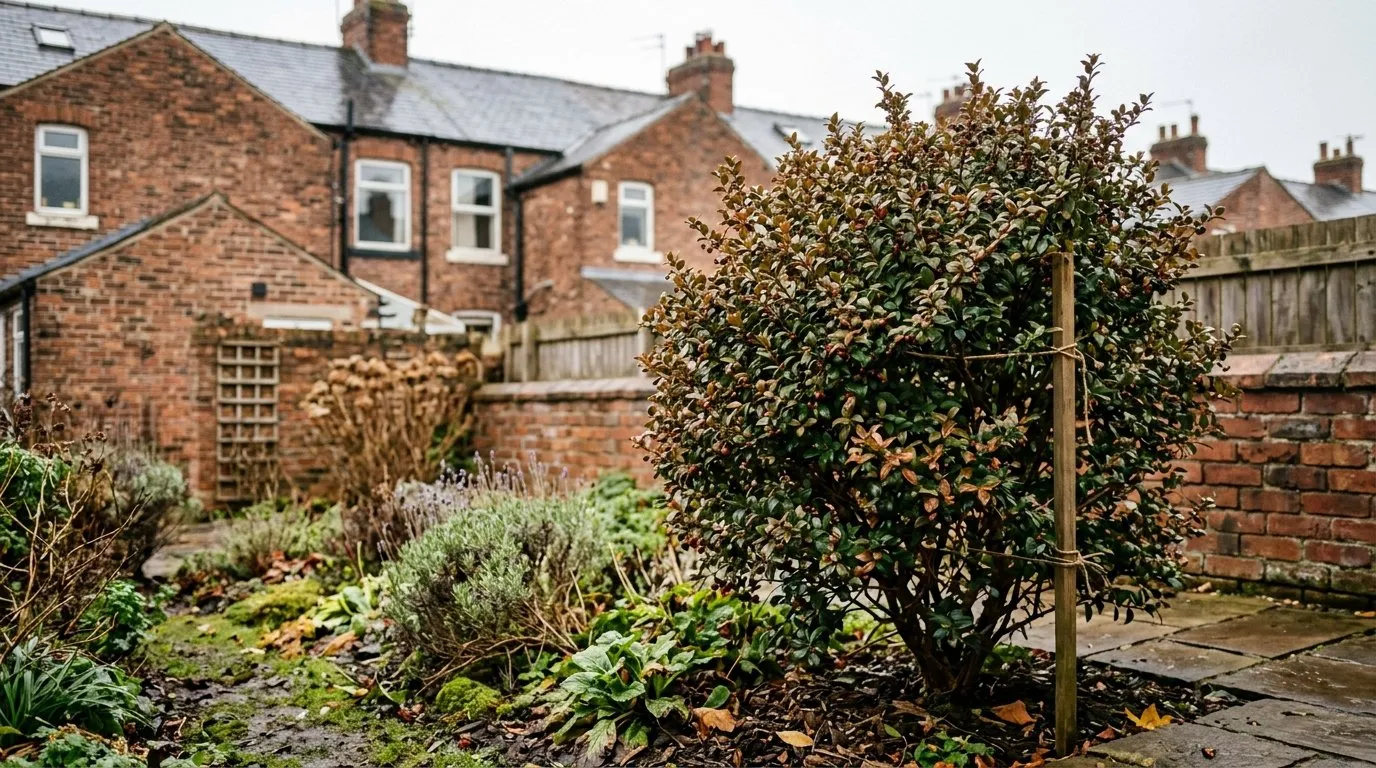 An established plant holds its leaves right through a northern winter. The bronze tinting on the foliage is normal and not a sign of damage.
Why wet clay kills more plants than frost does
This is the root cause of most Chilean guava failures in Britain, and almost everyone blames the wrong thing.
When a plant dies over winter, gardeners record it as frost damage. The plant was outside, it got cold, it died. But Ugni molinae evolved in the temperate rainforests of southern Chile on free-draining volcanic soils. It is adapted to high rainfall and cold nights. What it never meets there is standing water sitting around its roots for weeks.
The roots are the tell. Chilean guava is shallow-rooted, with most of the fine feeding roots in the top 200mm to 300mm of soil. That is exactly the zone that stays saturated on heavy clay from November through March. Those fine roots need oxygen. Waterlogged soil has none, the roots suffocate and begin to rot, and secondary fungal problems follow. The plant may hold its leaves for months, then collapse in the first warm spell of spring when it suddenly needs water and has no working roots to take it up.
That delayed collapse is why the cause gets missed. The plant dies in March, so nobody blames the water it was standing in during January.
The permanent fix is not fleece or a warmer spot. It is drainage. Put the plant where winter water physically cannot sit around the roots: a container, or a raised bed of ericaceous mix lifted 300mm above the surrounding soil. Solve the water and the cold stops mattering.
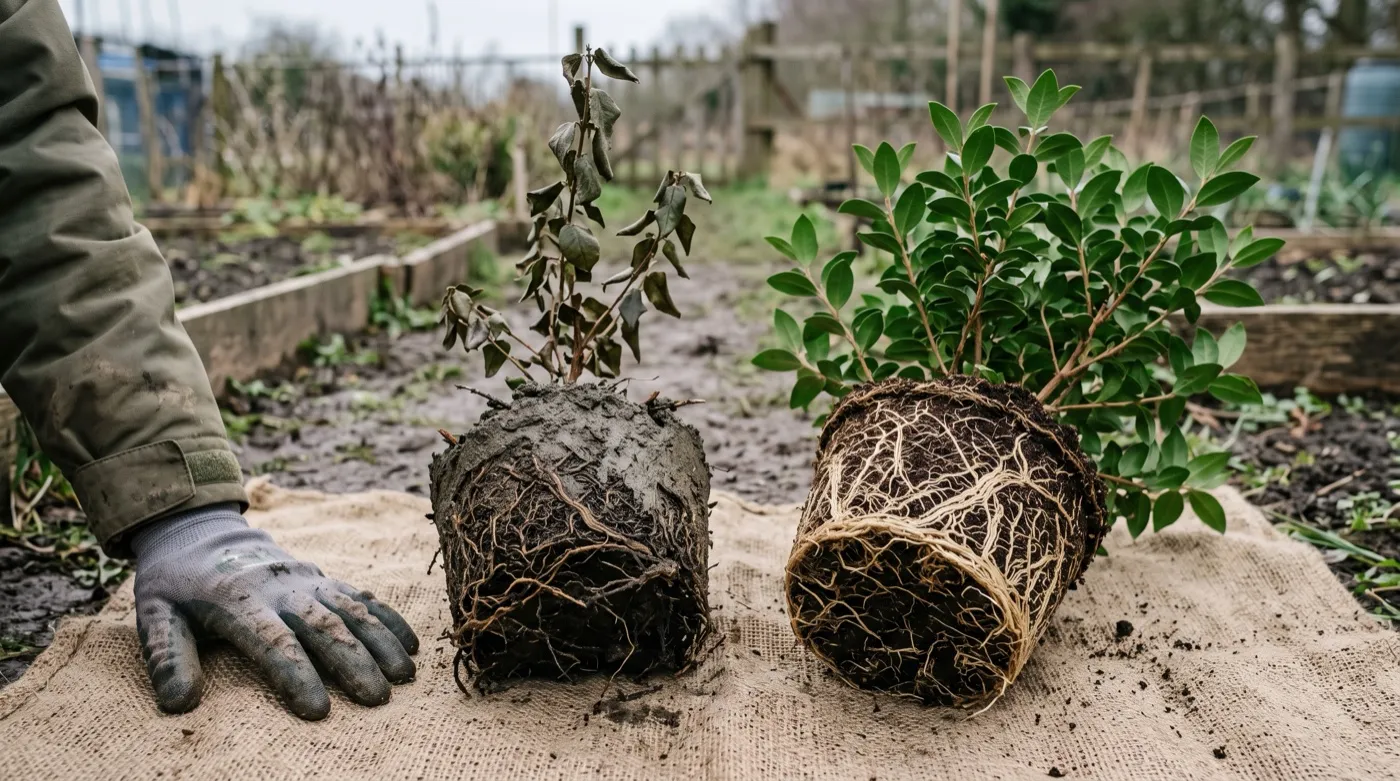 The plant on the left drowned in clay over winter. Dark, collapsed fine roots on one side, pale fibrous roots on the other. The difference is drainage, not temperature.
Warning: Do not try to fix heavy clay by digging a planting hole and backfilling it with ericaceous compost. You have built a sump. Water drains through the compost, hits the clay wall, and fills the hole from the bottom. The plant sits in a bucket of water all winter. Raise the bed above the clay or use a container instead.
Soil, pH and the ericaceous question
Chilean guava is a member of the Myrtaceae, the myrtle family, and it wants acid soil. Target pH 5.0 to 6.5. Above about pH 7.0 it cannot take up iron efficiently, and you get lime-induced chlorosis: yellow leaves with green veins, weak growth and no fruit.
If you garden on chalk, do not attempt open ground. No amount of ericaceous compost dug into a chalk soil will hold its pH, because the surrounding ground buffers it straight back up within a season or two. The techniques in our guide to making soil more acidic work in a container but will not hold a chalk border in range.
Water is the part people forget. In hard water areas, tap water runs at pH 7.5 to 8.5 and carries dissolved calcium. Watering an ericaceous container with tap water all summer raises the pH of the compost steadily. Over two seasons that alone can push a container out of range. Use rainwater from a butt wherever you can. A 200 litre butt fed off a shed roof covers one or two containers through an average summer.
Feed with an ericaceous liquid feed from April to August, roughly every two weeks at half strength. Chilean guava is not a hungry plant and overfeeding produces soft growth that gets damaged over winter. If leaves yellow between the veins mid-season, that is iron and manganese lockout rather than a nitrogen shortage. Check the pH before reaching for more fertiliser.
Growing Chilean guava in a container
For most of the UK this is the answer, and it is not a compromise. A container gives you control of the two variables that decide whether the plant lives: pH and drainage.
The same container logic applies to most soft fruit, and our guide to growing fruit in pots and containers covers the watering and repotting side in more depth.
Start with size. A 40 litre pot is the working minimum for a plant you intend to fruit properly. Anything under 25 litres dries out too fast in summer and freezes through too readily in winter. Terracotta looks right but dries faster than plastic, and a plastic or resin pot is the easier plant to keep alive.
Fill with ericaceous compost and add roughly 20 per cent by volume of horticultural grit. The grit is not optional. Peat-free ericaceous composts slump and compact within two seasons, and the grit keeps air in the mix. Raise the pot on feet so the drainage holes never sit in a saucer of water.
Repot every two to three years. You are refreshing the pH as much as giving the roots room, because compost pH drifts upwards over time. Go up one pot size, or root-prune by about a quarter and return it to the same pot with fresh compost.
Over winter, move the container against a house wall on the south or west side. That single move buys 2C to 3C on a cold night and, more usefully, keeps the worst of the rain off the compost. In a hard freeze, wrap the pot itself rather than the plant. The roots are what need protecting; the evergreen top is tougher than it looks. Our guide to winter care for potted fruit trees uses the same principle on a larger scale.
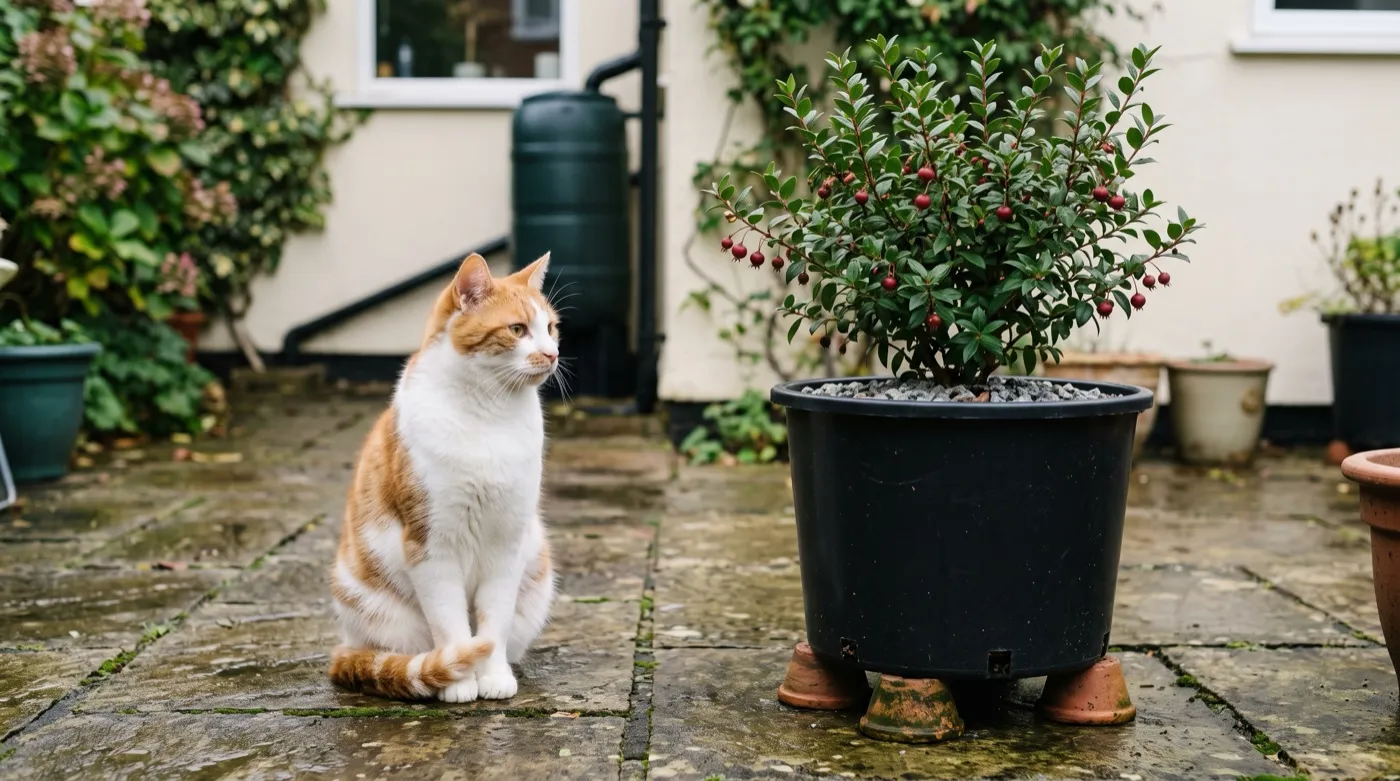 A 40 litre tub on pot feet against a house wall. The grit mulch keeps the compost surface open and the pot feet stop it standing in water.
The flowering and fruiting year, stage by stage
Understanding this sequence is what fixes the harvest problem. The plant runs to a long, slow schedule that is unlike any other UK soft fruit.
- Bud break, March to April. New growth starts once soil temperature holds above roughly 8C. Bronze-tinted new leaves appear at the shoot tips.
- Flower bud formation, April to May. Buds form on the previous year’s wood. This is why hard pruning in spring costs you the entire crop.
- Flowering, May to June. Small pink or white bell-shaped flowers, 6mm to 8mm across, hang beneath the shoots. They are easy to miss and quietly one of the prettiest things in the garden.
- Pollination and fruit set, June. The plant is self-fertile, so a single bush will set fruit. Bees work the flowers readily. A second plant improves set markedly.
- Fruit development, June to September. Roughly 130 days from flower to ripe berry. The fruit sits green and unremarkable for most of the summer, which is why people forget it is there.
- Colouring, early to mid October. The berries turn red. This is not ripeness.
- Sugar accumulation, mid October to November. Over the following two to three weeks the sugars and aromatic compounds develop. This is the stage that makes the fruit worth growing.
The critical mistake is harvesting at stage 6 instead of stage 7. Every other berry in a British garden is ripe when it is coloured. This one is not. Colour arrives two to three weeks before flavour, so gardeners pick in early October, taste something thin and resinous, and conclude the plant was not worth the effort. It is the single most common reason people give up on Chilean guava.
| Condition | Effect on the crop |
|---|---|
| Soil above 8C in March | Triggers bud break and new growth |
| Sustained 18C+ in June | Good fruit set, heavier crop |
| Cool, dull August below 16C | Slows development, pushes ripening into November |
| First frost before berries ripen | Fruit survives light frost; flavour often improves |
| Air below -10C | Leaf and shoot damage likely |
| Waterlogged roots above 0C | More lethal than any of the above |
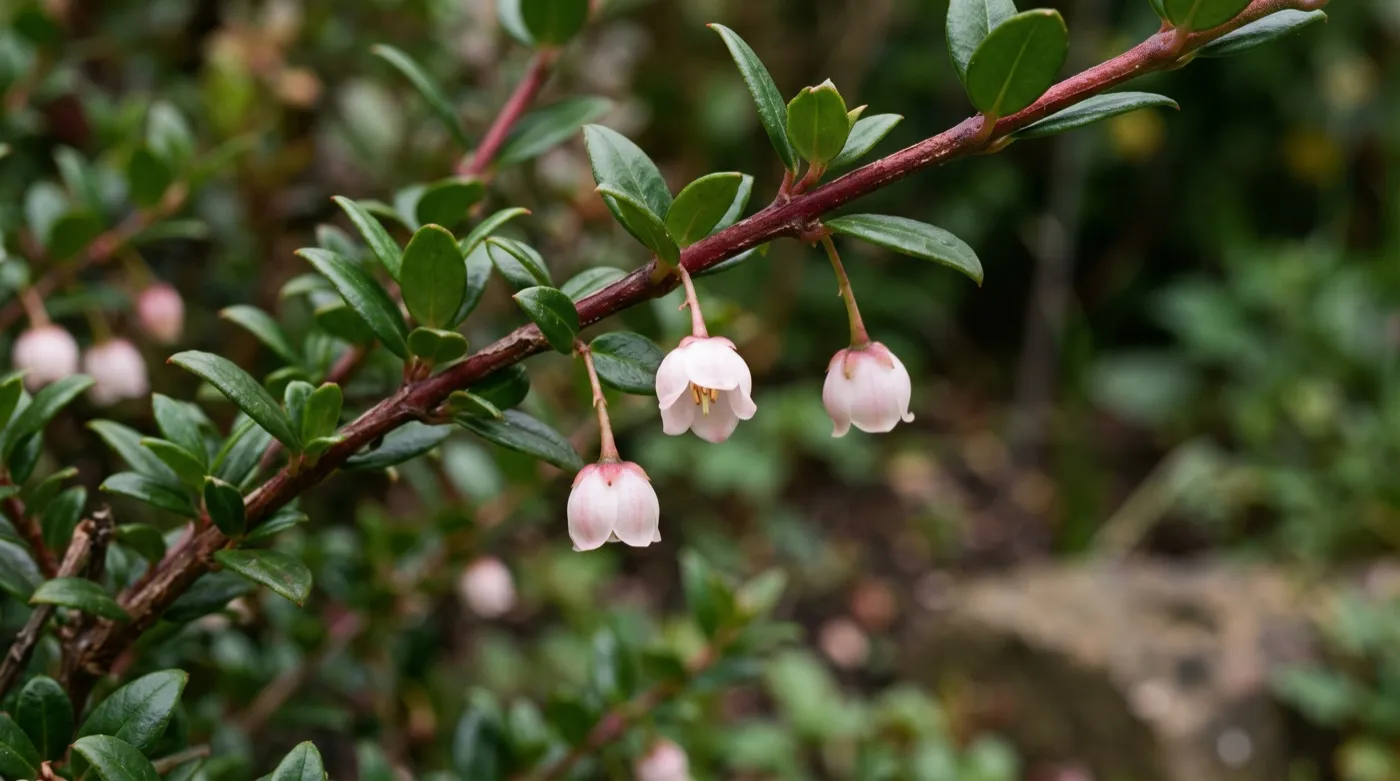 The bell flowers open in May and June and hang under the shoots at 6mm to 8mm across, so they are easy to walk past entirely.
Ways to grow Chilean guava in Britain, ranked
The gold standard is the 40 litre container. It is not the most elegant answer but it is the one that works from Kent to Aberdeen, because it removes both variables that kill the plant. Fleece is the entry that deserves the most suspicion: it addresses cold, and cold is not what is killing your plant.
Month-by-month Chilean guava calendar
| Month | Task |
|---|---|
| January | Check container is not waterlogged. Knock ice off the surface if capped |
| February | Order plants from specialist nurseries before spring stock sells out |
| March | Top-dress containers with 25mm of fresh ericaceous compost |
| April | Start ericaceous feed at half strength, every two weeks. Watch for bud break |
| May | Flowering begins. Do not prune. Keep the compost evenly moist |
| June | Peak flowering and fruit set. Water with rainwater in dry spells |
| July | Take semi-ripe cuttings. Keep watering; drought stress now costs autumn fruit |
| August | Last feed of the season. Continue watering through any dry spell |
| September | Ease off watering. Berries are green and swelling |
| October | Berries colour up. Do not pick yet. Start weekly taste tests mid-month |
| November | Harvest. Pick when berries drop into your hand with no tug. Move pots to a wall |
| December | Wrap containers in a hard freeze. Protect the pot, not the plant |
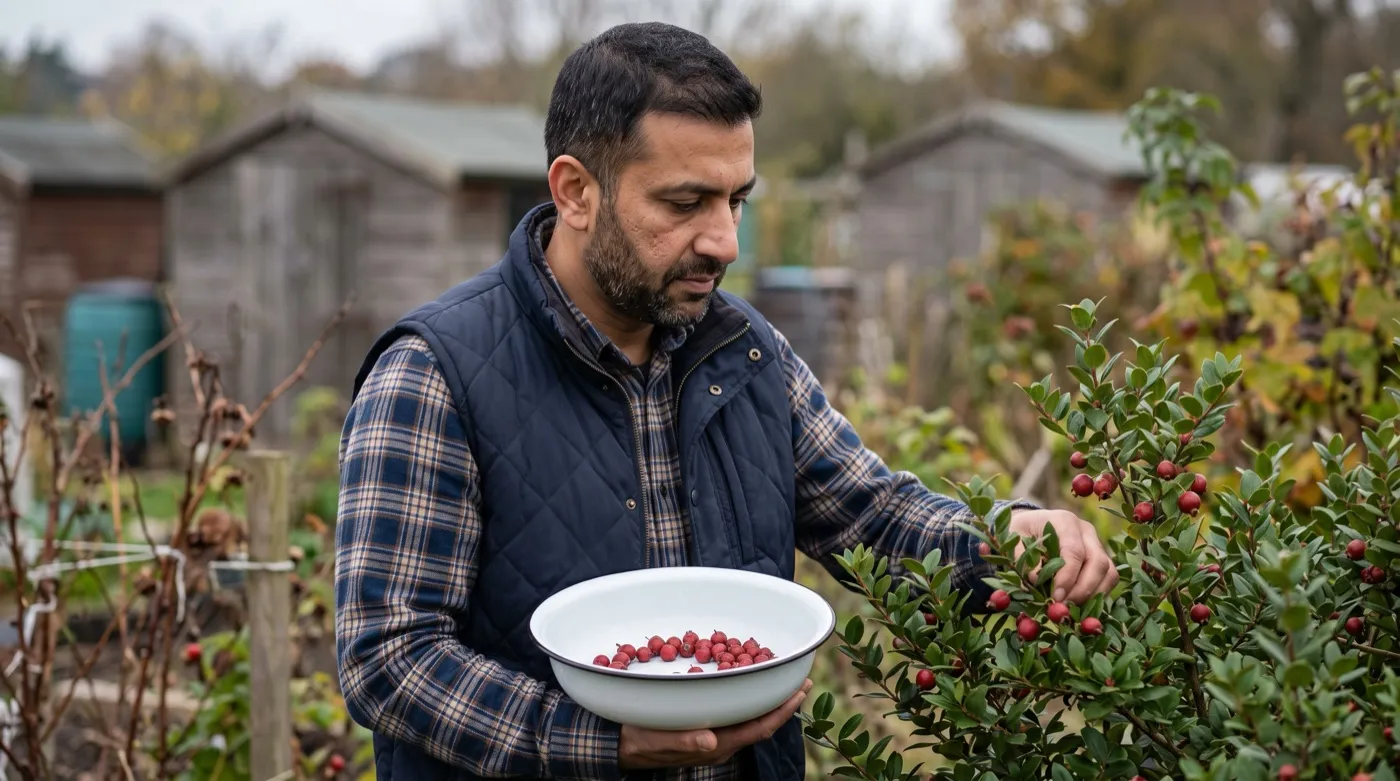 A November picking. A mature bush gives a bowl rather than a glut, which is the honest trade for fruit this late in the year.
Taking semi-ripe cuttings in late summer
Chilean guava propagates well, which matters when a single plant costs £12 to £18. Semi-ripe cuttings are the reliable route, and July to early September is the window.
Take material where the shoot is firm at the base but still soft at the tip. Cut lengths of 100mm to 120mm, strip the leaves from the lower half, and trim the base just below a leaf node. Dip in hormone rooting powder. Insert around the edge of a pot of 50:50 ericaceous compost and perlite.
The wider method is covered in our guide to propagation by cuttings, division and layering. Keep the cuttings out of direct sun and under a propagator lid or a clear bag. Pot on individually once roots show at the drainage holes, and overwinter the young plants somewhere frost-free for their first winter. They are noticeably more tender in year one than an established bush.
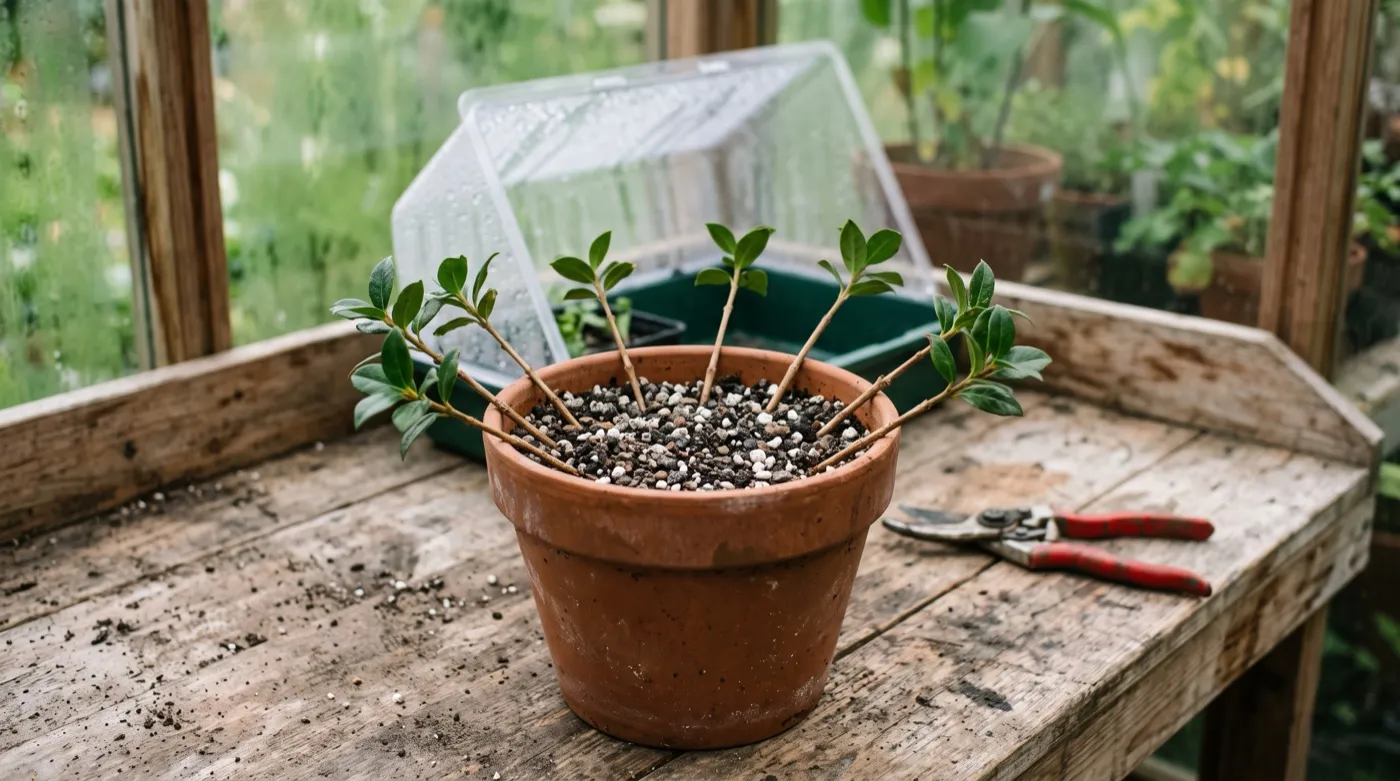 Semi-ripe cuttings taken in July, set around the edge of a pot of ericaceous compost and perlite. Bottom heat at 20C is what lifts the strike rate.
Where to buy Chilean guava, and which cultivar to pick
Ordinary garden centres do not stock this plant. You are ordering online from a specialist, and there are two named cultivars worth knowing about.
‘Ka-Pow’ is the heavier cropper and the one to choose if fruit is the point. ‘Villarrica’ is a more compact plant, better suited to a smaller container, with slightly smaller berries. Unnamed seedling stock is sold simply as Ugni molinae and is perfectly good, though cropping is more variable plant to plant.
Common mistakes with Chilean guava
- Picking as soon as the berries turn red. Colour comes two to three weeks before sugar. Early-picked fruit tastes thin and resinous, and it is the main reason people write the plant off. Taste weekly from mid-October and pick nothing until it releases with no tug.
- Planting into a hole of ericaceous compost in clay. This builds a sump that fills with water all winter and rots the roots. Raise the bed above the clay, or use a container.
- Watering an ericaceous container with hard tap water. Tap water at pH 7.5 to 8.5 drags the compost pH up over two seasons until the plant yellows. Use rainwater from a butt.
- Pruning in spring. Flower buds form on the previous year’s wood. A tidy-up in March removes the entire crop. Prune lightly straight after harvest instead, if at all.
- Blaming frost for a March death. A plant that collapses in the first warm spell of spring drowned in January. The symptom is delayed by months, which is why the cause gets missed.
Is Chilean guava worth the trouble?
Honestly, it depends on what you want from it. If you measure a fruit plant by weight of crop per square metre, Chilean guava loses to almost everything. A mature bush gives you a decent bowl of berries, not a glut. You are not going to fill a freezer.
What you get instead is a fruit nobody else has, ripening in a month when the rest of the garden has finished. There is real value in walking out on a grey November afternoon and picking something worth eating. The plant is evergreen, so it looks like a garden plant for the other eleven months rather than a row of bare canes. The flowers in May are genuinely lovely.
If it suits you, lingonberries want almost identical conditions and can share the same ericaceous bed. Both sit among the more rewarding options in our growing guides.
For a gardener in Cornwall or west Wales on acid soil, it is an easy recommendation: plant it in the ground and get on with something else. For the rest of us it is a container plant that asks for rainwater, ericaceous compost and a wall to sit against over winter. That is a fair price for the only berry in Britain that ripens in November.
Now you know what Chilean guava needs, read our guide to growing blueberries in the UK for the other acid-loving fruit that thrives in exactly the same ericaceous container setup.
Frequently asked questions
What does Chilean guava taste like?
Wild strawberry with an aromatic, slightly perfumed note behind it. The guava comparison is about the scent rather than the flavour. Fully ripe berries are sweet and dense, closer to a good alpine strawberry than to any shop fruit. Picked early they taste thin and faintly resinous, which is why harvest timing matters more than anything else.
Is Chilean guava hardy in the UK?
Yes, to roughly -10C, which is RHS rating H4. That covers most of the UK in an average winter. The bigger risk is wet soil rather than cold air. A plant sitting in waterlogged clay at 2C will die faster than a plant in free-draining compost at -8C.
Do I need two Chilean guava plants to get fruit?
Can I grow Chilean guava in a pot?
Yes, and in most of the UK a pot is the better option. Use a 40 litre container of ericaceous compost. Containers let you control the pH and the drainage, which are the two things that kill this plant. They also let you move it against a wall for the winter.
When do Chilean guava berries ripen?
October and November, later than any other outdoor soft fruit in Britain. Flowers open in May and June, and fruit takes roughly 130 days to develop. In a cool northern summer ripening can slip into late November. That late window is the plant’s main selling point.
Where can I buy Chilean guava in the UK?
Otter Farm in Devon is the established specialist source. Expect £12 to £18 for a 9cm plant. Some specialist nurseries stock the named cultivars ‘Ka-Pow’ and ‘Villarrica’. Ordinary garden centres almost never carry it, so order online in spring or autumn.
Will Chilean guava grow on chalk or clay soil?
Not in open ground. It needs acid soil at pH 5.0 to 6.5. Chalk locks up iron and causes yellowing leaves. Heavy clay holds winter water around the roots and rots them. On either soil, grow it in a container of ericaceous compost instead.
Our team produces practical UK gardening guidance from source research, contributor records and established horticultural practice. Editorial standards are overseen by Matt W.