Key takeaways
- Not GM and not a hybrid: it is a hand-grafted union, which is why it costs £15 to £20
- Both crops are genuinely real, but yields run around 55 to 60% of plants grown separately
- Blight risk doubles because both host species sit on one plant with a shared sap system
- It is an annual and the graft cannot be propagated at home, so you rebuy every year
The TomTato arrived in 2013 with a headline nobody could resist: one plant, tomatoes above and potatoes below. Thompson & Morgan sold it as a British horticultural first, and the press ran with it. More than a decade on, the plant is still sold every spring and gardeners still ask the same question. Does it actually work, or is it a gimmick with a £17 price tag?
What a TomTato actually is
A TomTato is a grafted plant. A tomato shoot, the scion, is physically joined to a potato plant’s root system, the rootstock. The join is called the graft union, and on a shop-bought plant you can usually see it as a slight swelling or a small clip 50mm to 80mm above the compost.
It is not genetically modified. It is not a hybrid, and no breeding took place. Nobody crossed a tomato with a potato. Two ordinary plants were cut and taped together, and they fused. This distinction matters because the plant is regularly described as a GM curiosity in comment threads, and that is simply wrong.
Thompson & Morgan launched it in the UK in 2013. An equivalent product, Ketchup ‘n’ Fries, appeared in the United States around the same time. Both rely on the same technique and neither is patented magic; grafting is centuries old.
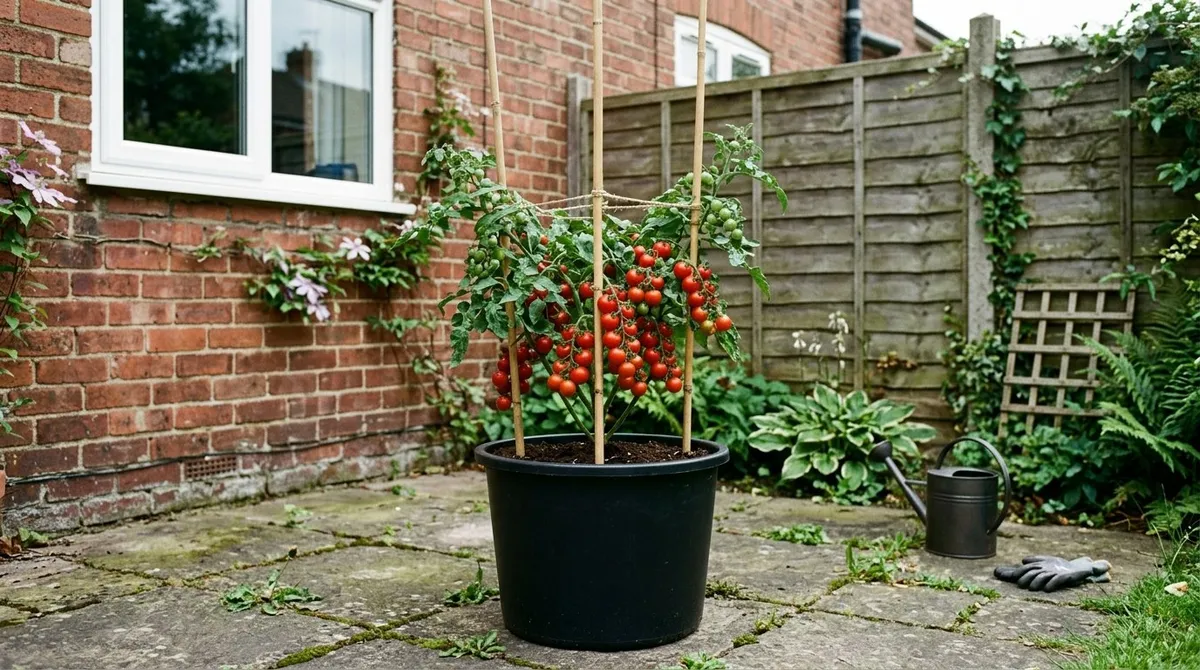
What you buy is a single plant in a pot, usually despatched from late April. Above the union it behaves like a cherry tomato. Below it, unseen, a potato plant is forming tubers in the compost. The whole thing is one connected vascular system, and that connection is the source of both the appeal and the disappointment.
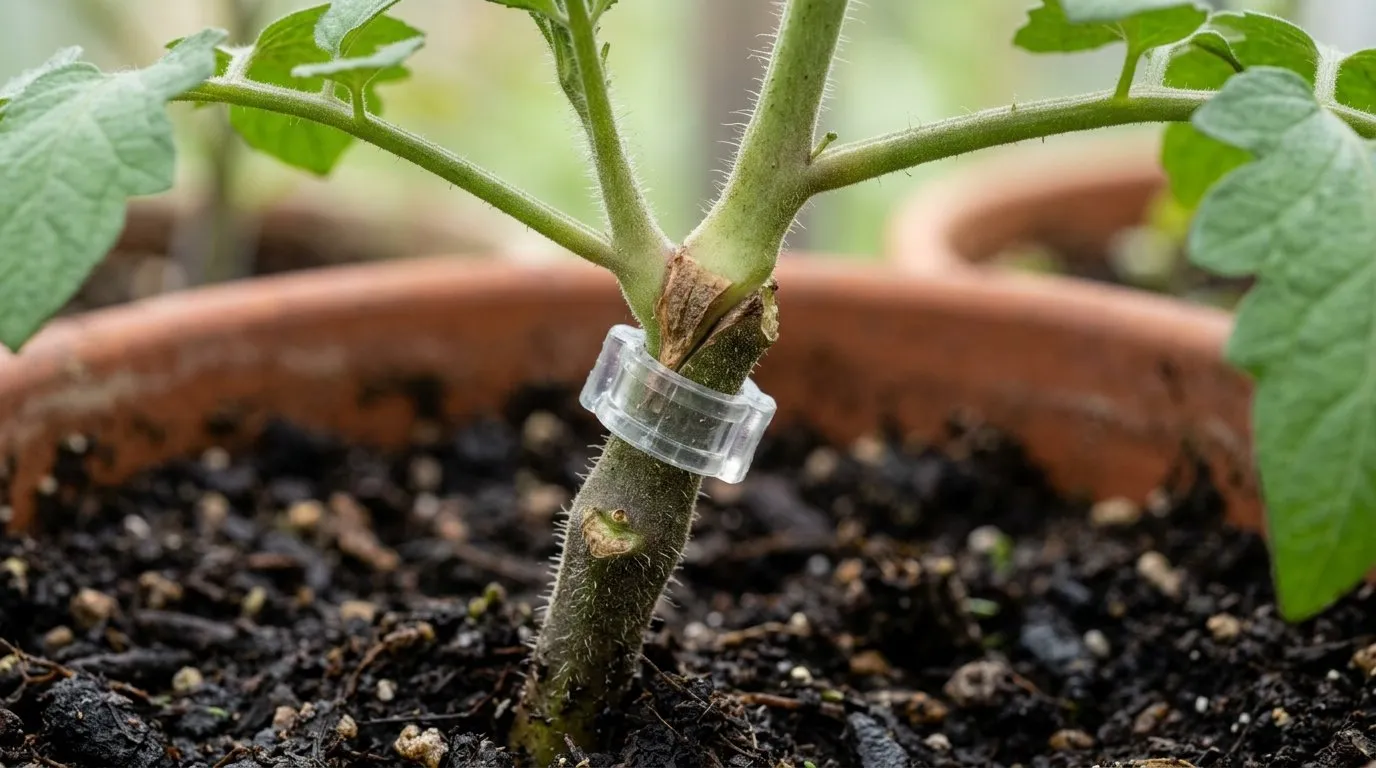 The graft union, roughly 60mm above the compost. The slight swelling and the healed scar are where the tomato scion was joined to the potato rootstock by hand.
Why tomato and potato will graft together
Grafting only works between closely related plants, and these two are far closer than most people realise.
Both belong to the genus Solanum. The tomato is Solanum lycopersicum and the potato is Solanum tuberosum. Same genus, same family, the Solanaceae, alongside aubergines, peppers and deadly nightshade. That relatedness is what allows the graft to take.
For a graft to succeed, the cambium of scion and rootstock must line up. The cambium is a thin layer of actively dividing cells just under the bark or skin. When the two cambium layers meet under warm, humid conditions, they produce callus tissue, that callus differentiates into new xylem and phloem, and the two plants become one plumbing system. Xylem carries water and minerals up from the potato roots. Phloem carries sugars down from the tomato leaves.
The union takes roughly 7 to 14 days to form at 22C to 25C in high humidity, which is why commercial grafting happens in a controlled healing chamber rather than on a windowsill.
Here is the part that explains the price. Every union is cut and joined by hand. There is no machine and there is no seed. A worker makes a matching diagonal cut on each plant, clips them together, and the plant spends two weeks healing, during which a percentage fail. That labour and that failure rate is why a novelty plant costs £15 to £20 rather than the £2 a seed-raised tomato costs. If you want the technique behind it, our guide to grafted vegetable plants in the UK covers why commercial growers graft in the first place.
The TomTato yield question, answered with scales
This is the section the marketing does not write, and it is the only reason to read an article about this plant rather than a product listing.
Thompson & Morgan have advertised figures in the region of 500 cherry tomatoes plus a crop of potatoes from a single plant. Treat that as a best case under ideal conditions, not a forecast for a patio in Staffordshire.
The TomTato delivered 58 per cent of the tomato crop and 56 per cent of the potato crop. Two plants’ worth of output, at a bit over half strength each. Repeating it with two plants in 2024 gave 1.7kg and 1.0kg, so the pattern held.
The root cause is source-sink competition, and it is not a fault in the plant. One root system supports two developing crops that both want the same sugars at the same time. Tomato fruit and potato tubers are both sinks: tissues that import sugar rather than make it. The leaves are the source. From July to September those two sinks are drawing on one shared pool of photosynthate through one shared phloem system, and neither gets what a dedicated plant would.
Why is this missed? Because the marketing frames the plant as two crops in the space of one, and gardeners read that as additive. It is not additive. It is divided. Once you understand that the limit is the root system rather than the grafting, the modest yields stop being a disappointment and start being arithmetic.
There is no fix that makes it additive. The permanent answer is to size the container generously, feed properly, and set your expectations to roughly 60 per cent of each crop. Anyone chasing weight should grow the two crops separately.
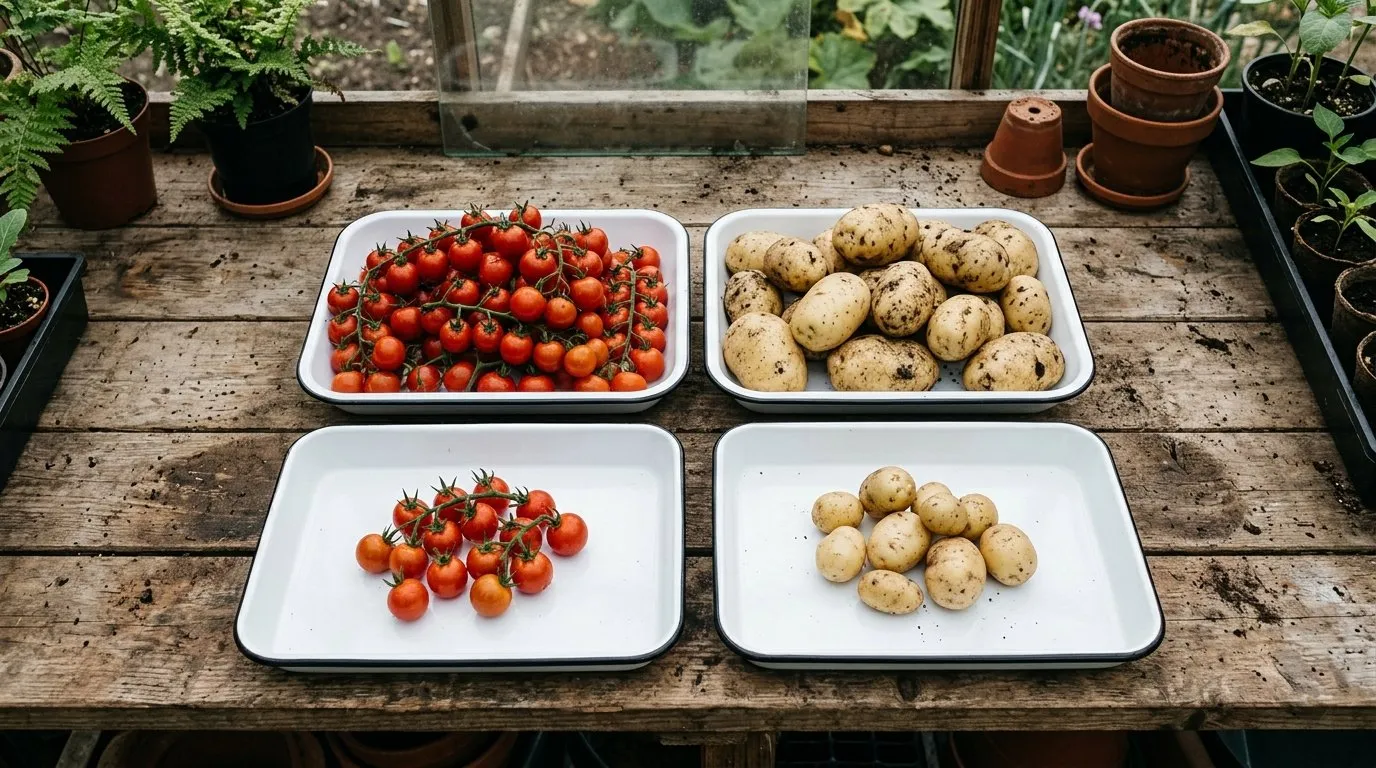 The 2023 trial laid out. TomTato crops on the near trays, solo control crops behind. Both crops are real. Both are roughly 60 per cent of a dedicated plant.
TomTato compared with growing the two crops separately
Ranked by total useful output, with what each approach cannot do for you.
| Method | Tomatoes | Potatoes | Effectiveness | Role | What it cannot do |
|---|---|---|---|---|---|
| Separate tomato and potato, two 40L tubs | 3.1kg | 1.6kg | 100%, the gold standard | Primary | Cannot fit one container footprint; needs twice the space |
| TomTato in a 45L tub, fed properly | 1.8kg | 0.9kg | ~57% | Supplementary, novelty | Cannot match a solo crop; cannot be saved or propagated |
| Tomato alone in a 40L tub | 3.1kg | none | Tomatoes only | Primary for tomatoes | Cannot give you any potatoes |
| Potato alone in a 40L tub | none | 1.6kg | Potatoes only | Primary for potatoes | Cannot give you any tomatoes |
| TomTato in a 30L tub | 1.1kg | 0.4kg | ~32% | Not recommended | Cannot supply enough root volume for two crops |
| TomTato earthed up over the union | 1.9kg | 0.2kg | ~24% total | Not recommended | Cannot form tubers once the scion self-roots |
The gold standard for yield is two separate plants in two tubs. That is not a close call. The TomTato’s honest role is supplementary: it buys you a talking point and a genuine second crop from one container footprint, at a real cost in weight.
The last row deserves attention. Earthing up over the graft does more damage than halving the pot size, and it is the single most avoidable failure on this plant.
Container size decides your crop
Root volume is the hard limit on a plant feeding two crops, so the container is not a detail.
Depth matters as much as volume. Tubers form in the compost below the union, so you want at least 300mm of depth beneath the plant. A wide shallow planter of the same litreage crops worse than a deep tub.
Drainage has to be right. Drill or check for at least four 10mm holes and stand the tub on feet. Waterlogged compost rots developing tubers and, in a container carrying two crops, you have no margin.
Fill with a soil-based compost such as John Innes No. 3, or a good peat-free multipurpose with around 20 per cent loam mixed in. The reason is water buffering. A pure multipurpose in a 45 litre tub swings between saturated and bone dry, and irregular watering is what splits the tomatoes and produces hollow, knobbly tubers. Our guide to growing potatoes in buckets and containers covers the same container logic for a straight potato crop.
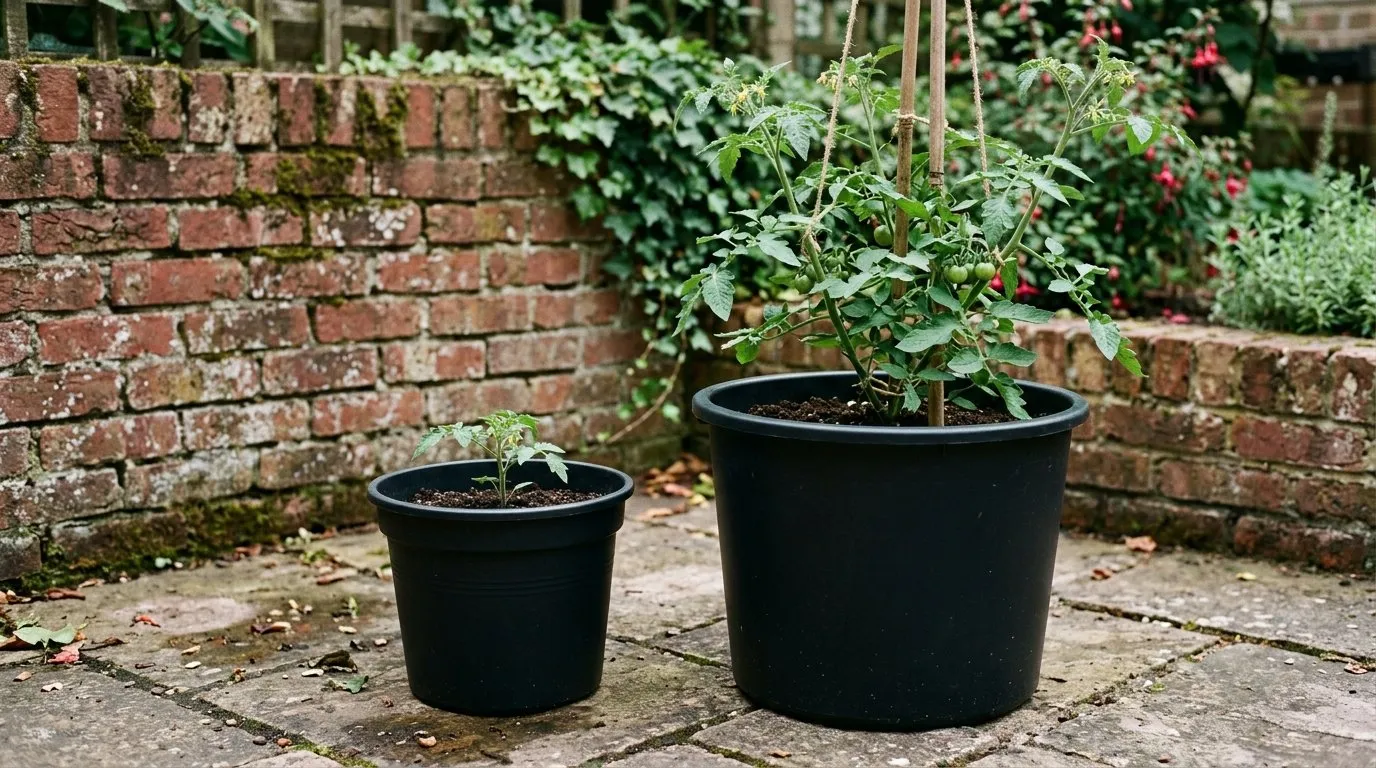 Same variety, same compost, same feed. The plant in the 30 litre pot on the right ran out of root room and cropped roughly a third lower on both counts.
Feeding two crops from one root system
The feeding question sounds like a conflict and mostly is not, with one real exception.
Potash suits both crops. Tomatoes need it for fruit set and ripening, and potatoes need it for tuber bulking. A standard high-potash tomato feed at roughly 4-5-8 NPK serves both, so the usual advice to feed tomatoes weekly from first truss does not harm the potatoes at all.
Nitrogen timing is where they diverge. A young potato plant wants nitrogen early to build foliage before tuber initiation. A tomato given too much nitrogen makes leaf instead of fruit and delays the first truss. On a TomTato both demands land on one root system at once.
What works: use a balanced feed at half strength weekly for the first three to four weeks after planting out, then switch to high-potash tomato feed weekly once the first truss sets, and stay on it. That gives the potato the early nitrogen it needs while the tomato is still building, then swings to potash for the rest of the season when both crops are bulking.
Do not overfeed to compensate for the shared root system. Extra fertiliser does not create extra photosynthesis, so it will not lift the yield ceiling. It scorches roots in a container and pushes soft, blight-prone growth on a plant that already has double the blight exposure.
Water consistently. A 45 litre tub in July can need 4 to 5 litres a day in a hot spell. Erratic watering splits tomato skins and causes hollow heart in tubers.
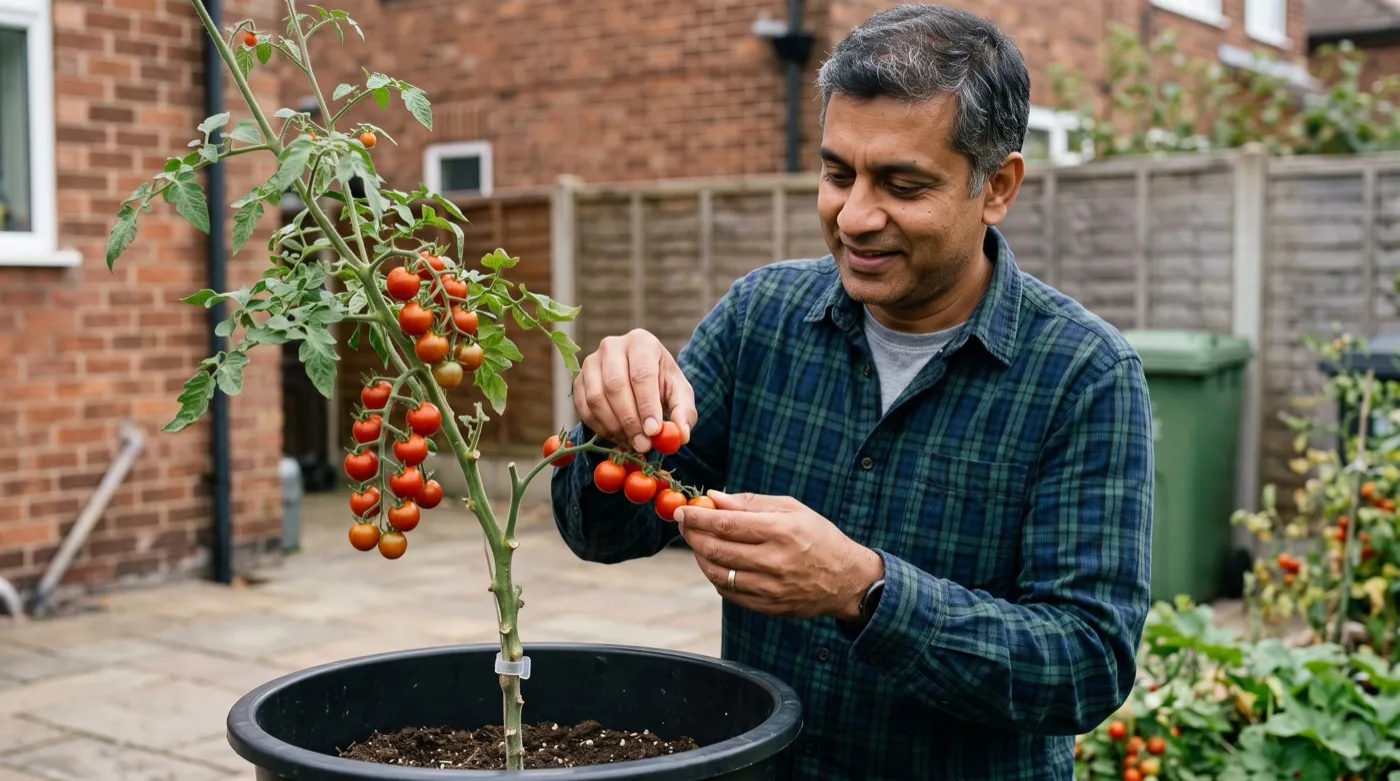 Picking the top crop in August. Above the union it behaves like any cherry tomato, and ripe fruit left on the plant slows everything behind it.
Gardener’s tip: Feed at the base with a watering can and keep the foliage dry. On a plant hosting two blight-susceptible species, wet leaves in warm humid weather are the exact conditions blight needs. This single habit does more for a TomTato than any fungicide you can buy over the counter.
Never earth up over the graft union
This is the warning that matters most, and it catches experienced gardeners rather than beginners. Anyone who has grown potatoes has earthed up hundreds of times, and the hand does it without asking the brain.
Earthing up means mounding soil or compost up the potato stem as it grows. On a normal potato it is essential: it stops tubers greening in the light and encourages more to form along the buried stem. On a TomTato it is a disaster.
The mechanism is straightforward. Mound compost above the graft union and you bury the base of the tomato scion. Tomato stems root readily from anywhere along their length, so within two to three weeks the scion has pushed its own roots into the mound. From that point the tomato is feeding itself directly and no longer needs to draw through the potato. The potato becomes a spare part. Tuber development slows or stops, and you lift marbles in October.
You can safely top up compost below the union to cover any greening tubers near the surface. You must never bring it above. Mark the union height with a cane on planting day.
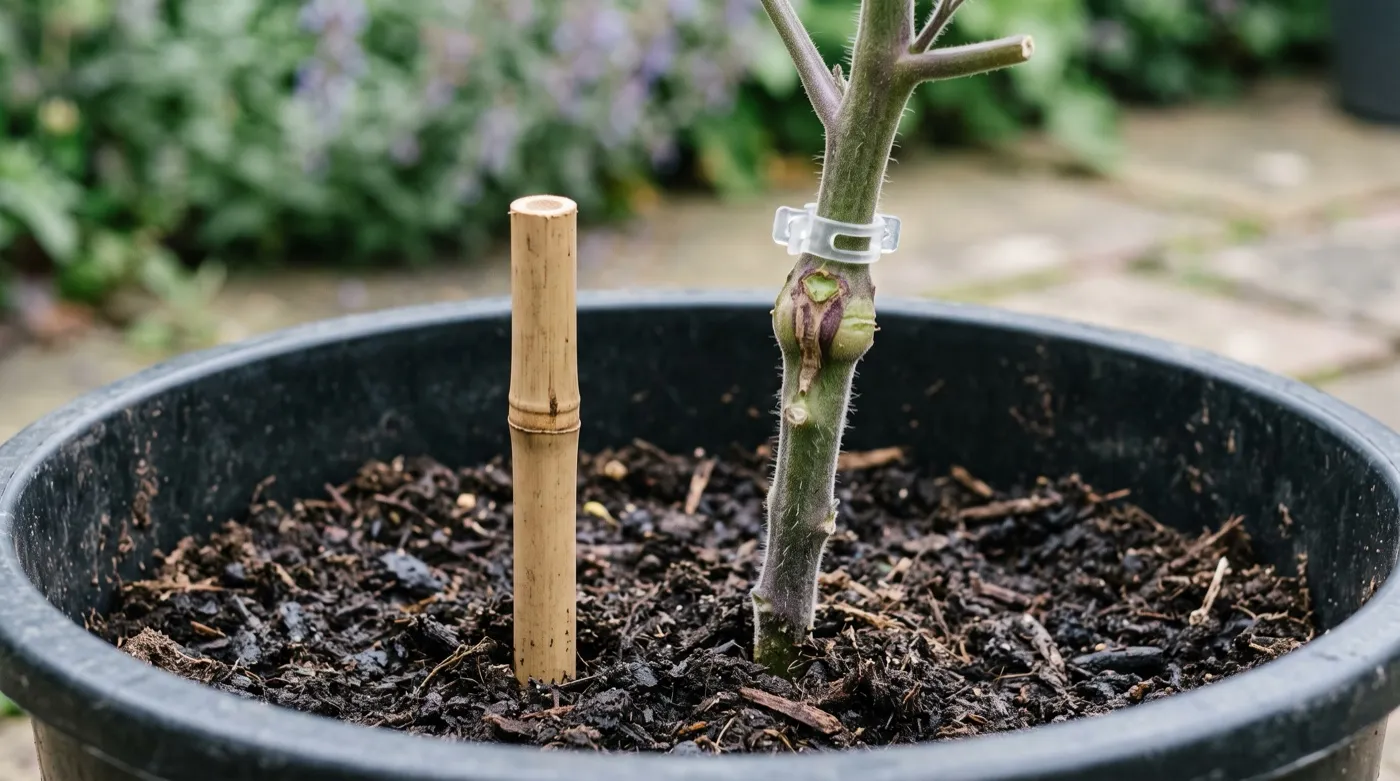 The cane is cut off level with the union and pushed in alongside the stem on planting day. It costs nothing and it stops thirty years of earthing-up habit from taking your potato crop.
Warning: If you find the scion has already rooted into a mound, do not cut those roots off. The plant is now depending on them, and severing them mid-season will collapse the tomato crop as well. Accept the poor potato harvest, leave it alone, and mark the union properly next year.
The full technique, and why it works on ordinary crops, is in our guide to earthing up potatoes.
Double the blight risk on a single plant
This is a genuine warning rather than a caveat, and it is under-reported on a plant sold to beginners.
Late blight (Phytophthora infestans) attacks both potatoes and tomatoes. They are the two main host species in a British garden, and a TomTato puts both on one plant, joined by one sap system. You have not doubled your chance of infection so much as removed the firebreak that normally exists between two separate plants in two separate places.
Blight needs warm, humid conditions, classically two consecutive days at 10C or above with 90 per cent humidity for at least 6 hours, the old Smith Period. In practice that means most British Julys and Augusts. Spores arrive on the wind, so keeping a clean plot does not protect you.
On a TomTato, infection starting in the tomato foliage has a direct path to the tubers below through the same plant. Brown lesions with a pale halo appear on leaves, stems blacken, and tomatoes develop firm brown patches. Tubers rot in storage weeks later. Garden Organic and the Agriculture and Horticulture Development Board both track blight outbreaks through the season, and their regional warnings are worth watching if you grow either crop.
Practical defences for a container plant: site it on an open, airy patio rather than a still corner, keep it well away from an allotment potato bed, water at the base only, and remove any affected foliage the moment you see it. If blight takes the top growth, cut the whole plant off at compost level immediately and leave the tubers in place for two weeks before lifting. That gives the spores on the surface time to die rather than being dragged past your tubers as you lift them.
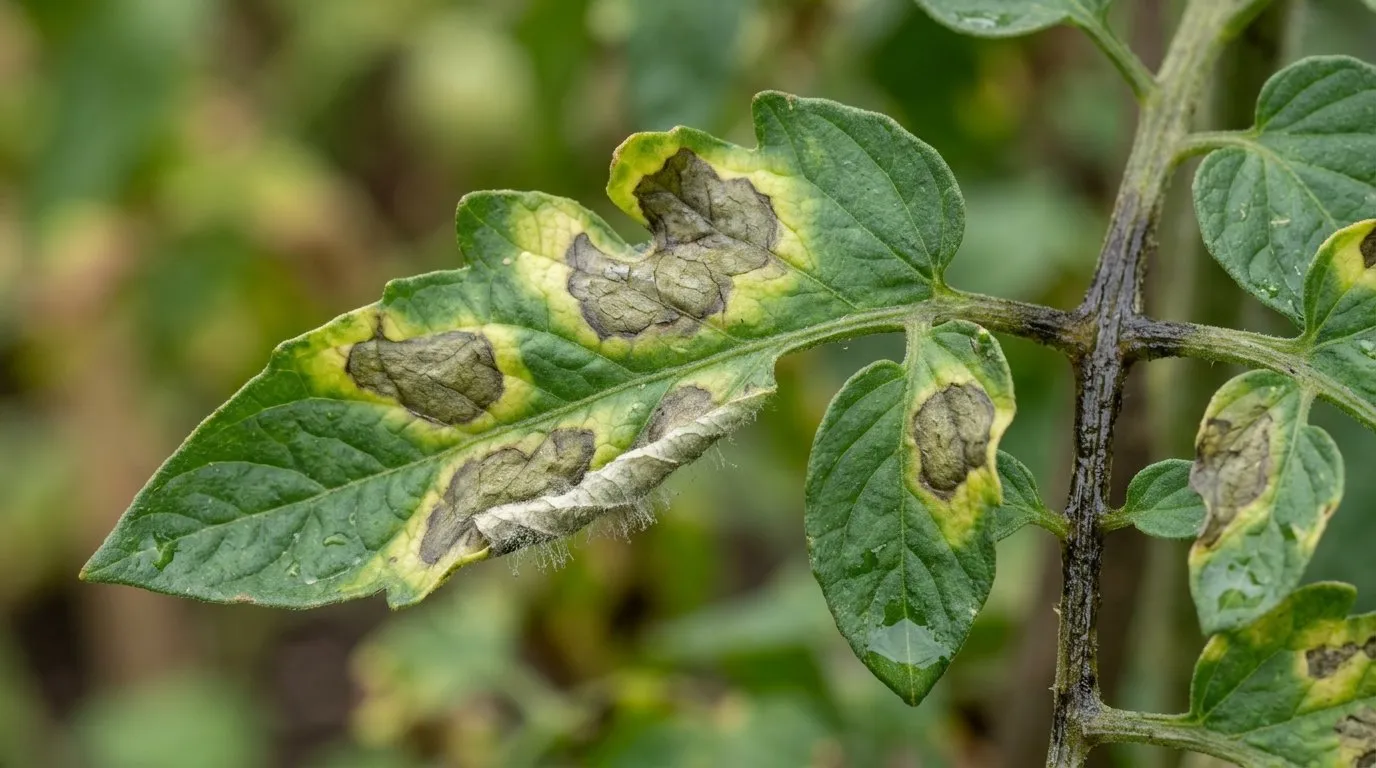 Late blight on the tomato foliage. On a TomTato the same sap system runs straight down to the tubers, so there is no firebreak between the two crops.
There are no blight-resistant TomTatoes. If blight is an annual event in your garden, growing a blight-resistant tomato variety separately is a more sensible use of the space. Our full guide to late blight on potatoes and tomatoes covers identification and treatment.
How the TomTato season runs, stage by stage
- Delivery, late April to May. Plants arrive small, usually 150mm to 200mm tall, already grafted and healed. Pot on but keep them frost-free.
- Hardening off, 10 to 14 days. Move outside by day, in by night. The graft union is fine but the tomato top is tender below 5C.
- Planting out, late May to early June. After the last frost. Plant so the union sits 50mm to 80mm above the final compost level. Mark it with a cane now.
- Establishment, weeks 1 to 4. Balanced feed at half strength. The potato is building foliage and initiating tubers underground while the tomato builds leaf.
- Tuber initiation, roughly 4 to 6 weeks after planting. Triggered as day length and temperature shift. Invisible to you. Nothing to do but water evenly.
- First truss and flowering, June to July. Switch to high-potash tomato feed weekly. Pinch out sideshoots if it is a cordon type.
- Dual bulking, July to September. Both sinks are drawing hard on one source. This is where the yield ceiling shows.
- Tomato harvest, late July to September. Pick regularly. Leaving ripe fruit on the plant slows further ripening.
- Foliage dieback, late September to October. The top goes over naturally, or blight takes it.
- Potato harvest, October. Tip the tub out. Tubers need 2 to 3 weeks after the foliage dies to set their skins.
The critical mistake is lifting the potatoes too early because the tomatoes have finished. The tomato crop finishing tells you nothing about the tubers. They carry on bulking after the top growth slows, and lifting in early September to reclaim the tub can cost a third of the potato weight. Wait for the foliage to die back, then wait another fortnight.
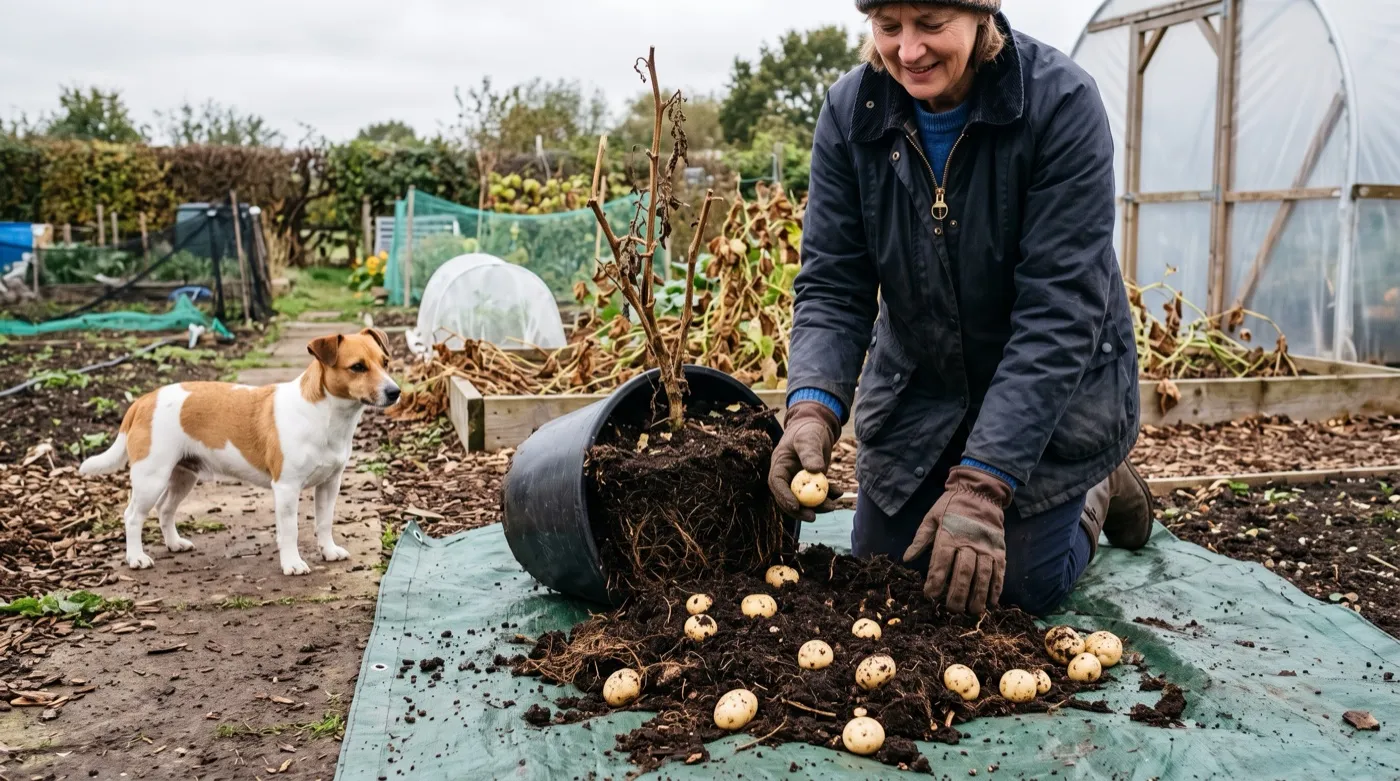 Tipping the tub on the allotment in October. The tomato stem is still visible at the top of the rootball, with the potato crop underneath it.
Month-by-month TomTato calendar
| Month | Task |
|---|---|
| March | Order. Plants sell out and despatch slots fill from late April |
| April | Plant arrives. Pot on into a 2L pot. Keep frost-free at 10C or above |
| May | Harden off over 10 to 14 days. Do not plant out before the last local frost |
| June | Plant into a 45L tub, union 50mm above compost. Cane the union height. Balanced feed |
| July | Switch to high-potash feed weekly. Water 4 to 5L a day in heat. Watch for blight |
| August | Peak tomato harvest. Keep picking. Keep foliage dry |
| September | Last tomatoes. Ease off feed. Let foliage begin to go over |
| October | Lift the potatoes 2 to 3 weeks after the foliage dies. Tip the tub onto a sheet |
| November | Compost the plant. Do not save tubers for seed |
| December to February | Nothing. It is an annual. Decide whether you are rebuying |
Why you cannot save a TomTato for next year
Every year someone tries, and it does not work in either direction.
Saving the tubers gives you a potato. The tubers are pure Solanum tuberosum, produced by the rootstock. Plant one next spring and you get an ordinary ‘Charlotte’-type potato plant with no tomato attached. The graft was a physical join, not a genetic change, so nothing about the tomato passes into the tuber.
Taking a tomato cutting gives you a tomato. Cut a sideshoot above the union and root it in water, which takes about 10 to 14 days, and you have a plain cherry tomato plant on its own roots. Useful, free, and not a TomTato.
Saving the seed gives you a variable tomato. Seed from the fruit is tomato seed, and from a commercial variety it will not come true anyway.
Recreating the graft at home is possible in principle and awkward in practice. You need seedlings of both at matching stem diameter, a clean diagonal cut, a silicone graft clip, and 7 to 14 days at 22C to 25C in near-total humidity while the union heals. Without a humidity chamber the scion wilts before the callus forms. The accessible techniques are covered across our growing guides.
So the plant is an annual with an annual cost. Five seasons of TomTato is £75 to £100. That is worth knowing before you decide it is a permanent fixture.
Who should buy a TomTato, and who should skip it
Buy one if: you are growing with children, you have a single container’s worth of space and want two crops from it, you like novelty plants, or you want to see grafting work at first hand. On a small patio or a balcony where one tub is all you have, the arithmetic changes. Half a tomato crop plus half a potato crop from one footprint genuinely beats a full crop of one thing.
Skip it if: you are growing for the kitchen and measure success in kilos, you already have two containers spare, blight is an annual event in your garden, or you dislike rebuying a plant every spring. Anyone with the room should grow tomatoes and potatoes separately and eat roughly 75 per cent more from the same two tubs.
Common mistakes with a TomTato
The honest verdict
The TomTato is not a con. The grafting is real, the science is sound, and both crops turn up. It is also not the free lunch the headline implies, because one root system cannot feed two crops the way two root systems can. Roughly 60 per cent of each, from one container instead of two. Whether that is a good trade depends entirely on whether space or weight is your constraint.
Judged as a food plant it is mediocre and expensive. Judged as the most effective demonstration of grafting you can buy for £17, and as a thing that gets a seven-year-old to tip out a tub of compost in October with genuine excitement, it earns its place. Buy it for what it actually is.
If you want more from a single container this summer, read our guide to container vegetable gardening in the UK for crops that pay back the space without a graft.
Frequently asked questions
Is the TomTato genetically modified?
No. It is a hand-grafted plant, not a GM plant and not a hybrid. A tomato shoot is physically joined to a potato rootstock by hand, the same technique used on fruit trees for centuries. No genes are altered or transferred. The grafting is done individually by a person, which is the main reason a plant costs £15 to £20.
Does the TomTato actually produce both crops?
Why does the TomTato cost so much?
Because a person grafts every plant by hand. There is no machine for it and no seed to sow. Each union has to be cut, joined, clipped and healed under controlled humidity, with a percentage failing along the way. That labour, plus the losses, is what puts a novelty plant at £15 to £20 rather than £2.
Can I earth up a TomTato like a normal potato?
No. Never mound compost above the graft union. If the tomato scion roots into the mound it feeds itself and stops drawing through the potato, and your potato crop collapses. Mark the union height with a cane on planting day. You can top up compost below the union, but never above it.
Can I save a TomTato for next year?
No. It is grown as an annual and the graft cannot be recreated at home. Saved tubers grow on as ordinary potatoes with no tomato attached. Tomato cuttings root easily but give you a plain tomato plant. To have one next season you buy another plant.
Is blight a bigger problem on a TomTato?
Yes, the risk roughly doubles. Both potato and tomato are hosts for late blight, and here they share one sap system. Blight arriving on the foliage can move to the tubers through the same plant. Growing in a container on an open, airy patio away from other potatoes is the practical defence.
How big a pot does a TomTato need?
Our team produces practical UK gardening guidance from source research, contributor records and established horticultural practice. Editorial standards are overseen by Matt W.