Key takeaways
- Two plants share the name: annual Iberis umbellata for fast scented colour, evergreen Iberis sempervirens for a white spring carpet
- Sow annual candytuft direct in 1cm drills from March; it flowers in 8-10 weeks and self-seeds for free
- Perennial candytuft drapes over walls, raised beds and rockeries; shear it by a third after flowering to keep it tight
- Give it full sun and sharp drainage; it thrives on poor, chalky, alkaline soil and shrugs off drought
- The flat flowers feed early bees, butterflies and aphid-eating hoverflies, useful next to a veg plot
- It is a brassica relative, so rotate away from cabbages and watch for club root and slugs on young seedlings
The one thing that trips people up is the name. Candytuft covers two very different plants. One is a fast hardy annual you sow fresh each spring. The other is an evergreen perennial that carpets walls and edges for years. This guide covers both, so you can pick the right one for the job.
Two candytufts, one easy plant: annual versus perennial
Candytuft is the common name for Iberis, and garden centres sell it in two quite different forms. Get the two clear in your head before you buy, because they are sown, planted and used in completely different ways.
The first is annual candytuft, mainly Iberis umbellata (garden candytuft) and the taller, scented Iberis amara (rocket candytuft). These are hardy annuals. You sow the seed direct where it is to flower, it grows fast, flowers in a couple of months, sets seed and dies. Umbellata gives domed clusters in white, pink, lilac, mauve and deep carmine on plants 20 to 30cm high. Amara throws fragrant white spikes to about 30cm. Both are lightly scented and both self-seed.
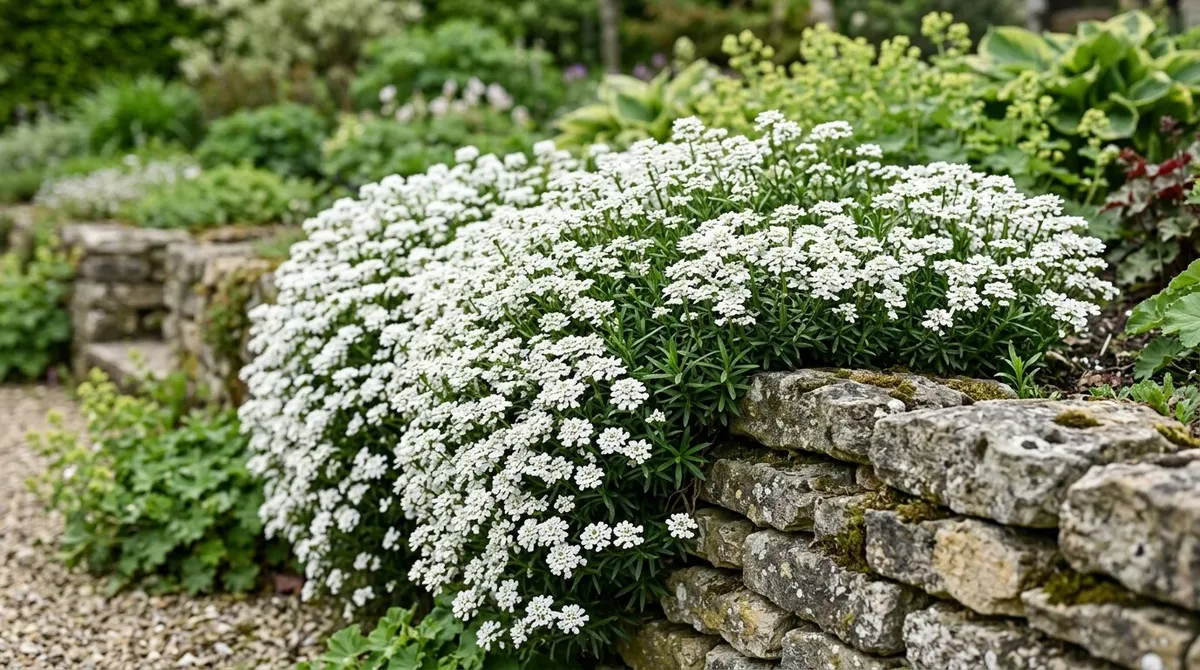
The second is perennial candytuft, Iberis sempervirens. This is an evergreen sub-shrub, not a bedding plant. It forms a low mound of narrow dark green leaves, 20 to 30cm high and 45 to 60cm across, smothered in pure white flower heads every April and May. It lives for years, drapes beautifully over a wall or raised bed, and is one of the best plants there is for softening a hard edge.
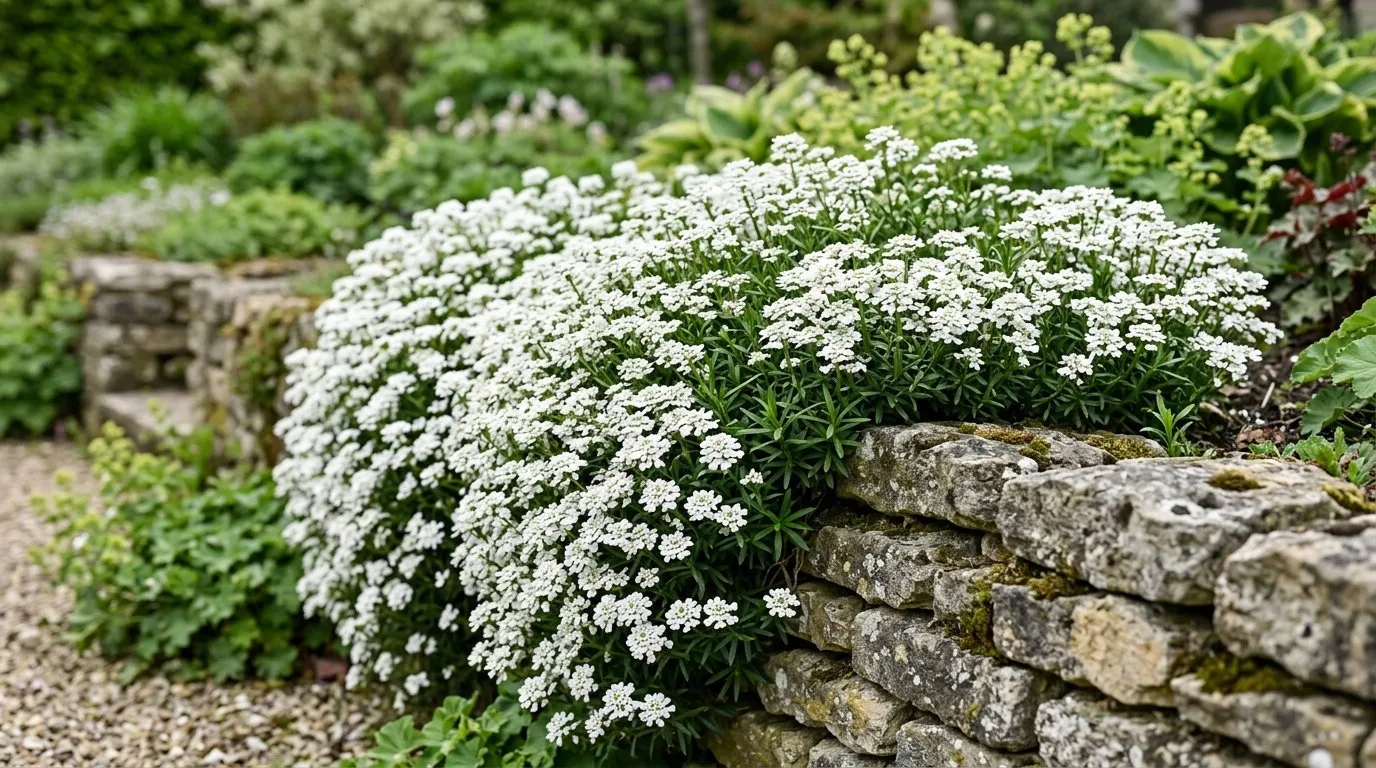 Evergreen Iberis sempervirens spilling over a dry stone wall. This is the white spring carpet that returns every year.
Which candytuft should you grow?
Choose the annual for fast summer colour and cut flowers, and the perennial for permanent white cover on walls and edges. Many gardeners, myself included, grow both. The annual fills gaps and posy jugs through summer, the perennial holds the structure of an edge all year and flowers hard in spring.
The table below sets the two side by side so you can match the plant to the spot.
| Feature | Annual (Iberis umbellata) | Perennial (Iberis sempervirens) |
|---|---|---|
| Life cycle | Hardy annual, one season | Evergreen perennial, 5+ years |
| Height and spread | 20-30cm x 20cm | 20-30cm x 45-60cm |
| Flower colour | White, pink, lilac, carmine | Pure white (some pink cultivars) |
| Main flowering | June to September | April to May |
| How you get it | Sow seed direct | Buy plants or take cuttings |
| Scent | Light, honey-like | Slight |
| Best use | Edging, cut flowers, gap filler | Walls, raised beds, rockeries |
| Self-seeds | Yes, freely | Rarely; spreads by mounding |
For the perennial, three cultivars are worth knowing. ‘Snowflake’ is the classic, a strong white carpet 25 to 30cm high with an RHS Award of Garden Merit. ‘Absolutely Amazing’ is a compact, free-flowering white that repeat-flowers if trimmed. ‘Pink Ice’ opens pale pink and fades to white, useful if you want something softer than dead white. All three want the same full sun and sharp drainage.
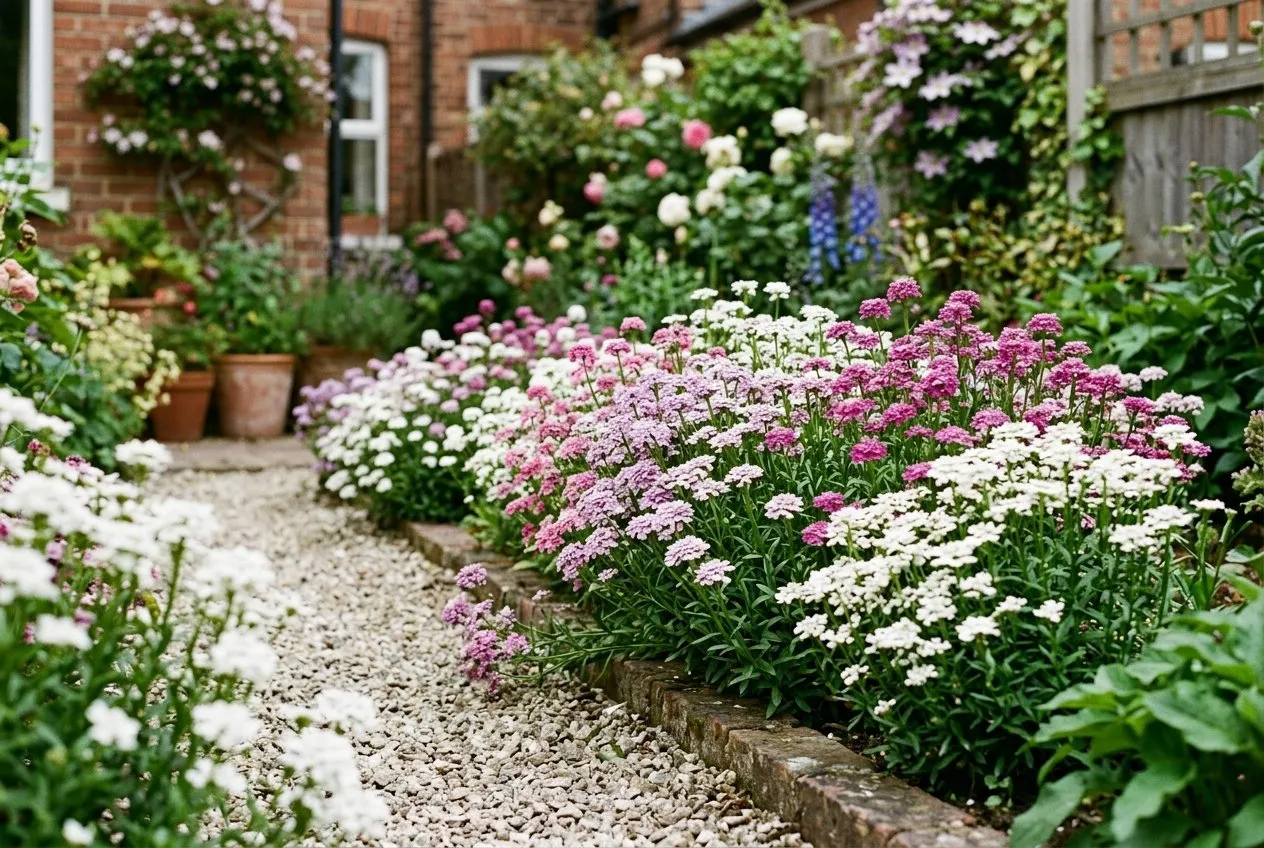 Annual Iberis umbellata edging a path in mixed white, pink and carmine. Sown fresh each spring, it flowers all summer.
How to sow annual candytuft direct
Sow annual candytuft straight into the ground from March to May, exactly where you want it to flower. It resents root disturbance, so direct sowing beats raising it in trays and transplanting. This is one of the simplest jobs in the flower garden, and it is a good place to start if you are learning to sow hardy annuals direct.
Rake the soil to a fine, crumbly tilth first. Draw out a shallow drill about 1cm deep with the corner of a hoe or a cane. Sow the seed thinly along the drill, cover it back over, and water with a fine rose if the soil is dry. Seedlings usually show in 10 to 21 days. When they are big enough to handle, thin them to about 15 to 20cm apart so each plant has room to bush out.
 Thinning seedlings to 15-20cm. Give each plant room now and it bushes out into a fuller dome later.
The reward for that small effort is speed. Annual candytuft flowers roughly 8 to 10 weeks after sowing, so a March sowing is in bloom by June. To keep the colour running, sow a fresh short row every three to four weeks until early June. This succession is how you avoid the classic annual problem of everything flowering at once and then finishing together.
 Sowing thinly into a 1cm drill. Annual candytuft dislikes being moved, so sow it where it is to flower.
Growing perennial candytuft for walls and edges
Perennial candytuft is bought as plants and set out in spring or early autumn. It is grown for its evergreen mound and its habit of pouring over any edge you give it. Plant it at the front of a border, along the lip of a raised bed, or in the crown of a wall, and let it cascade.
Set plants 30 to 45cm apart, with the crown level with the soil. Firm them in and water until established. On the top of a wall or in a rockery you build, tuck the rootball into a pocket of gritty soil between the stones and let the shoots find the drop. Within two seasons a single plant will drape a curtain of white 40 to 60cm wide.
The one job it needs is a trim. After the April to May flush fades, shear the whole plant back by about a third with hand shears. This stops it going woody and bare in the centre, keeps the mound tight, and often brings a lighter second flush. Skip the trim for two or three years and the plant splits open in the middle and looks tired. It is the perfect plant for softening rock and stone edging, where its white froth blurs the hard line of the stone.
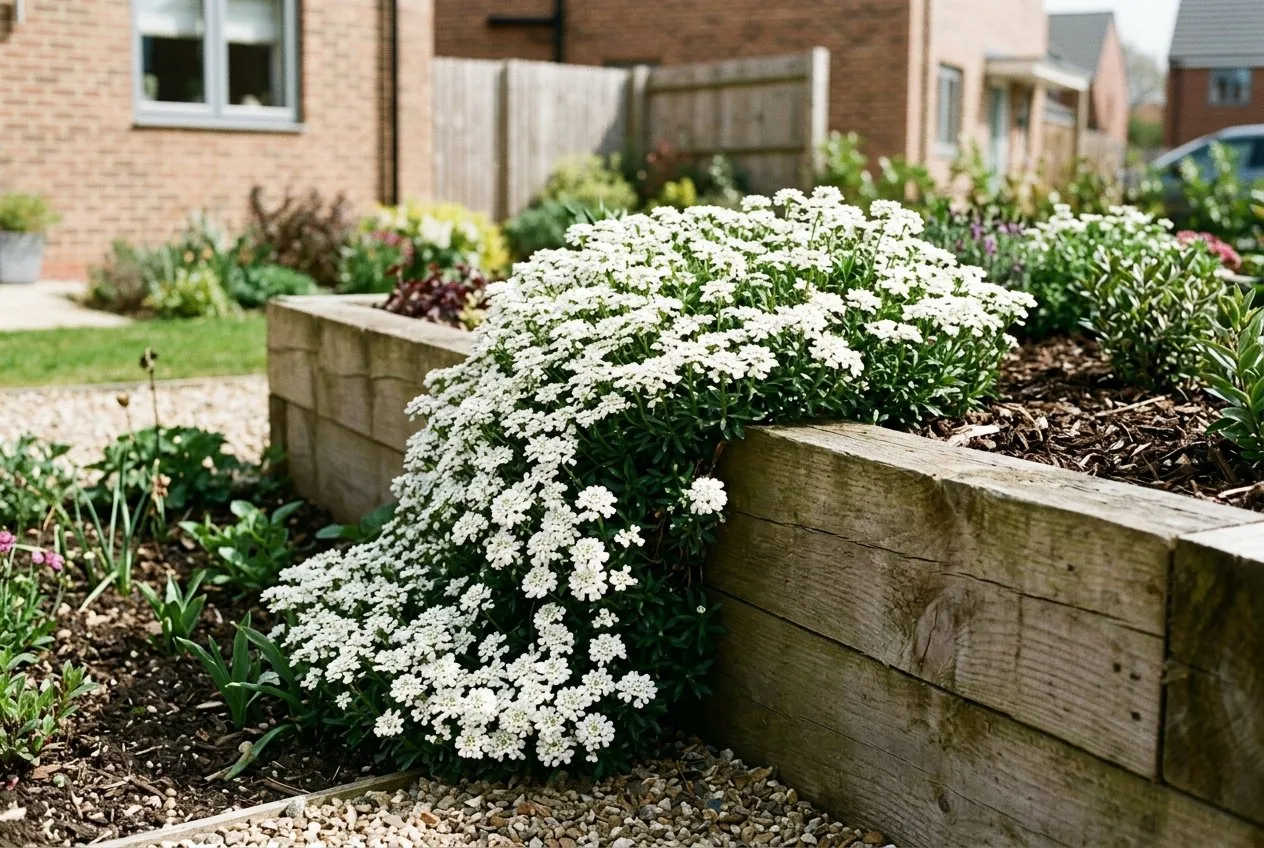 Iberis sempervirens draping over a sleeper raised bed. A shear-over after flowering keeps the mound dense.
Where candytuft grows best: sun, soil and drainage
Candytuft needs full sun and sharp drainage, and it actively prefers poor soil. Both types want at least six hours of direct sun a day. In shade they grow leggy and flower poorly. This is a plant for the hot, dry, awkward spots where richer plants sulk.
Soil is where candytuft really surprises people. It thrives on thin, stony, chalky and alkaline ground, the sort of soil that defeats many perennials. The RHS lists Iberis as happy on poor to moderately fertile, neutral to alkaline soil in full sun (RHS). Rich, heavily manured beds give you soft leafy growth and fewer flowers, so resist the temptation to feed it up.
Candytuft care through the year
Candytuft is close to no-maintenance once it is in the right spot, but a few timed jobs keep it at its best. The calendar below runs through a full year for both the annual and the perennial.
| Month | Task |
|---|---|
| January | Nothing needed; evergreen perennial holds its leaves through frost |
| February | Clear fallen leaves off perennial mounds so light reaches the centre |
| March | First direct sowing of annual candytuft into a fine tilth |
| April | Perennial candytuft comes into full white flower; second annual sowing |
| May | Shear perennial back by a third as flowers fade; third annual sowing |
| June | Annual candytuft from March sowing starts to flower; deadhead spent heads |
| July | Peak annual flowering; cut for the vase and keep deadheading |
| August | Let some late annual heads set seed for self-sowing; water pots in drought |
| September | Optional autumn sowing on free-draining ground for early flowers next year |
| October | Collect ripe annual seed if you want to sow deliberately next year |
| November | Tidy dead annual plants onto the compost; leave perennial standing |
| December | No action; perennial provides quiet evergreen cover |
Feeding is barely needed. A single light dressing of general fertiliser in spring is plenty for the perennial, and the annual needs nothing on average garden soil. Deadheading the annual by snipping off faded clusters keeps it flowering for longer and delays seeding. When you want it to self-sow, simply stop deadheading in August and let the last heads ripen.
Candytuft for bees, butterflies and beneficial insects
Candytuft is one of the best easy plants for early pollinators. Both the annual and the perennial carry masses of small flowers in broad, flat heads. That shape gives bees, butterflies and flies a wide, stable landing pad, and the nectar sits within easy reach of short-tongued insects.
Timing is what makes it valuable. Perennial candytuft flowers in April and May, filling the hungry gap when many borders are still waking up. It sits well among other early spring pollinator plants in a wildlife-minded garden. The annual then takes over through summer, so between the two you feed insects across a long stretch.
The hidden bonus is hoverflies. Candytuft is a magnet for them, and hoverflies are one of the gardener’s best friends. The adults feed on the nectar, then lay eggs on plants nearby, and their larvae eat aphids by the hundred. Buglife rates hoverflies among the most useful garden allies for exactly this reason (Buglife). Grown as companion planting along the edge of a veg bed, candytuft pulls in these aphid-eaters right where you want them, near your lettuces and beans.
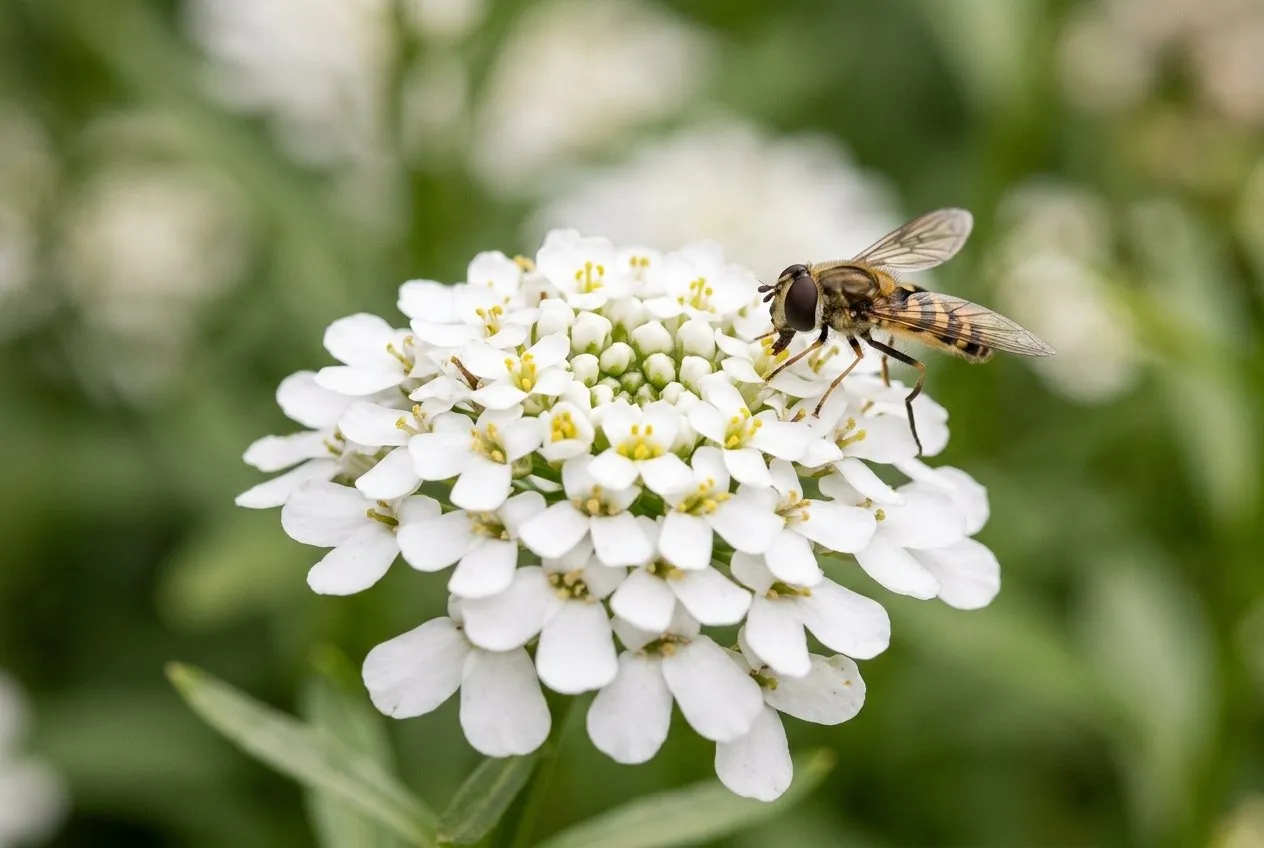 A hoverfly on candytuft. The adults sip nectar, then their larvae clear aphids off nearby crops.
Managing self-seeding candytuft
Annual candytuft self-seeds readily, and that is a feature to use rather than fight. Left to ripen, the seed drops around the parent and germinates the following spring, so a patch sown once can carry on for years with no more work from you. It slots neatly into the group of reliable self-seeding plants for easy gardens.
If you want more control, collect the ripe seed in October instead. Snip the seedheads into a paper bag, let them dry, and rub the seed out. Store it somewhere cool and dry, then sow deliberately next spring exactly where you want it. That way you get the free plants without them wandering across the whole bed.
Annual candytuft self-sown along a path edge. Shallow-rooted seedlings are easy to hoe out where you do not want them.
Cutting candytuft for the vase
Annual candytuft makes a pretty, informal cut flower for short posies. Iberis amara in particular gives fragrant white spikes on stems long enough for a small jug, while umbellata offers domed heads in mixed colours. It is not a florist’s long-stemmed bloom, but for a jam-jar posy on the kitchen table it is charming and free.
Cut in the cool of the morning when about half the florets in a cluster are open. Strip the lower leaves, plunge the stems straight into cold water, and give them an hour in a cool spot before arranging. Treated this way the flowers last five to seven days in a vase. Cutting also acts as deadheading, so the plant keeps producing more stems.
 Annual candytuft cut for a simple kitchen posy. Cut when half the florets are open for the best vase life.
Common candytuft problems and mistakes
Candytuft is almost trouble-free, but a handful of avoidable errors account for nearly every failure. Most trace back to soil that is too wet, too rich, or a plant that has been left untrimmed too long.
Wet, badly drained soil
Cold, waterlogged soil in winter rots the perennial from the roots up. It is the number one killer of Iberis sempervirens in UK gardens. Plant on a mound, add grit to the hole, or grow it in a raised bed or wall where water drains away fast. Never plant it in a low spot where puddles sit.
Letting the perennial go woody
A perennial candytuft left untrimmed for two or three years splits open in the middle and turns bare and woody. The fix is a yearly shear-over by a third straight after flowering. This one habit is the difference between a tight green cushion and a scruffy, gappy plant.
Overfeeding for bigger plants
Rich soil and high-nitrogen feed give you lush leaves and few flowers. Candytuft evolved on poor ground and flowers best when a little hungry. Feed lightly in spring at most, and never pile on manure. Lean, gritty conditions produce the most flower.
Slugs on young seedlings
Slugs and snails graze off newly emerged annual seedlings overnight, especially in a damp spring. Protect a fresh drill with a scatter of grit, wool pellets or crushed shell until the plants toughen up. Established candytuft is too tough and dry-leaved to interest them.
Club root from careless siting
Candytuft belongs to the brassica family, so it can catch club root, the same soil disease that swells and rots cabbage roots. It rarely troubles candytuft badly, but on infected ground do not plant it where brassicas have struggled, and keep it out of your cabbage rotation. On clean soil it is a non-issue.
Warning: Do not treat candytuft as a plant for damp shade. Sun and sharp drainage are what it needs, and the wet, shady corner that kills it is exactly where beginners often tuck it. When candytuft dies, cold wet soil is almost always the cause, not cold air.
Frequently asked questions
How long does candytuft take to flower from seed?
Annual candytuft flowers about 8 to 10 weeks after sowing. Sow Iberis umbellata direct from March to May and the first domed clusters open by early summer. Sow a fresh short row every three weeks to keep flowers coming into September. Perennial candytuft grown from seed flowers the spring after an autumn sowing.
Is candytuft an annual or a perennial?
Both, depending on the species. Iberis umbellata and Iberis amara are hardy annuals grown fresh from seed each year. Iberis sempervirens is an evergreen perennial that returns for years and carpets walls and edges. Most seed packets labelled candytuft are the annual; nursery pots are usually the perennial.
Does candytuft come back every year?
Perennial candytuft returns yearly; the annual self-seeds instead. Iberis sempervirens is fully hardy and evergreen, living five years or more with a yearly trim. The annual dies after flowering but drops seed that germinates the next spring, so a patch keeps itself going without you sowing again.
Where is the best place to plant candytuft?
Full sun on free-draining soil. Candytuft needs at least six hours of direct sun and hates wet ground. It thrives on poor, stony, chalky and alkaline soils where richer plants struggle. Perennial types look best draping over a wall, raised bed or rockery. Avoid shade and heavy, waterlogged clay.
Is candytuft good for bees and pollinators?
Yes, candytuft is excellent for early bees, butterflies and hoverflies. The flat flower clusters give insects an easy landing pad full of nectar. It flowers when little else is open, so it bridges an early gap. The hoverflies it draws lay eggs whose larvae eat aphids, which helps a nearby veg plot.
How do you stop candytuft getting leggy?
Shear perennial candytuft by a third straight after flowering. Iberis sempervirens goes woody and bare in the middle if left uncut. A hard trim in late May keeps the mound tight, green and covered in leaves. Do the same each year and one plant stays neat for five or six seasons.
Can you grow candytuft in pots?
Yes, both types grow well in pots and troughs. Use a gritty, free-draining compost and a container at least 20cm wide with drainage holes. Perennial candytuft trails over the rim of a wall pot or alpine trough. Water in dry spells but never let the pot stay soggy, which rots the roots.
For more low-effort colour that fills a bed and feeds insects, see our guide to the best white flowers for UK gardens.
Our team produces practical UK gardening guidance from source research, contributor records and established horticultural practice. Editorial standards are overseen by Matt W.