Key takeaways
- Most colocasia are tender and die below 5C; only 'Pink China' is root-hardy, to about -10C under a deep dry mulch
- Elephant ears covers three genera: Colocasia leaves droop down, Alocasia point up, Xanthosoma are arrow-shaped
- Start dormant tubers indoors in March at 18-21C, then plant out after the last frost in late May or June
- They are water lovers: constant moisture, rich feeding and warmth grow the biggest leaves, so a pond margin or bog suits them
- After the first autumn frost blackens the leaves, lift the tubers, dry them, and store frost-free at 7-10C in barely-damp compost
- Shelter them from wind, which shreds the leaves, and watch for red spider mite under glass
Colocasia give a UK garden the biggest, boldest leaves you can grow from a single tuber. The huge heart-shaped foliage, often 40 to 60cm long, turns a corner of a British back garden into something that looks genuinely tropical. The catch is that they come from warm, wet Asia, and our climate is neither.
Grown as tender summer plants, they need heat and constant moisture to size up, then a frost-free winter to survive. Get the rhythm right and one tuber gives you a plant taller than a person by August. Get it wrong and it rots in a cold, wet border by November. This guide sets out how to grow colocasia the way our climate actually demands.
What elephant ears actually means: Colocasia, Alocasia and Xanthosoma
Three different plant groups are all sold as elephant ears, and they are not interchangeable. Buy the wrong one and the growing advice you follow will be wrong too. This article is about Colocasia esculenta, the taro, and its garden cultivars, but it helps to know how to tell the three apart before you spend money.
The quickest test is which way the leaves point. Colocasia leaves droop and point downwards, hanging like soft green shields. The leaf stalk joins the blade inside the margin, which is why they nod. Alocasia hold their leaves stiffly, tips pointing up and out. Xanthosoma, sometimes called tannia, have narrower arrowhead leaves that also point upward. Colocasia are the true water lovers of the three, happy with wet feet that would rot the others.
| Feature | Colocasia | Alocasia | Xanthosoma |
|---|---|---|---|
| Common name | Taro, elephant ear | African mask, elephant ear | Tannia, arrowleaf |
| Leaf tips | Point down | Point up and out | Point up |
| Leaf shape | Broad heart | Broad heart or shield | Narrow arrowhead |
| Water needs | Loves wet, bog or pond | Moist but well-drained | Drier, more drought-tolerant |
| Hardiness | Tender (‘Pink China’ hardiest) | Tender | Tender |
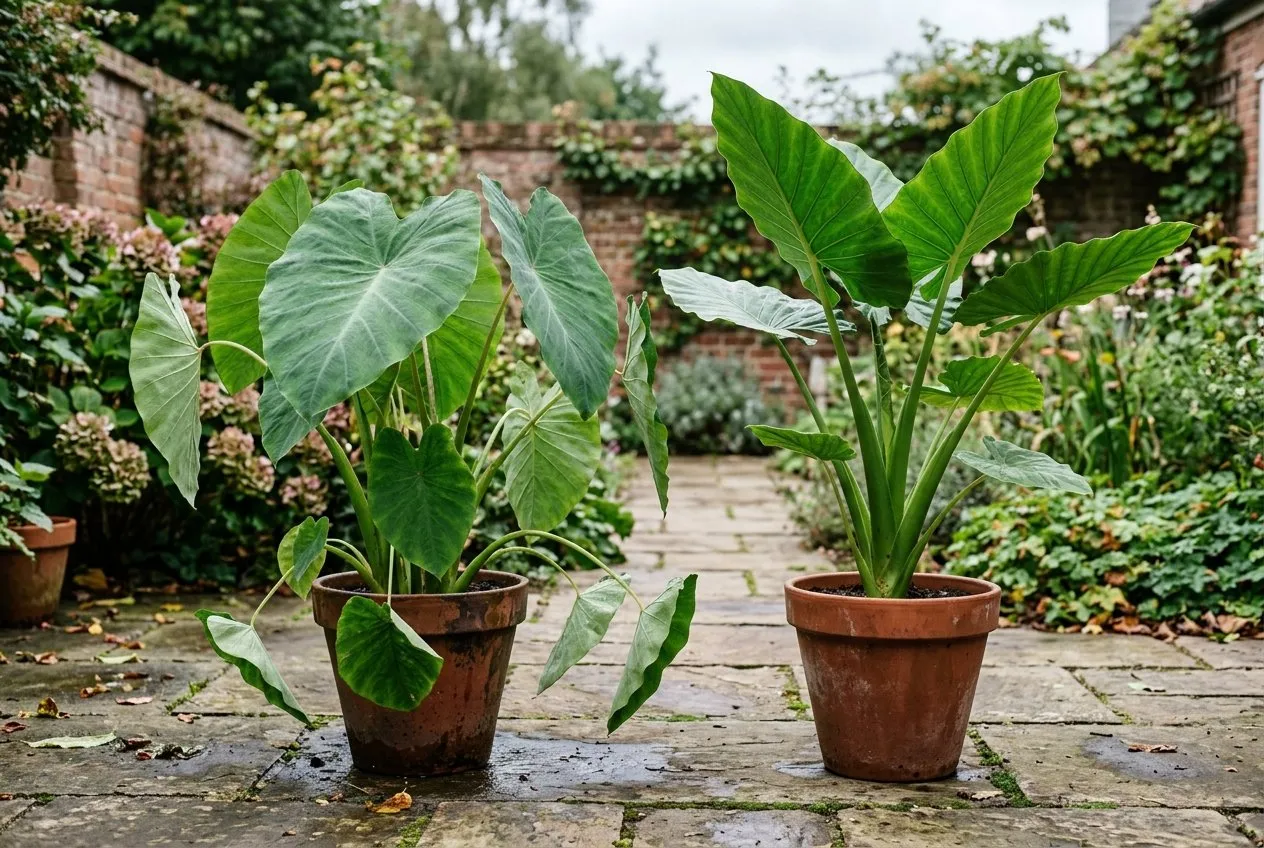 Leaf direction is the giveaway: the Colocasia on the left droops downward, while the Alocasia on the right points up.
Colocasia sit alongside other hardy exotic and tropical plants in a UK jungle border, but unlike a hardy banana or a phormium, most need lifting each winter. Keep that difference in mind from the day you plant.
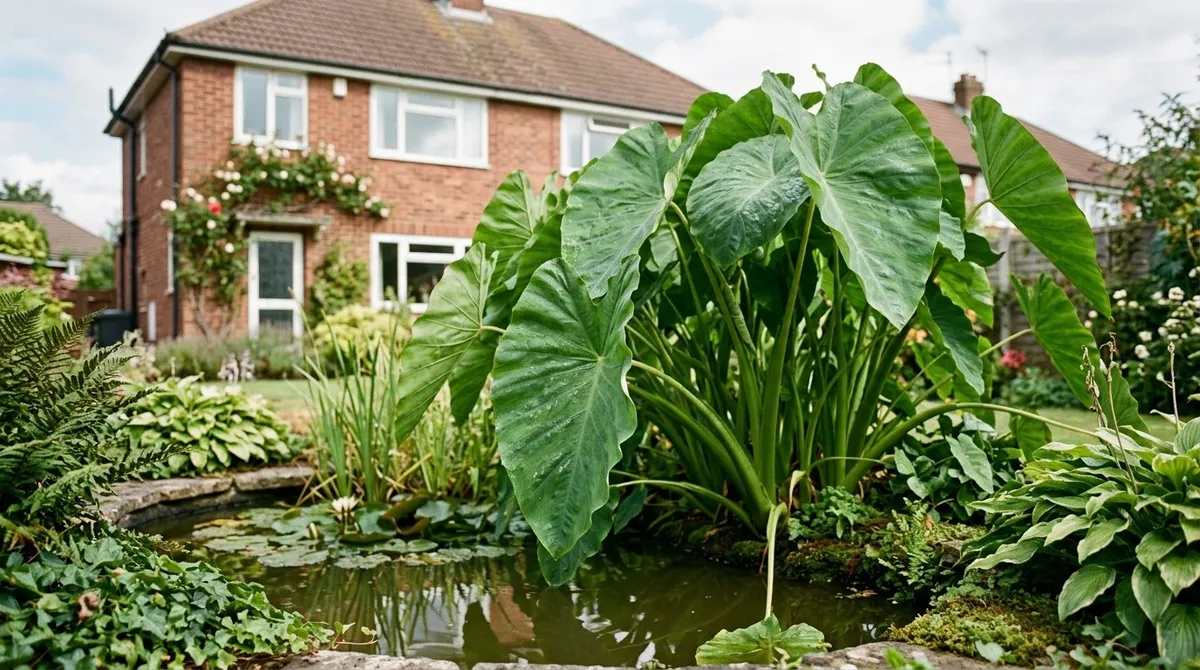
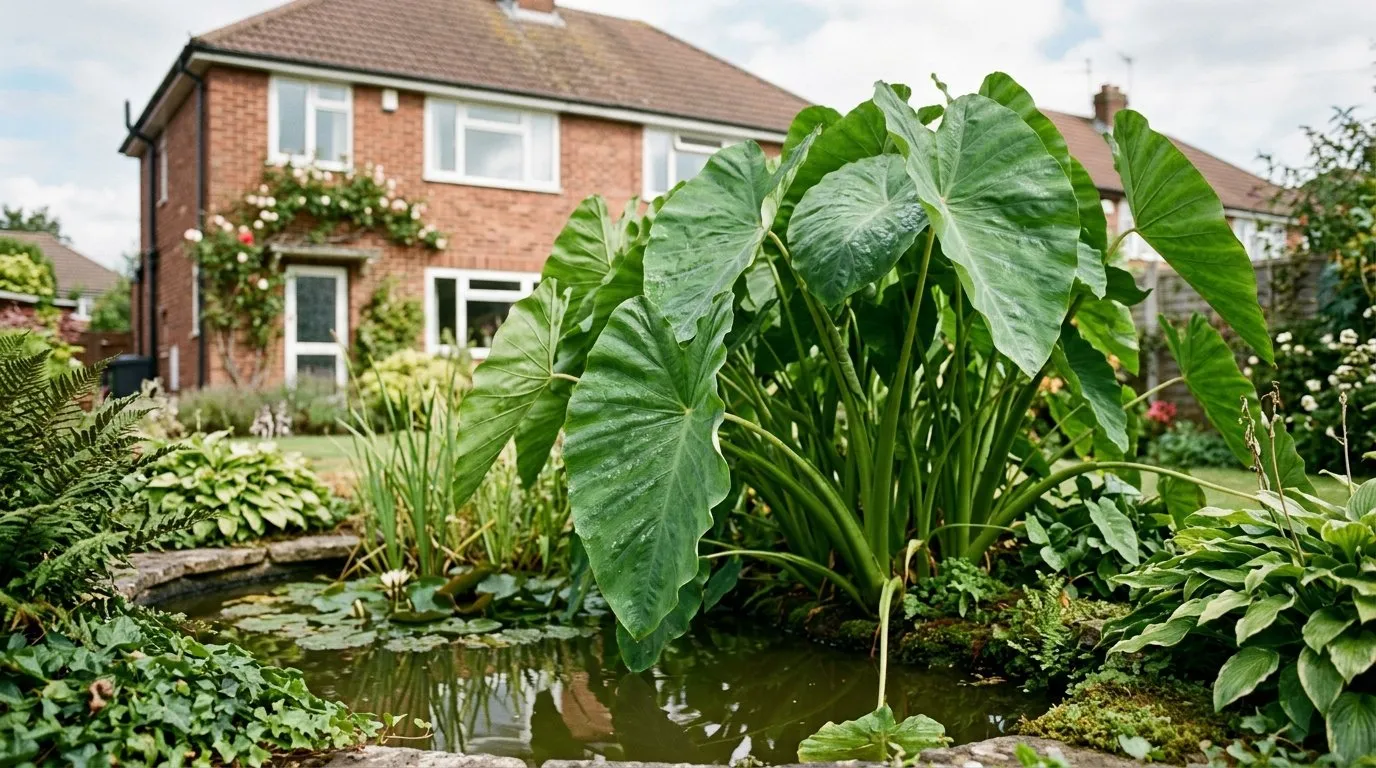 Colocasia esculenta at a pond margin, its huge heart-shaped leaves drooping in the classic elephant-ear pose.
Are colocasia hardy in the UK?
No, most colocasia are tender and die below about 5C. The Royal Horticultural Society rates the common cultivars as frost-tender, which means a normal UK winter kills the top growth outright and rots an unprotected tuber in cold, wet soil. Treat them as you would a dahlia or a canna: a summer plant that needs a frost-free winter.
Everything else on the market, the black-leaved and flecked cultivars in particular, should be lifted and stored. A mild coastal garden in Cornwall or west Wales might get a tender variety through a soft winter, but that is a gamble, not a plan. Across most of the country, plan to lift.
Best colocasia varieties for UK gardens
The best colocasia for a UK garden depends on whether you want to leave it out or lift it. ‘Pink China’ is the one to grow if you want to chance leaving it in the ground. If you are lifting anyway, the dark-leaved cultivars give the most drama. Heights below are what these plants reach in a good UK summer, which is well short of their tropical potential.
‘Pink China’ carries plain mid-green leaves on pink-flushed stems and reaches 1 to 1.5m. ‘Black Magic’ is the famous one, with matte purple-black leaves to 1.5m that glow when backlit. ‘Fontanesii’ pairs glossy green leaves with near-black stems, tall to 1.5m and superb by water. ‘Mojito’ is smaller at 0.9 to 1.2m, its green leaves flecked and streaked with dark purple. Plain Colocasia esculenta, the unnamed green taro, grows the largest leaves of all, up to 1.8m in a wet, warm, sheltered spot.
| Cultivar | Leaf colour | Height | Hardiness | Best for |
|---|---|---|---|---|
| ’Pink China’ | Green, pink stems | 1-1.5m | Hardiest, root-hardy to -10C | Leaving outside under mulch |
| ’Black Magic’ | Matte purple-black | 1.2-1.5m | Tender | Dark drama, containers |
| ’Fontanesii’ | Glossy green, black stems | 1.5m | Tender | Pond margins |
| ’Mojito’ | Green, purple flecks | 0.9-1.2m | Tender | Smaller gardens and pots |
| C. esculenta (plain) | Mid-green | Up to 1.8m | Tender | The biggest leaves |
For the dark cultivars, the RHS ‘Black Magic’ entry is worth a look before you buy, as it confirms the tender rating and the sheer size these reach with heat.
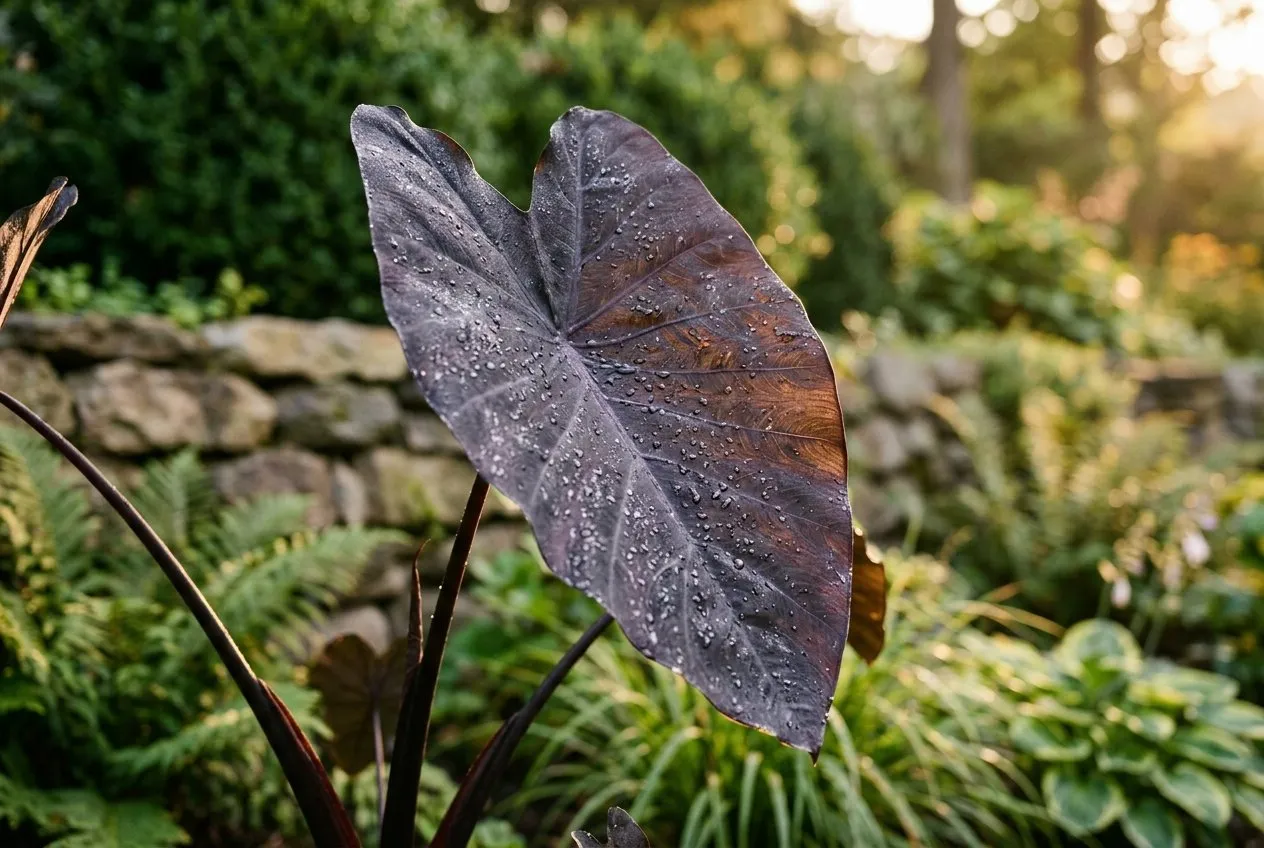 ‘Black Magic’ earns its name: matte purple-black leaves that glow when the low evening sun catches them from behind.
Where to plant colocasia: the water-lover angle
Colocasia are bog and pond-margin plants that want constant moisture, rich soil, warmth and shelter. This is the single fact that changes everything about how you grow them. Treat a colocasia like an ordinary border perennial and it sulks. Treat it like a marginal aquatic and it doubles in size.
In its native range, Colocasia esculenta grows in paddy fields and along wet ditches. Give it the closest UK equivalent and it responds fast. The best spot is the margin of a pond or a permanently damp bed. If you have a bog garden, plant one straight into it. If you do not, a large pot with no drainage holes standing in a saucer of water mimics the same conditions on a patio. The plant will even grow with its crown in a few centimetres of water on a pond shelf, set in an aquatic basket.
Alongside the moisture, it wants heat and shelter. Full sun to light shade suits it, but wind is the enemy. A gusty site shreds those big soft leaves into tatters within days, so tuck it into a warm, sheltered corner where the foliage stays whole. Rich soil matters too: dig in plenty of well-rotted manure or compost before planting, because a hungry colocasia stays small. Many of the same plants for wet, boggy soil make good neighbours and enjoy the same rich, damp ground.
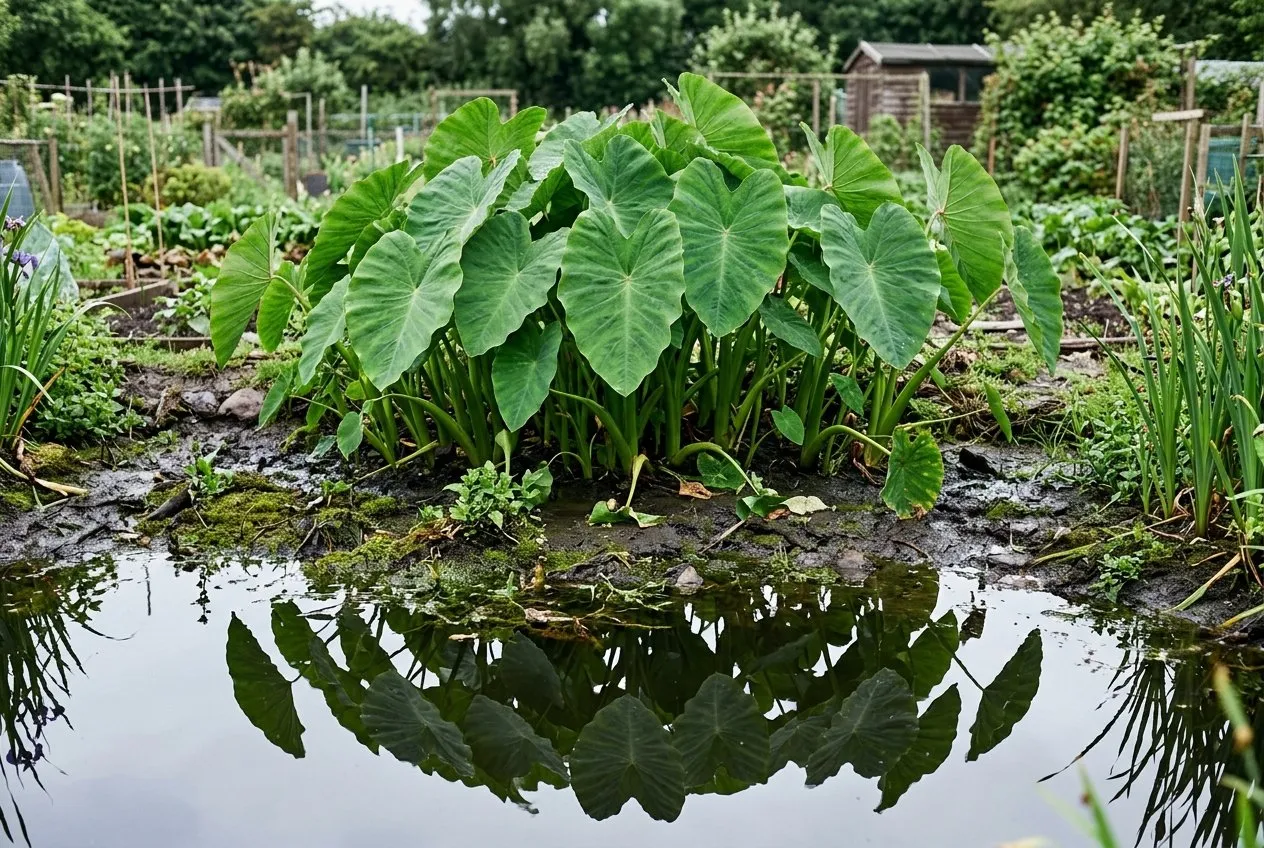 A pond margin gives colocasia exactly what it wants: constant moisture at the roots and its reflection doubling the show.
Starting colocasia tubers indoors in spring
Start dormant colocasia tubers indoors in March at 18-21C. Warmth, not day length, is what wakes them, so a heated propagator, a warm windowsill or an airing cupboard until the shoot appears all do the job. Starting them early gives the plant two extra months of growth before it goes outside, which is the difference between a modest plant and a giant.
Pot each tuber into a 2 to 3 litre pot of moist multipurpose compost, with the growing point, the slightly pointed end, just below the surface. Water lightly and keep the compost moist but not soaking until growth begins. Cold, wet compost with no warmth is how a dormant tuber rots, so hold back the water until you see a shoot. Once leaves appear, step up the watering hard, because from that point the plant is thirsty.
Grow the young plant on in the brightest spot you have, potting it up into a larger container as it fills its pot. By mid-May you want a strong plant with several leaves, hardened off gradually to outdoor conditions over a week or two. Never rush it outside. A late frost on soft indoor-grown growth sets the plant back by weeks.
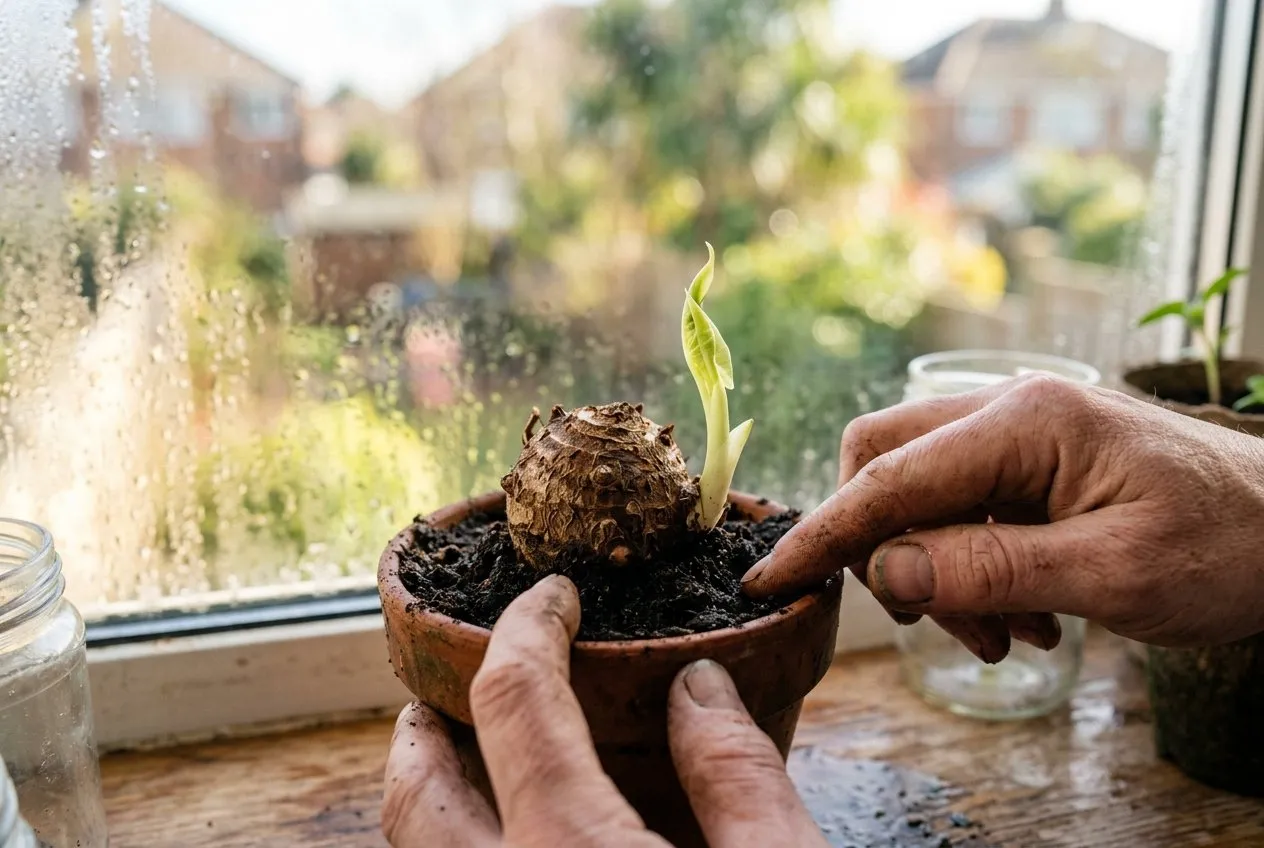 A dormant tuber started in March. Warmth on a windowsill wakes it, giving two months’ head start before it goes out.
Planting colocasia outside: pots versus the ground
Plant colocasia outside after the last frost, from late May to June, once night temperatures stay reliably above 10C. In the ground it makes the largest plant, given rich, wet soil and shelter. In a pot it stays a little smaller but travels indoors easily for winter, which suits a small garden or a cold, exposed one.
For a border plant, choose your warmest, most sheltered, dampest corner. Improve the soil first with barrowloads of compost or manure, then plant so the tuber sits just below the surface and water it in well. Space plants 60 to 90cm apart, as one healthy colocasia spreads more than people expect. The bold foliage pairs beautifully with the flame flowers of cannas in the same warm, wet bed.
For a container, go big. A pot of at least 40cm across, filled with rich compost and stood in a saucer of water, keeps a colocasia happy all summer. The advantage is control: come autumn you simply cut it back, let the pot dry a little, and move the whole thing into a frost-free shed without disturbing the roots. That makes pot culture the easy route for anyone nervous about lifting and storing loose tubers.
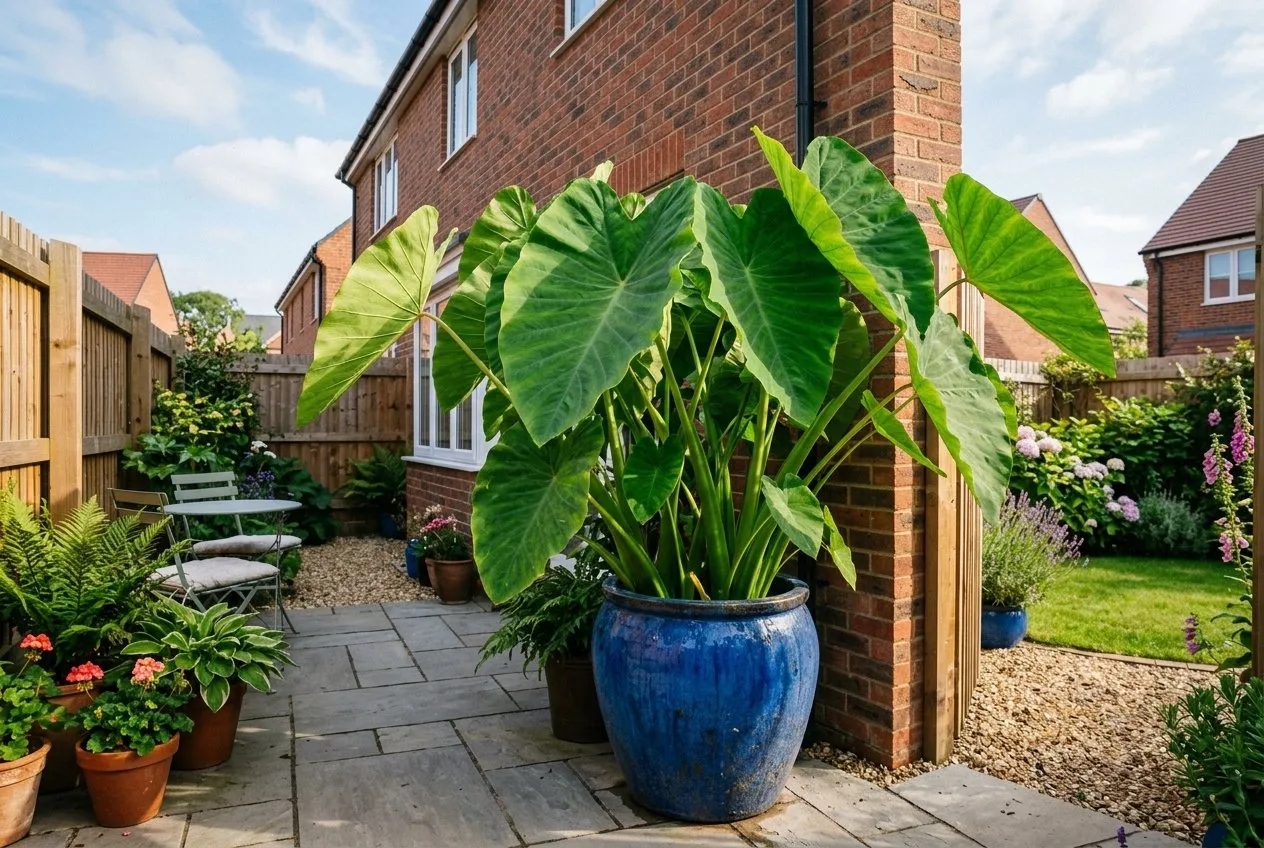 A big glazed pot in a sheltered corner keeps a colocasia happy and makes moving it indoors for winter simple.
Feeding and watering for the biggest leaves
Colocasia are hungry and thirsty, so heavy feeding and constant water grow the biggest leaves. This is a plant you cannot really overfeed or overwater in summer. The tropical leaf size everyone wants comes directly from generous treatment, not from any special variety.
Water is first. The compost or soil should never dry out. In a hot spell a potted plant may need watering twice a day, and standing the pot in water removes the worry entirely. A plant that dries out even once responds by dropping a leaf, and that leaf does not come back. Consistent moisture is what keeps a full head of foliage.
Feed is second. From the moment leaves appear, feed weekly with a balanced or slightly nitrogen-rich liquid feed, or push a few controlled-release fertiliser pellets into the compost in spring for a steady supply. A general tomato or foliage feed at full strength every week through summer is not too much. The same generous approach that suits hardy bananas works here: keep the water and food coming and the plant keeps building bigger leaves right through to autumn.
How to lift and store colocasia tubers over winter
Lift and store colocasia tubers by digging them up after the first frost and keeping them frost-free at 7-10C until spring. It is the same routine gardeners use for dahlias, and once you have done it once it takes half an hour a plant. The full step-by-step sits in the how-to steps above; the notes below explain why each stage matters.
The trigger is the first proper frost, which usually blackens the leaves in mid to late October. That cold snap tells the tuber to pull its energy down into store, so lift a day or two after, not before. Cut the blackened top growth back to a stump, then ease the clump out with a fork from the side, since the tubers are shallow and snap easily.
Drying is the stage most people skip, and it is the one that saves the tuber. Three to five days on newspaper in an airy, frost-free shed lets the surface dry and any wounds callus, which stops rot taking hold. Then pack the tubers in barely-damp compost or vermiculite, well spaced, and store them dark and cool at 7-10C. Check monthly and bin any that turn soft. A garage, a spare room or a frost-free shed all work; a cold greenhouse does not, because it dips below freezing on the worst nights.
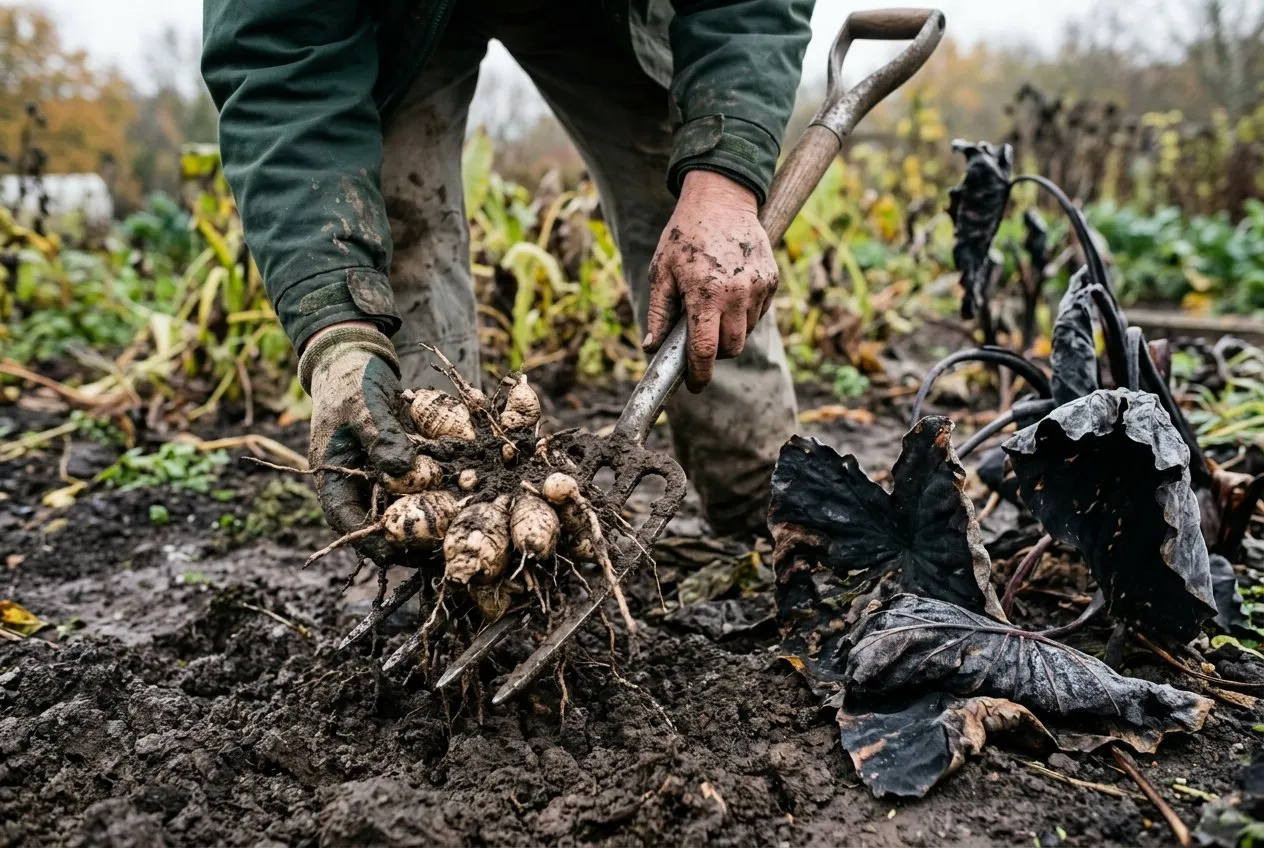 Lift a day or two after the first frost has blackened the leaves, easing the shallow, brittle tubers out from the side.
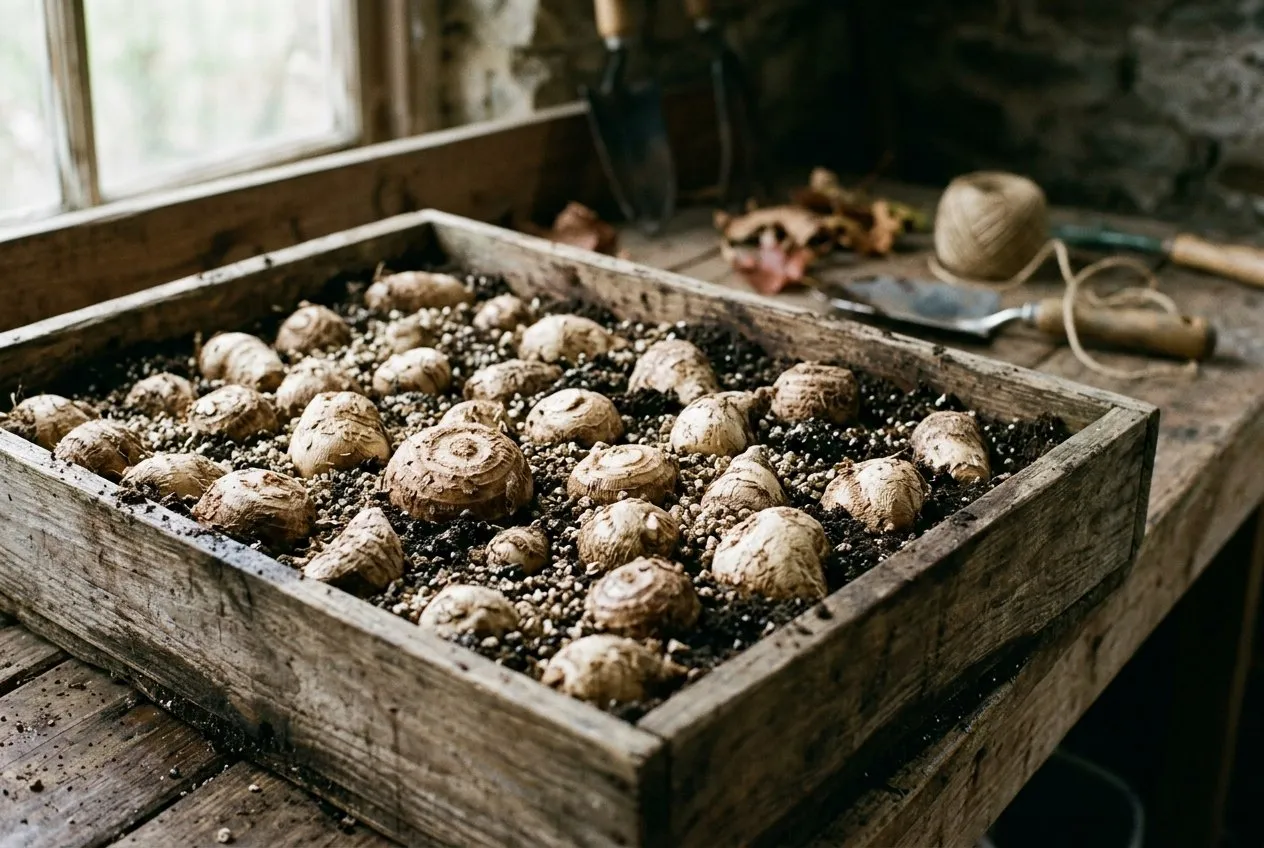 Packed for winter: tubers spaced in barely-damp compost, dark and frost-free at 7-10C until they restart in March.
Leaving ‘Pink China’ outside: the overwinter gamble
‘Pink China’ is the only colocasia you can reasonably leave in the ground in the UK, and even then only on free-draining soil under a deep, dry mulch. It is root-hardy to around -8C to -10C, but the killer is wet, not cold. A tuber sitting in cold, saturated clay all winter rots long before frost alone would trouble it.
If you want to try it, choose your driest, best-drained spot, never a low, wet pocket. After the first frost, cut the top growth back and pile 15 to 20cm of dry mulch over the crown: bark, bracken, straw or dry leaves held down against wind. The mulch does two jobs, insulating against cold and, just as importantly, keeping winter rain off the dormant tuber. A sheet of something to shed water over the top helps on heavy ground. The same thinking runs through our guide to protecting plants from frost.
Month-by-month colocasia calendar
This calendar assumes a typical Midlands or southern UK garden. Northern and Scottish gardeners should push the outdoor dates a week or two later in spring and earlier in autumn.
| Month | Task |
|---|---|
| January | Check stored tubers monthly; remove any that have gone soft |
| February | Keep tubers cool and dark; order new varieties now |
| March | Pot stored tubers into moist compost; start them at 18-21C |
| April | Grow young plants on in the brightest spot; pot up as they fill out |
| May | Harden off over two weeks; plant out only after the last frost |
| June | Plant out late-started tubers; begin weekly feeding and heavy watering |
| July | Water daily in heat; feed weekly; enjoy peak leaf size |
| August | Keep water and feed coming; leaves reach their largest now |
| September | Growth slows; ease off feed but keep the roots moist |
| October | After the first frost, lift and store tubers; mulch any ‘Pink China’ left out |
| November | Move potted plants to frost-free storage; check stored tubers |
| December | Keep everything frost-free and dry; do nothing to dormant tubers |
Colocasia problems: red spider mite, wind and rot
The three problems that catch out colocasia growers are red spider mite under glass, wind-shredded leaves, and rot in storage. None is hard to avoid once you know the cause, and a healthy, well-watered plant shrugs off most trouble anyway.
Red spider mite is the main pest, and it thrives in the hot, dry air of a greenhouse or conservatory. The first sign is fine pale mottling on the leaves, then delicate webbing on the undersides. Because colocasia love humidity, the simplest defence is also the best: mist the plant, stand it over a tray of wet gravel, and keep the air damp. Dry air invites the mite; moist air keeps it away.
Wind is the other big enemy, though it is a physical problem rather than a pest. Those large, soft leaves tear along the veins in a stiff breeze, and a shredded leaf never repairs. Shelter is the only answer, so plant in a corner protected by a wall, fence or shrubs. Rot, finally, is a storage issue: tubers packed too wet, or lifted before they had dried, turn soft over winter. Dry them properly, store them barely damp, and check monthly, and losses stay low.
Common mistakes when growing elephant ears
Most colocasia failures come down to a handful of avoidable errors. Fix these and the plant is genuinely easy.
Planting out too early
The most common mistake is putting plants outside while frost is still possible. Cold turns the tender leaves to mush overnight. Wait until the last frost has passed, late May to June, and keep a fleece handy for a surprise cold night.
Letting the plant dry out
Colocasia will not forgive drought. Miss a watering in a hot spell and the plant drops a leaf that never returns. Keep the roots constantly moist, stand pots in water, and treat it as a bog plant, not a border perennial.
Leaving tender types out over winter
Only ‘Pink China’ has any real chance of surviving a UK winter outdoors, and only on free-draining soil. Leaving a ‘Black Magic’ or ‘Fontanesii’ in cold, wet ground is simply throwing the plant away. Lift and store all the tender cultivars.
Storing the tubers too wet
Tubers packed in wet compost rot before spring. Dry them for a few days after lifting, then store them barely damp and check monthly. Too wet is far more dangerous than too dry.
No shelter from wind
A colocasia in an open, windy spot ends the summer as tattered rags. The leaves are big and soft and tear easily. Give it a warm, sheltered corner and the foliage stays whole and impressive.
Designing with colocasia in a tropical scheme
Colocasia are foliage anchors, so build a planting around their bold leaves rather than dotting them singly. One large plant, or a group of three, gives a border instant scale and a look that reads as tropical from across the garden. The trick is to surround them with plants that share their love of heat and moisture.
Pair the dark cultivars with hot flower colour for contrast. ‘Black Magic’ against orange cannas or scarlet dahlias is a classic hot-border combination, the near-black leaves throwing the flowers forward. For a green-on-green jungle effect, group colocasia with a hardy banana and a tree fern in a sheltered, damp corner and the space feels a world away from a British street outside.
Scale the variety to the space. A courtyard or small patio suits the more modest ‘Mojito’ in a big pot, while a large bog bed can carry plain esculenta at its full 1.8m. Keep them near water where you can, both for the growing conditions and because the reflection doubles the drama.
Now your elephant ears are sized up and safely stored, keep the rest of the garden going through the cold months with our guide to how to overwinter plants in the UK.
Frequently asked questions
Are elephant ears (colocasia) hardy in the UK?
Most colocasia are tender and will not survive a UK winter outdoors. They are hardy only to about 5C, so a frost kills the top growth. The one reliable exception is ‘Pink China’, root-hardy to around -10C under a deep, dry mulch on free-draining soil. Lift and store every other variety.
How do I overwinter colocasia tubers?
Lift the tubers after the first frost and store them frost-free at 7-10C. Cut back the blackened leaves, ease the clump out with a fork, and brush off loose soil. Dry the tubers for a few days, then pack them in barely-damp compost or vermiculite. Keep them in a shed or garage until March.
When should I start colocasia into growth?
Start dormant tubers indoors in March at 18-21C. Pot them into moist compost with the growing point just below the surface. Warmth is the trigger, so a heated propagator or a warm windowsill both work well. Do not plant them outside until the last frost has passed, usually late May or June.
Why are my colocasia leaves so small?
Small leaves usually mean too little water, food or warmth. Colocasia are hungry, thirsty plants that need constant moisture, a feed every week or two, and a sheltered, sunny, warm spot. In a cold or dry summer the leaves stay modest. Grow them at a pond margin or in a bog bed for the biggest foliage.
What is the difference between colocasia and alocasia?
Colocasia leaves droop and point downwards; alocasia leaves point up and out. Colocasia are water-loving taro plants that spread by runners and tubers and cope with wet soil. Alocasia prefer moist but well-drained ground and hold their arrow-shaped leaves stiffly upright. Both are sold as elephant ears, which causes plenty of confusion.
Can colocasia grow in water or a pond?
Yes, Colocasia esculenta thrives at a pond margin or in shallow water. It is a marginal bog plant in its native range and copes with its crown sitting in a few centimetres of water through summer. Grow it in an aquatic basket on a pond shelf, or in permanently wet soil. Lift it before winter unless it is ‘Pink China’.
Are elephant ears poisonous?
Yes, all parts of colocasia are toxic if eaten raw. The leaves and stems contain calcium oxalate crystals that irritate the mouth and throat. Keep curious pets and small children away from the plant and wash your hands after cutting stems. The taro tuber is only edible after long, thorough cooking.
Our team produces practical UK gardening guidance from source research, contributor records and established horticultural practice. Editorial standards are overseen by Matt W.