Key takeaways
- Buy size 3 or larger rhizomes with 3 or more visible eyes for vigorous first-year plants
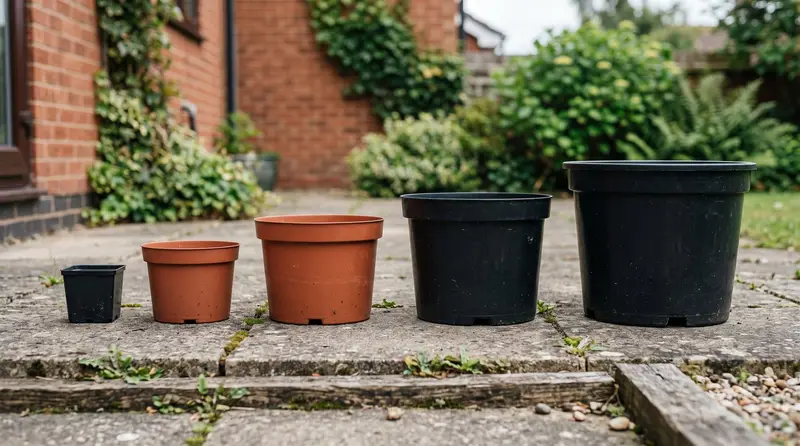
- Start rhizomes indoors in March in 2 to 3 litre pots at 15 to 18 Celsius for a six week head start
- Plant out after the last frost, mid-May in southern England, early June in Scotland
- Feed weekly with a high-potash liquid feed from late June; cannas are heavy feeders
- Lift rhizomes after the first hard frost and store at 5 to 10 Celsius in dry compost
Cannas turn a UK border into a piece of the tropics for four months. From the first July spike to the first October frost they throw out paddle leaves up to 60cm long and flowers in shades of cardinal red, tangerine, lemon, peach, and watermelon pink. Plants reach 2m by August in a sheltered Staffordshire south-wall position. A single rhizome costing five to ten pounds produces a clump that doubles each year, so the second-season display is twice as full as the first.
Cannas earn their place in a tropical jungle garden design, where big leaves and hot colour set the mood.
These exotic-looking perennials have a strong British pedigree. The late Christopher Lloyd planted them in his hot border at Great Dixter, and Will Giles built his celebrated Norwich exotic garden around them from 1986. This guide covers buying rhizomes, the March indoor start, planting out timing by UK region, feeding, the best varieties for British gardens, pest watch, and the lift-and-store routine that keeps them coming back year on year.
What size canna rhizome should I buy?
UK suppliers grade canna rhizomes by the number of eyes (growing buds). The grading matters because larger rhizomes flower in their first season, while small offsets often spend year one building up energy.
- Size 1: single eye, 30 to 50g, often sold in mixed packs. Cheap but may not flower in year one.
- Size 2: two eyes, 50 to 100g. Reliable for medium varieties.
- Size 3 or 4: three to four eyes, 100 to 200g. The size to buy for vigorous first-year flowering.
- Pot-grown plants: 9cm or 1 litre, sold from April. Faster, more expensive at £10 to £15 each.
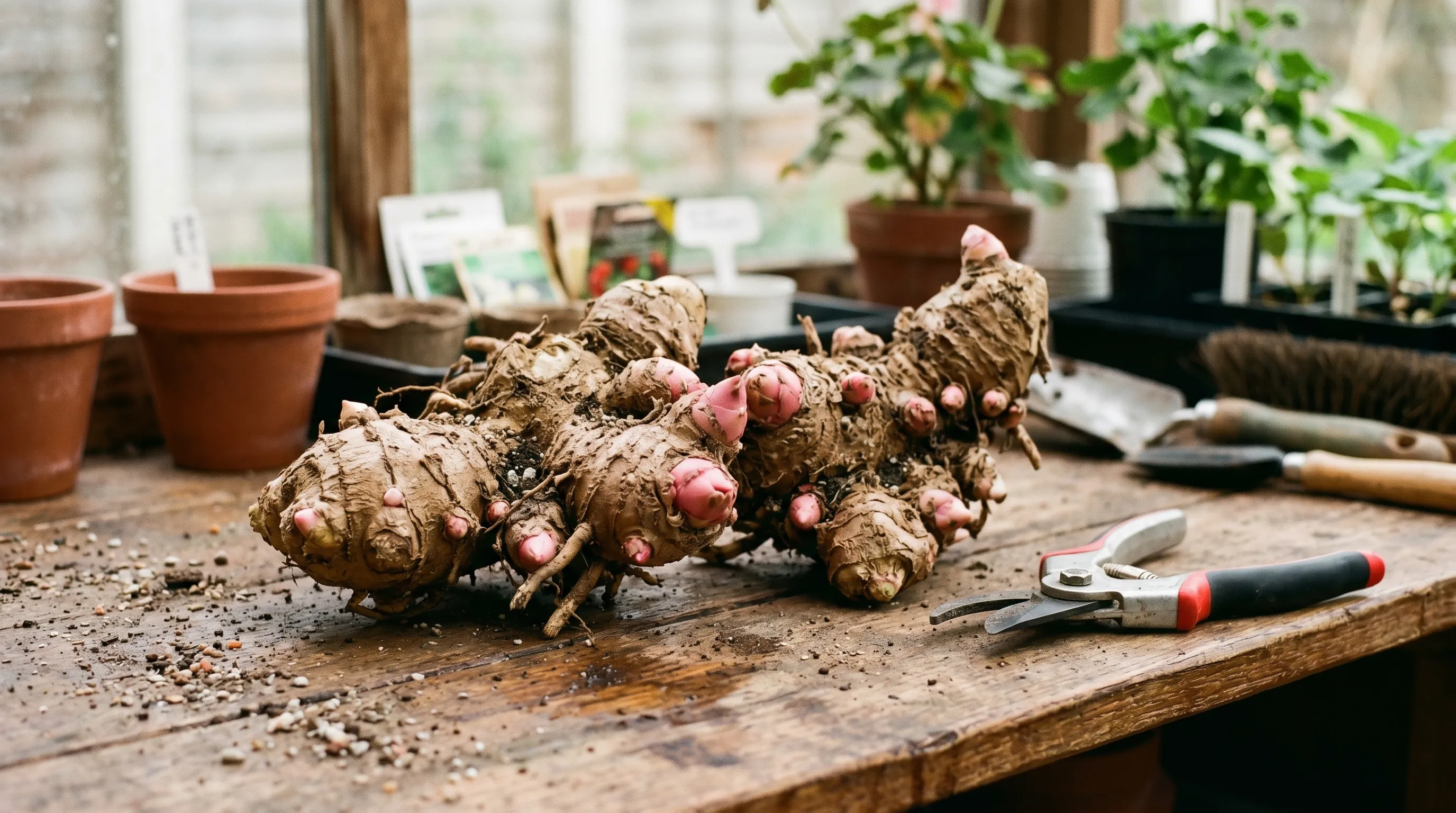 A size 3 rhizome with four visible pink shoot eyes. Look for firm, heavy stock with no soft black patches.
Starting canna rhizomes indoors in March
The UK growing season is too short to plant cannas straight outside. Even a strong rhizome put in the ground in May will only flower in late August. Starting indoors in March buys six extra weeks and brings flowering forward to mid-July.
In mid to late March pot each rhizome into a 2 to 3 litre pot of multipurpose compost. Lay the rhizome horizontally with the buds (eyes) pointing upward. Cover with 5cm of compost. Water once to settle, then sparingly until growth appears. A heated propagator at 15 to 18 Celsius is ideal. A sunny windowsill in a warm room works too. A cold conservatory below 12 Celsius is too slow.
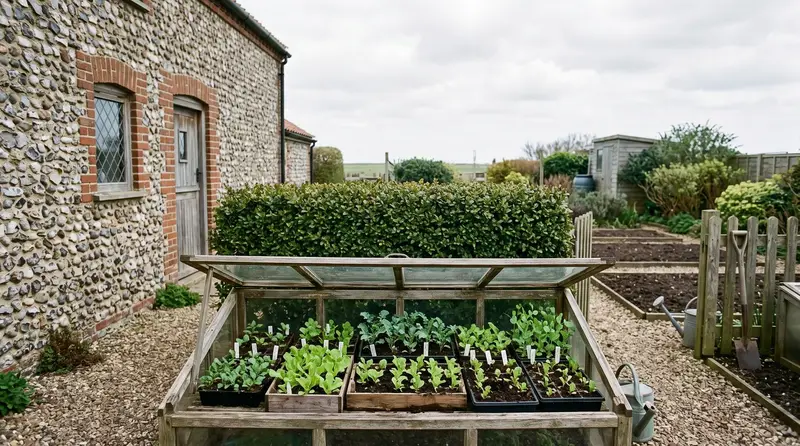
Shoots emerge in two to three weeks. Once growth is 10cm tall, water more generously and start a weak liquid feed every fortnight. By mid-May plants are 30 to 60cm tall and ready to harden off over seven to ten days. Move pots outside during the day, bring them in at night, and gradually increase outdoor time. Frost on tender canna foliage is fatal. Anyone working with multiple tender plants benefits from protecting plants from frost in late spring through fleece and cloches.
When and where to plant cannas outdoors
The rule is simple. Wait until the last frost has gone, then add a week for safety. In southern England and Cornwall that means mid-May. In the Midlands and northern England wait until late May. In Scotland and exposed upland gardens hold off until early June. Soil temperature matters as much as air temperature; cannas sulk in cold ground below 13 Celsius and may rot.
Site requirements
Soil preparation
Cannas need rich, moisture-retentive soil. Dig in two buckets of well-rotted manure or garden compost per square metre two weeks before planting. On heavy clay, also add a 5cm layer of horticultural grit and fork through the top 20cm. On sandy soil, increase the compost rate and consider a mulch of bark chips after planting to hold moisture.
Planting depth and spacing
Set the rhizome 5 to 10cm below the soil surface. Space large varieties (Wyoming, Stuttgart, Australia) at 60cm apart and dwarf varieties (Picasso, Cleopatra) at 40cm apart. Water in well, then water weekly through any dry spells. A 5cm bark or compost mulch around the crown holds moisture and warms the soil.
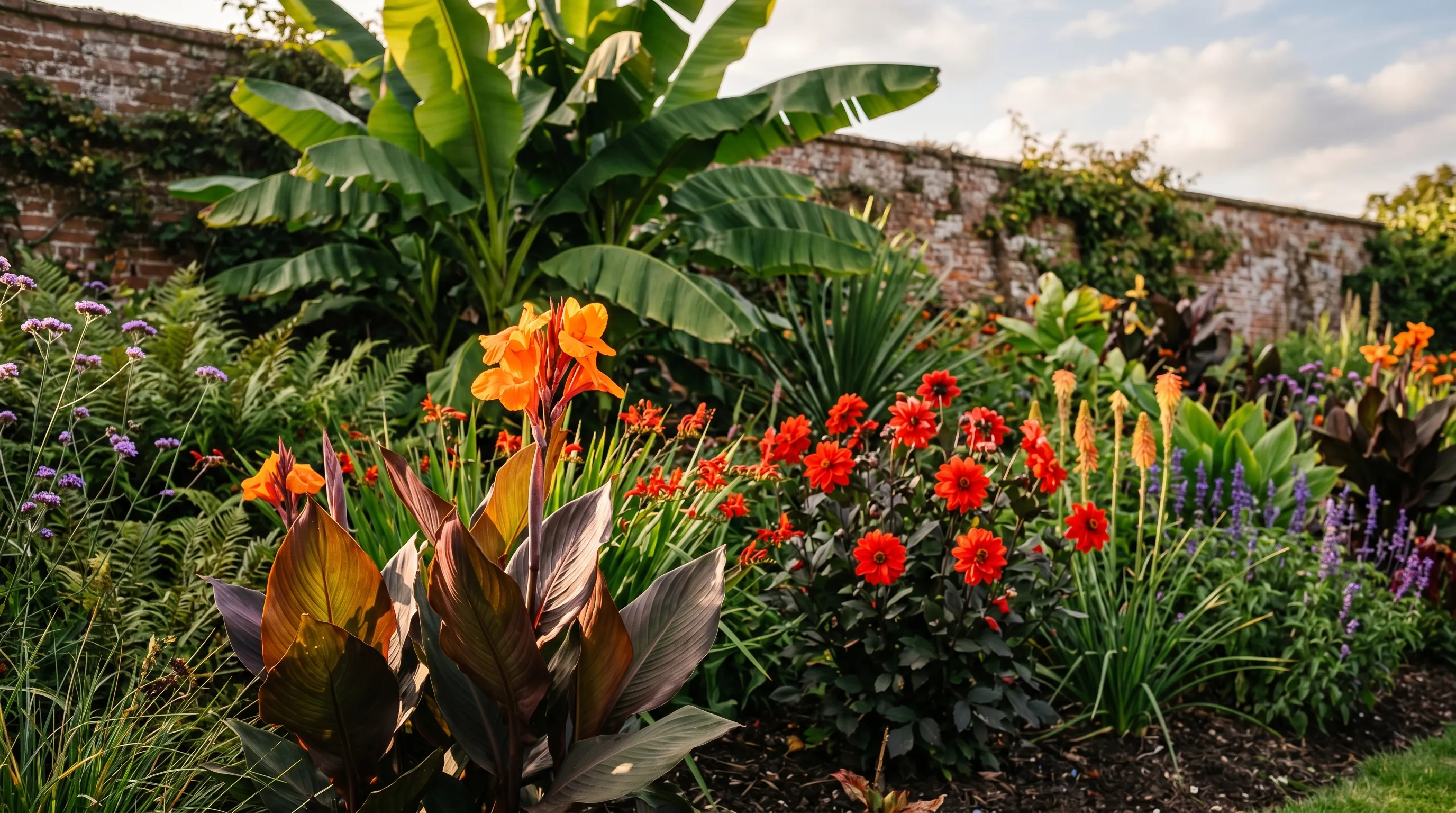 An exotic-effect border at peak August: hardy banana behind, Wyoming canna in the middle, scarlet dahlias at the front. Pair cannas with dahlias and bananas for that Great Dixter look.
The best canna varieties for UK gardens
Tropicanna (also sold as Phasion)
Wyoming
Deep bronze-purple paddle leaves and bright tangerine-orange flowers. Height 1.8 to 2.1m in a warm spot. Wyoming was a Will Giles favourite and the backbone of his Norwich hot border. The dark leaves make it a brilliant contrast for any orange or red planting.
Picasso
Yellow flowers heavily spotted in deep red. Compact at 90 to 120cm, well suited to pots and the front of borders. Picasso is a child-pleaser and one of the few cannas worth growing in a 50cm container.
Cleopatra
A chimera that produces yellow flowers, red flowers, and bicoloured yellow-and-red flowers on the same plant. Leaves are partly green and partly streaked dark bronze. Endlessly entertaining and only 90cm tall.
Stuttgart
Variegated white and pale green leaves with soft salmon-orange flowers. Height 1.8 to 2.4m. Stuttgart is the giant of the variegated cannas. The leaves scorch in full midday sun, so plant in light dappled shade against a wall.
Black Knight
Wine-red flowers so dark they look black at dusk. Bronze-purple foliage. Height 1.5 to 1.8m. Black Knight is the night-effect canna. Pair with silver foliage like Plectranthus argentatus and Eucalyptus gunnii for a moonlight border.
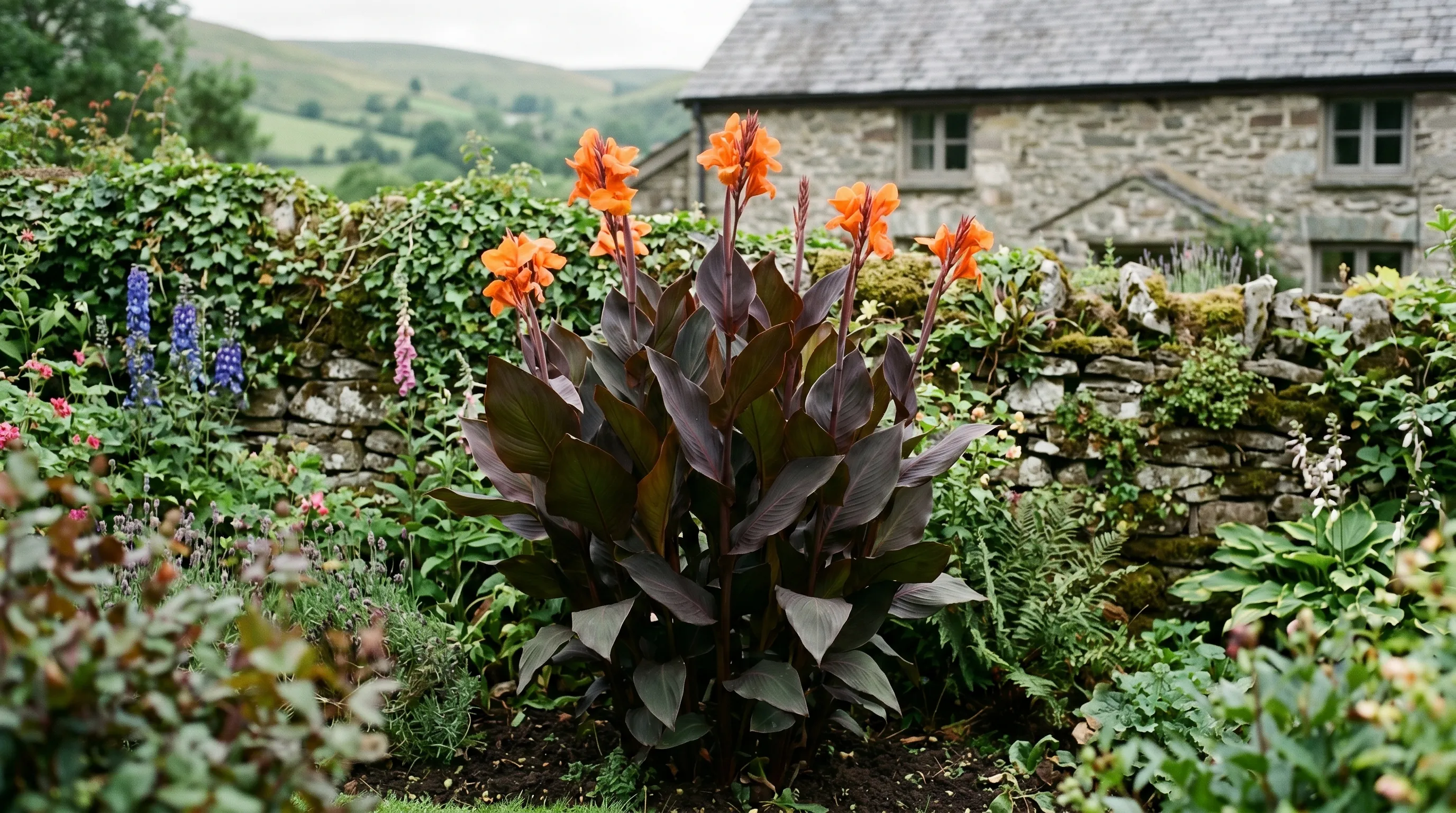 Wyoming in flower in a Welsh valley cottage garden. The bronze leaves provide six months of structure even before the flowers open.
Variety comparison
| Variety | Leaf colour | Flower colour | Height | Best position | First-season vigour |
|---|---|---|---|---|---|
| Tropicanna | Striped pink/orange/green | Bright orange | 1.5-1.8m | South wall | Very high |
| Wyoming | Bronze-purple | Tangerine-orange | 1.8-2.1m | South wall | High |
| Picasso | Mid green | Yellow with red spots | 0.9-1.2m | Borders, pots | Moderate |
| Cleopatra | Green and bronze streaked | Red, yellow, bicoloured | 0.9m | Borders, pots | Moderate |
| Stuttgart | Variegated white and green | Salmon-orange | 1.8-2.4m | Light shade against a wall | Moderate |
| Black Knight | Bronze-purple | Wine red | 1.5-1.8m | South wall | High |
Feeding and watering through summer
Cannas are among the hungriest plants in the UK herbaceous border. Treat them like a heavy-feeding tomato.
Watering
Soak the root area weekly through May, June, and any dry spell. Plants in pots need water every day in hot weather and twice a day if exposed. The leaves wilt visibly when thirsty, recovering within an hour of watering. Persistent wilting indicates rot in the rhizome, which is incurable.
Feeding schedule
- Planting time: two handfuls of fish, blood and bone or slow-release fertiliser per plant
- Late June onward: liquid feed weekly with high-potash tomato fertiliser at the recommended dilution
- Pots: every five to seven days, never less than once a week
- August: switch to half-strength feed to encourage flower bud formation rather than leafy growth
- September: stop feeding to allow the plant to harden off before lift
Deadheading
Each flower spike produces a succession of blooms over three to four weeks. Snap off the spent flower head with finger and thumb to redirect energy into the next flush. When the whole spike is finished, cut it back to the next side shoot using clean secateurs. Each plant produces two to four flowering spikes through the season.
Pests, diseases and what to look out for
Cannas are largely trouble-free in the UK. Two issues do warrant attention.
Canna leaf rollers
Two species cause problems abroad (Calpodes ethlius and Geshna cannalis), but neither is established in the UK. The caterpillars roll new leaves and sew them shut with silk. Garden caterpillars (mostly noctuid moth larvae) occasionally cause the same effect on UK cannas. Unroll any affected leaves to remove the caterpillar by hand. Damage is cosmetic on established plants.
Canna virus complex
Three viruses can affect UK cannas: Canna yellow mottle virus (CaYMV), Canna yellow streak virus (CaYSV), and Bean yellow mosaic virus. Symptoms include yellow streaks or blotches on the leaves, narrow distorted foliage, and reduced flowering. There is no cure. Buy from reputable specialist nurseries, avoid swapping rhizomes with unknown gardens, and destroy (do not compost) any plant showing clear viral symptoms. The Royal Horticultural Society maintains up-to-date guidance on canna virus and recommends prompt removal.
Slugs and snails
A minor issue. Slugs occasionally chew young shoots in spring but established plants outgrow damage. Sharp grit around emerging shoots and a torchlight patrol on warm damp evenings handles most cases. The same approach that works to stop slugs eating dahlias works on emerging canna shoots.
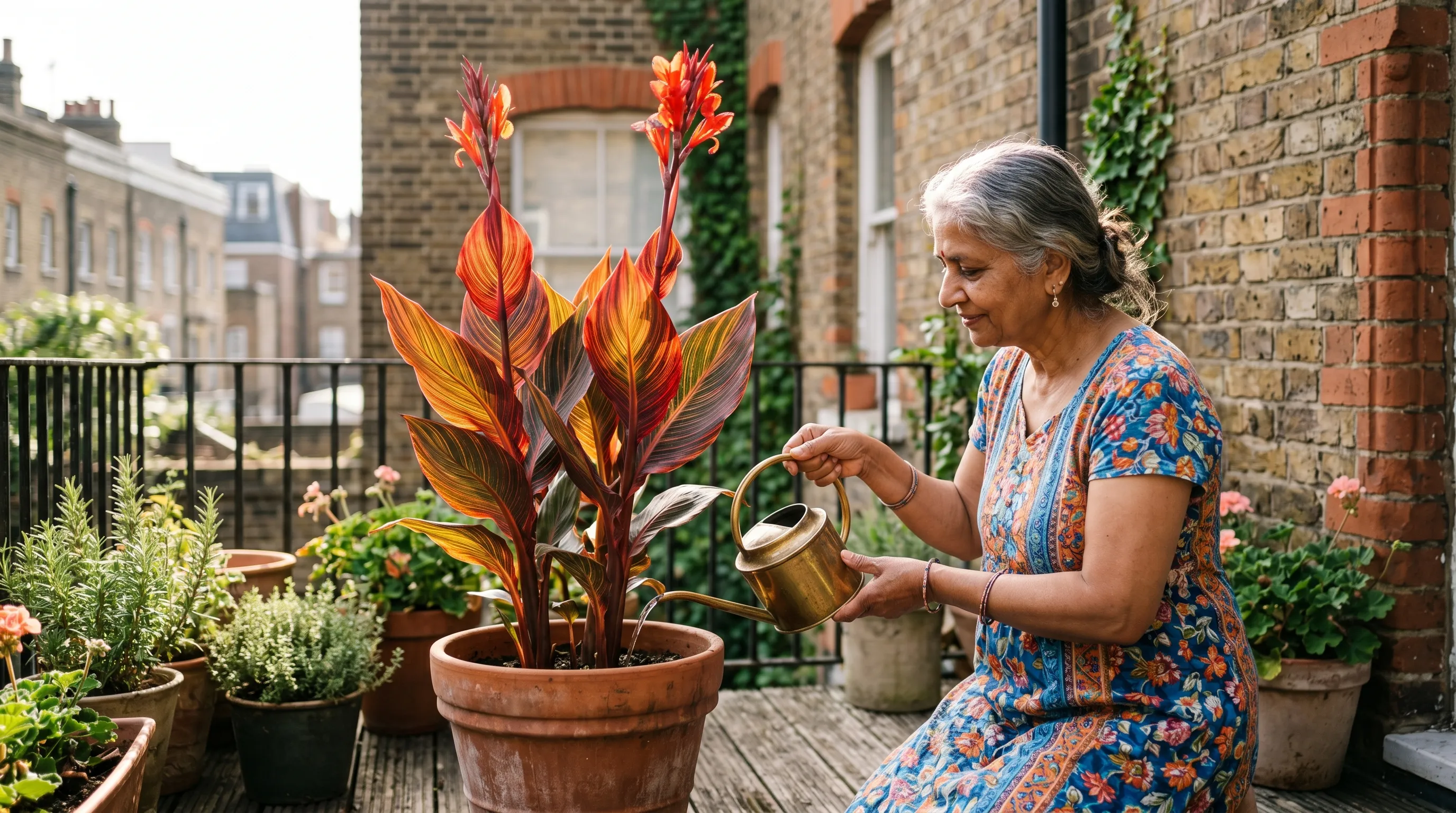 Tropicanna in a 50cm terracotta pot on a London courtyard. Container cannas need watering every day in hot weather.
Lifting and storing cannas for winter
When to lift
Wait until the first hard frost blackens the foliage. This is usually mid to late October in the Midlands, early November in Cornwall, and early October in Scotland. The frost signals the rhizome to draw stored energy down and go dormant. Lifting before frost can shorten next year’s growth.
Lift, clean, and store
- Cut stems back to 10cm with a sharp pair of secateurs.
- Lift the whole clump with a fork, working from 30cm out and easing it up rather than tugging on stems.
- Shake off loose soil but do not wash. Wet rhizomes rot in storage.
- Air-dry upside down in a frost-free shed for three to five days.
- Pack into trays of barely damp old compost, vermiculite, dry sand, or wood shavings. Cover the rhizomes but leave the cut stems exposed.
- Store at 5 to 10 Celsius in a frost-free shed, garage, or unheated spare room. Below 3 Celsius they freeze. Above 12 Celsius they break dormancy too early.
- Check monthly. Bin any rhizomes that go soft or black. Mist any that are shrivelling badly.
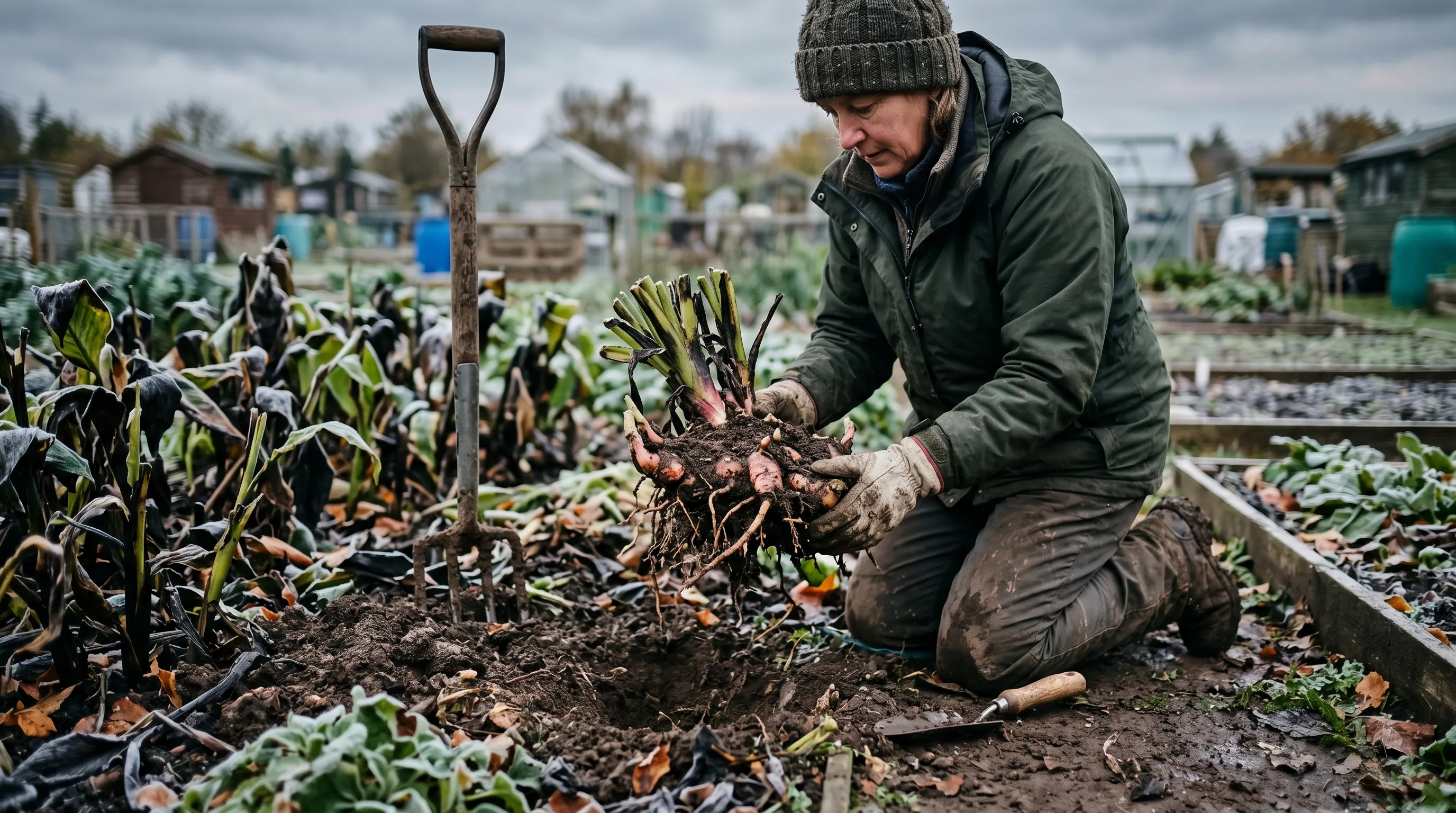 Lifting cannas in late October after the first hard frost has blackened the foliage. The frost is the signal the rhizome has gone dormant.
Dividing in spring
Every three to five years rhizomes get crowded and flower less freely. In late February, before potting up, slice the rhizome with a clean knife so each piece has at least two visible eyes. Dust cut surfaces with sulphur powder or leave them to dry overnight. Pot up as normal in March.
Cannas in pots and small gardens
Not every UK garden has space for a 2m exotic. Dwarf cannas in containers bring the tropics to a balcony, patio, or courtyard.
Choose the right variety
Picasso, Cleopatra, the Tropical series (sold as Tropical Rose, Tropical Sunrise, etc.), and the Cannova series stay under 1m. They flower reliably in pots and need less feeding than the giants.
Container set-up
Use a pot at least 40cm wide and 35cm deep. Plastic or glazed ceramic holds moisture better than terracotta. Fill with John Innes No 3 mixed with one third garden compost. Put two handfuls of fish, blood and bone at the bottom. Plant one rhizome per 40cm pot or three per half-barrel.
Care in pots
Water daily in summer, twice a day if the pot is in full sun on hard standing. Feed weekly with high-potash tomato fertiliser from late June. Move pots into a frost-free shed or garage in late October. Keep the compost just barely damp through winter. Restart watering and feeding in mid-April when shoots reappear.
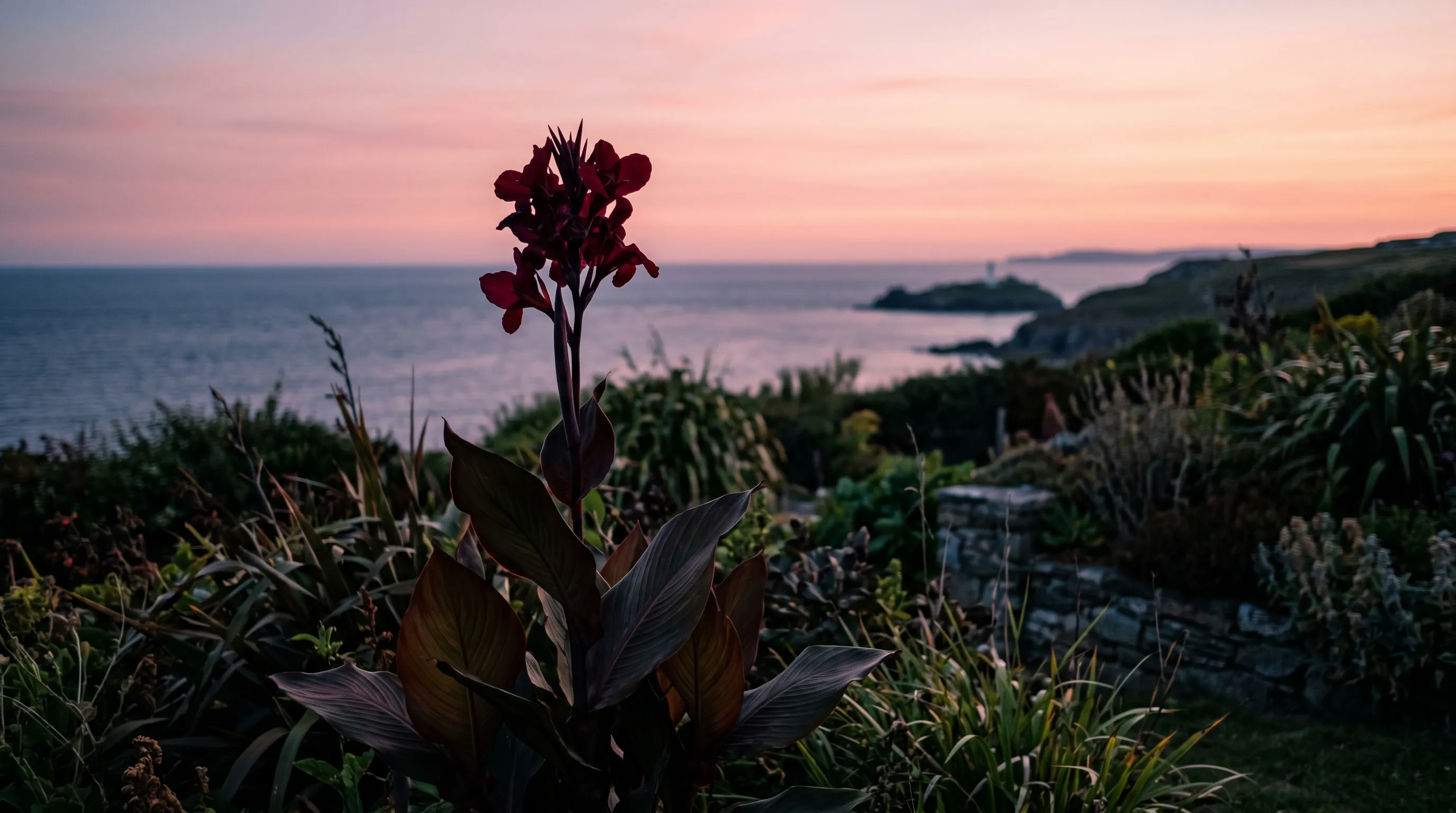 Black Knight at dusk in a Cornish seaside garden. The dark flowers pair beautifully with silver-leaved partners.
For dramatic foliage under cover, see our guide to growing caladium.
Common mistakes to avoid
These are the five mistakes that account for most disappointment with cannas in UK gardens.
Planting out too early. Cannas in cold wet soil below 13 Celsius sulk and often rot. Wait until the last frost has passed and the soil feels warm to the hand. A late start gives a far better season than a frost-damaged early one.
Choosing a cold or shady site. Cannas in part shade reach half their potential height and flower late or not at all. Pick the warmest sunniest spot in the garden, ideally with a south-facing wall behind.
Underfeeding. Treating cannas like a typical perennial starves them. Without weekly liquid feeding from late June, plants run out of energy in August and flowering stops short.
Storing rhizomes too cold or too wet. Below 3 Celsius rhizomes freeze. Above 12 Celsius they sprout in January. Wet rhizomes rot in weeks. The 5 to 10 Celsius dry compost rule is the survival rate that matters.
Buying cheap mixed bags. Unnamed mixed rhizomes from supermarket bins are often size 1 stock from leftover lots. Many do not flower in year one. Spend the extra five pounds on a named size 3 rhizome from a specialist.
Month-by-month canna calendar
| Month | Task |
|---|---|
| January | Check stored rhizomes monthly for rot. Order new varieties from specialist nurseries before stocks sell out. |
| February | Divide crowded rhizomes if needed. Sulphur or dry cut surfaces overnight. |
| March | Pot up rhizomes in 2 to 3 litre pots at 15 to 18 Celsius. Water sparingly until shoots appear. |
| April | Move on into larger pots if shoots are vigorous. Begin a weak liquid feed once growth is 15cm tall. |
| May | Harden off from second week. Plant out from mid-May in southern England after the last frost. |
| June | Plant out in the Midlands and Scotland (early June). Begin weekly high-potash feed from late June. |
| July | First flowers open from mid-July. Water deeply in any dry spell. Deadhead spent spikes. |
| August | Peak flowering. Maintain weekly feed at half strength. Watch for slug damage on new growth. |
| September | Continue watering. Stop feeding by mid-month. Photograph the best clumps to plan next year’s combinations. |
| October | Watch for the first frost. Lift rhizomes within a week of foliage blackening. Cut stems to 10cm. |
| November | Air-dry lifted rhizomes for three to five days. Pack into trays of vermiculite. Move to frost-free storage. |
| December | Check stored rhizomes for rot. Plan next year’s combinations using flower catalogues. |
Hart Canna is based in Hampshire and runs the only specialist canna nursery in the country. Mail order opens in November and runs through spring. Prices range from £6 for common varieties to £18 for rare named cultivars.
Pair cannas with the right partners
Cannas earn their keep by anchoring an exotic-effect border. The classic Christopher Lloyd / Will Giles combination uses three layers:
- Backbone: hardy banana (Musa basjoo), tetrapanax, or castor oil plant (Ricinus communis)
- Middle: cannas, dahlias, Verbena bonariensis, nicotiana for evening scent, and ginger lilies for late-summer colour
- Front: coleus, Ipomoea Sweet Caroline, Plectranthus argentatus, and colocasia (elephant ears) for big-leaf drama at ground level
For more on the wider tropical palette in British conditions, see our guide to hardy exotic and tropical plants for UK gardens. For best practice on the dahlia partners, our guide on when to plant dahlias in the UK covers the same May-June outdoor timing.
Gardener’s tip: Plant cannas in groups of three or five of one variety. Dotted single plants look weak. A clump 60 to 80cm wide reads as deliberate planting from across the garden and gives the tropical impact that a single plant cannot.
Now you have mastered cannas
Cannas combine well with other tender exotics that share the same May-out, October-in routine. Another tender tuber worth lifting and storing the same way is gloriosa, the flame lily, a climber that twines up through cannas for an extra layer of exotic colour. Now you have the planting, feeding, and storage cycle in hand, the next step is to expand the exotic palette. Read our guide on hardy exotic and tropical plants for UK gardens for the full Will Giles-style border, or build out the summer flower display with our guide to growing dahlias in the UK.
Our team produces practical UK gardening guidance from source research, contributor records and established horticultural practice. Editorial standards are overseen by Matt W.