Key takeaways
- The milky white sap is caustic: it burns skin and can cause serious eye injury, so always wear gloves and eye protection
- Euphorbia is a giant genus of around 2,000 species; six groups cover almost all UK garden use
- Most garden spurges are drought-tolerant and thrive in gravel gardens and poor, free-draining soil
- Hardiness ranges from RHS H3 (honey spurge) to H6 (E. polychroma), so match the plant to your site
- Cut flowered stems of E. characias right to the base after flowering to keep clumps fresh
- Expect to pay £8-15 for a 2-litre pot; many named forms hold an RHS Award of Garden Merit
Get one warning in early. Every euphorbia bleeds a milky white sap when cut or broken, and that sap is caustic. It burns skin and can injure eyes. None of the growing is hard, but the safety is non-negotiable, so we start there.
Is euphorbia sap dangerous? Handling spurge safely
Yes, euphorbia sap is a caustic skin and eye irritant, and you must wear gloves and eye protection whenever you cut it. The milky white latex that oozes from any cut stem or snapped leaf contains diterpene esters. On skin these cause an irritant reaction: burning, redness, and in worse cases blistering that can take days to settle. The RHS lists euphorbia in its potentially harmful plants group as a skin and eye irritant, harmful if eaten.
The eyes are the real danger. Sap flicked or rubbed into an eye causes painful keratitis, inflammation of the cornea, with streaming, light sensitivity and blurring. Medical case reports document severe cases needing hospital treatment, and a small number of temporary or even permanent sight loss after a sap splash. This is not garden-forum scaremongering. It is documented in the ophthalmology literature.
The effect is often described as photosensitising, like giant hogweed but milder. Warm weather and sunshine make skin reactions worse. Treat the sap with the same respect you would give a caustic cleaner.
- Nitrile or rubber gloves, never bare hands
- Eye protection: safety glasses or goggles, especially when cutting at height
- Long sleeves, because the sap runs down secateurs and stems onto your forearms
- A water bottle in the barrow to rinse any splash off skin within seconds
- Cut on a still day, so sap is not flicked back at your face
If sap gets on skin, wash it off at once with soap and water. If it gets in an eye, rinse with cool running water for at least 15 minutes, do not rub, and seek medical advice the same day. Wash gloves and secateurs afterwards, because dried sap on tools transfers to your hands next time.
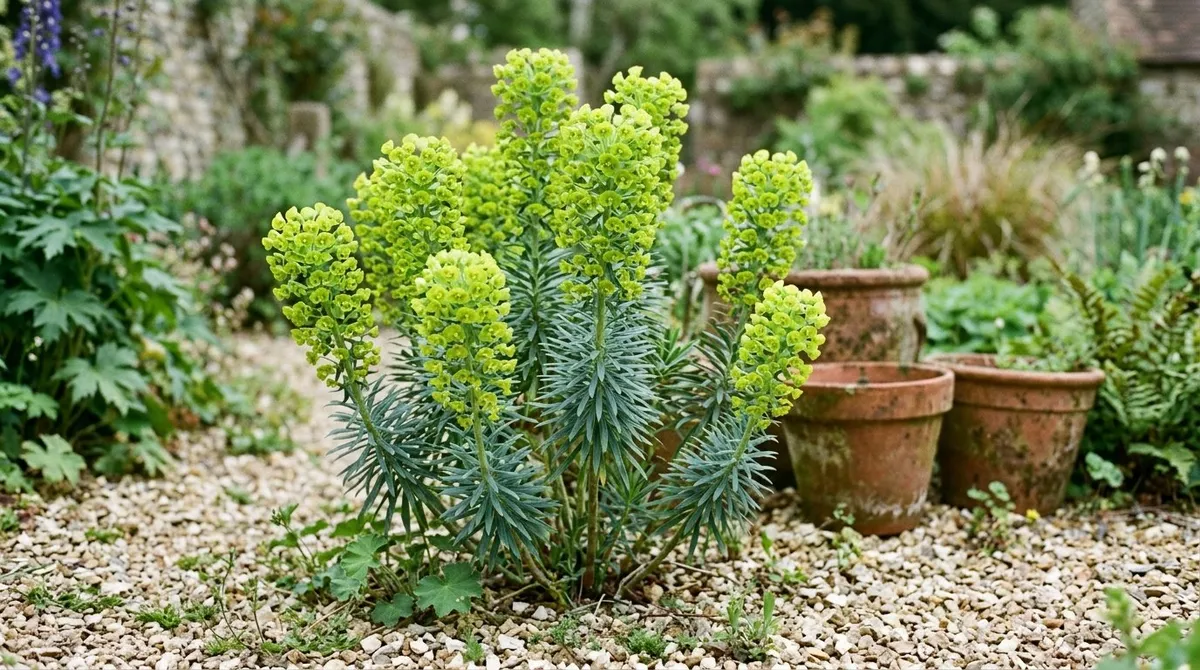
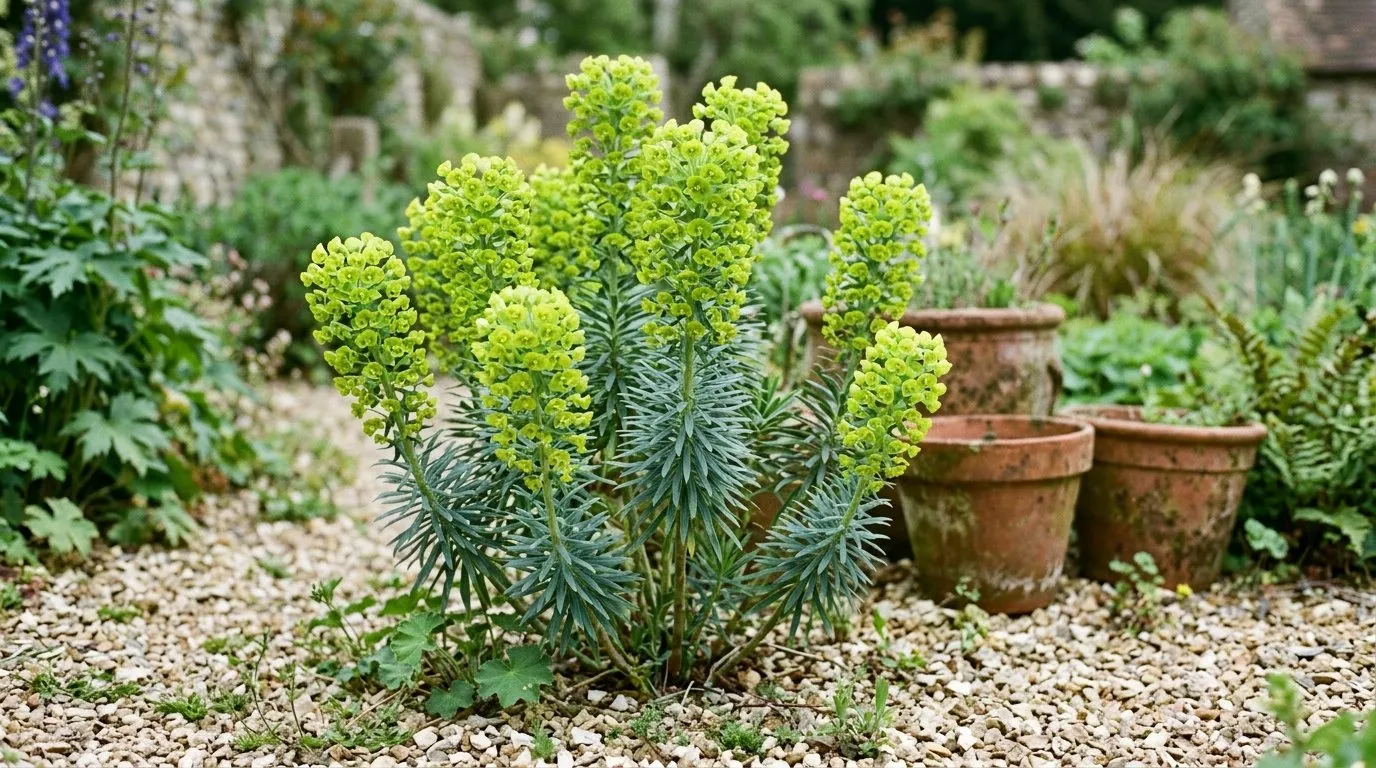 Euphorbia characias lights a gravel garden with acid-green heads. Every stem you cut bleeds caustic sap, so glove up and protect your eyes.
What is euphorbia and how many types are there?
Euphorbia, or spurge, is one of the largest plant genera on Earth, with around 2,000 species ranging from tiny alpines to cactus-like desert succulents. What unites them is the odd flower structure, a cyathium, and that shared milky latex. For UK gardens only a small, hardy, herbaceous slice matters.
Most garden euphorbias are drought-tolerant and thrive on poor, free-draining soil in sun, which makes them ideal for a gravel garden or a hot, dry border. A few prefer shade. Getting the group right for your site is the whole game, so here are the six worth growing.
The 6 best euphorbias for UK gardens compared
The best euphorbia for your garden depends on sun, soil and the effect you want. Here are the six groups that cover almost every UK situation, with the standouts in each. Prices are for 2-litre pots, roughly £8-15 at a good nursery in 2026.
| Euphorbia | Height | Sun / shade | Evergreen? | RHS hardiness | Best use |
|---|---|---|---|---|---|
| E. characias subsp. wulfenii | 100-120cm | Full sun | Evergreen | H4 (to -10C) | Architectural, gravel garden, structure |
| E. amygdaloides var. robbiae | 40-60cm | Shade / part shade | Evergreen | H5 (to -15C) | Dry shade ground cover under trees |
| E. polychroma | 40-50cm | Full sun / light shade | Deciduous | H6 (to -20C) | Neat spring dome for border edges |
| E. griffithii ‘Fireglow’ | 75-90cm | Full sun / part shade | Deciduous | H5 (to -15C) | Fiery colour in a hot border |
| E. mellifera (honey spurge) | 150-200cm | Full sun, sheltered | Evergreen | H3 (to -5C) | Scented spring shrub, mild gardens |
| E. oblongata | 45-60cm | Full sun | Annual | Half-hardy | Acid-green filler for cutting |
Euphorbia characias: evergreen architecture
Euphorbia characias subsp. wulfenii is the architectural spurge everyone recognises, and the best starting point. It forms a shrubby dome of upright, blue-green, bottlebrush stems to 100-120cm, holding its foliage all winter. In spring each two-year-old stem is topped by a huge cylindrical head of acid-green bracts, often 20-30cm long, from March to June.
It is rated RHS H4, hardy to about -10C, and wants full sun and sharp drainage. The AGM forms ‘Silver Swan’ (variegated) and subsp. wulfenii itself are reliable. This is the plant for evergreen backbone, and it earns its place among other low-maintenance architectural plants in a modern scheme.
Pruning is specific and covered below, because each stem flowers only once.
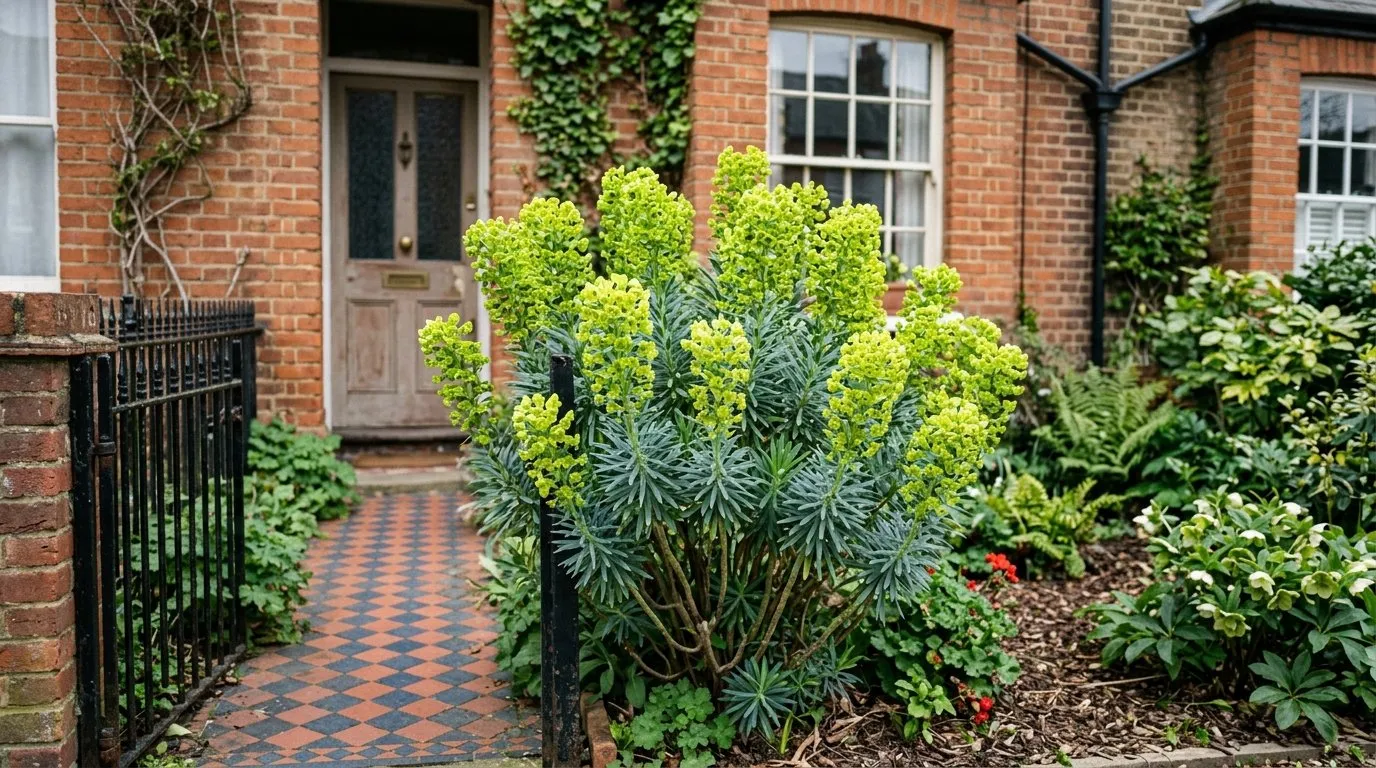 Euphorbia characias gives evergreen blue-green structure and huge acid-green heads. Here it lifts a London front garden against warm brick.
Euphorbia robbiae: the dry-shade workhorse
Euphorbia amygdaloides var. robbiae is the one euphorbia that thrives in dry shade, where little else spreads. It makes dark evergreen rosettes on running rhizomes, sending up 40-60cm stems of lime-green flowers in spring. It colonises the difficult ground under trees and along shady fences that defeats most plants.
Rated RHS H5, hardy to -15C, it is tough to the point of thuggish, so give it room to run or a hard edge to stop it. It is one of the most useful plants for dry shade under trees and shrubs, earning its keep as weed-suppressing ground cover.
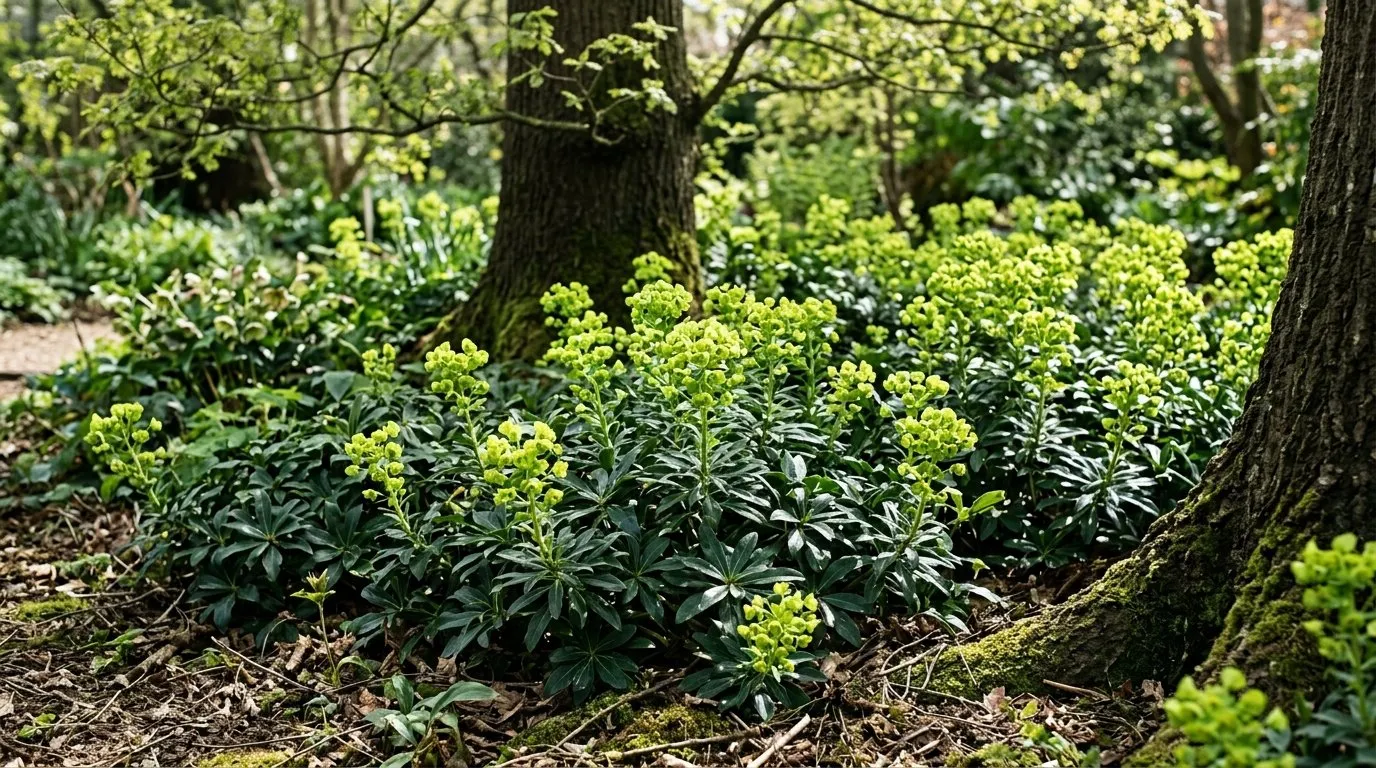 Euphorbia robbiae spreads by rhizome to carpet dry shade under trees. The dark rosettes throw lime-green flower heads each spring.
Euphorbia polychroma: the spring dome
Euphorbia polychroma is the neatest and hardiest garden spurge, forming a tidy dome smothered in chrome-yellow bracts. It builds a rounded mound 40-50cm high and wide, glowing sulphur-yellow to lime from April to May, then staying quietly green through summer.
At RHS H6 it survives -20C, dies down for winter, and returns reliably each spring. It suits the front of a sunny border or a cottage garden planting scheme, pairing well with tulips and forget-me-nots. Unlike characias, you do not cut it hard; a light deadhead after flowering is all it needs.
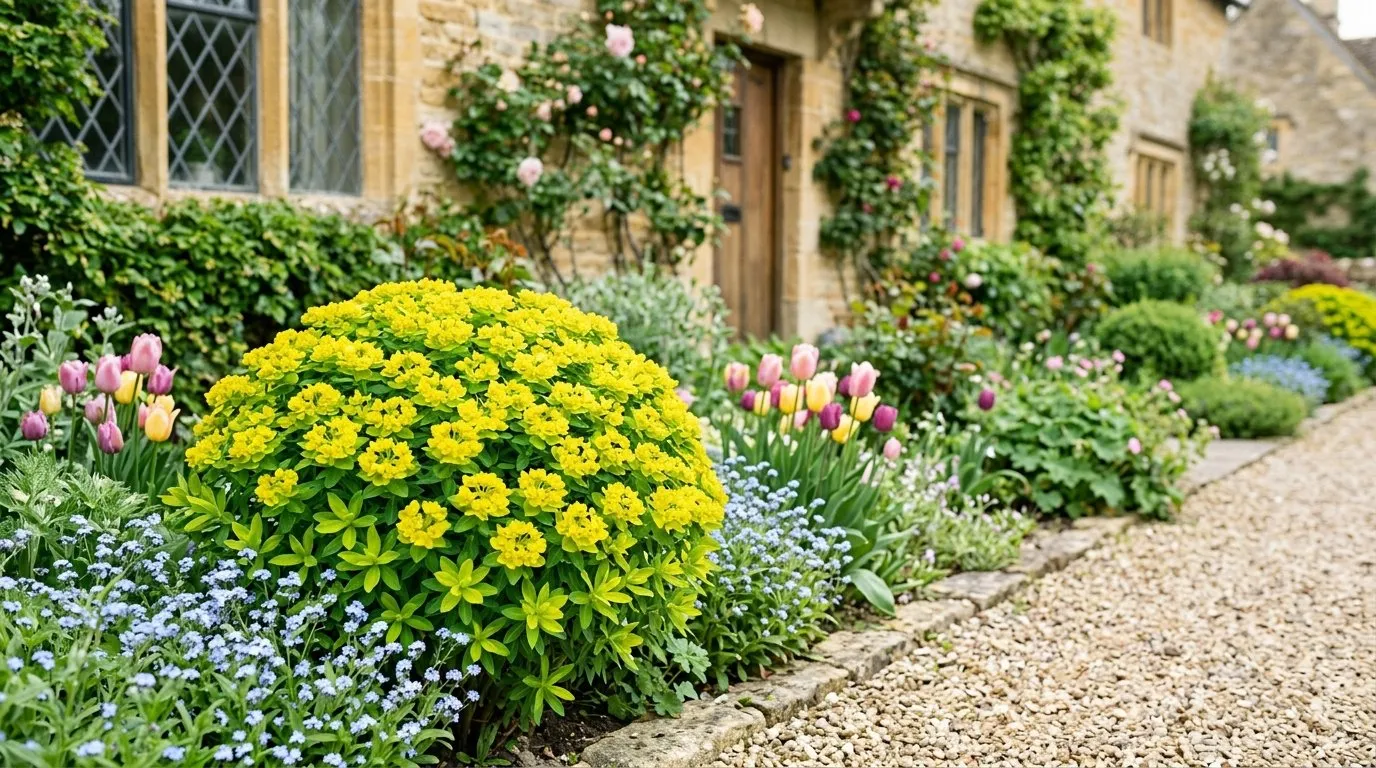 Euphorbia polychroma forms a neat lime-green dome in spring. It is the hardiest garden spurge at RHS H6 and needs only a light trim.
Euphorbia griffithii ‘Fireglow’: hot colour
Euphorbia griffithii ‘Fireglow’ brings the fiery end of the range, with orange-red bracts over coppery foliage. This herbaceous, spreading spurge reaches 75-90cm and lights up June with brick-orange to flame-red heads, then colours again in autumn. It runs gently at the root, so it fills space in a border.
Rated RHS H5, hardy to -15C, it prefers a moisture-retentive but not waterlogged soil in sun or light shade, unlike its drought-loving cousins. It is a natural in a hot border colour scheme alongside crocosmia and dahlias.
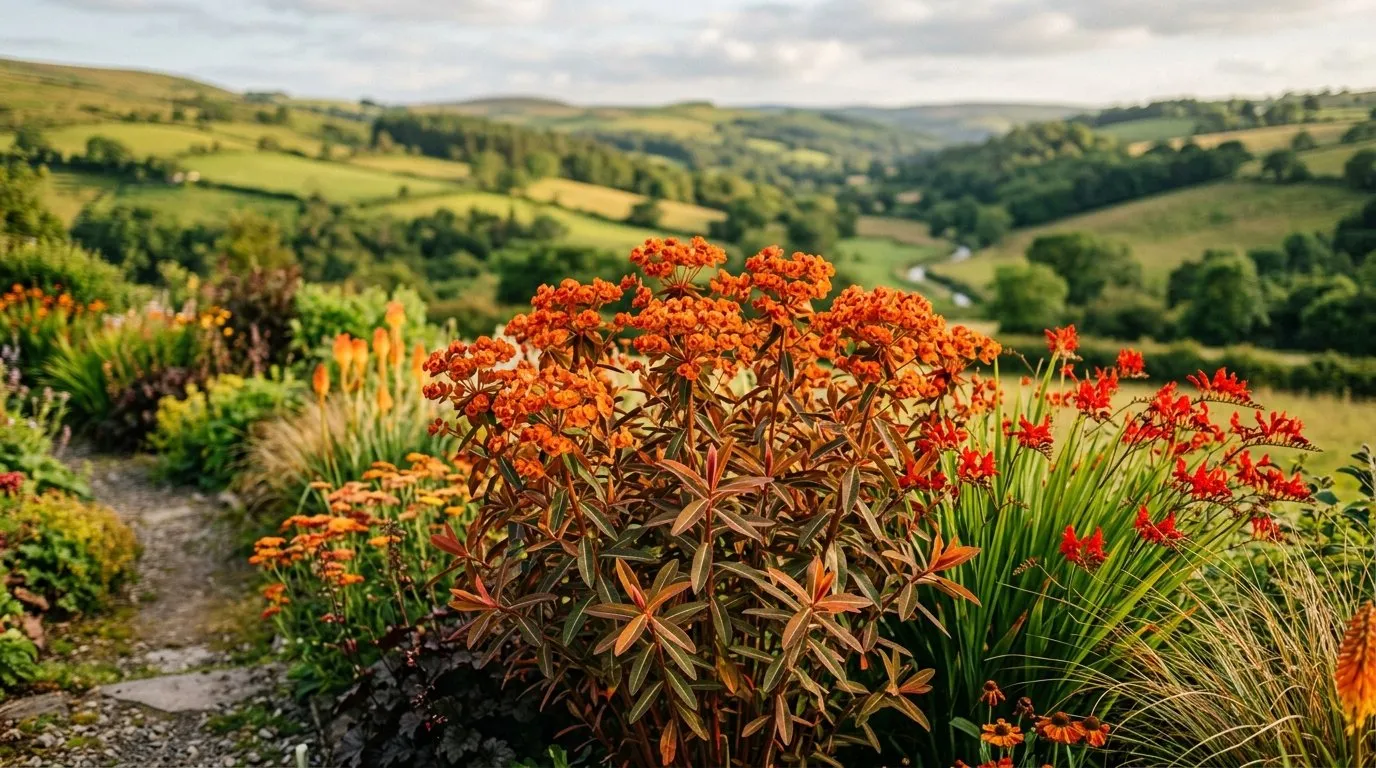 Euphorbia griffithii ‘Fireglow’ throws brick-orange and flame-red heads in June. Here it warms a hot border in a Welsh hillside garden.
Euphorbia mellifera: the honey spurge
Euphorbia mellifera, the honey spurge, is the big, scented one for mild and sheltered gardens. It builds into a rounded evergreen shrub 1.5-2m tall, with fresh green leaves and, in late spring, brown-and-honey flowers that carry a genuine honey scent on warm days.
It is the tenderest here at RHS H3, hardy only to about -5C, so it needs a sheltered spot and suits mild coastal, city and southern gardens best. In a cold inland garden give it a warm wall or grow it in a container you can protect. It has real presence and suits a warm, Mediterranean-style planting scheme.
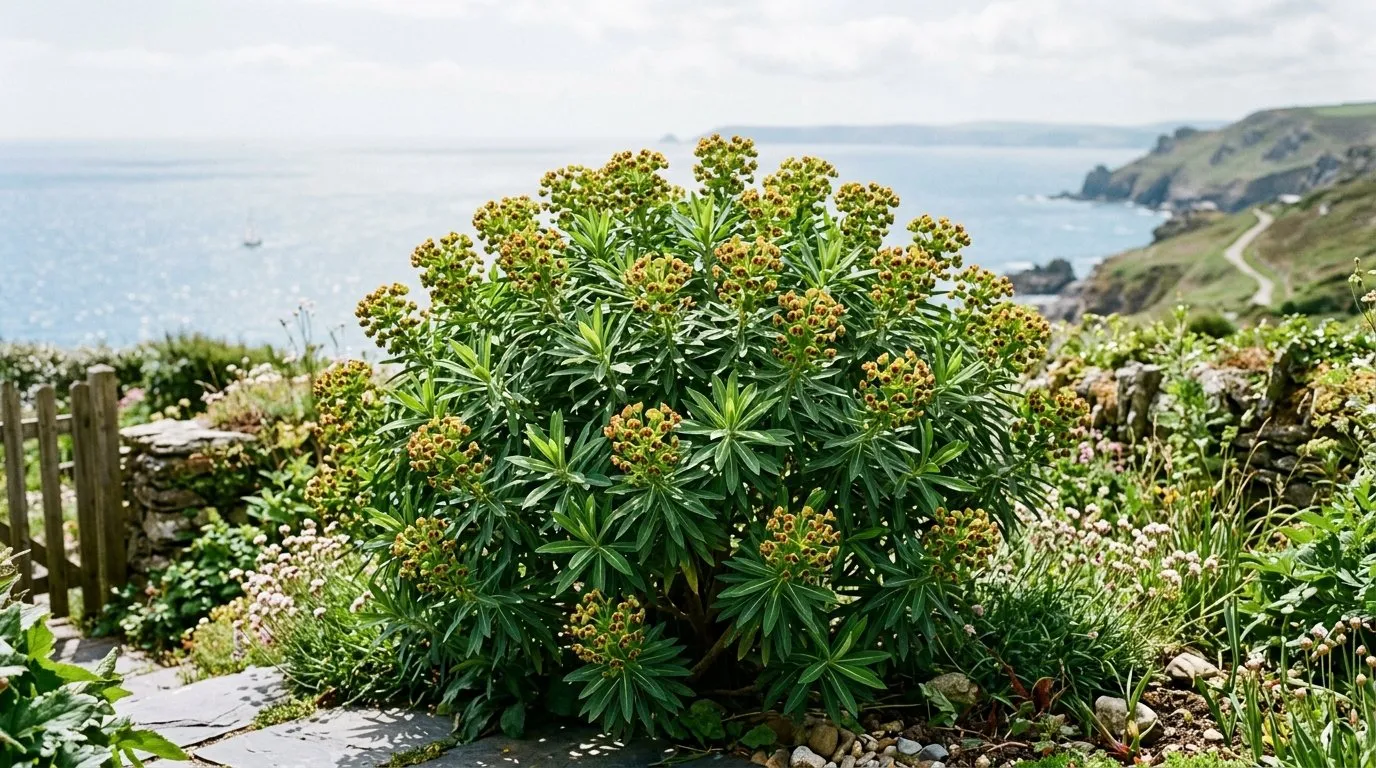 Euphorbia mellifera, the honey spurge, makes a scented evergreen shrub to 2m. It needs a sheltered, mild spot such as this seaside gravel garden.
Euphorbia oblongata: the annual for cutting
Euphorbia oblongata is grown as a half-hardy annual for its long-lasting acid-green flower heads, prized by florists. Sown in spring, it makes bushy 45-60cm plants covered in bright chartreuse bracts from summer into autumn, the perfect zingy filler in a mixed bouquet.
It self-seeds freely, so one packet keeps you supplied for years. It is a favourite in any cut flower garden, where its acid-green cools down hot colours in the vase. The sap makes conditioning fiddly, which the next section solves.
How do you prune euphorbia and cut it for the vase?
Pruning depends entirely on the type, so match the method to the plant, and glove up first. Getting this wrong is why so many characias clumps look a mess.
Euphorbia characias and other biennial-stemmed types. Each stem grows in year one, flowers in year two, then dies. Once the flower head fades in early summer, cut that whole stem right down to the base, leaving the fresh non-flowering shoots to overwinter and bloom next year. Do this in one session in June or July, wearing gloves and eye protection, and the clump stays dense and tidy. Leave the spent stems and the plant looks tired and flops.
Euphorbia polychroma and herbaceous types. These do not need hard pruning. Deadhead E. polychroma lightly after the yellow bracts fade to keep it neat, then cut the whole plant to the ground in autumn or late winter as it dies back. E. griffithii is the same: let it die down, then clear the dead stems.
Euphorbia robbiae. Cut the flowered stems out at the base once they brown, and dig out any runners that stray too far. That is the extent of it.
Cutting euphorbia for the vase: cut and sear
Euphorbia is a superb cut flower, but the sap makes stems bleed and poisons the vase water, so you must sear the cut ends. The technique is simple:
- Cut stems in the cool of the morning, wearing gloves and eye protection.
- Plunge the cut ends into just-boiled water for 10-30 seconds, or hold them to a flame until the sap stops flowing.
- Move the seared stems straight into cold, deep water to condition overnight.
Searing stops the milky sap leaking, which otherwise clouds the water and shortens the life of everything in the arrangement. Done properly, euphorbia lasts 7-10 days in a vase, holding its acid-green colour longer than most fillers.
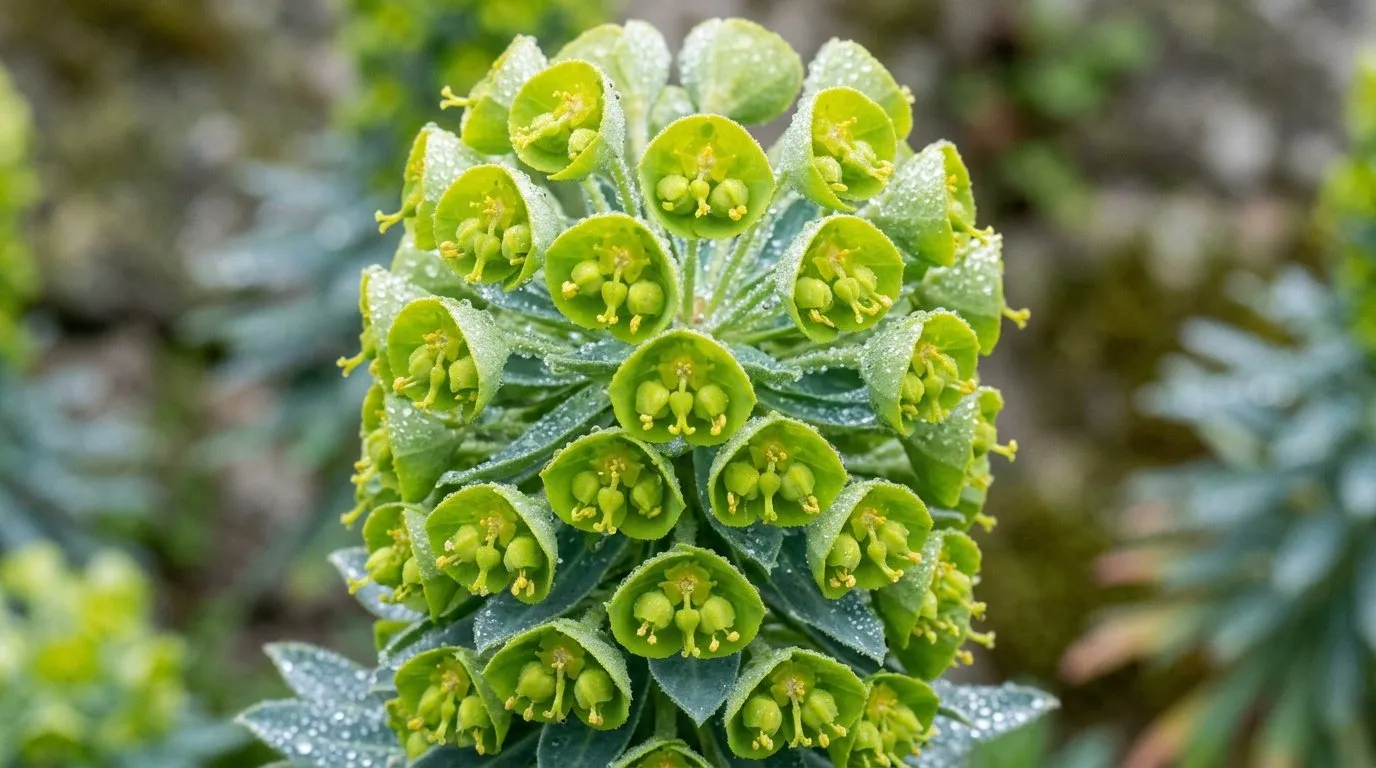 The acid-green cylindrical heads of Euphorbia characias close up. Cut stems must be seared in boiling water to stop the sap bleeding into the vase.
Where should you plant euphorbia, and is it drought-tolerant?
Most euphorbias are strongly drought-tolerant and want full sun with sharp drainage, which makes them the backbone of low-water planting. The evergreen sun-lovers, characias and mellifera, cope with long dry spells once established and rarely need watering. This puts them among the most useful drought-tolerant plants for UK gardens as summers grow hotter and drier.
The main killer is wet winter soil. Euphorbia roots rot in cold, waterlogged ground, so on heavy clay add grit or plant on a slight mound. They shine in gravel gardens, sunny slopes and raised beds where water drains away fast.
Two groups break the drought rule. E. robbiae wants shade and copes with dry soil there, while E. griffithii ‘Fireglow’ prefers soil that stays a little moist. Read the group, not the genus.
For a container on a city balcony or courtyard, choose the compact E. polychroma or a young characias in a large pot with gritty, free-draining compost. Water in summer but never let the pot stand wet, and move tender mellifera under cover for winter.
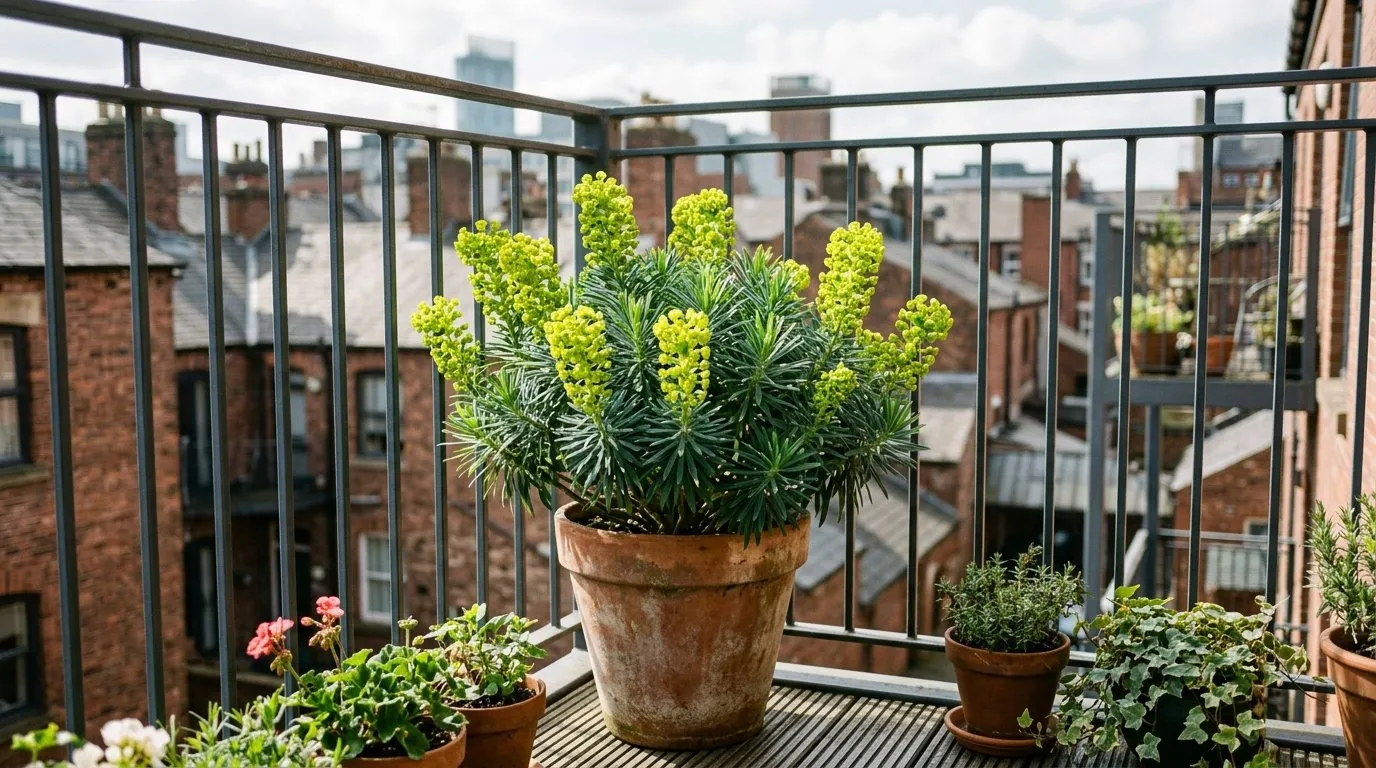 A young Euphorbia characias in a large container on a city balcony. Use gritty, free-draining compost and never let the pot stand wet.
Controlling self-seeding and keeping euphorbia in bounds
Euphorbia can spread by seed and by root, so a little management keeps it from taking over. E. characias and E. oblongata self-seed freely, scattering offspring around the garden. This is a bonus if you want more, and a chore if you do not.
To control seeding, cut the flower heads off before the seed ripens and drops, usually within a few weeks of the bracts fading. Deadheading also tidies the plant. Seedlings pull up easily when small; wear gloves, because young stems bleed sap too.
E. robbiae and E. griffithii spread by underground runners rather than seed. Keep them in check by slicing round the clump with a spade each spring and lifting any runners that stray. Plant robbiae where its spread is a virtue, such as a difficult shady bank, and it becomes an asset rather than a problem.
Divide congested clumps of the herbaceous types in spring, replanting healthy outer sections. This is also the cheapest way to make more plants for free, and lifts a tired clump at the same time.
Frequently asked questions
Is euphorbia sap dangerous?
Yes, euphorbia sap is a caustic skin and eye irritant. The milky white latex causes burning, redness and blistering on skin, and splashes in the eye can cause painful keratitis. Rare cases have caused temporary or permanent sight loss. Always wear gloves and eye protection when cutting, and wash any splash off at once.
What do I do if euphorbia sap gets in my eye?
Rinse the eye with cool running water for at least 15 minutes immediately. Do not rub it. Hold the eyelid open and flush thoroughly, then seek medical advice the same day, especially if pain, blurring or light sensitivity continues. Eye contact with spurge sap is a genuine emergency, not something to wait out.
Which euphorbia is best for a UK garden?
Euphorbia characias subsp. wulfenii is the best all-round choice for most UK gardens. It gives evergreen blue-green structure and huge acid-green flower heads from March to June. For dry shade choose E. amygdaloides var. robbiae; for a neat spring dome choose E. polychroma. Match the species to your soil and light.
Is euphorbia hard to grow in the UK?
No, most garden euphorbias are easy and drought-tolerant. They want free-draining soil and, for the evergreen types, full sun. They rarely need feeding or watering once established. The two rules that matter are safe sap handling and correct pruning of the flowered stems. Waterlogged winter soil is the main killer.
Do you cut euphorbia back after flowering?
Yes, cut the flowered stems of Euphorbia characias right to the base once the heads fade. On this species each stem flowers only once, so removing it makes room for next year’s shoots and keeps the clump tidy. Wear gloves and eye protection. Deadhead E. polychroma instead; do not cut it hard.
Is euphorbia poisonous to dogs and cats?
Yes, euphorbia is toxic to dogs, cats and people if eaten. The sap irritates the mouth and gut and causes drooling, vomiting and discomfort. Serious poisoning is uncommon because the acrid taste puts animals off. Site plants away from pets that chew, and wash hands after handling. Contact a vet if a pet eats any.
Does euphorbia come back every year?
Yes, almost all garden euphorbias are hardy perennials that return each year. Evergreen types like E. characias keep their foliage through winter; herbaceous types like E. griffithii die down and reshoot in spring. Only a few, such as E. oblongata grown for cutting, are treated as annuals and resown each year.
Once your spurge is settled, build the rest of the scheme around it with our guide to evergreen shrubs for year-round interest.
Our team produces practical UK gardening guidance from source research, contributor records and established horticultural practice. Editorial standards are overseen by Matt W.