Key takeaways
- Buy only named ornamental oxalis; purple shamrock, Iron Cross and alpine O. adenophylla are safe and well-behaved
- Never plant creeping yellow O. corniculata or pink O. articulata, debilis or latifolia; they spread by explosive seed and bulbils
- Oxalis triangularis is tender (H2-H3); grow it as a houseplant or lift it indoors before the first frost
- Alpine species like O. adenophylla are hardy to -10C and want gritty, free-draining pans in full sun
- The RHS confirms home weedkillers do not control oxalis; smothering and persistent hand-weeding are the real tools
- Never rotivate or compost weedy oxalis; both actions scatter bulbils and make the problem far worse
Few plants divide gardeners as sharply as oxalis. In one garden it is a treasured houseplant with deep purple leaves that fold shut at dusk. In the next it is the creeping weed seeding through the greenhouse gravel and the cracks in the patio.
Both plants are oxalis. The genus holds around 800 species, and the gap between the best and the worst is enormous. Get the identification right and you either buy a jewel or you shut the door on a weed that takes years to shift. This guide sorts the two groups and shows you how to grow the good ones and fight the bad ones.
Is oxalis a weed or a garden plant?
Oxalis is both, and the answer depends entirely on the species you are looking at. The genus, sometimes called wood sorrel, spans around 800 species worldwide. A handful are sold as ornamentals in garden centres. Several more are among the most persistent weeds in UK gardens. The leaves look similar across the whole group, which is exactly why people get caught out.
All oxalis share the clover-like leaf, usually with three heart-shaped leaflets, though some carry four. The flowers are five-petalled and funnel-shaped, in yellow, pink, white or purple. The trap is that a pretty pink flower can belong to a garden treasure or to a weed that colonises a border in two seasons. Colour and leaf shape alone will not tell you which you have. You need to know the species name and how it spreads.
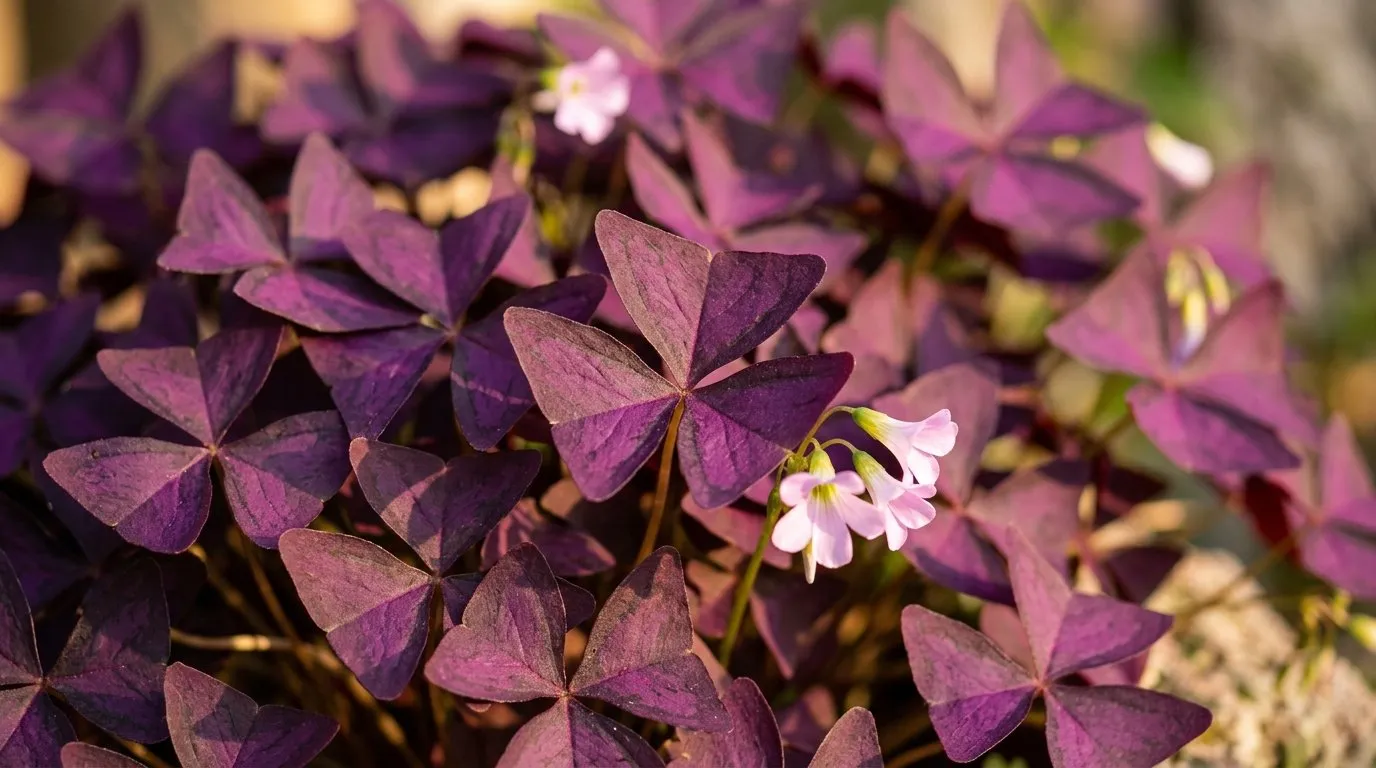 Purple shamrock, Oxalis triangularis, is the ornamental face of the genus. Its triangular leaflets fold shut at night.
The safe rule is simple. Buy only a named ornamental oxalis from a reputable nursery, and never dig up or accept a spreading oxalis from another garden. If a friend offers you a clump of pretty pink oxalis for free, be very cautious. The generous ones are almost always the invasive species, because those are the plants that produce enough spare material to give away by the bucketful.
The ornamental oxalis worth growing
The ornamental oxalis are clump-forming or bulbous plants that stay where you put them. They earn a place on a windowsill, a patio or an alpine bench. None of them run through a border or seed themselves into paving. These are the species to seek out by name.
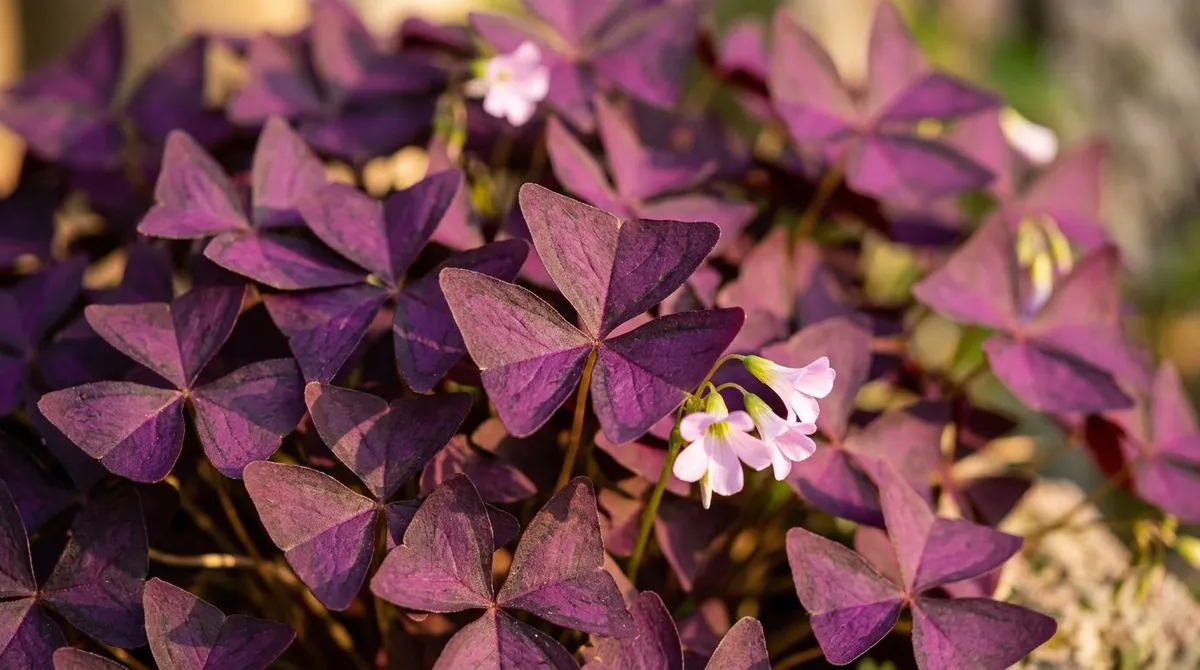
Oxalis triangularis, purple shamrock or false shamrock, is the most popular of all. It carries deep beetroot-purple leaves, each split into three broad triangular leaflets, above which sit pale pink or lilac flowers through summer. It reaches 15-30cm. It grows from small scaly rhizomes and makes a first-rate houseplant. The RHS rates it as tender (rhs.org.uk), so it needs a frost-free winter.
Oxalis tetraphylla ‘Iron Cross’, sometimes sold as O. deppei, is the lucky four-leaf clover of the genus. Each leaf splits into four leaflets, and every leaflet carries a dark maroon blotch at its centre. Together they form a cross, which gives the plant its name. Bright magenta-pink flowers rise on 15-25cm stems in summer. It grows from small bulbs and is tender, so lift the bulbs before winter.
Oxalis adenophylla is the alpine star. It forms a tight fan of silvery grey-green crinkled leaflets, only 8-10cm high, topped in late spring by cup-shaped pink flowers veined in darker rose. This one is genuinely hardy, down to around -10C, and holds an RHS Award of Garden Merit. It grows from a fibrous-coated bulb and suits a gritty trough or rock garden.
Oxalis ‘Ione Hecker’ is a hybrid alpine with deep violet-blue flowers over blue-grey foliage at around 8cm. It also holds an AGM and wants the same sharp drainage as O. adenophylla. Oxalis versicolor, candy cane sorrel, is the showman: its white flowers are edged in crimson on the reverse, so the furled bud looks like a striped sweet. It is borderline hardy at about -5C and best in a pot you can shelter.
These ornamentals pair well with other purple and pink flowers in a container display, and the purple shamrock in particular makes a strong foil for silver foliage.
Grow these, never these: the oxalis comparison table
The single most useful thing you can carry in your head is which oxalis to welcome and which to refuse. This table sets the prized ornamentals against the invasive weeds, with the identification feature and spread mechanism for each. Learn the weeds as carefully as the plants you want.
| Species | Common name | Group | Key ID feature | How it spreads |
|---|---|---|---|---|
| O. triangularis | Purple shamrock | Grow | Deep purple triangular leaflets, pink flowers | Slow-clumping rhizome, stays put |
| O. tetraphylla | Iron Cross | Grow | Four leaflets, maroon central cross, magenta flowers | Small bulbs, well-behaved |
| O. adenophylla | Silver shamrock | Grow | Silvery crinkled fan, pink spring flowers, 8-10cm | Fibrous bulb, non-invasive |
| O. versicolor | Candy cane sorrel | Grow | White flowers, crimson-striped reverse | Small bulb, tidy clump |
| O. corniculata | Creeping wood sorrel | Never | Tiny yellow flowers, bronze-tinged leaves, creeping stems | Explosive seed pods, roots at nodes |
| O. articulata | Pink sorrel | Never | Bright pink flowers, clover leaves, dense clump | Brittle tubers, fragments regrow |
| O. debilis | Large-flowered pink sorrel | Never | Deep pink flowers, broad leaflets | Tiny bulbils around parent bulb |
| O. latifolia | Garden pink sorrel | Never | Pale pink flowers, wide leaflets | Bulbils on rhizome ends, plus seed |
| O. pes-caprae | Bermuda buttercup | Never | Bright yellow flowers, mild-area menace | Bulbils, notorious in Cornwall and Scilly |
The pattern is easier once you see it. Yellow flowers on a low creeper mean O. corniculata, a weed. Bright yellow on a taller plant in a mild coastal garden points to Bermuda buttercup, also a weed. Bright pink on a spreading clump means one of the pink sorrels, all weeds. The ornamentals you want are the purple-leaved shamrock, the four-lobed Iron Cross, and the low silvery alpines with soft pink or violet flowers.
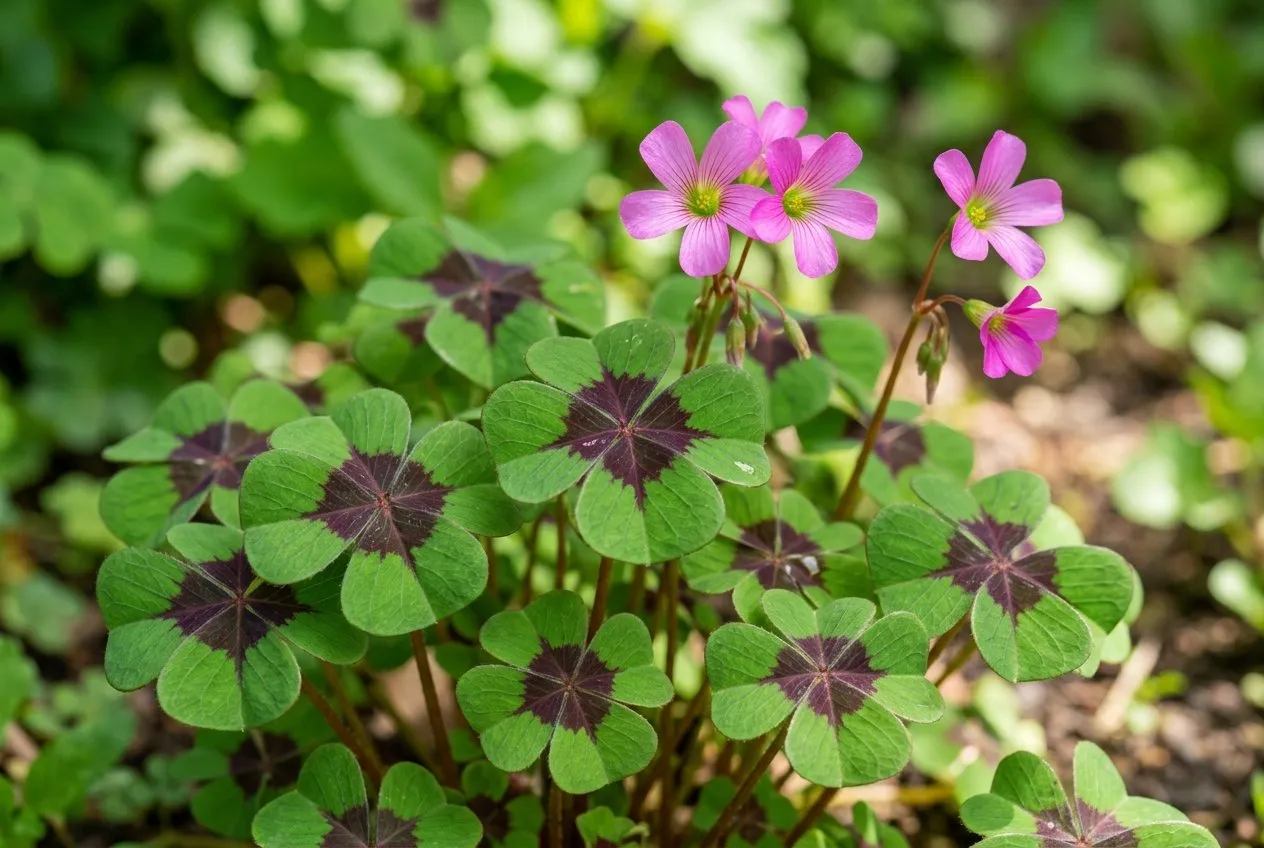 Oxalis tetraphylla ‘Iron Cross’. The four leaflets and maroon central markings make it unmistakable and safe to grow.
How to grow purple shamrock (Oxalis triangularis)
Grow purple shamrock as a houseplant, or move it outdoors for summer and lift it before frost. It is the easiest ornamental oxalis and the most forgiving of the lot. Treat it as a tender pot plant and it will run for years.
Give it bright, indirect light. A north or east windowsill indoors keeps the purple colour rich, while harsh midday sun through south glass can scorch the thin leaves. Outdoors from late May, stand it in partial shade on a patio. The compost should be gritty and free-draining. The RHS recommends equal parts loam, leaf mould and grit, or a soil-less compost with added grit. Water moderately while it is in leaf and let the surface dry between waterings. Feed with a balanced liquid feed once a month through summer.
Purple shamrock has a natural rest period. After a flush of growth the leaves may tire and flop. When this happens, cut the whole plant back to the compost, ease off the watering, and let it sit almost dry for a few weeks. Fresh purple leaves push up again within a month. This dormancy catches out new growers who assume the plant has died. It has not. It grows from small pink scaly rhizomes just under the surface, and these hold plenty of reserves.
The plant also folds its leaves down every evening. This nightly movement is called nyctinasty and it is completely normal. The leaflets drop into a closed purple umbrella as the light fades, then reopen at dawn. A sudden touch or a move into deep shade triggers the same response. It is one of the quiet pleasures of growing this plant, and children love watching it. Purple shamrock sits happily alongside the best indoor plants on a bright shelf.
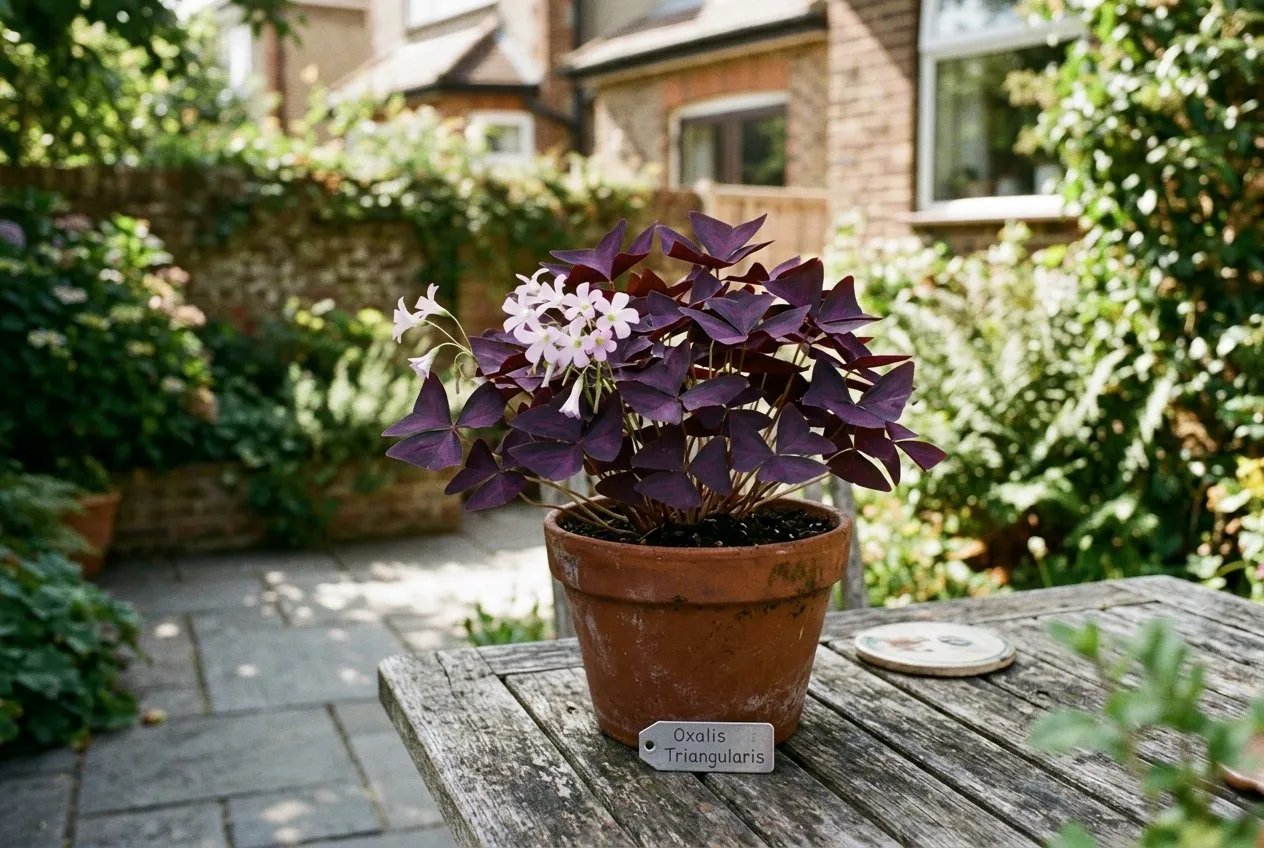 Purple shamrock earns its keep on a summer patio in partial shade. Lift it under cover before the first autumn frost.
Growing the alpine oxalis in gritty pans
The alpine oxalis want sharp drainage, full sun and lean living. Species like O. adenophylla, O. ‘Ione Hecker’ and O. versicolor come from high, dry habitats, and they rot fast in rich, wet ground. Grow them in gritty pans, troughs or a raised rock garden and they are trouble-free.
Mix a gritty compost of roughly equal parts loam-based compost, leaf mould and coarse horticultural grit. Aim for at least a third grit by volume. Plant the small bulbs 3-4cm deep in autumn, top-dress the surface with 1cm of grit, and stand the pan somewhere it gets full sun and never sits in a saucer of water. In the open ground, plant them on a slope or a raised bed where winter rain drains away fast.
These plants suit the same conditions as the gems in alpine trough displays, and a shallow stone trough of mixed alpines with a few oxalis among them earns its place by a doorway. Understanding how each species stores itself helps, so it is worth reading up on bulbs, corms and rhizomes before you plant.
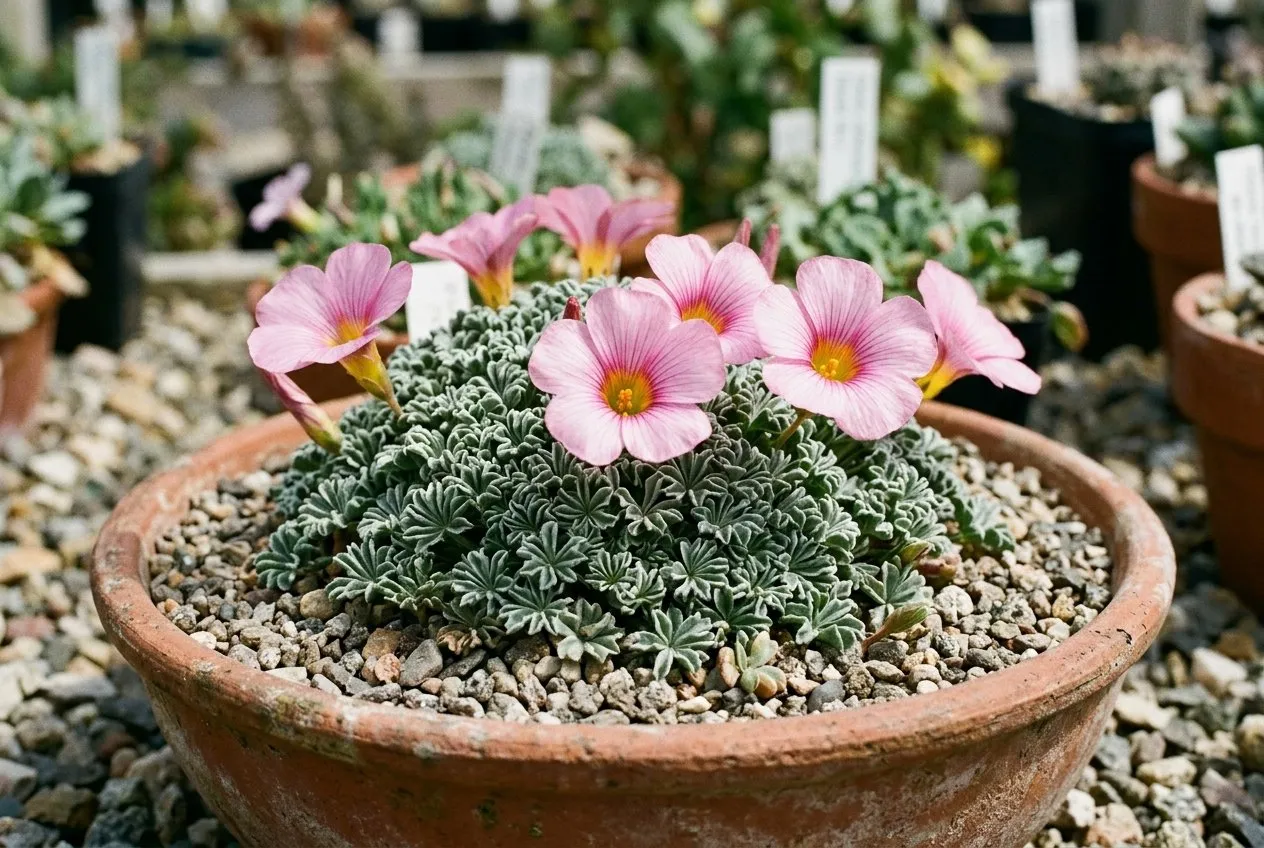 Oxalis adenophylla in a gritty pan. This hardy alpine wants full sun and sharp drainage, never rich or wet soil.
Lifting and overwintering the tender oxalis
The tender ornamentals must be protected from frost, and the safest method is to lift or move them under cover before the first hard night. Purple shamrock, Iron Cross and candy cane sorrel all sit in the tender bracket, hardy only to somewhere between 1C and -5C depending on the species. A single sharp frost on an exposed pot can finish them.
For bulbous types like Iron Cross, you can lift the bulbs entirely. Wait until the foliage yellows in autumn, dig up the small bulbs, brush off the soil, and store them dry in a paper bag of dry sand in a frost-free shed. Replant them 4cm deep in spring once frost has passed. This mirrors the way you would handle other tender summer bulbs, and the same principles in our guide to how to overwinter tender plants apply here. Label everything. Small dry oxalis bulbs are easy to lose or muddle with other stored corms.
The invasive oxalis you must never plant
The weedy oxalis are among the hardest garden weeds to remove, so prevention beats any cure. Once one establishes, you face years of work, not weeks. Never introduce them on purpose, and inspect the rootball of any bought plant for tell-tale bulbils and creeping stems.
Oxalis corniculata, creeping wood sorrel or yellow sorrel, is the worst offender in most gardens. It is a low creeper with tiny yellow flowers and small clover leaves that are often bronze or purple-tinged. Its stems root at every node as they run. Worse, the RHS notes that its upright seed pods fire seed at speed in late summer and autumn, flinging it a metre or more from the plant. That is how it colonises pots, greenhouse gravel and paving cracks so fast.
The pink sorrels are the other main group. Oxalis articulata makes a dense clump of clover leaves under bright pink flowers, and its brittle tubers fragment and regrow from any piece left behind. Oxalis debilis and Oxalis latifolia spread by producing dozens of tiny bulbils around the parent, and the RHS warns these bulbils dislodge and scatter the moment you dig. Oxalis pes-caprae, Bermuda buttercup, is a bright yellow menace in mild areas like Cornwall and the Isles of Scilly. All of these behave like classic garden thugs that take over once they get a foothold.
Warning: Never accept free oxalis from another gardener, and never buy an unnamed pink or yellow oxalis from a plant swap or car boot sale. The invasive species are the ones people have to spare, precisely because they spread so freely. A single donated clump of O. articulata can seed a whole border within two summers.
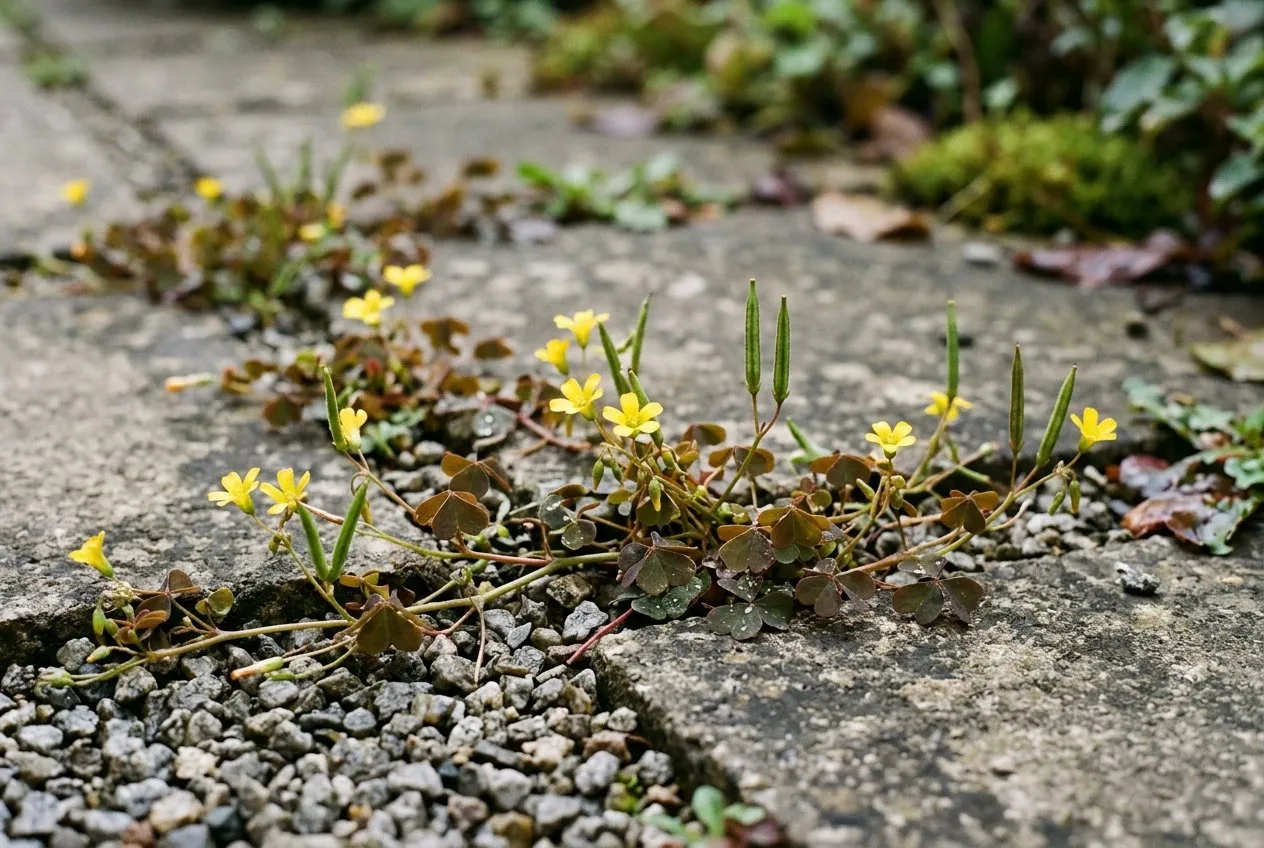 Creeping wood sorrel, Oxalis corniculata, threading through gravel. Its exploding seed pods scatter seed a metre or more.
How to get rid of oxalis weeds
Getting rid of weedy oxalis comes down to smothering, patient hand-weeding and stopping seed, because chemicals largely fail. The RHS is blunt about it: weedkillers available to home gardeners are not effective at controlling oxalis. The waxy leaves shed contact sprays, and the plant regrows from bulbils and root fragments no home product reaches. Accept that early and you save money and frustration.
Hand-weeding works but only if you are thorough and persistent. For O. corniculata, remove the whole plant including its taproot before the seed pods ripen. For the pink bulbous sorrels, this is where care matters most. Digging scatters the bulbils and multiplies the problem. Ease a fork under the whole clump, lift it in one intact block onto a sheet, and pick out every bulbil you can find. Sieve the soil if the infestation is bad. Then keep returning every few weeks to remove regrowth, because you will never get every bulbil first time.
Smothering is the most reliable non-chemical method for a heavy infestation. Cover the area with a layer of cardboard, then pile 20cm of organic matter or a light-excluding mulch on top. Leave it in place for a full season or more. Denying the plant light exhausts the bulbils. Dense planting of strong ground cover afterwards helps stop reinvasion. The same light-first thinking runs through our guide to preventing weeds without chemicals.
Two rules matter above all else. Never rotivate ground infested with bulbous oxalis, because the blades chop and spread bulbils across the whole plot. And never compost the roots, bulbils or seed heads. Home heaps rarely get hot enough to kill them, and you simply spread the weed wherever the finished compost goes. Bag the lot and put it in the general waste bin.
Why bagging and binning beats every shortcut
The temptation is to throw oxalis on the compost or bonfire pile. Do not. Bulbils the size of a grain of rice survive both. Bag every scrap of root, bulbil and seed head in a sealed sack for general waste. It feels wasteful, but it is the one action that stops the cycle.
 Lift weedy oxalis in one intact block onto a sheet. Digging carelessly scatters the pale bulbils and spreads the problem.
How to spot an invasive oxalis seedling early
Catching a weedy oxalis in its first weeks is far easier than fighting an established colony. The seedlings are small and easy to miss among other growth, so it pays to know what you are looking for in spring and early summer.
A young O. corniculata shows tiny clover leaves, often flushed bronze or purple, on thin stems that quickly start to creep sideways and root. Pull it the moment you see it, before it flowers and sets seed. A single plant left for a month can seed a whole raised bed. The pink sorrels appear as small clumps of fresh green clover leaves pushing up from bulbils, usually near where a bought plant went in or where soil has been moved.
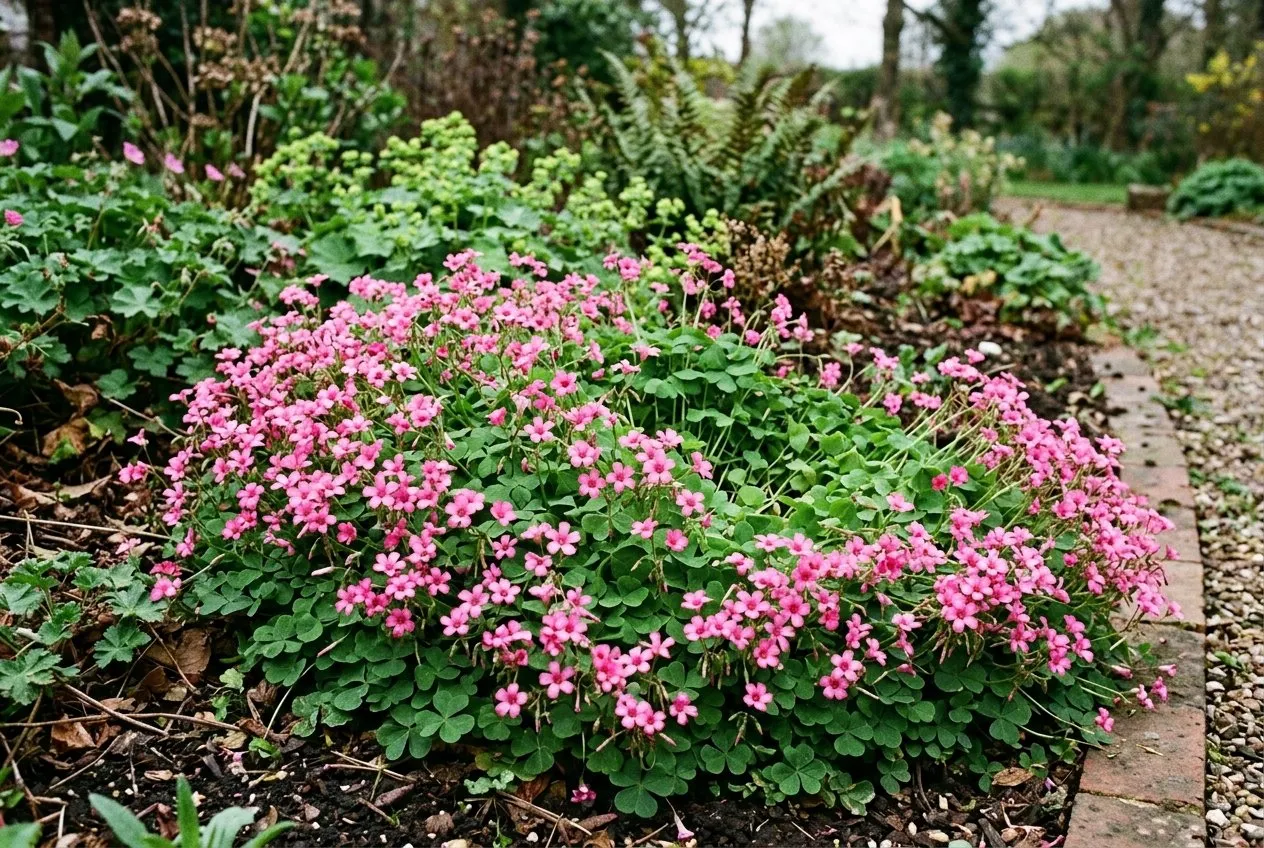 Pink sorrel, Oxalis articulata, forms a spreading clump. Its brittle tubers regrow from any fragment left in the soil.
The give-away is behaviour, not just looks. An ornamental oxalis stays as a neat clump where you planted it. A weed appears where you planted nothing, spreads outward, and turns up in cracks, gravel and pot edges. If a clover-leaved plant arrives uninvited and starts to run, treat it as guilty until proven otherwise.
Month-by-month oxalis calendar
This calendar covers the ornamental oxalis through a UK year, with a note on when to tackle the weeds. Timing the lifting and the weeding well makes both jobs easier.
| Month | Task |
|---|---|
| January | Keep tender pots frost-free and barely moist; check stored Iron Cross bulbs for rot |
| February | Purple shamrock resting; resist overwatering dormant plants |
| March | Start watering tender pots as light returns; divide congested purple shamrock |
| April | Pot up stored Iron Cross bulbs; alpine oxalis start into growth |
| May | Alpine O. adenophylla flowers; move tender pots outdoors after the last frost |
| June | Feed purple shamrock monthly; watch for weedy oxalis seedlings emerging |
| July | Peak growth; hand-weed O. corniculata before seed pods ripen |
| August | Deadhead weedy oxalis to stop seed; keep alpine pans on the dry side |
| September | Collect and bag any weed seed heads; reduce watering on ornamentals |
| October | Lift or move tender pots under cover before first frost; store Iron Cross bulbs |
| November | Smother heavy weed patches with cardboard and mulch for the winter |
| December | Ornamentals dormant; plan next year’s alpine pans and check no weed bulbils remain |
Common mistakes when growing oxalis
Most oxalis problems trace back to a few repeated errors. Avoid these and you keep the ornamentals thriving and the weeds out.
Buying or accepting an unnamed oxalis
This is how nearly every invasion starts. A free clump or an unlabelled pot of pretty pink oxalis is almost always one of the weedy sorrels. Only ever buy a named ornamental from a nursery you trust, and inspect the rootball for bulbils and creeping stems before it comes home.
Leaving purple shamrock in the frost
Purple shamrock is tender, not hardy, and a single hard frost on an outdoor pot can kill it. Every autumn, move the pot into a frost-free spot before the first frost is forecast. Gardeners who treat it as a hardy border plant lose it in its first winter.
Panicking when the leaves die back
The natural dormancy of purple shamrock looks like death to a new grower. Tired, floppy leaves are a signal to cut back and rest the plant, not to bin it. Ease off the water, wait a few weeks, and fresh purple growth returns from the rhizomes.
Digging out weedy oxalis carelessly
Turning a fork through a patch of bulbous oxalis scatters the bulbils and makes the problem far worse. Lift infested clumps intact onto a sheet, pick out every bulbil, and never rotivate the ground. Careless digging is why so many people feel the weed is impossible to beat.
Rich, wet compost for alpine species
The silvery alpine oxalis rot in rich, moisture-retentive soil. They evolved in lean, gritty, free-draining ground. Give them at least a third grit, full sun and sparing water, and never leave the pan standing in a wet saucer over winter.
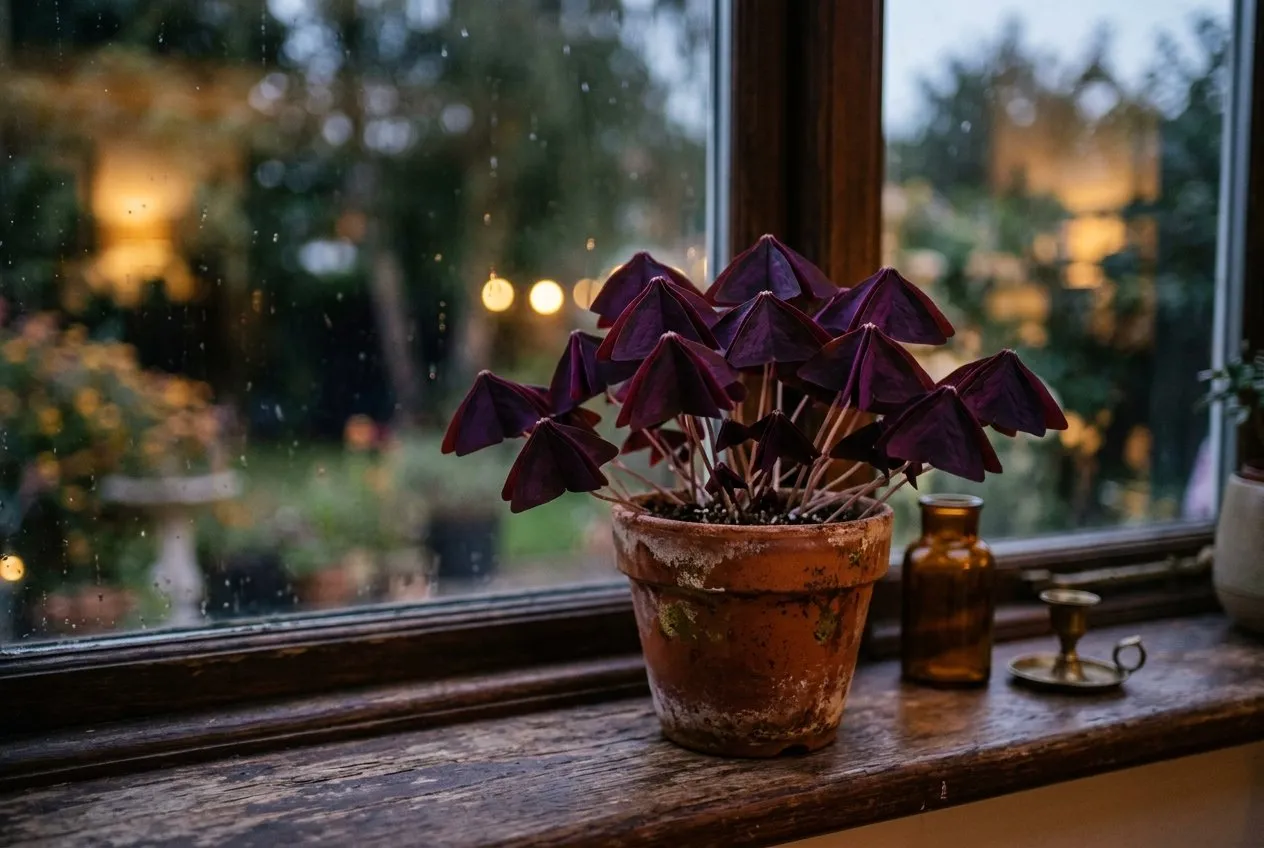 Purple shamrock folds its leaflets shut each evening. This nightly movement, called nyctinasty, is normal and healthy.
Frequently asked questions
Is oxalis a weed or a garden plant?
It is both, depending on the species. The genus holds around 800 species. Some, like purple shamrock and O. adenophylla, are prized ornamentals sold in garden centres. Others, like creeping yellow O. corniculata and pink O. articulata, are invasive weeds that spread aggressively. Always buy a named ornamental and learn to recognise the weedy ones.
How do you grow purple shamrock oxalis?
Grow purple shamrock (O. triangularis) as a houseplant or summer patio plant. It is tender, hardy only to about 1-5C, so it needs frost-free winters. Give it bright, indirect light, gritty free-draining compost and moderate water in growth. Keep it barely moist while dormant. Lift or bring pots indoors before the first autumn frost.
Why is oxalis so hard to get rid of?
Weedy oxalis spreads by two routes that beat most control. O. corniculata fires seed several feet from exploding pods. Pink sorrels like O. debilis make dozens of tiny bulbils that scatter when you dig. The RHS confirms home weedkillers do not work. Digging often multiplies the problem, so smothering and patient hand-weeding are the only reliable tools.
Can you compost oxalis weeds?
No, never compost weedy oxalis. The bulbils and seed survive most home compost heaps and reinfest wherever you spread the finished compost. Bag the roots, bulbils and seed heads and put them in the general waste bin, not the green-waste collection. The leaves alone are safe, but separating them is rarely worth the risk.
Are the alpine oxalis hardy in the UK?
Yes, several alpine oxalis are fully hardy here. O. adenophylla and O. ‘Ione Hecker’ survive to around -10C and grow outdoors in gritty, free-draining soil or an alpine trough. O. versicolor is borderline, hardy to about -5C, and does best in a pot you can move under cover in the wettest winter weeks. All hate sitting wet in winter.
Why do oxalis leaves fold up at night?
Oxalis leaves fold down each evening through a movement called nyctinasty. Cells at the base of each leaflet change pressure as light fades, dropping the three or four leaflets into a closed umbrella. They reopen at dawn. The same response follows a sudden touch or heavy shade. It is normal and healthy, not a sign of stress.
Is oxalis poisonous to pets?
Oxalis contains oxalic acid, so large quantities can upset cats, dogs and rabbits. Small nibbles rarely cause more than mild stomach upset, but the soluble oxalates can affect kidneys if a pet eats a lot. Keep purple shamrock houseplants out of reach of determined chewers, and discourage pets from grazing oxalis outdoors.
Our team produces practical UK gardening guidance from source research, contributor records and established horticultural practice. Editorial standards are overseen by Matt W.