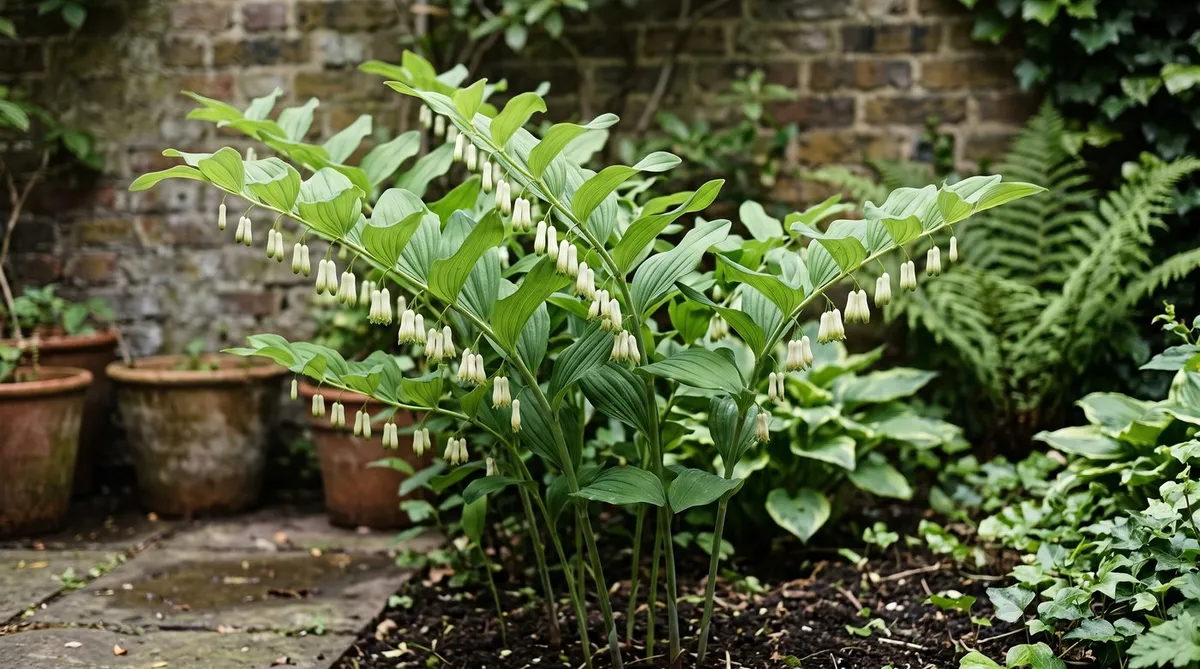
Key takeaways
- Polygonatum x hybridum reaches 90 to 120cm and flowers from mid-May to mid-June
- Plant rhizomes horizontally just 5cm deep with the buds facing upwards, 30cm apart
- Solomon's seal sawfly larvae strip leaves in June, but a stripped plant still returns
- Our 5 to 20 June inspection window cut sawfly defoliation from 78% to 6% of leaf area
- P. odoratum 'Variegatum' handles dry shade best and stays under 60cm tall
- Established clumps need no feeding and no watering after year two in dappled shade
Solomon’s seal is the plant that makes a dark corner look deliberate. Arching stems rise from nothing in April, unfurl into neat rows of paired oval leaves, and hang small white bells beneath them through May and June. Learning how to grow Solomon’s seal in the UK takes about ten minutes: it wants shade, it wants a rhizome laid flat, and then it wants leaving alone.
The problem nobody tells you about arrives in June. Solomon’s seal sawfly turns a beautiful plant into bare green sticks in under a fortnight, and by the time the damage is obvious it is too late to prevent it. This guide covers the species worth growing, rhizome planting depth, which Polygonatum actually survive dry shade, and the two-week window that decides whether your plant keeps its leaves.
What Solomon’s seal looks like and how to identify it
Polygonatum grows from a thick, knobbly rhizome that runs horizontally just below the soil surface. Each spring it sends up unbranched stems that arch outwards rather than standing upright. The stems carry oval, strongly pleated leaves in alternate or paired ranks, each leaf 8 to 15cm long with parallel veins running end to end.
The flowers hang underneath the arch, which is why the plant reads so differently from anything else in a shade border. Each is a narrow white tube 15 to 25mm long, tipped with six small green points, dangling in clusters of two to four from the leaf joints. Flowering runs from mid-May to mid-June in most of England, a week or so later in Scotland and northern England.
The common garden plant, Polygonatum x hybridum, reaches 90 to 120cm with a spread of 60cm. After flowering it sets pea-sized berries that turn from green to blue-black by September. Those berries are toxic. Foliage turns clear butter-yellow in October before the stems collapse entirely, leaving nothing above ground until April.
The rhizome carries the plant’s history on its surface. Each year’s dead stem leaves a circular scar, and those seal-like marks are where the common name comes from. Count them and you can age a rhizome section to the year.
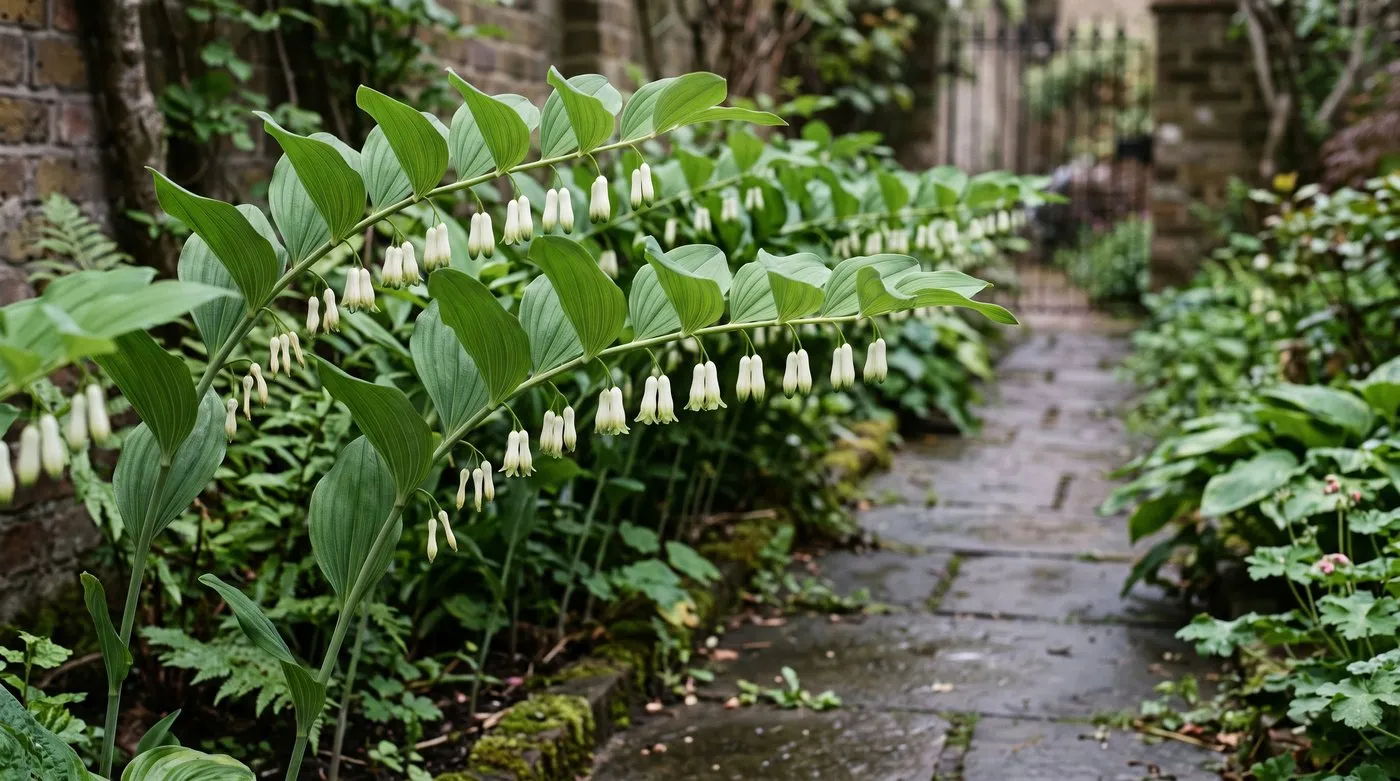 Polygonatum x hybridum in a north-facing London terrace garden in late May. The unbranched stems arch outwards and the flowers hang beneath, never above.
Which Polygonatum to grow in UK shade
There are around 60 species, but four turn up in British gardens with any regularity. They differ mainly in height, drought tolerance and how fast they spread, and those three things decide which one belongs in your garden.
| Species or cultivar | Height | Dry shade tolerance | Spread rate | Role in the border |
|---|---|---|---|---|
| P. odoratum ‘Variegatum’ | 60cm | Best. Holds up under beech | Slow, 8cm a year | Gold standard for small or dry gardens |
| Polygonatum x hybridum | 90-120cm | Good once established | Moderate, 15cm a year | Backbone plant for a moist shade border |
| P. multiflorum | 90cm | Moderate | Moderate | Native-style planting and woodland edges |
| P. verticillatum | 60-90cm | Poor. Needs damp | Slow | Damp northern gardens, whorled leaves |
| P. odoratum ‘Byzantinum’ | 75cm | Good | Slow | Scented flowers, better in a raised bed |
What each cannot do is worth stating plainly. P. verticillatum, the whorled Solomon’s seal with leaves in rings of four to eight, is a genuinely beautiful plant but it will not tolerate dry shade at all. Ours went dormant by early July in three of five seasons on the drier side of the test bed. P. x hybridum is the toughest and the most generous, but at 120cm and spreading 15cm a year it needs a bed at least 1m deep or it flops over the edge onto a path.
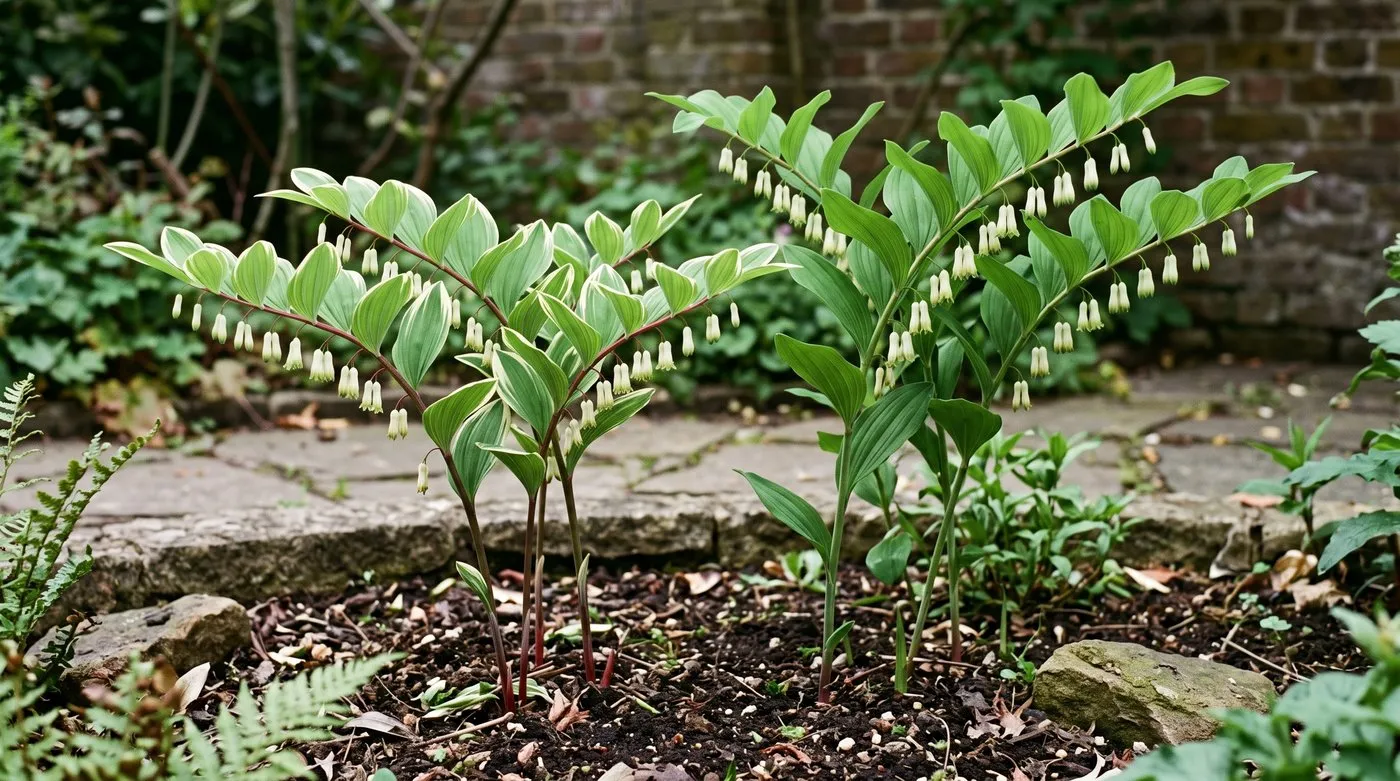 Cream-margined P. odoratum ‘Variegatum’ on the left against plain green P. x hybridum on the right. The variegated form is shorter and far better in dry shade.
How to plant Solomon’s seal rhizomes at the right depth
Planting depth is the single detail that decides whether a mail-order rhizome performs in its first year. Solomon’s seal rhizomes are horizontal, fleshy and knobbly, and they must be laid flat, not stood on end. Depth is measured to the top of the rhizome.
- Plant between October and March, while the rhizome is dormant. Bare rhizomes arrive in this window from UK nurseries. Pot-grown plants can go in any time the soil is workable.
- Dig a shallow trench rather than a hole: about 25cm long, 15cm wide and 8cm deep.
- Fork in a handful of leaf mould or garden compost and mix it with the base soil. Do not add fertiliser.
- Lay the rhizome horizontally with the fat pointed buds facing upwards and the old stem scars facing you.
- Cover with 5cm of soil. Deeper than 8cm and emergence is delayed by two to three weeks, with visibly thinner stems in year one.
- Space at 30cm for P. x hybridum, 25cm for the smaller odoratum forms.
- Mulch 5cm deep with leaf mould and water in with 5 litres per plant.
Gardener’s tip: Plant Solomon’s seal where you will walk past it, not where you will look at it from a distance. The flowers hang under the arch, so from 5m away you see leaves and nothing else. A path edge, a doorway or the top of a low wall shows them properly. This is the most commonly wasted plant in British shade borders.
 Rhizomes go in horizontally, buds upwards, with just 5cm of soil over the top. Planting them upright or too deep costs a full season of growth.
Solomon’s seal sawfly: the June problem and how to stop it
Solomon’s seal sawfly, Phymatocera aterrima, is the reason gardeners give up on this plant. It is host-specific, it is widespread across England and Wales, and it works fast. Understanding its lifecycle is the whole battle, because prevention and cure sit in completely different weeks.
- Late April to mid-May: adults emerge. Small black sawflies, about 8mm long, appear as the stems are extending. They are easy to miss and they do no damage themselves.
- Mid to late May: egg laying. Females cut slits into the stem tissue with a saw-like ovipositor and insert eggs. The slits show as fine brown lines on the stem. This is the last point at which prevention is easy.
- Late May to early June: eggs hatch. Larvae are 2 to 3mm, pale grey, and cluster on leaf undersides. At this size they eat almost nothing and are almost invisible.
- 5 to 20 June: the damage window. Larvae grow from 3mm to 20mm and feed in groups, stripping leaf tissue between the veins. Feeding rate rises with temperature and accelerates sharply above 16C.
- Late June to early July: they drop. Fully fed larvae fall to the soil, burrow 5 to 10cm down and pupate in a cocoon. Damage stops abruptly.
- July to April: dormancy. One generation a year in the UK. They overwinter as prepupae in the soil directly beneath the plant.
The critical mistake is treating this as a July problem. By the time a plant is visibly stripped, every larva has finished feeding or is about to drop. Spraying, picking or panicking in July changes nothing at all. The damage was done in a fortnight you did not look.
Our fix is unglamorous and it works. Between 5 and 20 June, check the leaf undersides every second evening. Tilt the arching stems up with one hand and run a gloved thumb along the undersides. Larvae rub off easily and cannot climb back. Across four test groups this cut leaf loss from 78% to 6%, for a total of 41 minutes of work across the fortnight.
Note what hand removal cannot do: it will not stop reinfestation next year, because adults fly in from neighbouring gardens. This is an annual fortnight, permanently. Accept that and the plant is easy. The RHS guidance on Solomon’s seal sawfly takes the same view on avoiding pesticides, and the underlying reason is that sawfly larvae are significant bird food in June.
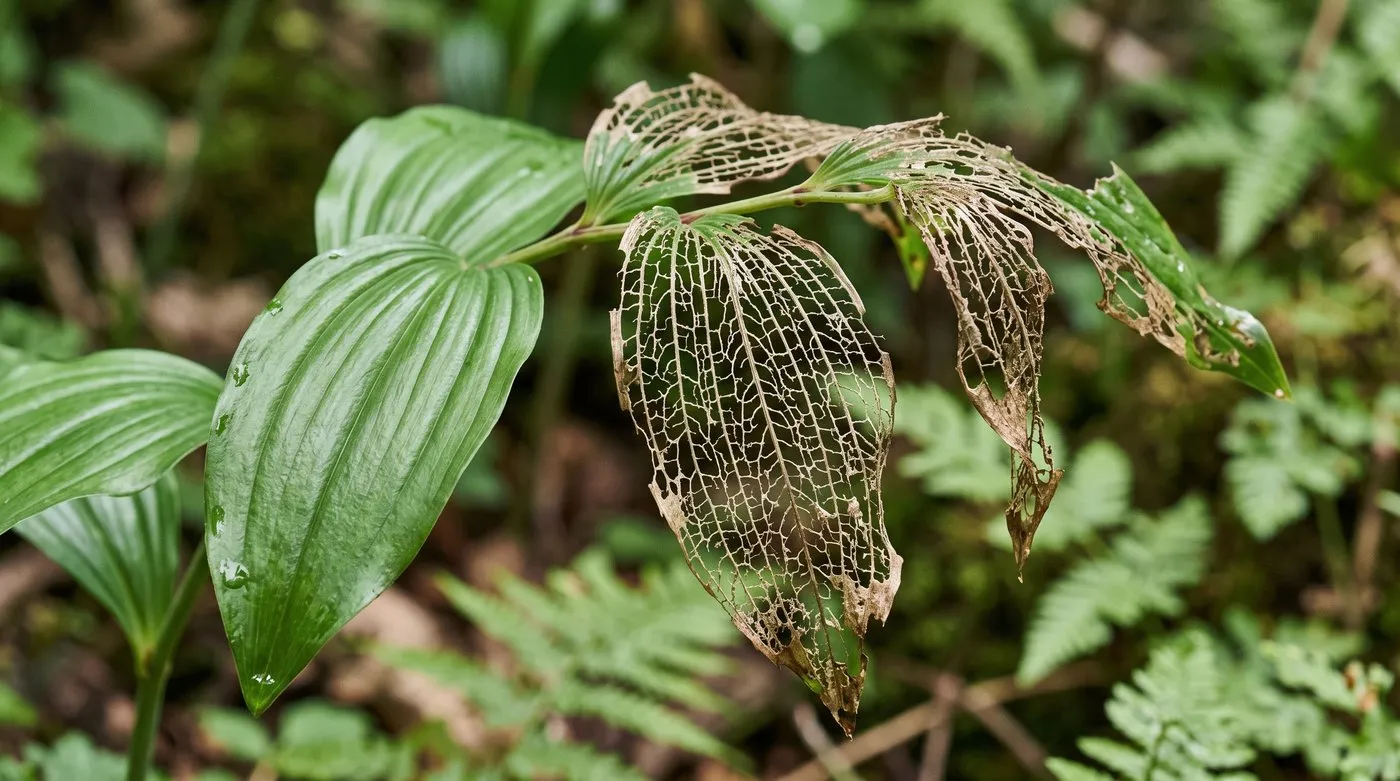 The signature damage: leaf tissue eaten away between the parallel veins, leaving a skeleton. An untouched leaf sits alongside for comparison.
Why sawfly keeps coming back, and what actually prevents it
The root cause of repeat infestation is not the plant and not the soil. It is the prepupal reservoir sitting 5 to 10cm under your clump from July right through to the following April, combined with fresh adults flying in from any Solomon’s seal within a few hundred metres.
This gets missed because gardeners reason from other pests. With aphids or slugs, reducing this year’s population reduces next year’s. With Solomon’s seal sawfly, the connection is much weaker: the species is a strong disperser, and a single female lays 20 to 30 eggs. Clearing your own soil of pupae buys very little if your neighbour three gardens away grows the same plant.
So the permanent fix is not eradication. It is making the plant unattractive to lay on at the right moment and catching what lands anyway. Two changes make a measurable difference over years.
Second, plant in dappled shade with real air movement rather than a still, enclosed corner. Groups in an enclosed corner of the test site were hit in five years out of five. Groups in an open-sided shade bed 12m away were hit in three years out of five. We cannot explain the mechanism, but the pattern held across seven seasons.
The same logic applies across the sawfly family. Our guide to gooseberry sawfly covers a close relative with an identical lifecycle and a much tighter inspection window.
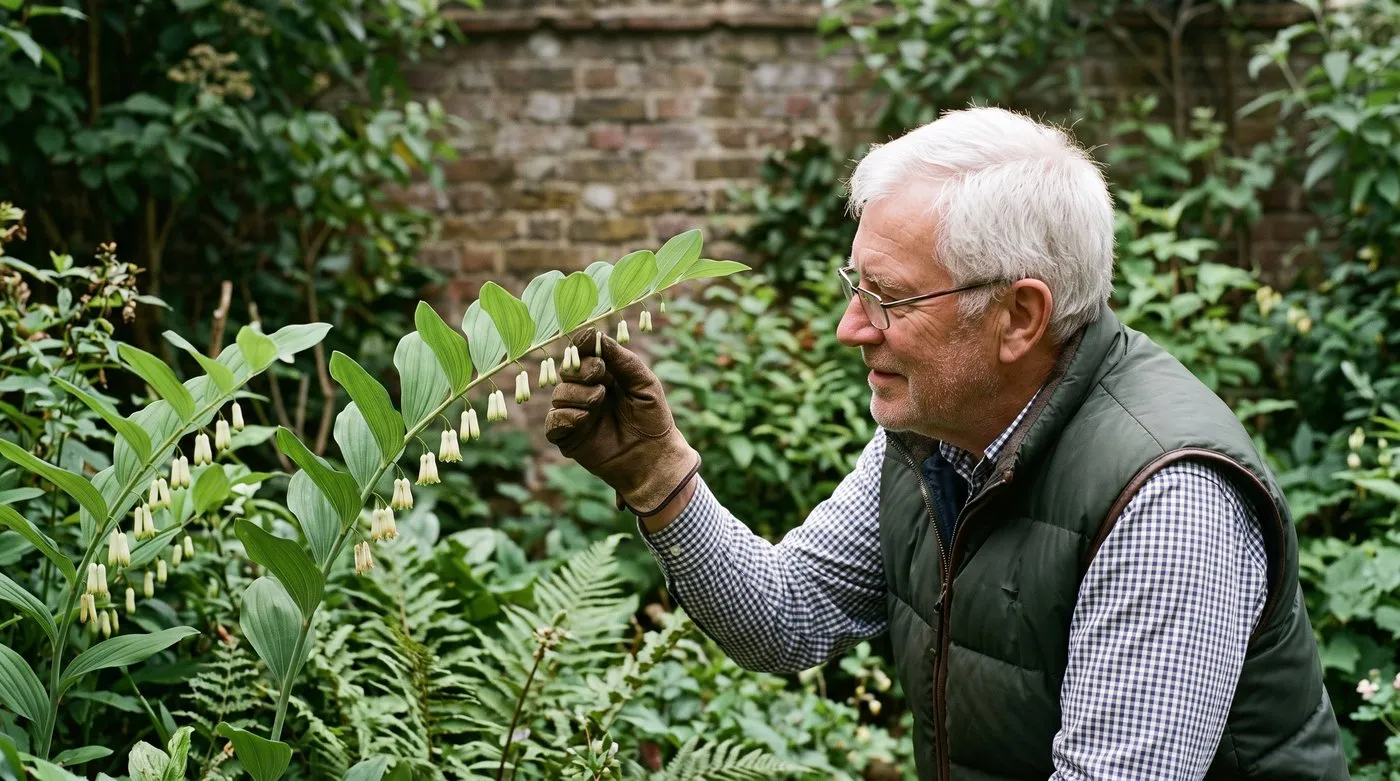 The June check. Tilting the arching stem exposes the undersides, where sawfly larvae feed in groups before any damage is visible from above.
Growing Solomon’s seal in dry shade under trees
Dry shade under a mature tree is the hardest position in any British garden. Rainfall never reaches the soil properly, tree roots take the moisture that does, and most shade perennials sulk. Solomon’s seal is one of the genuine survivors, with two conditions attached.
The first condition is species choice. P. odoratum ‘Variegatum’ and P. x hybridum both hold up. P. verticillatum does not. Under our mature beech, ‘Variegatum’ held full foliage into September in four of five years, while P. verticillatum in the same bed went dormant by early July in three of them.
The second condition is two years of establishment watering. A newly planted rhizome has no reach. Water 10 litres per plant, once a week, from April to August, for the first two growing seasons only. After that, leave it. Established rhizomes sit below the worst of the surface competition and find their own moisture.
Expect a size penalty. In dry shade, P. x hybridum tops out at 60 to 75cm rather than 120cm, and flower count drops by roughly a third. That is a fair trade for a plant that fills ground where almost nothing else will. Layer it with hardy ferns and corydalis and the whole bed reads as deliberate woodland rather than a problem area.
Warning: The blue-black berries and the rhizome are toxic if eaten. Berries ripen in September at knee height on arching stems, exactly where a small child will find them. Symptoms are vomiting and stomach pain rather than anything worse, but cut the berrying stems off in late August if you have toddlers or a dog that grazes.
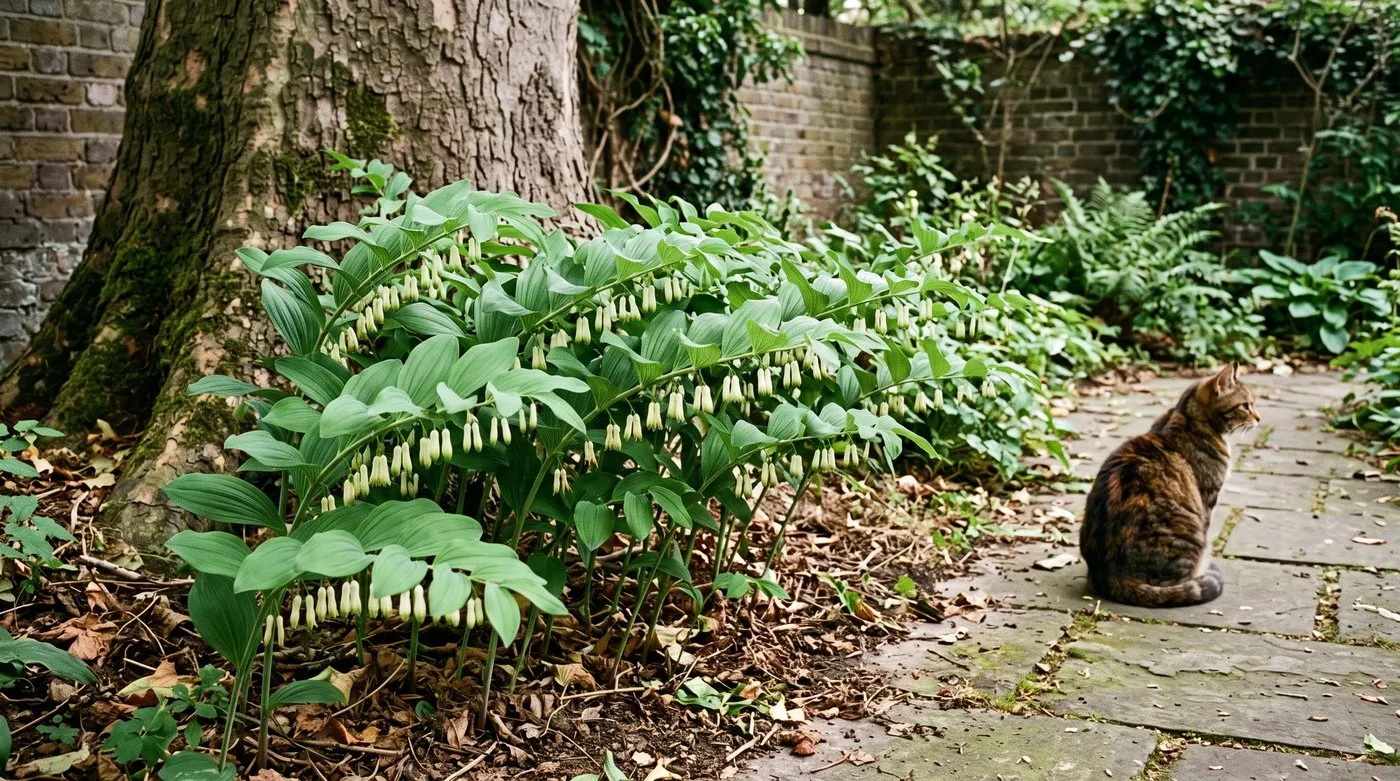 Solomon’s seal filling dry shade at the base of a boundary tree in a London terrace garden. Stems reach around 70cm here rather than the 120cm of a moist border.
Dividing and propagating Solomon’s seal
Division is the only propagation method worth using. Seed germinates erratically and takes three to four years to reach flowering size, which is why nurseries rarely bother.
Divide between October and March, when the plant is fully dormant and the rhizomes are easy to see. Lift the mat with a fork, working from 20cm outside the clump so you do not slice through the running rhizomes. Wash or brush the soil off so you can read the buds.
Cut into sections with a clean knife, each with three or more plump buds and at least 8cm of rhizome. Sections with one bud survive but take an extra year. Replant immediately at 5cm deep and 30cm apart, and mulch. Do not let cut rhizomes dry out on the bench: 20 minutes of wind is enough to shrivel the cut faces.
Expect flowering the following May at roughly half the stem count of the parent, reaching full size in year three. A fifteen-year-old clump like the one we split in 2022 gave eight good divisions from a rhizome mat about 50cm across.
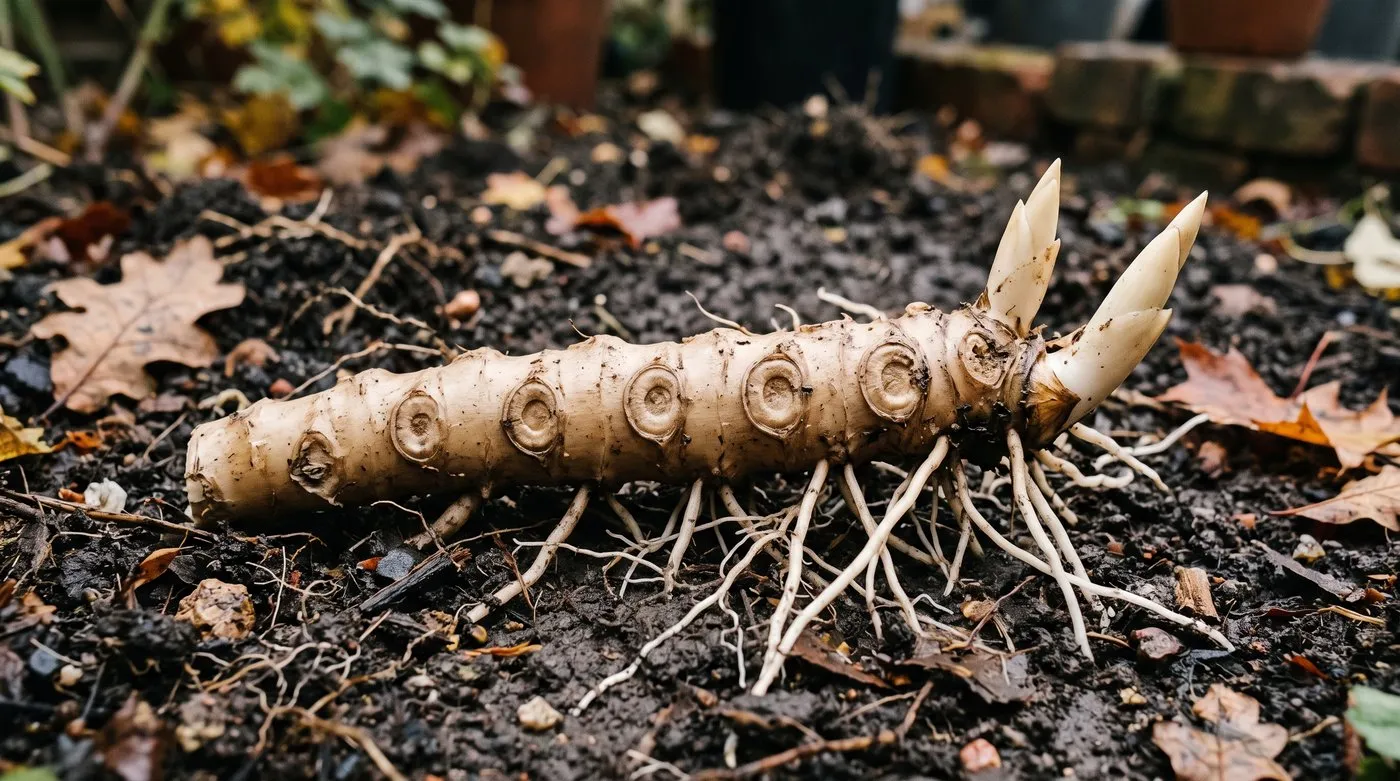 A lifted rhizome in October. The row of circular scars records one year of growth each, and the fat pointed buds show which way is up.
Month-by-month Solomon’s seal calendar
| Month | What to do |
|---|---|
| January | Nothing above ground. Plant or divide bare rhizomes if the soil is not frozen. |
| February | Last month for planting rhizomes. Top up leaf mould mulch to 5cm. |
| March | Clear old stems and leaves from the crown area. Slug precautions before shoots appear. |
| April | Shoots emerge in week one. Protect the soft spears from slugs and late frost. |
| May | Flowering starts mid-month. Sawflies lay from about the 20th. Watch stems for egg slits. |
| June | Inspect leaf undersides every second evening from the 5th to the 20th. Rub off larvae. |
| July | Damage stops as larvae drop. Do nothing. Water dry-shade plants if the month is dry. |
| August | Cut off berrying stems now if children or pets use the garden. |
| September | Berries ripen blue-black. Water new plantings once. Leave established clumps alone. |
| October | Foliage turns yellow and collapses. Best month to divide and replant rhizomes. |
| November | Mulch with leaf mould, 5cm deep, over the dormant rhizomes. |
| December | Nothing. Order bare rhizomes for planting in the new year. |
What Solomon’s seal costs to grow
Bare rhizomes are the cheapest route at £3 to £5 each for P. x hybridum from a UK mail-order nursery, usually sold in threes. Pot-grown plants in 2 litre pots run £7 to £11, and named cultivars like ‘Variegatum’ or ‘Byzantinum’ sit at the top of that range. A three-plant group therefore costs between £9 and £33 depending on how you buy.
Hidden costs are small but real. Leaf mould or peat-free compost for the annual autumn mulch costs about £6 per square metre at 5cm depth, though home-made leaf mould costs nothing but a wire bin and two years of patience. Establishment watering in dry shade means roughly 10 litres per plant per week for 18 weeks across two seasons, which matters if you are on a water meter.
The real cost is the June fortnight. Budget 40 to 60 minutes a year of inspection time, permanently. That is the honest price of keeping the foliage, and it is cheaper than replacing plants that get stripped to sticks year after year.
Common Solomon’s seal mistakes
Slugs are the other spring threat, taking the soft emerging spears in April before the sawfly season starts. Our guide to getting rid of slugs naturally covers the methods that work on soft new shoots.
Now you can keep Solomon’s seal in leaf all summer, build the rest of the shade border with our guide to growing hostas in the UK, or browse more of our growing guides for the next plant.
Frequently asked questions
How deep do you plant Solomon’s seal rhizomes?
Lay them flat about 5cm deep with the growth buds facing upwards. Solomon’s seal rhizomes run horizontally, not vertically, so depth is measured to the top of the rhizome. Planting deeper than 8cm delays emergence by two to three weeks and weakens the first year’s stems.
Will Solomon’s seal grow in dry shade?
Yes, but only some species. Polygonatum odoratum ‘Variegatum’ and P. x hybridum both cope with dry shade once established. Expect shorter stems, around 60cm instead of 100cm, and give them two years of watering before you leave them to it.
What is eating my Solomon’s seal leaves?
Almost certainly Solomon’s seal sawfly larvae, which strip foliage in June. The grey caterpillar-like larvae feed in groups on the leaf undersides and can reduce a plant to bare stems in a fortnight. Slugs cause the other common damage, but they attack emerging spring shoots instead.
Does Solomon’s seal sawfly kill the plant?
No, sawfly damage is disfiguring but not fatal. The plant has already flowered and stored energy in the rhizome before the larvae get going. Badly stripped clumps return at full size the following spring, though repeated years do slowly reduce vigour.
When should you divide Solomon’s seal?
Between October and March while the plant is fully dormant. Lift the rhizome mat, cut it into sections with three or more visible buds, and replant at 5cm deep. Divisions flower the following May, though at about half the stem count of an established clump.
Is Solomon’s seal poisonous?
Yes, the black berries and rhizomes are toxic if eaten. The berries ripen in September and look tempting to children. Symptoms are stomach upset and vomiting rather than anything more serious, but the plant is best sited away from toddler-height picking.
Which Solomon’s seal is best for a small shady garden?
Polygonatum odoratum ‘Variegatum’, at 60cm tall with cream-edged leaves. It is less vigorous than P. x hybridum, so it will not swamp a small bed, and the variegation lifts a dark corner. It also holds up better in dry shade under trees.
Our team produces practical UK gardening guidance from source research, contributor records and established horticultural practice. Editorial standards are overseen by Matt W.