Key takeaways
- Cape primrose flowers spring to autumn, often for 20 or more weeks a year
- Grow on an east or north windowsill in bright indirect light, never direct summer sun
- Let the top 2 to 3cm of compost dry before watering; overwatering rots the crown
- Feed fortnightly in growth with a high-potash feed at half the label strength
- Rest it cooler and drier over winter at 10 to 13C to trigger heavier flowering
- One leaf cutting yields 5 to 20 plantlets; Dibleys of North Wales holds over 20 Chelsea golds
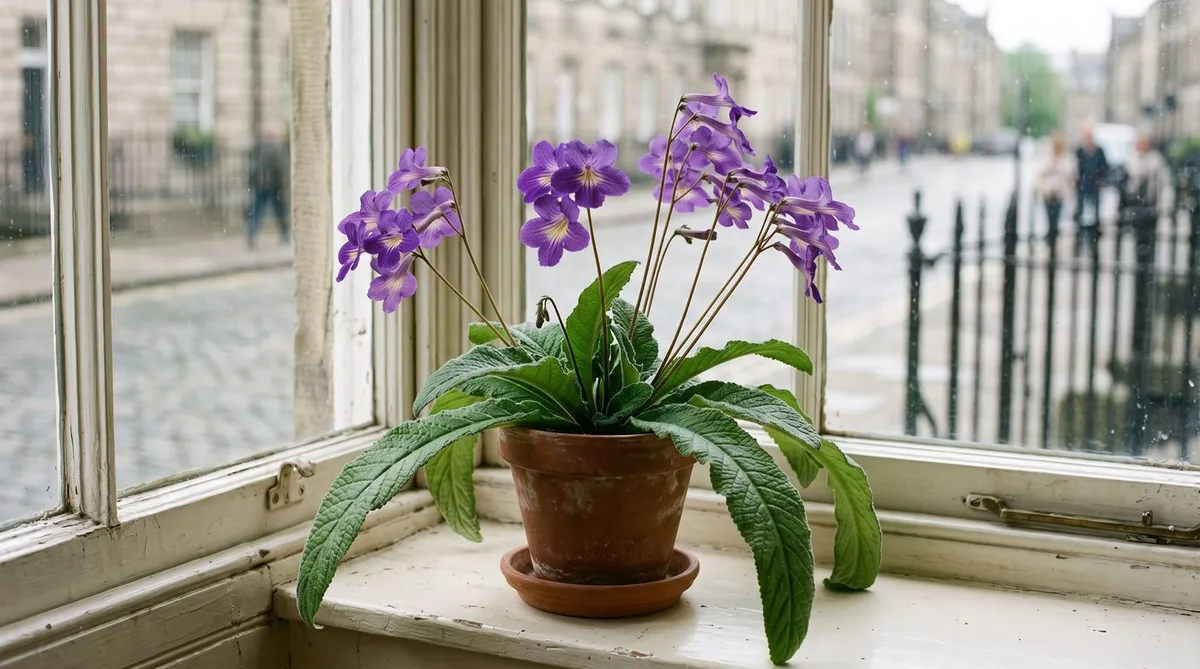
Streptocarpus, the Cape primrose, is one of the best value flowering houseplants you can grow in a UK home. A single streptocarpus plant throws up trumpet flowers in blue, purple, pink or white for months on end, often from March right through to October. It asks for very little: an east or north windowsill, water when the compost dries, and a high-potash feed through summer. It comes from the shaded forest floors and rocky banks of South Africa, so it thrives in the bright but indirect light most British rooms already have.
This guide covers which varieties to grow, how to water without rotting the crown, and the winter rest that doubles the flowering. It also explains the leaf cuttings that turn one plant into a whole tray of free ones.
The Welsh nursery that made Cape primrose famous
Streptocarpus belongs to the family Gesneriaceae, the same family as the African violet. The name means “twisted seed”, after the spiralled seed pods. In gardens we call it Cape primrose, because the soft, funnel-shaped flowers recall a primrose and the plant hails from South Africa’s Cape region.
Most of the varieties sold in Britain trace back to one family. Dibleys Nurseries, at Llanelidan near Ruthin in North Wales, has bred streptocarpus since the 1950s. The Dibley family has won more than 20 gold medals at the RHS Chelsea Flower Show for their displays. Names like ‘Harlequin Blue’, ‘Crystal Ice’ and ‘Falling Stars’ are all Dibleys introductions, and many hold the RHS Award of Garden Merit.
That British breeding matters to the grower. These are not fussy tropical rarities. They were selected over decades to flower long and hard on an ordinary windowsill in an ordinary British house. For more houseplants that suit our light levels, see our roundup of the best indoor plants for UK homes.
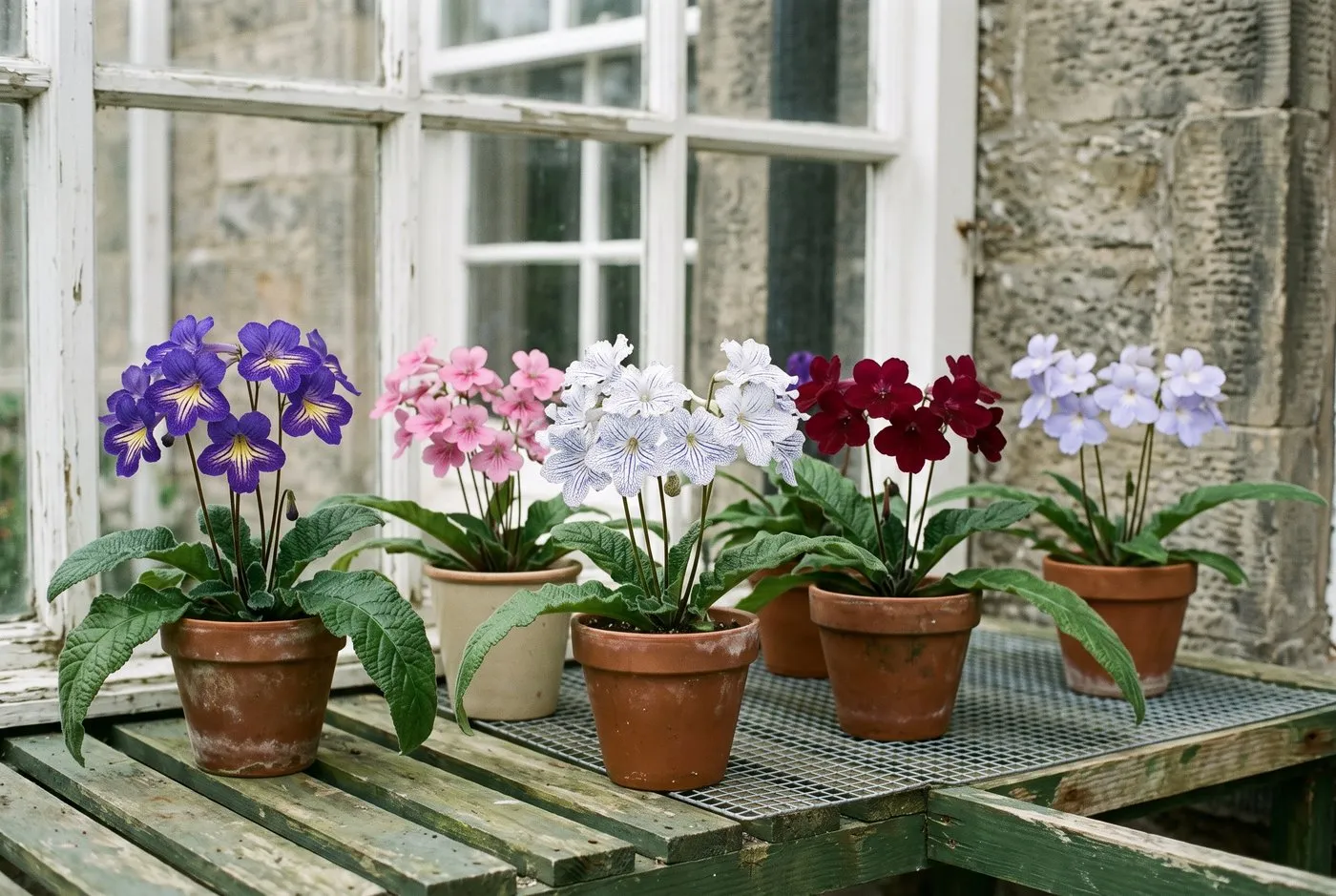 A group of named Cape primrose varieties on greenhouse staging, showing the range of flower colour from deep purple through pink and white to wine-red. Each plant flowers for months from a single crown of quilted leaves.
Which streptocarpus varieties to grow
Not every Cape primrose flowers with the same freedom. Some varieties bloom almost non-stop, others take a rest between flushes. Colour, flower size and vigour all vary. For a first plant we steer people towards ‘Harlequin Blue’ or ‘Crystal Ice’, both proven, both holders of the Award of Garden Merit, and both widely sold.
The table below ranks the most reliable varieties for a UK windowsill, based on our own side-by-side growing since 2018. Flowering weeks are what we actually recorded, not catalogue claims.
| Variety | Flower | Height | Flowering weeks | Best use | Reliability |
|---|---|---|---|---|---|
| ’Harlequin Blue’ | Blue with yellow throat | 25-30cm | 20-24 | First plant, east sill | 1st, most reliable |
| ’Crystal Ice’ | White with blue veining | 20-25cm | 18-22 | Bright north room | 2nd |
| ’Falling Stars’ | Small deep blue, many | 20-25cm | 18-20 | Massed flower display | 3rd |
| ’Polka-Dot Purple’ | Purple, spotted throat | 25-30cm | 16-20 | Statement plant | 4th |
| ’Ruby’ | Deep wine-red | 25-30cm | 14-18 | Warm colour scheme | 5th |
| ’Bethan’ | Pale pink, compact | 15-20cm | 14-18 | Small sills, tight spots | 6th, most compact |
The right windowsill: light, aspect and temperature
Light is the single thing that makes or breaks Cape primrose. It evolved in dappled shade on forest floors, so it wants bright but indirect light. An east or north-facing windowsill is close to perfect. East gives gentle morning sun then shade for the rest of the day. North gives steady, cool light with no scorch risk at all.
Temperature is easier. Cape primrose grows well between 15 and 25C, the normal range of a heated home. Keep it above 10C at all times and away from cold draughts and radiators. A north room that stays cool and bright suits it far better than a hot, dark corner. If your best light is a shaded room, our guide to the best low-light houseplants for UK homes lists plants that cope with even less.
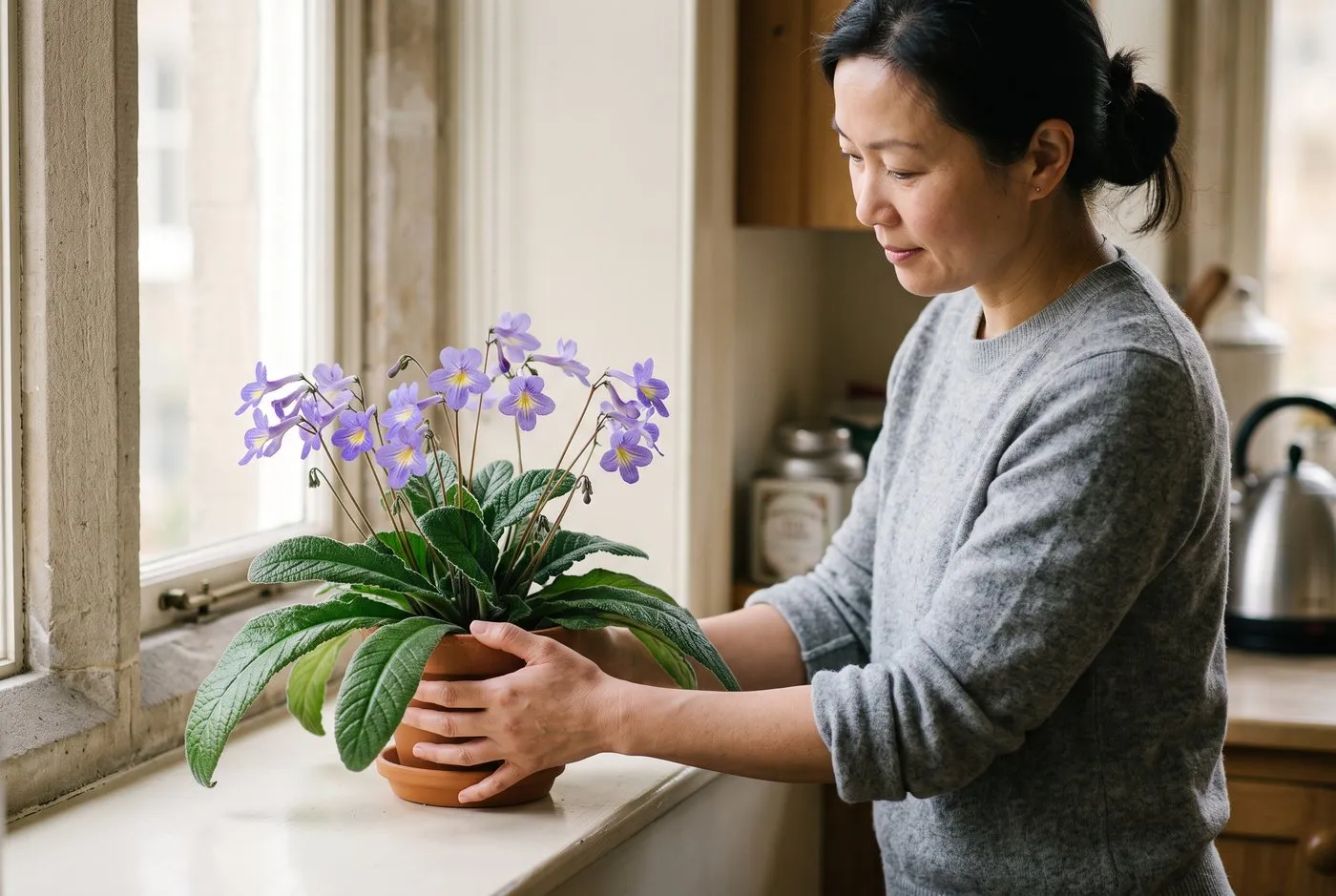 Turning the pot a quarter every few days keeps the plant flowering evenly towards the light. An east-facing kitchen windowsill gives the bright, indirect light Cape primrose needs.
How to water streptocarpus without killing it
Overwatering kills more Cape primrose than anything else. The thick, fleshy crown rots quickly if it sits wet. The rule is simple: let the top 2 to 3cm of compost dry out before you water again. Push a finger in to check. If it feels damp, wait another day.
In summer that usually means watering every 5 to 10 days. In winter it drops to every 2 to 3 weeks. Always use room-temperature water, as cold water shocks the roots and can spot the leaves. Water around the edge of the pot, not over the crown, and tip away anything left in the saucer after ten minutes. Never leave the pot standing in water.
Bottom watering suits streptocarpus well. Stand the pot in 2cm of water for 20 minutes, let it drink up, then drain it fully. This keeps the crown and leaves dry while wetting the roots. Our guide to bottom watering seed trays uses the same soak-and-drain method that works here.
Warning: A soft, translucent, browning crown means crown rot from overwatering, and it spreads fast. Cut away every mushy part with a clean knife back to firm white tissue, let the wound dry for a day, and repot into fresh gritty compost. If more than half the crown has gone, take leaf cuttings from a healthy leaf instead and start again.
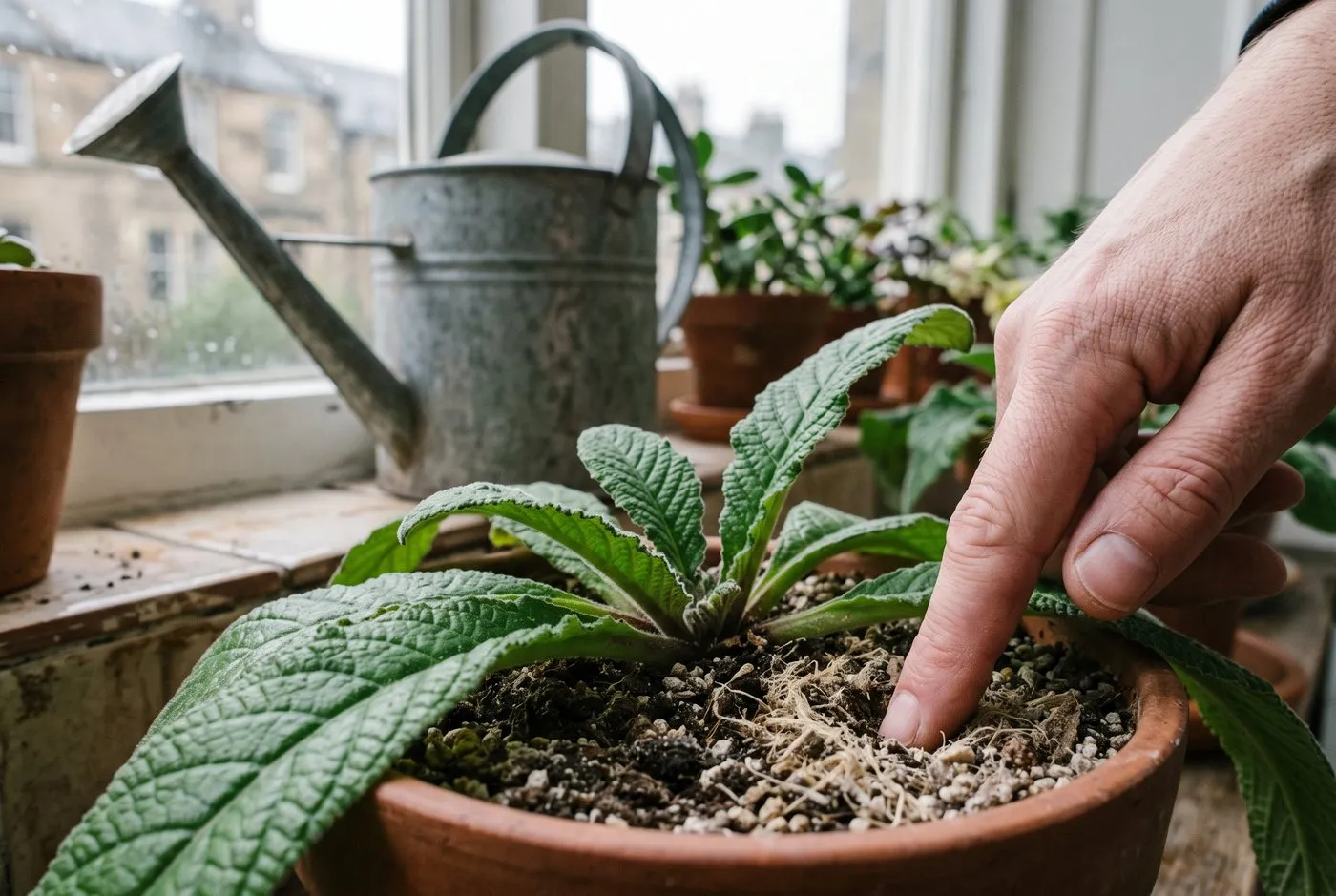 The finger test decides every watering. When the top 2 to 3cm of compost feels dry, water around the pot edge, never over the crown.
Feeding for months of flowers
Feeding is what turns a tidy plant into one smothered in bloom. Cape primrose is a hungry plant in growth, but it needs the right feed. Use a high-potash liquid feed, the sort sold for tomatoes, rather than a high-nitrogen houseplant feed. Potash drives flowers. Nitrogen drives soft leaf at the expense of buds.
If your plant makes big lush leaves but few flowers, the feed is usually the reason. Switch off the nitrogen and move to potash and you will often see buds within a fortnight. Our full year-round plan for feeding house plants covers the different feeds and when each one earns its place.
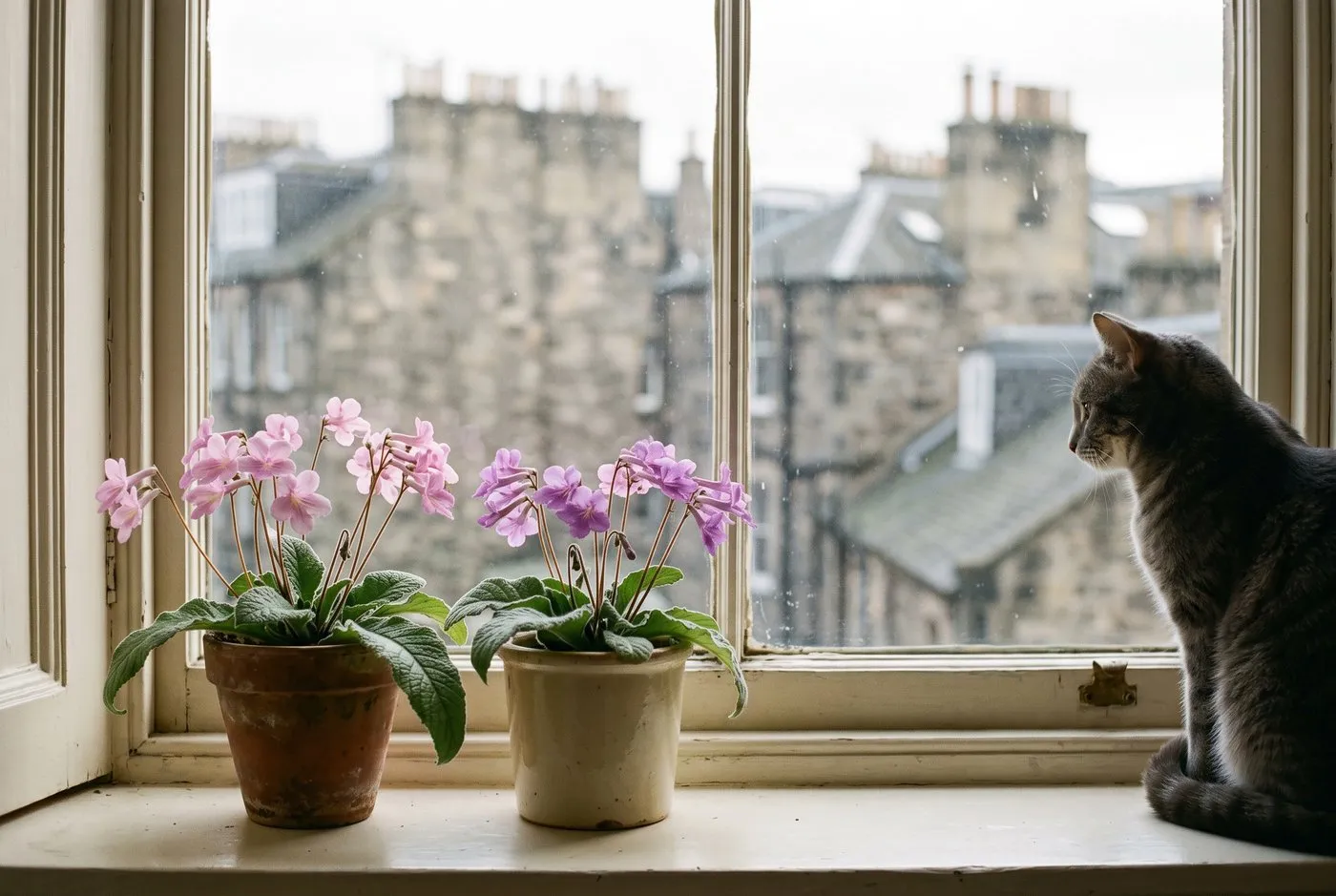 Cape primrose is non-toxic to cats and dogs, which makes it a safe choice for a shared windowsill. A grey tabby keeps the plants company above the rooftops.
The yearly growth cycle and the winter rest that boosts flowers
Understanding the plant’s year makes every care job obvious. Cape primrose follows four clear stages, and matching your care to the stage is the difference between a plant that flowers for 12 weeks and one that flowers for 24.
- Spring wake-up (March to April). As light returns the plant pushes new leaves from the crown. Resume watering as the compost dries and start the first half-strength potash feed. Repot now if the plant is pot-bound.
- Main growth and flowering (May to September). Growth is fast and flowering peaks. Water as the surface dries, feed fortnightly, and deadhead spent stalks. This is when a healthy plant carries 10 or more flower stems at once.
- Autumn wind-down (October). Flowering slows and days shorten. Stop feeding. Ease back on watering as the plant prepares to rest.
- Winter rest (November to February). Growth halts. Keep the plant cooler at 10 to 13C and water only enough to stop the leaves flopping, roughly every 2 to 3 weeks.
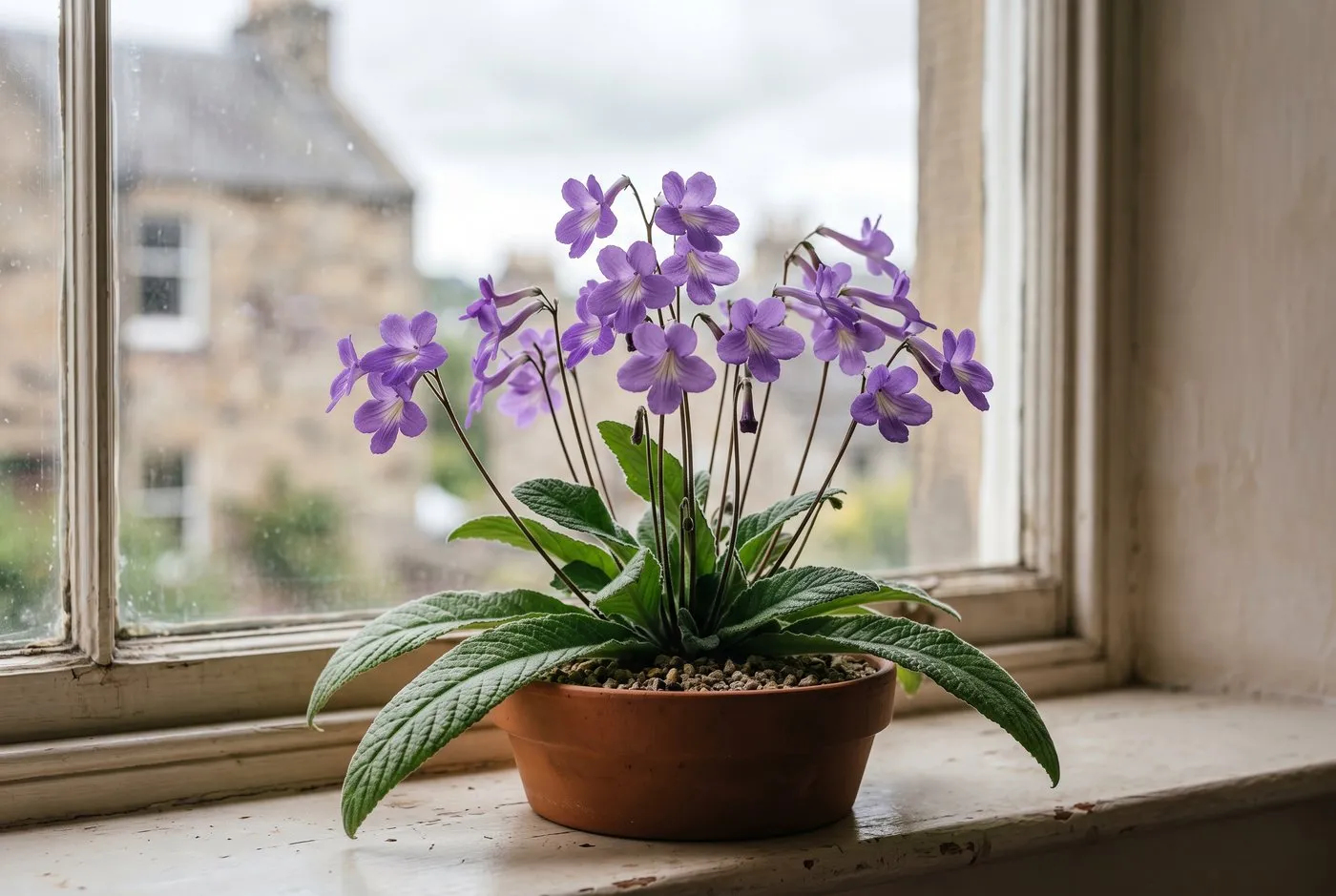 A well-fed plant in its main season carries ten or more flower stems above the rosette of soft, quilted leaves. A cool winter rest sets up this flush.
How to propagate streptocarpus from leaf cuttings
Here is the reason streptocarpus is such good value. One healthy leaf makes a whole tray of new plants, and the two classic methods both work on a warm windowsill. Nurseries use these exact techniques to bulk up named varieties. Take cuttings from late spring to midsummer, when the plant is growing hard, at a rooting temperature of about 20C.
The champagne method: rooting a whole leaf
The champagne method uses a whole leaf stood upright. Cut a healthy mature leaf from the base. Trim off the tip so you have a 6 to 10cm section. Push the cut base about 2cm into a tray of gritty, peat-free cutting compost, keeping the leaf upright like a glass of champagne. Cover with a clear lid or bag to hold humidity. Plantlets appear along the buried edge within 6 to 10 weeks. A single leaf this way gives 3 to 6 plants.
The midrib method: more plants per leaf
The midrib method yields the most plants. Lay a leaf face down and slice out the central midrib with a clean scalpel, leaving two long half-leaves. Insert each half cut-edge down, about 1cm deep, into the compost. Baby plants form all along the cut vein. One large leaf split this way can give 10 to 20 plantlets. Pot each on once it has two or three leaves of its own.
For the wider principles behind this, our guide to propagating houseplants covers hygiene, compost and humidity that apply to any leaf or stem cutting.
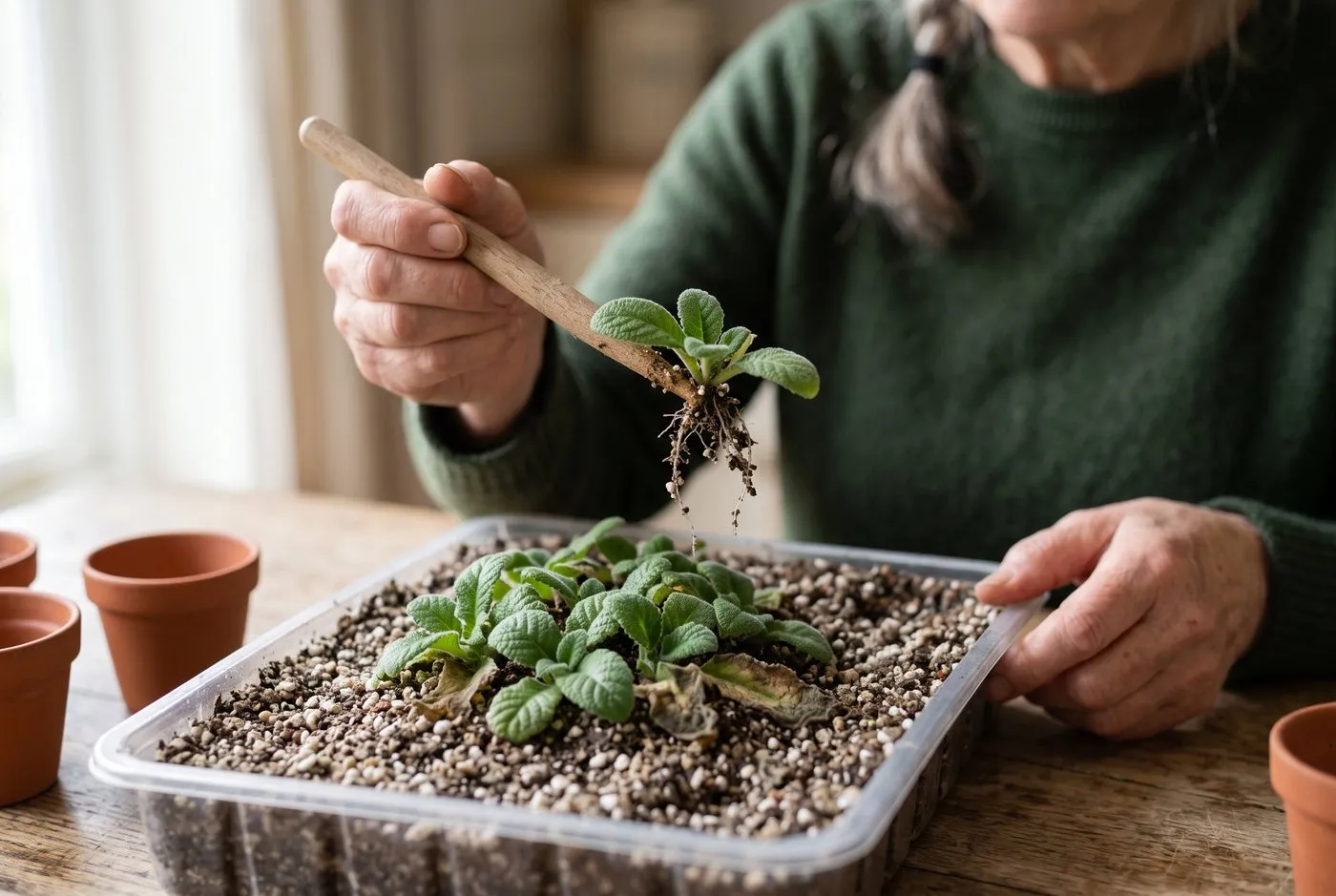 What the midrib method delivers: plantlets crowding the spent parent leaf, ready to lift once they carry three or four leaves. One leaf can yield up to 20 young plants.
Repotting and why non-flowering usually comes down to the roots
Cape primrose has a shallow, spreading root system, so it wants a wide, shallow pot rather than a deep one. Repot every one to two years in spring, moving up one pot size at a time to a maximum of about 13 to 15cm. A plant crammed in too large a pot pushes roots and leaf instead of flower.
The root cause of a shy plant is often hidden below the compost. Tired, exhausted compost and a pot-bound root ball both starve the plant of the nutrients and air it needs to bloom. Peat-free composts break down within a year, going airless and soggy, which then compounds the overwatering problem. The permanent fix is fresh, open compost every spring: two-thirds peat-free houseplant compost to one-third perlite or fine grit. This single change, plus the potash feed, cures most non-flowering. If your plant has filled its pot completely, our guide to fixing root-bound houseplants shows how to tease out and refresh the roots.
Month-by-month Cape primrose calendar
| Month | Task |
|---|---|
| January | Fully resting. Keep cool at 10 to 13C, water lightly every 2 to 3 weeks, no feed. |
| February | Still resting. Watch for vine weevil grubs and check the crown is firm and dry. |
| March | Growth resumes. Resume regular watering and start the first half-strength potash feed. |
| April | Repot pot-bound plants into fresh gritty compost. Move to the brightest indirect light. |
| May | Feed fortnightly. Take the first leaf cuttings by the champagne or midrib method. |
| June | Peak growth. Water as the surface dries and deadhead spent stalks to keep buds coming. |
| July | Main flowering. Shade south sills or move plants back from hot glass to stop scorch. |
| August | Keep feeding and deadheading. Take more leaf cuttings while the plant is in full growth. |
| September | Flowering slows. Reduce feeding towards the end of the month. Keep watering as normal. |
| October | Stop feeding. Ease back on watering as the plant winds down for winter. |
| November | Move to a cooler spot at 10 to 13C. Water only to stop the leaves collapsing. |
| December | Fully dormant. Keep cool, dry and bright. No feed. Remove any yellowing old leaves. |
The point of buying a named, bred variety is the years of selection behind it. Unnamed plants sold simply as “streptocarpus” are a lottery for flowering. A Dibleys AGM plant is a known quantity, chosen over decades to bloom long on a British windowsill. The RHS Award of Garden Merit it carries is your shortcut to the reliable ones.
Common mistakes when growing Cape primrose
- Overwatering. Keeping the compost constantly moist rots the crown from the base. Cape primrose wants the top 2 to 3cm to dry between waterings. Wet feet, not dry, is what kills it. Always drain the saucer.
- Direct summer sun. A south or west sill in July scorches the soft leaves within days, leaving bleached, crisp patches. Give bright but indirect light, or filter a bright sill with a net curtain.
- The wrong feed. A high-nitrogen houseplant feed makes lush leaf and few flowers. Use a high-potash tomato feed at half strength instead, and flowering picks up within a couple of weeks.
- No winter rest. Keeping the plant warm and watered all winter leaves it weak and shy to flower. A cool, drier rest at 10 to 13C from November to February is the trigger for next year’s blooms.
- Burying the crown. Potting with the crown below the compost line traps moisture and invites rot. Sit the crown proud of the surface and top-dress with grit to keep the neck dry.
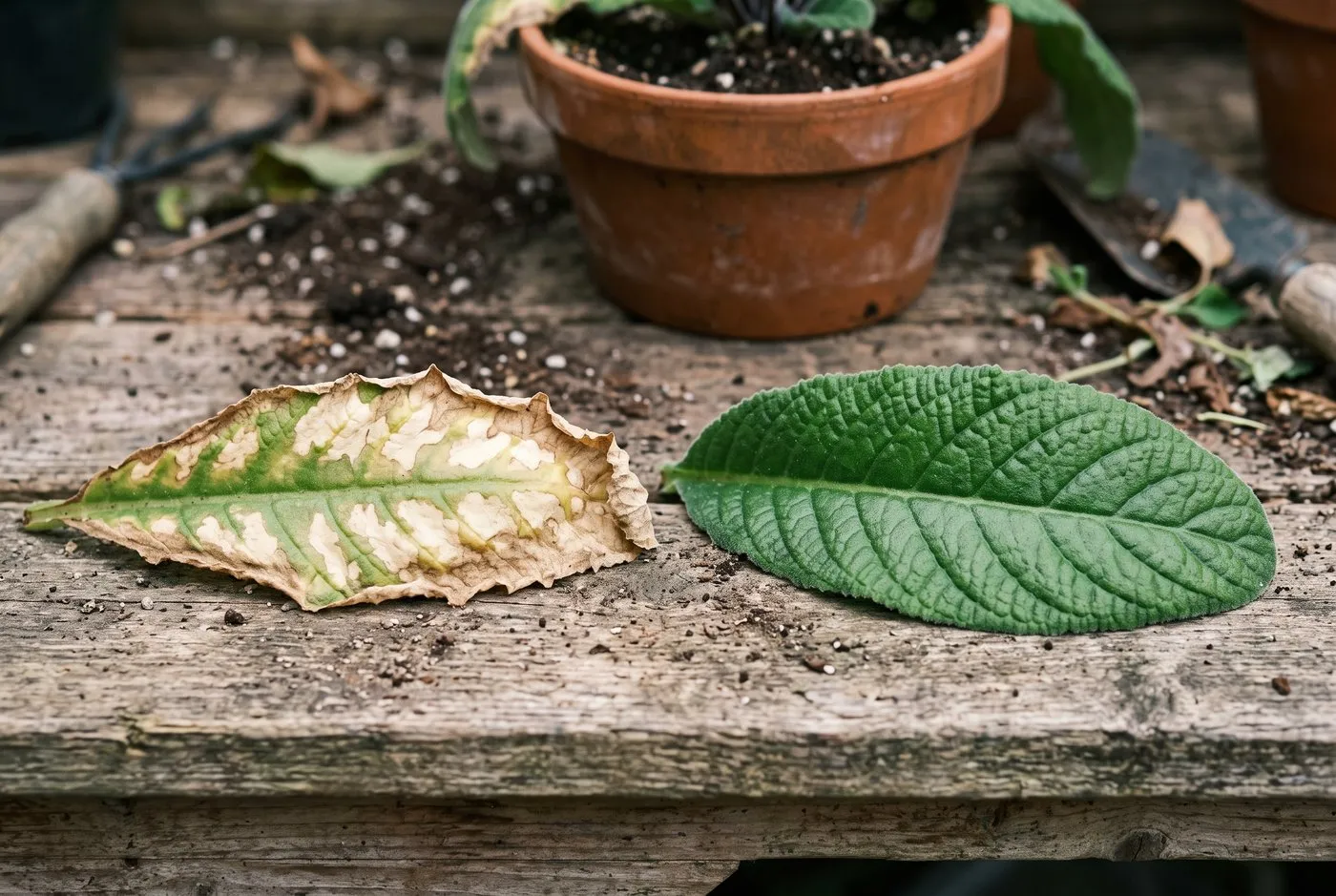 Left, a leaf bleached and crisped by direct summer sun through glass. Right, a healthy quilted leaf grown in bright indirect light. Filter a bright sill to avoid the damage.
Frequently asked questions
How do you grow streptocarpus indoors in the UK?
Grow it in bright indirect light on an east or north windowsill. Use peat-free compost in a shallow pot, water only when the top 2 to 3cm dries, and feed fortnightly with a high-potash feed through spring and summer. Keep it cooler and drier over winter at 10 to 13C.
How often should I water Cape primrose?
Water only when the top 2 to 3cm of compost feels dry. That is usually every 5 to 10 days in summer and every 2 to 3 weeks in winter. Overwatering is the main killer, so always let the surface dry first and tip away any water sitting in the saucer.
Why is my streptocarpus not flowering?
Too little light or too much nitrogen feed is the usual cause. The plant needs bright indirect light and a high-potash feed to set buds. A cool, drier winter rest at 10 to 13C also triggers heavier flowering. Plants in deep shade make leaves but few flowers.
How do you propagate streptocarpus from a leaf?
Take a healthy leaf and root it in gritty compost at about 20C. The champagne method inserts a whole leaf upright. The midrib method cuts the leaf lengthways and stands each half cut-edge down. Both grow plantlets along the cut within 6 to 10 weeks.
Is streptocarpus poisonous to cats and dogs?
Streptocarpus is regarded as non-toxic to cats and dogs. It is not listed among the plants known to harm pets, which makes it a safe flowering houseplant for homes with animals. Even so, discourage pets from chewing the leaves, which can still cause a mild stomach upset.
What temperature does streptocarpus need?
It grows best between 15 and 25C in the main season. Keep it above 10C at all times. A cooler winter rest at 10 to 13C encourages more flowers. Sudden cold draughts and temperatures below 7C damage the soft leaves and can rot the crown.
Should I cut off dead streptocarpus flowers?
Yes, remove each spent flower stalk at its base. Snapping off the whole stalk, not just the bloom, keeps the plant tidy and pushes energy into new buds. Regular deadheading through summer can extend flowering by several weeks and stops old stalks rotting into the crown.
How long do streptocarpus plants live?
A well-grown plant lives many years and improves with age. Repot every one to two years into fresh compost to keep it vigorous. Old plants eventually tire, but by then a single leaf cutting will have given you a tray of young replacements for nothing.
Now you know how to keep Cape primrose flowering for months, take a healthy leaf and follow our guide to propagating houseplants to turn one plant into a whole windowsill. You can browse more of our growing guides for flowering plants to grow alongside it.
Our team produces practical UK gardening guidance from source research, contributor records and established horticultural practice. Editorial standards are overseen by Matt W.