Key takeaways
- Tea has been farmed at Tregothnan in Cornwall since 1999, so UK growing is proven
- Camellia sinensis needs acid conditions: pH 4.5-5.5, ericaceous compost and rainwater
- A 40cm pot of ericaceous compost mixed with 20% bark suits most UK gardens
- Established var. sinensis plants take -10C briefly but hate cold, wet roots
- Pick two leaves and a bud from year 3, every 2-3 weeks, April to September
- A mature bush gives 50-100g of dried tea a year; a daily cup needs 3-4 bushes
Growing a tea plant in the UK sounds like a novelty until you look at who already does it. Camellia sinensis is farmed commercially here: Tregothnan in Cornwall planted its first bushes in 1999, and smaller plantations have followed in Perthshire and the Vale of Glamorgan. If tea can be cropped at field scale in British weather, one bush in a pot on your patio is well within reach. The plant is a camellia, so the rules are camellia rules: acid compost, rainwater, shelter from east winds. This guide covers buying the right variety, pot sizes and soil pH, the two-leaves-and-a-bud plucking rule, and how to turn a fresh pluck into green or black tea in your own kitchen.
Can you really grow tea in the UK?
Tea is already a British farm crop, which settles the question better than any hardiness chart. Tregothnan, near Truro in Cornwall, has grown Camellia sinensis commercially since 1999 and sold its first harvest in 2005. Growers in Scotland now crop tea in Perthshire, and a Welsh plantation picks leaves in the Vale of Glamorgan. None of these sites is heated or covered.
The plant behind all of this is a close cousin of the spring-flowering camellias in thousands of UK front gardens. If you have seen a camellia thriving down your street, your area can support a tea bush. Our guide to growing camellias covers the family traits in detail.
The variety matters. Camellia sinensis var. sinensis is the small-leaved Chinese type, and it is the one that handles British winters. The large-leaved Assam type, var. assamica, is frost-tender and only worth attempting in a heated glasshouse. Buy var. sinensis and you are growing the same plant Cornwall crops at field scale, just kept to patio size.
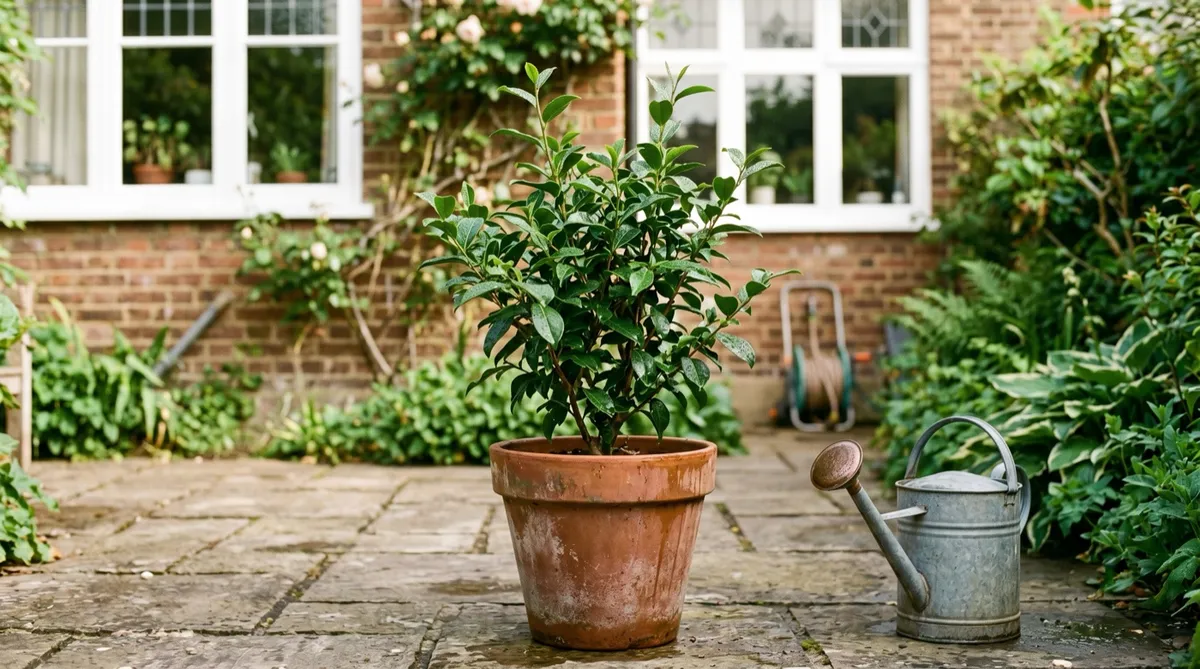
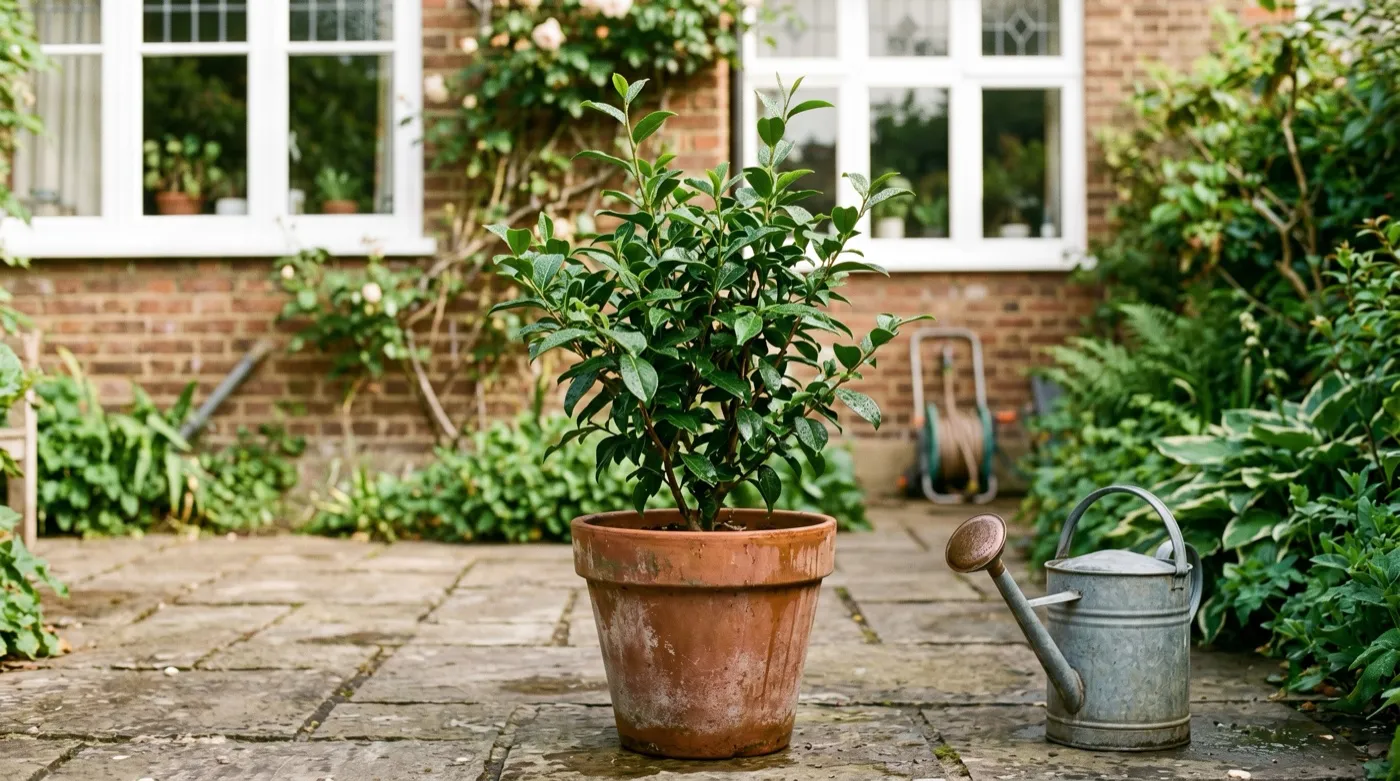 A young tea bush in a 40cm terracotta pot. One plant on a sheltered patio is enough for your first home-grown brew.
What soil does a tea plant need?
Acid soil is non-negotiable. Camellia sinensis needs a pH between 4.5 and 5.5, a touch more acidic than most garden camellias tolerate. In neutral or alkaline soil the roots cannot take up iron, and the leaves fade to a sickly yellow-green within a season. Test before you plant anything: a £10 test kit settles it in five minutes, and our guide to soil pH explained shows how to read the result.
Most UK gardens sit between pH 6 and 7.5, which rules out open ground for the majority of growers. That is no real loss. A pot filled with ericaceous compost gives you perfect chemistry from day one, with none of the slow fight against limey subsoil.
Water is the half of soil chemistry people forget. Tap water in hard-water areas carries dissolved lime, and every watering nudges the compost pH upward. The result is chlorosis: yellow leaves with green veins, covered in our guide to chlorosis and yellow leaves. Use rainwater as your default. The RHS gives the same advice for every ericaceous plant, and if you want planting companions, see our pick of the best plants for acid soil.
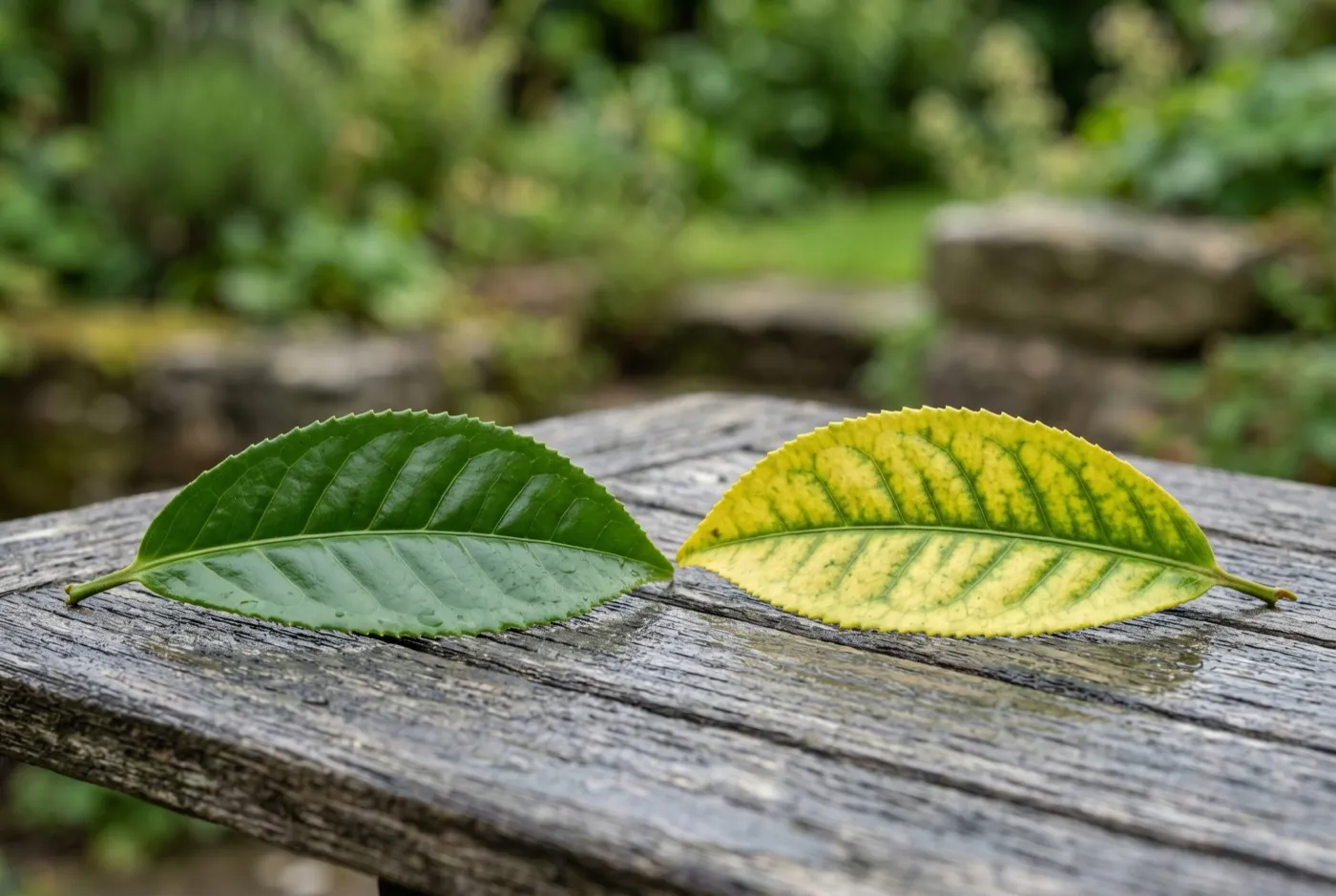 Diagnosis at a glance. The healthy leaf is a deep glossy green; the lime-affected leaf has yellowed between the veins.
How hardy is Camellia sinensis?
Two things do the real damage. The first is cold, wet roots. A tea plant standing in waterlogged compost through a freezing week suffers far more than a dry-rooted one at the same temperature. Free drainage matters more than fleece. The second is frost scorch from east winds. Frozen leaves that thaw fast in morning sun rupture their cells, so a bush facing the sunrise after a hard frost browns along its eastern side.
The fix is placement. Give the plant shelter from the east and north, ideally a spot with morning shade and afternoon light. A west-facing wall or fence is close to ideal. In the coldest districts, wrap the pot, not the plant, in bubble wrap from December to February to protect the roots. For colder snaps than -10C, the techniques in our guide to protecting plants from frost all apply here.
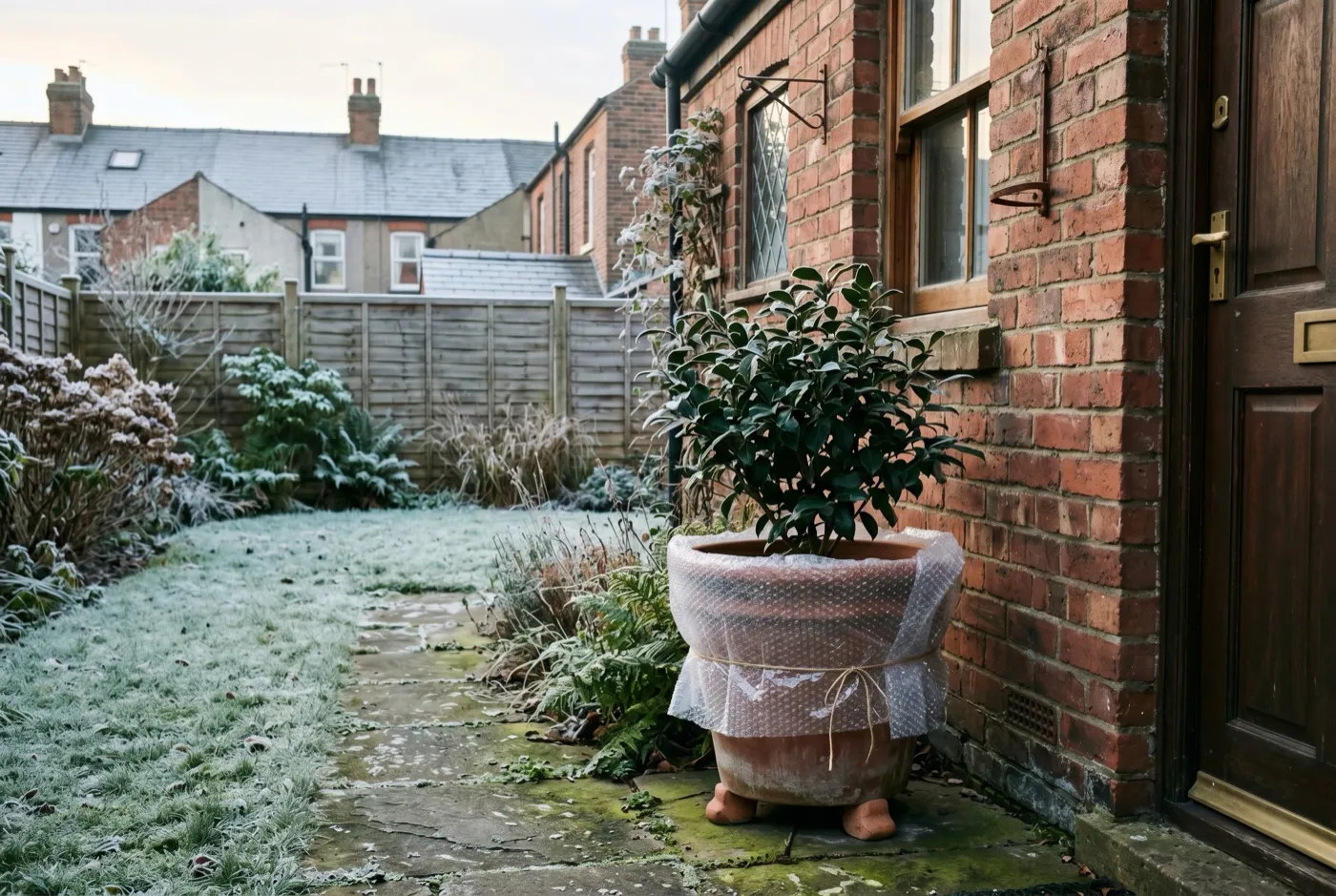 Shelter beats fleece. A west-facing wall blocks east winds and stops frozen leaves thawing too fast in morning sun.
Growing a tea plant in a pot
A 40cm pot suits a tea bush for years and puts the whole project within reach of a patio, balcony or small terrace. Pot growing also solves the soil problem outright, because you control the compost from the start.
Get the mix right and the rest is routine. Fill with ericaceous compost blended with 20% composted bark for drainage and structure. Set the pot on feet so winter rain runs straight through. Water with rainwater whenever the top 3cm of compost feels dry, which can mean daily in a hot July and fortnightly in winter. A water butt pays for itself here in a single summer; our guide to rainwater harvesting shows the simple setups.
Feed monthly from April to August with a half-strength ericaceous liquid feed. Then repot every 2-3 years in spring, either into a slightly larger pot or back into the same one with fresh compost and a light root trim. Compost breaks down and drifts alkaline over time, so this refresh is what keeps the chemistry honest. Kept plucked, the bush holds happily at 1-1.2m in a container.
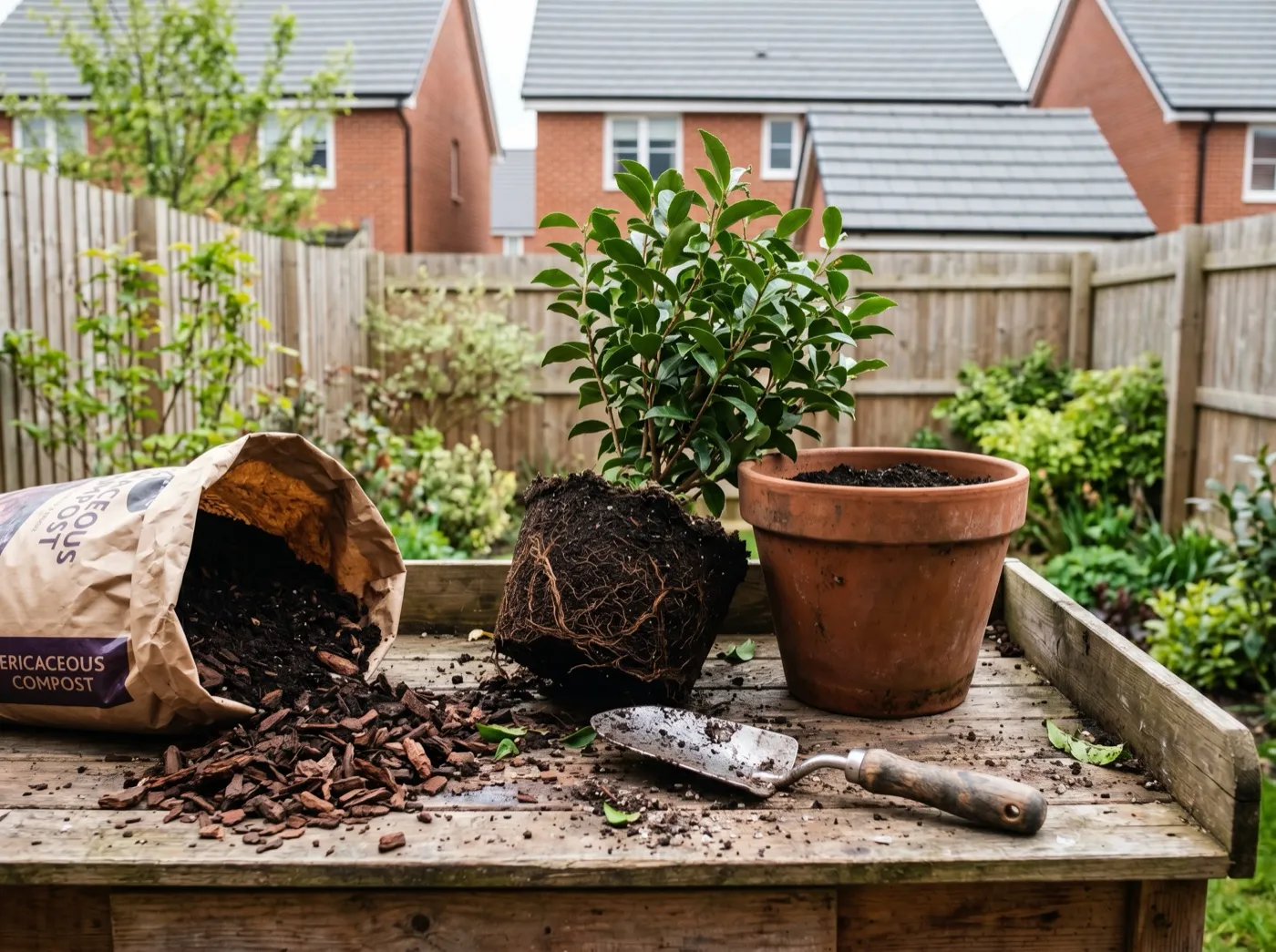 Repotting time. Fresh ericaceous compost with a 20% bark blend resets the pH and drainage every two to three years.
Buy a plant or sow seed?
Buy a named var. sinensis plant. Specialist UK nurseries sell them for £15-£25, usually as two-year-old bushes around 20-30cm tall. That single purchase skips every problem the seed route throws at you.
Tea seed is genuinely awkward. Viability collapses within weeks of harvest, so packet seed that has sat in a warehouse often fails completely. Even fresh seed germinates patchily over 4-8 weeks, and the seedlings vary wildly because tea does not come true from seed. One seedling might carry decent leaf flavour and reasonable hardiness; its sibling might have neither, and you cannot tell for years.
The arithmetic seals it. A bought two-year-old plant reaches plucking age around three years after planting. A seed-raised plant starts that clock from germination, so you wait three years longer, perhaps six in total, for a bush of unknown quality. Spend the £20, check the label says var. sinensis rather than just “tea plant”, and plant it out of its nursery pot in April or May.
Two leaves and a bud: how to pluck tea
The plucking rule is two leaves and a bud. From each shoot tip, take the unopened bud plus the two youngest leaves below it, pinched off with thumbnail and finger. These tender tips carry the flavour. Older leaves lower down are leathery, bitter and not worth processing.
Timing follows the plant’s flushes. In the UK, growth runs from April to September, and a plucked shoot regrows a new pluckable tip in 2-3 weeks. That gives you roughly 8-10 small harvests a season from a mature bush. Pick mid-morning on a dry day, once dew has gone, and process the same day.
Hold off until year three. Plucking a year-one or year-two plant strips the foliage it needs to build roots and frame, and sets the whole project back. Patience here is what separates a cropping bush from a struggling one.
Expect modest quantities. A mature bush yields roughly 50-100g of dried tea a year, because fresh leaf loses about 75% of its weight in processing. A daily cup needs 3-4 bushes. One bush makes you a grower with a few special brews a month, not self-sufficient in tea, and that is fine. It still beats an indoor coffee plant, which manages roughly one cup a year.
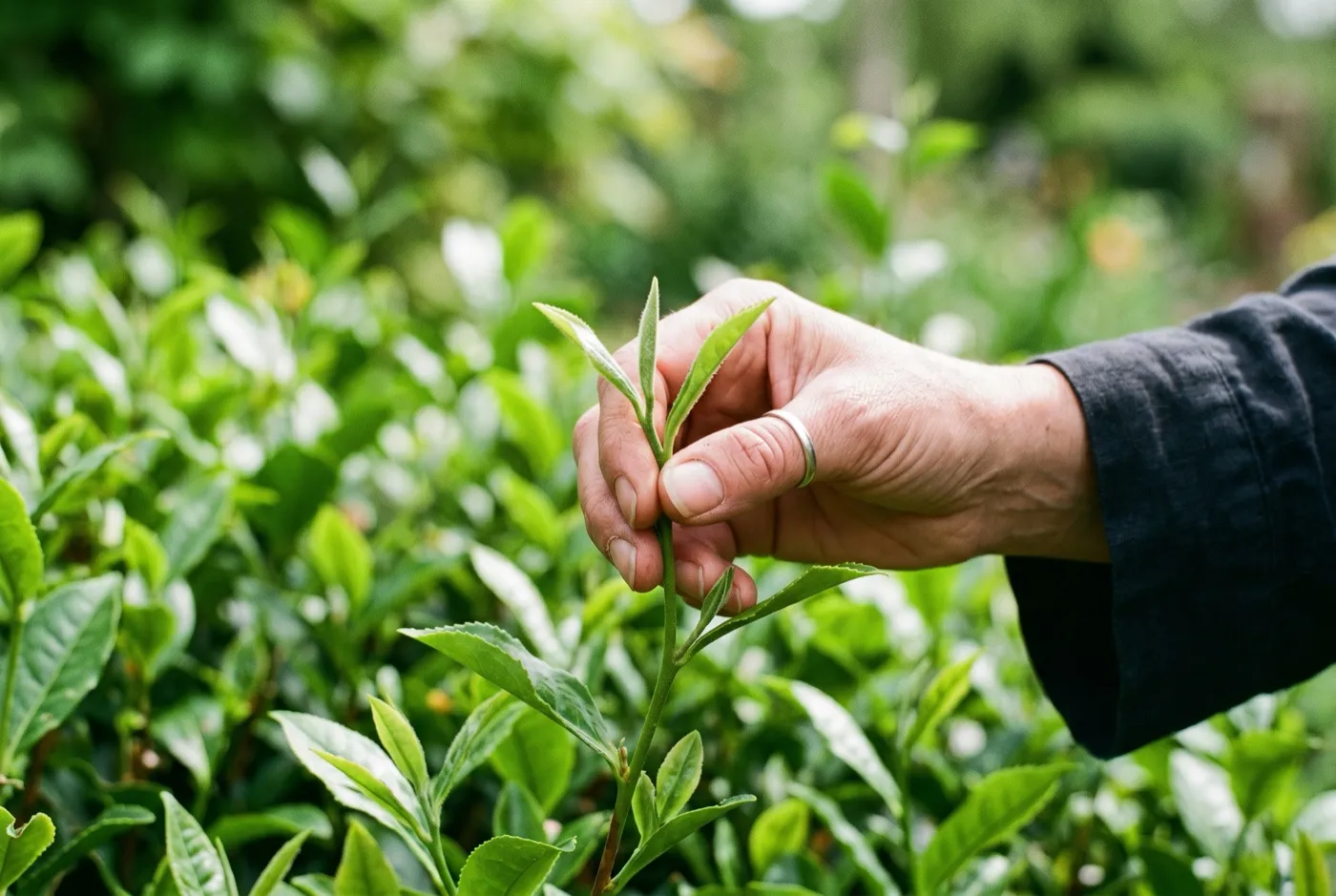 The pluck itself: the unopened bud and the two leaves directly below it, pinched cleanly from the shoot tip.
How to turn fresh leaves into drinkable tea
Green and black tea come from the same leaves. The difference is oxidation: green tea is heated quickly to prevent it, black tea is encouraged into it. Both are kitchen jobs needing nothing more than a tray, a dry frying pan and an oven.
For green tea:
- Wither for 2 hours. Spread the pluck one leaf deep on a tray indoors until slightly limp.
- Pan-fire for 2-3 minutes in a dry pan at 120-150C, tossing constantly. This kills the enzymes that drive oxidation.
- Roll the hot leaves gently between your palms into loose curls.
- Dry in the oven at 100C for 10-15 minutes until crisp.
For black tea:
- Wither overnight, 8-12 hours, until the leaves are floppy enough to roll without snapping.
- Roll firmly between your palms for several minutes until the leaves bruise, darken and smell grassy.
- Oxidise for 2-3 hours spread on a tray at room temperature, around 25C, until the leaves turn a coppery brown.
- Dry at 100C for 10-15 minutes until crisp.
The critical mistake is rushing the wither. Fresh-picked leaves are turgid and snap instead of rolling, so the cells never bruise and black tea never develops. Under-withered green tea stews in the pan rather than firing. The wither looks like nothing happening; it is the step everything else depends on.
| Tea style | Process and time | Ease of success | Role |
|---|---|---|---|
| Green | Wither 2h, pan-fire 2-3 min at 120-150C, roll, dry. About 3 hours total | Easiest: drinkable on the first attempt for most people | Primary: start here |
| Black | Wither overnight, roll, oxidise 2-3h at 25C, dry. About 12-16 hours total | Moderate: judging the coppery endpoint takes a batch or two | Supporting: weekend batch |
| Oolong | Partial oxidation with repeated rolling and resting, 6-10 hours of attention | Hardest: stopping oxidation midway is pure judgement | Advanced: try in your second season |
Green tea is the gold standard for a first attempt. It has the fewest stages, the shortest timeline, and any mistake shows up immediately in the pan rather than hours later.
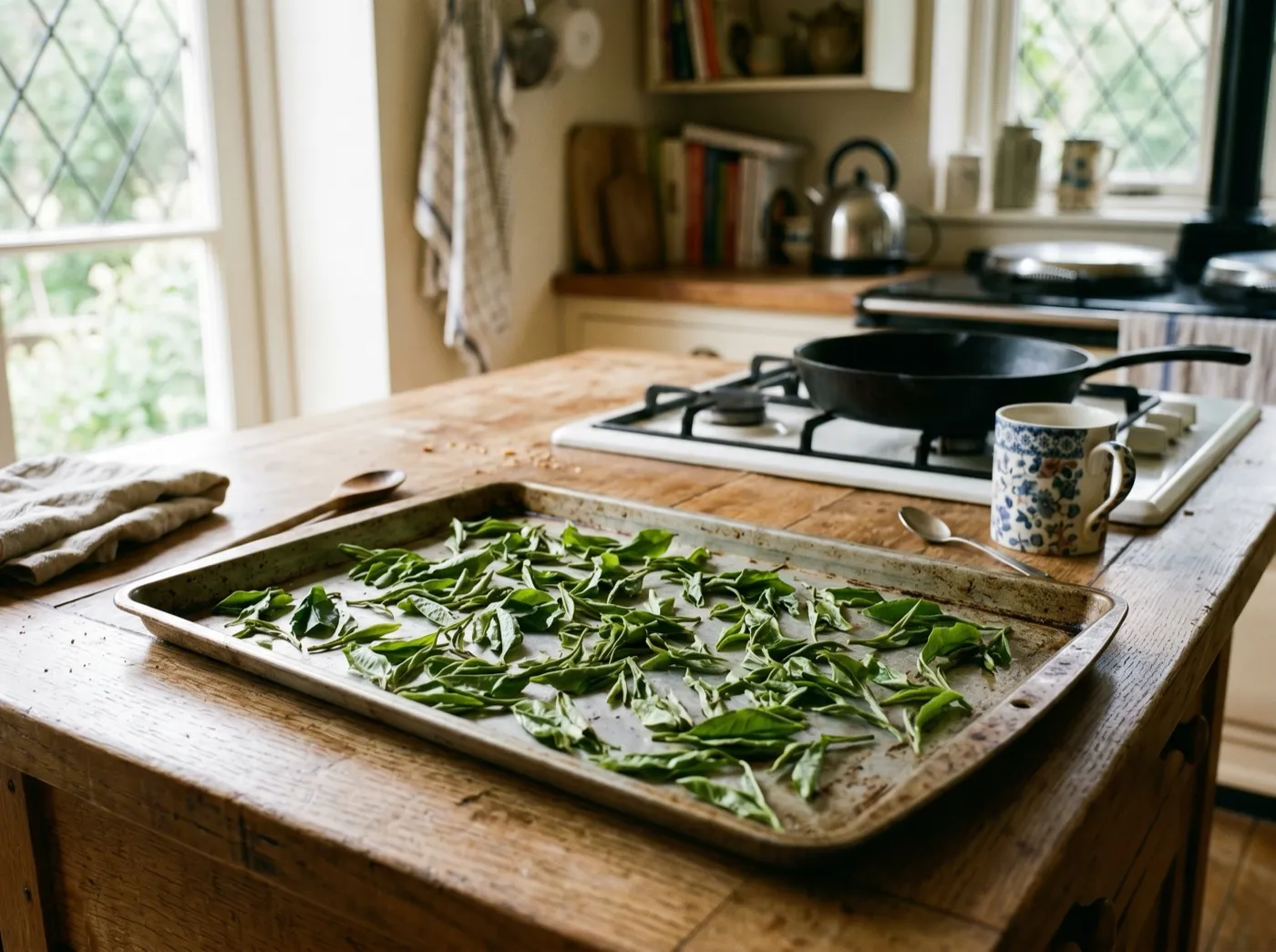 The wither under way. Leaves spread one deep on an indoor tray, softening for two hours before pan-firing.
Tea plant calendar: month by month
| Month | Task |
|---|---|
| January | Keep pot on feet, shelter from east winds, water sparingly with rainwater |
| February | Check pot insulation in hard frosts; never let compost sit waterlogged |
| March | Top-dress with fresh ericaceous compost; repot if due this year |
| April | Growth begins. Start half-strength ericaceous feed; first pluck on year-3 bushes |
| May | Pluck flushes every 2-3 weeks; water more as growth speeds up |
| June | Peak flush month; pluck, process, and feed monthly |
| July | Daily rainwater checks in hot spells; keep plucking shoot tips |
| August | Continue plucking and feeding; top up the water butt whenever it rains |
| September | Final plucks of the season; stop feeding at the end of the month |
| October | White scented flowers open; enjoy them and let bees at the pollen |
| November | Flowers continue; reduce watering and clear fallen leaves from the pot |
| December | Wrap the pot in coldest districts; water only when compost dries out |
The October flowers are a genuine bonus most growers never expect. Each bloom is white, 2-3cm across, lightly scented and carried just as the rest of the garden shuts down. Late bumblebees work them on mild autumn days.
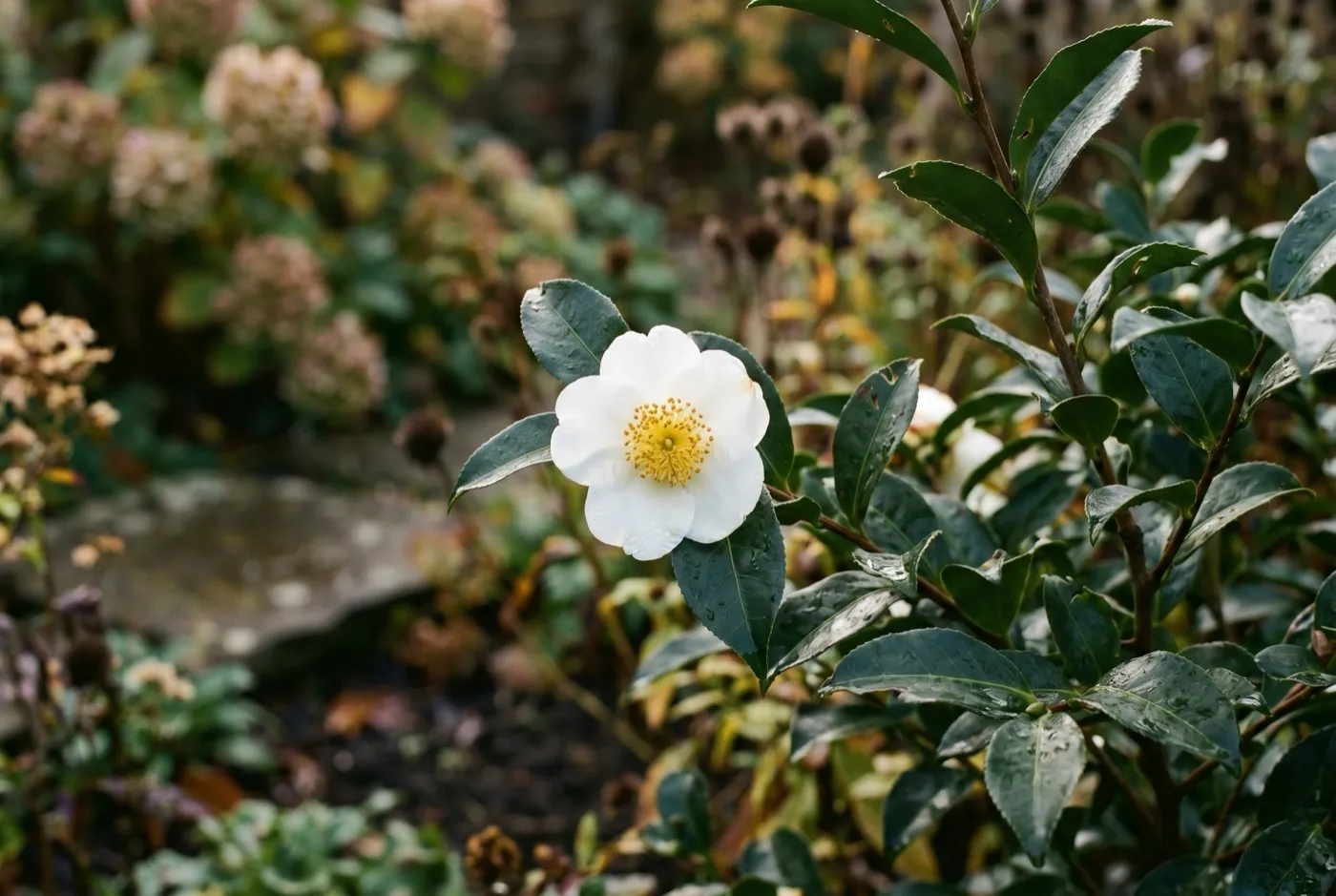 The autumn bonus: white 2-3cm flowers with golden stamens open in October, feeding late bumblebees.
Why tea plants fail in UK gardens
The root cause of most UK tea failures is chemistry, not climate. Gardeners brace for the cold, then lose plants to limey water and soggy roots. Understanding this changes where your effort goes.
The slow killer is pH creep. A plant potted in perfect ericaceous compost, then watered from the tap in a hard-water area, drifts upward toward neutral over 12-18 months. The first sign is new leaves emerging yellow between the veins. By the time the whole bush pales, vigour has already gone. Owners often blame frost damage from the previous winter, treat the wrong problem, and the plant fades over another season.
Permanent prevention costs little. Plumb a water butt into a downpipe and rainwater becomes the default rather than the exception. Repot into fresh ericaceous compost every 2-3 years before breakdown turns the old mix alkaline. Stand the pot on feet year-round so winter rain drains instead of pooling. With those three habits fixed, a tea plant in Britain is genuinely low-maintenance: the climate was never the real enemy.
Common mistakes with tea plants
- Watering pots with tap water. Hard tap water adds lime with every can, raising pH until leaves yellow. Fill a water butt and make rainwater the habit, keeping tap water for genuine droughts.
- Planting into untested garden soil. Most UK soil sits above pH 6, too alkaline for tea. Test first with a £10 kit; if it reads over 6, grow in a pot of ericaceous compost instead.
- Siting against a full-sun south wall. Reflected summer heat scorches leaf edges, and winter morning sun thaws frozen foliage too fast. Choose a west-facing spot with morning shade.
- Plucking in years one and two. Early picking strips the young plant of the leaves it needs to establish. Wait until year three; the bush repays the patience with stronger flushes.
- Letting pots sit waterlogged in winter. Cold, wet roots damage tea far more than cold air. Pot feet, a 20% bark mix and an emptied saucer prevent it entirely.
Frequently asked questions
Can you grow tea outdoors in the UK?
Yes, tea is farmed outdoors in Cornwall, Scotland and Wales. Tregothnan in Cornwall has grown Camellia sinensis since 1999. Choose var. sinensis, which takes -10C briefly once established, give it shelter and free drainage, and it will live outdoors in most of the UK.
Do tea plants need acid soil?
Yes, Camellia sinensis needs acid conditions between pH 4.5 and 5.5. Neutral or alkaline soil locks up iron and the leaves turn yellow. Test your soil before planting. If it reads above pH 6, grow the plant in a pot of ericaceous compost instead.
How much tea does one plant produce?
A mature bush gives roughly 50-100g of dried tea a year. That sounds small because fresh leaves lose around 75% of their weight in drying. A daily cup needs 3-4 mature bushes, so most growers treat the harvest as an occasional treat.
When can I start picking tea leaves?
From year three, once the bush is established and growing strongly. Pick two leaves and a bud from each shoot tip, April to September, with a fresh flush every 2-3 weeks. Plucking earlier weakens a young plant and delays proper cropping.
Can I use tap water on a tea plant?
Not in hard-water areas; the lime slowly turns the leaves yellow. Lime raises the compost pH with every watering until iron becomes unavailable. Use stored rainwater as the default. A few weeks of tap water in a drought will not kill the plant.
Can you make green and black tea from the same plant?
Yes, both come from identical leaves; only the processing differs. Green tea is pan-fired within hours of plucking to stop oxidation. Black tea is withered overnight, rolled and left to oxidise for 2-3 hours before drying. One bush gives you both.
Once your tea bush is settled in, the same acid-soil skills open up other crops. Read our guide to growing blueberries, which thrive in identical ericaceous pots, or browse the full growing section for more unusual edibles.
Our team produces practical UK gardening guidance from source research, contributor records and established horticultural practice. Editorial standards are overseen by Matt W.