Key takeaways
- One windowsill plant yields 40-100 beans a year: roughly one cup of coffee
- Plants are sold as clumps of 6-15 seedlings in one pot: separate or thin them
- Keep at 18-24C all year and never below 15C; cold draughts brown the leaf edges
- An east window is ideal; full south sun scorches the leaves
- First flowers at 3-5 years; cherries take 8-9 months to ripen red
- Water with rainwater when the top 2-3cm is dry; it dislikes lime, pH 5-6
A coffee plant is two different purchases in one pot. As a foliage houseplant, Coffea arabica is excellent: glossy, dark green leaves up to 15cm long, quick growth and a neat upright habit. As a source of actual coffee, it is a maths lesson, and most guides skip the numbers. A windowsill plant that flowers at year three to five might set 20-50 cherries. That is 40-100 beans, which grinds down to roughly one cup a year. This guide covers both sides honestly: how to keep the plant thriving at 18-24C in a UK home, how to coax flowers and red cherries from it, and exactly what to expect when you finally roast your harvest.
Is it worth growing a coffee plant for the beans?
Not for supply, and the numbers settle it quickly. A standard cup of filter coffee uses 10-12g of roasted beans, which is 60-70 beans. One mature indoor plant produces 20-50 cherries in a good year. Each cherry holds two seeds, so the harvest is 40-100 beans. That is one cup, perhaps two if you brew weak.
Scale that up and the picture gets starker. A daily-cup habit needs around 4kg of roasted coffee a year, which works out at 15-20 mature trees. A commercial arabica tree in Ethiopia or Colombia carries roughly 2,500 cherries a season. A plant in a 30cm pot on a windowsill in Stoke will never get close.
So grow it for the right reasons. The foliage is glossy and architectural, growth is fast at 20-30cm a year once established, and the plant forgives the odd missed watering better than a calathea. The flowers smell of jasmine. The cherries turn a deep red and look superb against the dark leaves. If you want more plants that earn their place indoors on looks alone, our guide to conservatory houseplants covers the best performers.
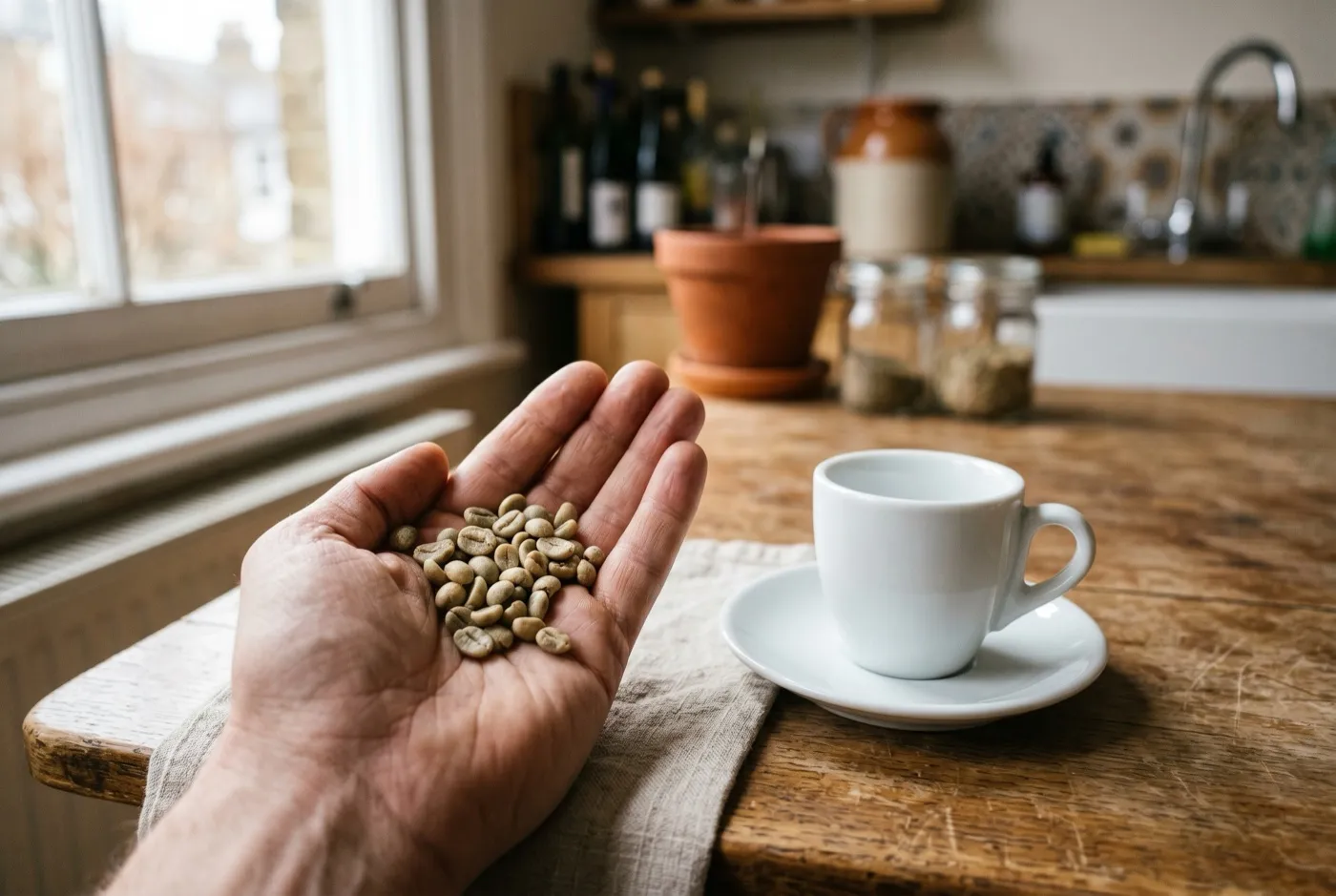 Four years of growing in one photo: a handful of beans, enough for a single small cup.
Buying a coffee plant: separate the seedling clump first
Deal with it in the first spring after purchase. Water the pot, slide the clump out, and tease the roots apart gently in a bowl of tepid water. Most clumps separate into singles with little damage because the seedlings are young. Pot each one into its own 9-10cm pot of ericaceous or peat-free compost at pH 5-6. Expect a sulk: drooped leaves for 7-10 days is normal while the roots recover.
If full separation feels brutal, thin instead. Snip off all but the strongest 2-3 stems at compost level. You lose plants but keep the roots undisturbed. Either route beats leaving the clump, where every seedling fights for the same water and the whole pot declines together by year two.
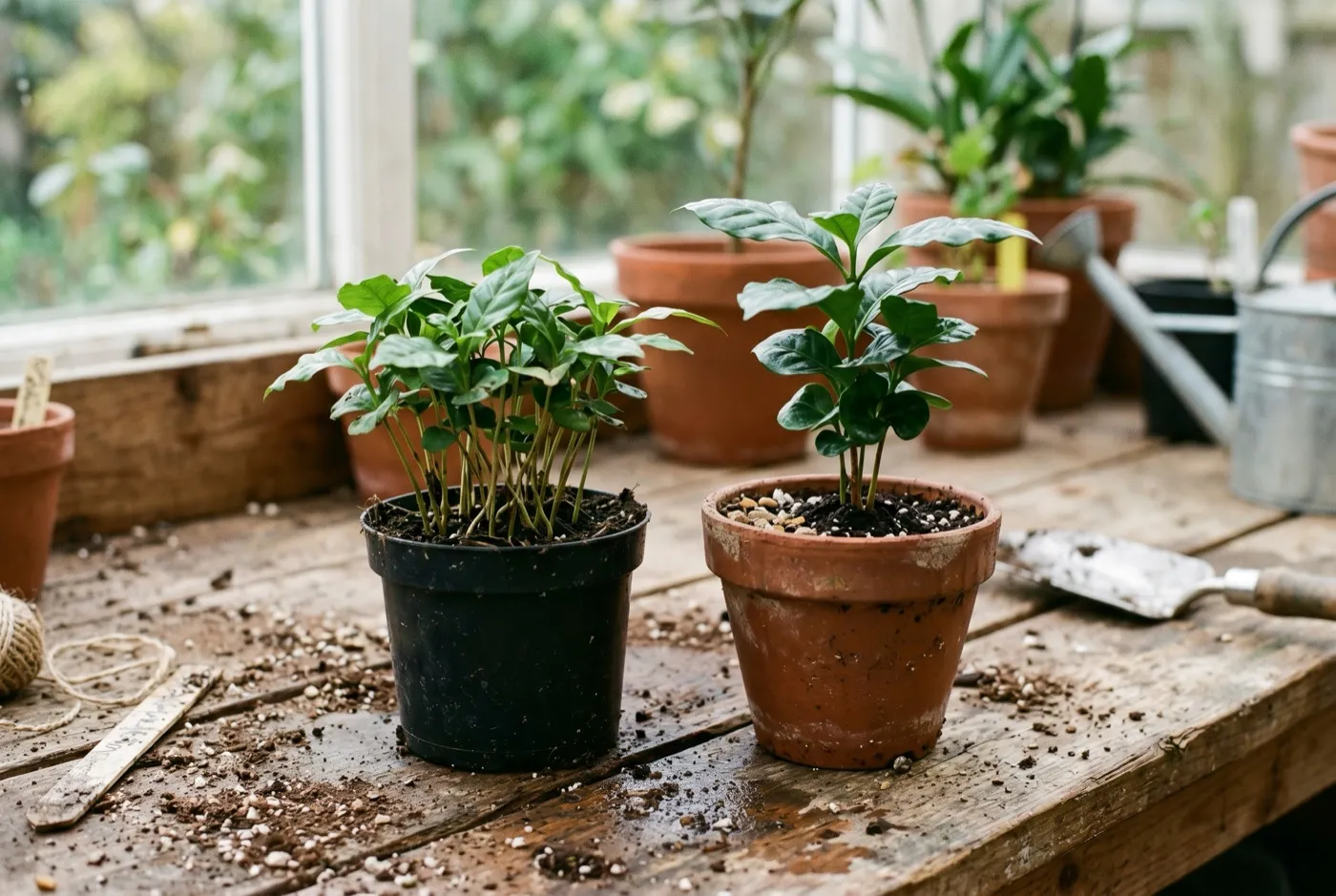 Left: the crowded clump as sold, with a dozen stems fighting for one root run. Right: a single separated seedling with room to grow.
What light and temperature does a coffee plant need?
Bright but indirect light, and steady warmth. In the wild, arabica grows as an understorey shrub at 1,200-2,000m in the Ethiopian highlands, shaded by taller trees. Indoors, an east-facing window recreates that well: 2-3 hours of gentle morning sun, then bright shade for the rest of the day. A south window in June will scorch the leaves, starting as bleached patches that crisp to brown.
Temperature matters more than most owners realise. Hold the plant at 18-24C all year round and never let it sit below 15C. At 10-12C growth stops and leaves begin to drop. Cold air moving across the foliage shows up as brown leaf edges within a week, so keep the plant away from frequently opened external doors and off cold sills trapped behind closed curtains at night.
The other danger sits below the window. A radiator under the sill pushes hot, dry air straight up through the canopy all winter. That combination of 25C blasts and 30% humidity browns leaf tips faster than any cold snap. Move the plant 1-2m away from any radiator from November to March.
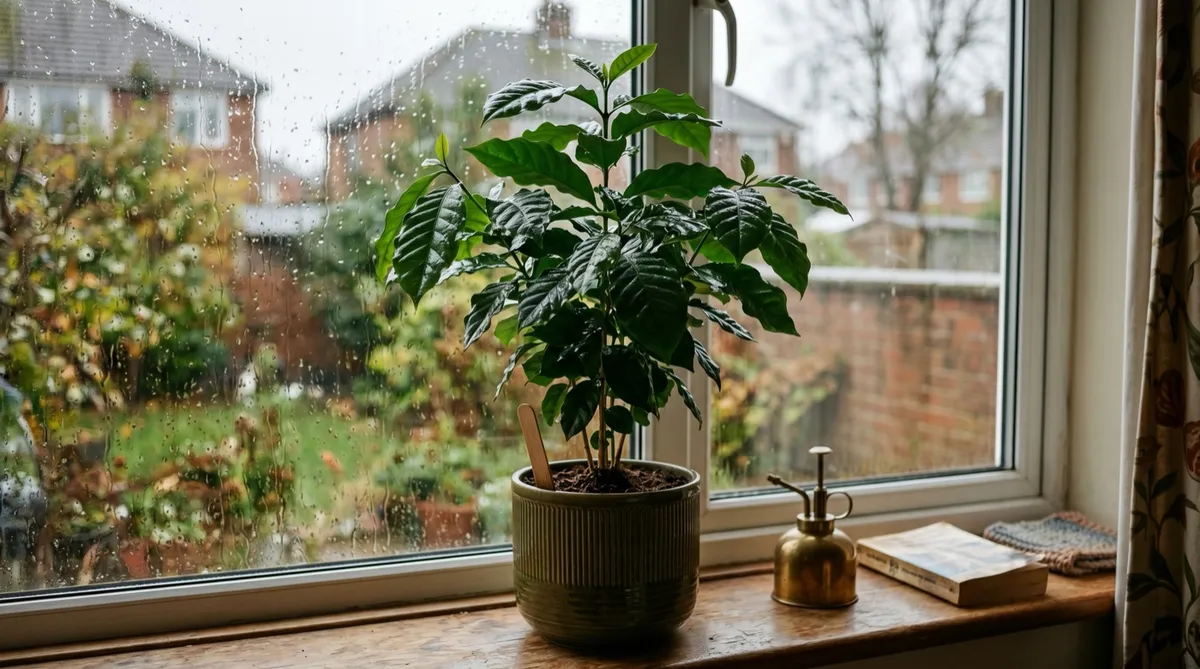
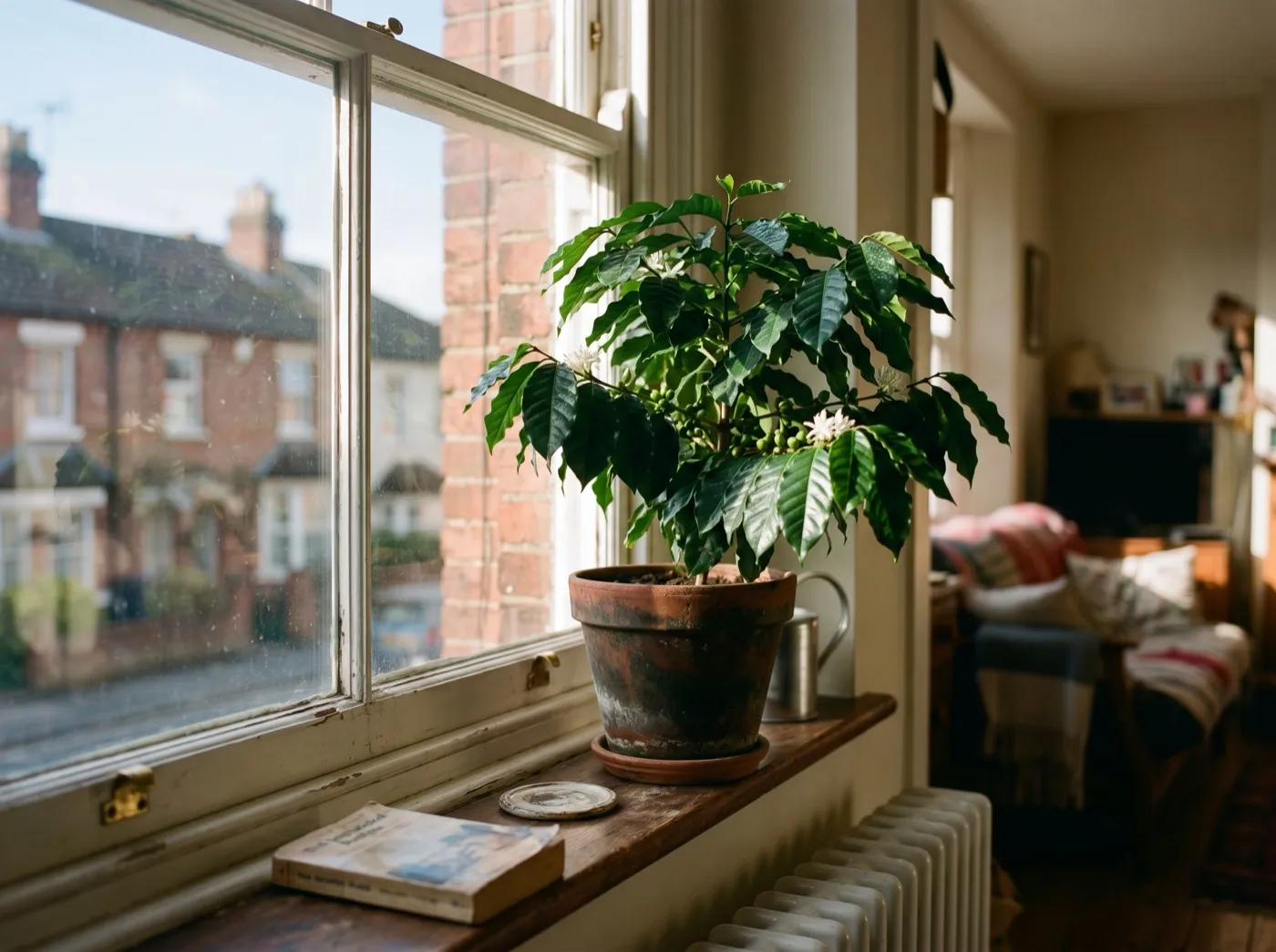 An east-facing sill gives a coffee plant its ideal dose: a couple of hours of soft morning sun, then bright shade.
Humidity, watering and feeding without the myths
Aim for humidity above 50%. A typical centrally heated UK living room sits at 35-40% in January, which is spider mite territory and browns leaf tips. Group your houseplants together so they share transpired moisture, and stand the coffee plant on a pebble tray: a saucer of stones with water kept just below the pot base. A £10 hygrometer takes the guesswork out.
Misting is the myth worth killing. It feels helpful, but the humidity spike lasts about 20 minutes before room air swallows it. We say so plainly because misting is the most repeated advice on coffee plant care and the least effective.
Water when the top 2-3cm of compost feels dry, usually every 5-7 days in summer and every 10-14 days in winter. Use rainwater if you can. Coffee sits with the acid-lovers at pH 5-6, and hard tap water slowly limes the compost until leaf edges brown and new growth yellows. A single water butt solves it; see our guide to rainwater harvesting for an easy setup. Feed monthly from April to September with a half-strength liquid feed, and not at all in winter.
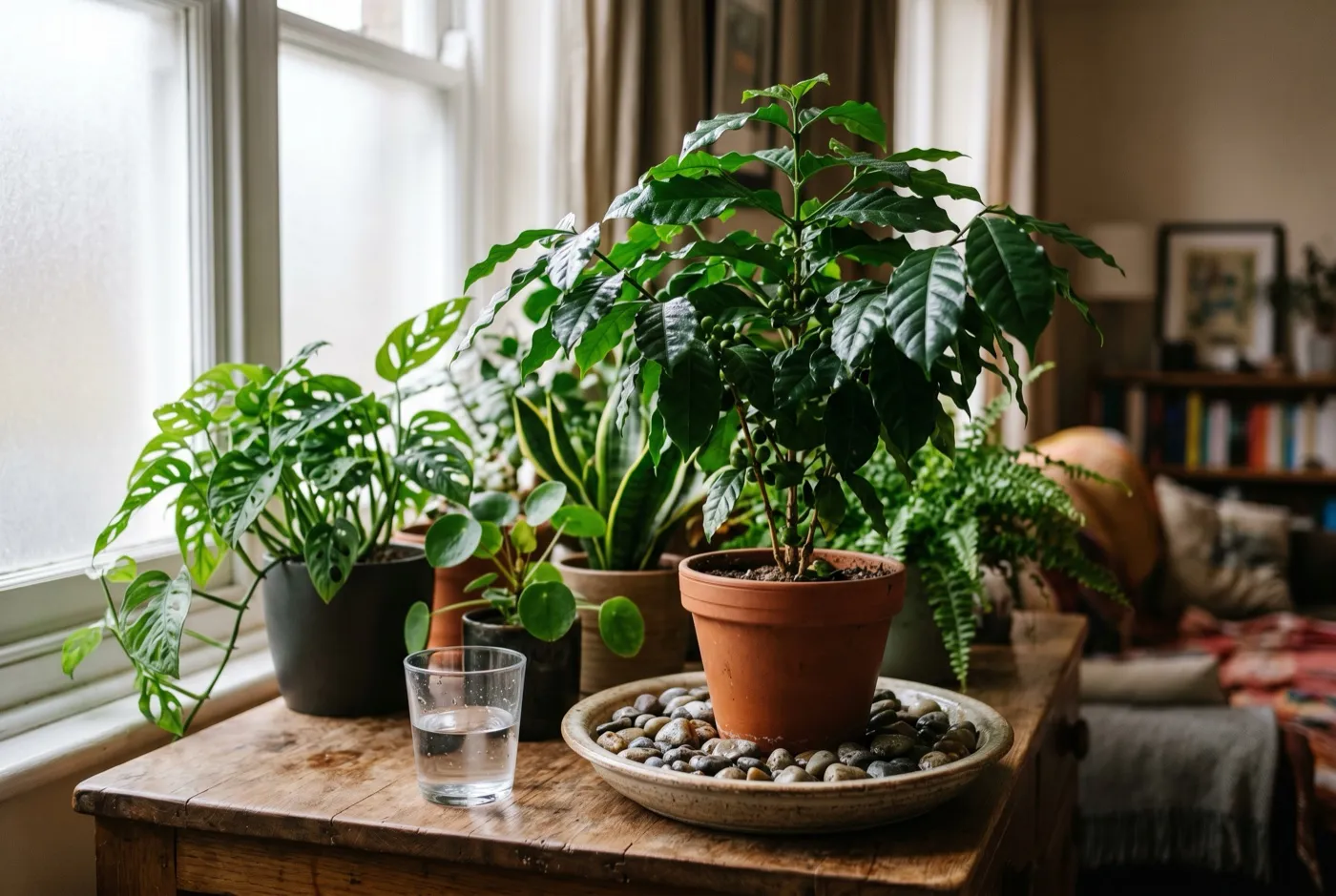 A pebble tray and close neighbours hold humidity in the 50-58% band all day, which misting cannot match.
Repotting, pruning and final size indoors
A happy coffee plant outgrows pots quickly. Repot every spring, going up one pot size at a time, until it reaches a 30cm pot. After that, refresh the top 5cm of compost each March instead. Always use an acidic mix at pH 5-6 and a pot with drainage holes. Our guide on repotting houseplants covers the technique step by step.
Left unpruned, an indoor arabica reaches 1.5-2m in five or more years and turns leggy, with long bare stretches of stem between leaf pairs. Prune in spring. Take the main stem back to 1.2m, cutting 5mm above a leaf pair, and shorten any wayward side branches by a third. The plant responds with side shoots from the leaf joints below each cut, which builds the dense, bushy shape you want.
There is a bonus to pruning beyond looks. Flowers form at the leaf joints on newer wood, so a plant with more side branches carries more flowering positions. A pruned 1.2m bush will usually out-flower a lanky 1.8m pole. Keep the prunings: 10cm tip cuttings root in water in 6-8 weeks during summer.
How do you get a coffee plant to flower in the UK?
Patience first: no coffee plant flowers before maturity, which takes three to five years from a young seedling. After that, flowering is triggered by a seasonal rhythm you have to fake. Give the plant a winter rest from November to January: move it somewhere cooler at 15-18C and cut watering back by half, so the compost almost dries between drinks. This 8-10 week rest mimics the highland dry season and sets flower buds.
Done right, clusters of white, jasmine-scented flowers open at the leaf joints in late spring. Each flush lasts only 2-3 days, so act fast. Arabica is self-fertile, but indoors there are no bees and no wind worth having. Hand-pollinate by working a small, soft paintbrush around every flower, twice a day while they last. Five minutes of brushwork is the difference between a heavy set and two lonely cherries.
The critical mistake is skipping the rest. A plant kept at a constant 21C and watered on the same schedule all year stays in leaf-growing mode indefinitely. Owners then blame feed or light, when the missing trigger was eight cool, dry weeks.
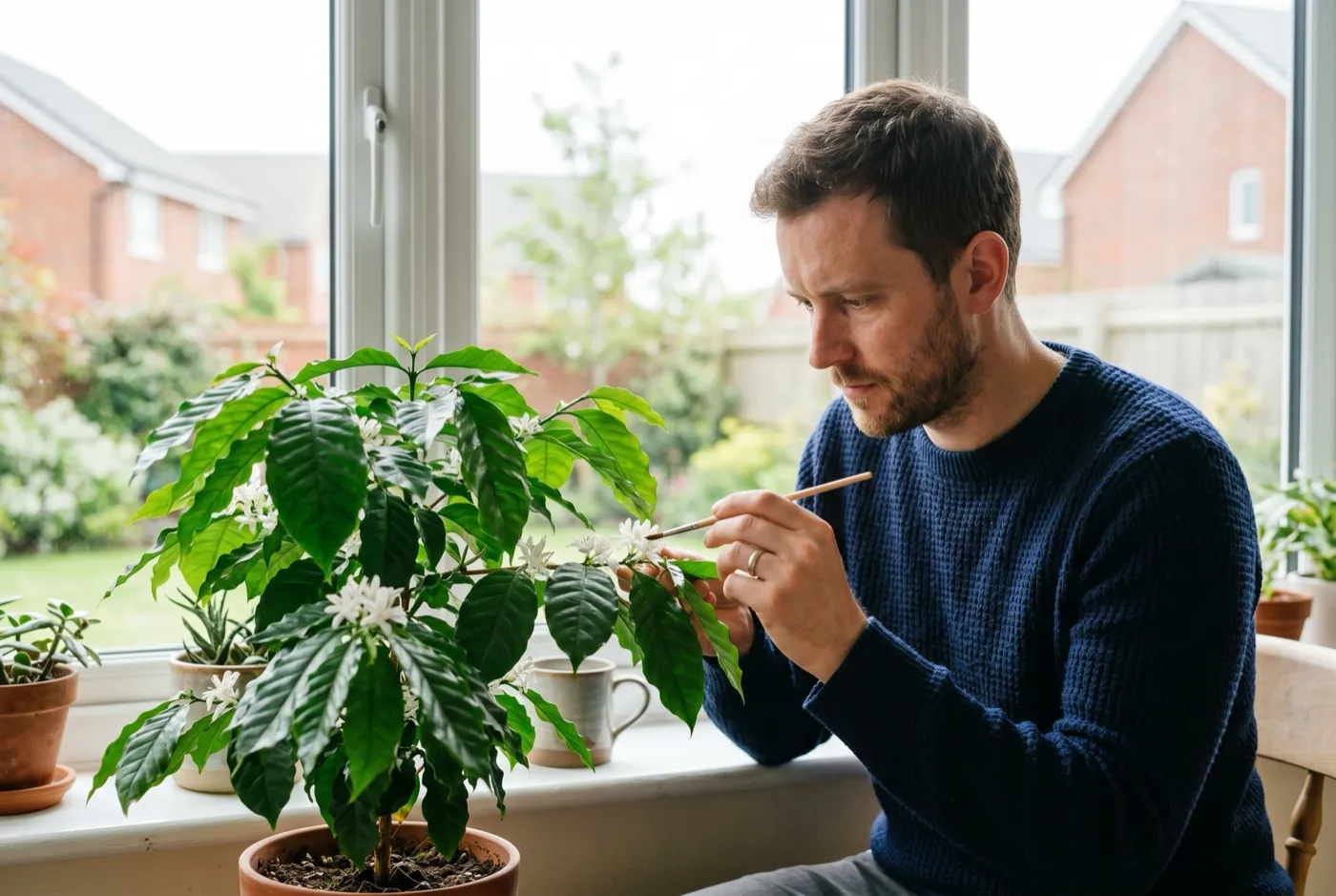 Each flower flush lasts 2-3 days, so a soft paintbrush twice a day does the work bees would do outdoors.
From flower to cup: the eight stages
The journey from pollinated flower to drinkable coffee runs to a fixed timetable. Knowing it stops you panicking when nothing seems to happen for months.
- Bud set (weeks 1-10). The winter rest at 15-18C with reduced water primes flower buds at the leaf joints.
- Flowering (2-3 days). White scented flowers open in flushes. Hand-pollinate every flower within 48 hours.
- Fruit set (weeks 3-4 after flowering). Tiny green cherries appear where pollination took. Unpollinated flowers drop cleanly.
- Swelling (months 1-6). Cherries grow slowly at 18-24C. They stay hard and green, and this stage tests everyone’s nerve.
- Ripening (months 7-9). Cherries turn yellow, then orange, then deep red over the final 6-8 weeks.
- Harvest (over 2-4 weeks). Cherries ripen unevenly. Pick only the fully red ones, every few days, by twisting gently.
- Processing (16 days). Squeeze each cherry so the two seeds pop out. Ferment the seeds in a jar of water for 24-48 hours to loosen the sticky mucilage, rinse, then dry on a rack for 14 days until they feel hard.
- Roasting (12 minutes). Roast the dried beans in a dry frying pan over medium heat for 10-12 minutes, stirring constantly, until they crack and brown. Rest 24 hours, then grind.
The critical mistake sits at stage 6. Stripping every cherry the day the first one blushes red wastes half the harvest, because the green ones never ripen off the plant. Pick individually, red only, over several visits.
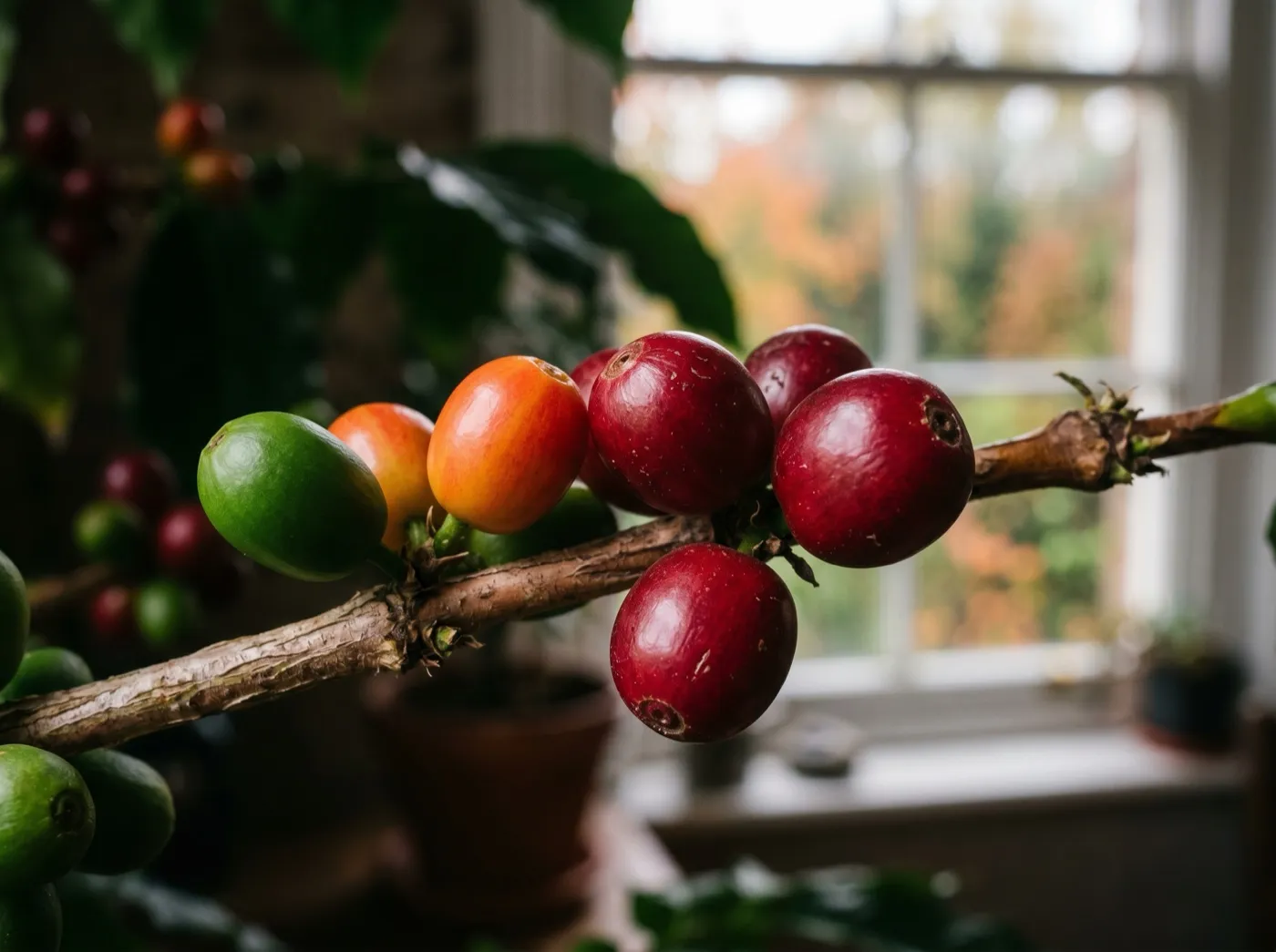 Cherries on one stem ripen weeks apart, from hard green through orange to picking-ready deep red.
Coffee vs other grow-your-own brews
If your real goal is a homegrown drink, rank the options by what one plant actually delivers in a year. Coffee comes last by a distance.
| Project | Cups per plant per year | Time to first harvest | Care demand | Role |
|---|---|---|---|---|
| Mint (fresh tea) | 200+ | 8-10 weeks | Very low | Primary supply: the gold standard |
| Lemon verbena (tisane) | 100+ | First summer | Low | Primary supply |
| Chamomile (dried flowers) | 60-80 | 10-12 weeks | Low | Supporting, easy win |
| Hops for home brewing | 20-40 pints from year 2 | 18 months | Moderate | Supporting, seasonal project |
| Coffee plant | 1 | 3-5 years | High | Novelty centrepiece |
Mint is the gold standard because a single £3 plant in a 25cm pot gives daily pickings from May to October, year after year, with no winter heating, no pollination and no processing. A tea plant sits between the two, giving 50-100g of dried leaf a year from one hardy bush. Coffee needs four years, a paintbrush, a fermentation jar and a frying pan to make one cup. Grow it anyway, but grow it for the glossy leaves and the story, and keep a mint pot going for the actual drinking.
A month-by-month coffee plant calendar
Indoor plants still follow a seasonal rhythm. This calendar keeps a UK coffee plant on track through the year.
| Month | Action |
|---|---|
| January | Winter rest continues at 15-18C; water only when the top 2-3cm is dry |
| February | Check weekly for spider mite in dry heated air; keep humidity above 50% |
| March | End the rest; repot one size up, resume normal watering as light improves |
| April | First monthly feed at half strength; turn the pot weekly for even growth |
| May | Watch for flower buds on mature plants; hand-pollinate any flush within 48 hours |
| June | Shade from direct midday sun; water every 5-7 days as temperatures rise |
| July | Peak growth; top up the pebble tray weekly and feed monthly |
| August | Prune leggy stems back to 1.2m; take 10cm tip cuttings to root in water |
| September | Give the final feed of the year; cherries from spring flowers begin colouring |
| October | Stop feeding; let the compost dry slightly more between waterings |
| November | Start the winter rest at 15-18C; move the plant 1-2m clear of radiators |
| December | Pick any fully red cherries individually; check sills for cold night draughts |
Why most indoor coffee plants fail in year one
The biggest is the unseparated seedling clump. A dozen stems share one root run, the strongest few slowly starve the rest, and the dying seedlings rot among the survivors. The owner sees yellowing stems and waters more, which speeds the rot. Separation or thinning in the first spring removes the cause permanently.
Second is hard tap water. Around 60% of England sits on hard water. Each watering adds lime, the compost creeps up from pH 5-6 towards neutral, and the plant loses access to iron. Edges brown, new leaves yellow, and no feed fixes it because the problem is chemistry, not nutrition. Rainwater, or filtered water at a pinch, prevents it for good.
Third is the winter position. A sill above a radiator by a draughty window serves cold shocks at night and hot dry blasts by day. Move the plant to a stable spot at 15-18C each November and the brown edges stop appearing. Fix all three and a coffee plant becomes genuinely easy to keep.
Which pests attack coffee plants indoors?
Three pests do almost all the damage, and dry winter air invites the worst of them. Spider mite thrives when humidity drops below 40%, stippling leaves with pale dots and fine webbing on the undersides. Your pebble tray is the first defence; our guide to spider mite control covers identification and treatment if they get a hold.
Scale insects appear as brown 2-4mm bumps along stems and leaf midribs, sticky honeydew on the leaves below them. They are slow to spread but stubborn; see our scale insect treatment guide for the wipe-and-oil routine that clears them. Mealybugs show as white, cottony clusters tucked into leaf joints, exactly where coffee flowers later form, so deal with them early. Our mealybug identification guide explains the cotton-bud and alcohol method.
Check the leaf undersides and joints for 30 seconds every time you water. The RHS lists all three among the most common houseplant pests in the UK, and every one is far easier to clear at first sighting than after three months of quiet spread.
Common mistakes
- Leaving the seedling clump unseparated. It looks bushier, so owners keep it. The stems strangle each other within 18 months. Separate or thin to 2-3 stems in the first spring.
- Parking it over a radiator in winter. The sill seems bright and warm, but 30% humidity and hot updraughts brown the leaves. Move it 1-2m away from November to March.
- Watering with hard tap water. Lime builds in the compost and locks out iron, browning edges slowly over months. Use rainwater and keep the compost at pH 5-6.
- Skipping the winter rest. Constant 21C and steady watering keep the plant in leaf mode forever, so it never flowers. Give it 8-10 weeks at 15-18C, kept drier.
- Expecting espresso. One plant makes roughly one cup a year, and disappointment makes people bin healthy plants. Grow it as foliage with a bonus harvest.
Frequently asked questions
Can you grow a coffee plant indoors in the UK?
Yes, Coffea arabica grows well indoors anywhere in the UK. It needs 18-24C year round, bright indirect light and humidity above 50%. Treat it as a foliage houseplant first. Any beans are a bonus, not a supply.
How much coffee does one plant actually produce?
One mature windowsill plant gives roughly 40-100 beans a year, about one cup. A daily-cup habit would need 15-20 mature trees. Commercial trees carry around 2,500 cherries each season, which a 30cm pot cannot match.
How long does a coffee plant take to flower?
Why are the leaf edges on my coffee plant turning brown?
Cold draughts, dry air or hard tap water cause brown leaf edges. Check for a draughty sill or a radiator below the window first, then your water. Switch to rainwater and keep humidity above 50% and new leaves emerge clean.
Should I mist a coffee plant?
No, misting raises humidity for around 20 minutes, then it falls back. A pebble tray and grouped plants hold 50-58% all day. Save the mister and fix the humidity properly.
Is a coffee plant safe around cats and dogs?
No, the leaves and unripe fruit are toxic to cats and dogs. All parts except the ripe cherry pulp contain compounds that upset pets. Keep the plant out of reach or choose something else.
Now your coffee plant has the right window, the right water and a realistic job description. For another tender evergreen that actually feeds you, read our guide to growing citrus trees in the UK, keep a curry leaf plant on the same warm sill, or browse the full growing section for more indoor projects.
Our team produces practical UK gardening guidance from source research, contributor records and established horticultural practice. Editorial standards are overseen by Matt W.