Key takeaways
- Vanilla planifolia is a tender orchid: keep it above 18C day and night, never below 13C
- It needs 70-85% humidity and bright indirect light, so a heated greenhouse or conservatory suits it
- The vine climbs 2-4m and takes 3-5 years to reach flowering size from a rooted cutting
- Each flower lasts one day and must be hand-pollinated between 06:00 and 13:00
- Pods appear within two months but must ripen on the vine for nine months before harvest
- Curing takes a further three to four months of daily sweating and drying before pods smell of vanilla
- A rooted cutting costs 15 to 40 pounds; a full heating and humidity setup adds 100 to 300 more
Learning how to grow vanilla in the UK means treating it as a tropical orchid, not a herb, and giving it years rather than a season. Vanilla planifolia is a climbing orchid from the rainforests of Central America. It produces the green pods that, once cured, become the vanilla we cook with. Grown outdoors here it would die in the first cold night. Grown under glass, warm and humid, it thrives.
Can you grow vanilla in the UK?
Yes, you can grow vanilla in the UK, but only indoors with heat and humidity. Vanilla planifolia is a tender tropical orchid rated for frost-free conditions only. It grows as a climbing vine, not a bush, and reaches 2-4 metres given room. Outdoors in Britain it has no chance. Under cover, in a heated greenhouse, a conservatory or a warm bright room, it grows steadily and can eventually fruit.
The plant is a true orchid, one of the very few grown as a food crop rather than for its flowers. The RHS lists Vanilla planifolia as a tender houseplant needing a minimum of around 15C and high humidity. It sits alongside the other exotic crops UK growers push under glass, and it rewards the same warm, patient approach.
If you already run a heated greenhouse for tender crops, vanilla slots in beside them. Growers who enjoy the challenge of our saffron growing guide or the slow reward of turmeric under cover will recognise the mindset. Vanilla just asks for more warmth and far more time.
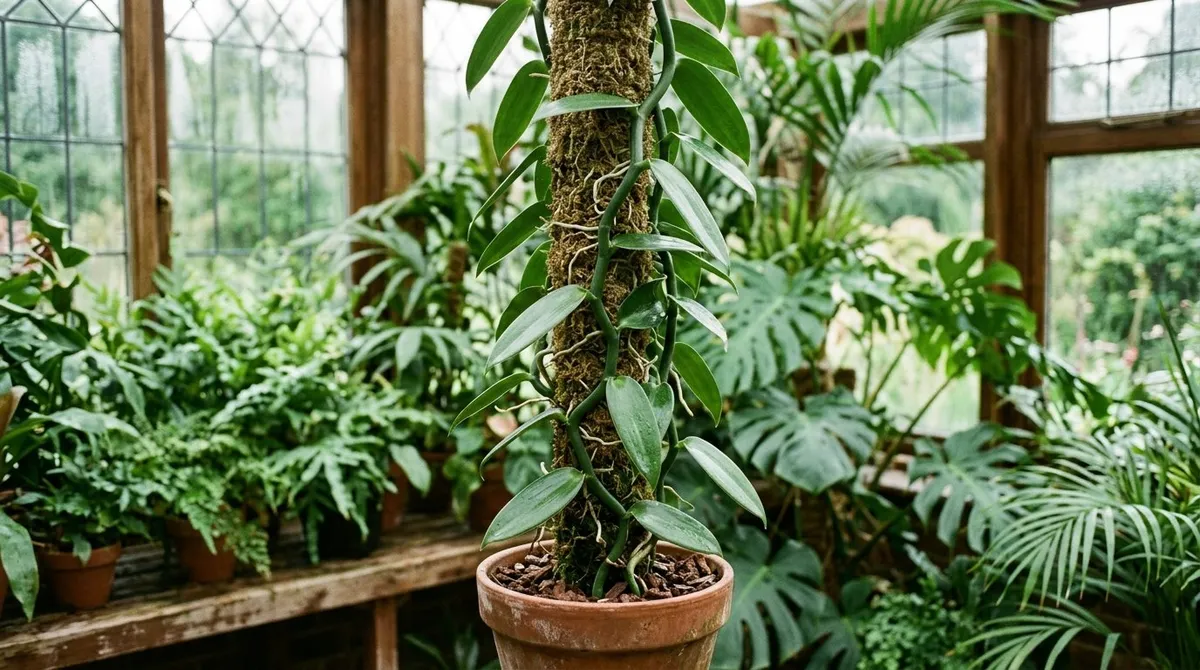
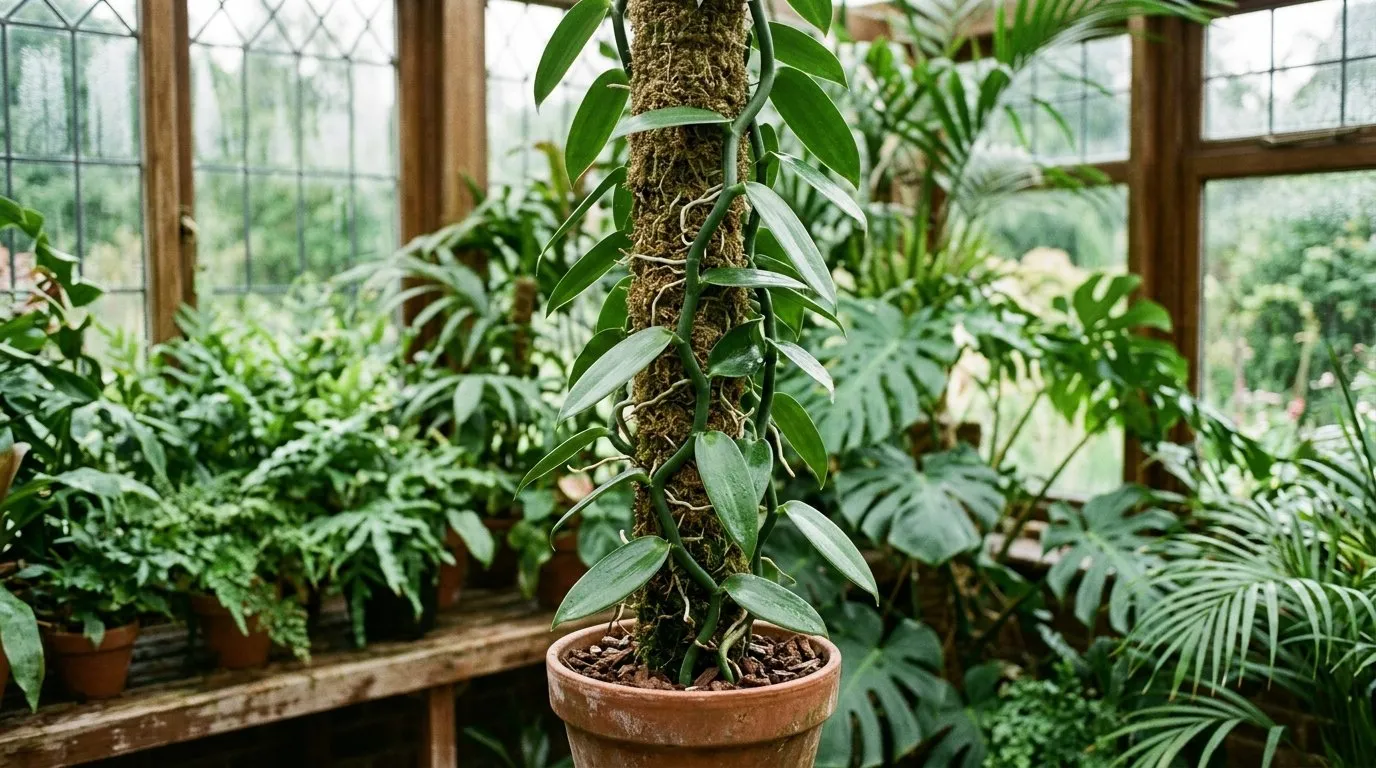 A vanilla vine trained up a moss pole under glass. It climbs 2-4m and takes three to five years before it flowers.
The plant is not difficult to keep alive. Kept warm and humid, it grows fast. The difficulty is the flowering and fruiting, which need maturity, timing and hand work.
What temperature and humidity does vanilla need?
Vanilla needs a minimum of 18C and humidity of 70-85%, held steadily all year. This is the single most important part of growing it. The ideal range is 21-29C by day, dropping no lower than 18C at night. Below 15C the vine sulks. Below 13C it takes damage, and a spell near 10C can kill it.
That rules out an unheated greenhouse in a British winter. You need a heat source that holds the minimum through the coldest nights: an electric fan heater on a thermostat, a heated propagator base, or a warm room indoors. Our greenhouse heating guide walks through the options and the running costs, which are the real expense of this crop over several years.
Humidity matters almost as much as heat. Vanilla evolved in rainforest air at 70-85% humidity, and UK indoor air often sits at 40-50%. Dry air shrivels the aerial roots, yellows the leaves and drops the flowers before they open. Mist the plant daily, stand pots on trays of damp gravel, and use a hygrometer to check you are near 80%. A conservatory full of other tropical foliage builds its own humid microclimate, which is why vanilla often does well among conservatory houseplants.
Light should be bright but filtered. Direct summer sun through glass scorches the leaves, while deep shade stops it ever flowering. Aim for the dappled light a rainforest floor gets. An east or west aspect, or light shading on a south-facing greenhouse in high summer, is about right.
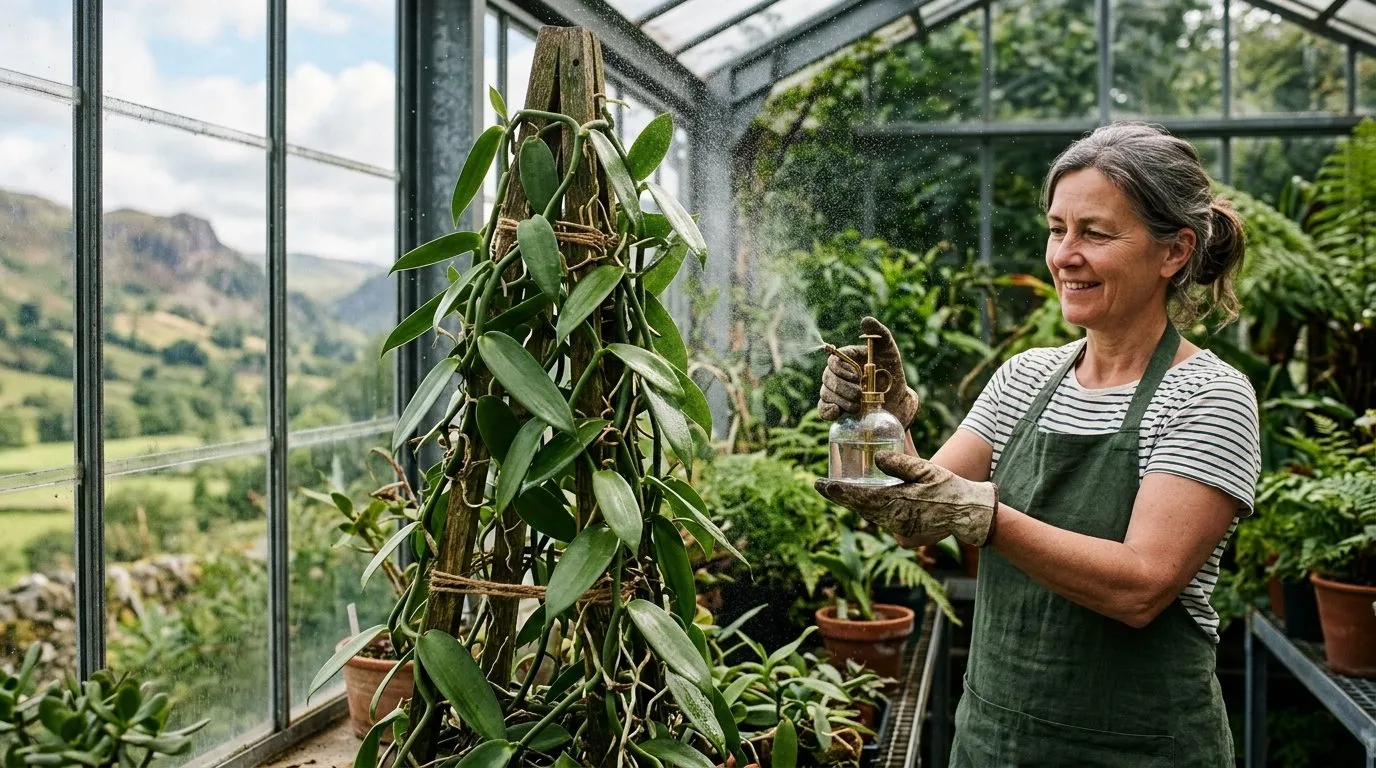 Daily misting keeps humidity near 80%. Dry air is the fastest way to shrivel a vanilla vine’s roots and drop its flowers.
How do you plant and support a vanilla orchid?
Plant vanilla in a free-draining orchid mix and give it a tall support to climb from day one. Vanilla is a hemi-epiphyte. It roots in the ground but climbs by clinging to bark and branches with aerial roots along the stem. In cultivation, a moss pole, a slab of tree fern, or a rough wooden stake does the job of the tree it would climb in the wild.
Use a coarse, open medium, not ordinary compost. A bark-based orchid mix, or a blend of orchid bark, perlite and coarse coir, keeps the roots aired and never waterlogged. A soggy root rots fast. Pot into something no bigger than the roots need, then let the vine climb.
Train the growing tip up the support and tuck the aerial roots against the moss as they form. The vine reaches the greenhouse roof, so many growers loop it back down once it nears the top. This looping also encourages flowering, since horizontal or descending growth triggers buds more readily than vertical growth.
Water when the top of the mix approaches dry, roughly twice a week in summer and once a week in winter. Feed fortnightly in the growing season with a half-strength orchid feed. The same care principles apply as for other indoor orchids, and our guide on caring for orchids indoors covers the watering and feeding rhythm in more detail.
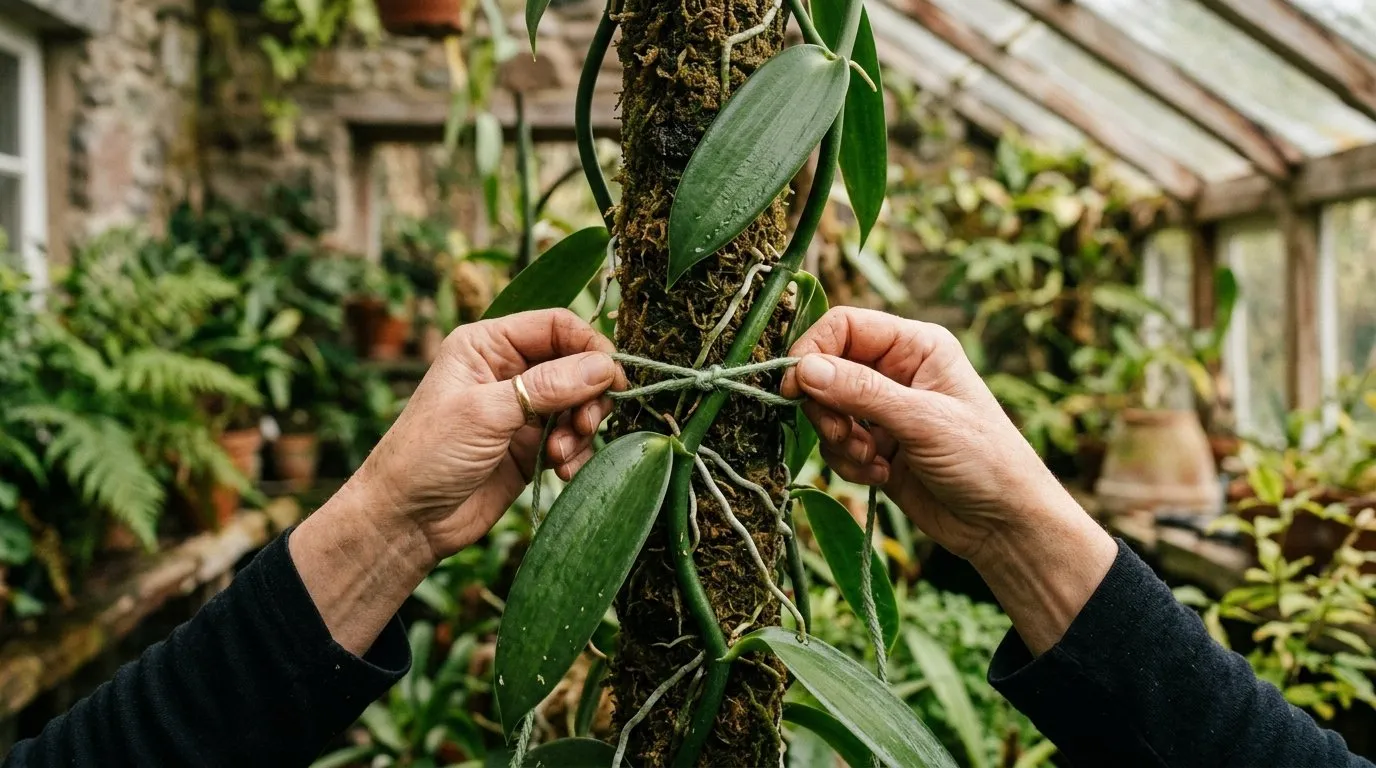 Tie the vine loosely to a moss pole and tuck each aerial root against it. Vanilla climbs 2-4m and flowers best on looped growth.
Most growers start from a rooted cutting rather than seed, because vanilla seed is almost impossible to germinate without a lab. A cutting of 30-60cm establishes quickly and shaves a year or two off the wait compared with a tiny plug.
How long does vanilla take to flower and fruit?
Vanilla takes three to five years to flower from a rooted cutting, then nine months more to ripen a pod. There is no shortcut. The vine must reach maturity, generally 3-4 years old and 3 metres or more of growth, before it forms a single bud. Feeding harder or heating warmer speeds growth a little but cannot force flowers on an immature plant.
When it does flower, the plant produces a spray of buds that open a few at a time over several weeks, usually in late spring. Each individual flower is pale green-yellow, waxy, and about 5-10cm across. And each one lasts a single day.
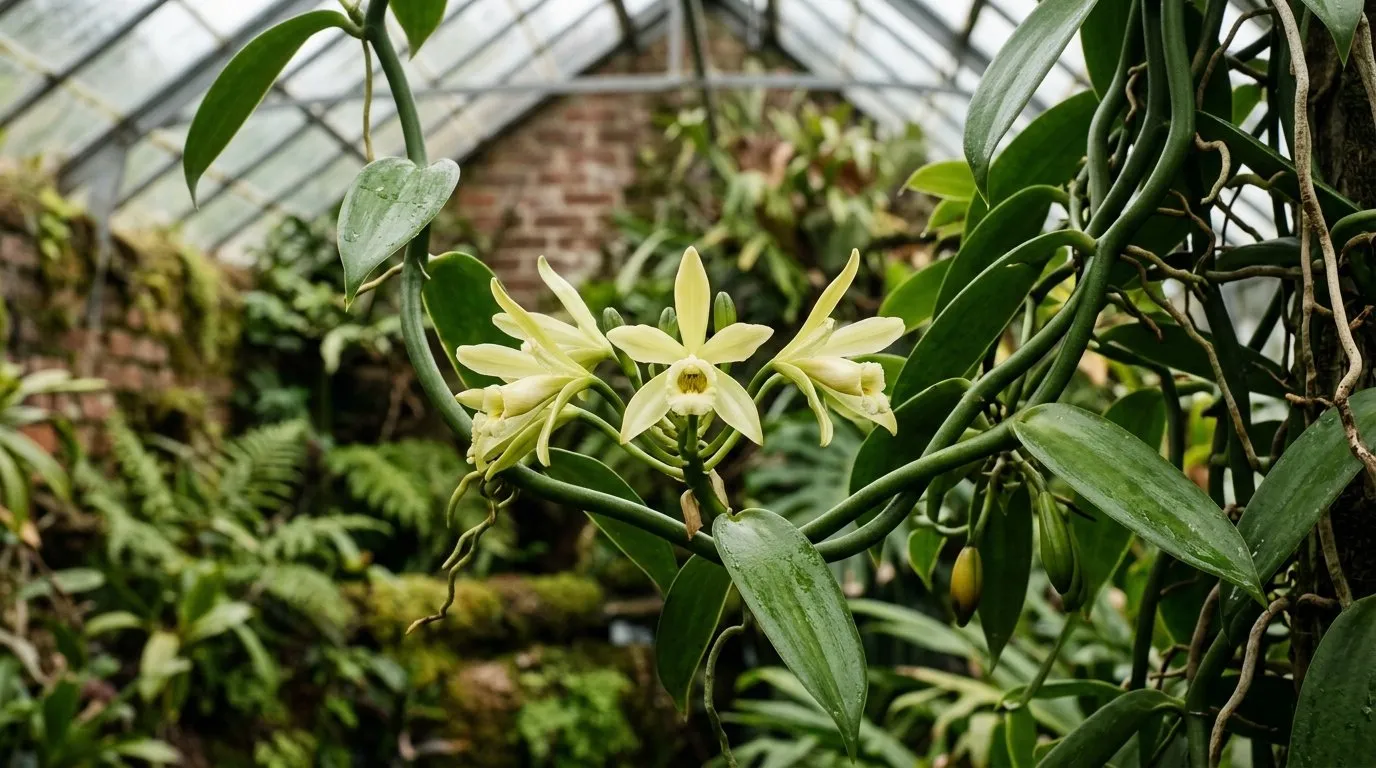 A spray of vanilla flowers on mature wood. Each waxy bloom opens for one morning only, so pollination cannot wait.
Once a flower is pollinated, a slender green pod begins to swell within a week or two. Pods reach full length, 15-25cm, within a couple of months, but the flavour compounds are not there yet. The pod must stay on the vine for a full nine months to ripen, slowly building the vanillin that gives the finished spice its scent. Picked early, it never develops properly.
So the honest full timeline, cutting to cured pod, runs to roughly four to six years. Here is how it breaks down.
Vanilla timeline from cutting to cured pod
| Stage | Typical duration | What is happening |
|---|---|---|
| Establishing the cutting | 3-6 months | Roots take hold, vine begins to climb |
| Growing to maturity | 3-5 years | Vine reaches 3m+; no flowers until mature |
| Flowering | A few weeks in late spring | Buds open one flower per day |
| Hand-pollination window | 1 day per flower | Pollinate between 06:00 and 13:00 |
| Pod ripening on the vine | 9 months | Green pod builds flavour, must not be picked early |
| Curing the harvested pod | 3-4 months | Sweating and drying develops the vanilla scent |
Set against that, the several-year commitments in our citrus growing guide start to look brisk. Vanilla is the long game of UK indoor growing.
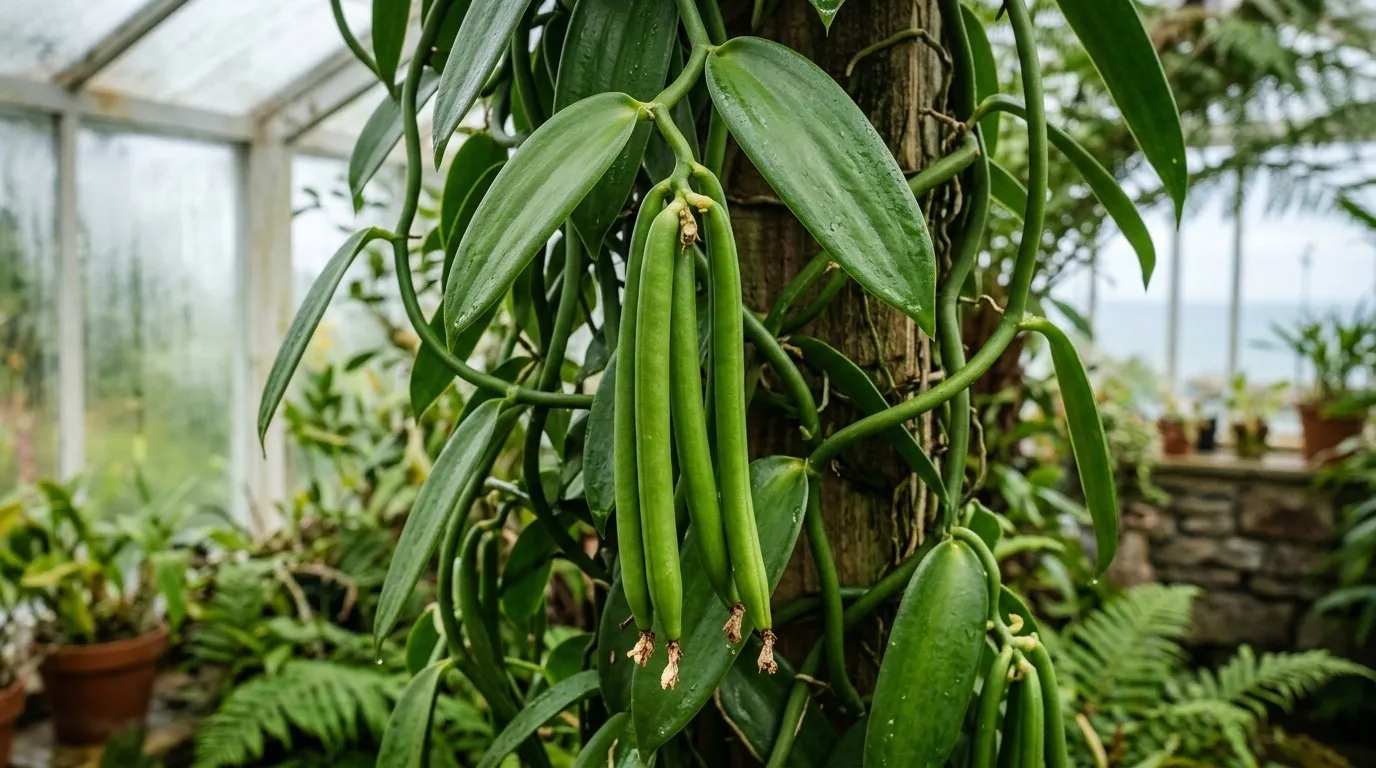 A green vanilla pod swelling on the vine. It reaches full length in weeks but must hang for nine months to ripen.
How do you hand-pollinate a vanilla orchid?
You must hand-pollinate every vanilla flower, because its natural pollinator does not live in the UK. In the wild, a specific Melipona bee from Central America does the work. Everywhere else on earth, including commercial plantations, people do it by hand. The technique is simple once learned, but the timing is unforgiving.
Each flower opens in the early morning and closes by early afternoon, never to reopen. Pollinate between 06:00 and 13:00, ideally within a few hours of opening while the stigma is freshest. Miss the window and that flower is gone. A mature spray opens flowers over several weeks, so you get repeated chances, just one per flower per day.
The obstacle inside the flower is a small flap called the rostellum, a membrane that separates the pollen from the stigma and stops the flower pollinating itself. Your whole job is to lift that flap and press the pollen onto the sticky stigma behind it.
Here is the method, using a cocktail stick or a fine toothpick:
- Hold the open flower gently in one hand, facing you.
- Find the column, the central structure, and the yellow anther cap at its tip holding the waxy pollen masses, the pollinia.
- With the stick, ease the anther cap forward to expose the pollinia.
- Lift the thin rostellum flap up and out of the way with the stick.
- Fold the pollinia down onto the sticky stigma below and press gently with a fingertip so they make firm contact.
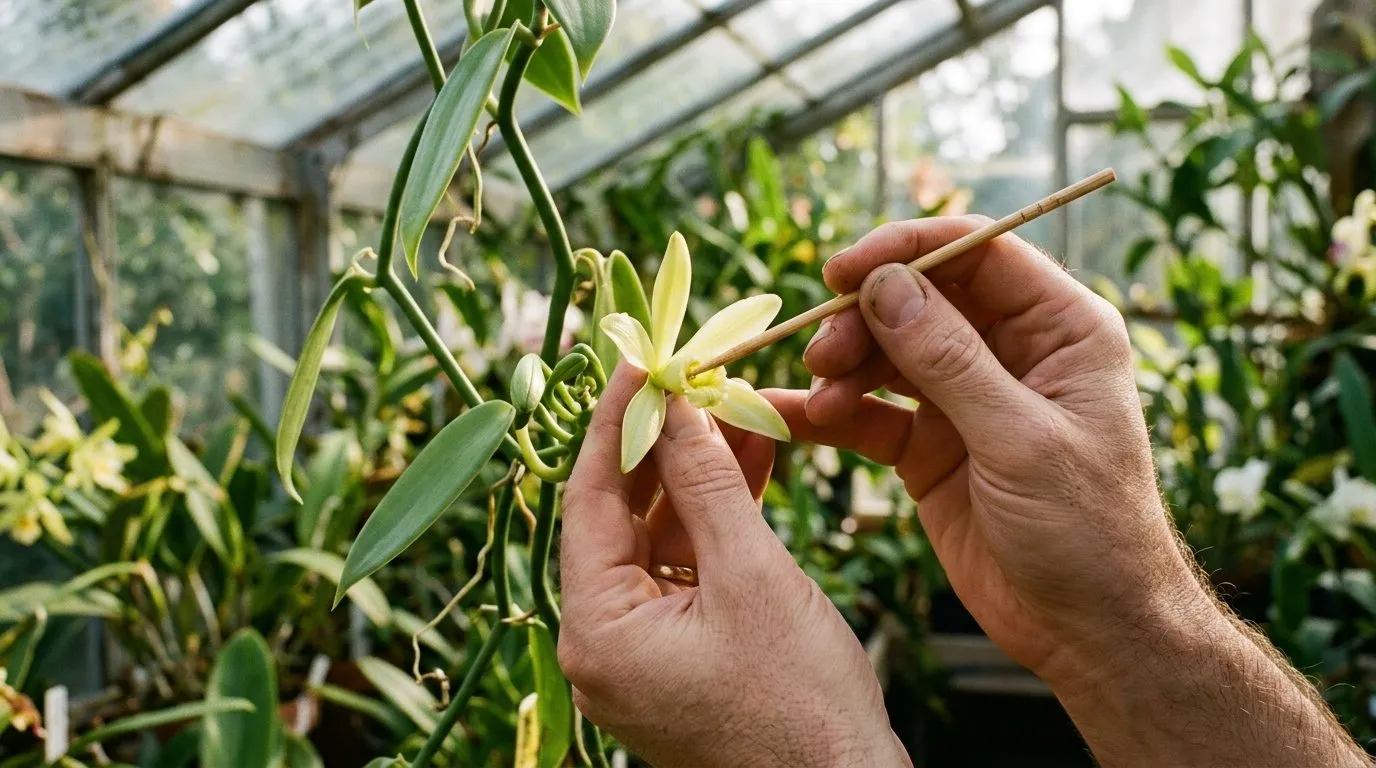 Hand-pollination with a cocktail stick. Lift the rostellum flap and press the pollen onto the stigma, all before 13:00.
How do you cure vanilla pods at home?
Curing turns a scentless green pod into fragrant vanilla over three to four months of sweating and drying. A freshly picked pod smells of nothing much. All the vanilla aroma develops during curing, as enzymes break down inside the pod and vanillin forms. A home grower with a handful of pods can manage a simplified version of the commercial method.
The process runs in four stages.
Killing. First, stop the pod growing. Dip the pods in hot water at around 65C for a couple of minutes, or lay them in the sun until they wilt. This halts the pod and kicks off the enzyme reactions.
Sweating. Wrap the warm pods in a cloth or place them in an insulated box each night, and lay them out in gentle warmth or sun each day. Repeat daily for one to two weeks. The pods turn from green to dark brown and become supple.
Slow drying. Spread the pods somewhere warm, dry and airy, out of direct sun, for two to three months. They lose most of their moisture and grow leathery. A warm airing cupboard, a sunny windowsill, or a spot near a radiator all work at home.
Conditioning. Finally, store the dried pods loosely wrapped in a sealed box for a month or more. The scent deepens and matures. A well-cured pod is dark, pliable, and unmistakably vanilla.
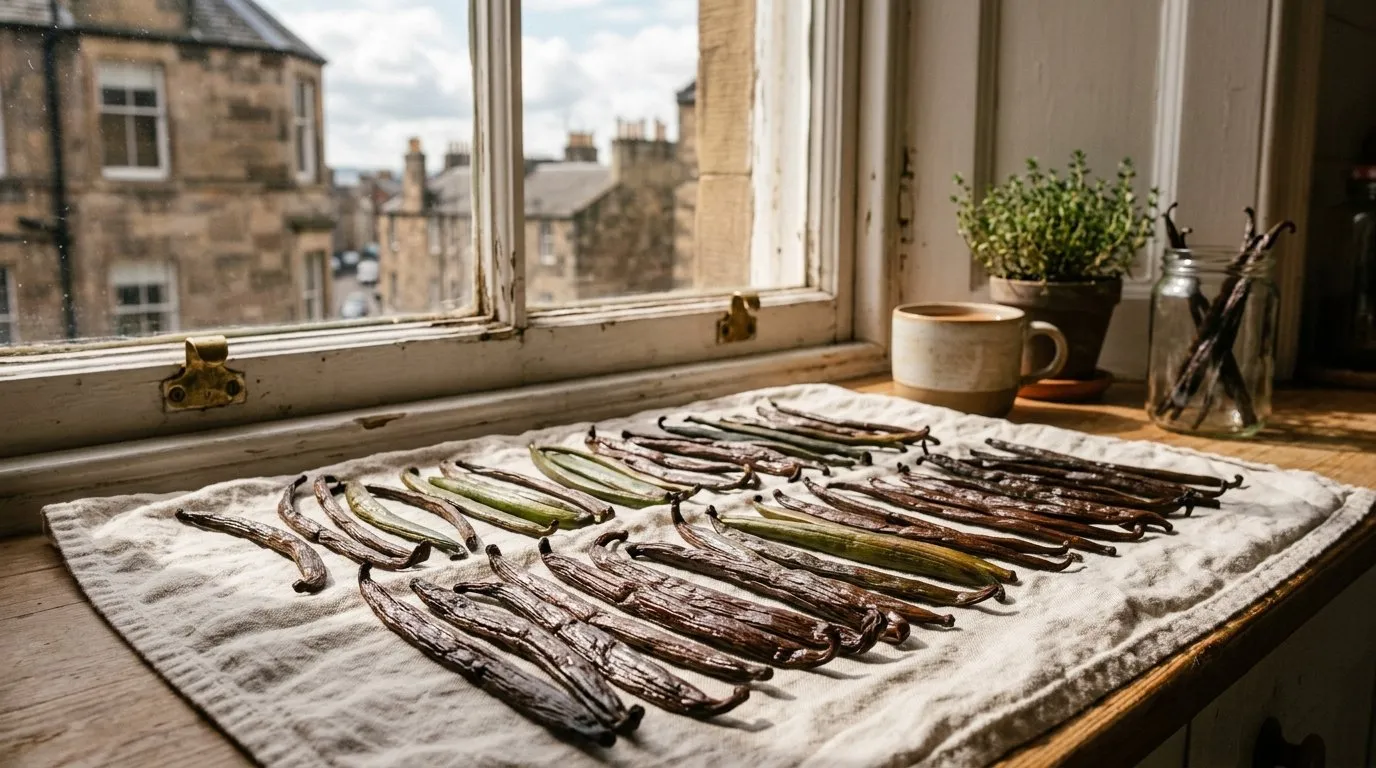 Home curing on a warm windowsill. Green pods darken and shrivel over three to four months into fragrant vanilla.
What does it cost to grow vanilla in the UK?
The plant itself is cheap, but the heating and humidity add up over years. A rooted cutting from a specialist orchid nursery costs 15 to 40 pounds, and a larger established plant 50 pounds or more. Against the running costs, the plant is the cheapest part of the exercise.
Here is a realistic breakdown of a home setup.
Vanilla growing cost breakdown
| Item | Typical UK cost | Notes |
|---|---|---|
| Rooted vanilla cutting | 15 to 40 pounds | Larger plants 50 pounds plus |
| Moss pole or support | 8 to 20 pounds | Or a homemade wooden stake |
| Orchid bark mix | 8 to 15 pounds per bag | Free-draining, never ordinary compost |
| Thermostatic heater | 25 to 60 pounds | Essential for winter minimum |
| Humidity tray or mister | 5 to 20 pounds | Plus daily misting by hand |
| Winter heating running cost | 50 to 200 pounds per year | The real long-term expense |
The heating is what makes or breaks the budget. Holding a greenhouse above 15C through a UK winter is not cheap, and you will pay it for several years before the first pod. Many growers keep vanilla in a warm spare room or heated conservatory instead, borrowing the heat they already pay for. Bubble insulation and zoning off a small heated corner both trim that bill.
Set against a supermarket pod at 3 to 5 pounds each, home-grown vanilla makes no financial sense. Nobody grows it to save money. You grow it for the pleasure of doing something most people think impossible in Britain.
Common vanilla growing problems and fixes
Most vanilla problems trace back to cold, dry air, or simple impatience. The plant is tough once warm and humid, but three faults account for nearly every failure. Here is what goes wrong and how to fix it.
The vine will not flower
Almost always, the plant is too young or too small. Vanilla needs to be 3-4 years old and 3 metres or more before it flowers. Low light and cold delay it further. Give bright indirect light, hold the temperature above 18C, let the vine ramble, and loop the top growth back down to encourage buds. Then wait.
Yellowing or shrivelled aerial roots
Dry air is the usual cause. Aerial roots that go brown, thin and papery are a sign the humidity is too low. Raise it towards 80% with daily misting and damp gravel trays. Root rot at the base, by contrast, means the mix is too wet, so switch to a coarser orchid bark and water less.
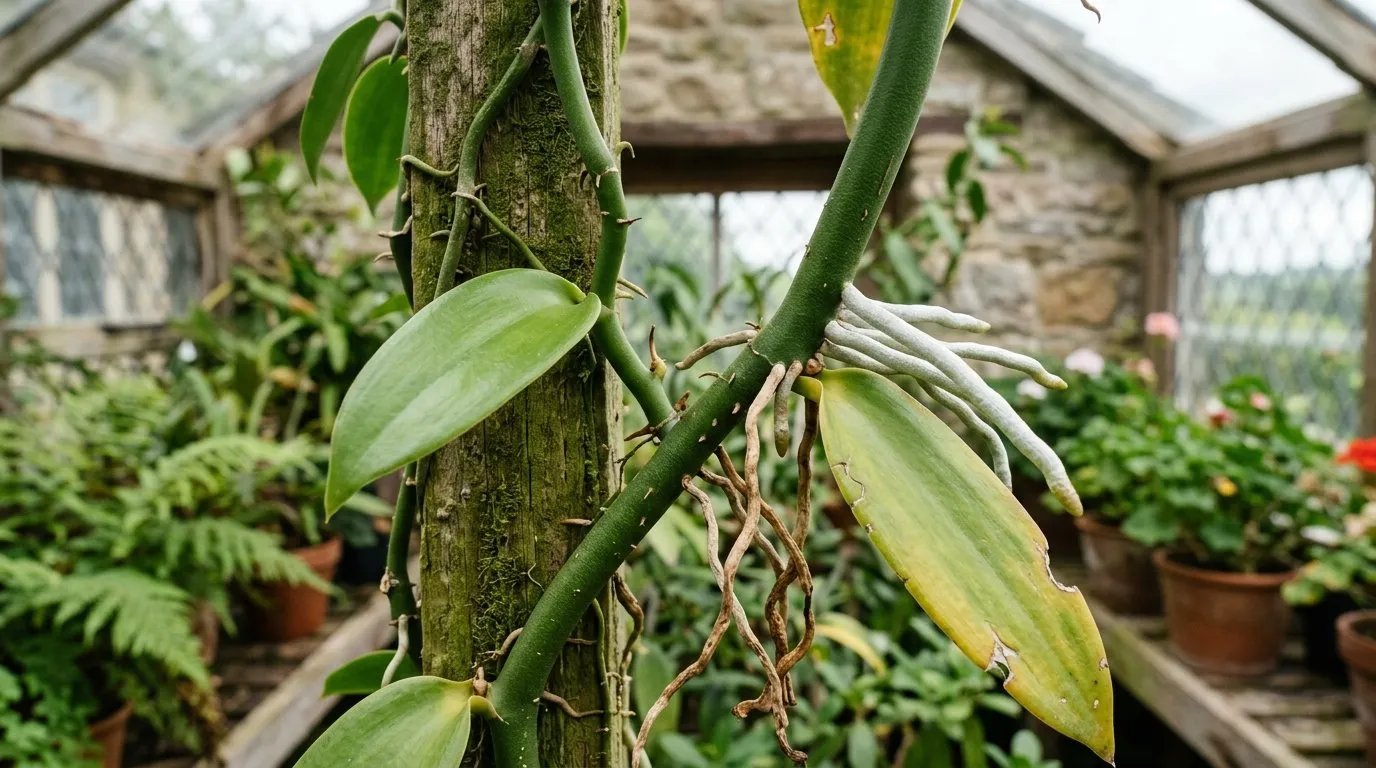 Thin, papery aerial roots signal air that is too dry. Vanilla wants 70-85% humidity to keep its climbing roots plump.
Cold damage over winter
Leaves turning soft, black or dropping in winter point to cold. Below 13C the plant suffers, and a night near 10C can kill it. Check your minimum temperature with a max-min thermometer and add heat if it dips. This is the commonest way UK growers lose a vanilla plant.
Pests under glass
Warm, humid growing suits red spider mite, mealybug and scale as well as it suits vanilla. Check the leaf undersides monthly. Red spider mite thrives in dry heat, so keeping humidity high both helps the vine and deters the mite. For a bad outbreak, the methods in our spider mite control guide apply directly to vanilla.
Get the warmth and humidity right, be honest about the timescale, and vanilla is one of the most rewarding crops you can grow under British glass. It is a plant that teaches patience, then repays it in a scent you grew yourself. For more on the orchid family it belongs to, the RHS orchid facts page is a good place to read on.
Our team produces practical UK gardening guidance from source research, contributor records and established horticultural practice. Editorial standards are overseen by Matt W.