Key takeaways
- Slender candelabra spires at 1.2-1.8m from July to September, opening from the base upwards
- Wants full sun and moisture-retentive soil; on that combination it stands without staking
- Fully hardy at RHS H7 (-20C), happy on clay, and rarely troubled by pests
- Slow to establish: little in year one, better in year two, the full display from year three
- A Piet Oudolf signature plant for prairie and naturalistic schemes among grasses
- Leave the near-black winter seedheads standing until February; bees work the spires all summer
What is veronicastrum and why is it worth growing?
Veronicastrum virginicum is a hardy herbaceous perennial from the damp prairies and open woodland edges of eastern North America, grown for its vertical flower spires and its near-total lack of maintenance. In the wild it stands among tall grasses on moist ground. That origin tells you almost everything about how to grow it.
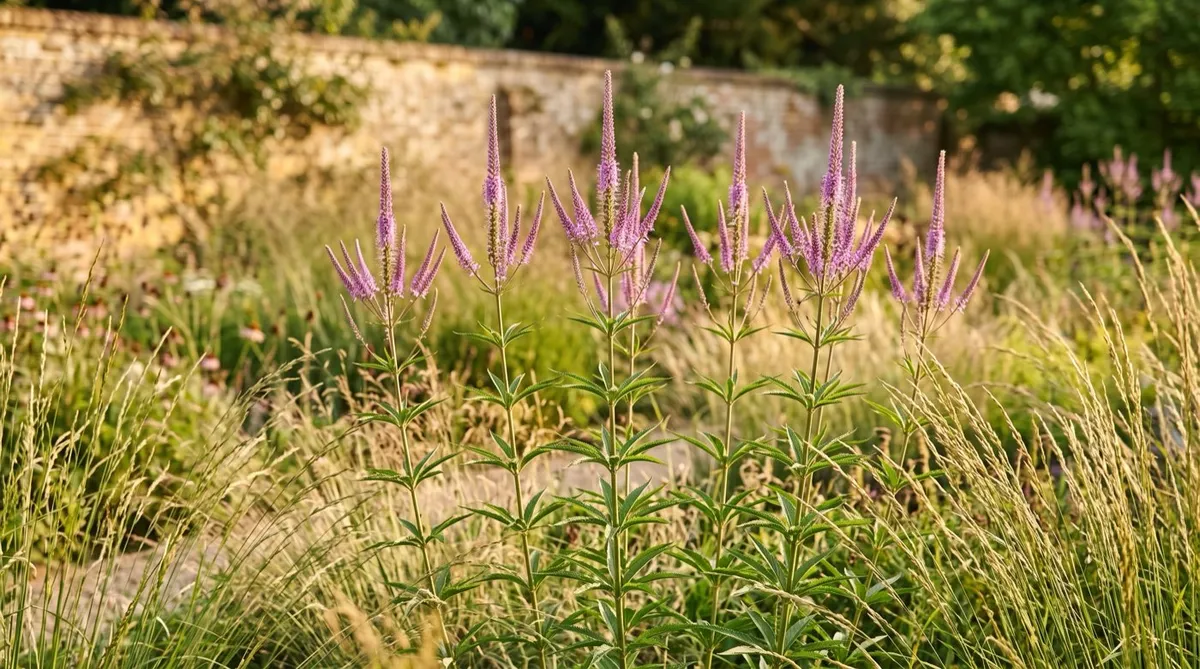
Two features make it instantly recognisable. First, the leaves: narrow, pointed, and held in neat whorls of three to seven around the stem, stacked in tiers all the way up like the floors of a pagoda. Even out of flower, the foliage looks deliberate and architectural. Second, the flowers: hundreds of tiny blooms packed into slender racemes 15-30cm long, the central spike surrounded by shorter side spikes to give that candelabra outline. They open from the base of the spike upwards, so each stem stays in colour for weeks.
Mature plants reach 1.2-1.8m depending on cultivar, and up to 2m on rich, moist soil, with a spread of 50-75cm. The RHS profile for Veronicastrum virginicum rates it H7, hardy below -20C, which means no UK winter will touch it. It grows on chalk, clay, loam or sand, acid or alkaline. Pests mostly ignore it. Rabbits and deer mostly ignore it. For a plant this elegant, the list of problems is remarkably short.
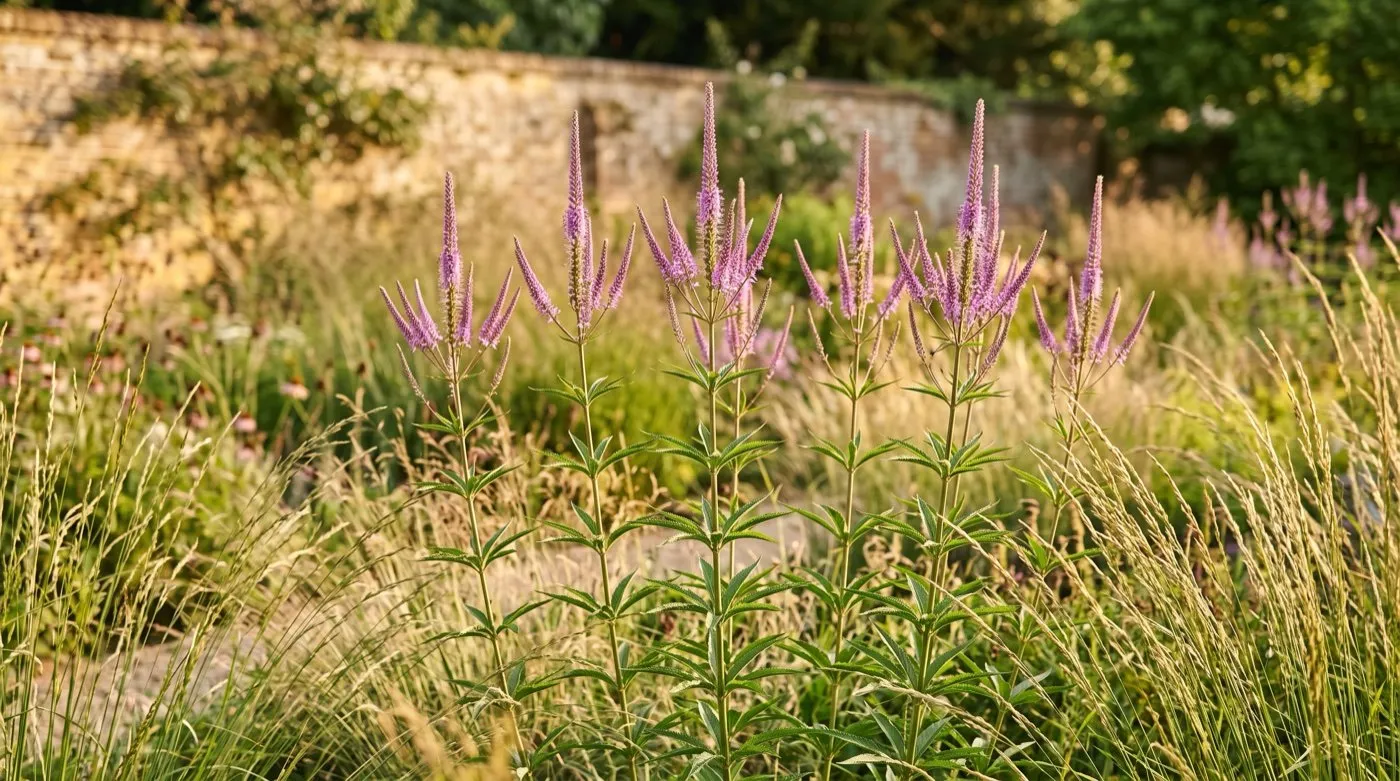 ‘Fascination’ at full height in late July. The candelabra branching and dead-straight stems are the whole point of the plant.
Which veronicastrum is best? Cultivars compared
Five cultivars cover almost every situation, and the differences between them are height and colour rather than temperament. All want the same conditions and all flower on the same July to September schedule.
‘Lavendelturm’ means lavender tower, which is exactly what you get. Pale lavender spires on a plant matching ‘Fascination’ for height at 1.5-1.8m, with a slightly softer, cooler colour. If you want a big drift in one quiet shade, this is the pick.
‘Album’ is the white, at 1.2-1.7m depending on soil, with dark green foliage that makes the pale spires glow at dusk. White veronicastrum against a dark hedge is one of the simplest good ideas in late-summer planting.
‘Erica’ is the shorter, pinker choice at around 1.2-1.35m. The buds are deep reddish-pink and open to two-tone pale pink spires. Piet Oudolf used it as one of the stars of the Oudolf Field at Hauser & Wirth in Somerset. For small gardens it is the most manageable of the five.
‘Adoration’ is Oudolf’s own selection: clear pink spires on reddish-brown stems to about 1.6m, multi-branched and notably self-supporting. If your site is a touch exposed and you are nervous about lean, ‘Adoration’ is the safest tall option.
Also worth a look: ‘Diane’, a clean white at around 1.3m, ‘Apollo’ in pale blue at 1.4m, and ‘Temptation’, lavender-blue at 1.4m with particularly good golden-brown seedheads. Our guide to the best plant combinations for UK borders shows how a restricted palette like this earns its keep.
Veronicastrum cultivar comparison
| Cultivar | Height | Flower colour | Notes |
|---|---|---|---|
| ’Fascination’ | 1.5-1.8m | Lilac-rose | Most widely sold; occasional fasciated stems |
| ’Lavendelturm’ | 1.5-1.8m | Pale lavender | Cool colour; best for big single-shade drifts |
| ’Album’ | 1.2-1.7m | White | Glows at dusk; superb against dark backgrounds |
| ’Erica’ | 1.2-1.35m | Two-tone pink, red buds | Shortest here; used in the Oudolf Field |
| ’Adoration’ | 1.6m | Clear pink, red-brown stems | Oudolf selection; the most self-supporting |
| ’Temptation’ | 1.4m | Lavender-blue | Notably good golden-brown seedheads |
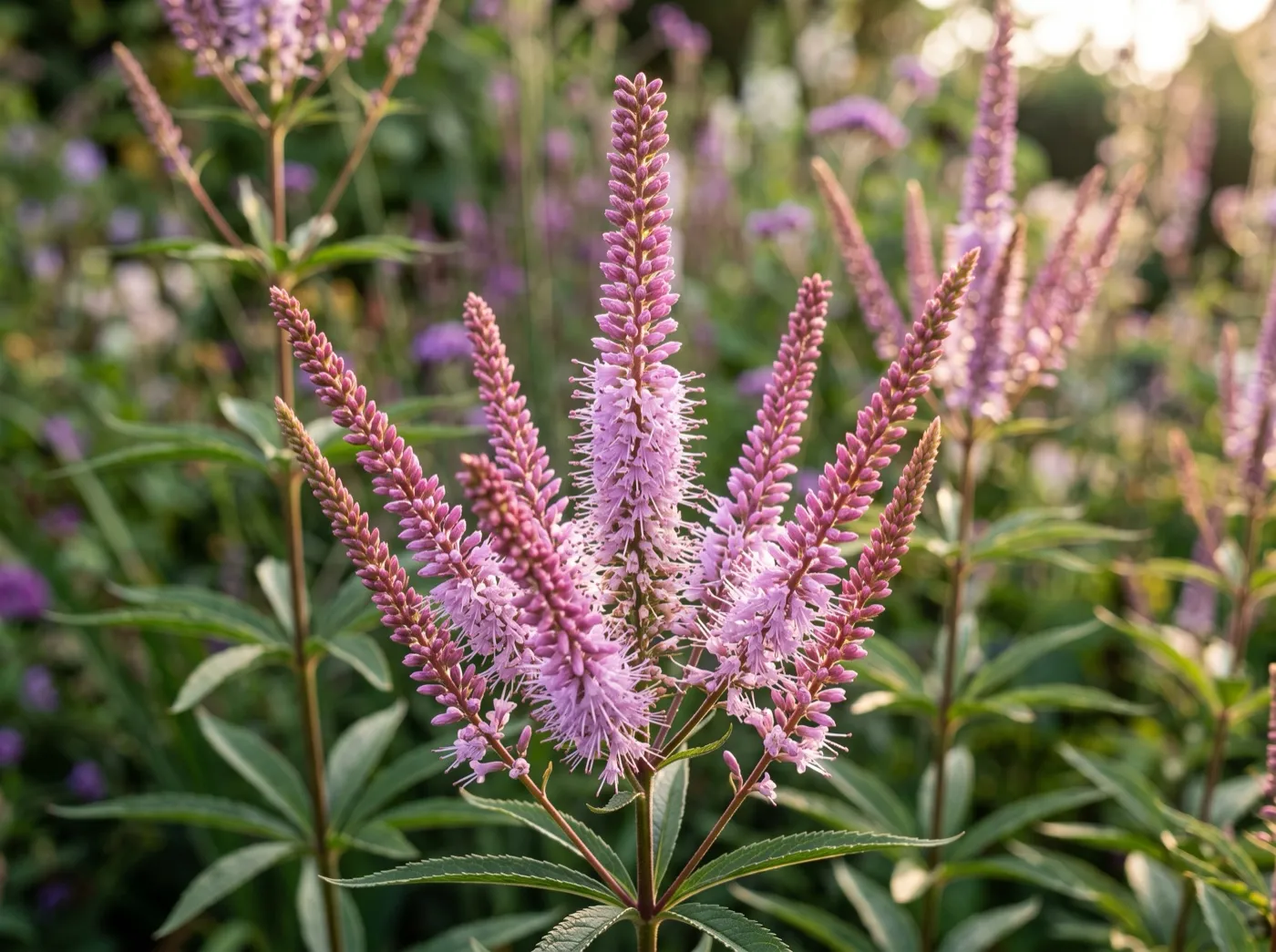 ‘Fascination’ in close-up. Each candelabra carries a central spike with angled side spikes, opening from the base up.
Where does veronicastrum grow best? Sun plus moisture
Veronicastrum grows best in full sun on fertile, moisture-retentive soil, and that pairing is not negotiable if you want self-supporting stems. Remember where it comes from: open prairie with damp ground and all-day light. Reproduce that and the plant does the rest.
Moisture controls size and health. This is not a drought plant. On soil that dries hard in summer, veronicastrum stalls, flowers briefly, and its lower leaves scorch or catch powdery mildew. It does not need a bog, and it dislikes standing winter water, but it wants ground that never fully bakes. Clay is genuinely good here, because clay holds summer moisture. If your ground is heavy and you want to make it better rather than fight it, our guide on how to improve clay soil covers the organic-matter routine that suits this plant perfectly.
On fast-draining sand or chalk, dig in generous compost before planting, mulch 5cm deep every spring, and expect to water in dry spells. The plant will still perform, just at the shorter end of its range.
Gardener’s tip: Do not feed veronicastrum to make it bigger. Nitrogen-rich feeding produces soft, sappy stems that lean exactly the way you were trying to avoid. An annual mulch of compost in late winter is all it needs. Height comes from moisture, sun and age, not from fertiliser, and stems grown slightly hard are the stems that stand through September gales.
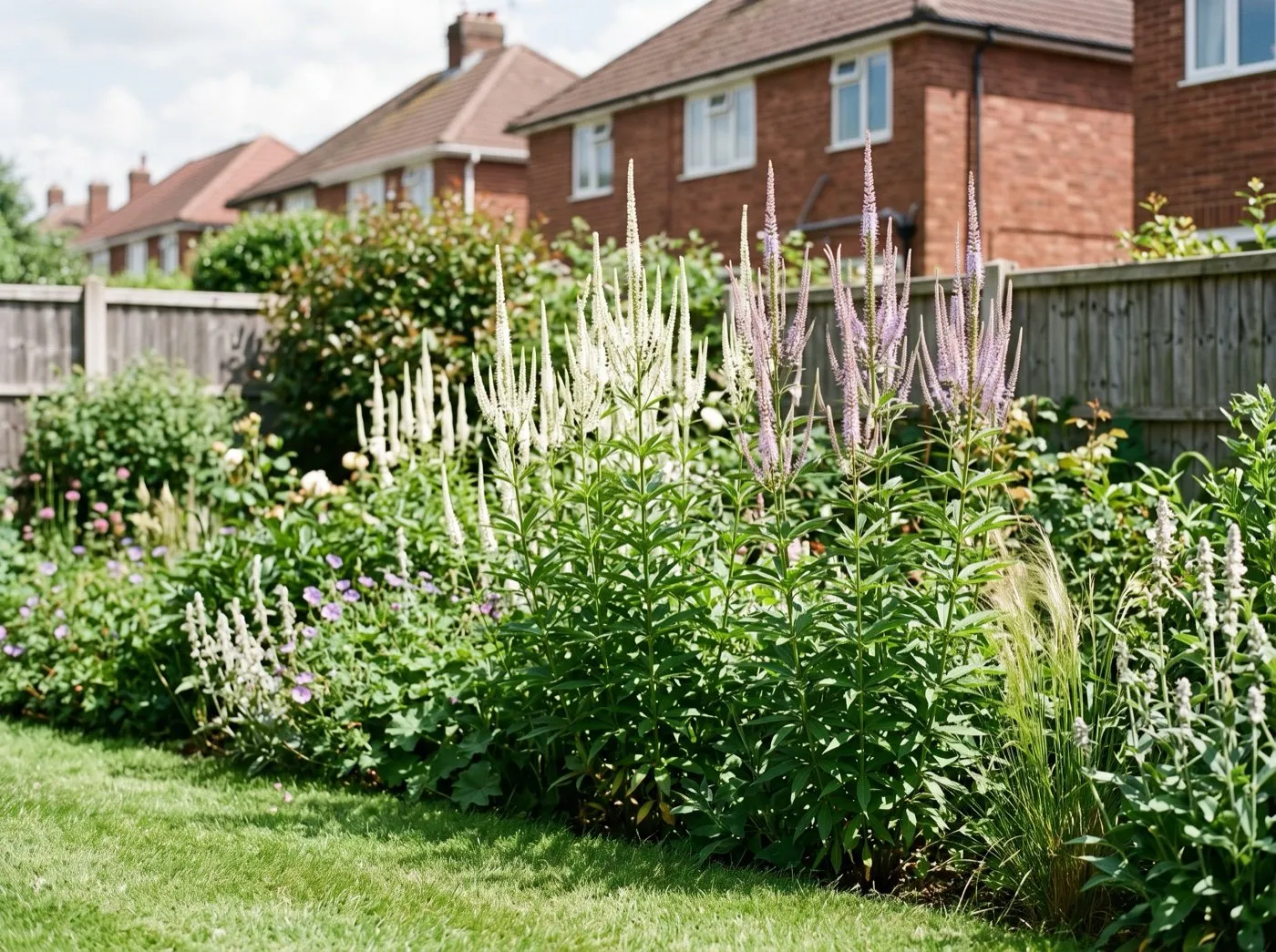 Full sun, decent soil, no stakes. In an ordinary suburban border veronicastrum reads as instant designer planting.
How and when to plant veronicastrum
Bare-root crowns are the cheap route and arrive from late autumn to early spring. They look like nothing, a knuckle of root with a few buds, and this is where the common name earns a mention: Culver’s root refers to the roots themselves, once sold as a medicinal purgative by an 18th-century American physician called Dr Culver. Pot bare roots up and grow them on for six to eight weeks before planting out, and they establish far more reliably than crowns dropped straight into a cold border.
Space plants 45-60cm apart. A single veronicastrum looks like a lost exclamation mark; a group of three, five or seven reads as a deliberate vertical drift. Dig in a bucket of garden compost per planting hole, set the crown at soil level, firm, water well, and mulch. Water through the first summer, roughly twice a week in dry spells, because a first-year plant with a small root system is the only veronicastrum that drought can actually kill.
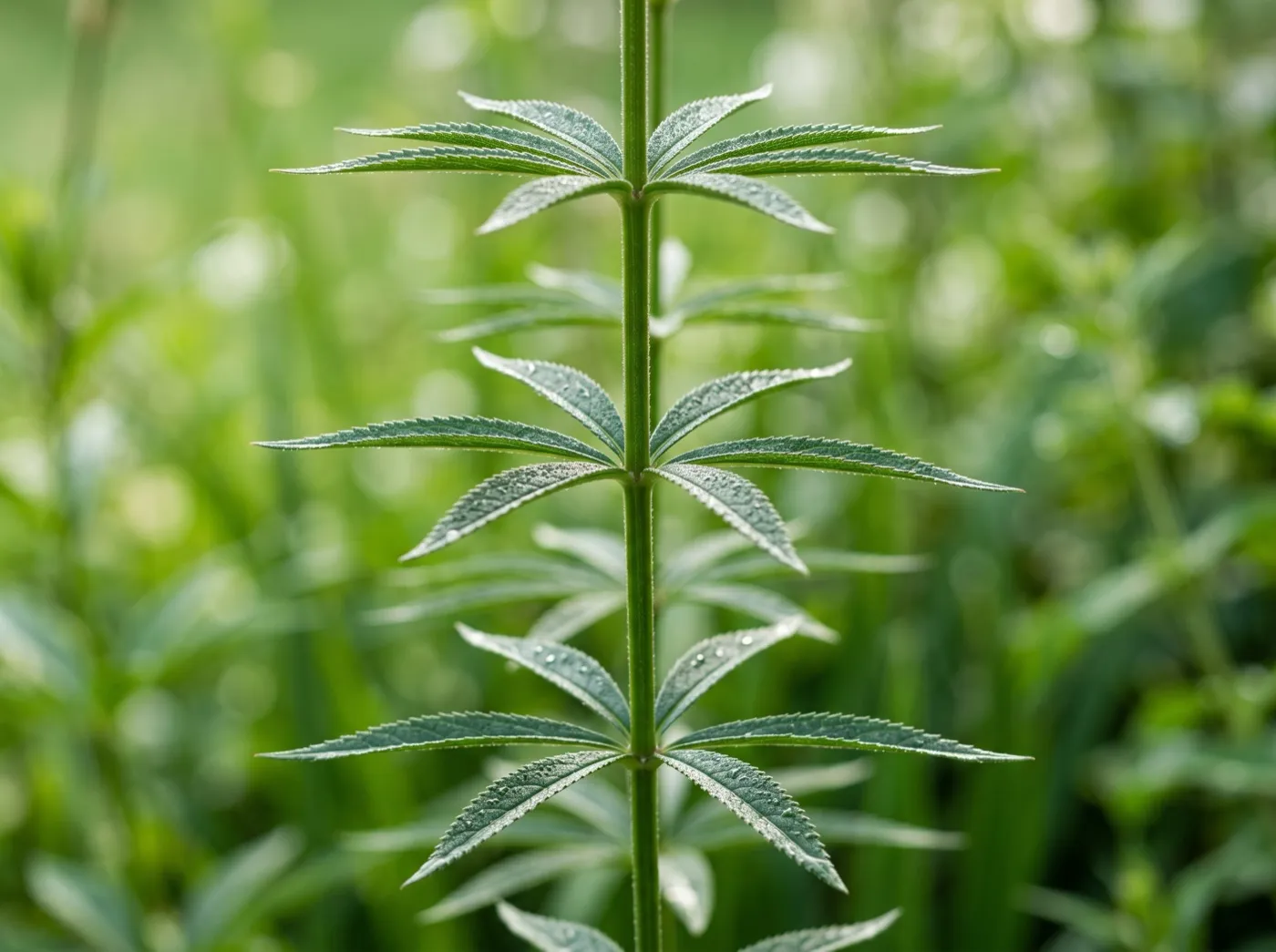 The whorled leaves, stacked in tiers of three to seven, make the plant handsome from May onwards, long before flowering.
Does veronicastrum need staking?
No, veronicastrum does not need staking when it grows in full sun on moisture-retentive soil. This is the plant’s best trick. Most perennials at 1.5-1.8m demand hoops, canes or brushwood by June. Veronicastrum grown right stands vertical through summer storms with nothing but its own stem strength, which is why designers lean on it so heavily for height.
When it does flop, one of three things has gone wrong. Shade has stretched it. Drought has checked it and weakened the stems. Or rich feeding and a wet season have made the growth soft and lush. The RHS notes that plants may need support in wet years or on exposed sites, and that is fair, but treat staking as the exception rather than the plan. Fix the position and the problem disappears the following year.
If you garden somewhere genuinely windy and still want the 1.8m cultivars, put grow-through supports in place in April so the foliage hides them by June, or ring the clump with twiggy hazel. Our guide to staking tall perennials covers both methods. Better still, choose ‘Adoration’, which was selected partly for its self-supporting habit, and let the plant solve it for you.
Veronicastrum takes three years to reach its full display, and knowing that in advance is the difference between keeping it and binning it. The RHS gives it two to five years to maturity. American prairie growers have a phrase for this establishment curve: sleep, creep, leap. Year one it sleeps, building roots. Year two it creeps, with more stems at modest height. Year three it leaps.
The payoff for that patience is longevity. Veronicastrum clumps expand slowly outwards without going bare in the middle, so they sit happily for ten years or more with no lifting, no splitting and no rejuvenation. Plant it once, properly, and it outlasts almost everything around it.
Veronicastrum month-by-month calendar
| Month | Task |
|---|---|
| January | Leave seedheads standing; enjoy them frosted; no other action |
| February | Cut all stems to ground level before new shoots emerge |
| March | Mulch 5cm deep with compost; plant potted-up bare roots late month |
| April | Main spring planting month; set grow-through supports only on exposed sites |
| May | Whorled foliage builds; water young plants in dry spells |
| June | Stems reach full height; check first-year plants weekly for water |
| July | Flowering begins, spikes opening from the base; bees arrive in numbers |
| August | Peak display; take side-shoot cuttings if you want more plants |
| September | Last flowers fade at the spike tips; do not deadhead the final flush |
| October | Seedheads darken to bronze-black; leave everything standing |
| November | Autumn planting on light soils; divide only if you must |
| December | No action; the black spires carry the border through midwinter |
How do designers use veronicastrum? Prairie and naturalistic planting
The design logic is simple. Prairie-style planting is built from contrasting flower shapes repeated in drifts: daisies, umbels, buttons, veils and spires. Veronicastrum is the best spire in the catalogue because it is genuinely vertical, holds its line from June to February, and never needs the staking that makes other tall verticals a maintenance job. Oudolf famously values a plant’s skeleton as much as its flower, and veronicastrum has one of the great skeletons.
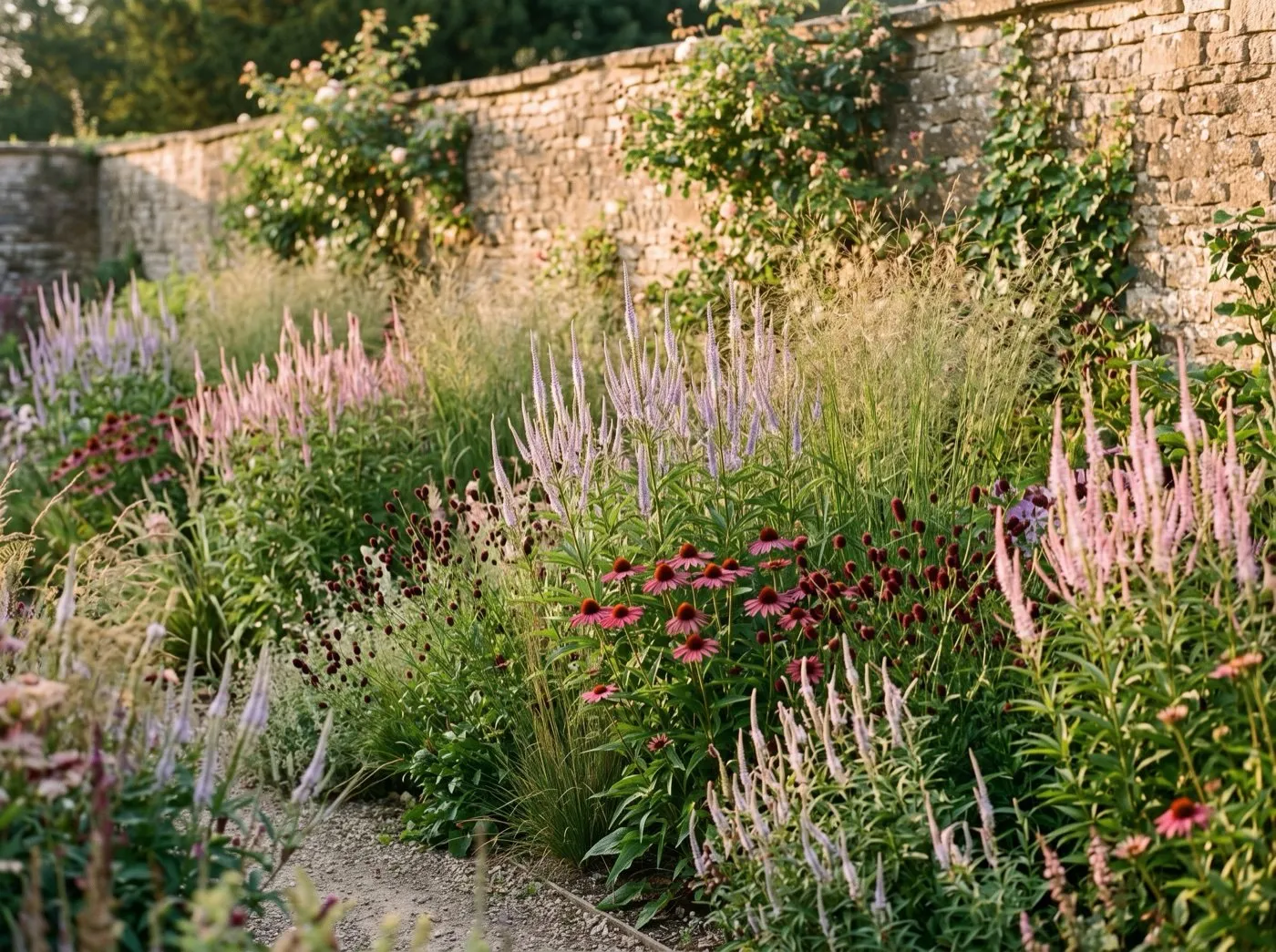 Spires against grasses, the core prairie contrast. Repeated drifts of veronicastrum give a scheme its vertical rhythm.
Is veronicastrum good for bees and pollinators?
Watch a clump on a warm afternoon and you will see bumblebees spiralling up the spikes in a queue, plus honeybees, hoverflies, solitary bees and the occasional butterfly. That July-August window matters because it bridges the gap between the early summer flush and the ivy-and-aster season, exactly the sort of continuity the Bumblebee Conservation Trust urges gardeners to plan for. If you are building a late-season nectar succession, our guide to autumn flowering plants for bees picks up where veronicastrum leaves off.
There is a tidy bonus at the other end of the year too. Hollow standing stems and intact seedheads shelter overwintering insects, so the no-cutting-until-February rule below does double duty as habitat.
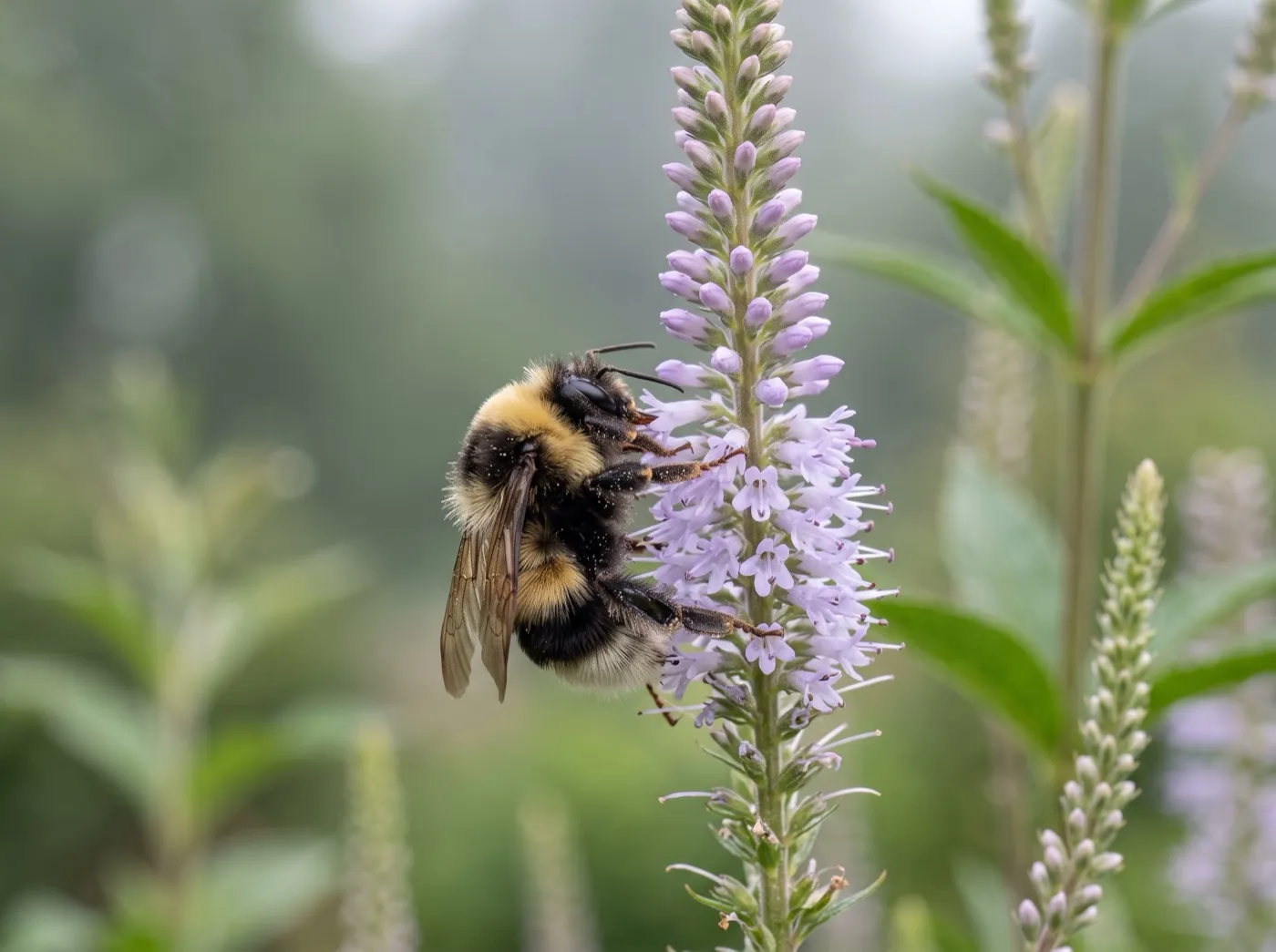 Bumblebees work the spikes from the base upwards. One mature clump feeds pollinators for eight to ten weeks.
How to propagate veronicastrum: division and root cuttings
Divide veronicastrum in spring, take root cuttings in winter, or take side-shoot cuttings in summer; the species also comes easily from seed. The good news is that you will rarely be forced into any of it, because clumps do not deteriorate with age. Propagation here is about wanting more plants, not rescuing old ones.
Division is the RHS-listed method and the most reliable. Do it in early spring, March, just as shoots emerge, and only on clumps at least three years old. The rootstock is dense and woody, so lift the whole crown and cut it into fist-sized sections with an old bread knife or sharp spade, each with several buds. Replant immediately at the same depth and water in. Expect divided plants to sulk for a season; they restart the year one, two, three clock at about year two.
Root cuttings work in late autumn and winter, while the plant is dormant. Lift a clump edge, cut pencil-thick roots into 5-8cm lengths, and lay them horizontally on gritty compost, covered with 1cm more. Kept in a cold frame, they shoot in spring. It feels like a conjuring trick the first time, and it produces plants identical to the parent.
Side-shoot cuttings in early summer suit gardeners who do not want to disturb the clump at all: take 8-10cm non-flowering shoots, root them in a covered propagator, and plant out the following spring. For the full technique on all three methods, see our guide to plant propagation by cuttings, division and layering. Named cultivars must be propagated vegetatively; seed from them will not come true.
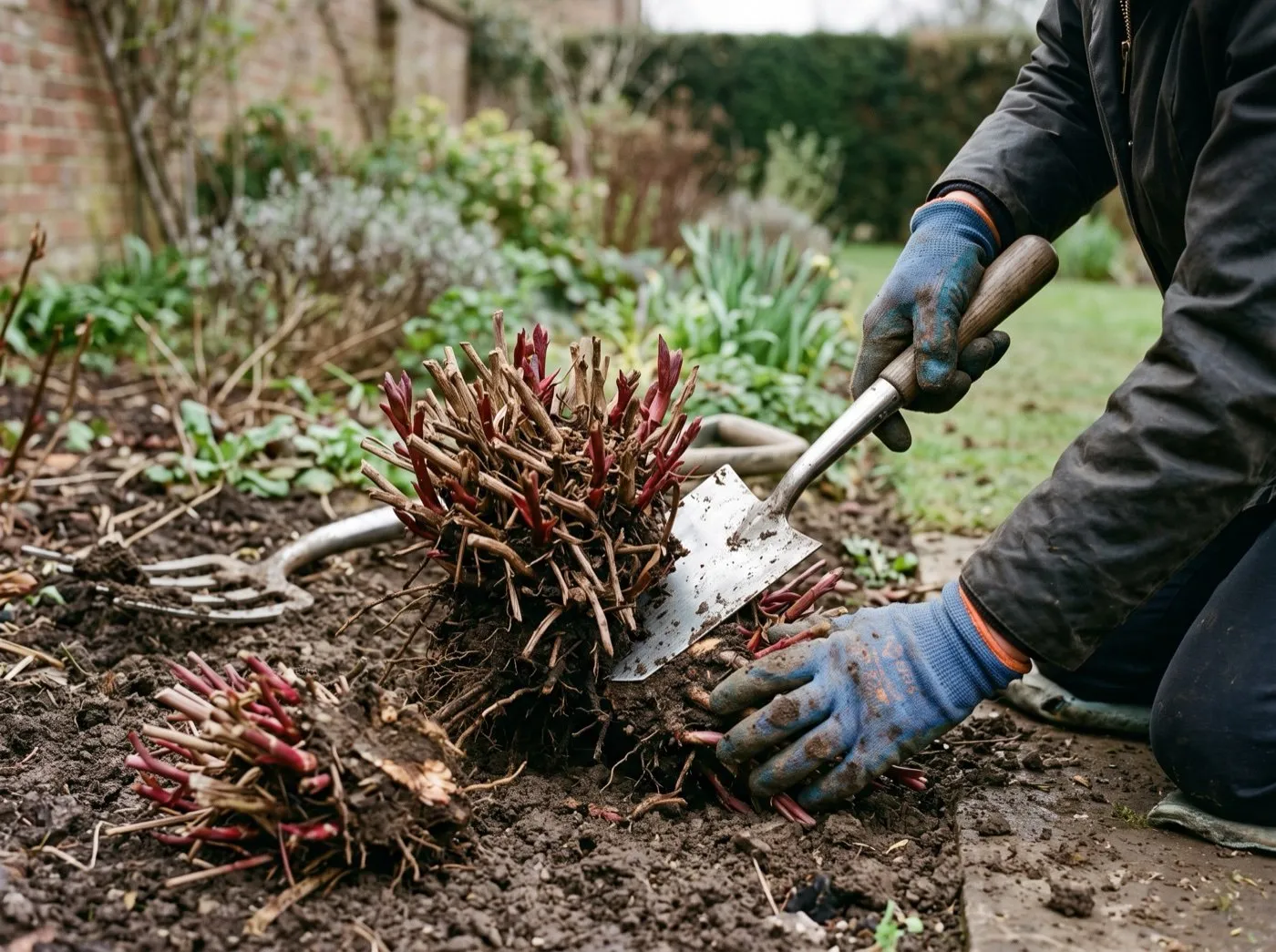 Spring division of a mature crown. Fist-sized sections with several buds each restart in one to two seasons.
When to cut back veronicastrum, and why the winter seedheads earn their keep
Cut veronicastrum to the ground in late winter, around February, and not a day before. This is the plant the leave-it-standing rule was written for. After flowering, the spires set seed and darken through bronze to near-black, and the stems stay rigid. Where most perennials collapse into mush by November, veronicastrum stands at full height through rain, snow and gale.
When February comes, cut every stem to ground level before the new shoots emerge, compost the lot, and mulch. That is the entire annual maintenance routine: one cut, one mulch, done in twenty minutes per clump per year.
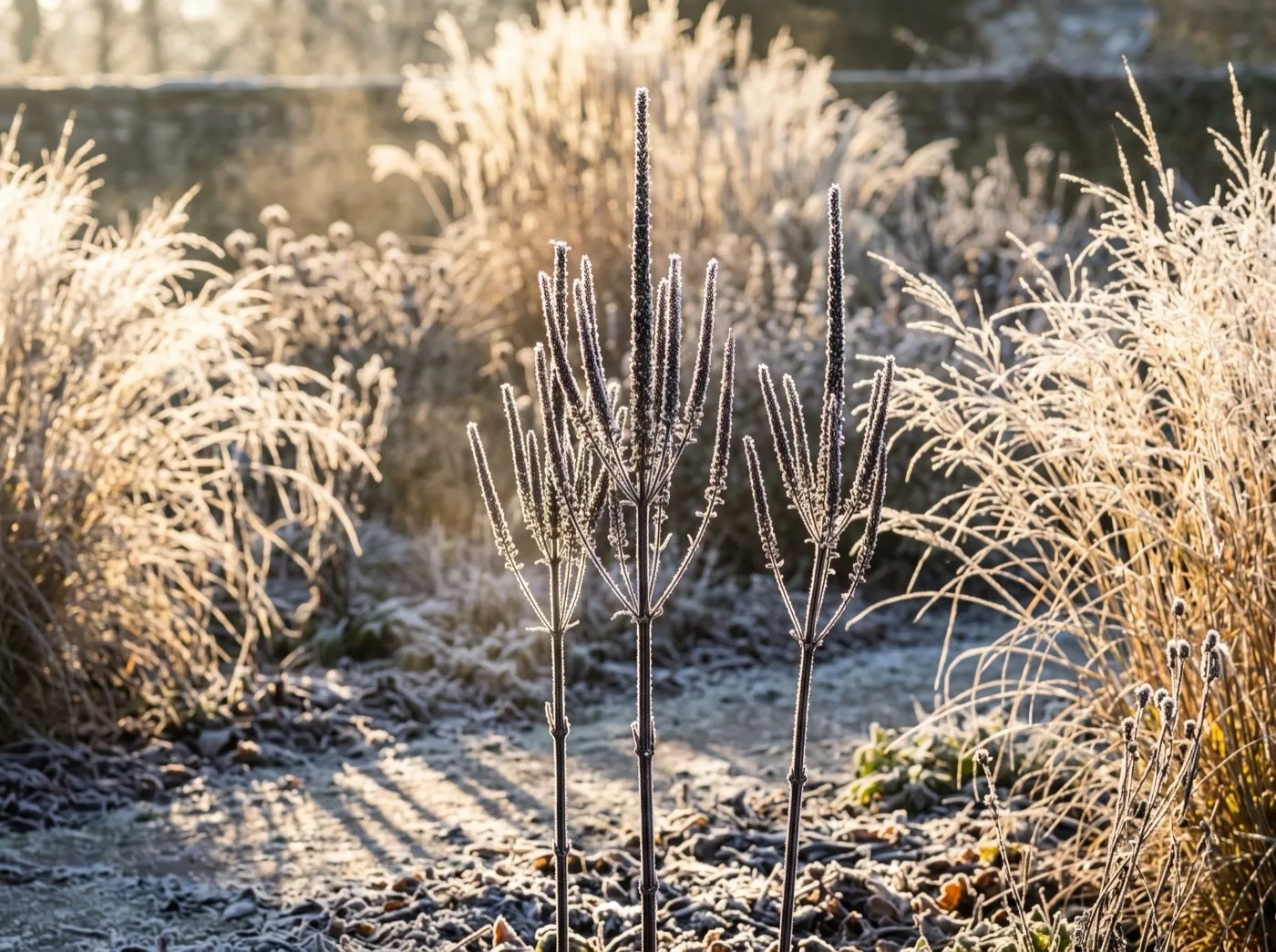 The winter skeleton. Seedheads darken to near-black and the stems stand rigid until you cut them in February.
Common mistakes when growing veronicastrum
Veronicastrum fails for a short list of predictable reasons. Every one of them is avoidable.
Giving up in year two
The commonest mistake by far. A plant showing three thin stems in its first summer is not failing; it is rooting. Judge veronicastrum in its third year, not its first. Composting a healthy plant in year two throws away the investment just before it pays out.
Planting it dry
A hot, free-draining gravel bed is the wrong home. Dry soil gives you a short, stalled plant with scorched lower leaves and powdery mildew. If your garden is genuinely dry and you cannot water, choose something else and let veronicastrum go.
Planting it in shade and blaming the plant
Lean is a position problem. In light shade the stems stretch and tip over, then get trussed to canes, and the plant looks miserable. Move it into full sun in early spring and the same plant stands upright the following summer.
Cutting back in autumn
Planting singles
One spire in a mixed border disappears. This is a drift plant. Three is the minimum, five is better, and a repeated group every couple of metres is how the designers use it.
Frequently asked questions
Is veronicastrum the same as veronica?
No, though they are close relatives and the flowers look similar. Veronicastrum is the taller plant, 1.2-1.8m, with leaves held in whorls around the stem and slender branched spires. Veronica, the speedwells, are mostly shorter with paired leaves. Veronicastrum virginicum, Culver’s root, is the species grown in UK gardens, and it was once classified within Veronica.
Does veronicastrum need staking?
Not when it grows in full sun on moisture-retentive soil. The stems are stiff and self-supporting even at 1.8m. It flops in shade, on dry soil that checks growth, or where heavy feeding makes it soft. If your plant leans, the honest fix is a sunnier, moister position, not a cane.
Why is my veronicastrum small or not flowering?
Almost always because it is still establishing. Veronicastrum is slow: expect a handful of short spires in year one, a better show in year two, and the full display from year three. Dry soil also stalls it. Water in dry spells, mulch every spring, and give it time.
Is veronicastrum invasive?
No. The clump expands slowly outwards and stays where you put it, with no running roots and little self-seeding in UK gardens. Clumps can sit untouched for ten years or more before they need dividing, which makes it one of the least demanding tall perennials you can plant.
When should I cut back veronicastrum?
In late winter, around February, before new shoots emerge. The stems and dark seedheads stay rigid through autumn and winter and rank among the best structural skeletons in the garden, especially under frost. Cutting back in autumn wastes that display and removes cover for overwintering insects.
Will veronicastrum grow in clay soil?
Yes, clay suits it well because it holds the summer moisture the plant needs. The RHS lists clay among its suitable soils. Avoid true winter waterlogging, and work organic matter into the heaviest ground. Veronicastrum on decent clay outperforms the same plant on light sand.
Is veronicastrum good for bees?
Yes, it is one of the best mid to late summer bee plants. Each spire carries hundreds of tiny nectar-rich flowers that open from the base upwards over several weeks. Bumblebees, honeybees and hoverflies work the spikes constantly through July and August, bridging the gap before autumn flowers arrive.
Our team produces practical UK gardening guidance from source research, contributor records and established horticultural practice. Editorial standards are overseen by Matt W.