Key takeaways
- Wild carrot is a UK native biennial; 'Dara' and 'Purple Kisses' are plum-pink selections grown as hardy annuals for cutting
- The white umbels carry a single dark central floret and curl into a concave bird's-nest seedhead
- Sow direct where it is to flower: the long taproot resents transplanting from modules
- It thrives on poor, free-draining, chalky soil and full sun, mirroring its wild grassland home
- A magnet for hoverflies and solitary bees, and a genuine UK native for wildlife planting
- SAFETY: learn to separate it from poison hemlock and hemlock water-dropwort before handling or cutting
What is wild carrot and is it the same as Queen Anne’s lace?
Wild carrot and Queen Anne’s lace are the same plant, Daucus carota, a native biennial of the carrot family. It is the wild ancestor of the vegetable in your kitchen, though the root is thin, white and woody rather than the fat orange thing we eat. In the garden it is grown for its flowers, not its root.
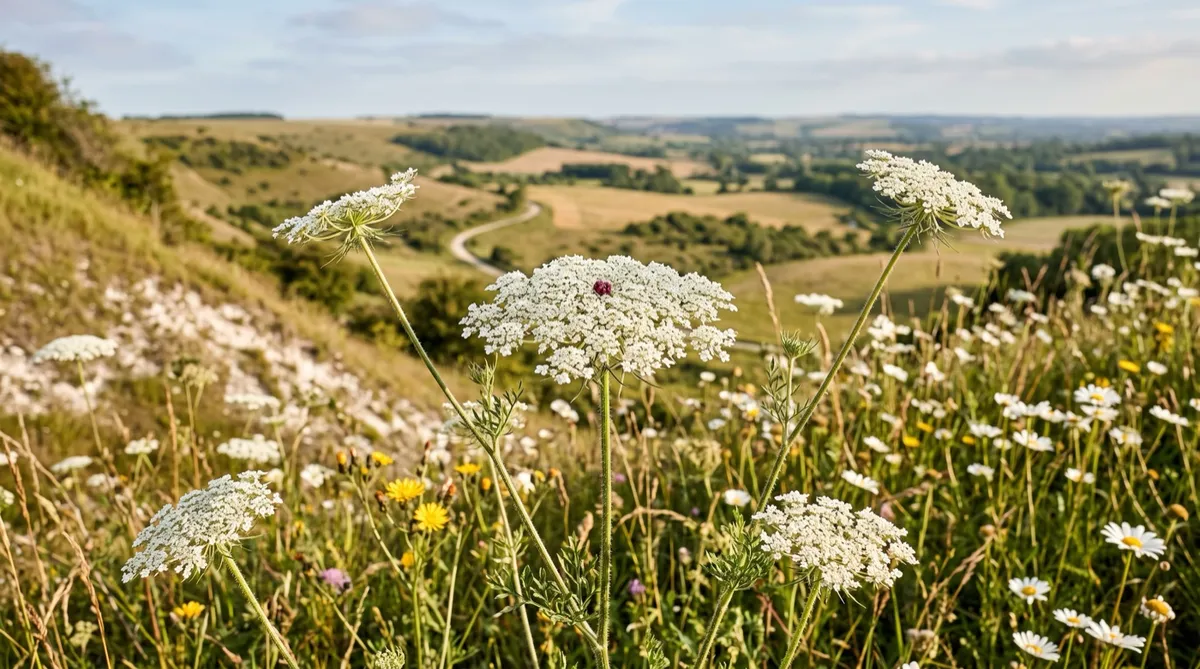
The flowerhead is the giveaway. It is a compound umbel, a broad flat plate 5-10cm across made of dozens of tiny white flowers held on spokes, like an upturned umbrella. At the very centre sits a single dark red or purple floret. Folklore says it is a drop of Queen Anne’s blood, pricked while she made lace. Botanists think it may help draw in pollinating insects. Either way, it is the feature that separates true wild carrot from every other white umbellifer at a glance.
Below the flowerhead sit three forked, feathery bracts, a ruff of green under the white plate. The stems are solid, ridged and covered in fine hairs. The leaves are soft and much divided, feathery like carrot tops, and smell of carrot when crushed. In its first year the plant makes a low rosette of leaves; in its second it throws up a branching flower stem to about a metre. After flowering the umbel curls inward as the seeds ripen, closing into a cupped, concave bird’s-nest seedhead. That structure alone is worth growing it for.
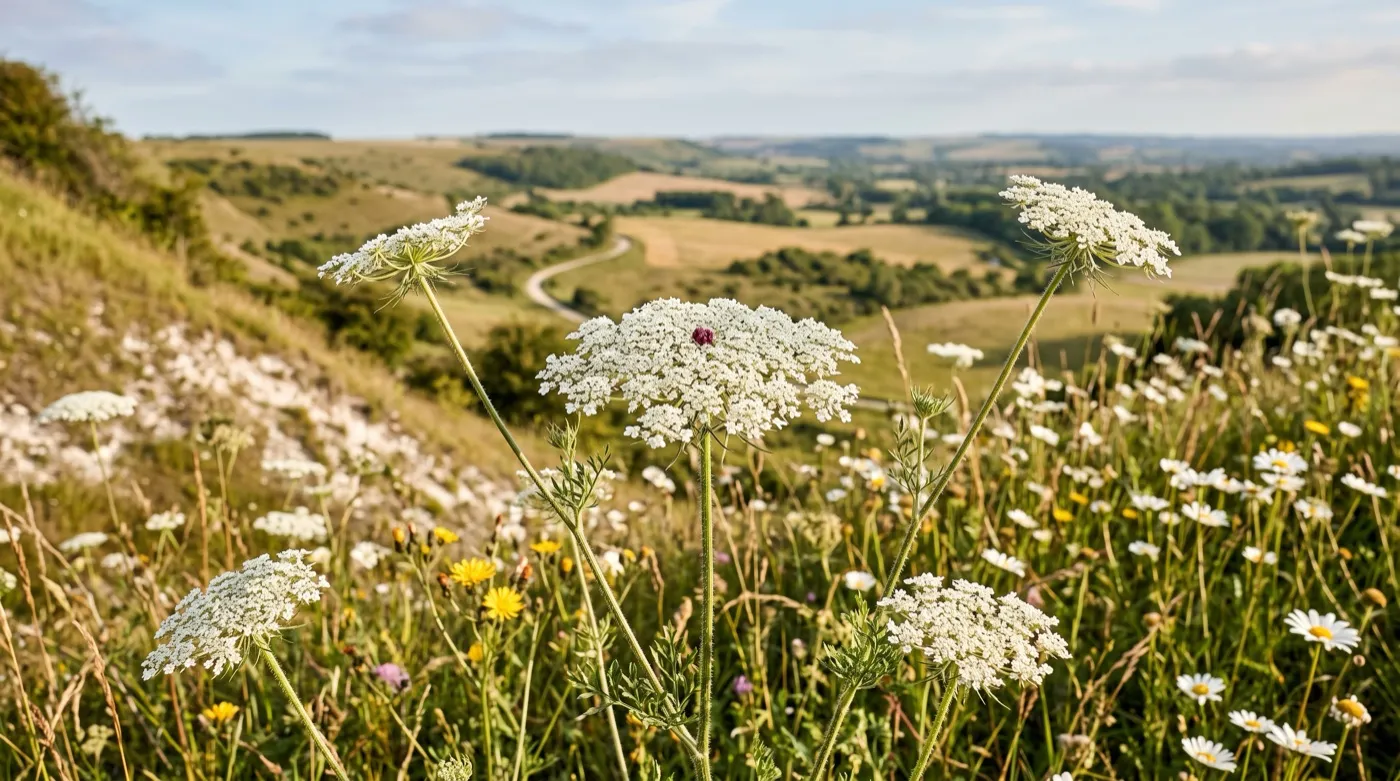 The classic wild carrot umbel: a flat plate of tiny white flowers with one dark floret at its heart, on a chalk meadow bank.
Where wild carrot grows in the UK
Wild carrot is a plant of open, sunny, poor grassland. In the wild it grows on chalk downland, limestone grassland, coastal cliffs and dunes, road verges and any thin, free-draining soil that bakes in summer. It is common across England and Wales, less so in Scotland, and it flowers from June to September. The Wildlife Trusts note it favours grasslands on chalk soils and coastlines, which tells you exactly what it wants in a garden (Wildlife Trusts: wild carrot).
The lesson for growers is counter-intuitive. This is not a plant to feed and pamper. Rich, moist soil gives you a tall, soft, floppy plant that falls over and produces fewer, coarser flowers. Poor, dry, free-draining ground gives you a sturdier, better-branched plant with more of those clean lacy heads. If you garden on chalk or sand you have the perfect site already. On heavier soil, grit it up and do not feed it.
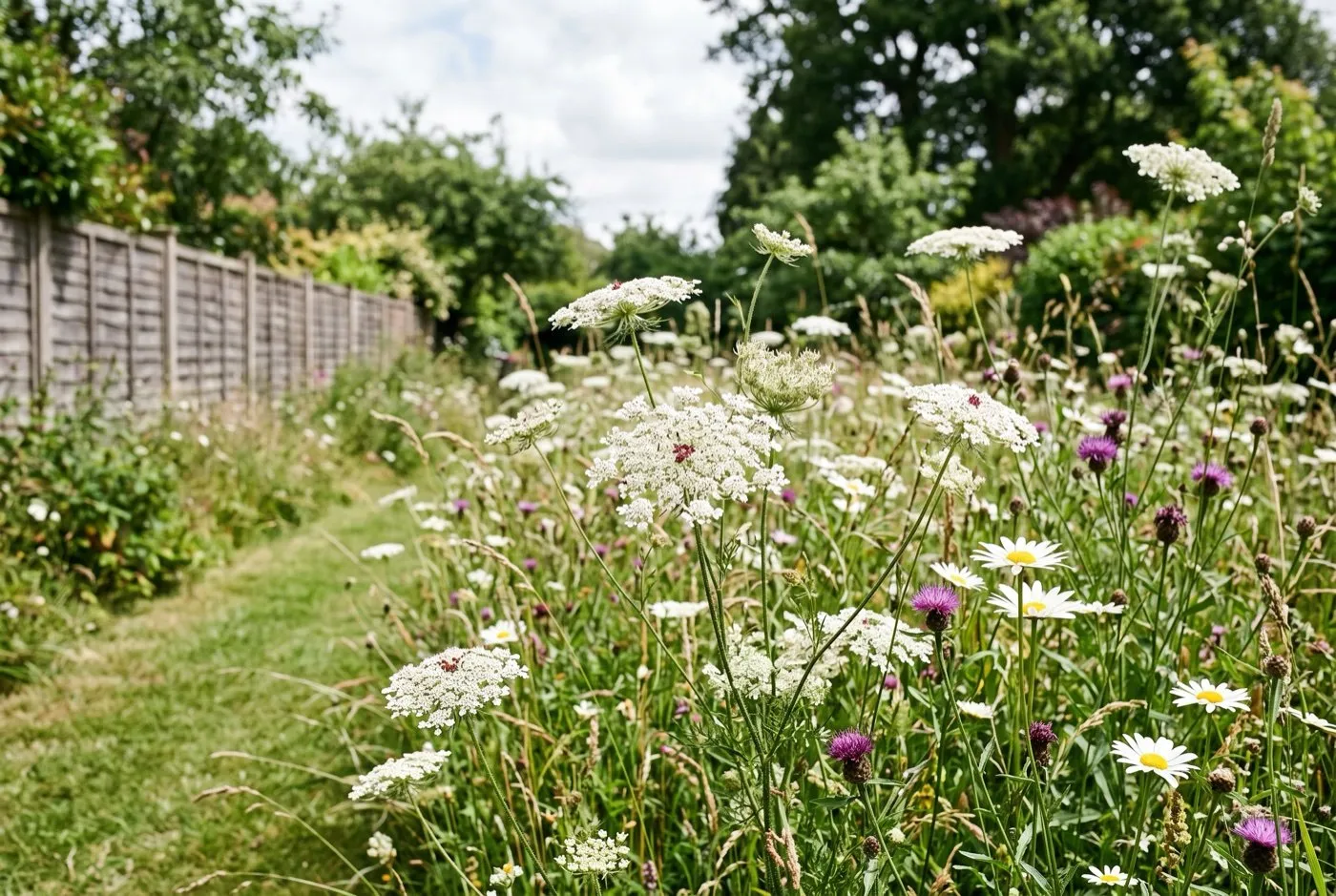 Wild carrot floating through a suburban mini-meadow with grasses and ox-eye daisies. Its grassland roots make it a natural for native planting.
Wild carrot, ‘Dara’ and ‘Purple Kisses’: which to grow
The choice comes down to what you want the plant for. If you are planting for wildlife and want the true native, grow the straight species. If you want cut flowers with warmth and colour, grow the named selections. They are the same species, bred for a wider palette.
The native (Daucus carota) is pure white with the single dark eye. It is the one for meadows, wild patches and native planting. Buy seed sold as UK-native provenance if wildlife value matters to you. It behaves as a true biennial: leaves the first year, flowers the second.
‘Dara’ is the cut-flower star. It carries the same lacy umbel form but in a range of warm tones on one plant: dusty pink, smoky rose, deep burgundy and near-chocolate mahogany, often all showing across a single patch. It reaches 80-100cm and is grown as a hardy annual for flowers in its first summer. This is the variety driving the native cut-flower trend and it is central to the loose, romantic wedding floristry style.
‘Purple Kisses’ is similar in spirit, a selection with dark plum and pink umbels, often opening darker and fading paler. Seed suppliers list it at 80-120cm, sown March to May, or in autumn to overwinter for taller earlier plants the next year. It self-seeds true enough to keep going if you let a few heads ripen. The RHS lists both the species and its selections with full growing detail and their annual-or-biennial habit (RHS: Daucus carota).
Wild carrot and its lookalikes at a glance
The table below sets the native and its garden forms beside Ammi majus, a common cut-flower stand-in, and against poison hemlock, the dangerous lookalike. Read the hemlock column as a safety check, not a growing option.
| Feature | Wild carrot (native) | ‘Dara’ / ‘Purple Kisses’ | Ammi majus | Poison hemlock (DO NOT TOUCH) |
|---|---|---|---|---|
| Type | UK native biennial | Selection, grown as annual | Non-native hardy annual | Toxic biennial weed |
| Height | 60-100cm | 80-120cm | 90-120cm | 150-250cm |
| Umbel colour | White, one dark central floret | Plum, pink, burgundy | Pure white, domed | Dull white |
| Stem | Solid, ridged, hairy, all green | Solid, hairy, green | Solid, ribbed, green | Smooth, hairless, purple-blotched |
| Bracts | Three forked feathery bracts | Feathery bracts | Finely divided bracts | No conspicuous lower bracts |
| Smell when crushed | Carrot | Carrot | Mild | Foul, mousy |
| Seedhead | Concave bird’s-nest | Bird’s-nest | Stays flatter | Open, splayed |
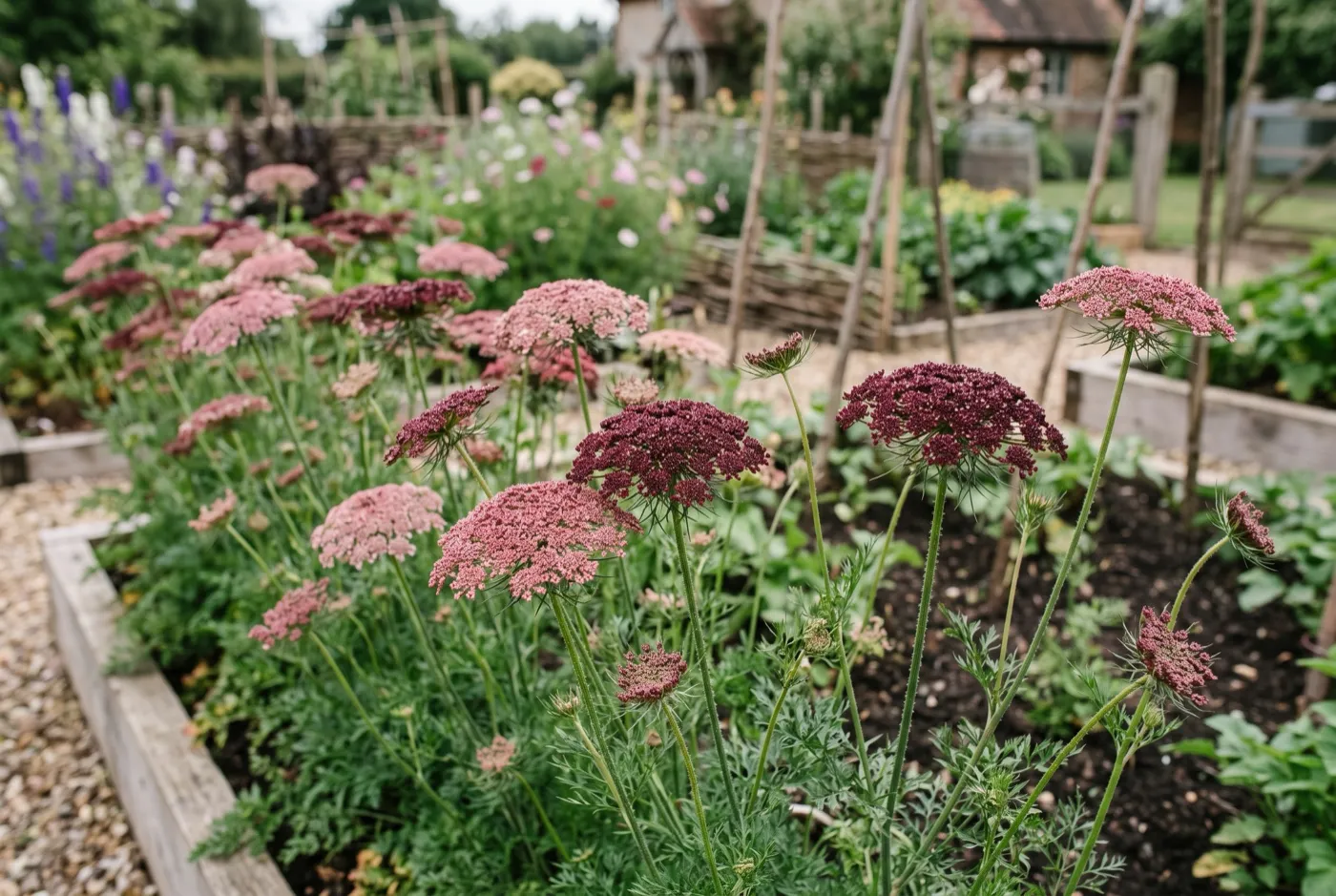 ‘Dara’ brings the lace-umbel form into plum, rose and smoky burgundy, often with several tones across one planting.
When and how to sow wild carrot
Sow wild carrot direct, straight into the ground where it is to flower, because the taproot hates being moved. There are two windows, and they give different results.
Spring sowing (March to May) is the standard route for ‘Dara’ and ‘Purple Kisses’ grown as annuals. Sow once the soil has warmed a little and you get flowers from July into October the same year. Rake the surface to a fine tilth, sow thinly in shallow drills or scattered patches, and cover with about 5mm of soil. The seed does not need light to germinate but it does need contact with moist soil. Germination takes roughly 14-21 days. Thin the seedlings so plants stand 20-30cm apart; crowded plants stay thin and weak.
Autumn sowing (September to October) suits the native and gives bigger, earlier plants. The seedlings sit as small rosettes over winter, get a natural cold spell, then race away in spring to flower earlier and taller the following summer. This mimics the plant’s true biennial cycle. On cold or wet ground, sow under a cloche or in an unheated cold frame in deep cells and plant out while tiny.
Whichever window you choose, the golden rule holds: the long taproot dislikes disturbance. This is the same reason we sow poppies, cornflowers and other taprooted flowers direct. Our guide to sowing hardy annuals direct covers the drill-and-thin method that suits wild carrot exactly.
If you have no choice but to start under cover, the fix is deep root-trainers or long cells, sowing one or two seeds per cell, and planting out very young, before the taproot reaches the bottom and turns. But given a patch of open soil, sow direct and thin. It is less work and gives better plants.
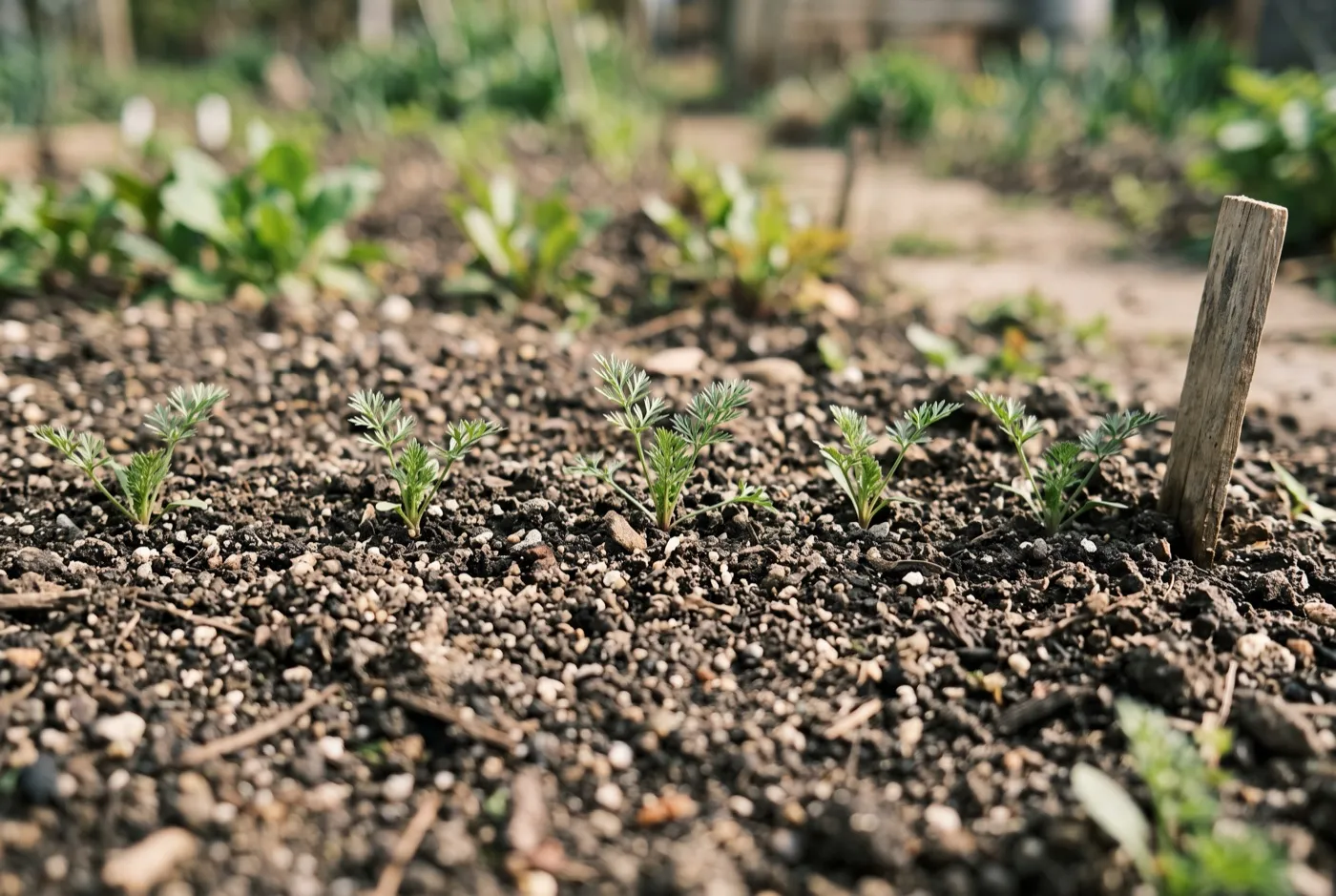 Direct-sown ‘Dara’ seedlings thinned to 20-30cm. Sowing where they stand avoids the taproot kink that stunts module-raised plants.
Soil, position and caring for wild carrot
Give wild carrot full sun and free-draining soil and it needs almost nothing else. It is drought-tolerant once its taproot goes down, and it copes with poor, thin and chalky ground that defeats fussier flowers. On heavy clay it struggles, so dig in grit to open the soil, or grow it on a raised, gritty bed.
Watering is only for establishment. Water the seedlings in dry spells until they have a few true leaves and a root running down. After that, leave the plants to fend for themselves except in a long drought. Overwatering does more harm than good, giving soft growth that flops.
Feeding is the mistake to avoid. Do not feed wild carrot at all on any decent soil. It evolved on hungry grassland and rich ground ruins it. Skip the fertiliser, skip the mulch of rich compost, and let it grow lean.
Support is worth a thought for the tall selections in an exposed spot. ‘Purple Kisses’ at 120cm can lean after rain. Rather than staking each plant, sow them close enough to lean on one another, or run a single layer of pea-netting horizontally for the stems to grow up through. In a border, let them thread between sturdier neighbours. For cutting rows, pinching out the growing tip when plants are 20-25cm tall makes them branch lower and produce more, longer stems; the technique is the same one covered in our guide to pinching out cut flowers.
Wild carrot month-by-month calendar
| Month | Task |
|---|---|
| January | Order seed; the native and ‘Dara’ both sell out early in the cut-flower catalogues |
| February | Prepare the ground; firm and rake a lean, stone-free seedbed, no added feed |
| March | Begin spring sowing under a cloche in mild areas; chit nothing, sow direct |
| April | Main direct-sowing month for ‘Dara’ and ‘Purple Kisses’ as hardy annuals |
| May | Continue sowing; thin earlier seedlings to 20-30cm apart |
| June | Pinch out tips at 20-25cm for more cutting stems; first native flowers open |
| July | Peak flowering begins; start cutting for the vase as umbels open fully |
| August | Cut regularly to keep plants producing; watch for self-seeding heads |
| September | Native flowering fades; leave some heads to form bird’s-nest seedheads |
| October | Autumn-sow the native for earlier, taller plants next year; collect ripe seed |
| November | Leave seedheads standing for birds and overwintering insects |
| December | Clear spent annual plants; the native rosettes sit over winter to flower next year |
Using wild carrot and ‘Dara’ as cut flowers
Wild carrot has become a signature cut flower because it does the job Ammi majus and gypsophila used to do, but with more character and, in ‘Dara’, real colour. The airy umbels are the filler that ties a bunch together, softening bolder blooms and adding that loose, meadow-picked look.
Cut at the right stage. Harvest when the umbel is fully open and flat but still fresh, before the central florets brown or the head starts to cup inward. A head cut too early stays limp; one cut too late drops its florets. Early morning, when the stems are full of water and cool, is the best time.
Condition properly. Wild carrot wilts fast if you skip this. Strip the lower leaves so none sit below the water. Cut or split the stem ends and stand them in deep, cool water for several hours, or overnight, somewhere shaded before you arrange them. This deep drink is what buys you the vase life. The full method is in our guide to conditioning cut flowers for vase life.
Expect seven to ten days in the vase from a well-conditioned stem. Change the water every couple of days and re-cut the stems if they start to flag. The bird’s-nest seedheads that follow are also worth cutting, fresh or dried, for a completely different autumn look.
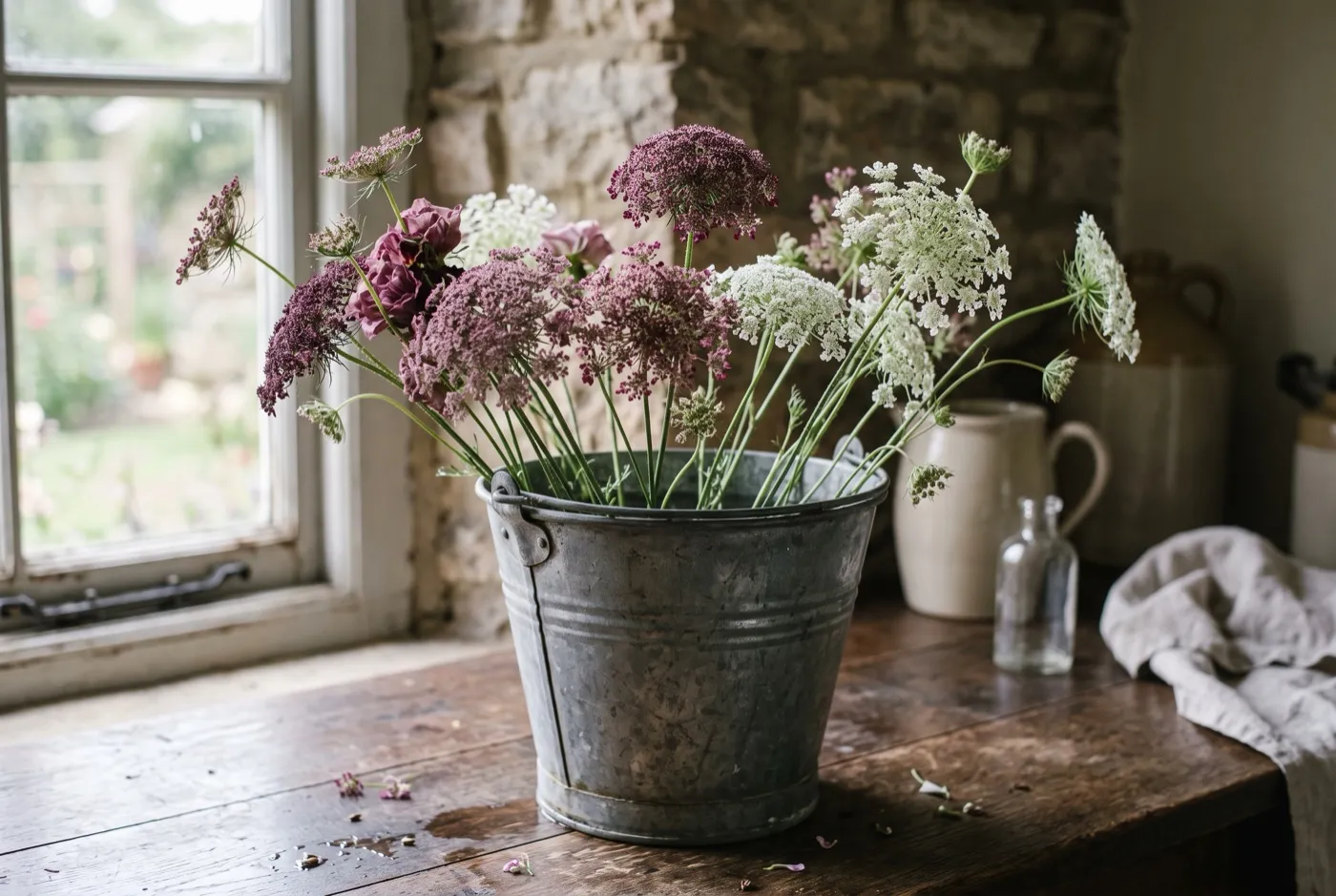 Cut ‘Dara’ at full open, strip the lower leaves and give the stems a deep cool drink before arranging for the best vase life.
Wild carrot for wildlife: hoverflies and solitary bees
Wild carrot is a first-rate wildlife plant, and its shape is the reason. The flat, open umbel is an easy landing pad for insects with short mouthparts that cannot reach into deep tubular flowers. Hoverflies, solitary bees, small wasps, beetles and flies all work the heads for the accessible nectar and pollen.
The wildlife value carries on after flowering. Leave the seedheads standing and they feed seed-eating birds through autumn, while the hollow, dried stems shelter overwintering insects. A patch left to seed and stand is doing more for your garden’s ecology in winter than a tidied, cut-down border ever could.
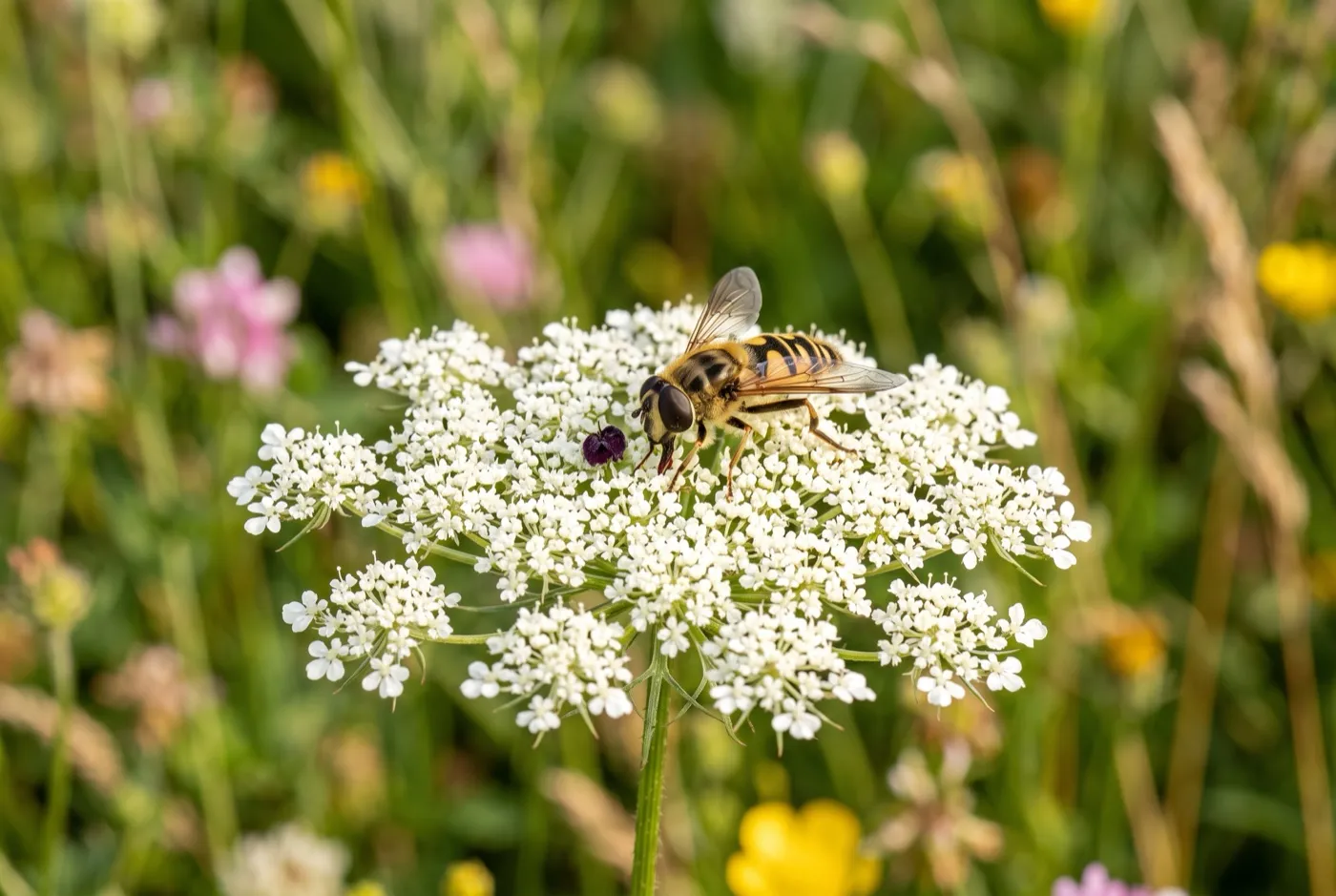 The flat umbel is an easy landing platform for hoverflies and solitary bees, which cannot reach into deep tubular flowers.
SAFETY: telling wild carrot from poison hemlock and hemlock water-dropwort
This is the section to read twice. The carrot family contains some of the most dangerous plants in Britain, and two of them look, to a careless eye, like wild carrot. Never eat any wild umbellifer, and learn the identification before you cut wild carrot from a verge or meadow. If you are in any doubt, do not touch the plant.
Poison hemlock (Conium maculatum) is the classic lookalike. It killed Socrates. The tells are clear once you know them. Its stem is smooth, hairless and blotched with purple, quite unlike wild carrot’s solid, all-green, hairy stem. Crush any part of hemlock and it gives off a foul, mousy, rank smell; wild carrot smells pleasantly of carrot. Hemlock also grows much taller, often 1.5-2.5m, and lacks the neat ruff of three forked bracts under the flowerhead. Purple-blotched smooth stem plus a bad smell means walk away.
Hemlock water-dropwort (Oenanthe crocata) is arguably worse, often called the most poisonous plant in Britain. It grows beside water, in ditches, streamsides and wet meadows, which wild carrot does not. Its stems are hollow, grooved and hairless, sometimes purple-streaked, and it smells unpleasant when cut, an acrid celery odour. Its roots are clusters of pale, swollen tubers like small parsnips. Habitat is your first clue: a carrot-family plant growing in wet ground by water is one to leave strictly alone.
The safe wild carrot checklist is short. Solid, ridged, hairy stem. All green, no purple blotches. Three forked bracts below the umbel. A single dark floret in the centre of a fresh white head. A clean carrot smell when a leaf is crushed. Dry, grassy or coastal habitat, never standing water. If any one of those is wrong, treat the plant as dangerous. If you would rather learn the whole family in one place, our wildflower identification guide sets the umbellifers side by side.
Warning: The sap of wild carrot itself can cause phytophotodermatitis, a blistering skin rash triggered when the sap meets sunlight. Handle plants on a dull day or wear gloves and long sleeves when cutting a lot of stems, and wash your hands and forearms before going out in the sun. The reaction is far milder than giant hogweed, but sensitive skin can still blister.
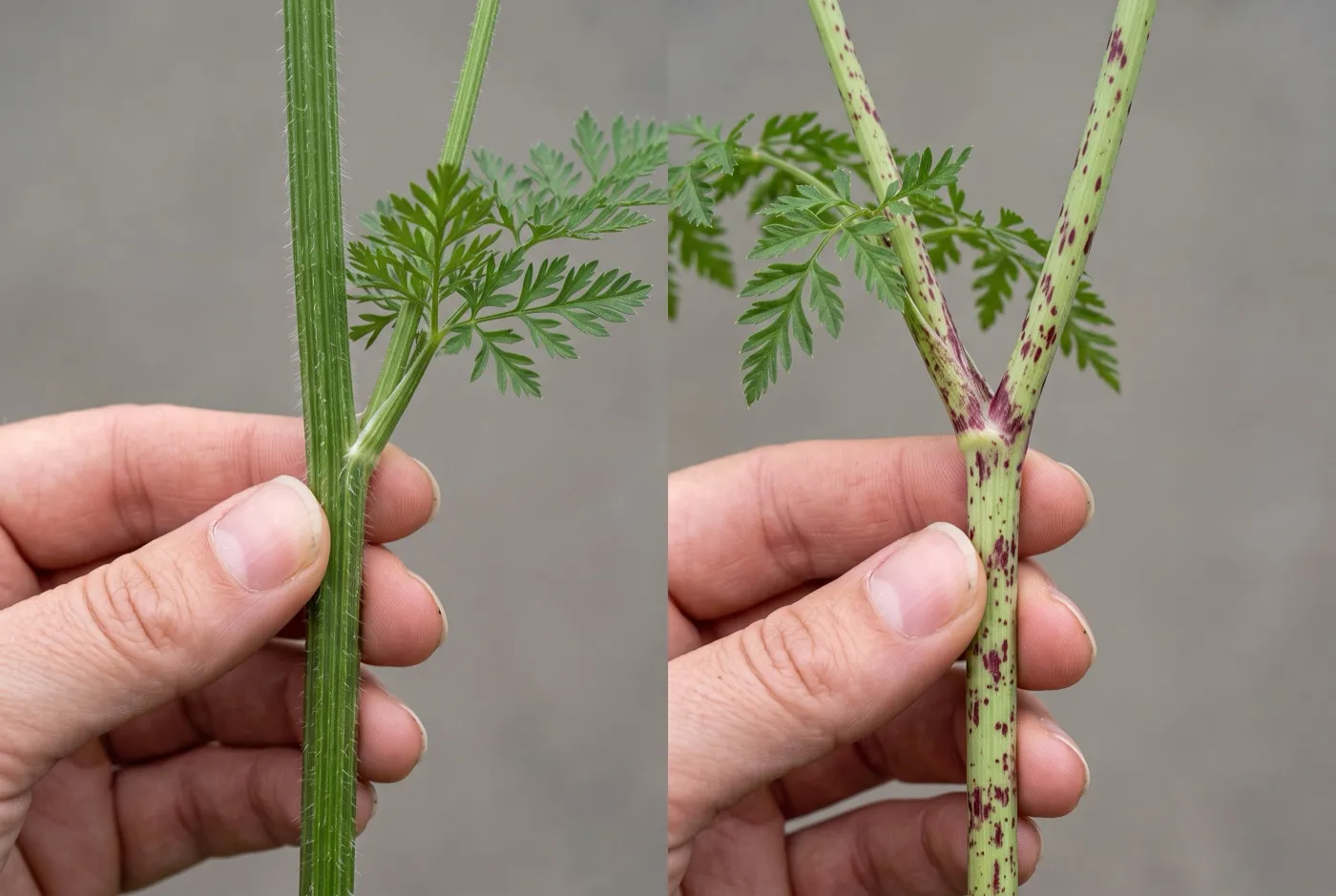 The stem tells the truth: wild carrot is hairy and all green (left); poison hemlock is smooth with purple blotches (right).
Managing self-seeding and keeping wild carrot in check
Wild carrot self-seeds with enthusiasm. One plant sets thousands of seeds, and left alone it will colonise bare ground fast. In a meadow or wild corner that is exactly what you want. In a tidy border or a working cutting patch it needs a light hand on the reins.
To encourage spread, do nothing. Let the umbels ripen into their bird’s-nest seedheads and shed where they stand. The seed germinates well on open, disturbed ground, so a scratched-up patch fills quickly. This is how the plant naturalises into grassland and how a mini-meadow keeps itself going year on year.
To keep it in bounds, cut the seedheads off before they ripen and shed. In a cutting patch this happens naturally, because you are harvesting the flowers before they set seed. Anywhere else, snip or pull the heads once flowering finishes. Unwanted seedlings pull out easily while young, taproot and all, from moist ground; leave them and the taproot makes them harder to shift.
One point on the biennial habit: because the native flowers in its second year and then dies, a self-sustaining patch always has two generations present, rosettes for next year and flowering plants for this. Let a few plants seed every year and you never have to sow again. Stop them all seeding and the patch fizzles out. It is a balance you tune to how wild or how tidy you want the spot to be.
Common mistakes when growing wild carrot
Most disappointments with wild carrot trace back to treating it like a pampered border flower. Get these five things right and it is close to foolproof.
Sowing into rich, fed soil
Rich ground gives a tall, soft, floppy plant with fewer flowers. Wild carrot wants lean, stony, hungry soil. Do not add manure or feed; sow into firmed, poor ground and thin the seedlings hard.
Raising it in modules
The taproot kinks in a cell and the plant never recovers, staying short and prone to bolting. Sow direct where it is to flower, or use deep root-trainers and plant out while tiny if you have no open ground.
Cutting the flowers at the wrong stage
Cut too early and the umbel wilts limp; cut too late and it drops its florets. Harvest when the head is fully open and flat but still fresh, in the cool of the morning, and condition it deeply before arranging.
Skipping identification before cutting from the wild
The deadly lookalikes are real. Never cut a wild umbellifer without checking the stem is hairy and all green, the smell is carrot, and the habitat is dry grassland, not a wet ditch. When in doubt, leave it.
Letting it seed everywhere unchecked
In a border, uncut seedheads shed thousands of seeds and the plant spreads fast. Cut the heads before they ripen unless you want a self-seeding colony. In a meadow, let it seed freely.
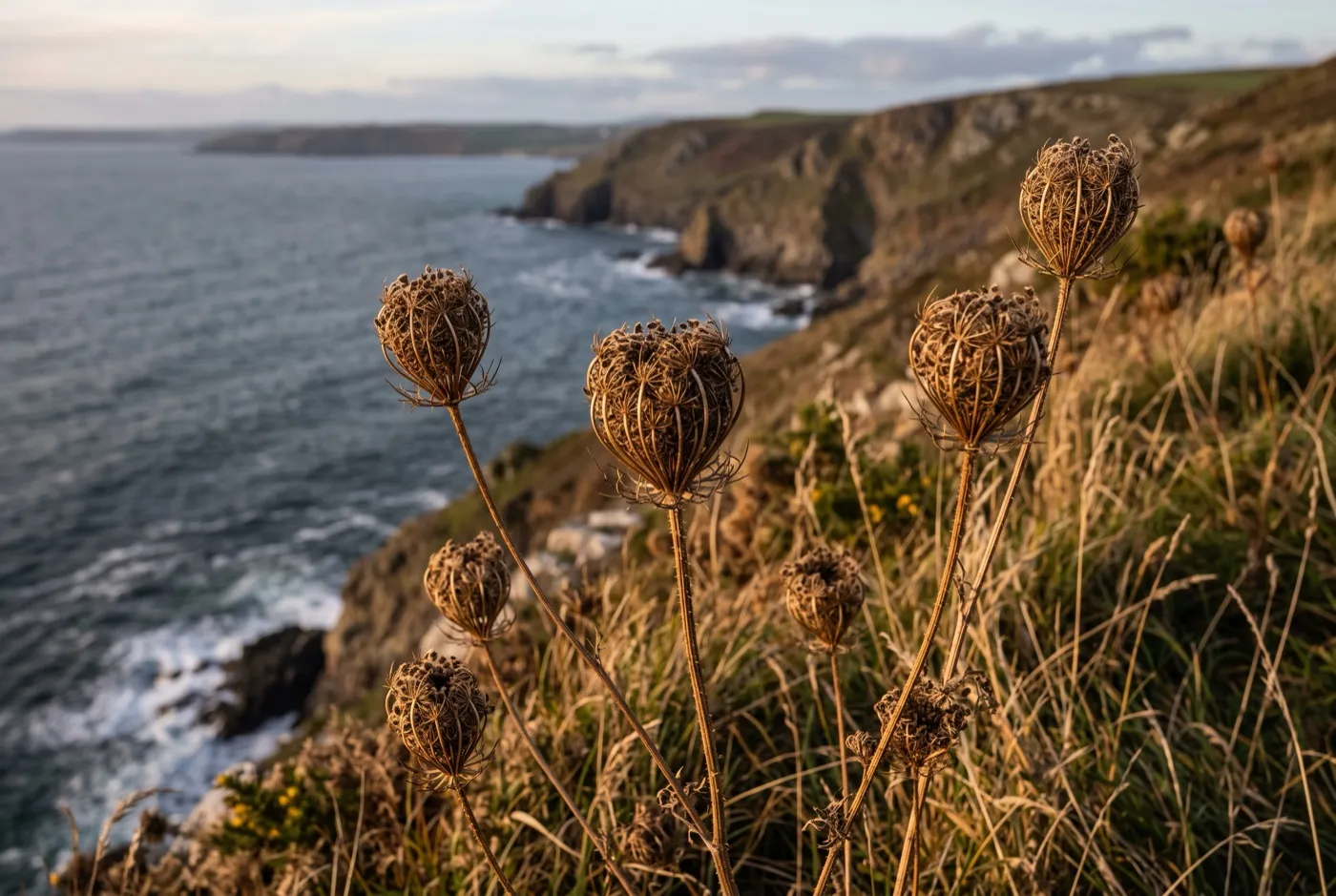 After flowering the umbels curl inward into concave bird’s-nest seedheads, feeding birds and self-seeding the next generation.
Frequently asked questions
Is wild carrot the same as Queen Anne’s lace?
Yes, wild carrot and Queen Anne’s lace are two names for the same plant, Daucus carota. The name Queen Anne’s lace comes from the flat, lacy white flowerhead. The single dark floret at its centre is said to be a drop of the queen’s blood. Both names describe the UK native wildflower and its garden selections such as ‘Dara’.
How do I tell wild carrot from poison hemlock?
Check the stem. Wild carrot has a solid, hairy, all-green stem. Poison hemlock (Conium maculatum) has a smooth, hairless stem with purple blotches and a foul mousy smell when crushed. Wild carrot also has three forked bracts below the flowerhead, which hemlock lacks. If you are not certain, do not touch or cut it.
Is Daucus carota ‘Dara’ an annual or a biennial?
‘Dara’ is technically a biennial, like all wild carrot, but gardeners grow it as a hardy annual. Sow it in spring and it flowers the same summer, then dies. Sowing in autumn gives earlier, taller plants the next year. Growing it as an annual is the standard method for cut flowers because you get blooms in the first season.
Can you sow wild carrot in modules or must it be direct?
Direct sowing is far better. Wild carrot forms a long taproot that bends and kinks in a module cell, giving weaker, shorter plants that resent transplanting. Sow thinly where the plants are to flower and thin the seedlings. If you must start under cover, use deep root-trainers and plant out very young, before the taproot sets.
Is wild carrot good for pollinators?
Yes, wild carrot is excellent for wildlife. The open, flat umbels give easy access to hoverflies, solitary bees and small beetles that cannot reach deep tubular flowers. As a genuine UK native it supports insects that co-evolved with it. Leave some plants to seed and the umbels feed birds and shelter overwintering insects too.
How long does wild carrot last in a vase?
Cut wild carrot and ‘Dara’ last seven to ten days in a vase. Cut in the cool of the morning when the umbels are fully open but still fresh, before the central florets brown. Strip the lower leaves, split or sear the stem ends, and condition the stems in deep cool water for a few hours before arranging.
Will wild carrot self-seed and take over the garden?
It self-seeds freely, which is welcome in a meadow or wild patch but can spread in a border. Each plant sets thousands of seeds. To control it, cut the seedheads before they ripen and shed, or pull unwanted seedlings while young. In a cutting patch, harvesting the flowers before they set seed keeps it in check.
Now you know how to grow wild carrot for both the vase and the bees, get the timing right across your whole wild patch with our guide to when to sow wildflower seeds.
Our team produces practical UK gardening guidance from source research, contributor records and established horticultural practice. Editorial standards are overseen by Matt W.