
Key takeaways
- Winter aconite flowers in January and February, one of the first nectar sources for queen bumblebees
- It grows just 5-10cm tall with 3cm bright yellow buttercup-like flowers set in a green ruff
- Dry tubers desiccate on the shelf and often fail; buy and plant in the green for far better results
- It wants humus-rich soil that stays moist in spring but drier in summer, in deciduous shade
- All parts are poisonous, like other aconites; wear gloves and keep it away from pets and children
- Once settled it self-seeds into wide carpets under trees and pairs with snowdrops and crocus
Winter aconite is the plant that tells me the gardening year has restarted. Long before the crocus open, sometimes in the first mild week of January, small fists of bright yellow push up through cold, bare soil and open into glossy cups the colour of egg yolk. Each flower sits in a neat green ruff of leaves, no more than 10cm off the ground. On a still, sunny winter morning a colony of them under a bare tree looks like light spilled across the floor.
It is a plant with a reputation for being tricky, and that reputation is only half deserved. Almost all the failure comes down to one thing: how you buy and plant it. Get that right and winter aconite is close to indestructible, seeding itself around for decades. This guide covers why dry tubers so often fail, how to plant in the green, the soil and shade it wants, and the toxicity you need to respect.
What is winter aconite?
Winter aconite (Eranthis hyemalis) is a low, tuberous perennial in the buttercup family, Ranunculaceae, grown for its bright yellow flowers in the depths of winter. It is native to woodland and scrub across southern Europe, from France to the Balkans, and has naturalised widely in Britain since it was introduced centuries ago. The old country name is winter hellebore, though it is not a hellebore at all.
The plant grows from a small, knobbly tuber, dark brown and about the size of a hazelnut. From that tuber it sends up a single flowering stem 5 to 10cm tall. The flower is a shallow cup around 3cm across, made of six petal-like sepals in a strong buttercup yellow. Just below the flower sits a whorl of deeply cut green bracts, the “ruff” that frames every bloom and makes the plant so recognisable. After flowering, the leaves fatten and green up, the plant feeds the tuber, and by late spring the whole thing dies back and vanishes underground until the next winter.
 A carpet of winter aconite lighting up the ground under bare churchyard trees in January, before any leaf canopy closes over.
The whole appeal is the timing. In January and February there is almost nothing else in flower at ground level, and winter aconite fills that gap with real colour, not the muted tones of hellebores or the white of snowdrops. It flowers, seeds and feeds early pollinators, then gets out of the way before the border plants of spring need the space. For a bulb that asks so little once settled, it earns its place many times over.
Why dry winter aconite tubers so often fail
Winter aconite fails most often because the dry tubers sold in autumn have already dried out too far to grow. This is the single biggest frustration gardeners have with the plant, and it is worth understanding before you spend money. Eranthis tubers have thin skins and hold little moisture. Left in a paper bag on a garden centre shelf for weeks, they shrivel, and a shrivelled tuber is frequently dead. You plant 50 and a handful appear.
The tubers usually sold dry are the Cilicica type, which travels a little better than the straight species but still suffers the same problem. Every reputable source gives the same advice: buy them as early in autumn as you can, and soak them in tepid water for 24 hours before planting to rehydrate the tissue. That helps. It does not fix a tuber that has already crossed the line into desiccation, which is why even soaked, early-bought dry tubers can give poor results.
Gardener’s tip: If you must plant dry tubers, choose the plumpest, heaviest ones in the batch and reject any that feel light, papery or hollow. Soak them overnight in tepid water, then plant the same day about 5cm deep and 5cm apart. Do not let them sit around after soaking. The clock is against you the moment they come out of the ground.
Planting winter aconite “in the green”
Plant winter aconite in the green in late winter or early spring, as soon as your plants arrive, while they are still in leaf. This is the reliable route to a colony. The plants come as small clumps with roots, foliage and sometimes fading flowers attached. Do not let them dry out between arriving and planting. If you cannot plant the same day, keep the roots damp and shaded and get them in within a day or two.
Plant each clump at the depth it was already growing, which you can read from the pale band on the stems where soil met air. That is usually 5 to 8cm deep. Resist the urge to split the clumps into single plants. Winter aconite establishes better planted in small groups of a few tubers together, and a clump gives you an instant patch of flower rather than dots. Space the clumps 10 to 15cm apart and let them knit together over the following seasons.
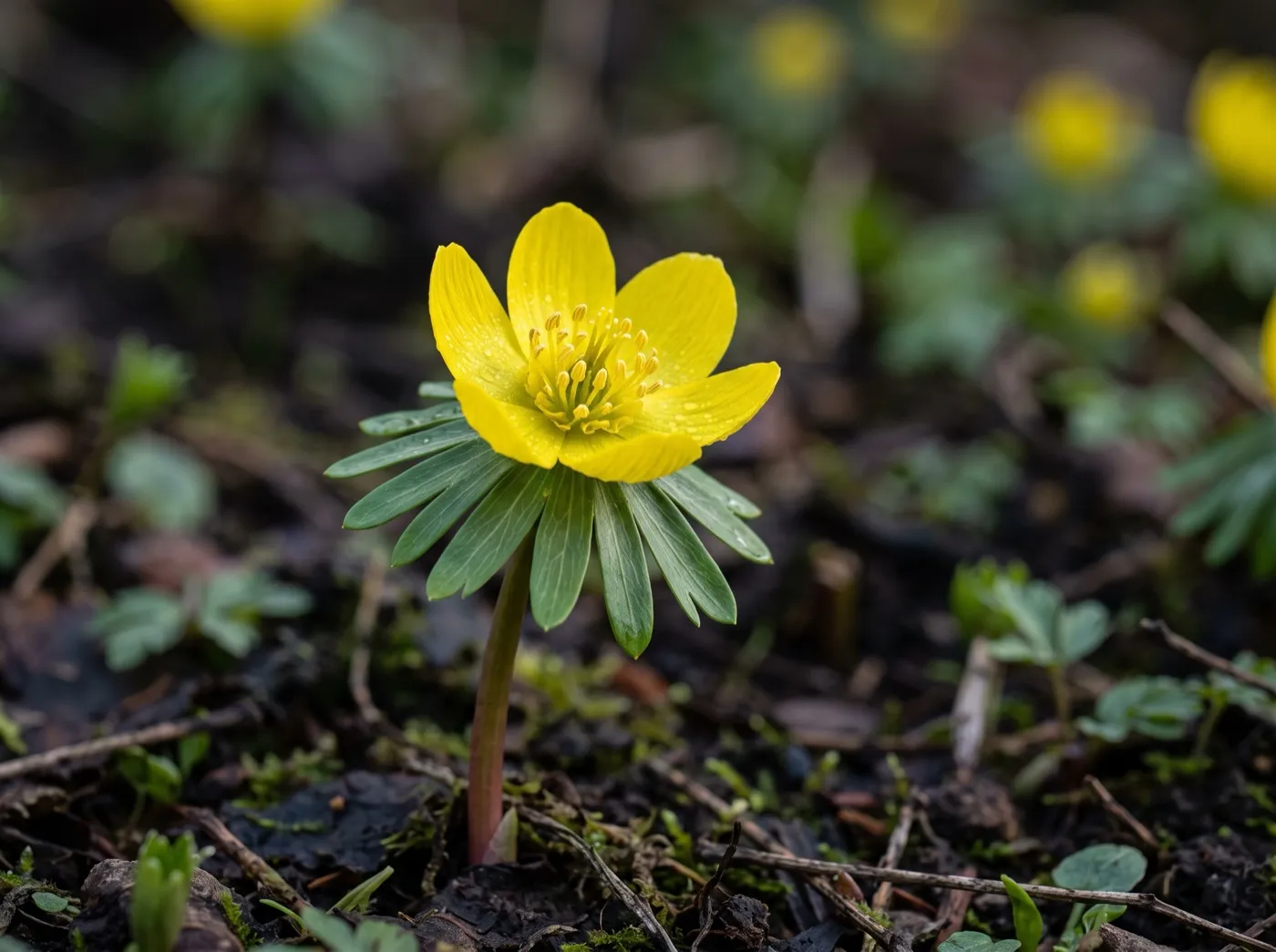 The signature winter aconite flower: a 3cm yellow cup of six sepals sitting in a deeply cut green ruff of bracts.
Firm the soil gently around each clump and water it in if the ground is dry, though in a wet British February it rarely is. After planting, leave the foliage completely alone. It will yellow and die back over the next few weeks as the plant pours energy into the tuber for next winter. Do not tidy it away, mow it or cut it. That fading foliage is doing the most important job of the year. Mark the spots with a few short canes so you do not accidentally dig into a dormant colony in summer.
For anyone new to this, it helps to understand how the plant stores itself underground. Our guide to bulbs, corms, tubers and rhizomes explained covers why a tuber like Eranthis behaves differently from a true bulb, and why letting the leaves die back naturally matters so much for next year’s flowers.
Where to plant winter aconite: soil and site
Winter aconite wants dappled or deciduous shade in humus-rich soil that stays moist in spring but dries a little in summer. Picture its wild home: the floor of a broadleaf wood, bare and open to the low winter sun, then shaded and leaf-littered through summer. That is the pattern to copy. A spot under deciduous trees or shrubs, where winter light reaches the ground before the canopy closes in April, is ideal.
 Planting winter aconite in the green, in small clumps at the depth shown by the pale band on the stems.
Two things it will not tolerate. The first is deep, dense evergreen shade. Under conifers or a thick evergreen hedge the ground is dark even in January, and the plant needs that early light to flower and feed. The second is ground that bakes bone-dry in spring while the plant is still in leaf. Summer drought after die-back is fine, even helpful, but spring drought starves the developing tuber. Winter aconite will still cope in dry shade as long as it gets some spring moisture, but it will never carpet the way it does in cool, leaf-mould-rich ground.
Because it grows and flowers so early, winter aconite fits neatly into the sequence of spring bulbs you plant across autumn and late winter. It opens the season before almost anything else, so give it the front row where you will actually see it from the house on a cold morning.
How to naturalise winter aconite in grass and under trees
To naturalise winter aconite, plant it under deciduous trees or in rough grass and then leave it entirely undisturbed to seed and spread. Naturalising is where this plant truly shines. A dozen clumps planted in the green become a drift of hundreds within a few years, at no further cost or effort, as long as you resist the two temptations: tidying and digging.
Under trees is the classic setting and the easiest. Scatter clumps in irregular groups rather than rows, planting more thickly near paths where you want impact and thinning out toward the edges so the colony looks natural. The fallen leaves that gather under the tree act as a free annual mulch, feeding the soil and keeping it the way the plant likes. Leave the leaf litter where it falls. Under a mature deciduous tree, winter aconite will often out-compete grass and moss to form a solid yellow carpet in time.
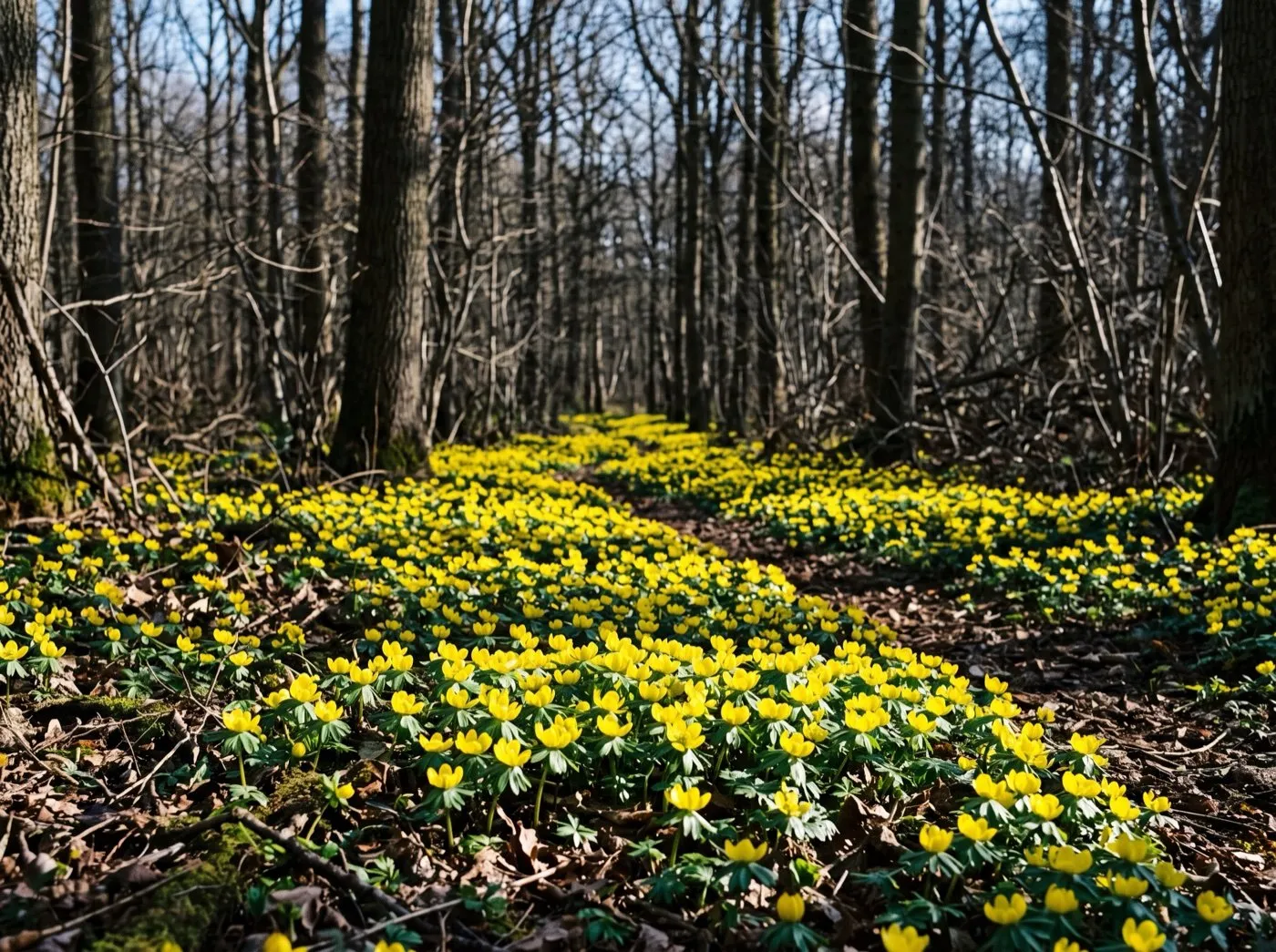 Naturalised winter aconite forming a solid carpet along a woodland edge, spread entirely by self-seeding over several years.
In grass it takes a little more planning. Winter aconite flowers and seeds in January and February, then holds its leaves into April. That means you cannot cut the grass until at least late April or May, once the foliage has fully yellowed and collapsed. If you can leave a patch of lawn or an orchard sward unmown until then, winter aconite naturalises in it happily. If you need to mow early for a tidy lawn, keep it in the borders and under trees instead. The rule is simple: no mowing, no digging, no tidying while there is any green leaf showing.
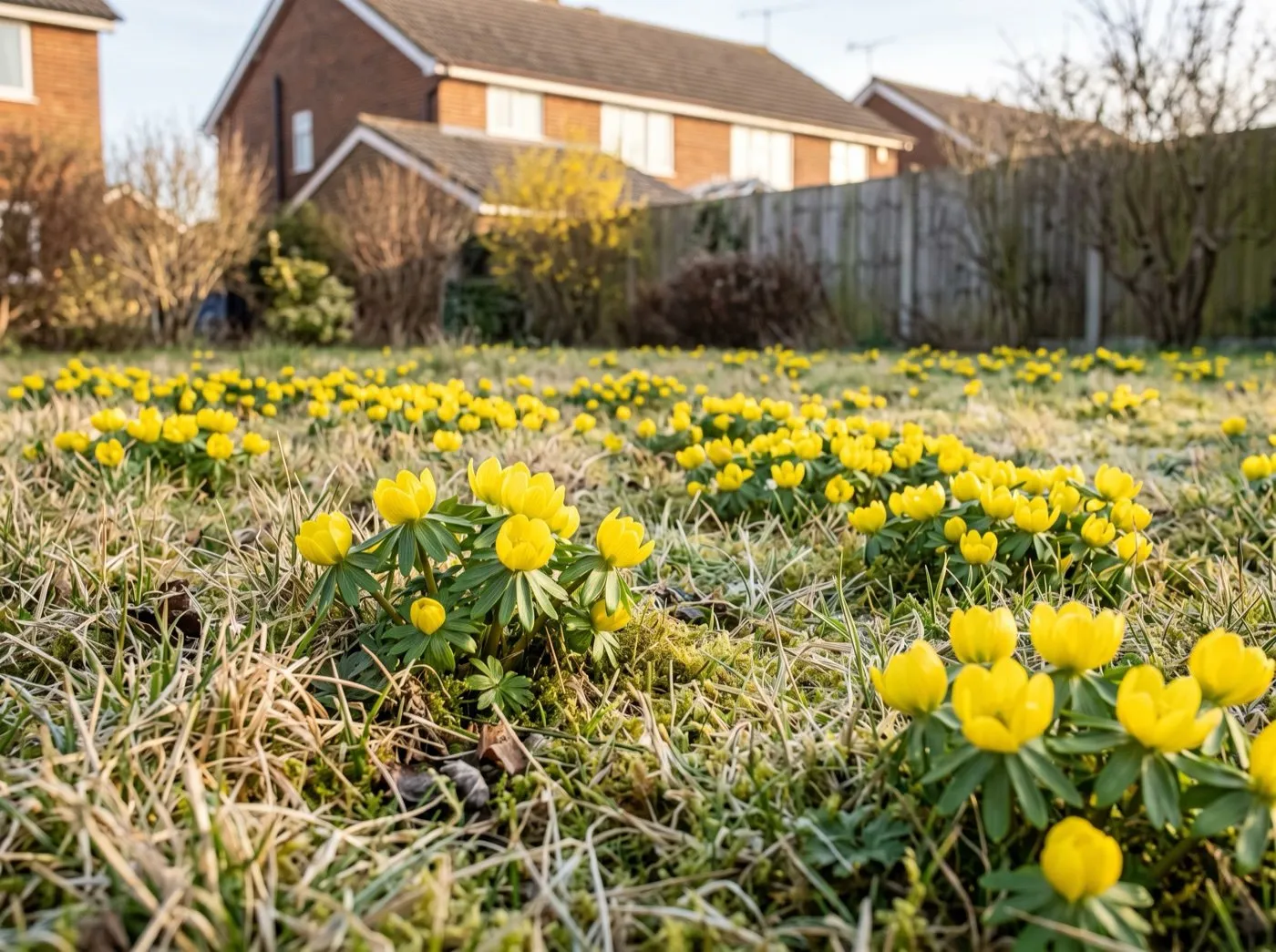 Winter aconite spreading through unmown suburban lawn. Delay the first cut until late April, after the leaves have died back.
Self-seeding is the engine of all this. Where the plant is happy it drops ripe seed in late spring, which germinates around the parent the following winter as tiny single leaves. These take three or four years to reach flowering size, so a colony builds slowly then accelerates. You can help it along by gently raking ripe seed into bare patches nearby, but honestly the plant does the job better left alone. The one thing that stops it is disturbance, so keep the fork away.
Winter aconite varieties: Cilicica Group and ‘Guinea Gold’
Most winter aconite sold is the straight species, Eranthis hyemalis, but a few named forms are worth knowing. The differences are modest, mostly in flower size, foliage colour and scent, but for a plant you will grow for decades they are worth choosing well.
The Cilicica Group (sometimes sold as Eranthis cilicica) comes from further east, in Turkey and the Middle East. Its flowers are a slightly deeper, richer gold and a touch larger, and the young foliage carries a bronze or reddish tint that sets off the yellow nicely. It flowers a little later than E. hyemalis, extending the season by a week or two. Confusingly, this is the type most often sold as dry tubers in autumn, so it carries the reputation for being hard to establish. Buy it in the green if you can find it.
‘Guinea Gold’ is the pick of the named forms and holds an RHS Award of Garden Merit. It is a hybrid, Eranthis x tubergenii, with large, deep golden-yellow flowers that are lightly fragrant, set against distinctly bronze-tinted foliage. It is sterile or nearly so, meaning it does not seed around the way the species does, so it stays where you put it and clumps up slowly instead of colonising. That makes it a good choice for a border where you want winter aconite but not a spreading carpet. It is sold in the green by specialists and is more expensive, but it is a lovely, well-behaved plant.
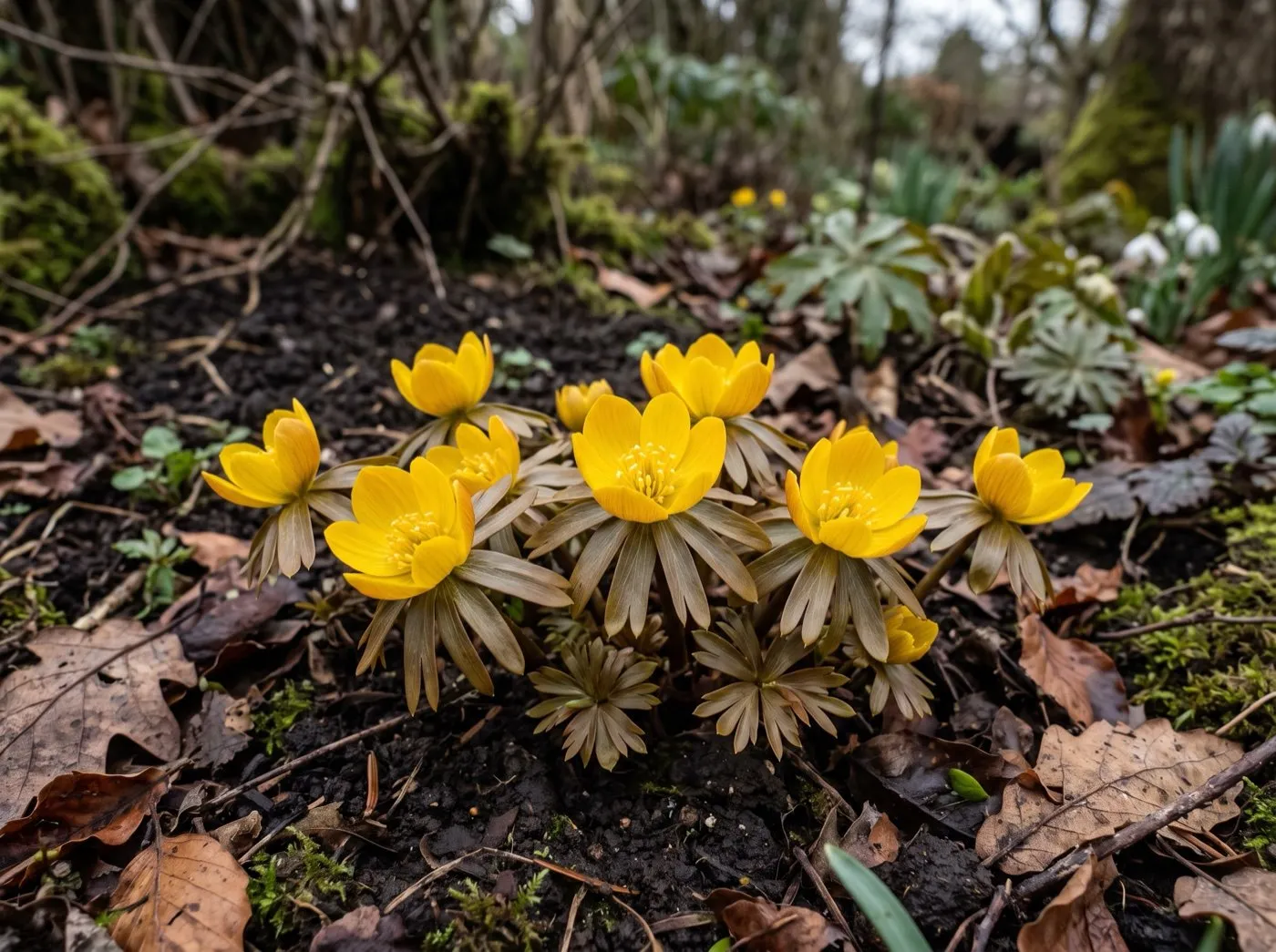 ‘Guinea Gold’, a fragrant, larger-flowered hybrid with bronze foliage that clumps up slowly rather than seeding around.
Winter aconite compared with snowdrops and crocus
These three early performers overlap in the garden, but they are planted and behave quite differently. This table shows how to choose and combine them.
| Plant | Flowering month | Height | How to plant | Spreads by |
|---|---|---|---|---|
| Winter aconite (Eranthis hyemalis) | Late Jan-Feb | 5-10cm | In the green (dry tubers unreliable) | Self-seeding, forms carpets |
| Snowdrop (Galanthus nivalis) | Jan-Mar | 10-15cm | In the green (dry bulbs unreliable) | Self-seeding and offset bulbs |
| Crocus (early species types) | Feb-Mar | 8-12cm | Dry corms in autumn (reliable) | Cormlets and some seeding |
The pattern is clear. Winter aconite and snowdrops share the same problem and the same solution, both hating dry storage and both best planted in the green. Crocus, by contrast, is straightforward from dry corms in autumn. Plant all three in the same undisturbed ground under trees and you get a rolling display from January into March.
How to propagate winter aconite
Winter aconite propagates two ways: by self-seeding, which it does freely on its own, and by division of established clumps in the green. For most gardeners, doing nothing and letting it seed is the best method, but division lets you move colonies to new spots quickly.
Self-seeding needs no work from you. Leave flowered plants to set and drop seed in late spring, and leave the ground undisturbed. Seedlings appear as single, grass-like leaves the following winter and take three to four years to flower. If you want to spread a colony faster, collect the ripe seed as the capsules yellow in May, and scatter it immediately onto fine, weed-free soil in a shady spot. Fresh seed germinates far better than stored seed, which loses viability quickly, so sow it the day you collect it.
Division is the way to bulk up quickly or start a new patch. Do it in the green, straight after flowering, while the plants are in full leaf in February or March. Lift a clump with a fork, tease it into smaller groups of two or three tubers each, and replant immediately at the same depth 10cm apart. Keep the roots damp throughout and never let the tubers dry in the sun while you work. Divided in the green like this, winter aconite barely notices the move. Divide dormant tubers in summer and you are back to the drying-out problem that kills so many.
The same die-back-and-feed cycle applies to caring for the colony each year as to any early bulb. Once flowering finishes, the job is simply to let the leaves work. Our notes on spring bulb care after flowering apply directly: no cutting, no knotting, no early mowing, just patience while the foliage yellows and feeds next winter’s flowers.
Is winter aconite poisonous?
Yes, all parts of winter aconite are poisonous, and this is the one thing about the plant you must not overlook. It sits in the same family as monkshood and the other true aconites, and like them it contains toxic compounds throughout the tuber, stem, leaf and flower. The RHS lists it as harmful if eaten and as a potential skin irritant. This is not a scare, but it is a genuine caution worth taking seriously.
In practice the risks are manageable and the plant is grown safely in millions of gardens. Eating any part can cause stomach upset, and larger amounts are more serious, so the concern is real where small children or pets might dig up and chew a tuber. The sap can also irritate sensitive skin. When you are handling the tubers at planting or division time, wear gloves, and wash your hands afterwards. Keep the tubers out of reach of children and pets, and do not plant winter aconite where a dog that digs, or a child that grazes, spends a lot of unsupervised time.
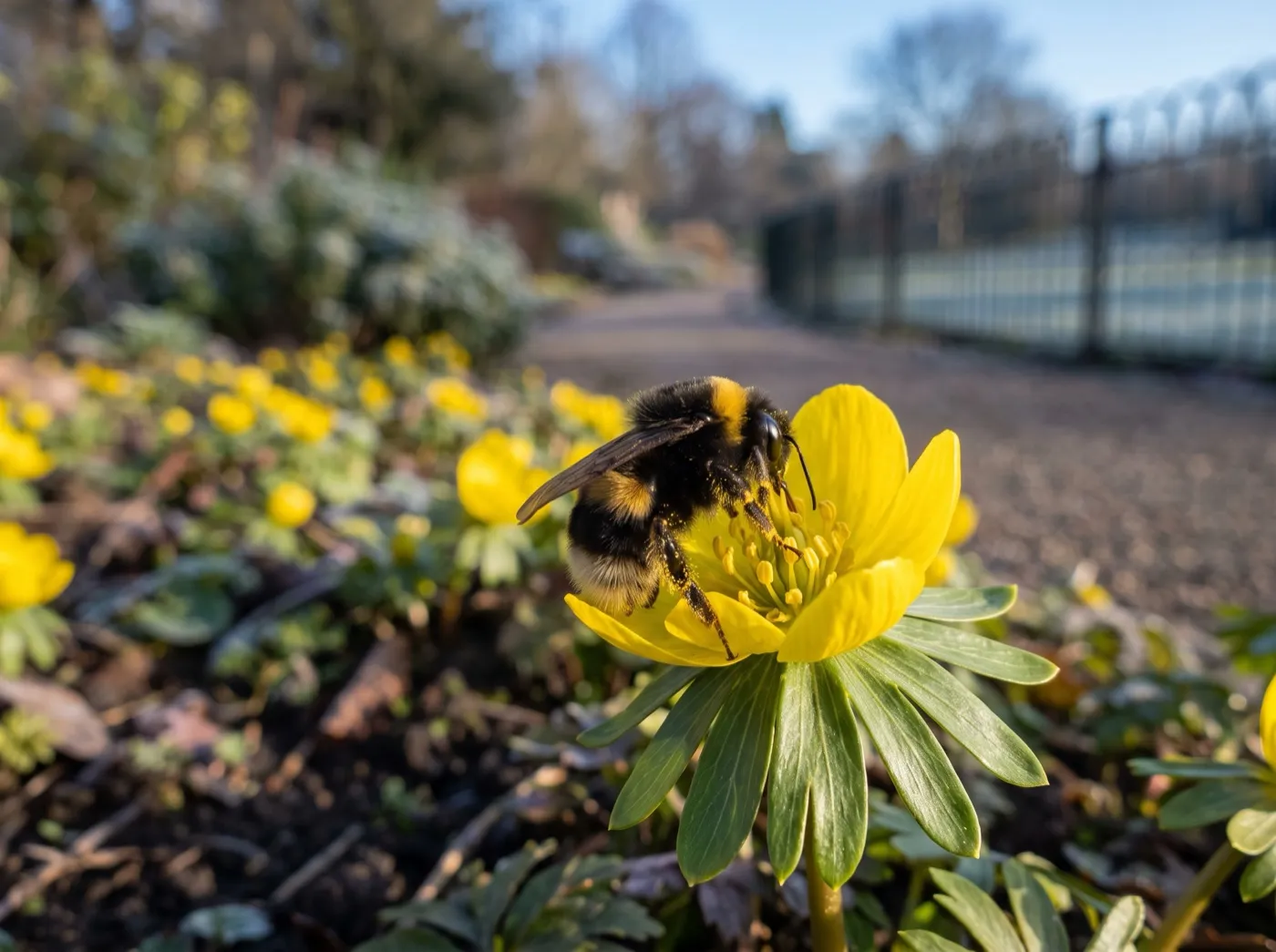 Winter aconite in a city park, one of the first nectar and pollen sources of the year for early queen bumblebees.
For all its toxicity to us, winter aconite is a valuable plant for wildlife, and there is no contradiction there. Its early flowers open in a season when almost nothing else offers food, providing pollen and nectar to the first insects on the wing. Queen bumblebees breaking hibernation on a mild January day, along with early honeybees and hoverflies, work the open cups on sunny mornings. The Bumblebee Conservation Trust stresses how important these very early flowers are for queens that need to refuel before founding a nest. Planting a good drift of winter aconite is one of the simplest things you can do for early pollinators.
What to plant with winter aconite
Winter aconite combines best with the other early bulbs and woodland plants that share its love of undisturbed, humus-rich shade. Because it is so short and so early, it works as a ground-level carpet beneath and between taller companions, and the classic partners are the ones that flower in the same cold weeks.
Snowdrops are the obvious match. They flower at the same time, want the same in-the-green planting and the same conditions, and the white bells against the yellow cups is one of the great sights of the winter garden. Plant them intermingled rather than in separate blocks. Our guide to growing snowdrops covers the same in-the-green approach that winter aconite needs, so you can plant both together on one trip.
Early crocus picks up as the aconites peak, adding purple, white and gold at a similar height. Our guide to crocus covers the species types that suit naturalising in the same grass and borders. A little later, the clear blue of chionodoxa takes over the ground layer as the aconites fade, and the taller white of leucojum, the snowflake, extends the woodland display into spring.
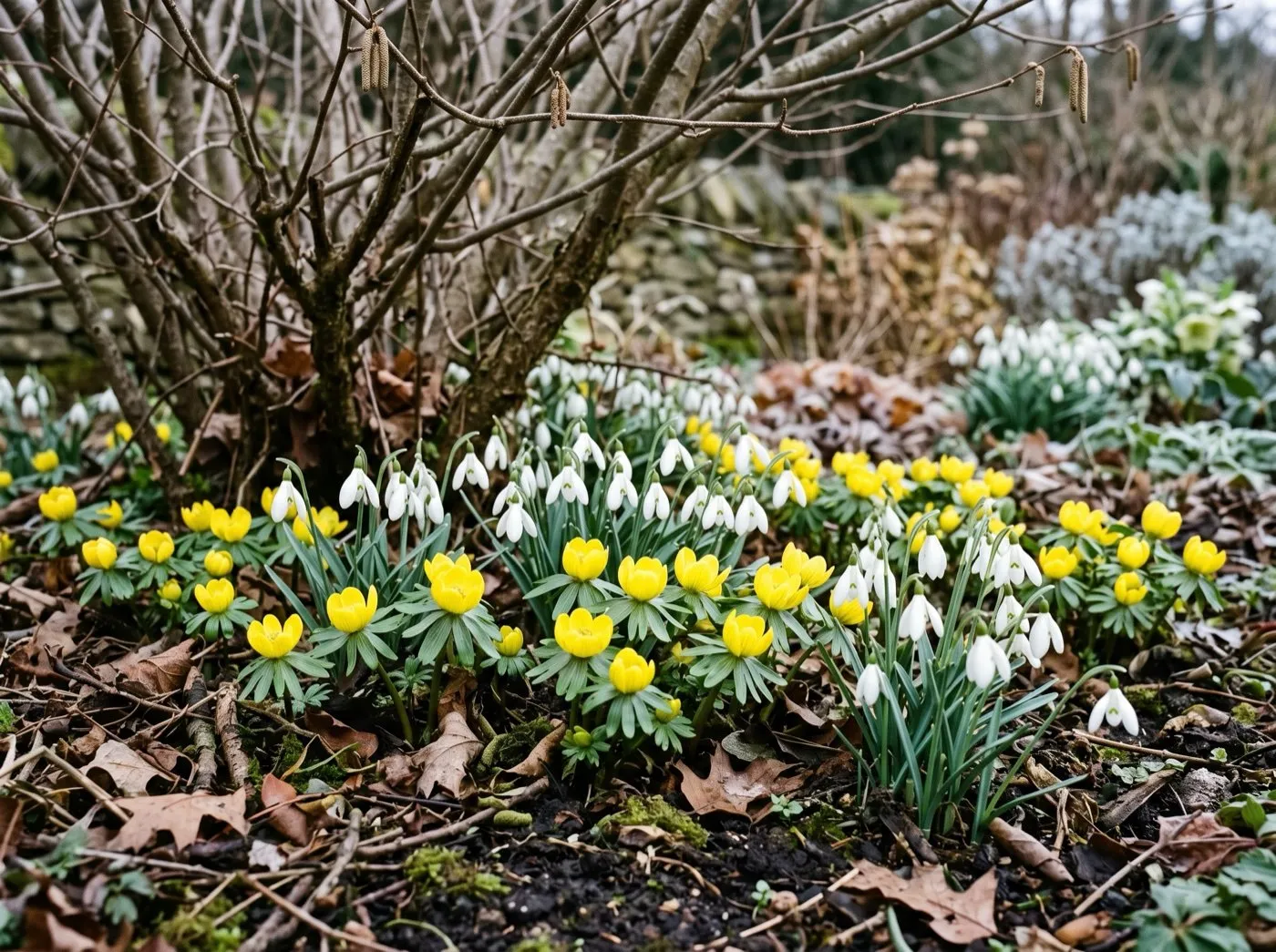 Winter aconite and snowdrops flowering together, the classic January pairing of yellow cups and white bells in dappled shade.
For structure and height above the carpet, the woodland shade-lovers are the ones to reach for. Hellebores flower at the same time, hold their nodding blooms at knee height, and want identical conditions, making them the perfect backdrop. Winter-flowering cyclamen, with their marbled leaves and pink or white flowers, weave through at ground level and enjoy the same dry summer dormancy. Put these together under a deciduous tree and you have a self-sustaining winter woodland floor that returns and expands every year.
Winter aconite month-by-month
Winter aconite needs very little hands-on care, but the timing of what little you do, and what you must not do, decides how well it spreads. This calendar sets out the year.
| Month | Task |
|---|---|
| January | Enjoy the first flowers; mark any patches you want to divide or add to |
| February | Peak flowering; buy and plant in the green now, in small clumps |
| March | Late flowers fade; lift and divide established clumps while still in leaf |
| April | Foliage yellows; leave it completely, do not mow grass over colonies yet |
| May | Leaves die back; collect and sow fresh seed the same day if bulking up |
| June | Plants dormant underground; safe to mow naturalised grass now |
| July | Nothing to do; avoid digging where colonies sleep |
| August | Dormant; mark colony edges before autumn planting elsewhere |
| September | Dry tubers appear for sale; buy the plumpest and plant at once if using them |
| October | Last chance to plant dry tubers; soak overnight, plant 5cm deep the same day |
| November | Ground quiet; keep leaf litter in place under trees as mulch |
| December | First noses may show in a mild spell; clear heavy leaf piles off emerging shoots |
The two rules that run through the whole year are worth repeating. Buy and plant in the green in February and March for reliable results. And never mow, dig or tidy over a colony while any green leaf is showing, because that leaf is building next winter’s flowers.
Frequently asked questions
Why did my winter aconite tubers not come up?
Dry winter aconite tubers desiccate on the shelf and often fail to grow. Eranthis tubers hate drying out, so a shrivelled tuber may already be dead when you buy it. Success from dry tubers can be low even after soaking overnight. Buy plants in the green in spring instead, or plant dry tubers the moment you get them. That is the single biggest reason gardeners see nothing come up.
What does ‘in the green’ mean for winter aconite?
In the green means buying and planting winter aconite while it is in leaf, just after flowering in spring, rather than as a dormant dry tuber. The plant arrives with roots, foliage and often flowers still attached. It re-establishes far more reliably because the tuber has never been allowed to dry out. Snowdrops are sold the same way and for the same reason.
Where is the best place to plant winter aconite?
Plant winter aconite in dappled or deciduous shade, under trees and shrubs that are bare in late winter. It wants humus-rich soil that stays moist through spring but dries out a little in summer. Winter light reaching the ground before the leaf canopy closes is exactly what it needs. It tolerates most soils and does especially well on chalk or limy ground.
Is winter aconite poisonous?
Yes, all parts of winter aconite are poisonous. It belongs to the same family as monkshood and other aconites, and contains toxic compounds throughout the tuber, stem, leaf and flower. Eating it can cause stomach upset, and the sap may irritate skin. Wear gloves when handling the tubers, and keep it away from pets and small children who might dig or nibble.
Does winter aconite spread and come back every year?
Yes, winter aconite is a true perennial that returns each year and spreads once settled. It multiplies by self-seeding, dropping seed that germinates around the parent to form wide colonies over several years. Established clumps also thicken from the tuber. Leave the foliage to die down naturally and do not disturb the ground, and a small planting slowly becomes a carpet.
When does winter aconite flower in the UK?
Winter aconite flowers from late January into February in most of the UK, sometimes opening in the first mild spell of the new year. It is one of the earliest bulbs, usually flowering alongside or just before snowdrops. The bright yellow cups open in sun and close in cold, dull weather. Flowering finishes by March as the leaves fatten and the plant builds next year’s tuber.
What grows well with winter aconite?
Winter aconite pairs best with snowdrops, which flower at the same time and contrast white against its yellow. Early crocus, dwarf iris and later chionodoxa extend the display. All want the same undisturbed, humus-rich ground under deciduous trees. Hellebores and hardy cyclamen make good taller companions that share the same shady, woodland conditions through the same weeks.
The RHS lists Eranthis hyemalis with full growing guidance and its H6 hardiness rating (RHS: winter aconite). Once your winter aconite is spreading, keep the early display going with our guide to the best winter-flowering plants for UK gardens.
Our team produces practical UK gardening guidance from source research, contributor records and established horticultural practice. Editorial standards are overseen by Matt W.