Key takeaways
- Apply in autumn after harvest, ideally 8 weeks before planting brassicas
- Never mix lime with manure: ammonia gas releases and nitrogen is lost
- UK clay typically needs 200-300g per m² to raise pH by 0.5 units
- Ground limestone (calcium carbonate) is the safe default for most UK plots
- Hydrated lime is caustic, fast-acting and only for clearing pH urgently
- Brassica club root is suppressed at pH 7.0+, the strongest case for liming
Garden lime in a UK vegetable plot does one job: it raises soil pH from acid to neutral or slightly alkaline. The wrong type, the wrong dose, or the wrong timing wastes money and damages crops. This guide covers when to apply garden lime, how much per square metre for each soil type, which of the three main lime forms (calcium carbonate, dolomite, hydrated) suits which purpose, and why brassica growers in particular rely on it.
When to Apply Garden Lime in the UK
The best time to apply garden lime is autumn after harvest, October to early November. Lime needs 8-12 weeks to react with soil moisture and start raising pH. Winter rain pulls calcium ions down through the topsoil to the rootzone. By spring, the bed is at planting pH and ready for sowing.
A late winter application in February is the second-best window. Apply just before the soil starts to warm. Avoid liming after seedlings have emerged. Lime dust burns young roots and can scorch tender brassica foliage.
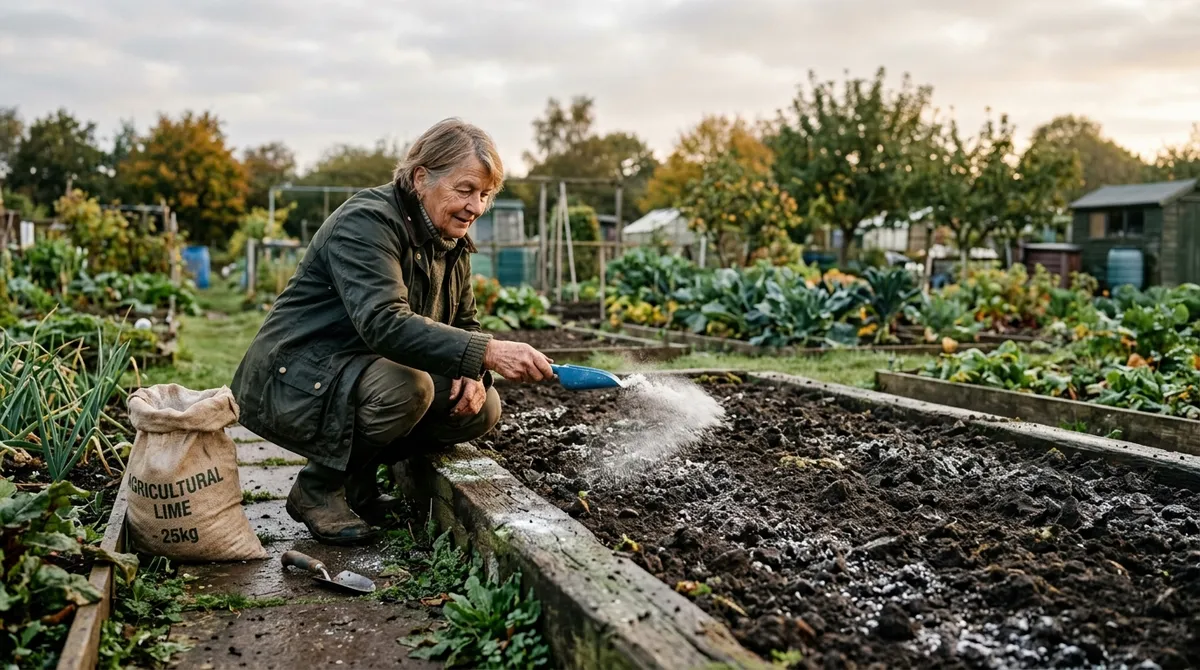
On heavy clay, work the lime into the top 50mm with a rake. On sandy soil, leave it on the surface and let the rain incorporate it. Heavy clay holds lime in the rootzone for 3-5 years. Sandy soil loses it within 18-24 months.
How Much Garden Lime per m² by Soil Type
Lime application rate depends on soil texture and starting pH. The lighter the soil, the less lime needed for the same pH shift. The lower the starting pH, the higher the dose.
| Soil type | Starting pH 5.0-5.5 | Starting pH 5.5-6.0 | Starting pH 6.0-6.5 |
|---|---|---|---|
| Heavy clay | 300-400g per m² | 200-300g per m² | 100-150g per m² |
| Silty clay loam | 250-350g per m² | 150-250g per m² | 75-125g per m² |
| Sandy loam | 150-200g per m² | 100-150g per m² | 50-100g per m² |
| Pure sand | 75-125g per m² | 50-100g per m² | 25-75g per m² |
These rates use ground limestone (calcium carbonate). For dolomite lime, use the same rate. For hydrated lime, halve the rate because it acts faster and stronger per gram.
A 25kg bag of ground limestone at £7-£12 treats roughly 100 square metres at the average UK rate of 250g/m². That makes lime one of the cheapest soil amendments per square metre on any UK allotment.
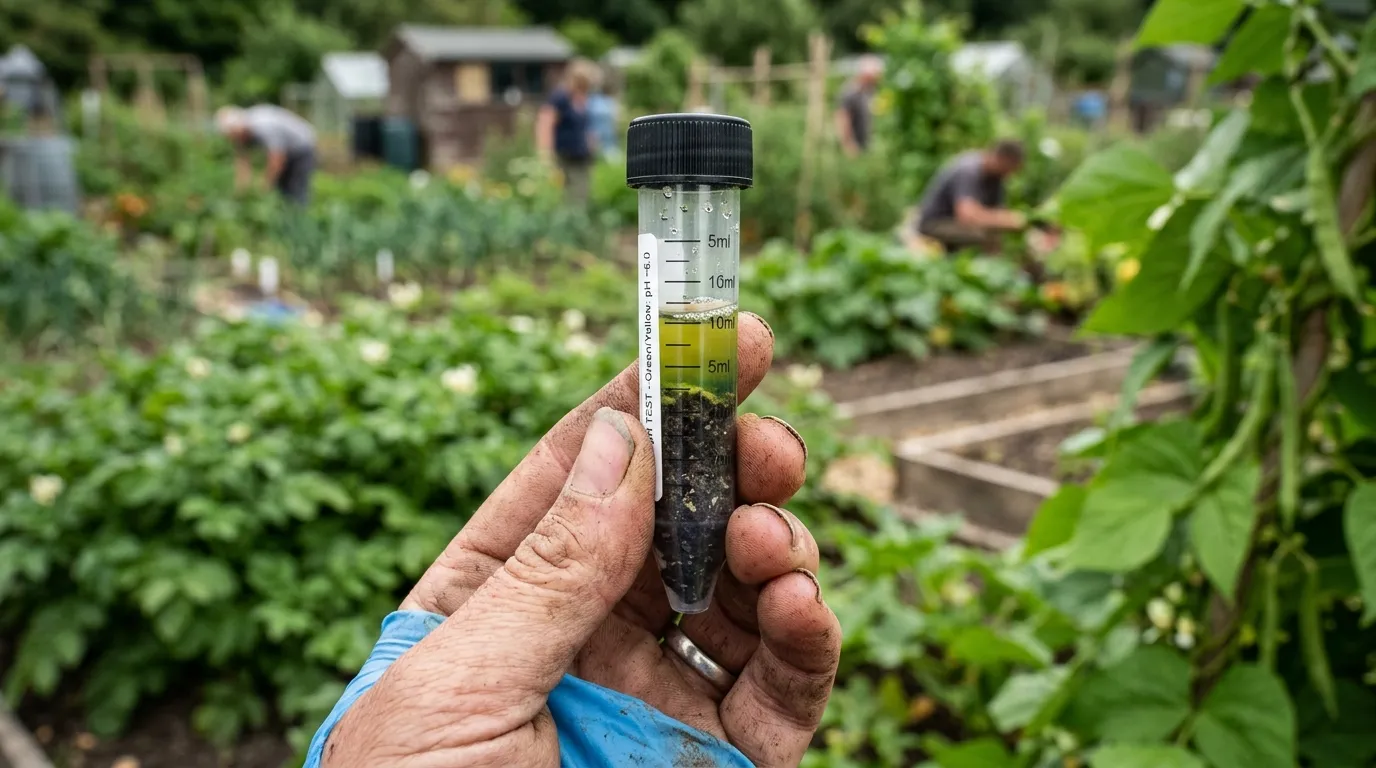 A standard chemical pH test kit. The indicator solution turns green-yellow at pH 6.5-7.0, the target range for most UK vegetable beds. Cost £6-£12 from any garden centre.
Calcium Carbonate vs Dolomite vs Hydrated Lime
Three lime types appear on UK garden centre shelves. Each has a different role. Picking the wrong one is a costly mistake.
| Lime type | Chemical name | Reaction speed | Strength per kg | Magnesium | Cost per 25kg | Safety |
|---|---|---|---|---|---|---|
| Ground limestone | Calcium carbonate (CaCO3) | Slow (8-12 weeks) | 100% baseline | No | £7-£12 | Safe to handle |
| Dolomite lime | Calcium magnesium carbonate | Slow (8-12 weeks) | 100% (plus Mg) | Yes (10-12%) | £10-£16 | Safe to handle |
| Hydrated lime | Calcium hydroxide (Ca(OH)2) | Fast (2-4 weeks) | 150-160% baseline | No | £12-£18 | Caustic, burns skin/eyes |
| Quicklime | Calcium oxide (CaO) | Very fast (1-2 weeks) | 175-180% baseline | No | Trade only | Highly caustic, do not use in gardens |
Ground limestone (calcium carbonate) is the safe default. Slow, steady, no risk of over-shoot. Buy this for any routine annual or biennial liming. The Westland, Vitax, and Gem-brand bags at UK garden centres are all ground limestone.
Dolomite lime is the choice when soil tests show low magnesium (under 50mg/kg) or when growing magnesium-hungry crops like tomatoes and brassicas in sandy soil. The 10-12% magnesium content corrects Mg deficiency without needing a separate Epsom salts dressing.
Hydrated lime is for emergencies only. Use it where pH must rise fast - a new plot that tests at pH 4.8, or a disease-cleared bed needing sterilisation. It burns skin, eyes, and young roots. Always wear gloves, eye protection, and apply on a still day. Never apply hydrated lime more often than once every 3 years.
Warning: Quicklime (calcium oxide) is a trade product not sold in UK garden centres. It is highly exothermic and will burn skin on contact with moisture. Never apply quicklime to a vegetable garden under any circumstance.
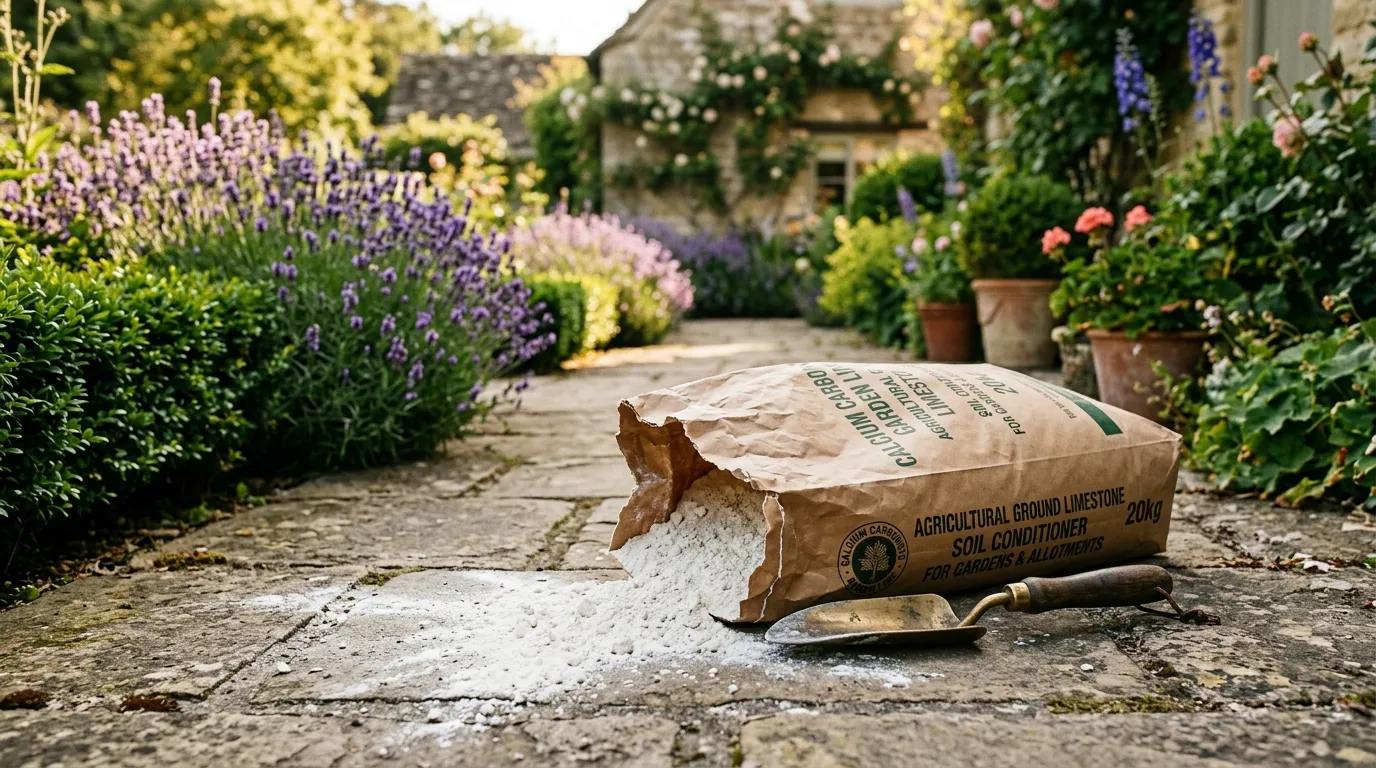 Ground limestone (calcium carbonate) is the safe default for routine UK garden liming. A 25kg bag costs £7-£12 and covers roughly 100 square metres at the average rate.
Garden Lime and Brassica Club Root
The strongest case for liming a UK vegetable plot is club root prevention in brassicas. Club root is caused by Plasmodiophora brassicae, a soil-borne organism that produces galls on the roots of cabbages, broccoli, sprouts, kale, and turnips. Affected plants wilt in dry weather, fail to head up, and yield 30-70% below healthy plants.
Club root spores germinate poorly above pH 7.0. Below pH 6.5, spore germination accelerates. Below pH 5.8, even healthy seedlings often fail in infected soil.
The protocol on a known-infected plot:
- Apply 300g/m² of ground limestone in October, 8 weeks before any brassica planting.
- Top-dress with 150g/m² of ground limestone in February before transplanting.
- Plant brassica seedlings into individual lime-coated transplant holes (a handful of lime per hole).
- Lift and burn all brassica roots at the end of season. Never compost diseased roots.
- Rotate brassicas off the bed for 7+ years if heavily infected.
Lime does not cure existing club root infection. It only suppresses new spore germination. The 7-year rotation is essential because spores stay viable in soil for 20+ years.
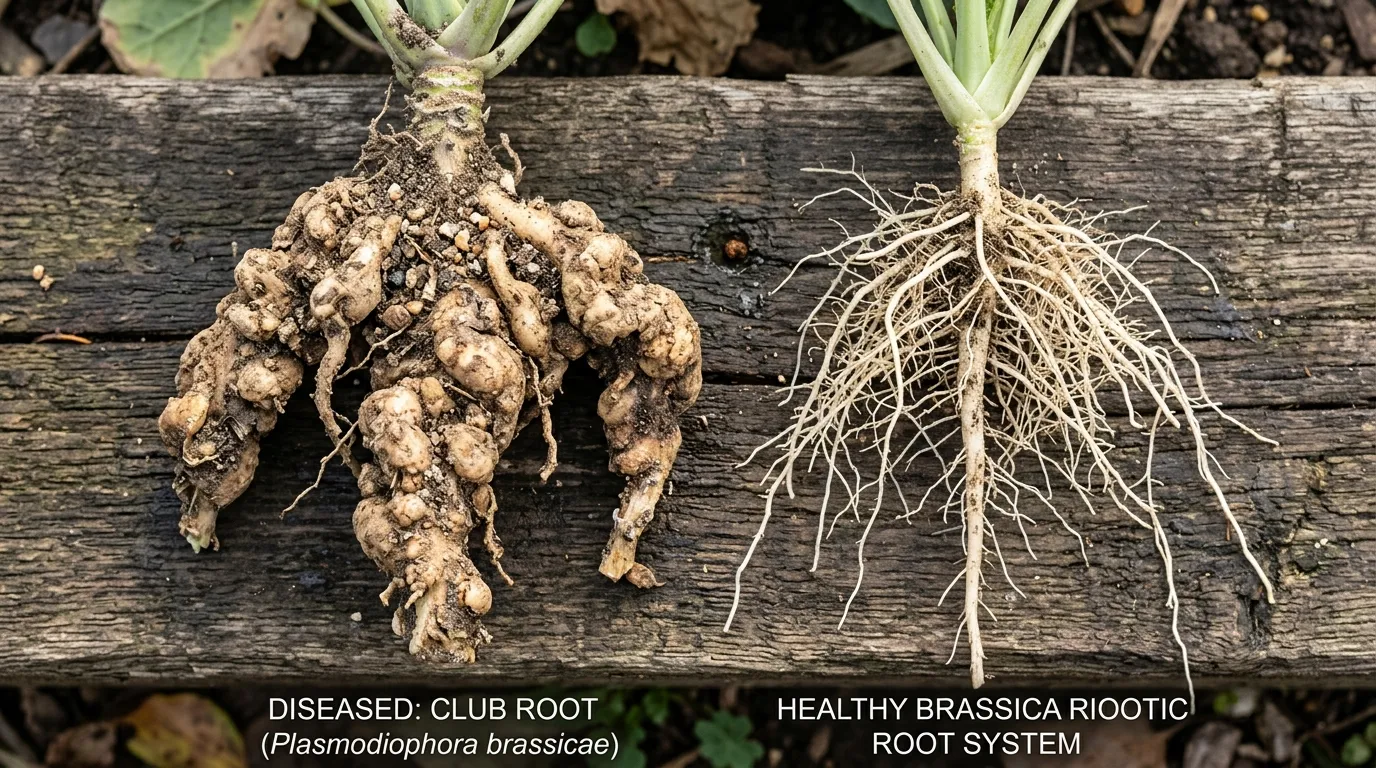 Club root (Plasmodiophora brassicae) galls on the left, healthy brassica roots on the right. Lime raises soil pH to suppress spore germination but does not cure existing infection.
When NOT to Apply Garden Lime
Lime is not a universal soil improver. Five situations call for keeping the bag closed.
1. With or near manure. Lime and ammonium nitrogen in fresh or partly rotted manure react to release ammonia gas. The nitrogen in the manure escapes to the air. Both inputs are wasted. Leave at least 12 weeks between a manure application and a lime application. Best practice: manure in autumn, lime in late winter, or split across alternate years.
2. On acid-loving beds. Never lime around blueberries, rhododendrons, azaleas, camellias, heathers, pieris, or conifers. These plants need pH 4.5-5.5 to absorb iron and manganese. Lime causes interveinal yellowing (chlorosis) and stunts growth. Keep limed beds at least 1.5 metres from any acid-lover border.
3. On potato beds. Potatoes prefer slightly acid soil (pH 5.5-6.0). High pH encourages common scab (Streptomyces scabies), which produces rough corky patches on tubers. Skip the potato rotation slot when liming a 4-bed rotation system. Lime the year before and the year after potatoes, never the potato year itself.
5. Just before sowing or transplanting. Lime dust burns young roots and tender foliage. Apply at least 8 weeks before any seed or seedling goes in the bed.
Garden Lime Application Rate Table UK
This table gives the dose to raise pH by 0.5 units on each common UK soil type. To raise pH by 1.0 unit, double the rate. To raise pH by 0.25 units, halve it.
| Soil type | Lime to raise pH by 0.5 (g/m²) | Lime to raise pH by 1.0 (g/m²) | Frequency |
|---|---|---|---|
| Pure sand | 75 | 150 | Every 2-3 years |
| Sandy loam | 125 | 250 | Every 2-3 years |
| Loam | 175 | 350 | Every 3-4 years |
| Silty clay | 225 | 450 | Every 3-4 years |
| Heavy clay | 275 | 550 | Every 4-5 years |
| Peaty soil | 350 | 700 | Every 2-3 years (peat resists pH shift) |
For long-term planning, the average UK clay plot dressed at 250g/m² every 3 years holds pH between 6.3 and 6.7 indefinitely. The same plot left unlimed drifts to pH 5.5-5.8 over a decade.
For acid hot-spots (where moss appears in vegetable beds, sorrel grows freely, or brassicas keep failing), spot-treat at double the standard rate over the problem area only.
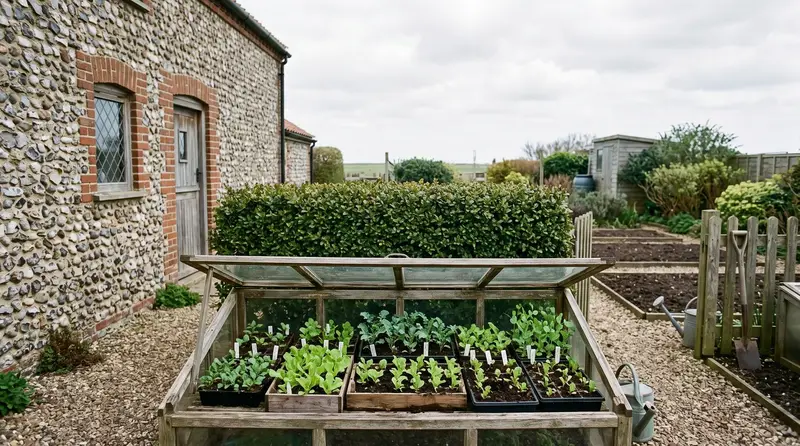
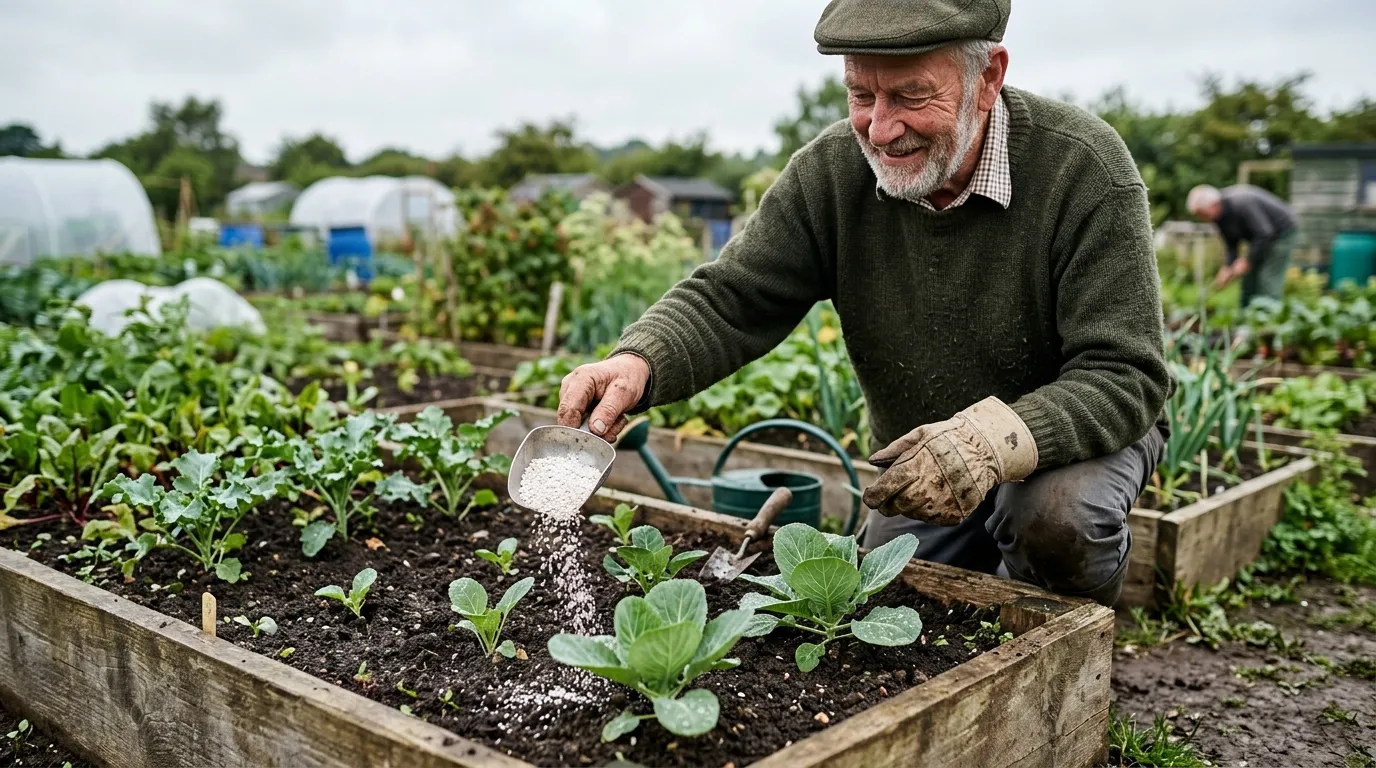 Dolomite lime applied around brassica seedlings in a Yorkshire raised bed. Dolomite supplies magnesium alongside calcium and is the preferred lime where soil Mg tests below 50mg/kg.
How to Test Soil pH Before Liming
Lime application without a pH test is a guess. The £8 spent on a kit pays back every time by preventing over-liming.
Three test options for UK gardens:
Chemical kit (£6-£12). A small bottle of indicator solution and a colour chart. Mix a teaspoon of soil with distilled water and 4-6 drops of indicator. Compare the colour after 30 seconds. Accurate to ±0.3 pH units. Available from any UK garden centre under brand names like Sudbury, Murphy, or Westland.
Electronic pH meter (£15-£35). A metal probe inserted into damp soil. Reads in 60 seconds. Accurate to ±0.2 pH units when properly calibrated. Calibrate every 6 months with buffer solutions (£8 a set). The Bluelab and Lusterleaf models are the reliable choices.
Lab analysis (£20-£40 per sample). Send a sample to a UK soil lab for a full report including pH, organic matter, nitrogen, phosphorus, potassium, magnesium, and trace elements. NRM Laboratories and Eurofins Agro both serve UK home gardeners. The detail is worth the cost for a new allotment or a problem plot.
Take samples from 5-7 spots across the bed, mix them in a clean bucket, then test. A single-spot sample misses bed-wide variation. UK plot pH can vary by 0.5-0.8 units across a 5-metre bed.
Test in spring (March) and autumn (October). Avoid testing within 12 weeks of a recent lime or sulphur application - the result will be skewed. Read the UK government soil testing guidance for context on regional UK soil acidity patterns.
Garden Lime Month-by-Month Calendar UK
| Month | Task |
|---|---|
| January | Order lime for late winter top-up. Calculate from previous October’s pH test. |
| February | Apply lime to potato-free beds where pH is below 6.0. Rake into the top 50mm of soil. |
| March | Take spring pH readings. Adjust the year’s liming plan if pH has dropped sharply. |
| April | No liming. Beds being planted with seeds or seedlings should already be at target pH. |
| May | Spot-treat any acidic patches with hydrated lime (small amounts only). |
| June | Watch brassicas for early club root symptoms (wilting in dry weather). |
| July | No liming on growing crops. |
| August | Plan autumn liming. Mark beds that need attention. |
| September | Order lime. Buy a fresh pH test kit. |
| October | Main liming window. Apply ground limestone after clearing crops. |
| November | Continue liming through the month. Avoid frozen ground. |
| December | Final liming opportunity before deep winter. Take year-end pH readings. |
The October dressing is the cornerstone of UK garden liming. A single autumn application at the right rate carries most beds for 2-3 years.
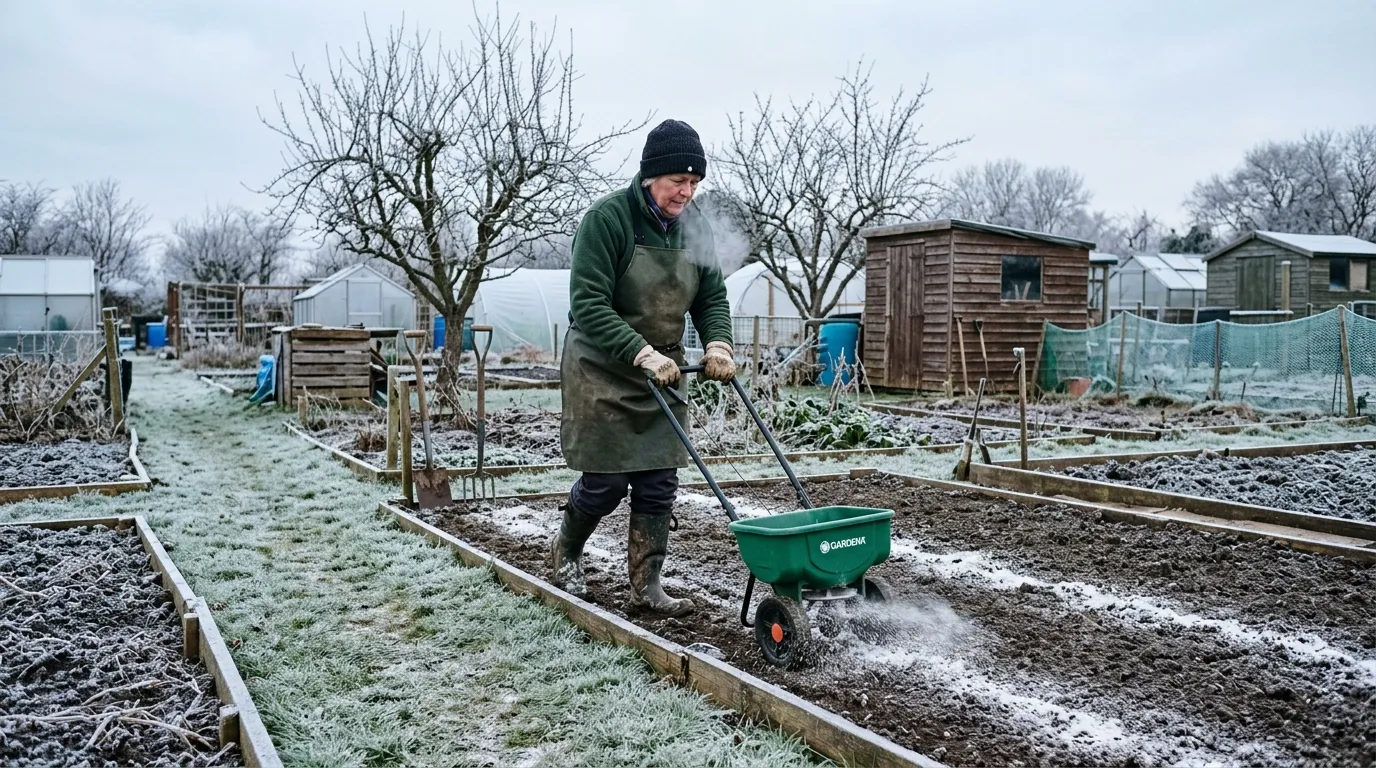 A hand-held drop spreader gives more even coverage than hand-broadcasting on beds larger than 10 square metres. Cost £25-£45 from a UK garden machinery supplier.
Common Garden Lime Mistakes UK Gardeners Make
Mistake 2: mixing lime with manure. The ammonia reaction loses 20-40% of the manure’s nitrogen content within 48 hours. Both inputs become less effective. Always split lime and manure by at least 12 weeks, ideally a full growing season. Garden Organic’s soil management guidance reinforces this rule for any organic vegetable system.
Mistake 3: applying lime at sowing. Lime dust burns young roots. Seedlings transplanted into freshly limed soil show stunted growth and pale foliage for 2-3 weeks. Apply at least 8 weeks before planting, ideally 12.
Mistake 5: hand-broadcasting hydrated lime on a windy day. Hydrated lime is caustic. Wind-blown dust burns skin, eyes, and respiratory tract. It also lands on neighbouring acid-lover beds and kills blueberries within a season. Use hydrated lime only on still, damp days, with eye protection, gloves, and a dust mask.
Why UK Clay Soils Go Acid
The root cause of pH drift in UK vegetable plots is calcium loss to rain. UK rainfall averages 850-1,200mm per year. Most rain has a pH of 5.0-5.6 (mildly acidic from dissolved CO2 and trace sulphur dioxide). This rain carries calcium ions down through the topsoil and away into drainage.
A typical UK loam loses 20-40kg of calcium per hectare per year to leaching. That works out to 2-4g per square metre. Over 25 years without lime, a clay bed loses enough calcium to drop pH from 6.5 to 5.5.
Three other factors accelerate the drop:
Ammonium fertilisers (sulphate of ammonia, blood, fish and bone) leave acid residues. A regular fish-blood-bone schedule drops pH faster than no feeding at all.
Plant uptake. Brassicas, fruit bushes, and potatoes all remove calcium from the soil in their tissues. A 10-tonne cabbage crop per hectare removes 30-50kg of calcium.
Organic matter decomposition. As compost breaks down, it produces humic and fulvic acids. These mild organic acids lower pH gradually.
The combined effect: most UK vegetable plots drop pH by 0.1-0.2 units per year without intervention. After 5 years unlimed, a plot started at pH 6.5 sits at 5.5-6.0. After 10 years, it falls to 4.8-5.2, where most vegetable yields collapse.
For larger plots, the agricultural-grade ground limestone from a UK quarry merchant works at one-third the cost, provided the grind is described as “fine” or “garden grade.” Coarse agricultural grades sold for arable fields can take 18-24 months to react in a garden bed.
Frequently asked questions
When is the best time to apply garden lime in the UK?
Apply garden lime in autumn after harvest, October to November. Lime needs 8-12 weeks to react with the soil before spring planting. Autumn rain washes calcium ions down into the rootzone. Apply at least 8 weeks before any brassica or onion planting for best results.
How much garden lime per square metre should I use?
Use 200-300g per m² on UK clay, 100-200g on loam, 50-100g on sand. The exact rate depends on current soil pH. To raise pH by 0.5 units on average clay needs roughly 250g of ground limestone per square metre. Always test pH first.
Can I apply lime and manure at the same time?
No. Lime reacts with manure to release ammonia gas and lose nitrogen. Apply manure in autumn, lime in late winter, or split by a full season. The minimum safe gap is 12 weeks between the two. Mixing them wastes both inputs.
What is the difference between ground limestone, dolomite and hydrated lime?
Ground limestone (calcium carbonate) is the safe default, slow-acting, no magnesium. Dolomite lime contains calcium and magnesium, used where Mg is low. Hydrated lime (calcium hydroxide) is caustic, very fast-acting, used only to clear pH quickly or sterilise diseased soil. Never use hydrated lime annually.
Does garden lime stop club root in brassicas?
Lime suppresses club root by raising pH above 7.0. Plasmodiophora brassicae spores germinate poorly in alkaline soil. Apply 300g/m² of ground limestone 8 weeks before planting brassicas. Lime does not cure existing infection but reduces new spore germination significantly across one season.
How often should I test garden soil pH?
Test soil pH every 2 years on stable plots, annually on new ground. Use a simple chemical test kit costing £6-£12, or an electronic pH meter for £15-£35. UK rain is mildly acidic, so most plots drift downward in pH by 0.1-0.2 units per year without intervention.
Which plants should I never lime?
Never lime around acid-loving plants: blueberries, rhododendrons, azaleas, camellias, heathers, pieris, and conifers. These plants need pH 4.5-5.5. Lime damages their nutrient uptake and causes leaf yellowing. Keep limed beds at least 1.5 metres from acid-lover borders.
Now plan your rotation around your soil
Our team produces practical UK gardening guidance from source research, contributor records and established horticultural practice. Editorial standards are overseen by Matt W.