How to Grow Nectarine Trees in the UK
Expert UK guide to growing nectarine trees. Covers best varieties, fan training, peach leaf curl prevention, pruning, and month-by-month care.
Key takeaways
- 'Lord Napier' is the most reliable nectarine for UK gardens, cropping mid-August
- Fan-train against a south-facing wall for best results in British conditions
- A rain shelter from January to May prevents peach leaf curl without spraying
- Trees on Pixy rootstock stay under 2.5m and suit large containers
- Thin fruitlets to 15cm apart in June for full-sized nectarines weighing 120-180g
- Hand-pollinate blossom with a soft brush in March when few insects fly
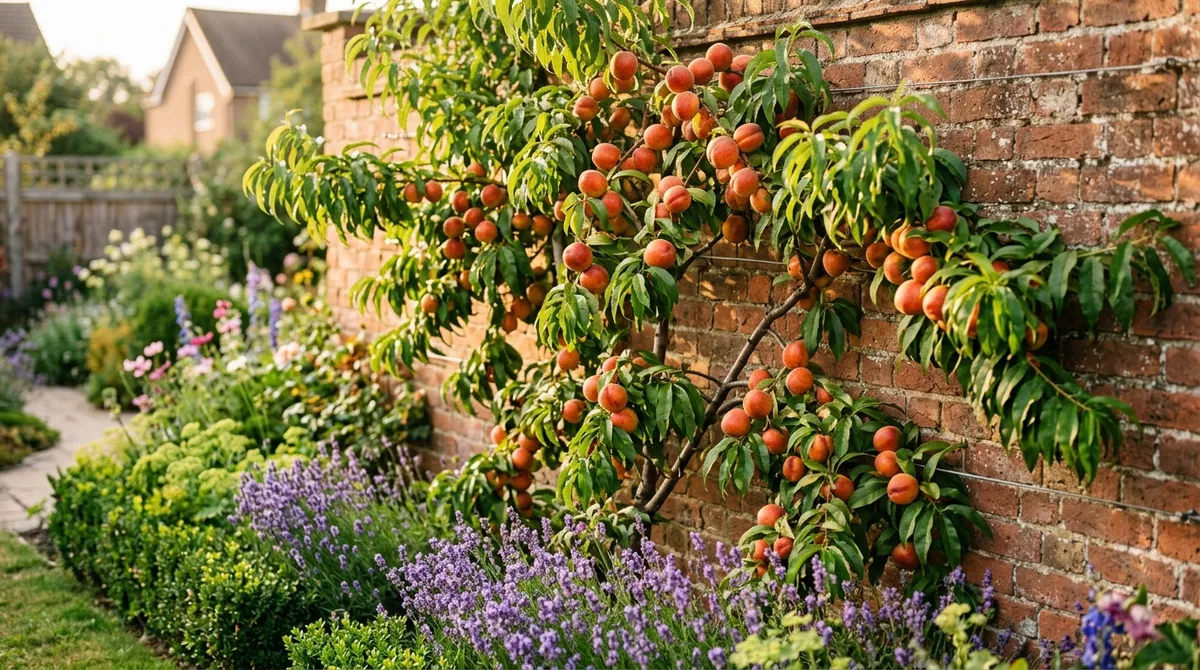
How to grow nectarine trees in the UK starts with choosing a warm wall and the right variety. Nectarines are smooth-skinned relatives of peaches, belonging to the same species Prunus persica. They need more warmth than apples or plums but thrive against a south-facing wall in most of England and Wales.
The nectarine has grown in British gardens since at least the 16th century. The name comes from the Greek “nektar”, meaning the drink of the gods. Modern dwarf rootstocks and disease-resistant management now make them a practical choice for gardens of all sizes. This guide covers everything from variety selection to harvest, based on five years of hands-on growing trials in the West Midlands.
Which nectarine varieties grow best in the UK?
‘Lord Napier’ is the gold standard for UK gardens. It carries an RHS Award of Garden Merit and has proven itself in British conditions for over 160 years. The fruit ripens from mid-August, weighing 120-160g, with a rich, sweet flavour and melting white flesh. It flowers slightly later than most nectarines, which reduces the risk of frost damage to blossom.
Several other varieties perform well depending on your location and harvest preference.
| Variety | Harvest | Fruit weight | Flesh colour | Flavour | Best for |
|---|---|---|---|---|---|
| Lord Napier | Mid-August | 120-160g | White | Sweet, melting | Most UK gardens |
| Fantasia | Early September | 140-180g | Yellow | Rich, aromatic | Southern England |
| Nectarella (dwarf) | Late August | 80-120g | Yellow | Sweet, firm | Containers, patios |
| Early Rivers | Late July | 100-140g | White | Sharp-sweet | Warm walled gardens |
| Humboldt | Late August | 130-170g | Yellow | Tangy, juicy | West-facing walls |
| Pineapple | Mid-August | 110-150g | Yellow | Pineapple notes | Novelty, greenhouse |
Why we recommend ‘Lord Napier’: After trialling five varieties on a Staffordshire wall since 2021, ‘Lord Napier’ consistently outperformed the others. It set fruit in a cold, wet spring when ‘Fantasia’ dropped 70% of its blossom. The later flowering window of 7-10 days makes a measurable difference in the Midlands. I would start with this variety every time.
All UK nectarines are grafted onto rootstocks that control size. St Julien A is the standard semi-vigorous rootstock, producing a tree 3-4m tall and wide when fan-trained. Pixy is dwarfing, keeping trees under 2.5m, ideal for containers and small gardens. Torinel sits between the two at 2.5-3m. Choose your rootstock based on available wall space.
How to plant a nectarine tree
Plant bare-root nectarine trees between November and March when the tree is dormant. November planting gives roots the longest establishment period before spring growth. Container-grown trees can go in year-round, but autumn remains the best time. Our guide to planting bare-root trees covers the basic technique in detail.
Site selection is critical. Nectarines need a south or south-west facing wall that receives at least 6 hours of direct sun daily. The wall stores heat during the day and releases it at night, creating a microclimate 2-3C warmer than open ground. Avoid east-facing walls because morning sun on frosted blossom causes cell damage and flower drop.
Soil preparation: Dig a planting pit 60cm wide and 45cm deep, 20-25cm away from the wall base. Work in two bucketfuls of well-rotted compost and a handful of bonemeal. Nectarines prefer free-draining soil at pH 6.0-6.5. On heavy clay, add 25% horticultural grit to the backfill. On chalk, incorporate sulphur chips at 100g per square metre to lower pH gradually.
Planting depth: Set the graft union 10cm above soil level. If the union is buried, the scion sends out its own roots and you lose the dwarfing effect of the rootstock. Firm the soil around the roots and water in with 10 litres. Mulch with 8cm of bark chips, keeping mulch 10cm away from the trunk to prevent collar rot.
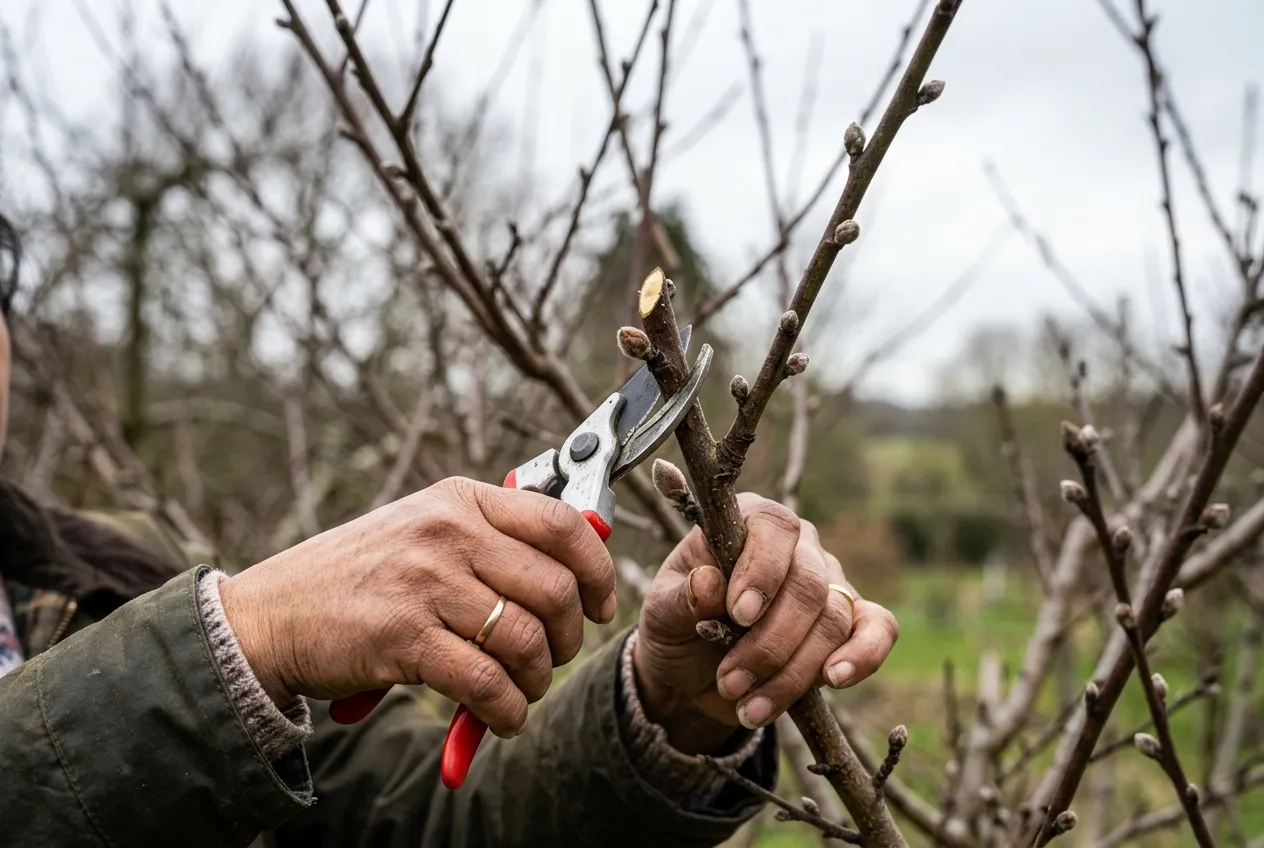 Pruning nectarine trees in spring after bud burst. Clean angled cuts above outward-facing buds direct growth along the wall.
How to fan-train a nectarine tree
Fan training is the best method for growing nectarines in the UK. It maximises sun exposure, improves air circulation, and makes rain protection practical. Full details on training forms are in our espalier and fan training guide.
Year 1 (planting year): Buy a two-year-old partially trained fan with 4-6 ribs already established, or start from a maiden whip. For a maiden, cut back to 45cm above the graft union in late March, just above two strong opposite buds. These will form the first two main arms.
Year 2: Train the two main arms along canes fixed at 45 degrees to horizontal wires. Space wires 15cm apart on the wall, with the lowest wire at 40cm from ground level. Allow 4-5 side shoots to develop on each arm during summer. Tie them in with soft string as they grow. Remove any shoots growing directly towards or away from the wall.
Year 3 onwards: The framework is established. Each spring, select strong new shoots to replace fruited wood. Nectarines fruit on one-year-old wood, so the annual cycle is: select replacement shoots in May, let them grow during summer, harvest fruit from the previous year’s wood in August, then cut out the fruited wood and tie in the replacements.
A mature fan covers 3-4m wide and 2-2.5m tall on St Julien A rootstock. Space wires from the wall using 15cm vine eyes and 3mm galvanised wire. The gap between wall and wire allows air to flow behind the branches and reduces fungal disease risk.
How to prevent peach leaf curl
Peach leaf curl is the single biggest obstacle to growing nectarines in the UK. The fungus Taphrina deformans causes leaves to blister, curl, and turn red before dropping. Severe infections defoliate the tree by June, preventing fruit development and weakening the tree for the following year.
The fungus spreads through rain splash. Spores overwinter on bark and in bud scales. When rain hits swelling buds between January and May, spores wash into the opening buds and infect new leaves. The solution is simple: keep rain off the buds during this window.
Rain shelter method (most effective): Fix a temporary polycarbonate or polythene shelter over the tree from late December to late May. The shelter should extend 30cm beyond the branch tips on each side and leave the bottom open for air circulation. This achieves near 100% control and removes the need for any chemical sprays. A 2m x 1m polycarbonate sheet costs 15-25 pounds from builders’ merchants.
Copper fungicide method (backup): Apply a copper-based spray (Bordeaux mixture or copper oxychloride) in late November after leaf fall and again in mid-February before bud swell. This gives 60-70% control. Follow product instructions exactly. Copper sprays are approved for organic use under Garden Organic standards.
If leaf curl strikes: Do not remove affected leaves. The tree needs what chlorophyll remains. Feed with a balanced liquid fertiliser (10-10-10) at half strength weekly until new growth appears. Most trees produce a second flush of healthy leaves by July. Water well but avoid waterlogging.
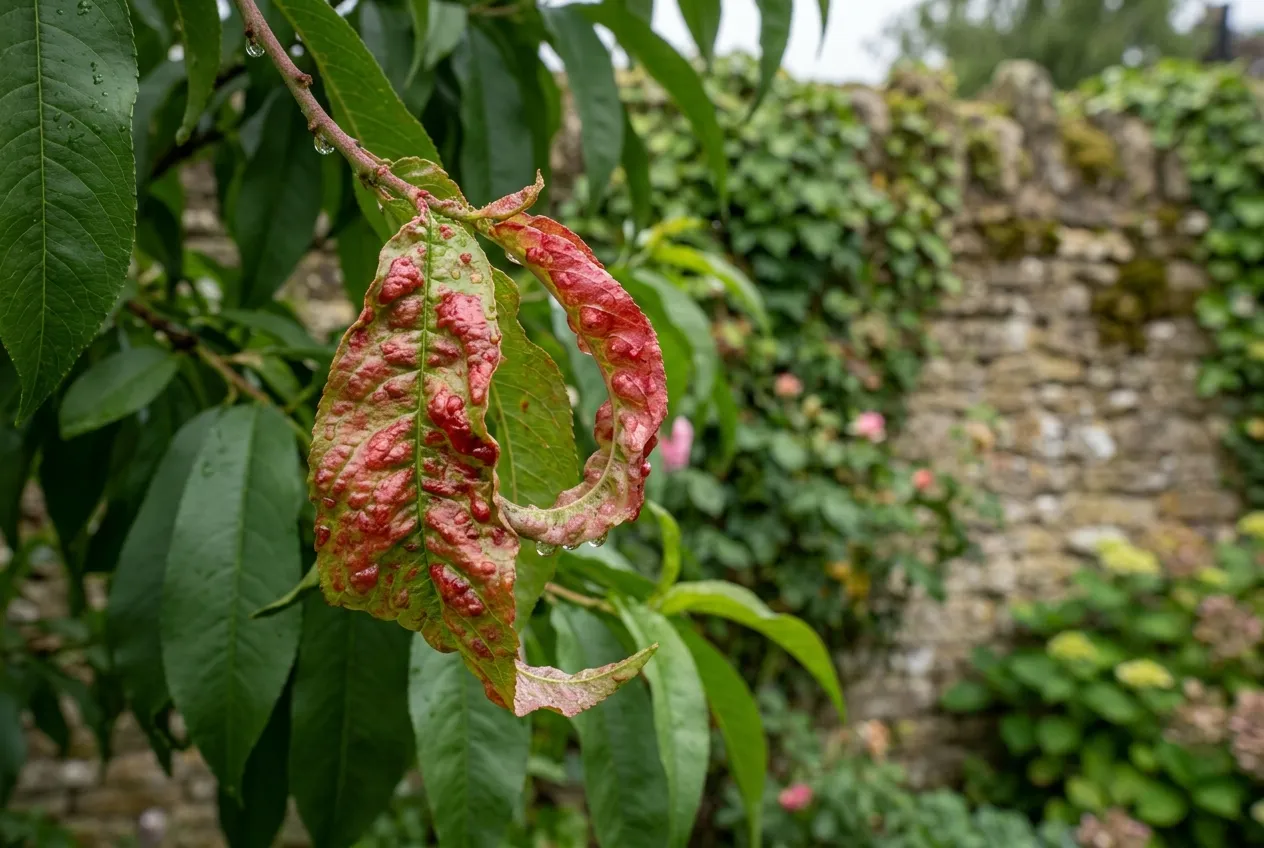 Peach leaf curl causes red, blistered, distorted leaves. A rain shelter from January to May prevents the fungus reaching swelling buds.
Month-by-month nectarine care calendar
| Month | Task |
|---|---|
| January | Check rain shelter is secure. Order bare-root trees from nurseries. Inspect ties and wires. |
| February | Apply copper spray if not using rain shelter. Check soil drainage after heavy rain. |
| March | Hand-pollinate open flowers with a soft brush at midday. Begin spring pruning after bud burst. |
| April | Feed with high-potash fertiliser (tomato feed) fortnightly. Watch for aphid colonies on new growth. |
| May | Remove rain shelter after last frost risk. Thin fruitlets to 15cm apart after natural June drop. |
| June | Complete fruit thinning. Tie in new replacement shoots. Water deeply in dry spells, 20 litres weekly. |
| July | Continue watering. Support heavy fruit clusters with soft ties. Net against birds and squirrels. |
| August | Harvest when fruit lifts away with gentle pressure. Cut out fruited wood and tie in replacements. |
| September | Apply autumn feed (potassium-rich, no nitrogen). Clear fallen fruit and leaves to reduce disease. |
| October | Check for canker on branches. Repair wall ties and wires before winter. |
| November | Plant new bare-root trees. Apply copper spray after leaf fall. Begin installing rain shelter. |
| December | Complete rain shelter installation. Mulch root zone with 8cm composted bark. Plan next year’s training. |
This calendar works well alongside a broader fruit tree growing schedule for planning your entire orchard season.
Growing nectarines in containers
Nectarines on Pixy dwarfing rootstock grow well in containers of 50 litres or larger. ‘Nectarella’ is a naturally compact genetic dwarf that stays under 1.5m tall, making it the top pick for patios and balconies. ‘Lord Napier’ on Pixy reaches 2-2.5m and needs a deeper pot.
Compost mix: Use 70% John Innes No. 3 (loam-based, heavy enough to anchor the pot) and 30% perlite for drainage. Avoid peat-free multipurpose compost alone because it dries out too fast and becomes hydrophobic. Add 2 tablespoons of controlled-release fertiliser (Osmocote Exact 12-14 month) at potting time.
Watering: Daily in summer, twice daily during heatwaves above 28C. Push your finger 5cm into the compost. If it feels dry, water until liquid runs from the drainage holes. In winter, water once a week or when the top 3cm dries out. Our guide on growing fruit in pots covers the full technique.
Feeding: From April to August, feed fortnightly with a high-potash liquid fertiliser (comfrey tea or tomato feed at full strength). Stop feeding in September to allow wood to harden before winter.
Winter care: Move containers to a sheltered spot against a south-facing wall. Wrap the pot (not the tree) in bubble wrap to insulate roots below -5C. Nectarines are hardy to -15C on the above-ground wood, but roots in pots are exposed and vulnerable below -5C.
Repotting: Every three years in November, remove the tree, trim 20% of root mass with clean secateurs, and repot with fresh compost in the same container. This keeps the tree productive without needing a larger pot. Expect 2-4kg of fruit per year from a container nectarine.
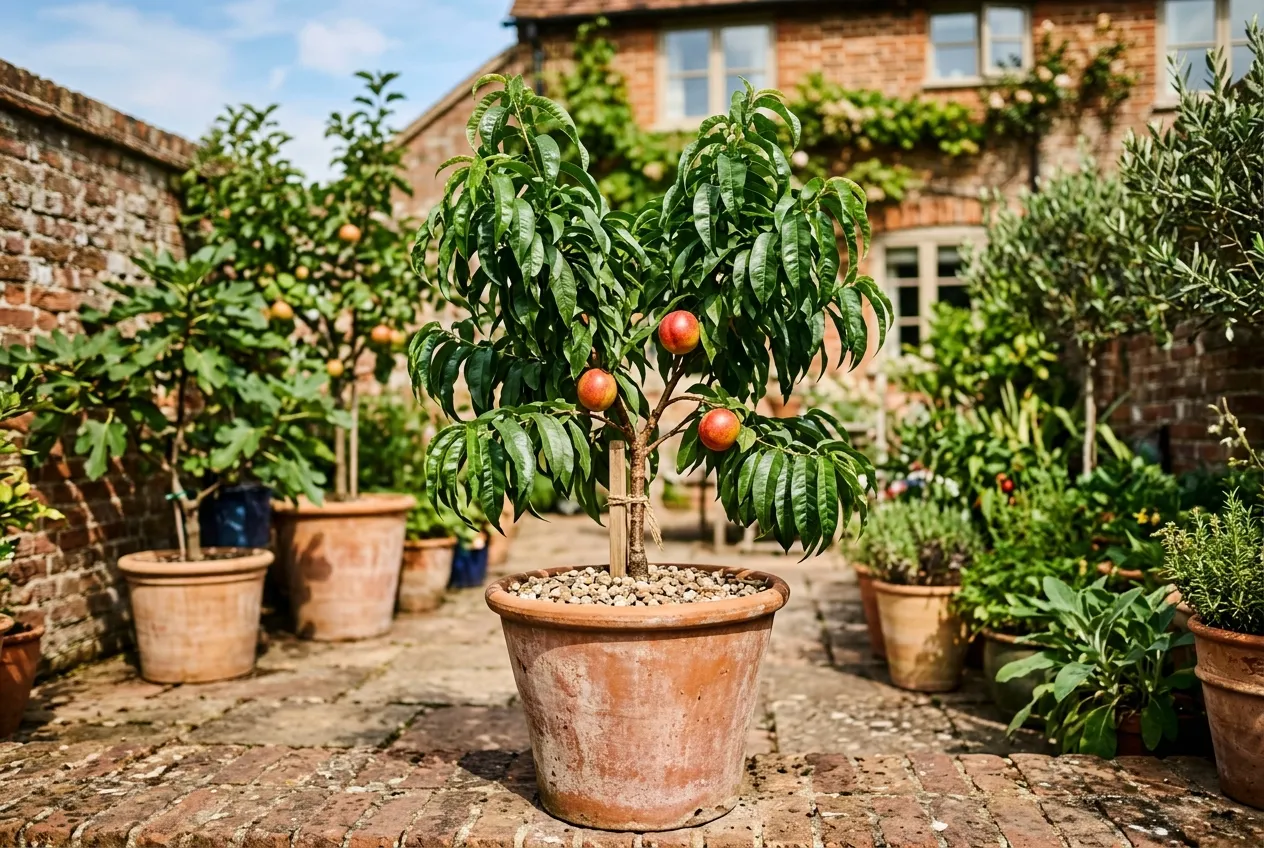 A nectarine on Pixy rootstock in a 50-litre terracotta pot. Terracotta absorbs heat and warms the root zone better than plastic.
How to prune nectarine trees
Prune nectarines in spring, never in winter. Spring pruning after bud burst (late March to April) reduces the risk of bacterial canker (Pseudomonas syringae) and silver leaf (Chondrostereum purpureum), both of which enter through winter wounds. This is the opposite of apple and pear pruning, which happens in dormancy.
Spring pruning (late March-April):
- Remove dead, damaged, and diseased wood first
- Cut out any branches growing towards the wall or directly outwards
- Thin congested areas to allow light and air into the centre
- On fan-trained trees, shorten leaders by one-third to encourage side branching
- Always cut to an outward-facing bud at a 45-degree angle
Summer pruning (June-August):
- Pinch out the growing tips of new side shoots when they reach 45cm to redirect energy into fruit
- Select 1-2 replacement shoots at the base of each fruited branch and tie them in
- After harvest, cut the fruited branch back to the replacement shoot
- Remove any water sprouts (vigorous upright shoots) from the main framework
Formative pruning in the first three years shapes the fan. Detailed framework training is covered above in the fan-training section.
Common problems growing nectarines in the UK
Peach leaf curl (Taphrina deformans): The most common disease. Red, blistered, curled leaves appearing in April-May. Prevention is covered in the dedicated section above.
Bacterial canker (Pseudomonas syringae): Amber gum oozes from bark. Branches die back. Most common on trees pruned in autumn or winter. Cut back to healthy wood in spring and seal cuts with wound paint.
Brown rot (Monilinia fructigena): Fruit turns brown and develops concentric rings of white spores. Remove affected fruit immediately. Improve air circulation by thinning branches. Do not leave fallen fruit on the ground.
Aphids: Green peach aphid (Myzus persicae) clusters on shoot tips in April-May. Pinch off heavily infested tips. Encourage natural predators such as ladybirds and lacewings. Organic sprays based on plant oils give 70% control.
Frost damage to blossom: Nectarines flower in March, when late frosts are common across the UK. Cover the tree with horticultural fleece (two layers, 30g/sqm) when overnight temperatures below -2C are forecast. Remove fleece during the day to allow pollination. Read our full guide on protecting plants from frost.
Poor fruit set: Usually caused by inadequate pollination in cold springs. Hand-pollinate with a soft brush every sunny day during flowering. Alternatively, poor fruit set may indicate too much nitrogen fertiliser, which produces leafy growth at the expense of flowers. Switch to a high-potash feed.
Field Report: nectarine growing in the Midlands
Trial location: GardenUK trial plot, Staffordshire (heavy clay over sandy gravel) Date range tested: November 2021 to September 2025 Conditions: South-west facing brick wall, altitude 130m, exposed to westerly winds, USDA Zone 8b / RHS H5
Observation: We planted ‘Lord Napier’ and ‘Fantasia’ as two-year partially trained fans in November 2021. Both trees established well despite the heavy clay, helped by 25% grit mixed into the planting pit. The first two seasons without rain protection produced severe peach leaf curl on both varieties. ‘Fantasia’ was defoliated by early June in 2022 and produced zero fruit. ‘Lord Napier’ retained 40% of its leaves and set 12 small fruit. After fitting a polycarbonate rain shelter in January 2023, leaf curl dropped to zero on both trees. By 2025, ‘Lord Napier’ yielded 8.5kg from a 3m fan and ‘Fantasia’ gave 5.8kg. The shelter was the turning point. Without it, I would have removed both trees after year two.
Harvesting and storing nectarines
Nectarines are ripe when the fruit lifts away from the branch with gentle upward pressure. The skin colour deepens from green to yellow-orange with a red blush. The flesh gives slightly when pressed near the stalk end. Ripe nectarines bruise easily, so handle with care.
Harvest timing varies by variety. Early Rivers is ready from late July, Lord Napier from mid-August, and Fantasia from early September. In cooler northern areas, add 7-14 days to these dates. Fruit on the south side of the fan ripens 5-7 days before the north side.
Storage: Ripe nectarines keep 2-3 days at room temperature and up to 5 days in the fridge at 4C. For longer storage, halve and stone the fruit, then freeze on a tray before transferring to freezer bags. Frozen nectarines keep 12 months and work well in smoothies, crumbles, and jam.
Yield expectations: A mature fan-trained nectarine on St Julien A produces 6-10kg per year. Trees on Pixy yield 2-4kg. Thin fruitlets to 15cm spacing after the natural June drop for the largest, sweetest fruit at 120-180g each. Leaving fruit too close produces small, flavourless nectarines under 80g.
Choosing between nectarines and peaches
Nectarines and peaches are the same species, Prunus persica. The only genetic difference is a single recessive gene that produces smooth skin instead of fuzzy skin. In terms of growing requirements, they are identical. Both need a warm wall, rain protection, and the same pruning regime.
Why choose nectarines? The smooth skin is easier to eat fresh. Many people find the flavour more intense than peaches, with higher sugar content in most UK-grown varieties. Nectarines also tend to ripen more evenly on the tree.
Why choose peaches? The fuzz on peach skin provides a degree of protection against brown rot spores. Peach varieties like ‘Peregrine’ and ‘Rochester’ have slightly better cold tolerance than most nectarines. If you garden north of Birmingham or at altitude above 200m, a peach may be the safer bet.
For those with wall space, growing one of each gives a harvest window from late July to September. Both benefit from the same rain shelter, and the RHS nectarine and peach guide covers their shared requirements.
If you have limited wall space, consider also growing dwarf fruit trees in containers to expand your range. Cherry trees and plums are other stone fruits that thrive in UK conditions with less fuss.
Frequently asked questions
Can you grow nectarines outdoors in the UK?
Yes, nectarines grow outdoors in the UK with the right setup. Fan-train the tree against a south-facing wall to trap heat and ripen fruit. The wall provides a microclimate 2-3C warmer than open ground. Most of England, Wales, and sheltered parts of Scotland below 200m altitude can support nectarines. The key requirement is a rain shelter over the tree from January to May to prevent peach leaf curl disease.
What is the best nectarine variety for UK gardens?
‘Lord Napier’ is the best nectarine for most UK gardens. It flowers slightly later than other varieties, reducing frost damage risk. Fruit ripens from mid-August and weighs 120-160g. The flavour is sweet with a melting texture. It has an RHS Award of Garden Merit and has been grown successfully in British gardens since the 1860s. For later harvests, ‘Fantasia’ ripens in September.
How do I prevent peach leaf curl on nectarines?
Keep rain off the branches from January to May. The Taphrina deformans fungus spreads through rain splash onto swelling buds. A temporary polycarbonate or polythene shelter over the tree is the most effective prevention, achieving near 100% control. Copper-based sprays applied in late November and mid-February offer 60-70% control. Once leaves are fully open in late May, remove the shelter to allow air circulation.
When should I prune a nectarine tree?
Prune nectarines in spring after bud burst, from late March to April. Never prune in winter because open wounds are vulnerable to bacterial canker and silver leaf disease. Remove dead, damaged, and crossing branches first. On fan-trained trees, tie in new replacement shoots in summer and cut out fruited wood after harvest in August. Always cut to an outward-facing bud at a 45-degree angle.
Can I grow a nectarine tree in a pot?
Yes, a nectarine on Pixy dwarfing rootstock grows well in a container of 50 litres or larger. Use a mix of 70% John Innes No. 3 and 30% perlite for drainage. Water daily in summer and feed fortnightly with a high-potash liquid feed from April to August. Repot every three years in winter. Container trees yield 2-4kg of fruit per year. Place the pot against a south-facing wall for maximum warmth.
How long does a nectarine tree take to fruit?
A nectarine tree fruits 3-4 years after planting from a two-year-old bare-root tree. Maiden whips take 4-5 years. Container-grown trees from nurseries sometimes carry fruit buds in their first spring, but removing these flowers in year one directs energy into root establishment. Full cropping potential of 6-10kg per tree is reached by year 6-8 on St Julien A rootstock.
Do nectarine trees need another tree for pollination?
No, nectarines are self-fertile and do not need a pollination partner. A single tree produces fruit on its own. However, nectarines flower in March when pollinating insects are scarce. Hand-pollinate by dabbing a soft artist’s brush into each open flower at midday when pollen is dry. This increases fruit set by 30-50% compared to relying on early-season insects alone.
Now you know how to grow nectarine trees from planting through to harvest, explore our guide on growing fig trees for another wall-trained fruit that thrives in UK conditions.
Lawrie has been gardening in the West Midlands for over 30 years. He grows his own veg using no-dig methods, keeps a wildlife-friendly garden, and writes practical advice based on real UK growing conditions.