Key takeaways
- Oral comfrey supplements have been illegal to sell in the UK since 2003 under the Medicines for Human Use Order 2002
- Topical over-the-counter comfrey creams were withdrawn in 2009 following an MHRA position statement on pyrrolizidine alkaloid (PA) exposure
- Homemade salve for personal use on intact skin is lawful in the UK but should not be applied for more than 4-6 weeks at a stretch
- Never use comfrey on broken skin, open wounds, mucous membranes, or for children under 12, pregnant or breastfeeding women, or anyone with liver disease
- The helpful compound is allantoin (around 0.6-0.8% dry weight in leaves); the dangerous compound is PA (up to 2.3% dry weight in roots)
- Wear nitrile gloves when making salve to limit cumulative PA absorption through the skin during preparation
Comfrey (Symphytum officinale) carries one of the oldest reputations in British herbal medicine. The medieval name knitbone hints at the practical use: a fresh leaf poultice or root paste packed on a bruise, a sprain or a slow-healing fracture. The herb appears in Anglo-Saxon leechdoms, in Culpeper’s Complete Herbal, and in early twentieth century home remedy books from across the British Isles. For a long time it was treated as a quiet kitchen-garden staple alongside lavender, calendula and chamomile.
Modern toxicology has changed the picture. The compounds that give comfrey its healing reputation (chiefly allantoin) come packaged with another group of compounds called pyrrolizidine alkaloids that are toxic to the human liver. The Medicines and Healthcare products Regulatory Agency (MHRA) banned the sale of oral comfrey supplements in the UK in 2003 and over-the-counter creams in 2009. Personal topical use on intact skin remains lawful but should be approached as a short-acting first-aid tool, not a daily wellness product.
This guide covers what the science says, what the law says, what is safe in a UK garden context and what is not. It also covers a working salve recipe, a poultice method, and the cases where comfrey is the wrong tool and an alternative herb is better.
The safety position UK gardeners need to know first
The most important section of this article sits at the top because too many older herb books, blogs and videos still treat comfrey as a universal remedy. The pharmacology says otherwise.
Comfrey contains pyrrolizidine alkaloids, or PAs. The main ones in Symphytum officinale are echimidine, lasiocarpine, symphytine and intermedine. When PAs are absorbed into the bloodstream (orally, through an open wound, or through repeated large-area topical application) the liver metabolises them into reactive intermediates that damage the small blood vessels of the liver. The clinical syndrome is called hepatic sinusoidal obstruction syndrome (formerly veno-occlusive disease). It has been documented in case reports going back to the 1980s, including a UK case of a woman who drank comfrey tea daily and developed liver failure.
That is the reason for the layered UK restrictions:
- 2003. Oral comfrey supplements (capsules, teas marketed as remedies, tinctures) were prohibited from sale under the Medicines for Human Use (Marketing Authorisations Etc) Amendment Regulations.
- 2009. Over-the-counter comfrey-containing topical creams were removed from sale following an MHRA position statement on PAs in topical herbal products. The MHRA accepted that older preparations had been used widely and recommended phased withdrawal.
Personal use of garden-grown comfrey for your own home topical preparations on intact skin remains lawful. It is treated by the regulator as analogous to growing rhubarb or foxglove: the law restricts commerce, not what you do with plants in your own garden. The responsibility for safe use sits with you.
The non-negotiable rules for safe topical use are short:
- Intact skin only. Never on open wounds, grazes, cuts, surgical sites, mucous membranes or recently broken skin.
- Maximum 4-6 weeks continuous use, then stop.
- Not for children under 12.
- Not for pregnant or breastfeeding women.
- Not for anyone with diagnosed liver disease, hepatitis, or current chemotherapy.
- Not on large surface areas (no whole-leg or whole-back applications).
If any of those rules feel restrictive, that is the point. Treat comfrey like a short-acting first-aid tool and the risk profile drops sharply. Treat it like a daily moisturiser and the risk profile climbs.
A short history of comfrey as knitbone
The name knitbone tells the story of how the plant was used. Across medieval and early modern Europe, fresh chopped leaves or pulped roots were packed in a cloth and bandaged onto a fracture, a sprain or a deep bruise. The herb sat on the injury for hours, often overnight, and was changed every day or so until the swelling came down.
The Romans (Pliny the Elder) and the Greeks (Dioscorides) both wrote about Symphytum for wound closure. Anglo-Saxon herbals refer to it as cumfirige, the Latin Symphytum coming from sumphuein, to grow together. Culpeper described it in 1653 as “good to heal all inward hurts, bruises, wounds, ulcers” and recommended both internal and external use.
That internal use is what modern toxicology now rules out. The external use, applied short-term to a closed injury, was a practical first-aid tool when ice packs and ibuprofen did not exist. Some of the effect was the allantoin. Some of it was the warmth of the poultice, the immobilisation of the bandage, and the placebo of doing something. Comfrey was never magic. It was a herb that gave the body a small biochemical assist while the rest of recovery did the heavy lifting.
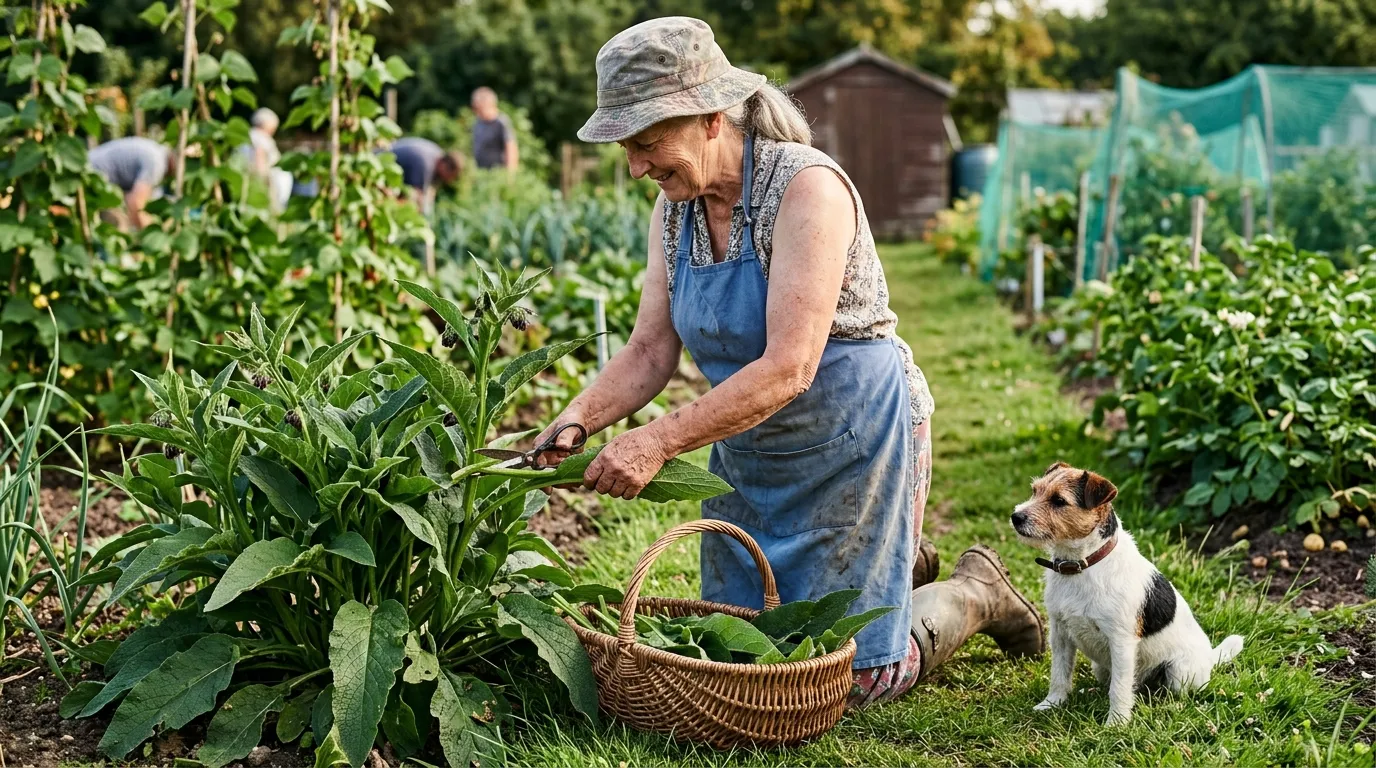
For more on growing the plant itself for compost and liquid feed (a separate, well-established use that has nothing to do with medicine) see the comfrey nettle feed recipe which uses Bocking 14 for fertilising vegetables.
The science of allantoin (the helpful compound)
Allantoin is a small nitrogen-containing molecule (C4H6N4O3) found across many plants and in the urine of most mammals. In comfrey leaf it sits at around 0.6-0.8% of the dry weight, and in fresh leaf sap at around 0.05-0.1%. Roots contain similar percentages. The molecule is colourless, odourless, water-soluble and stable to mild heat.
Two effects are documented in skin-care research:
- Cell-proliferation stimulant. Allantoin promotes the proliferation of fibroblasts, the cells that build new connective tissue. This is the basis of the wound-closure reputation.
- Keratolytic effect. Allantoin softens and exfoliates the outer layer of skin, allowing other compounds to absorb and easing dryness.
Allantoin is so well characterised that it is now manufactured synthetically and used in regulated UK skincare from supermarket hand creams to high-end dermatology preparations. The Cosmetic Ingredient Review panel and the EU Scientific Committee on Consumer Safety both consider synthetic allantoin safe at concentrations up to 2%. The substance itself is benign.
The trouble with whole-comfrey preparations is that the allantoin arrives with the PAs in the same plant material. You cannot easily separate the two in a home setting. The 2009 MHRA decision on creams was driven by exactly this point: regulated allantoin is fine, but PA-containing comfrey extracts are not.
The science of pyrrolizidine alkaloids (the dangerous compound)
The PAs in comfrey are a family of related molecules that exist in the plant largely as N-oxides (a slightly less toxic form). Once absorbed into a mammal’s body, liver enzymes (the CYP3A family) convert the alkaloids into reactive pyrrole intermediates that bind to liver cell DNA and protein, killing the cells that line the smallest blood vessels.
Some numbers from peer-reviewed analyses of UK comfrey:
| Plant part | PA content (mg/kg dry weight) | Risk if absorbed |
|---|---|---|
| Symphytum officinale roots | 12,000 to 23,000 (1.2-2.3%) | Highest |
| Symphytum officinale leaves (young) | 1,500 to 3,000 | High |
| Symphytum officinale leaves (mature) | 200 to 700 | Moderate |
| Bocking 14 (S. x uplandicum) leaves | 100 to 400 | Lower but present |
| Bocking 14 roots | 4,000 to 12,000 | Still high |
For comparison, the World Health Organisation suggests a tolerable daily PA intake of 0.007 micrograms per kilogram of body weight from food. A single cup of comfrey leaf tea brewed from 2g of dried leaf can deliver several thousand times that. Topical absorption is much lower (somewhere between 0.1% and 1% of the applied dose in most studies) but is still cumulative and rises with broken skin, larger surface areas, longer use periods and warm skin.
That is why the safe topical use rules above exist. They are not theoretical. They are derived from the same toxicology data that led to the UK bans.
The UK legal framework, plain English version
For a typical UK gardener, the legal position breaks down like this:
- You can grow comfrey. Both Symphytum officinale and the Bocking 14 cultivar are unrestricted and widely available.
- You can use your own plant material at home, on yourself, topically, on intact skin. This is treated as personal use of a garden plant.
- You cannot sell salves, creams, ointments or balms made with comfrey to anyone, friend or paying customer, without breaching the 2009 MHRA position and the Human Medicines Regulations 2012.
- You cannot sell or give away oral preparations (teas, capsules, tinctures, food products) containing Symphytum at all.
- You cannot make therapeutic claims about a comfrey salve in print, online or on a market stall.
The grey area is gifting. A jar of salve made for a friend with no payment is unlikely to attract regulator interest but is still legally murky. The cleanest position is: make it for yourself, label it clearly, and if a friend wants the same recipe, send them this article so they can make their own.
For wider context on regulated herbal preparations see the Medicines and Healthcare products Regulatory Agency guidance on herbal medicines and the NHS overview of herbal medicines safety.
What comfrey can safely help with
Within the narrow rules above, three short-term topical uses on intact skin are reasonable:
- Bruise compress. A cooled comfrey leaf poultice or salve rubbed gently on a fresh bruise (within 48 hours of impact). The allantoin and the cool/warm contact help reduce visible bruising over 3-7 days.
- Closed-skin sprain salve. A salve applied 2-3 times a day to a sprained ankle or wrist with no broken skin, for 5-7 days max.
- Closed-skin aching joint or muscle. A poultice or salve on a closed-skin muscle ache, applied for 1-2 weeks at most. After that, switch to alternative herbs or accept that the body’s own recovery is doing the work.
What comfrey must never be used for
The list of unsafe uses is longer and is the bit that often gets glossed over in older home-remedy books:
- No open wounds, cuts, grazes or surgical sites. PA absorption through broken skin is much higher than through intact skin and any wound infection risk goes up.
- No internal use of any kind. No teas, tinctures, capsules, smoothies, kombucha, vinegars, syrups. The 2003 ban applies to commercial products but the toxicology is the same whether you bought it or grew it.
- No use during pregnancy or breastfeeding. PAs cross the placenta and pass into breast milk.
- No use on children under 12. Their developing liver enzymes process PAs less safely and their skin absorbs more per kilogram.
- No use over more than 4-6 weeks continuously. PA absorption is cumulative.
- No use on mucous membranes (eyes, lips, inside the mouth, genital area).
- No use on large body areas. Patch on a wrist, ankle or bruise, not a whole limb.
- No use alongside other PA-containing herbs (butterbur, coltsfoot, borage, certain Senecio species). Cumulative exposure matters.
If you have a diagnosed liver condition, are on regular paracetamol, are receiving chemotherapy or have hepatitis, do not use comfrey topically at all. Use calendula salve from a regulated brand instead, or speak to a registered herbalist via the National Institute of Medical Herbalists.
A safe homemade comfrey salve recipe
Ingredients (makes 3 x 60ml jars)
- 30g dried mature comfrey leaves (Symphytum officinale or Bocking 14 leaves are both acceptable for this purpose, avoid using roots)
- 240ml cold-pressed extra-virgin olive oil
- 30g pure beeswax (food-grade, pellets or grated block)
- 3 amber or dark glass 60ml jars with screw lids
- Printed waterproof labels
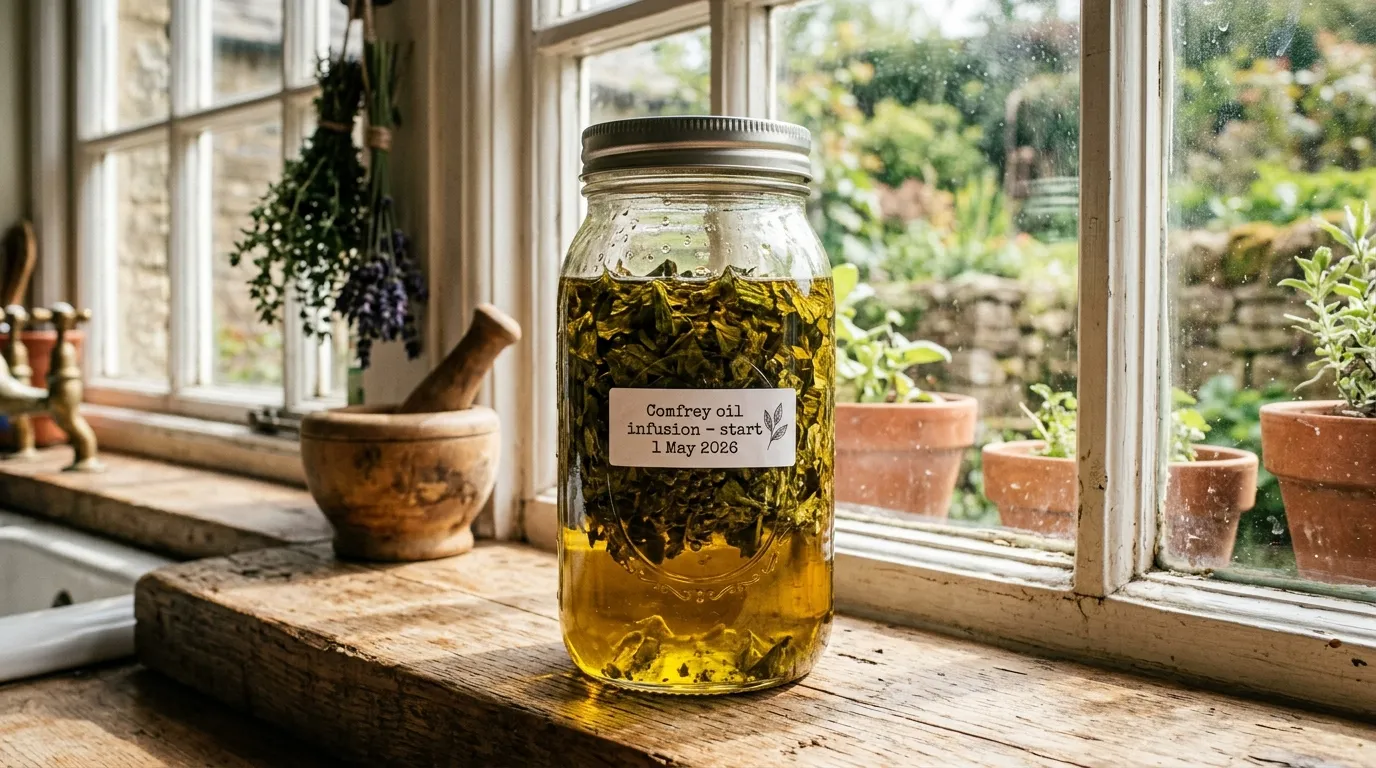
Method, oil infusion (4 weeks slow or 6 weeks sunny window)
- Harvest mature comfrey leaves in late spring or early summer when allantoin content is at its peak. Wear nitrile gloves throughout to limit skin absorption during prep.
- Wash, pat dry and chop the leaves coarsely. Spread on a wire rack in a warm dry room and dry for 7-10 days until they crumble cleanly. Skipping the dry step traps water in the oil, which spoils faster.
- Pack the dried leaves into a clean dry mason jar. Pour the olive oil over to fully submerge the leaves with a 1cm margin.
- Slow-cooker method: place the jar in a slow cooker on its lowest setting, with water around the jar to a depth of 5cm, and hold at around 40C for 4 weeks. Check water level daily.
- Sunny window method (slower): seal the jar tightly and place on a south-facing kitchen windowsill for 6 weeks. Turn the jar once a day.
- After infusion, strain through muslin into a clean jug, squeezing the leaves to extract as much oil as possible. Compost the spent leaf material.
Method, salve assembly
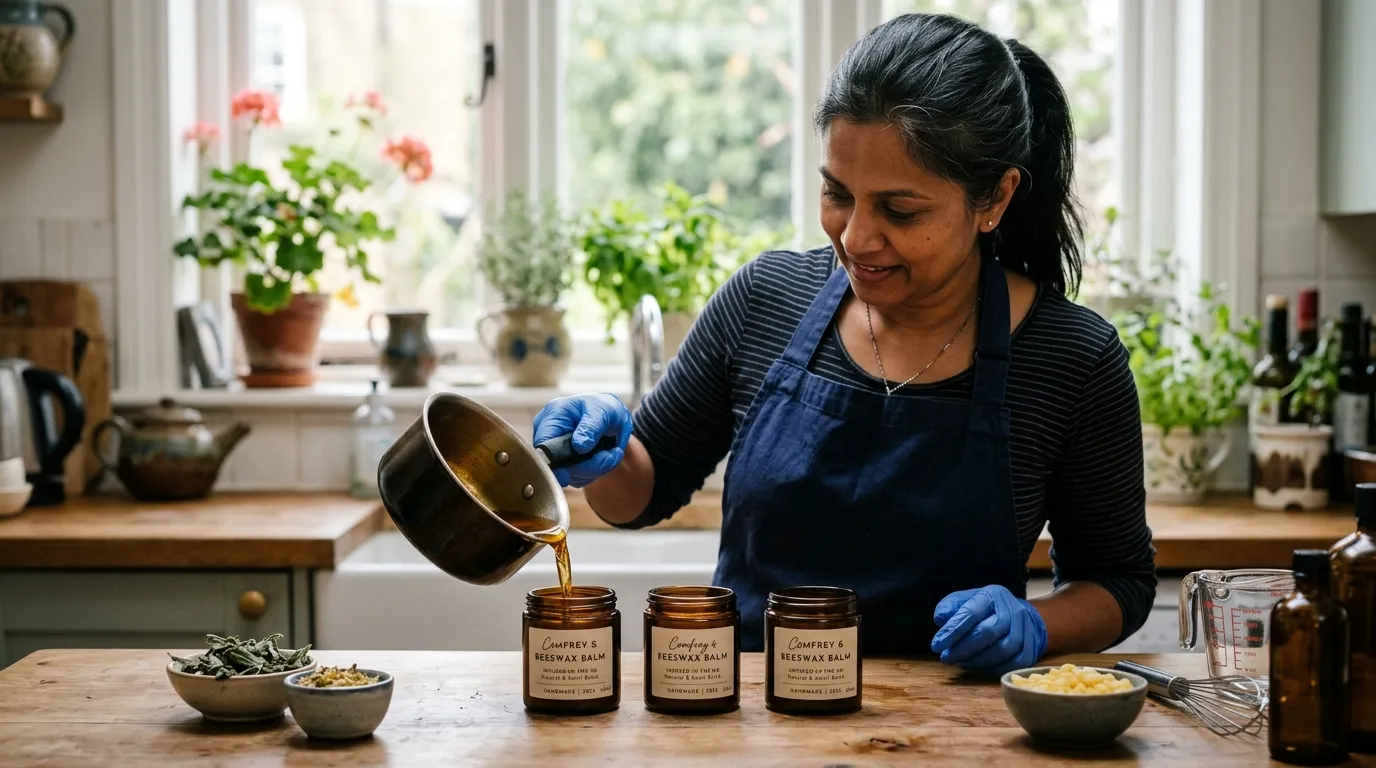
- Warm the strained oil gently in a clean pan or double boiler to 40-50C. Do not exceed 60C or the allantoin degrades.
- Add the beeswax (30g per 240ml oil = 1g per 8ml, which gives a firm but spreadable salve). Stir until the wax fully melts.
- Test the consistency: spoon a few drops onto a cold saucer and let it cool for 1 minute. If too soft, add more wax. If too hard, add more oil.
- Pour into the three 60ml amber jars immediately while still liquid. Leave to cool uncovered for 30 minutes, then lid and label.
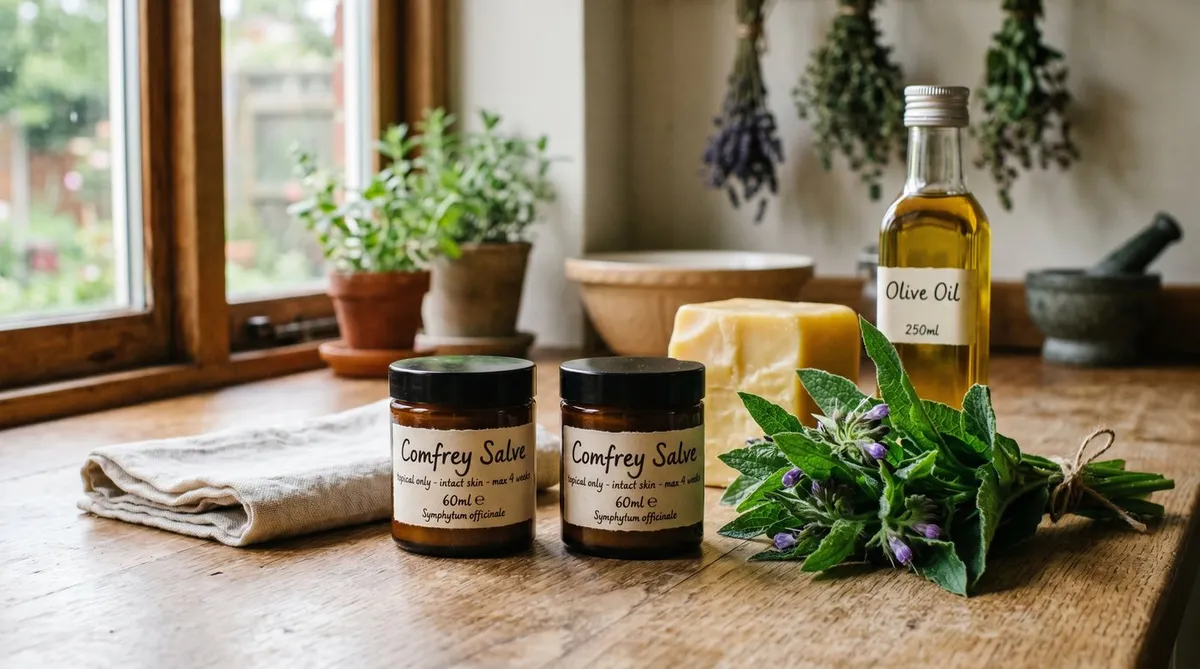
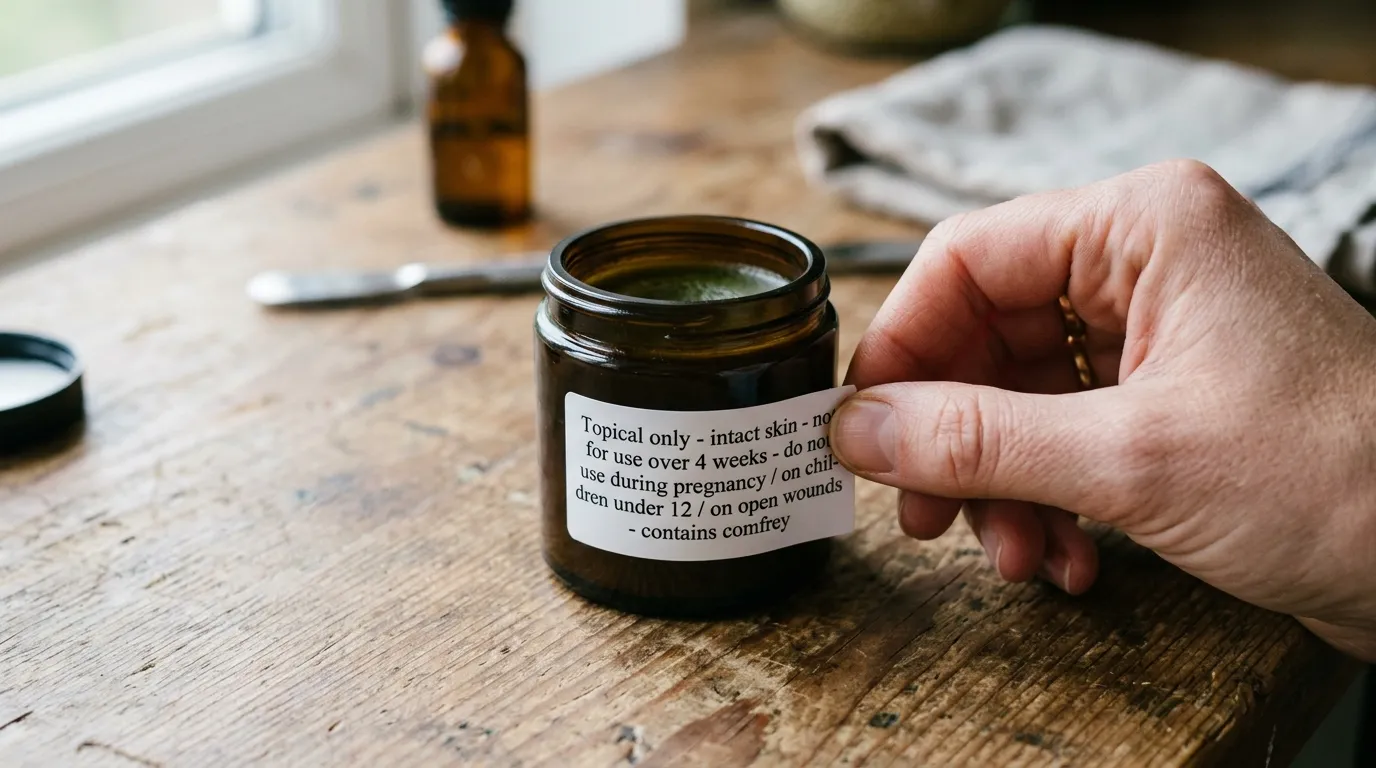
- Label every jar with the full caution wording: “Topical only - intact skin - not for use over 4 weeks - do not use during pregnancy / on children under 12 / on open wounds - contains comfrey.” Add the make date.
Storage and shelf life
Store in a cool dark cupboard. Each 60ml jar should be used within 12 months of making, ideally within 6 months. If the oil smells rancid at any point, discard the jar.
A fresh-leaf poultice method for short-term use
When you have just bruised, sprained or strained something and you have access to a growing comfrey plant, a fresh-leaf poultice gives the most direct effect. The allantoin and mucilage in the freshly bruised leaf transfer to the skin within minutes.
The basic method:
- Cut three or four mature comfrey leaves with gloves on. Wash and pat dry.
- Chop coarsely and place in the centre of a square of clean muslin or unbleached cotton.
- Pour just-boiled water over the leaves to wilt them (5-10 seconds, no longer) and let the excess water drain off.
- Fold the muslin into a parcel and let it cool until merely warm to the wrist (around 40-45C).
- Place on the bruised or sprained area (intact skin only) and secure with a crepe bandage or stretchy tape.
- Change every 4 hours, or sooner if the parcel cools. Use for no more than 48 hours of repeated application.
This is the classic knitbone poultice, scaled to UK kitchen reality. It does not replace medical care for anything serious. A suspected fracture, a deep cut, a swelling that is not improving after 48 hours or any change in skin colour beyond bruising should be assessed by NHS 111 or an A&E.
Comfrey vs arnica vs calendula, a quick comparison
The honest reading of this table for most UK households: keep a regulated arnica gel and a regulated calendula cream in the cupboard year round, and treat comfrey as an optional short-term tool for the specific case of a fresh bruise or sprain on intact skin when you happen to have a salve to hand.
If you want a properly diverse home apothecary, the medicinal herb garden planting plan sets out which herbs are worth dedicating space to and which are best bought in regulated form.
When the right answer is not comfrey at all
A useful filter when reaching for a herb is to ask: is there a regulated, lower-risk alternative for the same problem? For most situations a UK home gardener encounters, the answer is yes.
- Fresh bruise. Regulated arnica gel from any pharmacy. Cheap, safe, well studied.
- Muscle ache. Magnesium oil or a regulated capsaicin cream. Hot bath with Epsom salts.
- Dry or irritated skin. Calendula cream, oat-based emollient, or a 1% allantoin-formulated synthetic cream (the active ingredient on its own, no PAs).
- Wound or graze. Saline rinse and a regulated antiseptic. Never apply herbal preparations to broken skin without specific advice.
- General aches and stress. Chamomile or lemon balm tea (regulated, safe). For more options see how to dry and store herbs and the growing herbs UK guide.
- Anti-inflammatory longer-term. Speak to a GP about regular use of ibuprofen or paracetamol, or consult a registered herbalist (NIMH).
That leaves a narrow window where comfrey is the best tool: a closed-skin bruise or sprain in an adult, where you already have a labelled jar to hand, and you are using it for less than two weeks.
Common questions from UK readers, answered
Some people tolerate PAs better than others depending on liver enzyme genetics, total dose, frequency and other liver stresses (alcohol, paracetamol, other medications). The point is that the dose-response is unpredictable and the harm when it does occur (veno-occlusive disease) is severe and sometimes irreversible. The MHRA could not write regulations that depend on individual liver genetics, so they regulated the whole category. The grandmother’s experience does not change the pharmacology.
“What about Bocking 14, is it not safer?”
Bocking 14 (a sterile Russian comfrey cultivar bred by Lawrence Hills in the 1950s for compost and liquid feed use) has lower PA levels in the leaves than common comfrey, but still meaningful levels and high levels in the roots. The MHRA treats all Symphytum species the same in their topical and oral guidance. For Bocking 14 in the allotment it is excellent as a fertiliser plant. For the body, treat it with the same caution as common comfrey.
Within the UK, no licensed comfrey salve has been on the market since 2009. Imported salves from countries with looser regulations occasionally appear on online marketplaces. These are not legal to sell in the UK and the buyer has no quality assurance about PA levels, contamination, or correct labelling. The safest route is to make your own from named garden plants and label clearly.
“Is dried comfrey leaf safer than fresh?”
Dried leaf typically has slightly lower PA levels than fresh young leaf because some alkaloids degrade with drying, but the difference is small (10-20%) and is not enough to change the safety rules. Treat dried and fresh the same. Mature leaves harvested in mid to late season have lower PA levels than young spring leaves and are preferable for any topical use.
How to label every jar (and why labels matter)
Half the risk of homemade preparations is the jar that gets passed to a guest, taken on holiday, or used six months later when the user has forgotten what it is. A clear, durable, full-text label fixes most of that.
A working label includes:
- The herb (Comfrey, Symphytum officinale, leaf)
- Date made
- “Topical only - intact skin”
- “Not for use over 4 weeks continuous application”
- “Do not use during pregnancy or breastfeeding”
- “Not for children under 12”
- “Not on open wounds, broken skin or mucous membranes”
- “Not for use with diagnosed liver disease”
- A use-up date (12 months from making)
Print on waterproof label stock with a permanent black pen backup of the make date and use-up date. Keep all jars in a labelled cupboard or tin separately from your regular skincare, so there is zero chance a household member grabs the wrong jar in the dark.
What to grow next to comfrey in a kitchen herb plot
A working kitchen herb garden in the UK benefits from having comfrey near the back as a tall perennial backdrop, with lower-toxicity medicinal and culinary herbs in front. Useful neighbours that are safer for everyday use:
- Calendula (pot marigold), a gentle topical herb, edible petals, easy from seed.
- Lemon balm, a calming tea herb, safe in pregnancy, attractive to pollinators.
- Chamomile (Roman or German), useful for tea and topical use, low PA risk family.
- Thyme, culinary, mild antibacterial, easy to dry.
- Lavender, fragrance, mild topical use, dries well for sleep pillows.
- Rosemary, culinary and mild stimulant, woody perennial.
This mix gives you a useful day-to-day herbal toolkit where comfrey sits as one specific tool for one specific purpose, not the centrepiece. Most weeks you will reach for chamomile or calendula. Comfrey is a once-in-a-while jar.
A short word on conservation and slug damage
Comfrey is one of the easier perennials to grow in the UK. It tolerates heavy clay, partial shade, drought and waterlogging. It dies back fully in winter and re-emerges in spring at terrifying speed. A single mature plant can produce 1.5kg of fresh leaf per cut, three to five cuts per year.
The plant is excellent for pollinators (the tubular pink-purple flowers are loved by bumblebees in May and June) and is a deep tap-rooted accumulator that pulls minerals from subsoil. Common comfrey self-seeds enthusiastically, which is why most allotment growers prefer Bocking 14 (sterile, no seedlings). Either is fine for medicinal leaf if you observe the safety rules.
If you only want one or two plants for occasional salve making, plant in a contained spot away from delicate borders, because the leaves get large and shade out smaller herbs nearby. A 1m by 1m square is enough for a small household.
Related guides
For the wider medicinal herb plot setup see growing a medicinal herb garden in the UK and the standard how to grow herbs UK guide. For everyday herbal beverages (the safe oral side of the herb cupboard) see making herbal teas from the garden and how to dry and store herbs for keeping your jars stocked through winter. For the more practical fertiliser side of the same plant see how to make comfrey nettle feed, which uses Bocking 14 for the vegetable plot rather than the medicine cabinet. For a garden-design view of where to put a herb bed see allotment herb bed UK.
Sister deep dives in the comfrey cluster: the growing and using comfrey UK pillar is the master reference covering species selection (Bocking 14 vs officinale), site, harvest cycle and 10 uses across the garden. The Bocking 14 propagation guide covers the three vegetative methods to multiply your patch. The comfrey liquid feed recipe is the practical garden-feeding side of the same plant.
Comfrey earns its place as a small, well-labelled jar at the back of the cupboard, used short and used carefully. The medieval knitbone reputation is partly real, partly the placebo of doing something, and partly an artefact of a time before paracetamol and arnica gel. Treat the herb with the respect its pharmacology demands and it remains a useful, if narrow, tool. Treat it as a daily wellness product and the pharmacology will eventually push back.
Our team produces practical UK gardening guidance from source research, contributor records and established horticultural practice. Editorial standards are overseen by Matt W.