Key takeaways
- Grass restarts growth at 6C soil temperature, which sets the first cut date
- Parsnips need 7C, carrots 8C and beetroot 10C to germinate reliably
- Measure at 5cm depth at 9am on three mornings before you sow anything
- A soil thermometer costs GBP 8 to 15 and prevents most March sowing failures
- Set the mower to 40mm for the first cut, never the summer 25mm
- Frost risk runs to late May everywhere in the UK, including the south coast
Knowing what to do in the garden in March is less about the date than the temperature under your boots. March is the month the garden restarts, and the trigger is soil warmth. Most March failures come from sowing into ground still sitting below 7C, where seed sits, swells and rots rather than germinates. The air can read 14C on a bright Tuesday while the soil at 5cm is barely 5C.
This guide runs the month by threshold rather than by tradition. It covers measuring soil temperature, the first lawn cut, sowing hardy annuals and vegetables, planting shallots and early potatoes, pruning roses and hydrangeas, dividing perennials, mulching, slug control and greenhouse ventilation. Regional timings are included throughout, because a Bristol garden and an Aberdeenshire garden are three weeks apart in March.
Why soil temperature decides your March jobs
Soil temperature is the master variable in spring. Seeds respond to the warmth around them, not to the air above. Cold soil slows enzyme activity inside the seed, so germination stretches from days into weeks. During that delay soil fungi and slugs get first go at the seed, which is why a cold March sowing so often produces a thin, gappy row.
Measure at 5cm depth, which is the working zone for most seeds. Take the reading at 9am, before the sun has skewed the surface. Do it on three consecutive mornings and use the lowest figure. One warm afternoon does not make a warm seedbed.
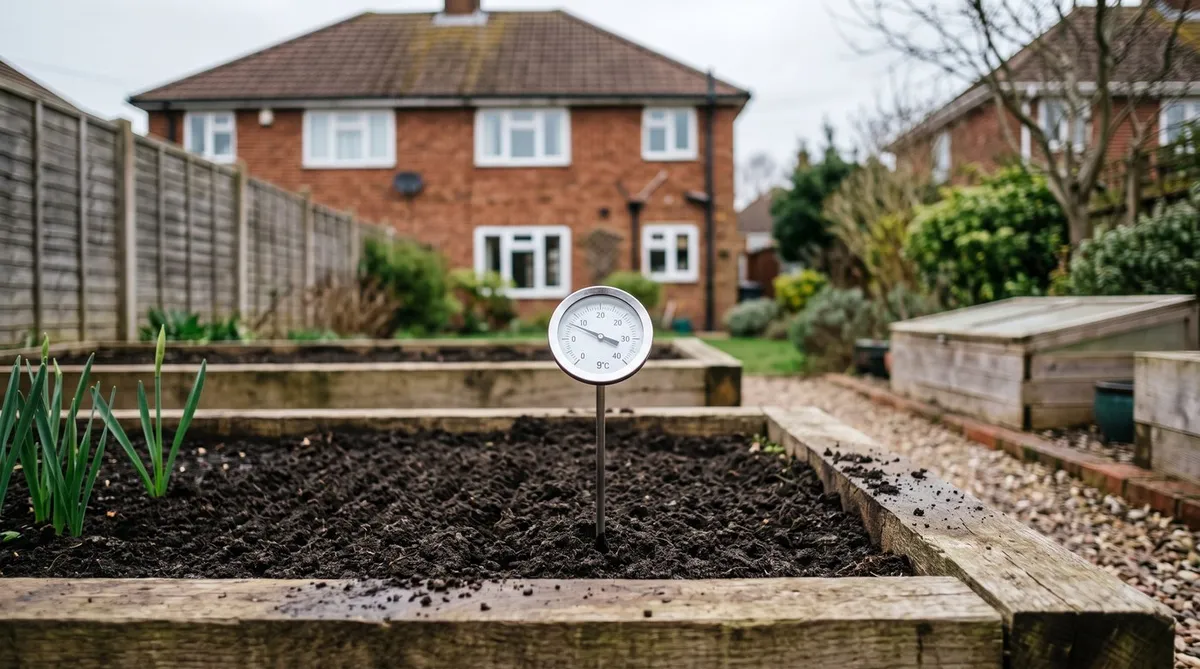
A basic soil thermometer costs GBP 8 to 15 from any garden centre. A digital probe with a stainless stem runs GBP 15 to 25 and gives a reading in about 20 seconds. Either is fine. What matters is that you own one, because guessing is where the money goes.
Raised beds and light sandy soils run 2 to 4C warmer than surrounding heavy clay in early March. A south-facing bed against a wall can sit 3C above an open plot 10 metres away. Measure the bed you actually intend to sow, not a convenient patch by the shed.
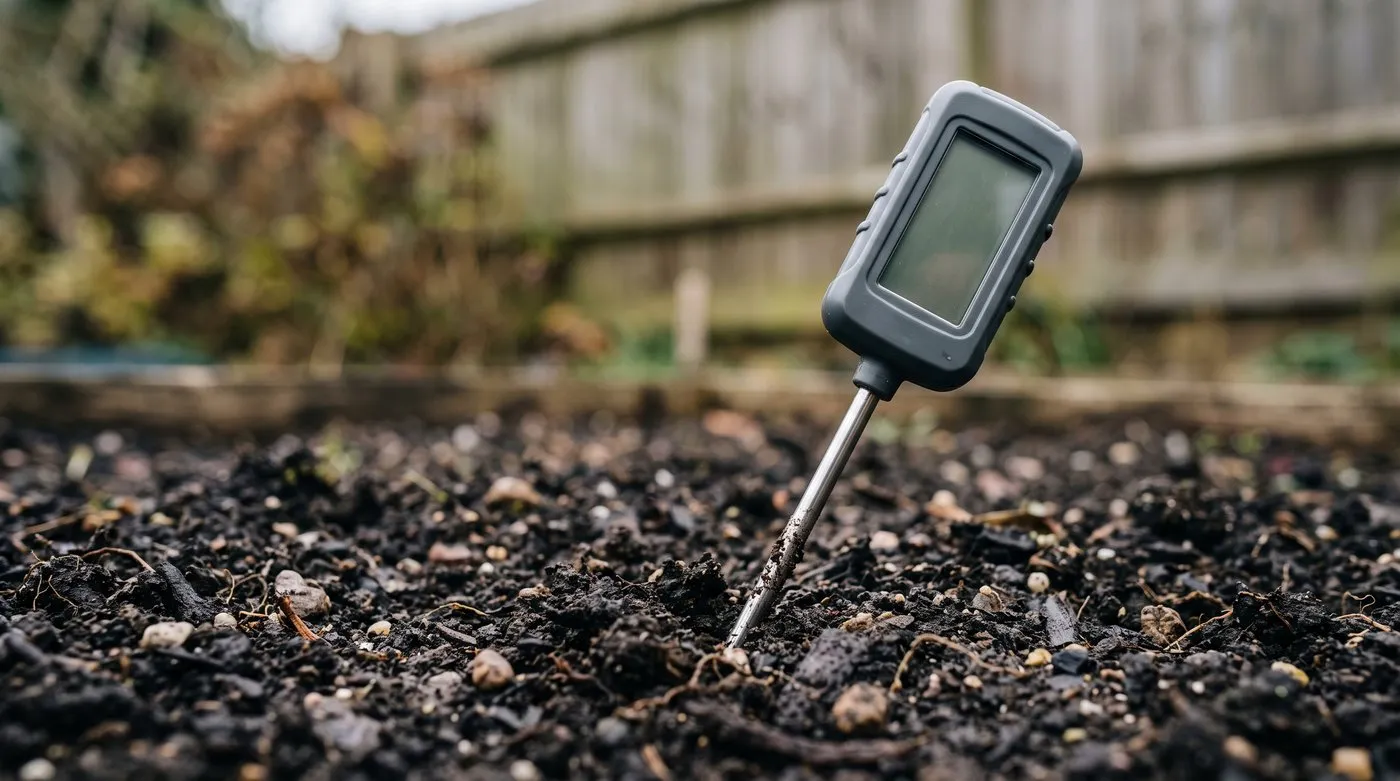 A digital probe reading 7.4C at 5cm depth in a Bristol raised bed. Take three mornings of readings at 9am and work from the lowest.
Soil temperature thresholds for March sowings
Hardy annual flowers are more forgiving. Calendula, nigella, cornflower and poppies germinate from 8C and tolerate a check. For the full sowing list by crop, our companion planting list for March sets out the varieties, and the full seed germination temperature table covers everything else you might start this month.
Regional timing across the UK
March runs at different speeds across Britain. These are the dates at which soil at 5cm typically reaches 7C in an open, level bed, averaged over the last decade.
| Region | Soil hits 7C | First lawn cut | Earliest safe carrot sowing | Last air frost |
|---|---|---|---|---|
| Cornwall and south Devon | Late February | Early March | Mid-March | Mid-April |
| Bristol and the south west | 8 to 14 March | Second week March | Late March | Late April |
| London and the south east | 10 to 16 March | Second week March | Late March | Mid-April |
| Midlands | 18 to 25 March | Third week March | Early April | Early May |
| North west and Yorkshire | Late March | Late March | Mid-April | Mid-May |
| Scotland, lowland | Early April | Early April | Late April | Late May |
| Scotland, upland and Pennines | Mid-April | Mid-April | Early May | Late May or June |
The spread between Cornwall and upland Scotland is roughly six weeks. National gardening advice written for the south will have Aberdeenshire gardeners sowing into 4C mud. Adjust every date you read, including the ones in this article, by your own thermometer.
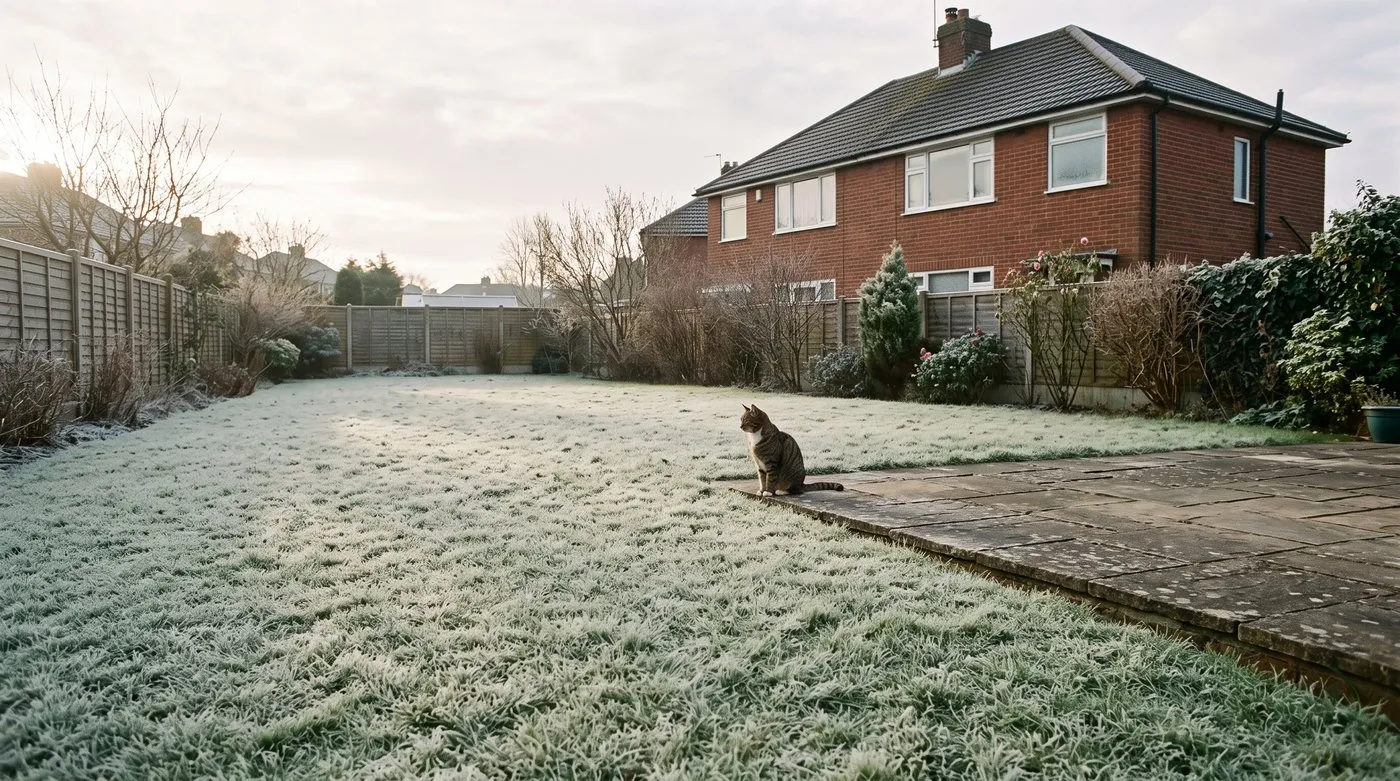 Ground frost in the second week of March. The grass had already started growing, which is normal: soil at 6C and air below zero happen on the same morning all month.
The first lawn cut and when to feed
The first cut is a March job in most of England and a late-March or April job further north. Grass restarts growth at a soil temperature of 6C, so use that as your trigger rather than a date.
Set the mower to 40mm. Summer height of 25mm is far too low for a first cut and scalps a sward that has been sitting flat and wet for four months. Never remove more than a third of the leaf in one pass. Bring the height down by about 5mm a week over the following six weeks until you reach your summer setting.
Mow only when the surface is dry enough to walk on without leaving a print. Cutting a saturated lawn tears the grass, compacts the soil and clogs the deck. Our guide to the first lawn cut after winter covers the wet-ground judgement in detail.
Hold the spring feed until you have cut twice. Feeding grass that is not yet growing wastes the nitrogen to leaching, and on a wet March that can be most of the bag. A high-nitrogen spring feed at 35g per square metre costs about GBP 20 for 400 square metres. Applied in the third week of March in Bristol, or mid-April in Perthshire, it works. Applied on 1 March anywhere, much of it ends up in the water table.
Gardener’s tip: Do not scarify or aerate in the same fortnight as the first cut. The turf needs three or four cuts of active growth behind it before it can recover from that level of damage. Mid-April is early enough for most UK lawns, and late April is safer in the north.
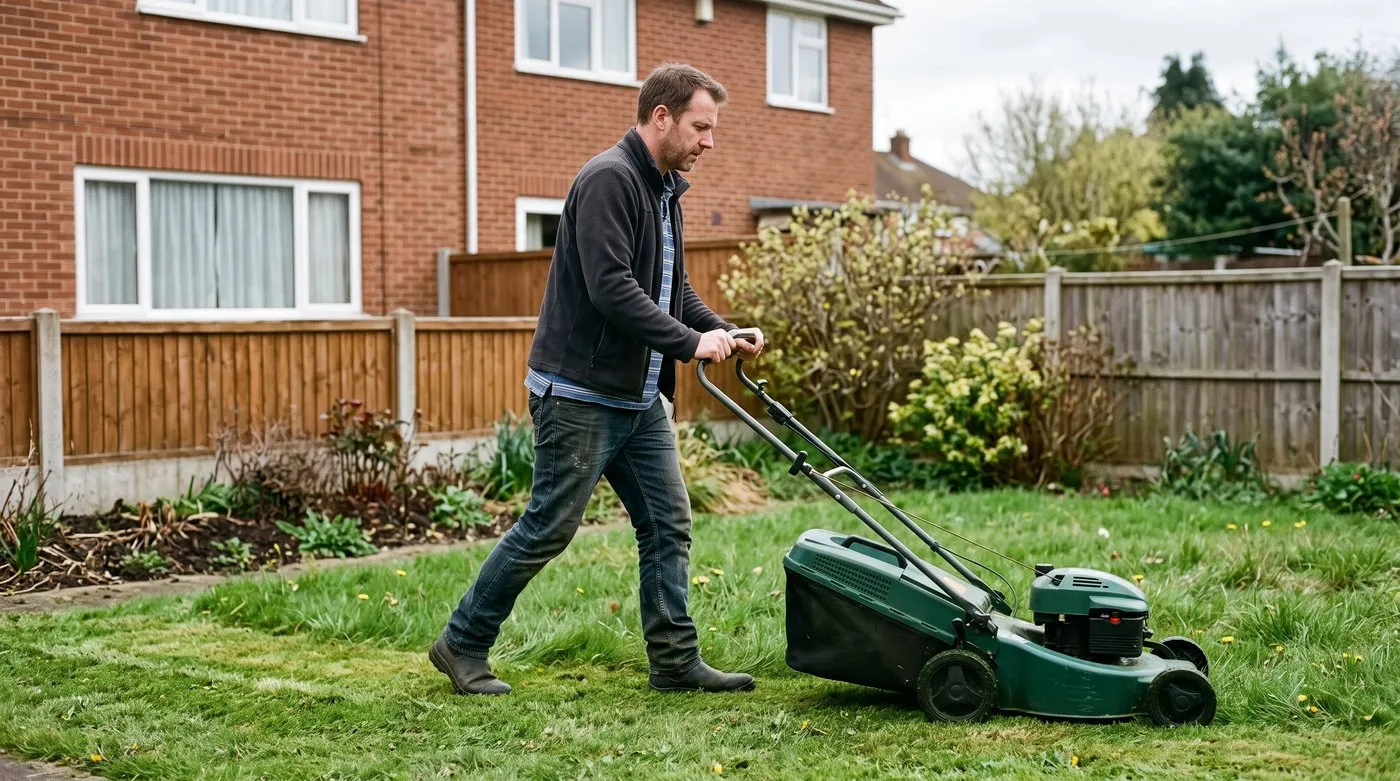 The first cut of the year on a Bristol suburban lawn, blade set to 40mm. The clippings are short because only the top third of the leaf has been taken.
Sowing under cover and direct in March
March splits neatly into two sowing streams. Under cover means a heated propagator, windowsill or unheated greenhouse. Direct means straight into outdoor soil that has passed its threshold.
Under cover in March, start tomatoes at 18 to 21C, chillies at 21 to 25C and aubergines at 21C. These need consistent bottom heat. A windowsill above a radiator swings from 22C at 4pm to 11C at 3am, which is the main reason home-sown chillies fail. Leggy seedlings are a light problem, not a heat problem: they need 12 to 14 hours of bright light a day from germination.
Direct sowing in March covers broad beans, parsnips, early carrots under fleece, spinach, radish and hardy annual flowers. Rake to a fine tilth, sow at the depth on the packet, and firm gently. Cover carrot and parsnip rows with fleece: it lifts soil temperature by 2 to 3C and keeps carrot fly off the seedlings from the outset.
Sow thinly. Most gardeners sow at three to four times the rate they need, then thin reluctantly and end up with a congested row. Carrots at 1cm apart in the row, thinned to 4cm, gives a better crop than a solid ribbon of seedlings.
 Sowing a shallow drill in a Bristol raised bed in late March. Thin sowing now saves an hour of thinning in April and produces straighter roots.
Planting shallots, onion sets and early potatoes
March is the main planting month for the allium family and the first potatoes. All three are planted rather than sown, which makes them more forgiving of cool soil than seed.
Shallots go in from early March. Push each bulb in so the tip just shows, spacing 15cm apart with 30cm between rows. Birds pull newly planted sets out by the dry tops, so run fleece or netting over them for the first fortnight. Onion sets are planted the same way at 10cm spacing, 30cm rows.
First early potatoes go in from mid-March in the south and early April in the north. Plant chitted tubers 12cm deep, 30cm apart, in rows 60cm apart for earlies and 75cm for maincrop. Chitting for 4 to 6 weeks in a cool, light room before planting brings the harvest forward by around two weeks. Shoots should be 2 to 3cm and stubby, not long and white.
The frost risk is real once shoots break the surface. Earth up as soon as 10cm of growth shows, or throw fleece over on a forecast frost night. A blackened potato top in April is not fatal, but it sets the crop back three weeks. Timing by region is covered fully in our guide to when to plant potatoes in the UK.
Pruning roses, hydrangeas and penstemons
March pruning is driven by bud movement, not by the calendar. Prune as buds swell and begin to break, which in Bristol falls in the first fortnight and in Aberdeenshire in early April.
Bush roses are the headline job. Cut hybrid teas back to 20 to 25cm above ground, to an outward-facing bud, on a slight slope away from the bud. Floribundas take a lighter touch at 30 to 40cm. Remove any stem thinner than a pencil, all dead wood and any branch crossing through the centre. Our full rose pruning guide covers each rose type separately.
Hydrangeas split by species. Hydrangea paniculata and arborescens flower on new wood, so cut them hard to a framework of two buds from the base of last year’s growth. Hydrangea macrophylla, the mophead, flowers on old wood: remove only the spent heads down to the first fat pair of buds. Cutting a mophead hard in March costs you the entire summer’s flowers, which is the most expensive March mistake in the ornamental garden. The species-by-species detail is in our hydrangea pruning guide.
Penstemons get cut back to 15cm once new growth shows at the base, usually late March. Cutting them in autumn leaves them exposed and loses plants over winter. Leave the old top growth on until the new shoots are visibly away.
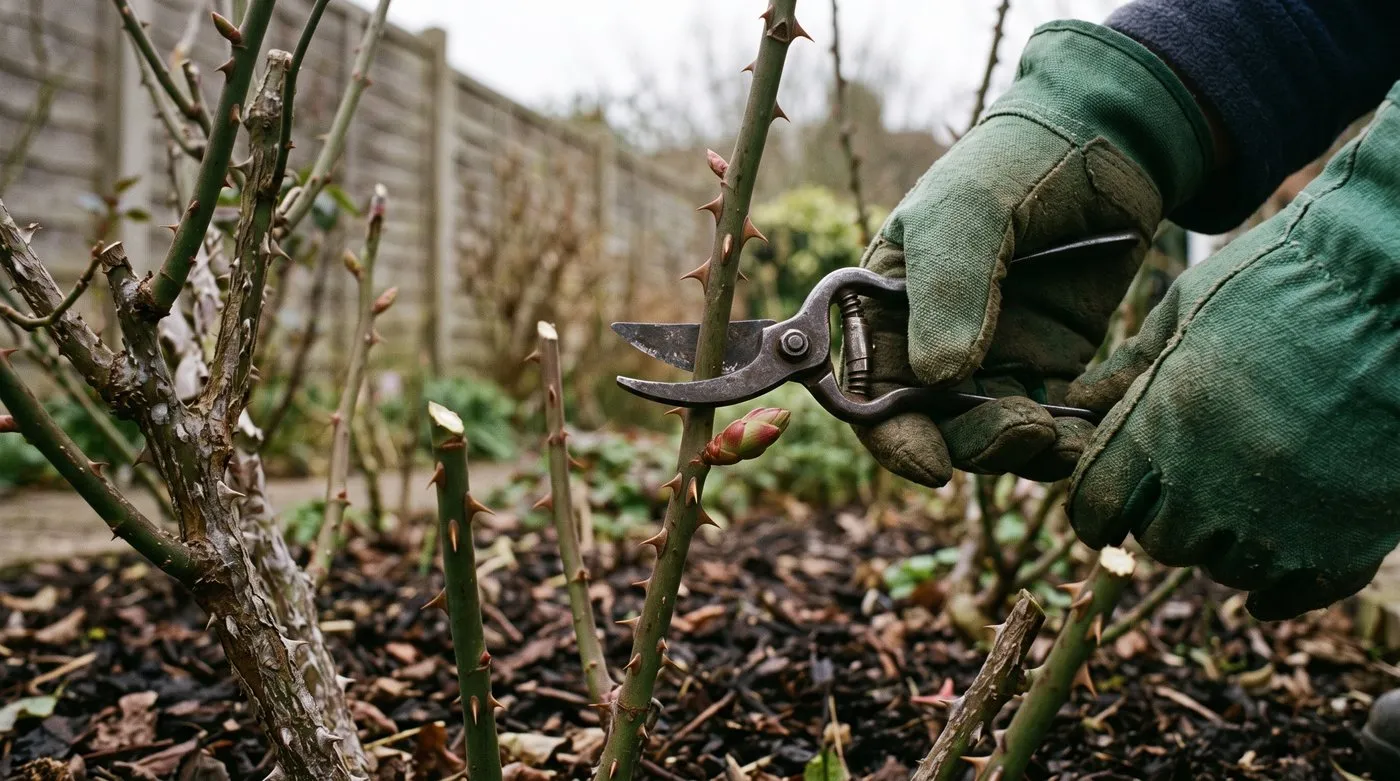 Pruning a hybrid tea to an outward-facing bud as the buds break. The cut is 20 to 25cm above ground and slopes away from the bud.
Dividing perennials and mulching after rain
Dividing perennials in March gives the divisions a full growing season to establish. Lift the clump with a fork, split it with two forks back to back or a spade, and discard the woody centre. The outer sections are the young, vigorous material. Replant at the same depth, water in, and expect flowering the same summer on most species.
Good March candidates are hosta, daylily, aster, heuchera, geranium and ornamental grasses once their new growth shows. Leave until autumn anything that flowers in spring, such as pulmonaria and primula. A clump split into four gives four plants worth GBP 8 to 12 each at retail, which is the best return on an hour’s work in the whole gardening year.
Mulching comes after the division and after rain. This ordering matters more than most people realise. Mulch does not add water: it holds what is already there. Spread a 5 to 7cm layer on dry March soil and you lock in the deficit for the whole season.
Wait for a week of proper rain, check the soil is wet to a spade’s depth, then mulch. Keep it 5cm clear of stems and trunks to avoid collar rot. Municipal green waste compost costs about GBP 4 to 6 per 40 litre bag, or GBP 45 to 70 per cubic metre delivered loose, which covers roughly 15 square metres at 7cm.
Warning: Never mulch with fresh woodchip straight onto a bed you are about to sow. Undecomposed chip locks up soil nitrogen at the interface as it breaks down, and seedlings go yellow within a fortnight. Stack fresh chip for 6 to 12 months, or use it only on paths and around established shrubs.
Getting ahead of slugs before the population builds
The single highest-value March job is slug control, because you are working on a population that has not yet exploded. Understanding the lifecycle explains why.
- Overwintering. Adults and eggs sit in soil crevices, under pots and in dense clumps of foliage through winter. A mild UK winter kills very few.
- Reactivation. At soil temperatures above 5C, adults resume feeding and move. This happens in most of England during the first fortnight of March.
- Egg laying. Each adult lays batches of 20 to 50 eggs, up to 400 in a season, in damp soil from mid-March onwards.
- Hatching. Eggs hatch in 14 to 28 days at 10 to 15C. The March eggs become the May juveniles that shred your bedding.
- Maturity. Juveniles reach breeding age in 3 to 12 months depending on species and conditions.
The critical mistake is starting control in May, when the damage appears. By then you are fighting the second generation. Acting in the first three weeks of March removes breeding adults before they lay, and every adult removed in March is 50 to 400 eggs that never happen.
Nematodes (Phasmarhabditis hermaphrodita) work from a soil temperature of 5C and last around six weeks per application, costing GBP 15 to 25 for 40 square metres. Beer traps, hand collection after dusk with a torch, and clearing overwintering debris all work at this stage. Our full guide to getting rid of slugs naturally ranks every method by effectiveness.
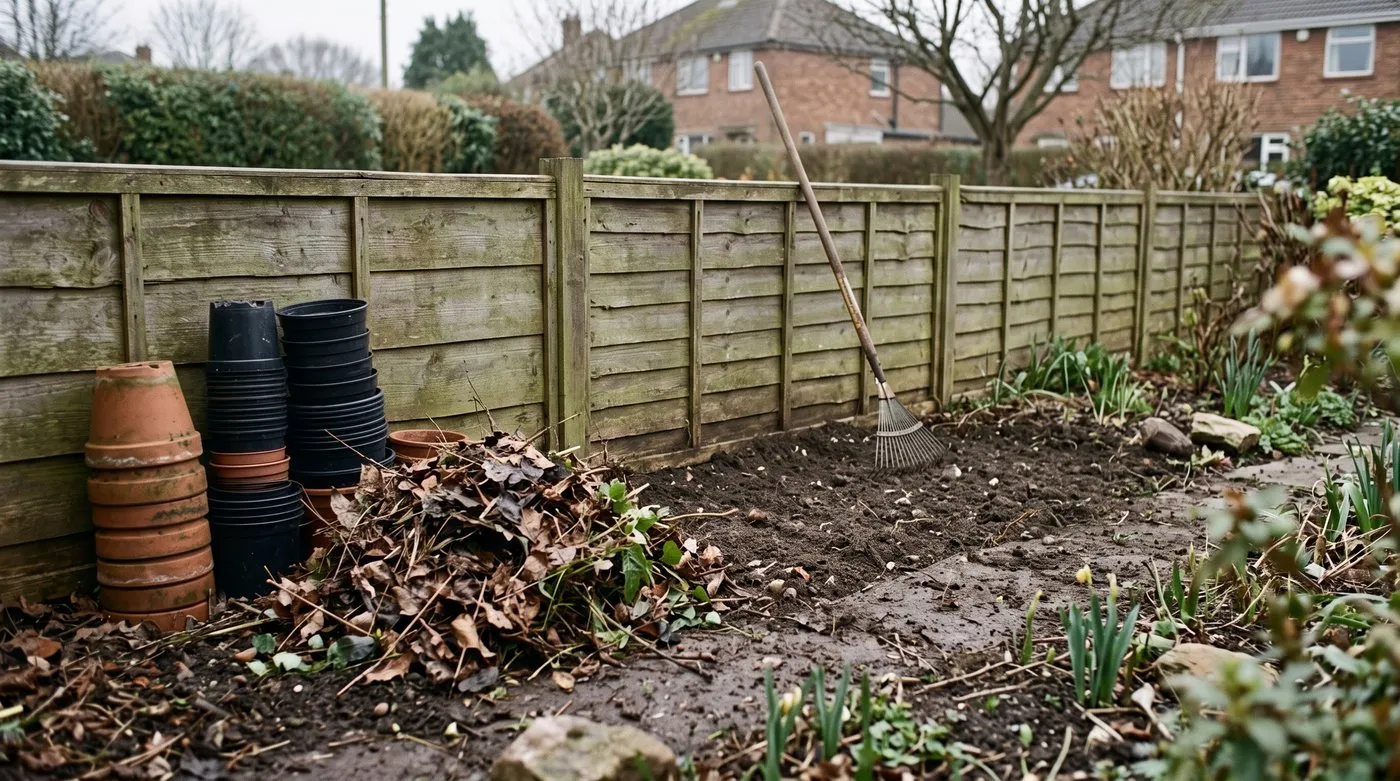 Turning pots and clearing the debris line along a fence in early March. This is where overwintering adults sit, and removing them now stops the May generation.
Greenhouse ventilation and hardening off
Sun strength climbs sharply through March. A closed greenhouse in Bristol on a clear 12C day in late March can reach 32C internally by 1pm and drop to 3C by 4am. That 29C swing is far harder on seedlings than steady cool.
Open vents when the internal temperature passes 18 to 20C and close them by mid-afternoon to bank warmth for the night. Automatic vent openers cost GBP 25 to 45 and trigger at a set temperature, which solves the problem for anyone at work during the day. They are the best value item in a greenhouse after the staging.
Hardening off in March applies to hardy plants only. Half-hardy bedding and tender crops wait until mid-April at the earliest. The process runs 7 to 14 days: two hours outside in a sheltered spot on day one, building to a full day by day seven, then a full night under fleece by day ten. Skipping it causes leaf scorch and a growth check of two to three weeks.
Damping down is not a March job. Humidity in a British greenhouse in March is already high and encourages botrytis. Keep air moving instead.
Why March gardens fail: the root cause
The underlying cause of most March disappointment is that gardeners follow a calendar written for someone else’s climate. Magazine and television schedules are broadly written for the Home Counties. A gardener in Cumbria following them to the week is sowing three to four weeks early, every year, into soil that has not reached threshold.
The reason it goes unnoticed is that the failure looks like bad seed or bad luck. A gappy carrot row reads as a poor packet. Rotted broad beans read as slugs. Neither gets connected to the 5.5C soil they went into, because nobody measured it.
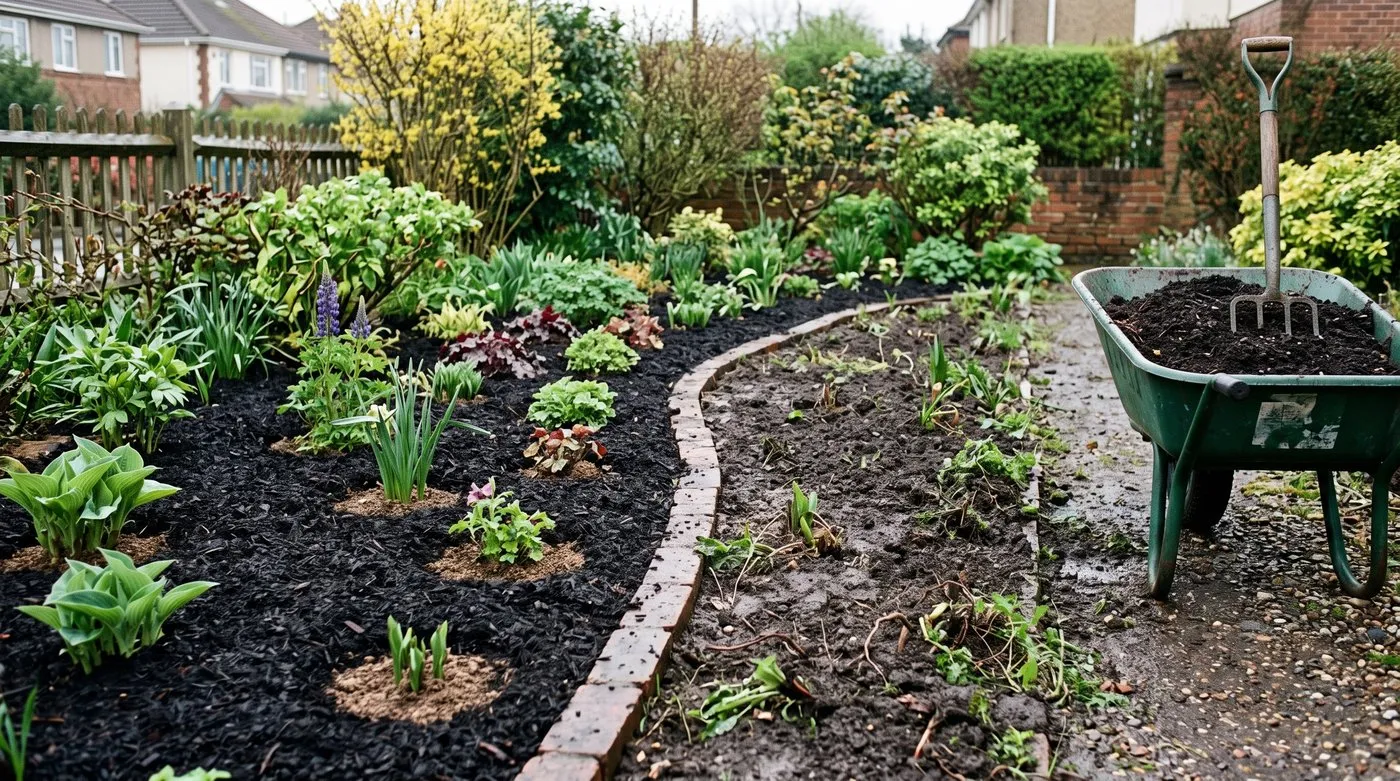 Mulching a Bristol border after a wet week. The layer is 5 to 7cm deep and kept clear of the crowns, which is the difference between holding moisture and rotting stems.
Common March mistakes
- Sowing to the date instead of the temperature. The packet says March, so out goes the seed on 1 March. Cold soil then delays germination for weeks and slugs get the lot. Measure at 5cm and wait for the threshold, even if that means sowing on 5 April.
- Cutting the lawn too short on the first pass. People reach for the summer setting because the grass looks scruffy. Scalping a winter-flattened sward opens it to moss and weeds for the rest of the season. Start at 40mm and reduce by 5mm a week.
- Hard-pruning a mophead hydrangea. It looks like a shrub that needs cutting back, so it gets one. Mopheads flower on old wood and lose an entire season’s bloom. Take off the dead heads only, down to the first fat buds.
- Mulching dry ground. March feels like the tidy-up month, so the mulch goes down whenever the compost arrives. On dry soil it seals the drought in until June. Wait for rain, check to a spade’s depth, then spread.
- Treating one warm week as the end of frost. A 17C March week tempts people to plant out tender crops. Air frost remains possible until mid-April in Cornwall and late May inland. Keep fleece to hand for another eight weeks minimum.
March jobs week by week
| Week | Priority jobs |
|---|---|
| Week 1 | Take first soil readings. Clear overwintering slug habitat. Sow tomatoes at 18 to 21C under cover. |
| Week 2 | Prune bush roses as buds break in the south. Plant shallots and onion sets. First lawn cut if soil is at 6C. |
| Week 3 | Divide perennials. Prune paniculata hydrangeas. Chit potatoes should be ready at 2 to 3cm. |
| Week 4 | Direct sow carrots and parsnips once soil is at 8C. Plant first earlies. Mulch after rain. Apply spring lawn feed. |
For the wider seasonal picture beyond this month, the RHS publishes a month-by-month job list, and the Met Office holds the regional frost and soil temperature records that make regional adjustment possible.
Now you have March ordered by soil temperature, work out exactly what goes in the ground with our guide to what to plant in March in the UK, or browse the full set of practical how-to guides for the jobs behind each task above.
Frequently asked questions
What soil temperature do I need to start sowing in March?
Most hardy March sowings need 7C or warmer at 5cm depth. Parsnips manage 7C, carrots want 8C and beetroot needs 10C. Take the reading at 9am on three consecutive mornings and use the lowest of the three, because a single warm afternoon reading is misleading.
When should I give the lawn its first cut in March?
Cut once soil reaches 6C and the grass is visibly growing. In most of southern England that falls in the first fortnight of March. Set the blade to 40mm and remove no more than a third of the leaf, then drop the height gradually over the following six weeks.
Is it too early to plant potatoes in March?
First earlies can go in from mid-March in the south, later further north. Plant 12cm deep with 30cm between tubers. Cold soil will not kill a chitted tuber, but shoots that break the surface before the last frost need earthing up or fleecing straight away.
Should I prune roses in March in the UK?
Yes, March is the standard month for pruning bush roses in most of Britain. Prune as the buds swell and start to break, cutting to an outward-facing bud 20 to 25cm above ground on hybrid teas. In Scotland and upland areas wait until late March or early April.
When do I mulch, before or after rain?
Can I start hardening off seedlings in March?
Only hardy plants, and only in the last week of March. Half-hardy bedding and tender crops should not go outside until mid-April at the earliest. Hardening off takes 7 to 14 days of increasing exposure, starting at two hours in a sheltered spot.
Is the risk of frost over by the end of March?
No, air frost remains possible everywhere in the UK until late May. Coastal Cornwall typically sees its last air frost in mid-April, inland Scotland in late May. Never treat a warm March week as the end of frost season.
Our team produces practical UK gardening guidance from source research, contributor records and established horticultural practice. Editorial standards are overseen by Matt W.