Key takeaways
- A blunt blade tears grass, leaving frayed tips that whiten then brown 1 to 2 days after mowing
- Sharpen a rotary blade every 20 to 25 running hours, or twice a season for a typical UK lawn
- Keep the original 30 degree factory bevel and never grind the blade flat
- Always rebalance the blade on a nail after sharpening to stop deck vibration
- Disconnect the spark plug or remove the battery before touching the blade
- Replace rather than sharpen if the blade is cracked, deeply nicked, or thinned at the trailing edge
Knowing when to sharpen a lawn mower blade is the difference between a clean, healthy lawn and a ragged, disease-prone one. Mower blade sharpening is the single maintenance job most UK gardeners skip, and a blunt blade quietly does damage every time you mow. This guide covers the exact signs a blade has gone blunt, how often to sharpen it through a UK season, and how to grind and rebalance it safely at home.
A sharp rotary blade slices each grass leaf cleanly in one pass. A blunt one tears and bruises the leaf, leaving a frayed wound that loses moisture and lets disease in. The advice here comes from running a petrol rotary across a Staffordshire lawn for years, logging the mower hours, and checking cut quality under a hand lens the morning after each mow.
The signs your mower blade has gone blunt
The clearest sign of a blunt blade is the colour of the lawn one to two days after mowing. A sharp blade leaves green, cleanly cut tips. A blunt blade tears the leaf, and the frayed end dries out and turns whitish, then straw-brown within 48 hours. Step back and the whole lawn takes on a dull, greyish cast rather than a fresh green. This is the symptom most people blame on watering or feeding when the real culprit is the blade.
Look closer and the evidence stacks up. Grass leaves are pulled out by the roots in patches rather than cut, leaving small bare tufts. The finish is uneven, with some blades long and some short across the same stripe. You find yourself making more passes over the same ground to clear it. The mower also works harder, the engine note drops under load, and a petrol mower burns more fuel while a cordless one drains its battery faster.
Get down and inspect a single cut leaf with a hand lens. A clean cut shows a flat, sharp edge. A torn one shows a ragged, stringy, split tip. That single check settles the question in seconds.
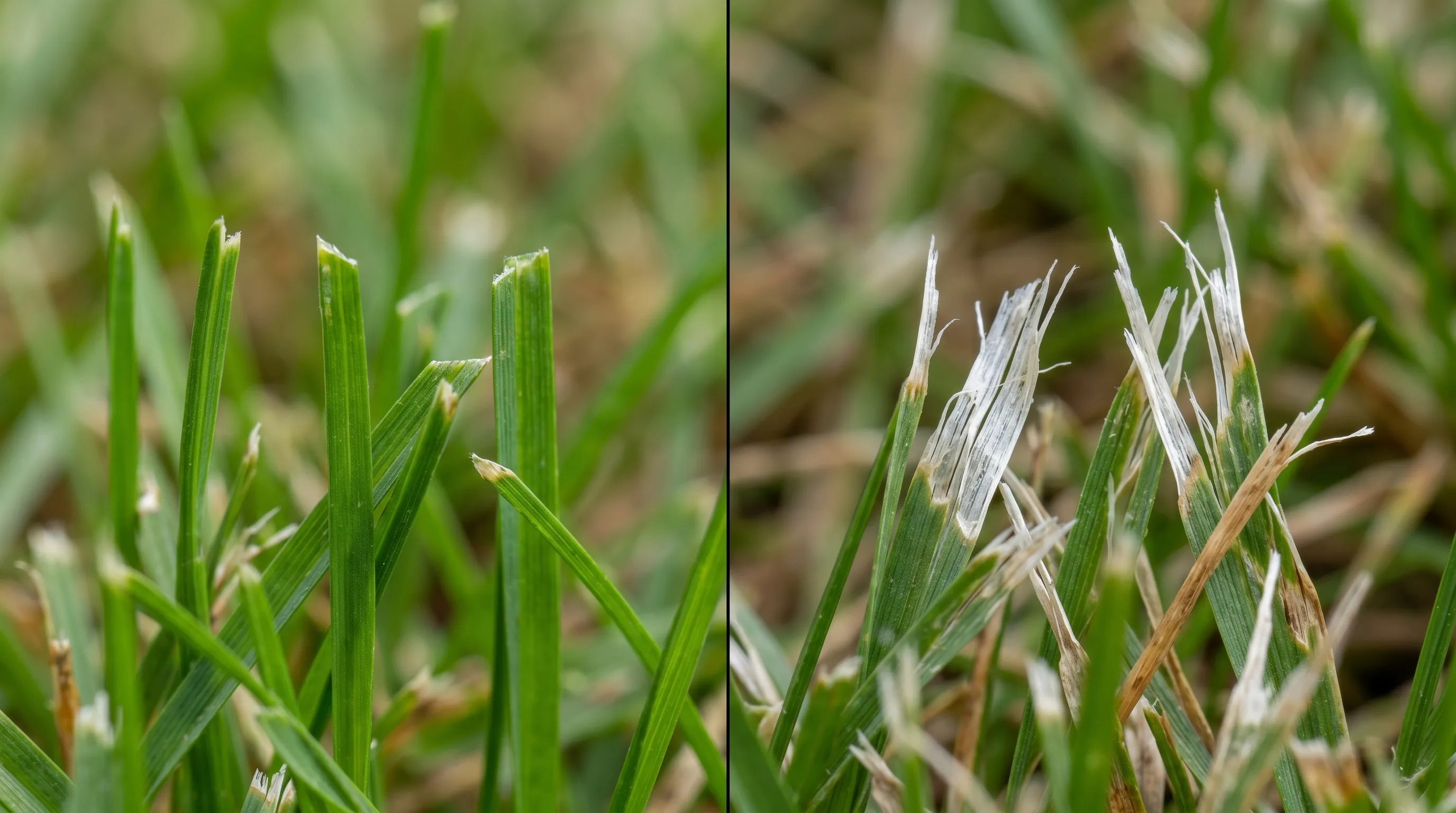 Left, a clean slice from a sharp blade. Right, the frayed, whitening tips a blunt blade leaves a day after mowing.
Why a blunt blade harms your lawn, not just the look
A blunt blade is a plant health problem, not just a cosmetic one. Each torn leaf is an open wound. A clean cut seals quickly and loses little moisture. A ragged tear leaves a large, frayed surface that dries out, so the grass loses water and the tips brown off. On a hot, dry UK June day this moisture loss alone can stress a lawn that a sharp blade would have left untouched.
The bigger risk is disease. Ragged wounds are an entry point for fungal infection. Red thread, fusarium, and dollar spot all colonise damaged grass far more readily than clean-cut grass. If your lawn shows patches of disease through summer, a blunt blade is often part of the cause. Our guide to lawn diseases and how to treat them explains how these infections take hold and why clean cutting is the first line of defence.
There is a cost angle too. A blunt blade forces the engine to tear rather than slice, so a petrol mower can use noticeably more fuel and a battery mower covers less area per charge. Over a season the wasted fuel and the extra wear add up to more than the price of a sharpening file.
How often to sharpen a mower blade in the UK
The rule of thumb is to sharpen a rotary mower blade every 20 to 25 running hours. That is hours the engine actually spends mowing, not weeks on the calendar. For a typical UK lawn mowed weekly from April to October, 20 to 25 hours works out at roughly twice a season: one sharpen at the start of the year and one touch-up around mid-July.
Some lawns blunt a blade much faster. Sandy or stony soil acts like sandpaper, and a few stray pebbles flicked up by the blade will nick the edge in a single mow. Large lawns clock up the hours quickly. Twiggy debris, dropped acorns, conkers, and pine cones all batter the cutting edge. If you mow any of these, check the edge monthly and expect to sharpen three or four times a season.
Fit a cheap engine hour meter to a petrol mower if you want to be precise. It clamps to the spark plug lead, costs around 10 pounds, and counts running hours automatically. That removes the guesswork entirely. For more on getting the timing of mowing itself right, see our guide on when to mow your lawn.
Rotary versus cylinder mowers
The 20 to 25 hour rule applies to rotary mowers, the spinning-blade type most UK gardens use. Cylinder mowers work differently. They cut with a scissor action, where a spiral of blades shears grass against a fixed bottom blade. They rarely need full sharpening. Instead they need backlapping, where a grinding paste is run between the cylinder and the bottom blade to restore the cutting contact. A well-set cylinder mower holds its edge for a whole season or more. Robot mowers are different again, using small swinging razor blades that you simply unclip and replace every two or three months rather than sharpen. Our robot mower guide covers blade replacement on those.
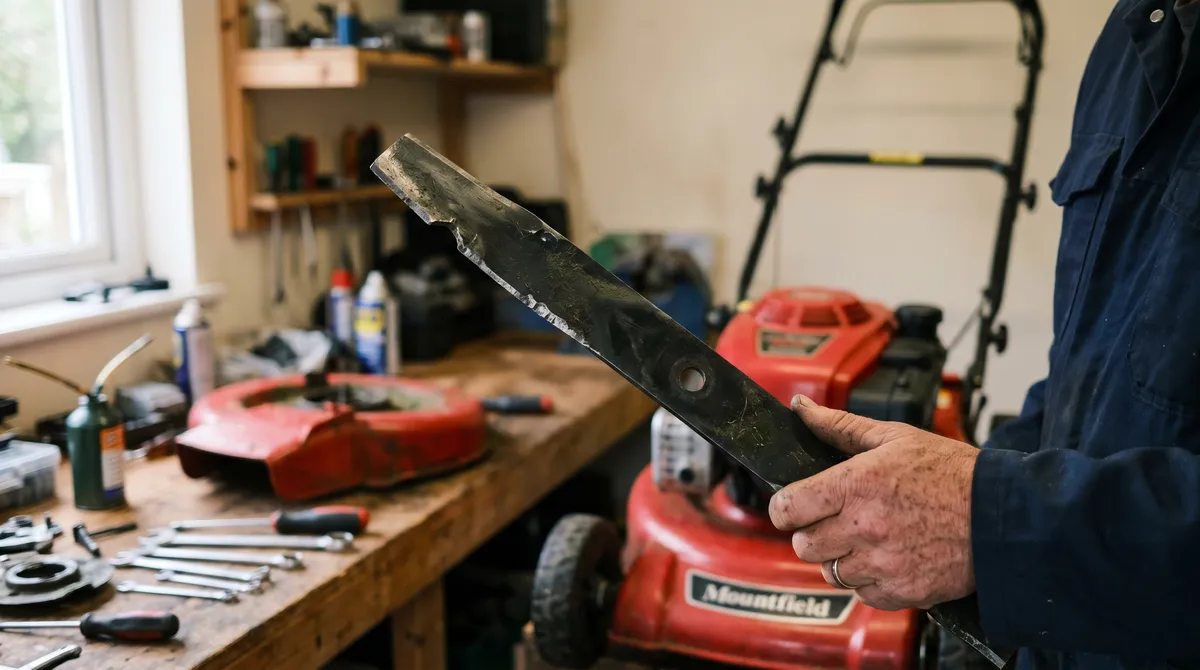
 Checking the edge by eye and feel. If light catches a shiny, rounded edge instead of a crisp line, it is time to sharpen.
A blunt-versus-sharp comparison at a glance
The table below sums up what changes when a blade goes from sharp to blunt. It is the quickest way to diagnose your own lawn.
| Symptom | Sharp blade | Blunt blade |
|---|---|---|
| Grass tip under a lens | Flat, clean slice | Frayed, split, stringy |
| Lawn colour 1 to 2 days after | Fresh green | Greyish, whitened tips browning |
| Cut consistency | Even height across the stripe | Patchy, some blades torn out |
| Passes needed | One pass clears it | Two or more passes |
| Engine or battery | Steady note, normal fuel use | Labours, more fuel, faster drain |
| Disease risk | Low, wounds seal fast | High, ragged wounds invite fungus |
If three or more of the blunt-blade signs match your lawn, the blade is overdue. Do not wait for the start of next season.
What you need to sharpen a mower blade safely
Sharpening a rotary blade at home needs little kit. The minimum is a socket or spanner to undo the central bolt, a flat metal file (a 250mm second-cut mill file is ideal), a vice or clamp to hold the blade, and a pair of thick gloves. A nail or a cheap blade balancer (around 5 pounds) handles the rebalancing.
For a faster job you can use an angle grinder fitted with a flap disc, or a bench grinder. Both remove metal quickly, which is a help on a badly nicked blade but a hazard if you are heavy-handed. Power tools generate heat that can soften the steel if you grind too long in one spot, so keep the blade moving and dip it in water to cool it between passes. A file is slower but almost impossible to ruin a blade with, so it is the safer choice for a first attempt.
Warning: Always disconnect the spark plug lead, or remove the battery on a cordless mower, before you go anywhere near the blade. A blade can turn the engine over and start it. Wear thick gloves throughout, because even a blunt blade has sharp corners and the lifting wings catch skin easily. Wear eye protection if you use any power tool.
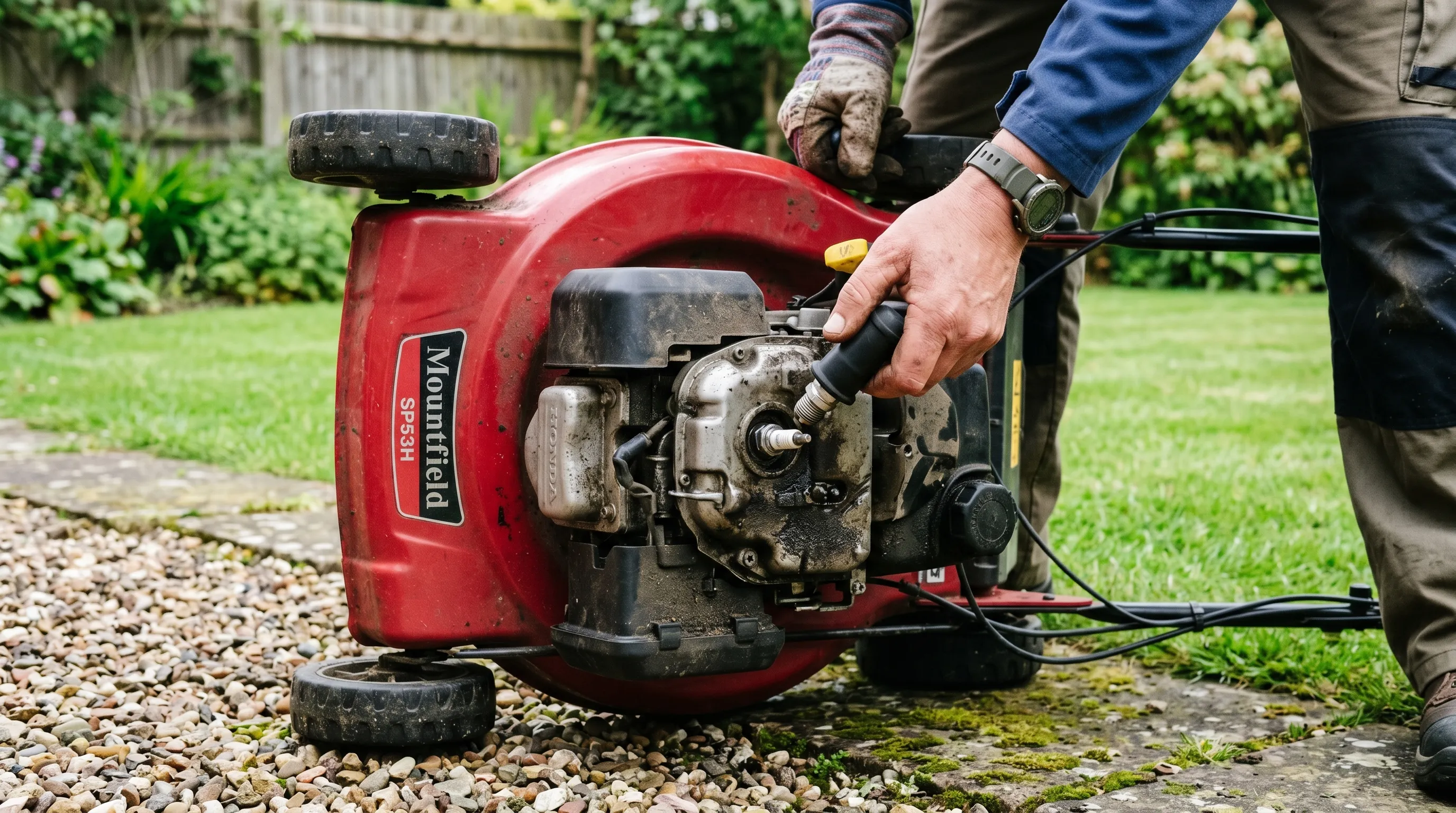 The first job, every time. Pull the spark plug cap off before the blade is touched, so the engine cannot fire while you work.
How to sharpen a rotary mower blade step by step
Work methodically and the whole job takes 20 to 30 minutes with a file.
- Disconnect the power. Pull the spark plug cap off, or remove the battery. Do this first, every time, with no exceptions.
- Tip the mower the correct way. Tip it with the air filter and carburettor pointing up, so oil and fuel cannot leak into them. On most mowers that means tipping it onto its side or back, not forward. Check the handbook if unsure.
- Mark the blade orientation. Before you undo anything, mark the underside of the blade with a paint pen or a scratch. A rotary blade only cuts and lifts correctly one way up. Refitting it upside down is the most common mistake.
- Remove the blade. Wedge a block of wood against the blade to stop it turning, then undo the central bolt. Lift the blade off and note any washers or spacers and their order.
- Clamp it in a vice. Secure the blade so one cutting edge is exposed and stable.
- File to the factory bevel. Look at the existing edge. It is ground on one face only, usually at about 30 degrees. Lay the file flat against that same bevel and push in long, even strokes, away from your body. File only on the push. Keep the original angle. Do not round it over and do not create a second bevel on the flat back.
- Stop at a butter-knife edge. A mower blade does not need to be razor sharp. Aim for an edge you could just about run a thumb along without cutting it. A finer edge chips and dulls within one mow.
- Do the other end. A rotary blade cuts at both ends. Give each end the same number of strokes so you remove equal metal from both.
 Filing along the existing 30 degree bevel in long, even strokes. Match the angle that is already there rather than guessing.
Why you must rebalance the blade after sharpening
Rebalancing is the step most people skip, and it is the one that causes real damage. When you sharpen, you almost never take exactly the same amount of metal off both ends. That leaves one end heavier. A rotary blade spins at around 3000 rpm, so even a tiny imbalance throws the deck into a heavy vibration. That vibration wears the engine crankshaft bearings, loosens deck bolts, and gives a poor, juddery cut.
Checking balance takes a minute. Hang the blade on a nail driven into a wall, passing the nail through the central mounting hole. A balanced blade hangs level. An unbalanced one tips, and the heavier end drops. File a little metal off the heavy end until the blade sits level on the nail. Take the metal from the flat back or the wing, not from the cutting edge you just sharpened. A purpose-made cone balancer (around 5 pounds) does the same job more precisely if you sharpen often.
Once balanced, refit the blade. Check your orientation mark is facing the ground, fit the washers and spacers in their original order, and torque the central bolt firmly, to the figure in the handbook if one is given. A loose blade bolt is dangerous. Reconnect the spark plug or refit the battery only once the blade is fully secured.
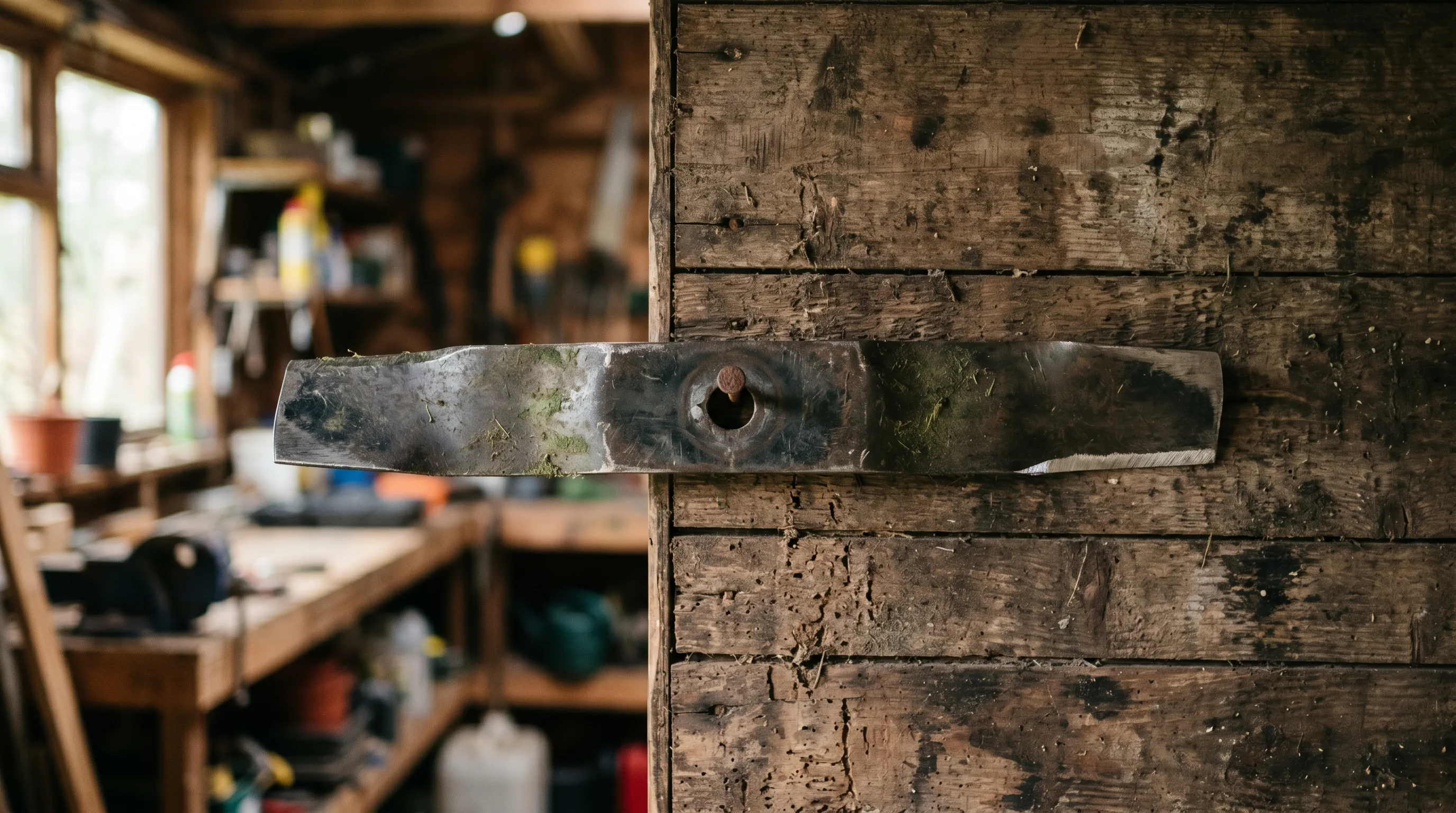 The nail test. A balanced blade hangs level. If one end drops, file metal off that end until it sits horizontal.
When to replace a mower blade instead of sharpening it
Some blades are past saving, and grinding a damaged blade is a false economy. Replace rather than sharpen if you find a crack, however small. A crack grows under the stress of 3000 rpm and the blade can break apart at speed, which is genuinely dangerous. Run a finger along the blade and inspect the central hole and the corners, where cracks usually start.
Deep nicks that a few file strokes cannot remove also mean a new blade. So does a bent blade, which you can spot by the uneven cut it leaves and by laying it on a flat surface to see if it rocks. The clearest replace signal is a thinned trailing edge or a worn lifting wing. Every sharpen removes a little metal, and after several seasons the cutting edge retreats and the lifting wing that creates the airflow wears down. A thin, worn blade cuts poorly no matter how sharp you make it.
Common mistakes when sharpening a mower blade
A handful of errors turn a simple job into a damaged blade or a damaged mower. Avoid these five.
Forgetting to disconnect the spark plug. This is the dangerous one. A blade you turn by hand can fire the engine. Pull the plug cap first, every single time, before the blade gets touched.
Grinding the wrong angle. People often guess at the edge angle or aim for a razor finish. Copy the factory bevel, around 30 degrees, and keep the single-bevel shape. A finer edge dulls within one mow and a flat grind ruins the cut entirely.
Sharpening the blade flat on both faces. A rotary blade is bevelled on one face only. Filing the flat back as well creates a thin, weak, double-bevel edge that chips fast. Work the bevelled face only.
Skipping the rebalance. An unbalanced blade vibrates the whole machine, wrecks the bearings, and cuts badly. Always do the nail test and file the heavy end level before refitting.
Over-thinning the blade. Removing too much metal, especially with a grinder, shortens the blade and thins the lifting wing. Take off the minimum needed to restore a clean edge, and replace the blade once it has worn thin rather than grinding it to nothing.
A seasonal mower blade sharpening calendar for the UK
This calendar suits a typical UK lawn mowed weekly through the growing season. Adjust it earlier and more often for big, sandy, or debris-heavy lawns.
| Month | Blade task |
|---|---|
| March | Sharpen and rebalance before the first cut. Inspect for cracks after winter storage. |
| April | First cuts of the year. Check the edge after the first mow if the lawn was overgrown. |
| May | Mow regularly. Pick stones and twigs off the lawn before each mow to protect the edge. |
| June | Check the edge mid-month. Frayed tips mean an early touch-up is due. |
| July | Mid-season sharpen and rebalance, usually around the 20 to 25 hour mark. |
| August | Peak growth. Watch for laboured cutting in dry spells and resharpen if needed. |
| September | Last regular cuts. A quick file keeps the autumn finish clean. |
| October | Final cut. Sharpen, clean, and oil the blade before storage. |
| November to February | Off season. Store the blade dry and lightly oiled to stop rust. |
The first cut of spring is the most important sharpen of the year, because grass coming out of winter is soft and shows tearing badly. Our guide to the first lawn cut after winter covers getting that first mow right, and feeding the lawn afterwards is covered in our lawn feeding guide.
Should you pay for professional sharpening
Paying a service is worth it if you lack a vice, a file, or the confidence to remove the blade. A garden machinery dealer charges around 8 to 20 pounds to remove, sharpen, and rebalance a rotary blade, and most do it while you wait or within a day. Mobile mower services and some hardware shops offer the same.
For the official line on power tool safety while sharpening, the Royal Society for the Prevention of Accidents sets out guidance on guards, eye protection, and isolating power. The Royal Horticultural Society covers lawn care timing and mowing height for UK conditions.
Frequently asked questions
How do I know if my lawn mower blade is blunt?
Frayed, torn grass tips that whiten a day or two after mowing mean the blade is blunt. A sharp blade slices cleanly and leaves green tips. A blunt one tugs and tears, so the lawn looks greyish, the cut is uneven, and the mower works harder and needs more passes to clear the same grass.
How often should I sharpen a lawn mower blade?
Sharpen a rotary blade every 20 to 25 running hours of mowing. For a typical UK lawn that means once at the start of the season and one touch-up mid-summer. Big lawns, sandy soil, or twiggy debris blunt the edge faster, so check the edge monthly through the cutting season.
What angle should a lawn mower blade be sharpened to?
Match the original factory bevel, usually around 30 degrees. Most rotary blades leave the factory with a 30 to 45 degree edge ground on one face only. Keep that same angle and that same single bevel. A finer edge dulls faster and a flat grind ruins the cut, so copy what is already there.
Do you need to balance a mower blade after sharpening?
Yes, always rebalance a rotary blade after sharpening. Removing more metal from one end leaves the blade heavy on that side. An unbalanced blade spinning at 3000 rpm vibrates the deck, wears the engine bearings, and ruins the cut. Hang it on a nail through the centre hole and file the heavy end until it sits level.
When should I replace a mower blade instead of sharpening it?
Replace the blade if it is cracked, bent, or deeply nicked. A crack can fail at speed and become dangerous. Also replace once the trailing edge has thinned, the lifting wing has worn down, or repeated grinding has shortened the cutting edge. A new rotary blade costs 10 to 25 pounds, so do not gamble on a damaged one.
Our team produces practical UK gardening guidance from source research, contributor records and established horticultural practice. Editorial standards are overseen by Matt W.