Quick answer
Winter prune apple trees between November and early March, while they're dormant and leafless. Start by removing dead, diseased and damaged wood, then crossing branches. Open up the middle of the tree so light and air get in. Shorten the main branch tips by about a third and thin crowded spurs. Never take off more than about a fifth of the tree in one winter.
Key points6 at a glance
- Prune apple trees in winter, from November to early March, while they have no leaves
- Avoid pruning in hard frost, as cold wood is brittle and cuts heal slowly
- Fat, round buds are fruit buds and thin, flat buds are leaf buds
- Work in order, starting with dead, diseased, damaged and crossing branches
- Remove no more than about a fifth of the tree each winter
- Tip-bearing apples need a lighter touch, so leave most of their shoot tips alone
In this article12 sections
Winter is the best time to prune an apple tree. From November to early March the tree is dormant. Its branches are bare, so you can see exactly what you’re doing. Start with dead, damaged and crossing branches, then open up the middle and shorten the main tips. Never remove more than about a fifth of the tree in one go.
This guide is all about apples. It explains how to read the buds and how to tell a spur bearer from a tip bearer. Then it walks through a winter prune, step by step. For plums, cherries, figs and pears, see our general guide to pruning fruit trees.
When to winter prune apple trees
Prune between November and early March, once the leaves have fallen and before the buds start to swell. With no leaves in the way, you can see the shape of the tree clearly. The tree is resting, so it copes well with the cuts.
Pick a dry, mild day. Avoid hard frost, as frozen wood is brittle and can split as you cut. Avoid very wet weather too, because damp spreads diseases such as canker.
Gardener’s tip: Try to finish before the buds begin to break in March. Late pruning wastes the tree’s energy on growth you then cut away.
This winter prune is for bush, standard and half-standard trees. Trained apples, such as cordons, espaliers and step-overs, are mostly pruned in late summer instead. Our guide to training fruit trees as espaliers covers those.
Why prune apple trees in winter?
Winter pruning shapes the tree and keeps it healthy. It also encourages new growth, which gives you fruiting wood for future years.
- More light and air. An open tree ripens apples better. It also stays drier, so it suffers less from scab and mildew.
- Better apples. Fewer, well-spaced fruiting spurs give bigger, better fruit.
- A manageable size. Shortening the leaders keeps the apples within reach.
- A healthier tree. Removing dead and diseased wood stops problems spreading.
Light winter pruning each year is far better than a hard chop every few years.
Fruit buds or leaf buds?
Before you cut, look closely at the buds. Telling them apart is the key to keeping a good crop.
- Fruit buds are fat, round and slightly fuzzy. They often sit on short, knobbly side growths called spurs. These will flower and fruit next year.
- Leaf buds are thin, flat and pointed. They lie close against the shoot and will only grow leaves and new shoots.
When you shorten a shoot, cut just above a bud. Keep plenty of fat fruit buds on the tree.
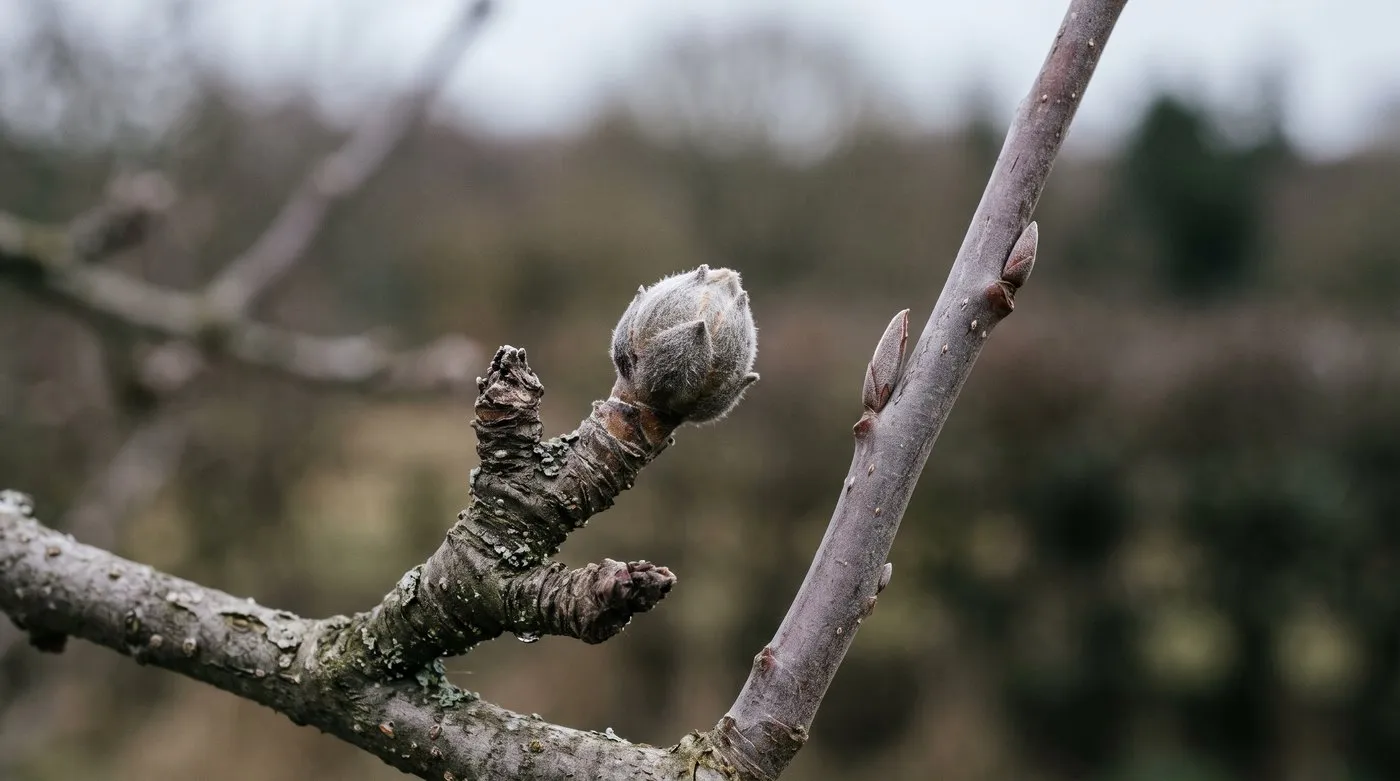
Fat, round buds on short spurs are next year’s flowers. Thin, flat buds lying against the shoot are leaf buds.
Spur bearers and tip bearers
Most apple trees are spur bearers. They fruit on short spurs along the branches. Cox’s Orange Pippin, Bramley, Gala, Egremont Russet and James Grieve are all spur bearers. You can prune these quite firmly, as new spurs keep forming.
A smaller group are tip bearers, or partial tip bearers. They carry lots of fruit at the ends of last year’s shoots. Worcester Pearmain, Discovery and Irish Peach are good examples. If you cut every shoot tip off, you’ll cut off most of the crop.
| Spur bearers | Tip bearers | |
|---|---|---|
| Where fruit forms | Short spurs along the branches | Tips of last year’s shoots, plus some spurs |
| Examples | Cox, Bramley, Gala, Egremont Russet | Worcester Pearmain, Discovery, Irish Peach |
| Leaders | Shorten by about a third | Shorten by about a third |
| Side shoots | Shorten to four to six buds | Leave most shoot tips uncut |
| Old wood | Thin crowded spurs | Remove a few old fruited shoots each year |
Not sure which you have? Look at last summer’s apples. If many grew right at the shoot ends, treat it as a tip bearer. Our guide to growing apple trees lists more varieties.
Tools for pruning apple trees
You only need three tools for most apple trees:
- Bypass secateurs for shoots up to about the thickness of a finger.
- Loppers for branches up to about the thickness of a thumb or slightly more.
- A folding pruning saw for anything thicker.
Keep the blades sharp and clean them between trees. Clean cuts heal far better than torn ones.
Warning: Don’t climb into the tree or stretch from a ladder on your own. Use a stable stepladder with someone holding it, or a long-handled pruner from the ground.
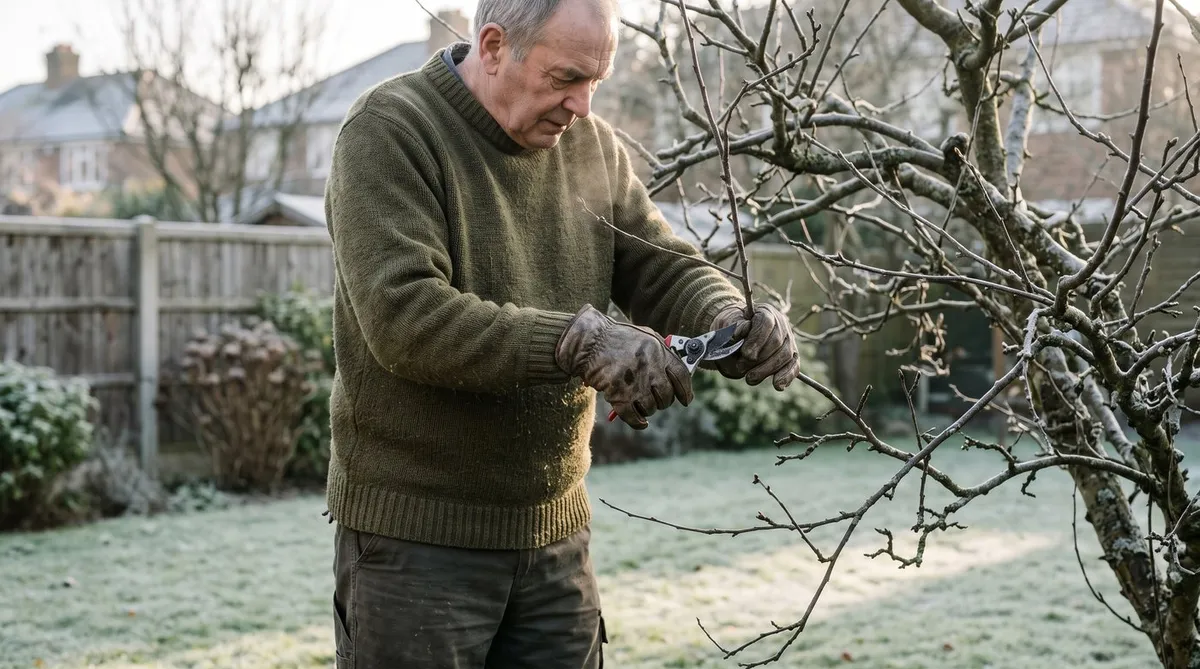
How to winter prune an apple tree, step by step
Work in this order. It stops you cutting off healthy wood before you’ve dealt with the problems.
- Clean your tools. Wipe the blades with disinfectant before you start.
- Remove the three Ds. Cut out anything dead, diseased or damaged, back to healthy wood.
- Take out crossing branches. Where two branches rub, remove the weaker or worse-placed one.
- Open up the middle. Remove one or two branches growing into the centre. Aim for a goblet shape, open in the middle.
- Shorten the leaders. Cut last summer’s growth on each main branch by about a third. Cut just above a bud facing outwards.
- Tidy side shoots. On spur bearers, shorten long side shoots to four to six buds. On tip bearers, leave most shoot tips alone.
- Thin old spurs. On older trees, spurs can become big and crowded. Remove some of the oldest, weakest ones so the rest have space.
- Step back. Look at the whole tree from a few paces away. Stop when you’ve taken off about a fifth.
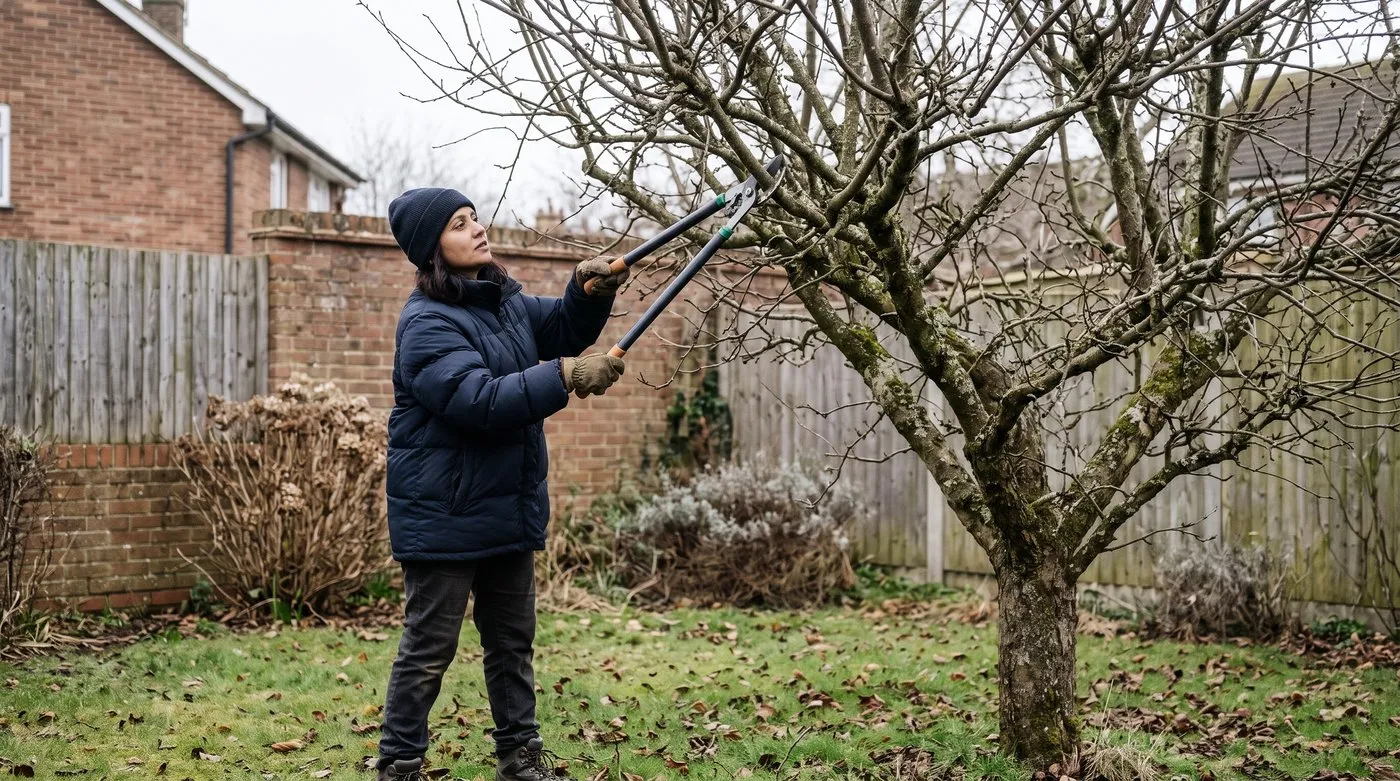
Take out crossing branches and open up the centre of the tree. More light means better, sweeter apples.
How to make a good pruning cut
Where you cut matters as much as what you cut.
- Shortening a shoot. Cut just above a bud, sloping away from it. Leave no more than a few millimetres above the bud.
- Removing a whole branch. Cut just outside the branch collar. That’s the slightly swollen ring where it joins the trunk or a bigger branch. Don’t cut flush against the trunk, and don’t leave a long stub.
- Heavy branches. Use three cuts to stop the bark tearing. First make a small undercut a little way out. Then cut through from the top just beyond it, so the branch drops. Finally, cut off the stub at the collar.
There’s no need for wound paint. Clean cuts in the right place seal themselves.
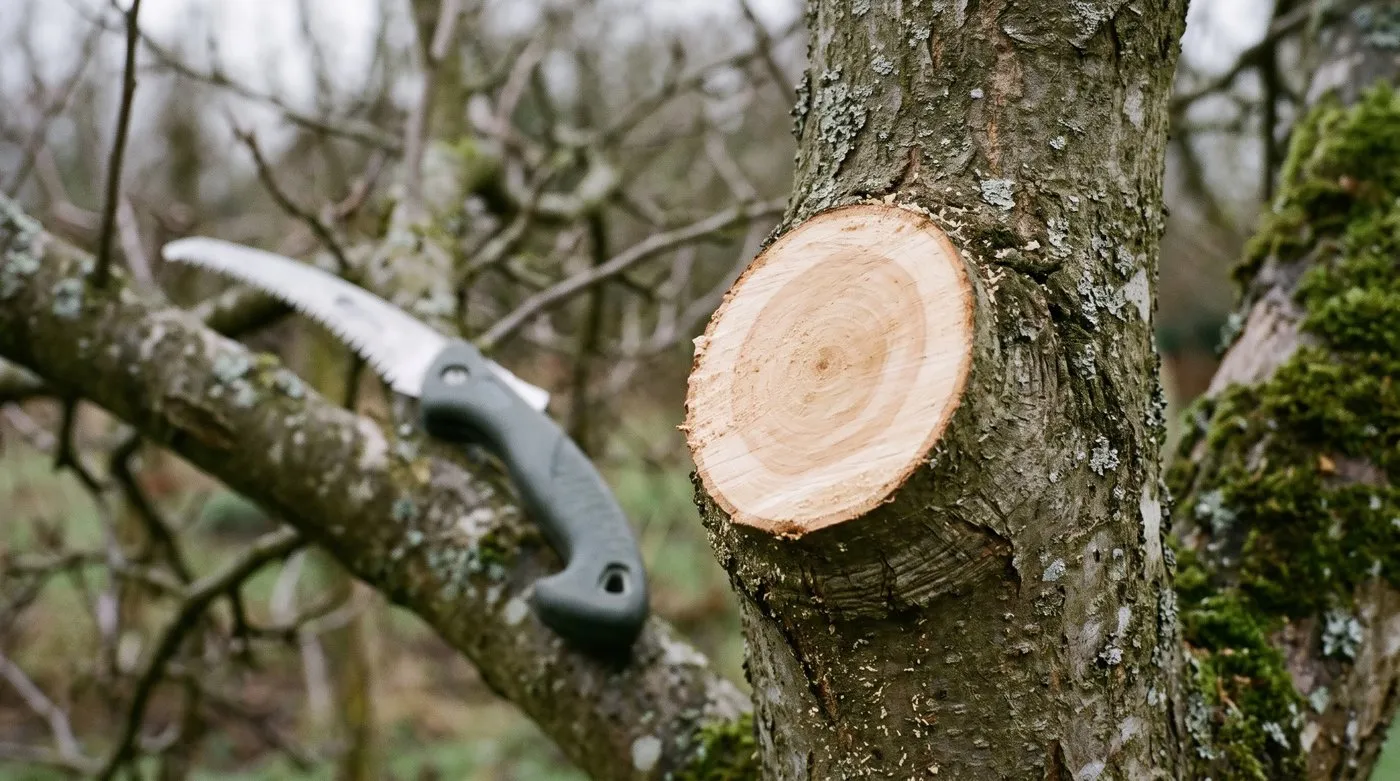
Cut just outside the swollen branch collar, never flush with the trunk. The tree will seal a clean cut by itself.
Pruning young apple trees
For the first three or four winters, your job is to build a good shape. Choose three to five strong, well-spaced branches to form the framework. Shorten their tips by about half to encourage branching. Remove any shoots that grow straight up into the centre or cross over.
Don’t worry about apples yet. A good framework now gives you heavy crops for years to come.
Pruning old and neglected apple trees
An overgrown tree needs patience. Cutting it back hard in one winter triggers a forest of upright water shoots and few apples.
Spread the work over three winters. Each year, remove the dead, diseased and crossing wood, plus one or two of the largest problem branches. Never take off more than about a quarter in one go. Does your tree crop heavily one year and barely at all the next? Our guide to biennial bearing explains how pruning can help.
Old apple trees often carry mistletoe. A ball or two is fine, but a heavy load weakens the branches. Our mistletoe guide explains how to keep it in check.
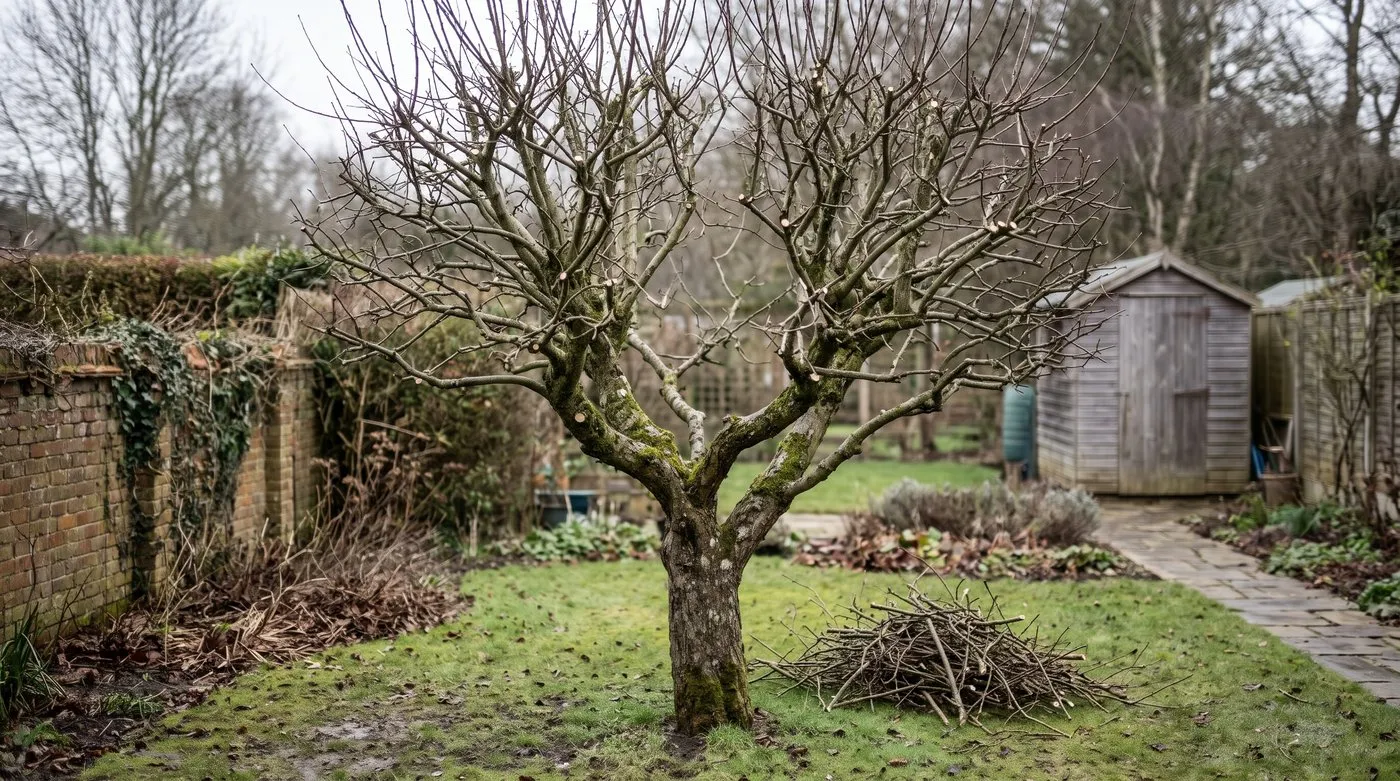
A well-pruned apple tree has an open centre and evenly spaced branches. Clear away the prunings afterwards.
Winter apple tree calendar
| Month | What to do |
|---|---|
| November | Rake up fallen leaves to reduce scab. Start pruning once the leaves are down |
| December | Main pruning time on mild, dry days |
| January | Carry on pruning. Check for canker and woolly aphid |
| February | Finish the winter prune. Feed with a general fertiliser and mulch |
| March | Stop pruning once the buds start to break |
| July to August | Summer prune trained cordons and espaliers |
Common mistakes when pruning apple trees
Cutting too much in one go is the classic mistake. The tree answers with lots of upright water shoots and fewer apples. Keep each winter’s prune to about a fifth.
Trimming every shoot tip on a tip-bearing variety removes most of next year’s fruit. Check what kind of tree you have before you start.
Cutting flush with the trunk damages the branch collar, which the tree needs to heal. Cut just outside it instead.
Pruning on frosty or wet days can split the wood or spread disease. Wait for a dry, mild day.
Leaving diseased prunings under the tree lets scab and canker spread. Clear them away, and don’t add diseased wood to the compost. Our guides to apple scab and fruit tree canker show what to look for.
Frequently asked questions
When should you prune apple trees in the UK?
Winter is the main time, from November to early March, while the tree is dormant and leafless. Avoid days with hard frost. Trained apples, such as cordons and espaliers, are pruned in summer instead.
How much can you cut off an apple tree in winter?
Take off no more than about a fifth of the branches in one winter. Cutting harder makes the tree send up lots of upright water shoots and fewer apples next year.
How do you tell fruit buds from leaf buds?
Fruit buds are fat, round and slightly fuzzy, often on short knobbly spurs. Leaf buds are thin, flat and pointed, and sit close against the shoot. Keep plenty of fruit buds when you prune.
What is a tip-bearing apple tree?
A tip-bearing apple carries much of its fruit at the ends of last year’s shoots. Worcester Pearmain and Discovery are well-known examples. Leave most shoot tips alone, and only shorten the main leaders.
Can you prune an apple tree in frost?
It’s best not to. Frozen wood is brittle, so cuts can split and tear. Wait for a milder, dry day instead.
Should I seal pruning cuts on apple trees?
No. Wound paint can trap moisture and disease. Clean cuts made with sharp tools, just outside the branch collar, heal best on their own.
How do you prune an old, overgrown apple tree?
Spread the work over three winters. Each year, take out a few of the biggest problem branches, plus dead and crossing wood. Never remove more than about a quarter in one go.
Got apples in pots too? Read our guide to winter care for potted fruit trees. Then wrap up warm, sharpen your secateurs and give your apple tree a little care this winter.
Our team produces practical UK gardening guidance from source research, contributor records and established horticultural practice. Editorial standards are overseen by Matt W.