Key takeaways
- Grows 1.5 to 2m tall but only 45 to 60cm wide, so it fits at the front of a border as a see-through plant
- Borderline hardy at RHS H3 (about -5 to -10°C) and persists mainly by self-seeding, not by the crown surviving
- Flowers July to the first frosts, often into November, giving one of the longest seasons of any perennial
- Full sun and sharp drainage are non-negotiable: wet winter soil rots the crown, the same failing that kills echinacea
- Seed is slow and erratic (2 to 4 weeks at 18 to 21°C), so lifting self-sown seedlings in spring is the easiest supply
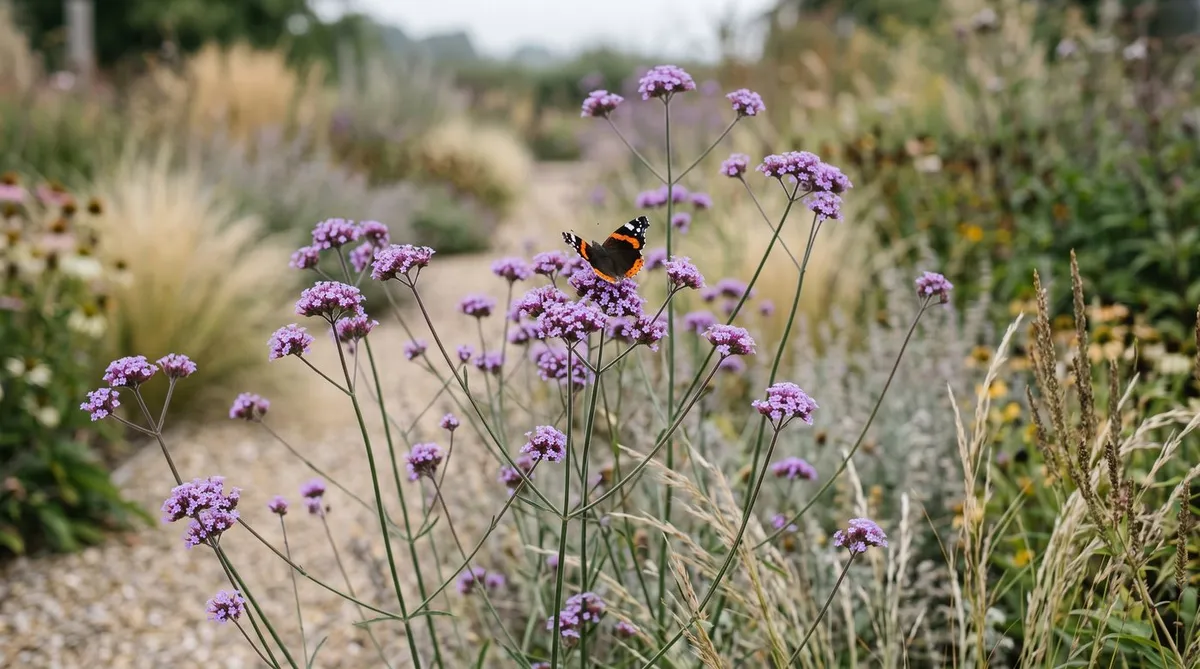
- Among the best butterfly plants in Britain: peacocks, red admirals, small tortoiseshells and painted ladies all feed on it
Verbena bonariensis is the see-through plant that carries a UK border from midsummer to the first frosts. Also called tall verbena or purple top, this Argentinian vervain sends wiry, near-leafless stems up to 2m high, each topped with clusters of tiny purple-lilac flowers. Yet it spreads only 45 to 60cm, so it never blocks the view. Butterflies work the flowers all day. The stems sway on the slightest breeze. Left standing, the seedheads feed birds through winter and sow the next generation for free. It is not the trailing bedding verbena, and it is not the herb lemon verbena. It is a prairie plant that looks light as air but works hard for wildlife.
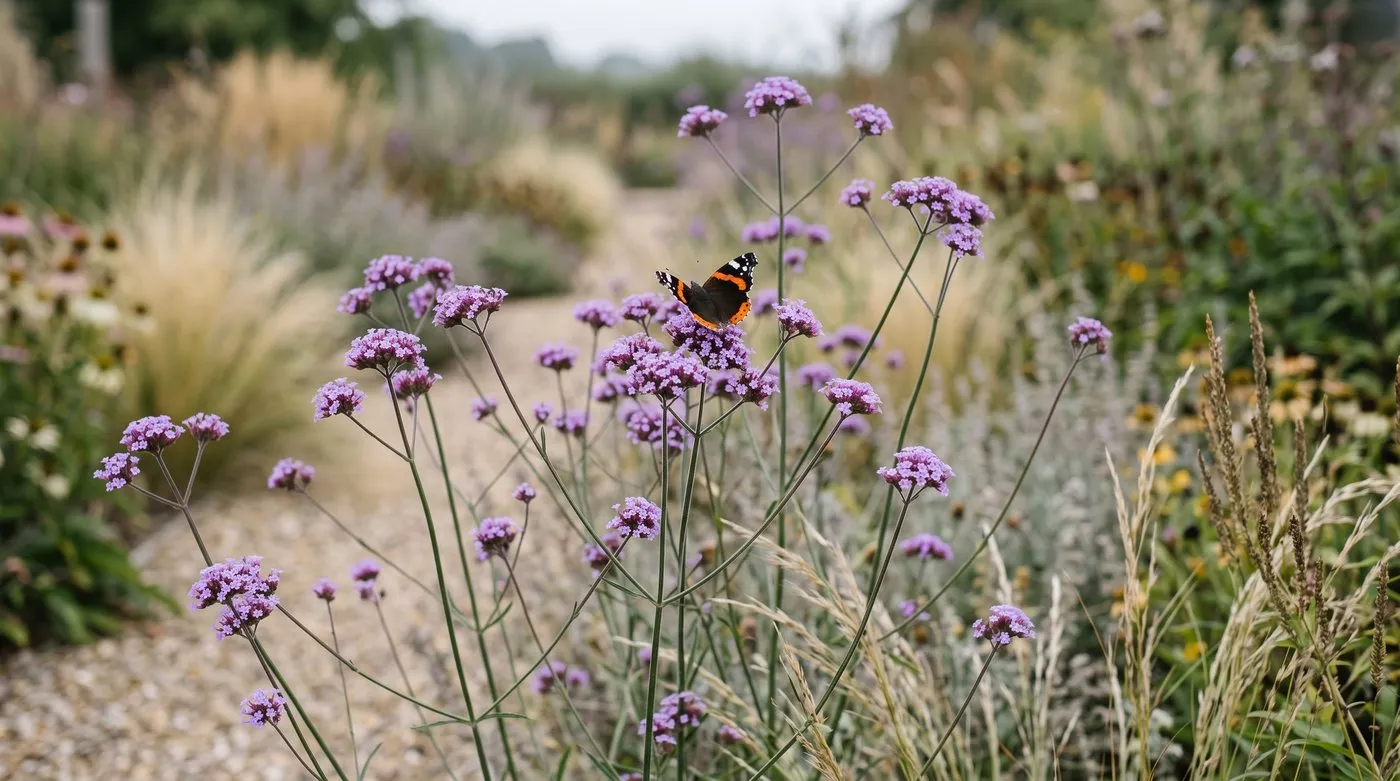 Verbena bonariensis reaches 2m yet stays see-through, so it suits the front of a border as well as the back.
This guide goes deep on the species itself. For the wider genus, including trailing and bedding types, see our general guide to growing verbena in the UK.
What conditions does Verbena bonariensis need in the UK?
Verbena bonariensis comes from the grasslands of Argentina and Brazil, open, sunny, free-draining places. That origin sets every rule for growing it well.
Sun: Full sun, at least 6 hours of direct light a day. South or west-facing borders are ideal. In shade the stems grow lax and lean, flowering thins out, and the whole plant flops.
Soil: Well-drained above all else. It tolerates poor soil and is drought-tolerant once established. It will not tolerate wet feet in winter. Heavy clay that sits waterlogged from November to February rots the crown. On clay, dig in horticultural grit or plant on a raised, gritty mound.
Fertility: Low to moderate. Rich, nitrogen-heavy ground pushes soft, floppy growth and fewer flowers. This is the opposite of what moisture-loving perennials want, and much closer to the lean, sharp-draining regime that suits echinacea.
Drainage is the survival factor. Frost rarely kills this plant. Cold, wet soil around the crown in midwinter is what finishes it. Get the drainage right and everything else follows.
Is Verbena bonariensis hardy, and will it come back each year?
Verbena bonariensis is borderline hardy, rated RHS H3, roughly -5 to -10°C. It is a short-lived perennial rather than a reliable one. Whether it returns depends far more on drainage than on temperature.
In a mild, free-draining garden the same crown often persists for three or four years. In a cold or wet garden the crown rots over winter, and the plant behaves as an annual or biennial. Either way, it rarely disappears, because it self-seeds so freely. New seedlings appear around the parent every spring and quickly fill any gap.
Treat it accordingly. On sharp-draining soil, grow it as a short-lived perennial and leave the crowns in place. On heavy clay, plan for it as a self-seeding annual, and never rely on one plant surviving the winter.
Warning: Wet winter soil kills more Verbena bonariensis than frost ever will. Never plant it in ground that puddles after rain. On clay, add a generous 2 to 3 handfuls of horticultural grit per planting hole, or build a raised gravel bed. A dry crown survives -10°C. A cold, sodden crown rots at 0°C.
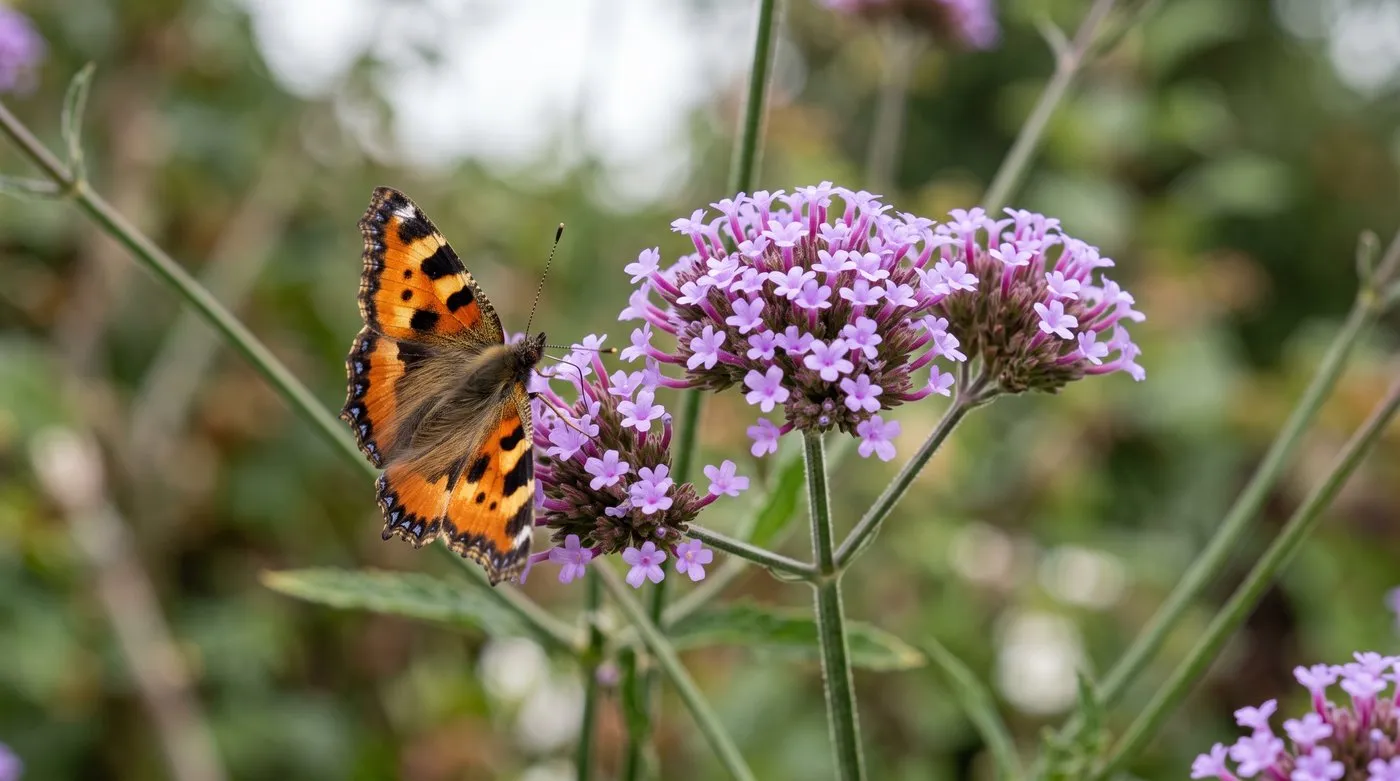 Each cluster holds dozens of tiny purple-lilac flowers, an open landing pad that butterflies and bees find easy to work.
How to use Verbena bonariensis as a see-through plant
The trait that defines Verbena bonariensis is transparency. The flowering stems are thin, stiff and almost bare, with clusters of flowers floating at 1.5 to 2m. You look straight through the gaps to whatever grows behind.
This changes the usual rule about tall plants going at the back. Plant Verbena bonariensis near the front of a border and it forms a purple haze you view the rest of the planting through. Weave it in drifts of 3 to 5 through the middle, and it laces the scheme together without hiding anything.
It pairs naturally with ornamental grasses, which catch low autumn light behind the purple flowers. In a prairie scheme it stands beside echinacea, rudbeckia, asters and salvia. The airy habit stops the border feeling solid or blocky.
Gardener’s tip: Do not stake Verbena bonariensis and do not space it too far apart. The wiry stems are designed to sway, and plants set 45cm apart in a drift lean on each other for support. A lone plant on rich soil is the one that flops. A close-planted group on lean soil holds itself up.
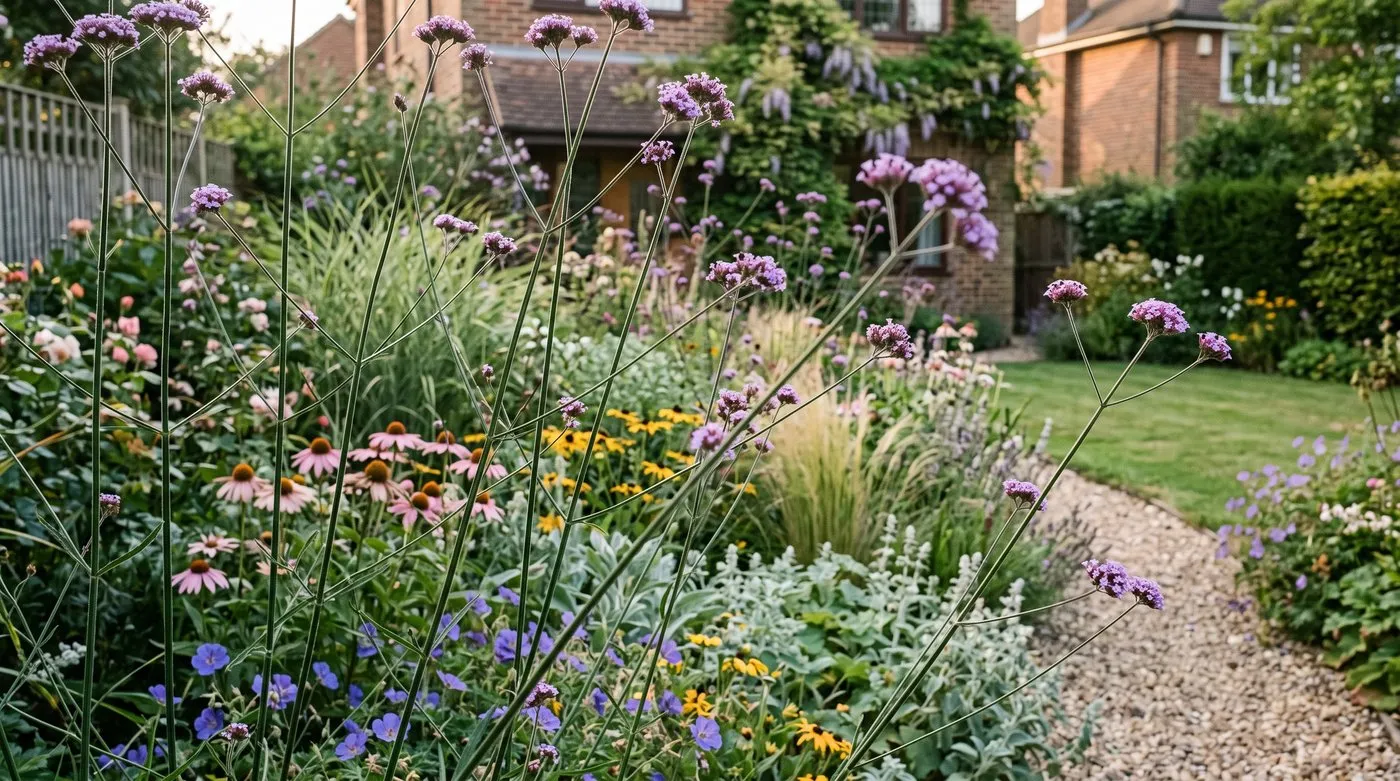 Set near the front of a border, the transparent stems create a purple veil you view the whole garden through.
Best Verbena bonariensis varieties and how they compare
The straight species is the classic choice and the tallest. A few selected forms offer shorter, tidier plants for small gardens and containers. All share the same purple colouring and butterfly appeal.
| Variety | Height | Spread | Best for | Notes |
|---|---|---|---|---|
| Verbena bonariensis (species) | 1.5-2m | 45-60cm | Prairie borders, back and front | RHS AGM. The airiest, tallest form. Self-seeds freely |
| ’Lollipop’ | 60cm | 30-45cm | Small gardens, pots, front of border | Compact and neat, same purple flowers, far less self-seeding |
| ’Little One’ | 40-50cm | 30-40cm | Containers, edging | Dwarf selection, tidy habit, good in windy sites |
| Verbena bonariensis ‘Buenos Aires’ | 1.2-1.5m | 45cm | Mid-border | Slightly shorter, sturdier stems than the species |
| Verbena rigida | 30-60cm | 30-45cm | Front edging, dry banks | A shorter relative, spreads by rhizome, deeper violet flowers |
Buying tip: The species carries an RHS Award of Garden Merit and comes true from seed, so a single packet raises 30 or more plants cheaply. Choose ‘Lollipop’ if you garden in a small space or in pots, or if free self-seeding would be a nuisance. It gives the same look at about a third of the height.
How to grow Verbena bonariensis from seed
Verbena bonariensis grows readily from seed, though germination tests your patience. The seed needs light and warmth, and it comes up slowly and unevenly.
When to sow: February to April indoors, at 18 to 21°C. An early sowing gives the longest first-year flowering.
How to sow:
- Fill trays or modules with peat-free seed compost and firm gently.
- Surface-sow the seed and press it lightly onto the compost. Do not cover it, as it needs light to germinate.
- Water from below by standing the tray in shallow water, then drain.
- Keep at a steady 18 to 21°C in a propagator or on a warm windowsill.
- Wait. Germination is slow and erratic, usually 2 to 4 weeks and sometimes longer. Do not throw the tray out early.
- Prick out into 7 to 9cm pots once seedlings have two true leaves.
- Grow on cool and bright to keep the seedlings sturdy rather than drawn.
- Harden off for 10 to 14 days, then plant out after the last frost, mid-May in most regions.
For the full indoor method, see our guide on sowing seeds indoors.
 Surface-sow the seed and press it on, never bury it. Light is what triggers germination.
Lifting and moving self-sown seedlings
The easiest supply of Verbena bonariensis is the plant itself. Leave one flowering stem to set seed and you will find seedlings dotted around the parent the following spring. This is how the plant survives cold or wet gardens where the crown does not.
Self-sown seedlings appear from April onward, once the soil warms. Recognise them by the same square, roughly-textured stems and paired leaves as the parent. They transplant well while small.
Lift them carefully with a hand trowel once they have three or four true leaves, keeping a plug of soil around the roots. Move them straight to their final position, or pot them on to give away. Space transplants 45cm apart in drifts. Water them in and keep the soil damp for the first fortnight while the roots take hold.
If free seeding is unwelcome, deadhead spent flowers before they ripen, or grow the compact ‘Lollipop’, which seeds far less. Verbena bonariensis is one of the most useful self-seeding plants for easy UK gardens, rarely a thug and simple to edit out where you do not want it.
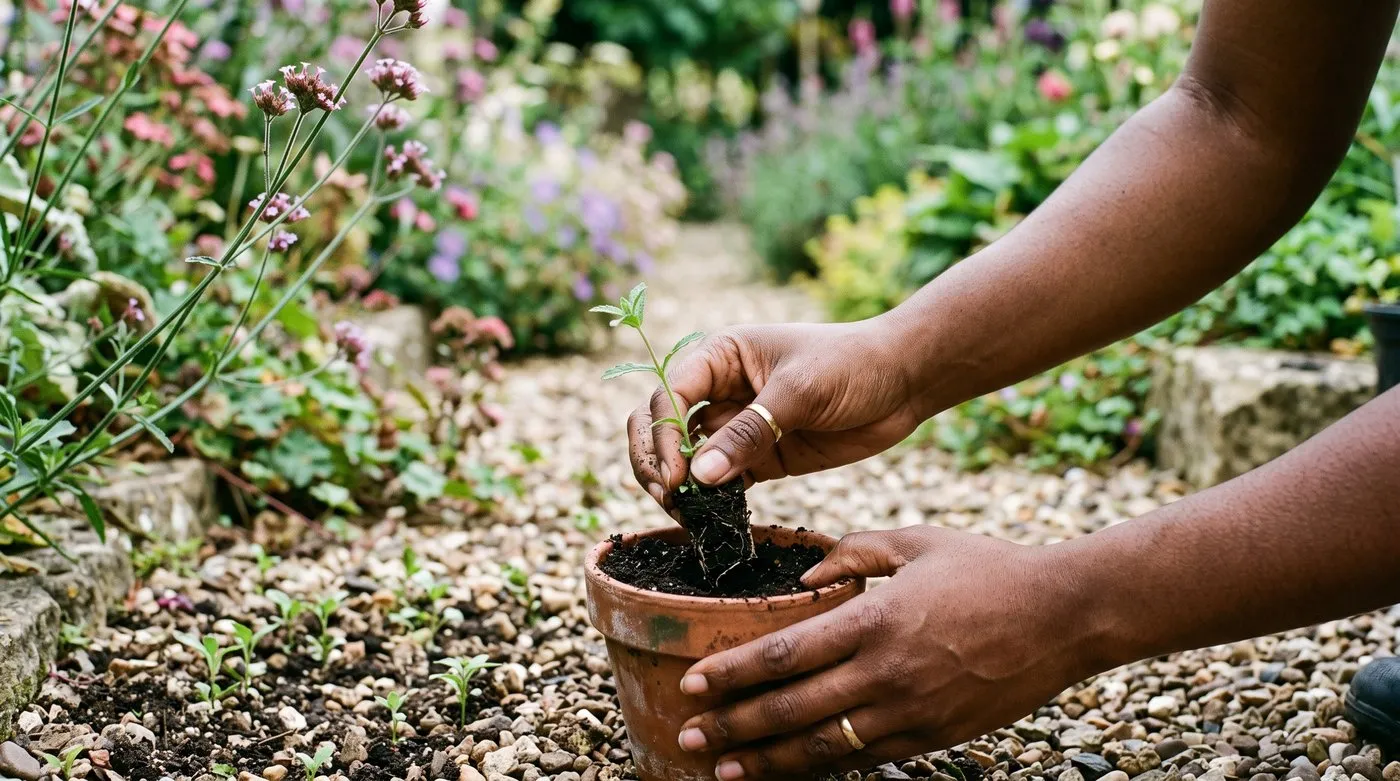 Self-sown seedlings lift easily in spring. Move them with a plug of soil once they have three or four true leaves.
How to plant Verbena bonariensis in the garden
When to plant: May to June for young plants and hardened-off seedlings, once the frosts have passed. Spring planting gives the roots a full season to establish before their first winter.
Preparing the soil: Fork the area over to 30cm deep. On clay, work in horticultural grit generously to sharpen drainage. On sandy soil, a little garden compost adds body without holding water.
Spacing: Plant 45cm apart in drifts of 3 to 5. Close planting lets the wiry stems support each other and reads as a purple haze rather than as dots.
Planting depth: Set the crown level with the soil surface, exactly as it sat in the pot. Burying the crown invites rot, the plant’s main weakness.
After planting: Water in well and keep the soil damp for the first few weeks. Once established, Verbena bonariensis is drought-tolerant and needs watering only in prolonged dry spells. Do not feed with high-nitrogen fertiliser, which weakens the stems.
Month-by-month Verbena bonariensis calendar
| Month | Task |
|---|---|
| January | Leave stems standing. Seedheads feed birds and the dead growth shields the crown from frost |
| February | Sow seed indoors at 18-21°C, surface-sown. Order fresh seed if needed |
| March | Main indoor sowing time. Cut last year’s stems to the base as new basal shoots appear |
| April | Prick out seedlings. Watch for self-sown seedlings emerging around old plants |
| May | Harden off for 10-14 days and plant out after the last frost. Lift and move self-sown seedlings |
| June | Plants establish and grow fast. Water new plants in dry spells. No feeding needed |
| July | Flowering begins. Bees and hoverflies arrive. Enjoy the first purple haze |
| August | Peak flowering. Butterflies work the flowers all day. Cut stems for the vase |
| September | Flowering continues strongly. Leave later flowers to set seed for self-sowing |
| October | Flowers carry on until the first frost. Collect seed now if you want to sow controlled batches |
| November | Flowering ends at the first hard frost. Leave every stem standing over winter |
| December | No action. Seedheads feed goldfinches. Mulch the crown in cold gardens |
Common problems and how to fix them
Verbena bonariensis is close to trouble-free once it is in the right spot. The issues that do arise are almost all down to soil or winter wet, not pests. Ranked by how often they cause real damage, here is what to do.
| Problem | Cause | Effectiveness of fix | Role |
|---|---|---|---|
| Crown rot over winter | Cold, wet soil around the crown | 90% by improving drainage before planting | Primary, prevention is the only cure |
| Slug and snail damage | Soft young growth and seedlings | 85% with nematodes on young plants only | Primary, protect seedlings early |
| Flopping stems | Rich soil, shade, or lone planting | 80% by planting lean, sunny, in close drifts | Maintenance, cultural fix |
| Powdery mildew | Dry spells and stagnant air | 70% by improving air flow, cosmetic only | Supplementary, rarely serious |
Crown rot is the one problem that kills. Persistently wet soil around the crown in winter is fatal, and no treatment saves an affected plant. The fix is entirely preventative: sharp drainage, a gritty planting hole, and never a waterlogged site.
Slugs and snails target soft new growth and young seedlings. Established plants with woody bases are rarely touched. Use nematode drenches or evening patrols while plants are small.
Powdery mildew shows as a white coating on the leaves in dry, still weather. It looks unsightly but rarely harms an established plant. Space plants for air flow rather than reaching for a spray.
Root cause on winter losses: gardeners blame the cold and reach for fleece. The real cause is almost always wet soil, not low temperature. A crown sitting in sodden clay rots at around 0°C, while a dry crown on gravel shrugs off -10°C. The permanent fix is drainage at planting time, plus leaving the dead stems standing to shield the crown, not wrapping the plant against frost it can already handle.
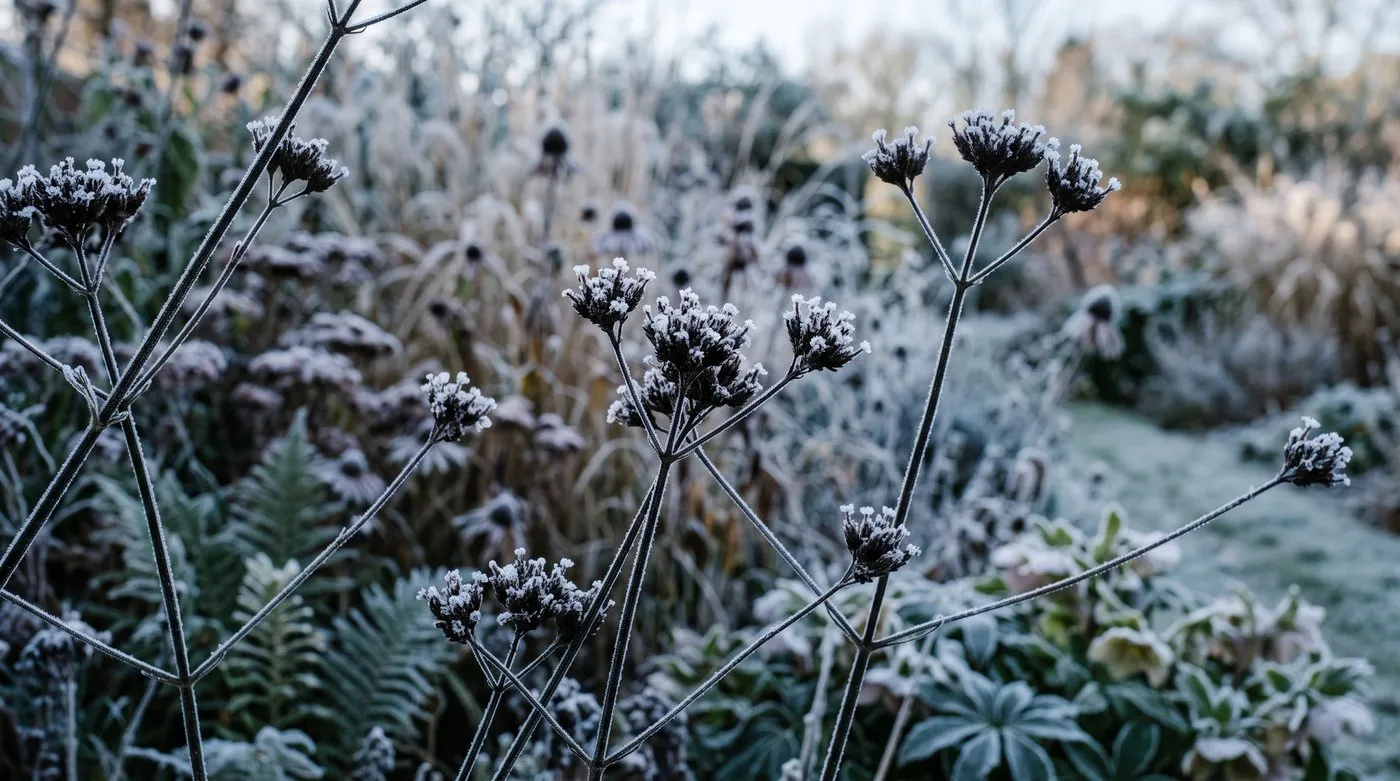 Leave the stems standing over winter. They shield the crown from frost and feed birds with seed.
Verbena bonariensis for butterflies and pollinators
Verbena bonariensis is one of the best butterfly plants you can grow in Britain. The flat clusters of tiny flowers make an ideal landing platform, and the plant is loaded with nectar right through late summer and autumn.
Peacocks, red admirals, small tortoiseshells and painted ladies all feed on it, often several at once on a warm August afternoon. Bees, hoverflies and moths work the flowers too. Because it flowers so late, into November in a mild year, it is a lifeline when other nectar sources have finished. Grow it beside other autumn-flowering plants for bees to stretch the forage season as far as possible.
The long season is the key. A plant flowering for 17 weeks feeds far more insects than one flowering for six. Every butterfly that overwinters as an adult, the peacock and small tortoiseshell among them, needs late nectar to build reserves before hibernation. Verbena bonariensis delivers exactly that, at exactly the right time.
The RHS Plants for Pollinators scheme lists Verbena bonariensis as a high-value plant for insects, valued both for the volume of nectar and for how late in the year it keeps producing it.
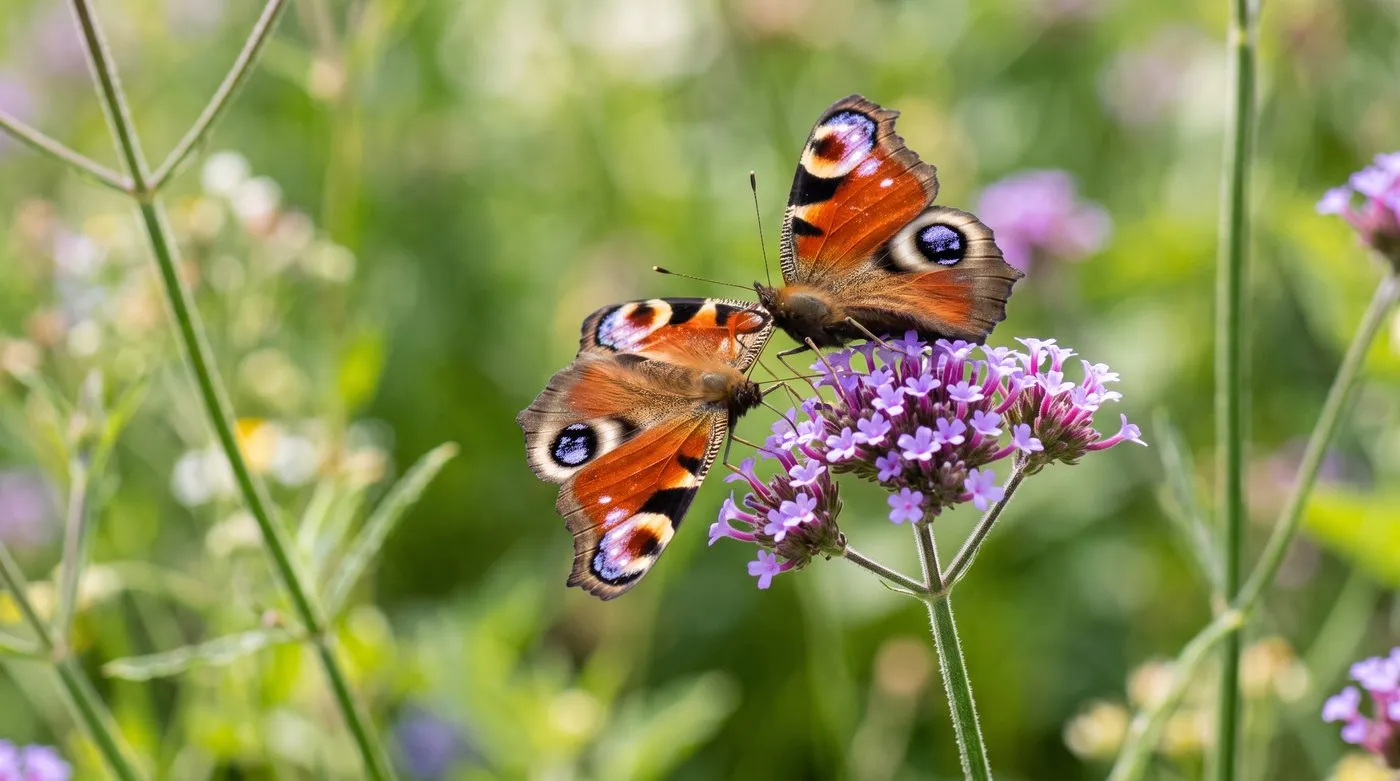 A red admiral on Verbena bonariensis. Peacocks, small tortoiseshells and painted ladies feed on it too, often several at once.
Using Verbena bonariensis as a cut flower
Verbena bonariensis makes a lovely airy filler in the vase. The tall, thin stems add height and a purple haze that lightens denser flowers like dahlias and rudbeckia. Vase life is around 7 to 10 days if you cut stems in the cool of the morning and change the water regularly.
Cut when the flower clusters are two-thirds open for the longest life. Strip the lower leaves, which are sparse anyway, and stand the stems in deep water for an hour before arranging. The wiry stems hold their shape well and rarely wilt.
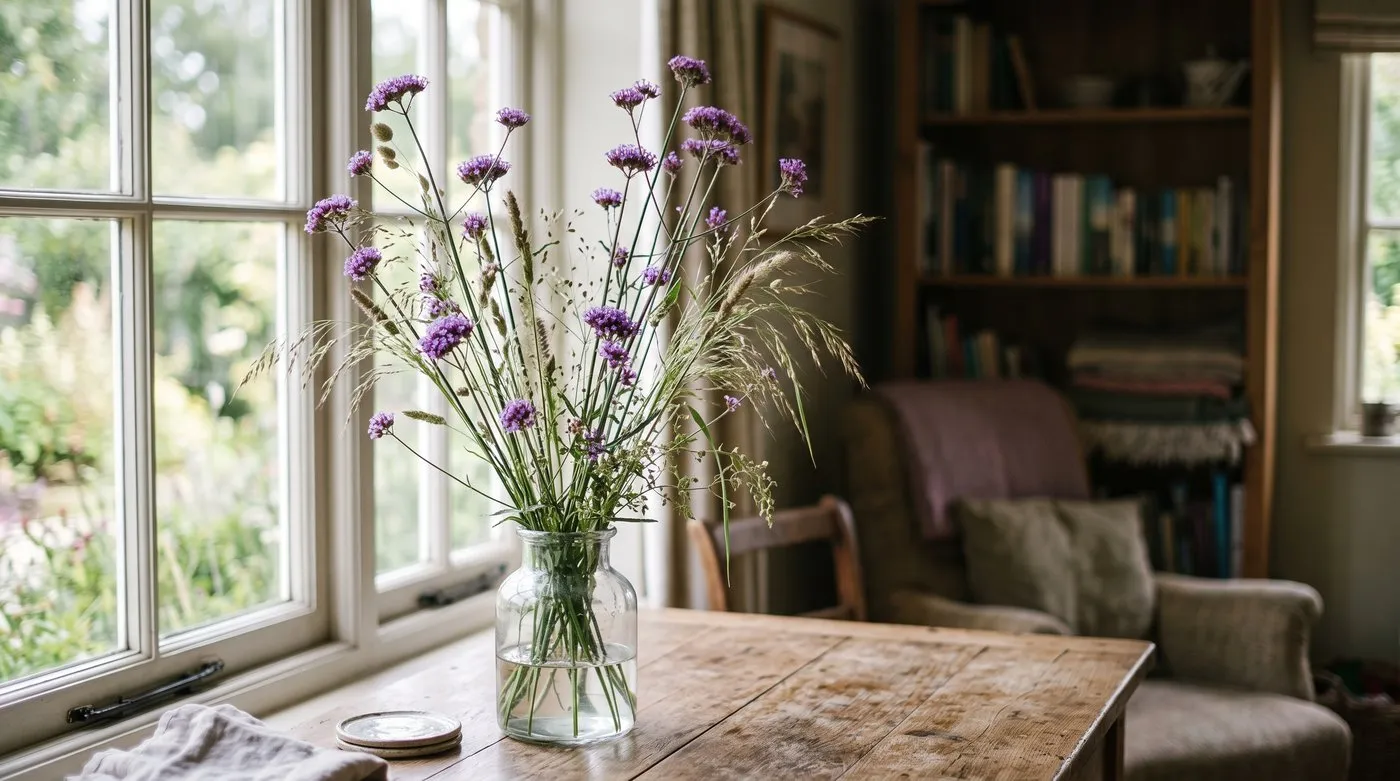 Verbena bonariensis lasts 7 to 10 days in the vase and lifts denser flowers with its airy purple haze.
Common mistakes to avoid
Planting in wet soil. This is the mistake that kills. Verbena bonariensis rots in cold, sodden ground over winter. Plant it lean, sunny and sharply drained, and add grit on clay.
Confusing it with other verbenas. This is not the trailing bedding verbena sold for hanging baskets, and not the culinary herb lemon verbena (Aloysia citrodora), a different plant entirely. Buy the correct species for a tall, hardy border plant.
Cutting it back in autumn. Removing the stems in autumn strips winter bird food, loses the self-sown seedlings, and exposes the crown to frost. Leave every stem standing until spring.
Feeding it too well. Rich soil and high-nitrogen fertiliser cause soft, floppy growth and fewer flowers. Verbena bonariensis flowers best on poor, lean ground. Hold back the feed.
Spacing it too far apart. Isolated plants on their own tend to lean and flop. Plant in drifts of 3 to 5 at 45cm apart so the wiry stems support each other and read as a haze.
Now you have mastered Verbena bonariensis, read our guide to the best half-hardy annuals for UK gardens for more plants to sow fresh each spring.
Frequently asked questions
Is Verbena bonariensis a perennial or an annual?
It is a short-lived perennial, often grown as an annual or biennial in the UK. On free-draining soil in mild gardens the same crown returns for three or four years. In cold or wet gardens the crown rots, and the plant persists instead by self-seeding freely around the parent each spring.
Is Verbena bonariensis hardy in the UK?
It is borderline hardy, rated RHS H3, roughly -5 to -10°C. Frost alone rarely kills it. Wet winter soil around the crown is the real risk. On sharp-draining ground it survives most UK winters. In heavy clay it is safest treated as a self-seeding annual or biennial.
How tall does Verbena bonariensis grow?
It reaches 1.5 to 2m tall but spreads only 45 to 60cm. The tall, wiry, near-leafless stems carry small purple flower clusters high on thin verticals. Because you see straight through it, plant it near the front of a border as well as the back. The compact form ‘Lollipop’ stays around 60cm.
Does Verbena bonariensis need full sun?
Yes, full sun is essential for strong, upright flowering. It wants at least 6 hours of direct sun a day. In shade the stems grow lax, flower poorly, and flop. It also needs sharp drainage. Poor, dry, free-draining soil in full sun suits it far better than rich, damp ground.
When does Verbena bonariensis flower?
It flowers from July to the first frosts, often into November. That is one of the longest flowering seasons of any hardy perennial, up to 17 weeks in a mild autumn. The long season is why it feeds butterflies and bees so late, when most other nectar plants have finished.
How do I grow Verbena bonariensis from seed?
Surface-sow the seed at 18 to 21°C, as it needs light to germinate. Sow February to April indoors. Germination is slow and erratic, 2 to 4 weeks and sometimes longer, so do not give up early. Easier still, lift self-sown seedlings in spring and move them where you want them.
Should I cut back Verbena bonariensis in autumn?
No, leave the stems standing over winter. They protect the crown from frost and feed birds with seed. Cut back to the base in early spring once new basal growth appears, usually March or April. In cold gardens, mulch the crown as well to improve its chance of surviving.
Further reading
- Best plants for winter seedheads, keep structure and bird food through the cold months
- Bee-friendly garden plants, top pollinator plants to grow alongside tall verbena
- Cottage garden planting plan, design ideas that use verbena for height and haze
- Seed sowing calendar for the UK, month-by-month timings for verbena and more
- How to grow dahlias in the UK, a late-summer partner for Verbena bonariensis
Our team produces practical UK gardening guidance from source research, contributor records and established horticultural practice. Editorial standards are overseen by Matt W.