Key takeaways
- Wintersweet flowers December to February on bare wood, with scent carrying 5 to 10 metres on still days.
- First flowers take 5 to 7 years from a seedling, or 3 to 4 years from a 3-litre container plant.
- Ripening this summer's wood in full sun against a warm wall is what triggers next winter's flowers.
- Plant against a south or west-facing wall; reflected heat lifts the microclimate 2 to 3 degrees C.
- Prune only after flowering in February, taking out old wood; it flowers on the previous year's growth.
- 'Grandiflorus' has larger flowers but weaker scent; 'Luteus' gives clear yellow without the maroon centre.
Learning how to grow wintersweet is mostly an exercise in patience. Chimonanthus praecox is the slow-burn star of the winter garden, and how to grow wintersweet well comes down to two things: choosing the right wall and waiting. This deciduous shrub rewards you with waxy, translucent pale-yellow flowers on bare branches from December to February. The scent is extraordinary, sweet and far-reaching on a still cold day. The catch is that it can take years to flower, and a poor position means it may never flower at all. Get the basics right at planting and you set up decades of midwinter perfume.
What wintersweet is and why gardeners covet it
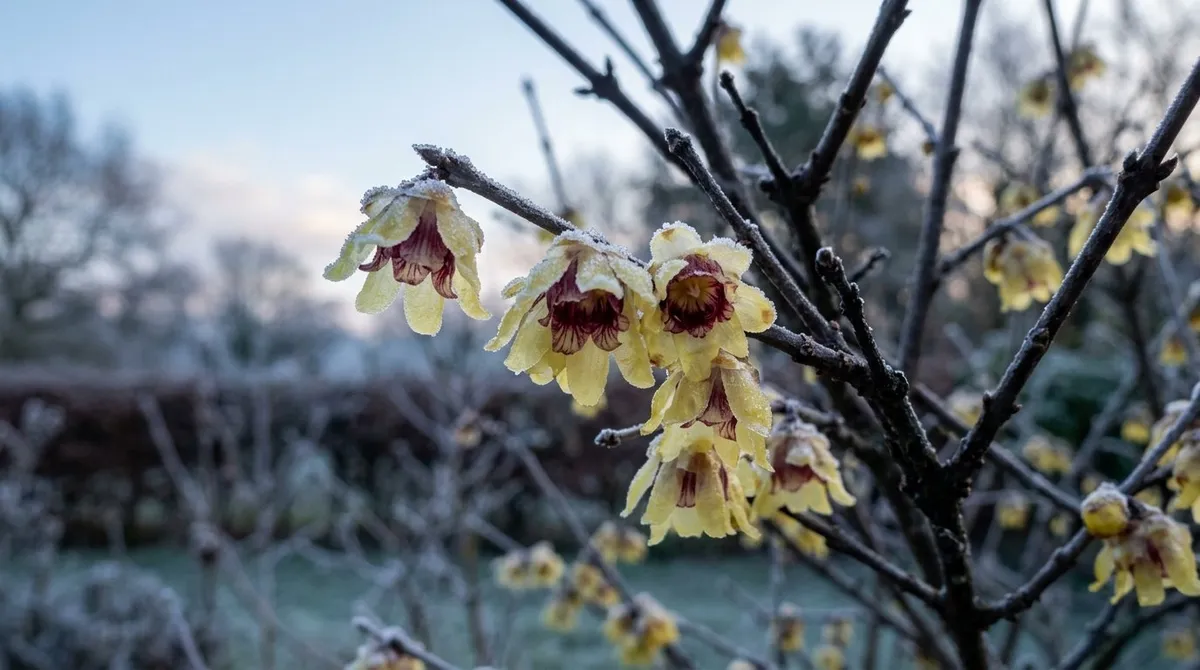
Wintersweet is a deciduous wall shrub from China, growing slowly to around 3 metres tall by 2.5 metres wide. It carries its flowers on bare wood in the depths of winter, usually December to February in the UK. Each bloom is small, nodding and made of waxy, translucent outer petals in pale primrose yellow, often with a stained maroon-purple centre.
The flowers look modest from a distance. The scent does the work. On a frosty, windless morning the perfume carries 5 to 10 metres and fills a courtyard. That is the whole reason to grow it. Few plants offer fragrance this powerful in January.
It is not a plant for instant gratification. Wintersweet is happiest trained flat against brick, where the warmth suits it and the structure shows off the flowers. If you want fast winter colour, look elsewhere. For long-term reward, few shrubs match it.
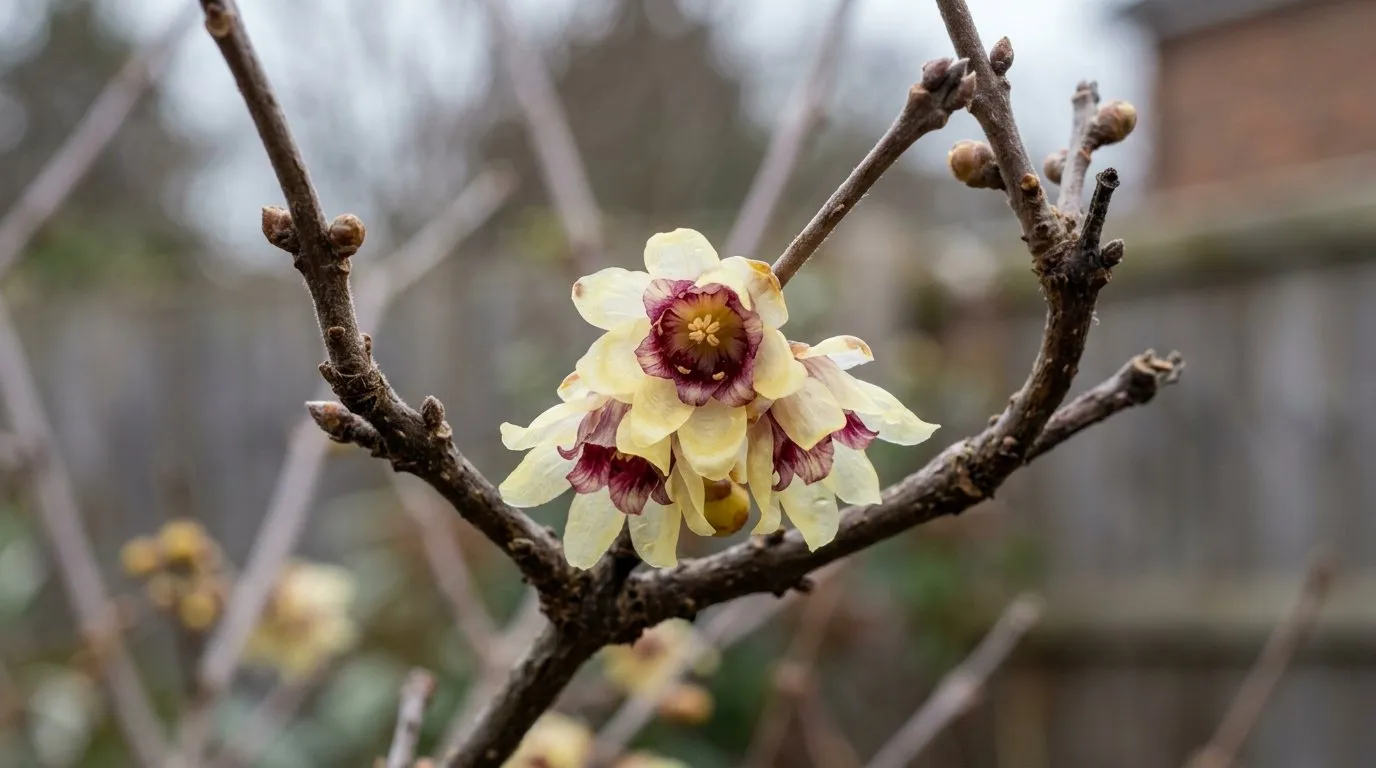 Translucent pale-yellow flowers open on bare wood, each with a stained maroon centre.
The honest truth about time to flower
Here is the part most plant labels skip. Wintersweet is slow to start, and the wait depends entirely on how you buy it. A seed-grown plant can take up to 10 years to bloom, and occasionally longer. That is a long time to look at a leafy, flowerless shrub.
A decent container plant speeds things up. From a 3-litre pot you can expect first flowers in 3 to 4 years, sometimes faster against a warm wall. From a seedling or a cheap whip, plan for 5 to 7 years. The difference is the maturity of the wood you start with.
Gardener’s tip: Buy wintersweet in flower in midwinter if you can. You see the exact flower colour and scent strength, and you know the plant is mature enough to bloom for you.
Why ripening this summer’s wood decides next winter’s flowers
This is the single fact that explains most failures. Wintersweet flowers on the previous year’s growth. The wood made this summer carries next winter’s flower buds. For those buds to form, that wood has to ripen properly, and ripening needs heat and light through July, August and September.
A plant in shade or a cool, open position makes soft, leafy growth that never matures. You get a healthy green shrub and no flowers, year after year. Gardeners blame the cold winter. The real cause was the previous summer’s lack of sun.
That is why a warm wall is close to essential in the UK. Brick stores heat and reflects light, lifting the local temperature by 2 to 3 degrees C and baking the wood hard. A south or west-facing wall is ideal. The south-facing garden full sun guide explains how to make the most of that reflected warmth. The RHS lists Chimonanthus praecox as needing full sun and shelter for exactly this reason (RHS).
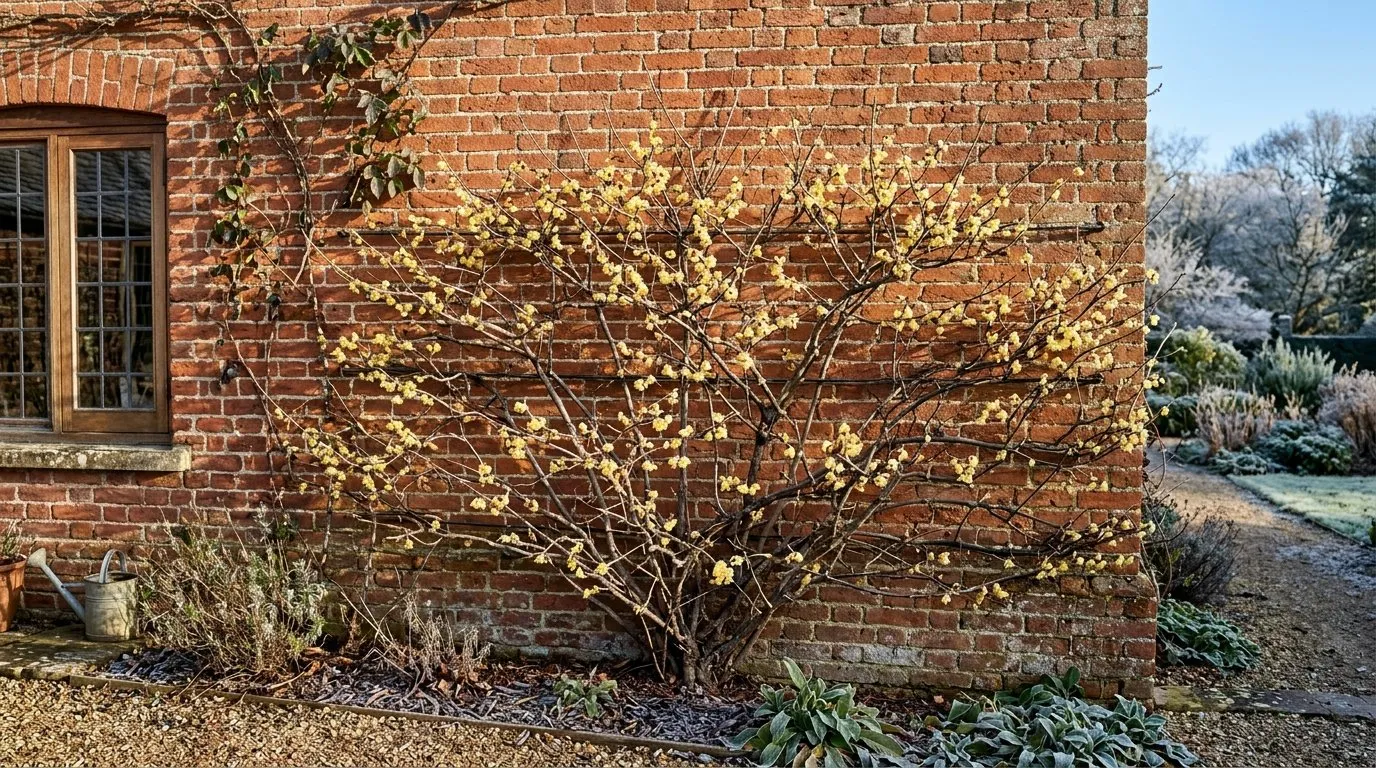 Trained against a warm south-facing wall, the ripened wood flowers reliably each winter.
How to plant wintersweet for the best chance of flowers
Get planting right once and the plant looks after itself for decades. Follow these stages.
- Choose the wall. Pick a south or west-facing wall or fence in full sun, sheltered from cold north and east wind. Avoid frost pockets at the bottom of slopes.
- Check the drainage. Wintersweet takes any well-drained soil, including chalk and clay, as long as it never sits waterlogged. Dig a test hole and fill with water; it should drain within a few hours.
- Dig the hole. Make it twice the width of the rootball and the same depth. Loosen the base and sides with a fork.
- Plant 30 to 45cm from the wall. Soil at the foot of a wall is dry, so set the plant out far enough to catch rain and angle the roots away from the brick.
- Plant level. Set the rootball so the top sits flush with the surrounding soil. Backfill, firm gently and water in well.
- Mulch and support. Apply a 5cm bark or compost mulch, keeping it off the stem. Fix horizontal wires to the wall and tie in the main stems.
The critical mistake most people make is planting in a convenient spot rather than a sunny wall. A wintersweet in light shade may grow happily and never flower. Position beats almost every other factor. If your only sunny wall is taken, it is worth moving another plant to free it up; the guide to moving a shrub safely shows how.
Aftercare through the year
Once planted, wintersweet needs little. Water new plants through their first two summers, especially against a wall where the soil dries fast. A bucket twice a week in dry spells keeps it growing. After two years the roots reach moisture and you can largely stop.
Feed lightly. A handful of general fertiliser in spring and a fresh mulch is plenty. Over-feeding pushes soft, leafy growth that fails to ripen, which is the opposite of what you want. Hungry plants on poor soil often flower better than pampered ones.
Keep the base weed-free and the mulch topped up. Tie in new growth to the wires through summer so the framework stays flat and the wood gets maximum light. That tying-in is part of the ripening job, not just tidiness. For the wider principles of training stems against walls, see training young climbers.
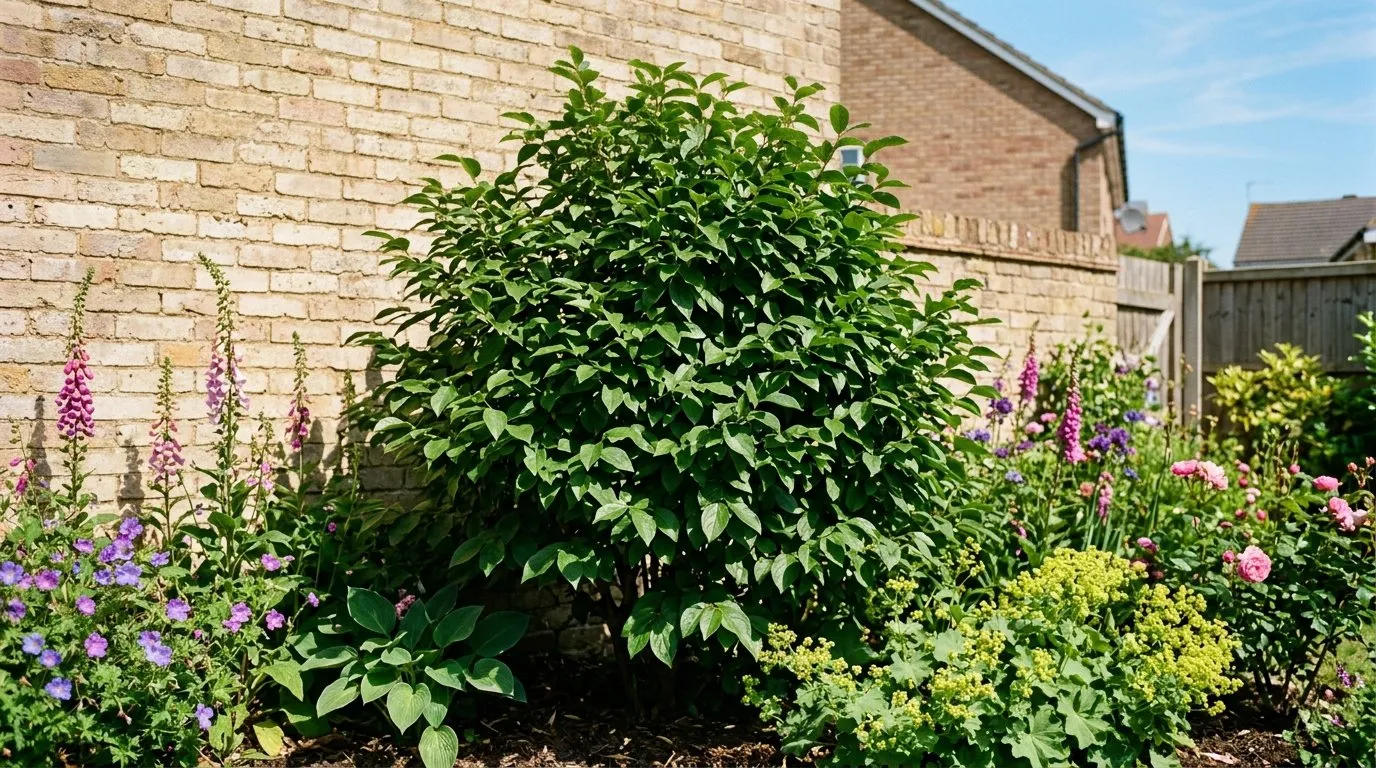 In summer the shrub is plain green; the sun-baked wood is quietly setting next winter’s buds.
When and how to prune wintersweet
Prune only after flowering, in February, once the blooms fade. This is non-negotiable. Because wintersweet flowers on the previous year’s wood, autumn or summer pruning cuts off the coming winter’s display before it opens.
Keep pruning light. Take out old, weak, dead or crossing stems to keep the centre open. On a wall-trained plant, shorten the flowered shoots back to a strong bud or to the main framework, and tie in replacements. Aim to shape, not to reduce size hard.
Wintersweet resents heavy pruning and regrows slowly, so never cut into old wood unless you must renovate. If a plant has become a tangled thicket, spread renovation over two or three years rather than all at once. The how to prune shrubs UK guide covers staged renovation in detail, and best winter flowering shrubs sets wintersweet alongside its rivals.
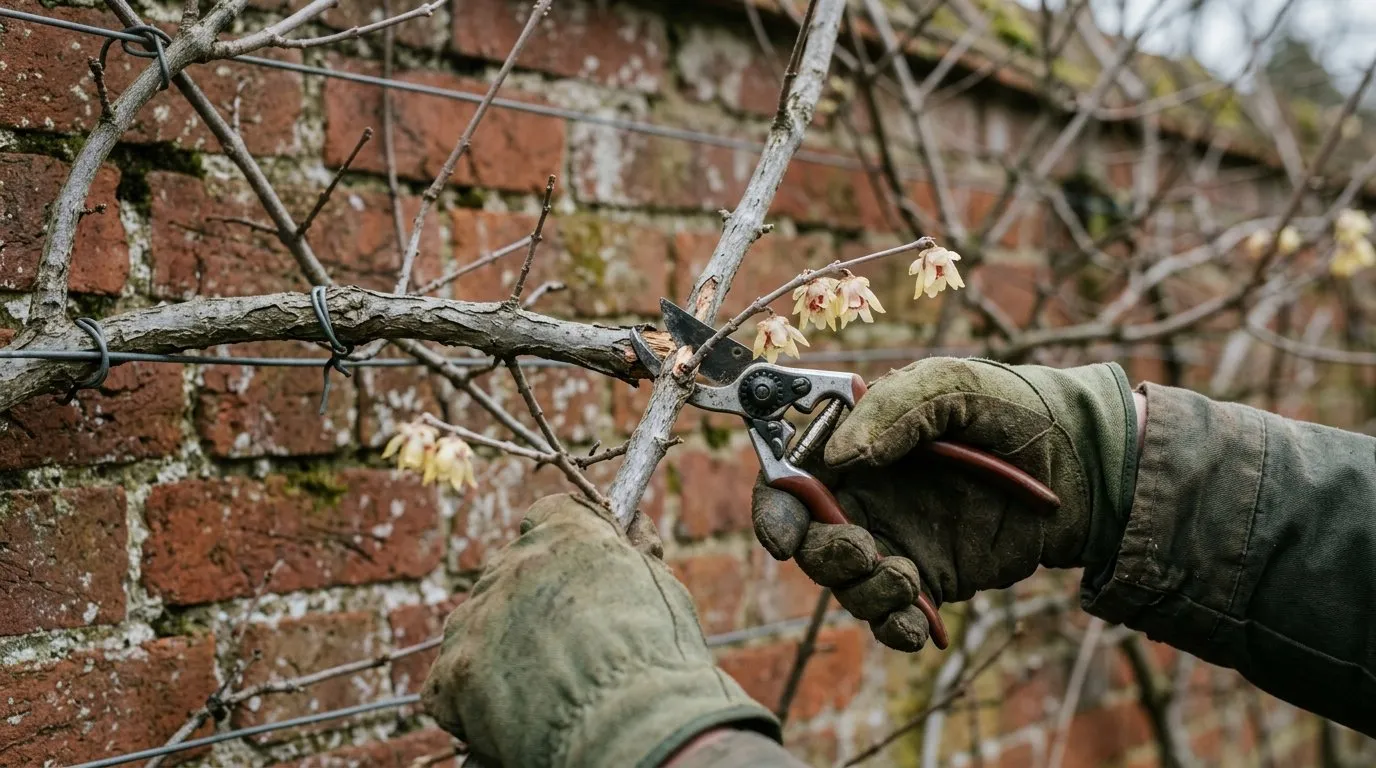 Prune straight after flowering in February, taking out old wood and tying in replacements.
Best wintersweet varieties for UK gardens
There are only a handful worth seeking, and they trade scent against flower size. Choose by what matters most to you.
The straight species holds the strongest perfume, which is the point of the plant for most growers. ‘Grandiflorus’ is the showy one: larger, brighter yellow flowers with deeper maroon centres, but the fragrance is noticeably weaker. ‘Luteus’ gives clear, uniform yellow flowers without the maroon stain, opening a little later, with moderate scent. The RHS holds an Award of Garden Merit assessment for several forms, so look for the AGM mark when buying (RHS).
| Wintersweet variety | Flower | Scent strength | First flower (container) | Best for |
|---|---|---|---|---|
| C. praecox (species) | Pale yellow, maroon centre | Very strong | 3 to 4 years | Maximum fragrance |
| ’Grandiflorus’ | Larger, brighter yellow | Moderate | 3 to 4 years | Showy blooms to cut |
| ’Luteus’ | Clear yellow, no maroon | Moderate | 4 to 5 years | Clean colour, later flowers |
| Seed-grown plant | Variable | Variable | 5 to 10 years | Patient gardeners only |
If you want flowers to cut for the house, ‘Grandiflorus’ wins. If you want a plant that scents the whole garden, buy the species. For a comparison across all the season’s fragrant options, see best scented plants for UK gardens.
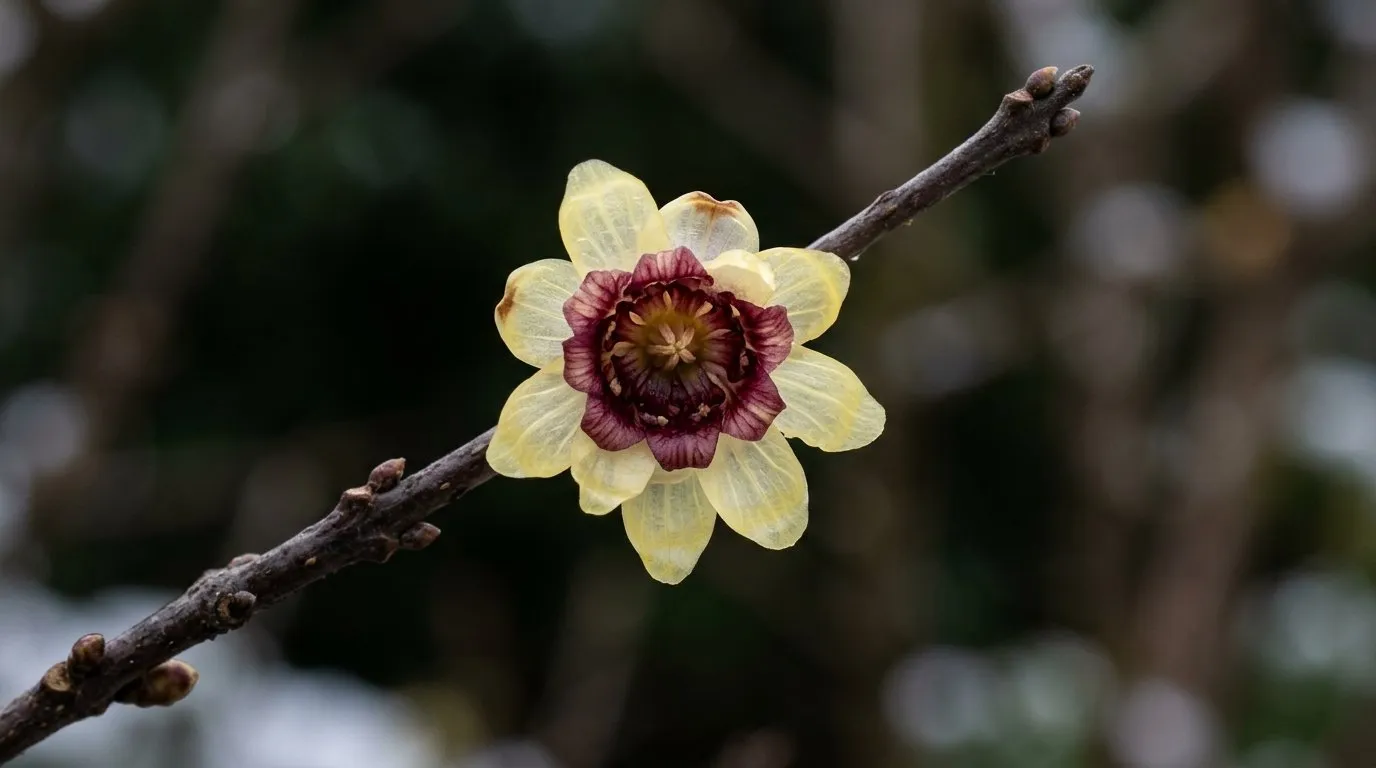 The straight species shows the deepest maroon staining at the heart of each waxy flower.
How wintersweet compares with other winter-scented shrubs
Wintersweet is not the only fragrant shrub for the cold months, and it is the slowest to establish of the lot. Knowing how it sits against the alternatives helps you plan a succession of winter scent rather than relying on one plant.
| Shrub | Flowering time | Scent | Mature size | Years to flower |
|---|---|---|---|---|
| Wintersweet (Chimonanthus) | Dec to Feb | Very strong, sweet | 3m x 2.5m | 3 to 7 |
| Witch hazel (Hamamelis) | Dec to Mar | Strong, spicy | 4m x 4m | 4 to 6 |
| Sarcococca (Christmas box) | Dec to Mar | Strong, honeyed | 1m x 1.5m | 2 to 3 |
| Winter honeysuckle (Lonicera fragrantissima) | Dec to Mar | Strong, lemony | 2m x 2.5m | 2 to 3 |
| Daphne bholua | Jan to Mar | Very strong, sweet | 2m x 1m | 2 to 4 |
The pattern is clear. Sarcococca and winter honeysuckle establish fastest and tolerate shade, so they earn their place while you wait for wintersweet. Witch hazel matches the scale and timing but needs acid soil. Daphne rivals the perfume but is shorter-lived. Plant wintersweet for the long game and use the faster shrubs to carry the early years. See the detailed guides on growing witch hazel, growing sarcococca and growing daphne to build the full sequence.
Month-by-month wintersweet calendar
This calendar tracks the working year for an established UK wintersweet against a warm wall.
| Month | Job |
|---|---|
| December | First flowers open; cut a few stems for indoors |
| January | Peak flowering and scent; enjoy on still days |
| February | Flowering ends; prune now, take out old wood, tie in |
| March | Apply general fertiliser and refresh mulch |
| April | New leaves emerge; check ties and wires |
| May | Tie in fresh growth flat to the wall for light |
| June | Take softwood cuttings if propagating |
| July | Water in dry spells; wood begins ripening |
| August | Keep new growth tied in and exposed to sun |
| September | Final wood ripening; ease off watering |
| October | Layer a low branch now if you want more plants |
| November | Tidy fallen leaves; flower buds swell on bare wood |
The two jobs that decide success sit in February (correct pruning) and July to September (wood ripening). Miss either and the display suffers. The winter gardening jobs UK guide puts these tasks in context with the rest of the cold-season work.
 A mature wintersweet earns its place in a frosty Cotswold garden when little else is in flower.
 A few cut stems scent a whole room; pick them in bud and let them open in the warm.
Cutting wintersweet for the house
One of wintersweet’s quiet pleasures is cutting it for indoors. Pick stems in December and January when buds are just colouring up. Cut on a dry day with sharp secateurs, taking shoots from the framework rather than vital structural wood.
Bring them inside and the warmth opens the buds within a day or two, filling a room with scent that no shop-bought flower matches. Strip any lower buds that would sit below the waterline and recut the stems at an angle. They last 7 to 10 days in a cool room.
Picking for the house doubles as light pruning, so do it from a wall-trained plant where you have stems to spare. Just keep the framework intact. For getting the longest vase life, the principles in conditioning cut flowers apply equally to woody winter stems.
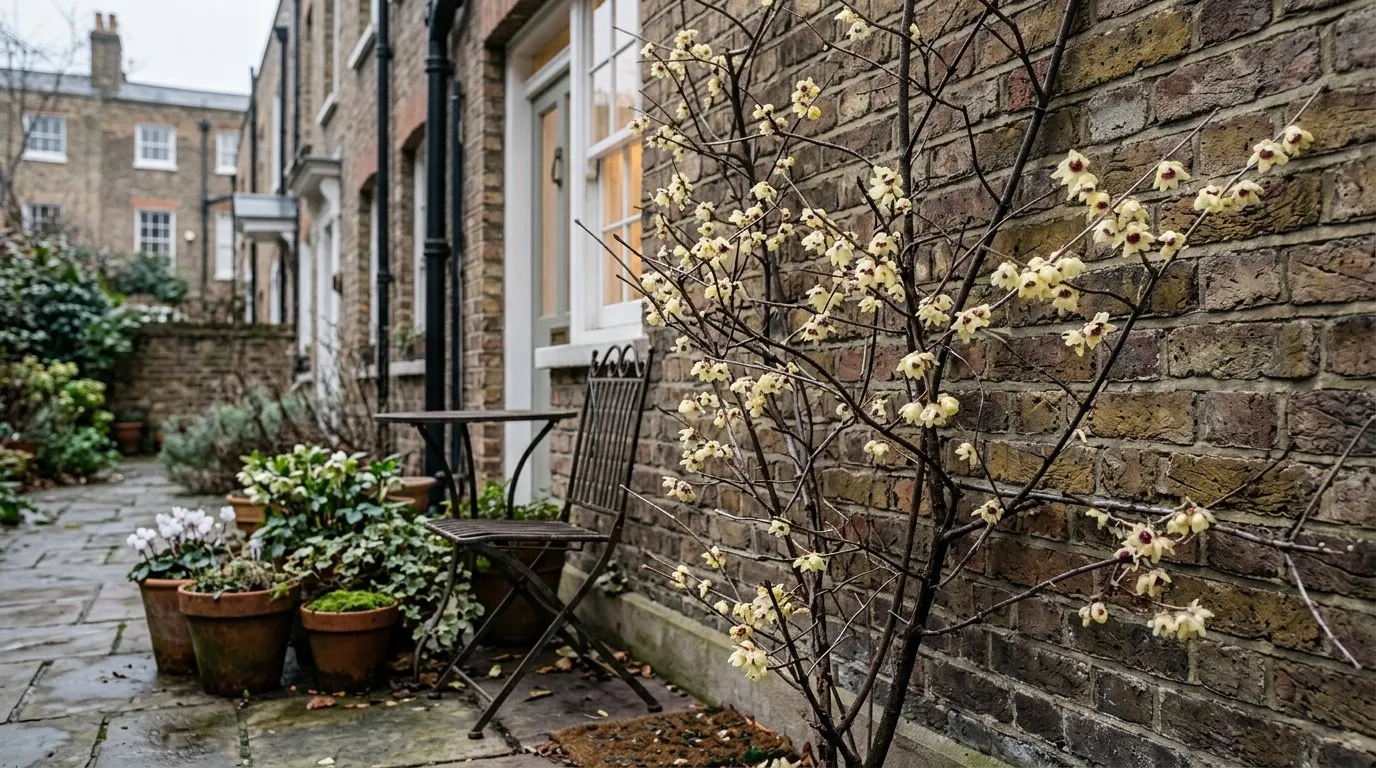 A warm courtyard wall traps heat and scent, making wintersweet a strong choice for small city plots.
Common mistakes when growing wintersweet
Most wintersweet failures trace back to a small number of avoidable errors.
Planting in shade or an open border. This is the big one. The wood never ripens, so no flower buds form. It happens because the plant looks healthy and green, so gardeners do not suspect the position. Avoid it by planting against a sunny wall from the start.
Pruning at the wrong time. Autumn or summer cutting removes next winter’s flowers, which sit on the previous year’s wood. It happens because people tidy shrubs in autumn out of habit. Avoid it by pruning only in February, straight after flowering.
Expecting quick flowers. Gardeners give up on a plant that is simply too young, sometimes digging it out a year before it would have bloomed. It happens because labels rarely state the true timescale. Avoid it by buying a mature container plant and committing to the wait.
Over-feeding. Rich soil and heavy feeding push soft growth that fails to ripen. It happens because we assume more food means more flowers. Avoid it by feeding lightly and letting the plant work a little.
Warning: Wintersweet seeds and parts of the plant are toxic if eaten. Keep cut stems and any seed pods away from children and pets, and wash your hands after pruning.
Frequently asked questions
How long does wintersweet take to flower?
Expect 5 to 7 years from a seedling, or 3 to 4 years from a container plant. A seed-grown plant can take up to 10 years and sometimes longer. Buy the biggest pot-grown plant you can afford and plant it against a warm wall. That single decision can pull first flower forward by three winters.
Why does my wintersweet not flower?
Usually the summer wood did not ripen in enough sun. Wintersweet sets flower buds on growth made the previous summer, and that wood needs heat and light to mature. A shaded or open, cool position gives leafy growth but no buds. Move it to a south or west-facing wall, or thin nearby plants to open up the light.
Where should I plant wintersweet?
Against a warm south or west-facing wall in full sun. Shelter from cold wind protects the open winter flowers and the reflected wall heat ripens the wood. Any well-drained soil suits it, including chalk and clay that does not sit wet. Avoid frost pockets and deep shade, which both delay or prevent flowering.
Does wintersweet need a wall to grow?
No, but a warm wall makes flowering far more reliable in the UK. It grows as a free-standing shrub, yet open positions rarely ripen the wood well enough for dependable winter flowers. Treat the wall as a near-essential for good displays north of the Midlands. In a mild southern garden it can manage in an open sheltered spot.
When and how do I prune wintersweet?
Prune straight after flowering in February, never in autumn. It flowers on the previous year’s wood, so autumn pruning removes the coming winter’s display. Take out old, weak or crossing stems and shorten any wall-trained growth to a framework. Keep it light; wintersweet resents hard cutting and is slow to regrow.
What is the most fragrant wintersweet?
The straight species, Chimonanthus praecox, has the strongest scent. The cultivar ‘Grandiflorus’ has bigger, brighter flowers but noticeably weaker fragrance. ‘Luteus’ gives clear yellow flowers without the maroon centre and moderate scent. If perfume matters most, buy the species; if you want showy blooms to cut, choose ‘Grandiflorus’.
Can you grow wintersweet from cuttings?
Yes, but it is slow and unreliable. Take softwood cuttings in early summer or layer a low branch in autumn. Layering is the surest home method and may take two years to root. Most gardeners buy a named container plant instead, which also flowers years sooner than a seedling.
Is wintersweet hardy in the UK?
Yes, it is fully hardy to about minus 15 degrees C once established. Young plants and the open flowers can be damaged by hard frost and cold wind, which is why shelter matters. Established wall plants shrug off most UK winters. In exposed northern or upland gardens, give it the warmest, most sheltered wall you have.
Now you’ve got the timing and the wall sorted, browse more plant growing guides or read our guide on best winter flowering plants for the UK for the low-growing partners that will fill the years while your wintersweet matures.
Our team produces practical UK gardening guidance from source research, contributor records and established horticultural practice. Editorial standards are overseen by Matt W.