Key takeaways
- Plants prevent flooding by intercepting rain, drinking it through transpiration and opening root channels that improve infiltration
- Planting is one part of SuDS, alongside rain gardens, swales, bog gardens, permeable surfaces, trees and rain butts
- A rain garden basin is 10 to 20cm deep, sited to catch a downpipe, with plants set by wet, mid and dry zones
- Iris ensata, Carex and Juncus tolerate standing water for days; Astilbe and Filipendula want moist but not flooded soil
- Never site a rain garden within 5m of house foundations or over a soakaway near the building
Planting is never the whole answer. It works as one element of a Sustainable Drainage System, sitting alongside rain gardens, swales, bog gardens, permeable surfaces, trees and rain butts. Get the plants and the zones right, though, and a problem corner becomes the part of the garden that takes the most rain and looks the best for it.
How plants reduce flooding in a garden
Plants cut flood risk through four physical processes that work together. None of them is dramatic on its own. Stacked across a bed, they shift far more water than bare ground ever could.
The first is interception. Leaves and stems catch raindrops before they hit the soil. A dense perennial clump or a tree canopy holds a film of water on its surface, and a share of that evaporates straight back to the air. The second is transpiration. A growing plant pulls water from the soil through its roots and releases it as vapour through its leaves. A mature birch can move tens of litres on a warm day. That is water leaving the soil rather than sitting in it.
The third process matters most on heavy ground: root channels. Living roots push through soil, die back, and leave fine pores behind. Earthworms follow the roots. Together they open the structure of compacted clay, and that raises infiltration, the speed at which water soaks downward. The fourth is the simplest. Stems and basal growth slow surface run-off, so water spreads and sinks instead of racing off in a sheet. A bare, mown lawn on clay does almost none of this. That is why it floods.
Where planting fits in a SuDS scheme
A Sustainable Drainage System manages rain where it falls, rather than rushing it into drains that then overflow. Planting is one tool inside a kit of several, and they are stronger combined. The point of SuDS is to slow, store and soak rainwater across the garden.
The main SuDS features for a domestic garden are these. A rain garden is a shallow planted basin that collects run-off, usually from a roof. A swale is a shallow vegetated channel that carries and slows water along a route. A bog garden is a permanently moist planted area for the wettest ground. Permeable surfaces, like gravel or porous paving, let rain soak through instead of running off hard standing. Trees intercept rain in the canopy and drink deeply through the year. Rain butts capture roof water for reuse, taking the first flush off the system entirely.
The rain garden plant list, zoned by wetness
A rain garden is not uniformly wet. Water collects in the centre and base, then drains, while the rim stays drier and dries out fast between downpours. The skill is matching each plant to its zone. Put a bog plant on the dry rim and it dies in summer. Put a dry-loving grass in the base and it rots in winter.
The table below ranks plants by how much standing water they tolerate, and places each one in its rain garden zone. The base or wet zone is the lowest, wettest centre. The mid slope is moist but drains within a day. The dry edge is the rim, moist in winter and dry in summer.
| Plant | Type | Tolerates standing water? | Rain garden zone | Height |
|---|---|---|---|---|
| Iris ensata / sibirica | Perennial | Yes, several days | Base / wet zone | 60 to 100cm |
| Carex elata, C. pendula | Sedge | Yes, several days | Base / wet zone | 50 to 120cm |
| Juncus effusus | Rush | Yes, prolonged | Base / wet zone | 60 to 90cm |
| Filipendula ulmaria | Perennial | Brief, hours to a day | Base to mid | 60 to 120cm |
| Lythrum salicaria | Perennial | Brief, hours to a day | Base to mid | 90 to 120cm |
| Ligularia | Perennial | No, but wants moist | Mid slope | 90 to 150cm |
| Astilbe | Perennial | No, but wants moist | Mid slope | 40 to 100cm |
| Rodgersia | Perennial | No, but wants moist | Mid slope | 90 to 120cm |
| Persicaria bistorta | Perennial | Brief | Mid slope | 50 to 90cm |
| Geum rivale | Perennial | Brief | Mid slope | 30 to 50cm |
| Hosta | Perennial | No | Mid to dry edge | 30 to 80cm |
| Deschampsia cespitosa | Grass | No | Dry edge | 60 to 120cm |
| Molinia caerulea | Grass | Brief | Dry edge | 60 to 180cm |
Plant the base heavily. The wettest zone takes the most water, so a dense mat of iris, sedge and rush roots there does the hardest infiltration work. Thin out towards the rim.
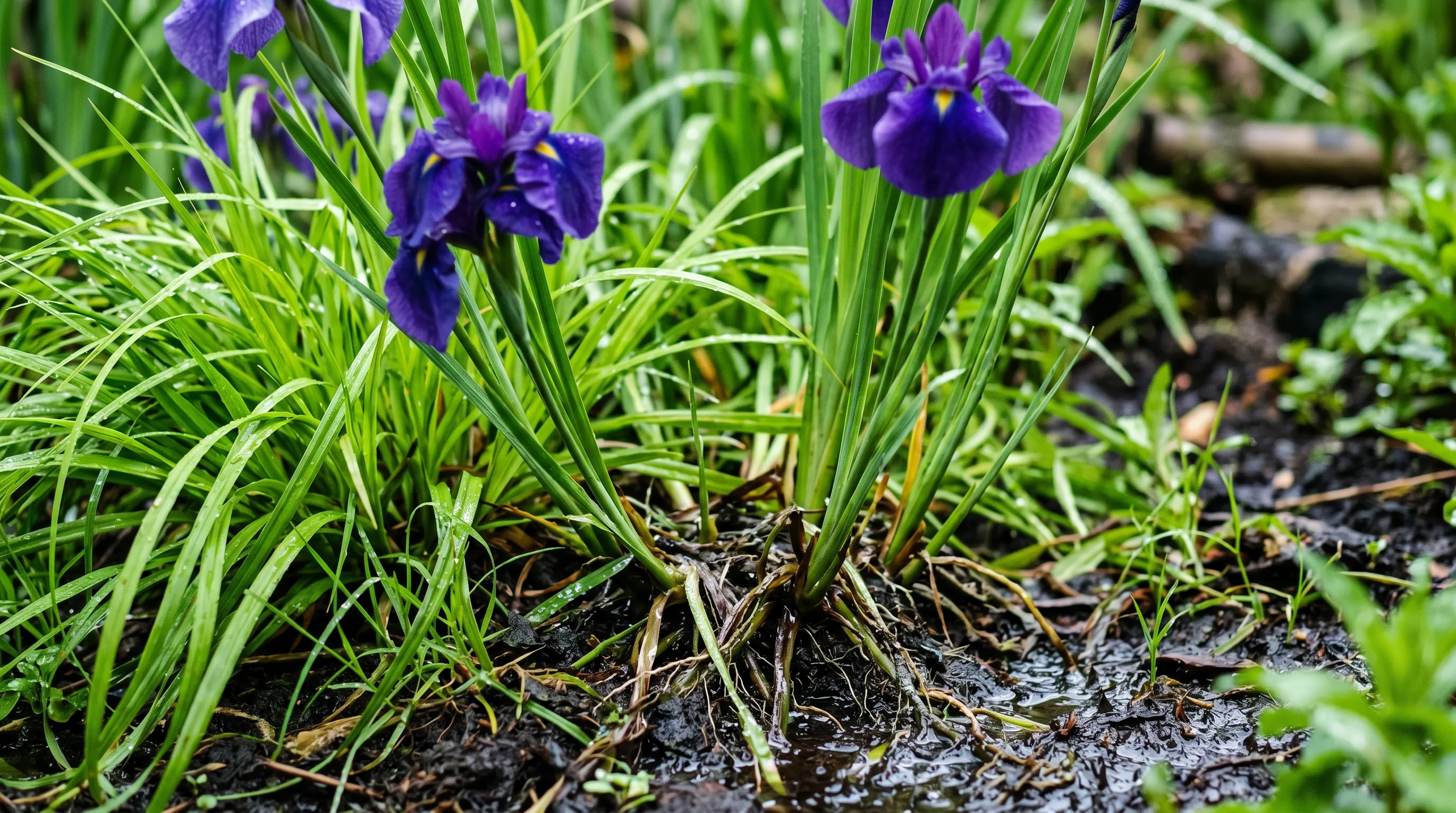 The wet base of the basin, packed with Iris ensata and Carex. These marginal roots open saturated clay and drive the fastest infiltration in the bed.
Trees and shrubs that drink the most water
Woody plants move more water than any perennial, because they are larger and root deeper. A single mature tree can transpire hundreds of litres on a hot day and intercept a heavy share of rain in its canopy. For a garden with a real flooding problem, a thirsty tree is the most effective single planting you can make.
For permanently damp or briefly flooded ground, the best choices are willow (Salix), alder (Alnus glutinosa) and dogwood (Cornus). Willow and alder both grow naturally in wet UK ground and drink hard. Keep willow well away from drains and foundations, as the roots seek water aggressively. For smaller gardens, birch (Betula), Amelanchier and the native guelder rose (Viburnum opulus) cope with damp but not standing water, and stay a sensible size.
For a corner that floods after rain but dries hard in summer, choose species that handle both. Amelanchier and Betula suit this swing. Site a water-thirsty tree near, not on top of, a soakaway, so its roots reach the moisture without blocking the drainage. The bigger the tree, the further from the house it must sit. A general rule keeps a vigorous tree at least its mature height away from any building.
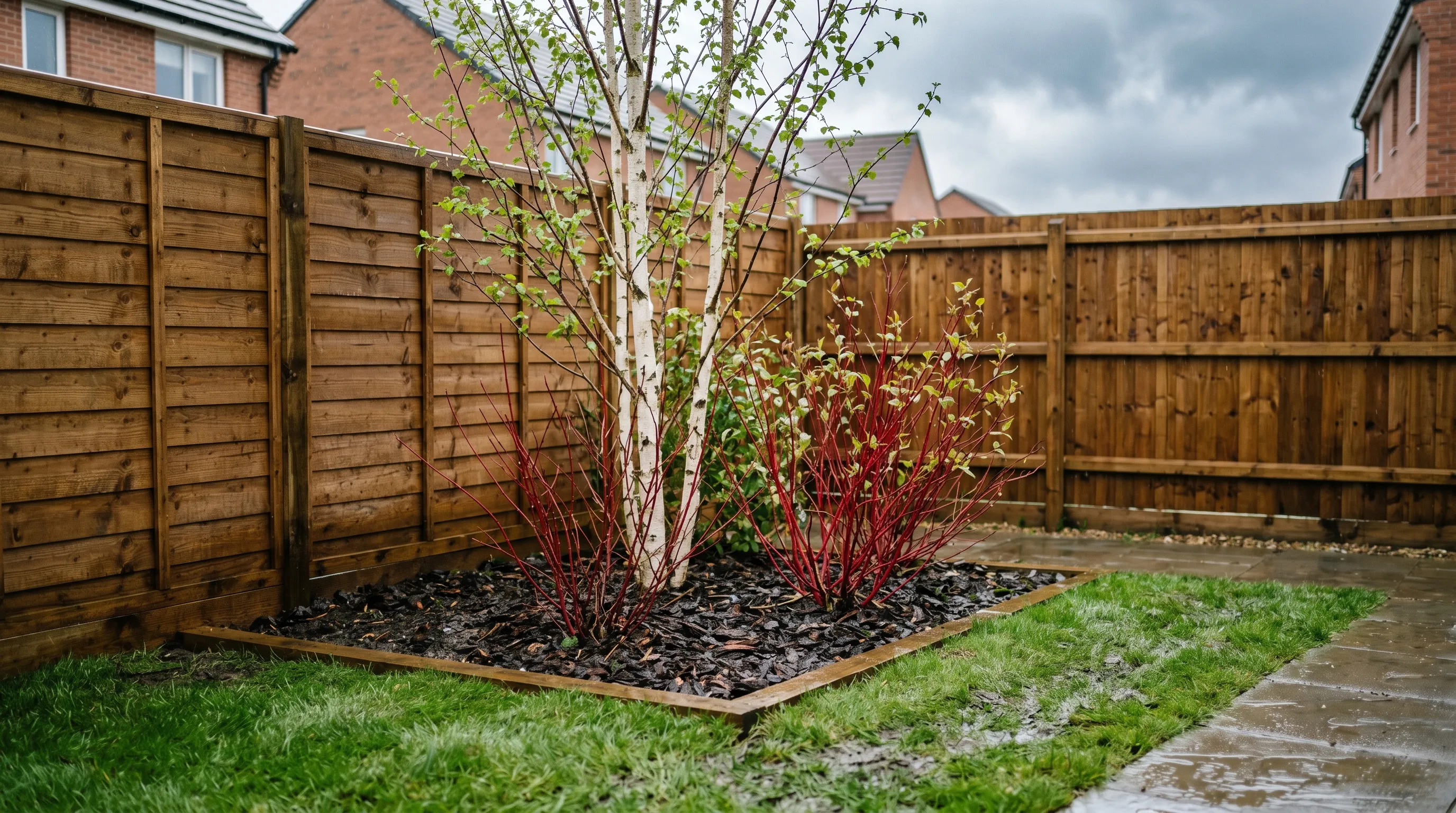 A multi-stem birch and red dogwood in the wet corner of a new-build garden. Both drink hard and cope with ground that floods then dries.
Perennials, grasses, sedges and ferns for damp ground
The body of a rain garden is its perennials, grasses and sedges. They give the seasonal display and do the steady infiltration work between the trees.
For the moist mid slope, the workhorses are Astilbe, with feathery summer plumes, Ligularia for bold leaves and yellow spikes, and Rodgersia for architectural foliage on heavy ground. Persicaria bistorta and Geum rivale fill the lower mid zone and flower from late spring. These want moisture but resent sitting underwater, so they belong on the slope, not the base.
Grasses and sedges earn their place twice over. Carex elata and Carex pendula are true sedges that thrive with wet feet and root densely. Juncus effusus is a soft rush for the wettest spot. On the drier rim, Deschampsia cespitosa and Molinia caerulea add movement and tolerate the summer dry-out that kills marginals. Ferns suit shaded, consistently damp edges. The native royal fern (Osmunda regalis) and Matteuccia struthiopteris (shuttlecock fern) thrive in moist soil and shade where flowering perennials struggle. For a permanently saturated area too wet even for a rain garden base, build a dedicated bog garden instead.
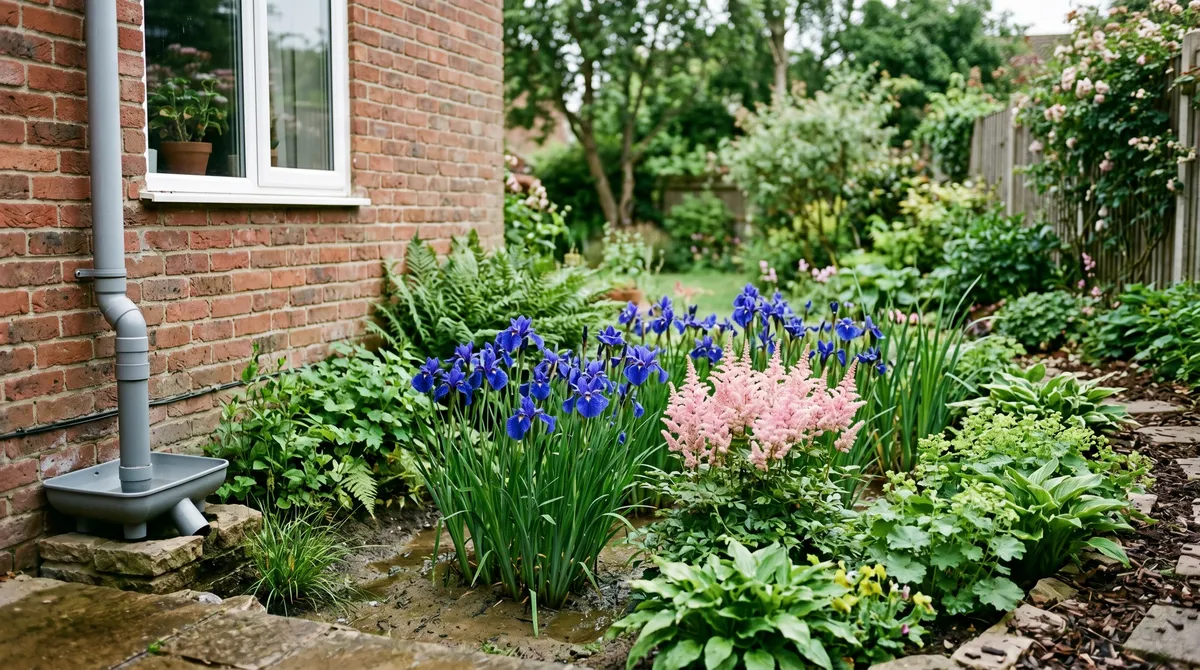
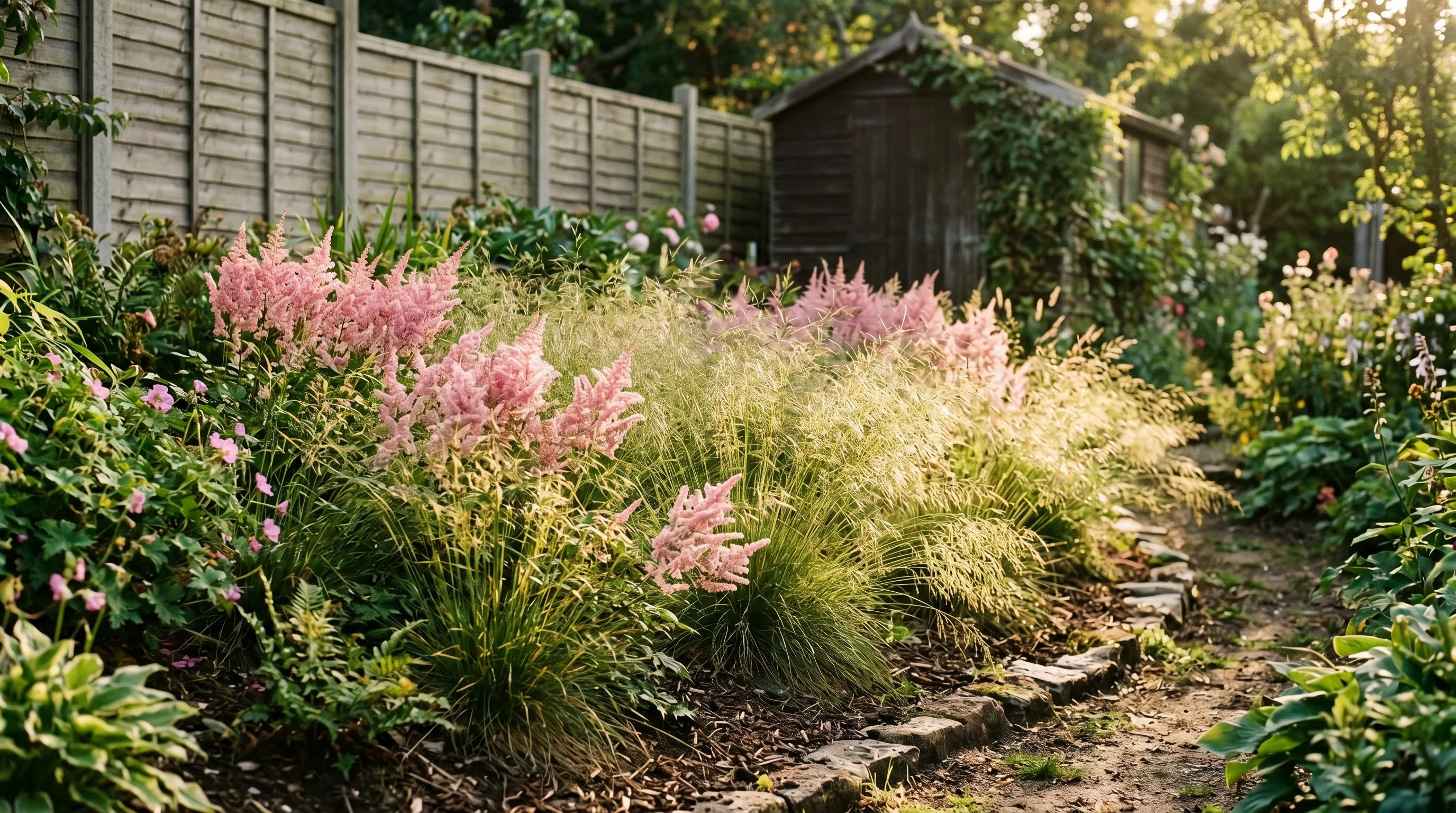 Astilbe and Deschampsia on the mid slope of a suburban rain garden. The grass edge dries out in summer; the astilbe holds the moister middle.
How to build a rain garden basin
A rain garden is a shallow, planted dish that catches run-off and lets it soak away. The build is straightforward and the depth matters more than anything.
Dig the basin 10 to 20cm deep. Shallower than 10cm holds too little water; deeper than 20cm keeps plants flooded too long. Aim for a base that drains within 24 to 48 hours after rain. Site it to catch a downpipe or a run of run-off, so roof or path water is guided in through a shallow channel or a pipe. The basin needs a free-draining base. On clay, dig out a further spade’s depth, then backfill with a mix of soil, grit and leaf mould or compost to open the structure. Form a low overflow point on one side so a storm that fills the basin spills somewhere safe, not towards the house.
Warning: Never site a rain garden within 5 metres of house foundations, and never over or beside a soakaway close to the building. Pooling water near walls risks damp and subsidence. Always guide run-off away from the house, into a basin set well out in the garden.
The numbers in this guide come from one corner of a heavy clay garden. The downpipe corner flooded after every real downpour, and a bare patch of lawn there held water for well over a day.
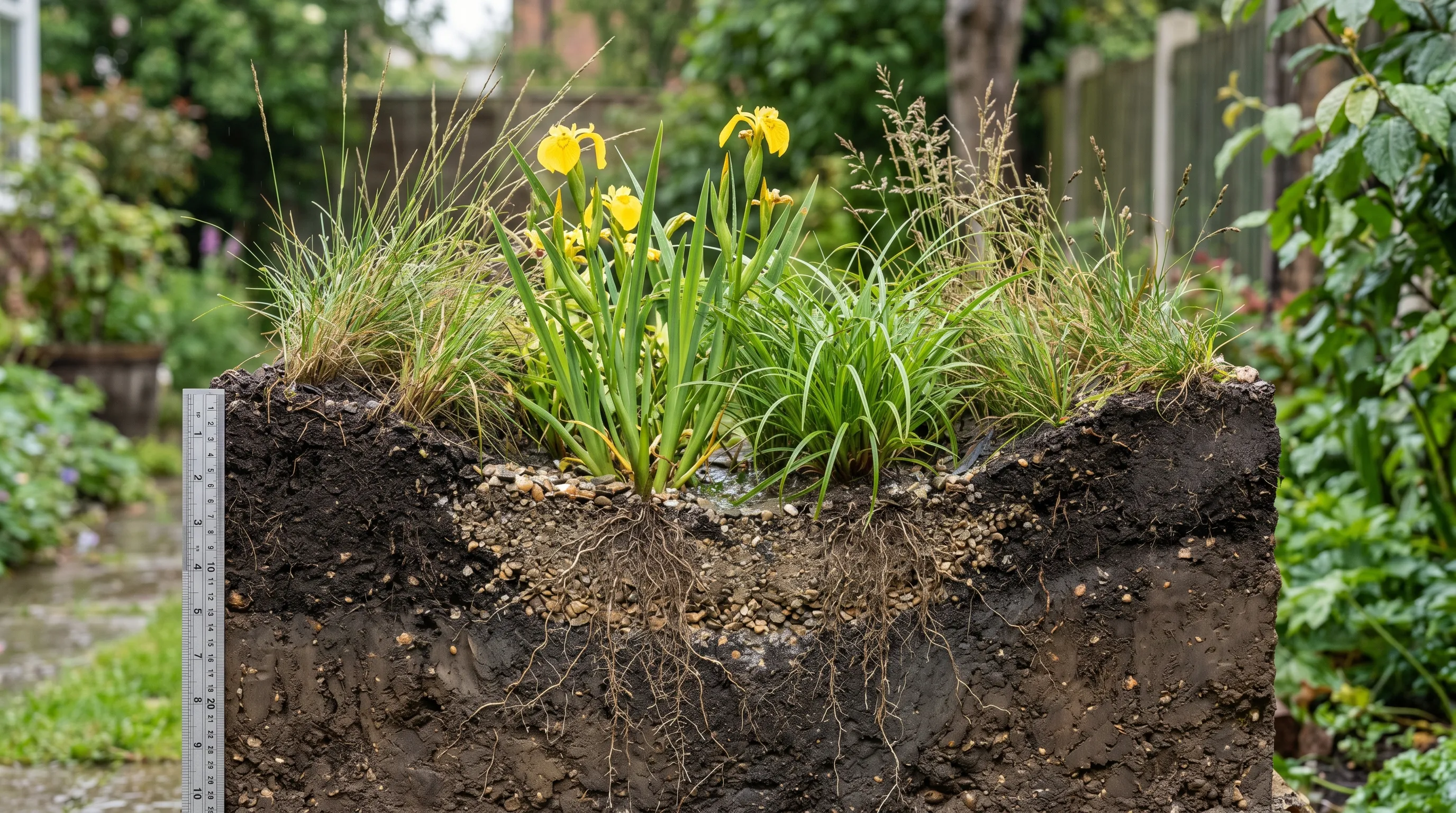 A cross-section of the basin: a shallow dish, a grit-and-leaf-mould base, and root channels reaching down into the clay below to drive infiltration.
Common mistakes that kill a rain garden
A rain garden fails for predictable reasons, and almost all of them come down to the wrong plant in the wrong zone, or the wrong place for the basin.
Planting bog plants on a dry mound. A rain garden rim dries out hard in summer. Set a moisture-lover like Astilbe or Ligularia on the rim and it scorches and dies by August. Keep moisture-lovers in the base and mid, and only grasses on the dry edge.
Choosing plants that hate winter wet. Many garden perennials tolerate summer moisture but rot if their crown sits in cold, wet soil over winter. That winter waterlogging, not summer damp, is what kills them. Stick to species proven for wet ground, like those in the table above.
Ignoring the dry spells. A rain garden is wet in winter and can bake in a dry summer. Every plant you choose must survive both. This is why true bog plants suit a dedicated bog garden, not a rain garden that empties between storms.
Siting the basin too close to the house. A rain garden over a soakaway near the building, or within 5m of foundations, drives water towards the walls. That risks damp and subsidence. Keep the basin well out in the garden and guide run-off to it.
Seasonal calendar for establishing a rain garden
Timing the build and planting raises your success rate. The basin is best dug when the ground is workable, and most plants establish fastest planted into warming or moist soil.
| Month | Task |
|---|---|
| January to February | Plan zones and order bare-root willow, alder or dogwood for the wet edge |
| March | Dig and shape the basin while soil is moist but workable; dig in grit and leaf mould |
| April | Plant marginals (iris, sedge, rush) into the base as growth starts; mulch 50mm |
| May | Plant mid-slope perennials (astilbe, ligularia, rodgersia); water in well |
| June to July | Water new plants through any dry spell; the basin may sit empty, so do not panic |
| August | Check for scorch on the rim; move any plant in the wrong zone now while you can see it |
| September to October | Best month to plant or divide most perennials and grasses into moist soil |
| November | Plant bare-root trees and shrubs; cut back spent perennial growth lightly |
| December | Leave seed heads and grasses standing for winter structure and infiltration |
Spring and autumn are the two planting windows. Avoid planting into the base during the wettest depths of winter, when roots cannot establish in saturated, cold soil.
When planting alone is not enough
Planting handles a lot of rain, but it has limits. If your garden floods because water runs in from a neighbour, a road or a field, or because a hard clay pan sits below the surface, plants alone will not fix it. Pair the planting with the wider SuDS features: a swale to route water, permeable paving to cut run-off from hard standing, and a rain butt to take the roof’s first flush off the system.
Rain butts in particular do quiet, useful work. Every litre captured for the watering can is a litre that never reaches the saturated ground. Our guide on rainwater harvesting for gardens covers butt sizing and linking. For plant choice across the wider scheme, the RHS guidance on rain gardens is a sound second reference. Browse more moisture-loving and flood-tolerant species in our wider plants section to fill out the zones.
Frequently asked questions
Which plants soak up the most water in a UK garden?
Willow, alder and dogwood soak up the most water. These thirsty trees and shrubs transpire heavily and root deep into damp ground. Among perennials, Iris ensata, Carex sedges and Juncus rushes drink hard and tolerate saturated soil. For the biggest single effect on a flooding corner, plant a water-thirsty tree, well clear of drains and foundations.
Can you plant straight into a waterlogged area?
Not without preparing the ground first. Most plants rot if set directly into cold, saturated clay. Dig in grit and leaf mould to open the structure, or shape a rain garden basin so water drains within 24 to 48 hours. Only true marginals, like Iris ensata, Carex and Juncus, will establish in ground that stays wet for days.
How long does standing water sit before plants help?
Do I need a liner for a rain garden?
No, a rain garden should not be lined. The whole point is to let water soak away into the ground below. A liner turns it into a pond instead. Only the separate bog garden uses a partial, perforated liner to hold moisture. A true rain garden drains freely through an improved, grit-rich base.
Are SuDS plants suitable for small gardens?
Yes, SuDS plants suit gardens of any size. Even a 2 square metre rain garden under one downpipe makes a measurable difference. Choose compact marginals like Geum rivale and shorter Carex, and a small tree such as Amelanchier instead of willow. Scale the basin and plant heights to the space you have.
Our team produces practical UK gardening guidance from source research, contributor records and established horticultural practice. Editorial standards are overseen by Matt W.