Key takeaways
- Four mealybug species are common in the UK: citrus, long-tailed, vine, and root mealybug
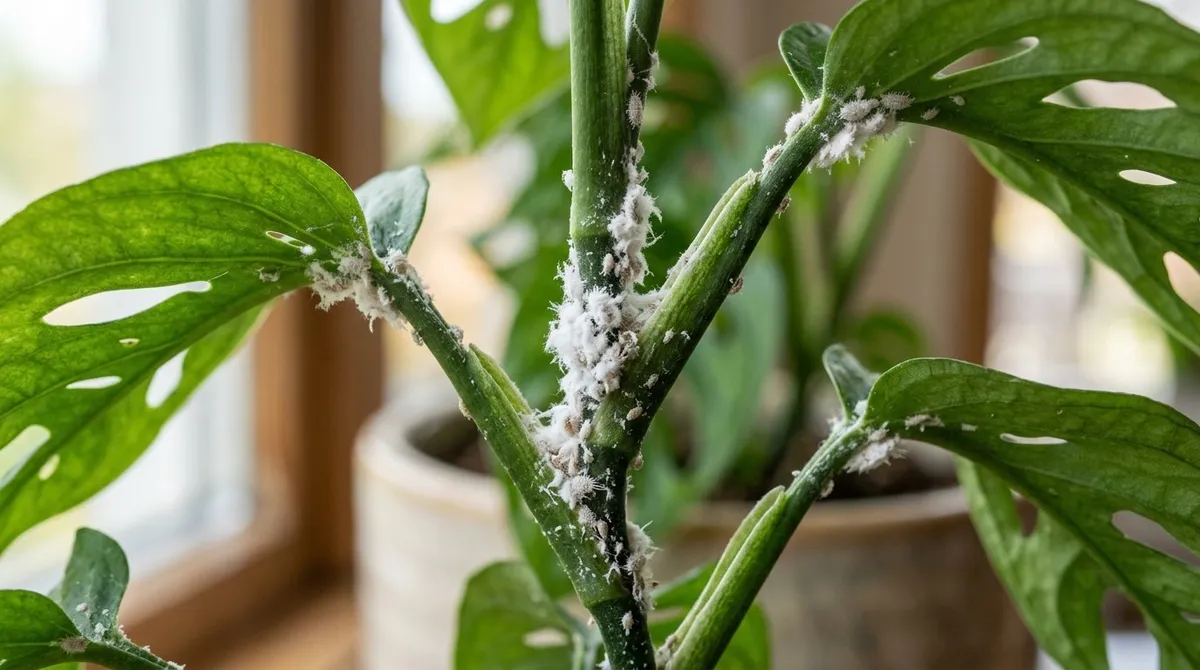
- White cottony clusters on stems and leaf axils are the most visible symptom of mealybug infestation
- Mealybugs secrete honeydew that causes black sooty mould, reducing photosynthesis
- Neem oil spray applied fortnightly gives 70-80% control on light infestations
- The predatory beetle Cryptolaemus montrouzieri clears heavy infestations in heated greenhouses within 6-8 weeks
- Root mealybugs live underground and are only discovered during repotting, causing unexplained wilting
Mealybug is one of the most persistent houseplant pests in the UK. These small, white, waxy insects cluster in leaf axils, along stems, and beneath leaves, forming cottony masses that many growers initially mistake for mildew or mineral deposit. By the time the white fluff is obvious, the colony may already number in the hundreds.
Unlike aphids, which are easy to blast off with a hose, mealybugs anchor themselves into crevices and protect their eggs beneath layers of wax. They reproduce fast, spread between plants on contact, and resist most general-purpose sprays. Understanding what you are dealing with is the first step to clearing an infestation.
How to identify mealybug on your plants
Mealybugs are oval, soft-bodied insects 2-5mm long, covered in a white powdery wax that gives them a cottony appearance. They belong to the family Pseudococcidae, which places them in the same order (Hemiptera) as scale insects and aphids. All are sap-suckers with piercing mouthparts.
The white waxy coating is the key identification feature. It distinguishes mealybugs from every other common UK plant pest. Scale insects are smooth brown or grey bumps. Aphids are soft and green, black, or pink. Woolly aphids produce white fluff but it is wispy and filamentous, not the dense cottony wax of mealybug.
Look for mealybugs in sheltered spots on the plant. They congregate where leaves meet stems, in the forks of branches, along leaf midribs on the underside, and around the base of flower buds. On cacti and succulents, they hide between the ribs and beneath spines. On orchids, check where leaves join the pseudobulb.
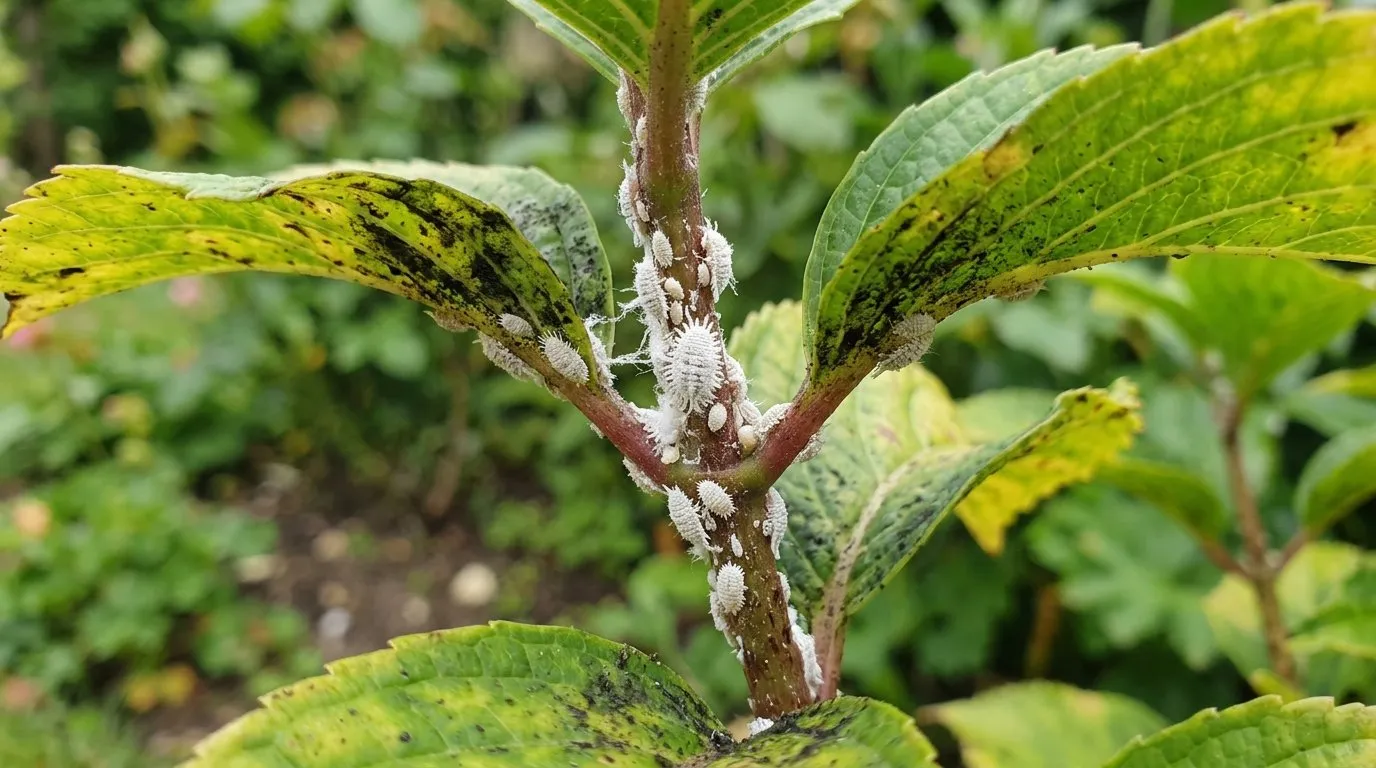
Egg sacs are another telltale sign. Female mealybugs lay 100-200 eggs in a dense, cottony ovisac that she deposits in a sheltered spot, often in a leaf axil or beneath a pot rim. The ovisac is pure white and about 5mm across. Crawlers emerge after 7-10 days.
Male mealybugs are tiny winged insects, about 1mm long, that look nothing like the females. They emerge briefly to mate and die within 2-3 days. You may see them flying near infested plants in warm weather but they are rarely identified.
A hand lens at 10x magnification reveals the body segmentation and short waxy filaments radiating from the body margin. These filaments are shorter in citrus mealybug and longer in long-tailed mealybug, where they extend to the full body length as a pair of tail-like threads.
Types of mealybug found in the UK
Four mealybug species cause the majority of problems on UK plants, each with distinct preferences for host plants and growing conditions. Several other species occur occasionally in heated glasshouses and botanical collections, but these four account for nearly all domestic infestations.
| Species | Common name | Size | Appearance | Main host plants | Location |
|---|---|---|---|---|---|
| Planococcus citri | Citrus mealybug | 3-4mm | White wax, short marginal filaments | Citrus, orchids, fuchsia, pelargonium | Indoors and greenhouses |
| Pseudococcus longispinus | Long-tailed mealybug | 3-4mm | Long tail filaments equal to body length | Houseplants, ferns, dracaena, palms | Indoors year-round |
| Planococcus ficus | Vine mealybug | 3-5mm | Pinkish body under white wax | Grape vines, figs, wisteria | Greenhouses, warm walls |
| Rhizoecus falcifer | Root mealybug | 1-2mm | White, found on roots only | Cacti, succulents, pot plants | Below soil surface |
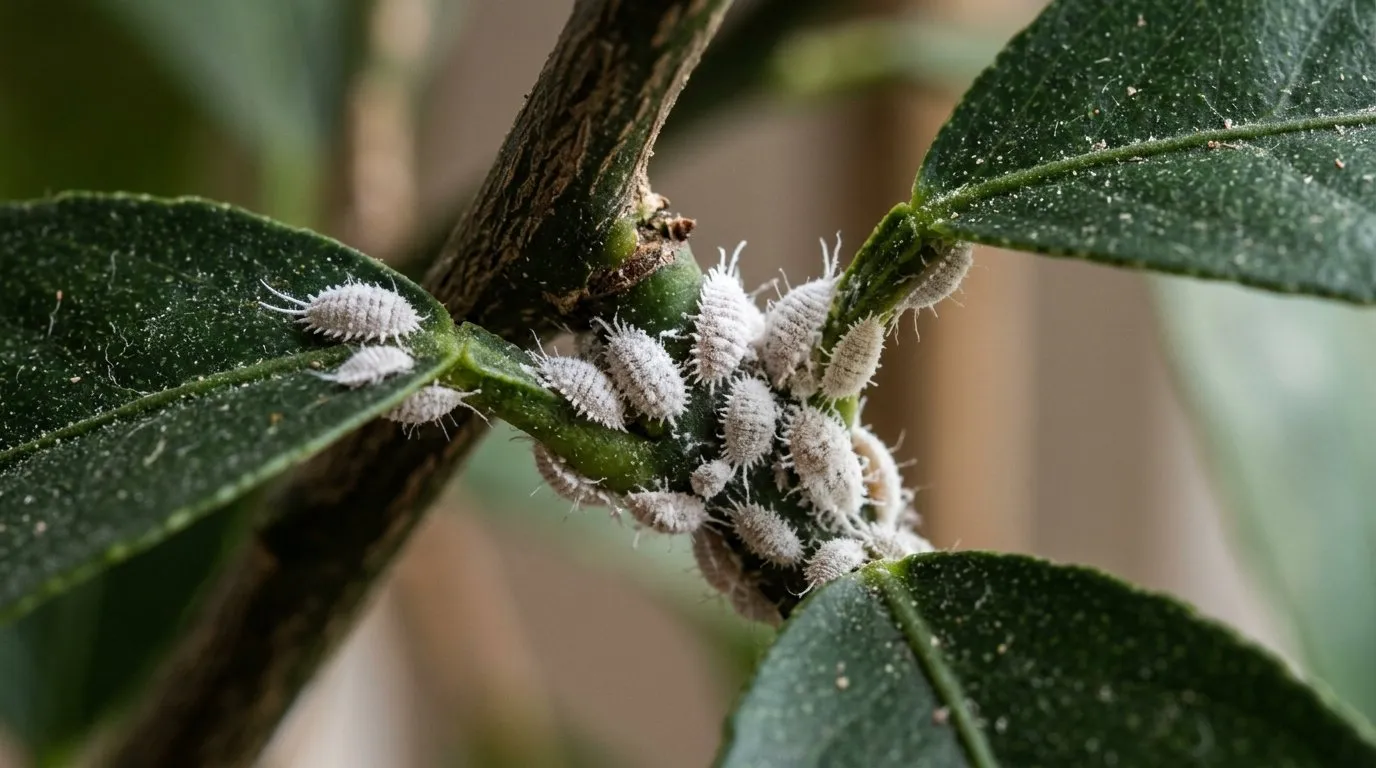
Citrus mealybug (Planococcus citri) is the most common species on UK houseplants and greenhouse crops. It attacks a wide range of tropical and subtropical plants. Females produce a large cottony ovisac containing up to 200 eggs. This species thrives at 20-27C and reproduces year-round indoors.
Long-tailed mealybug (Pseudococcus longispinus) is immediately recognisable by the two long waxy tail filaments, each as long as the body. Unlike citrus mealybug, it gives birth to live crawlers rather than laying eggs in an ovisac. This makes control harder because there is no visible egg stage to target. Common on ferns, dracaena, and palms.
Vine mealybug (Planococcus ficus) is a quarantine pest in parts of Europe but occurs in UK glasshouses on grape vines, figs, and wisteria. It colonises the bark, leaf axils, and developing fruit clusters. Vine mealybug has a pinkish body beneath the white wax and produces copious honeydew.
Root mealybug (Rhizoecus falcifer) is the sneakiest of the four. It lives entirely below the soil surface, feeding on roots. Above-ground symptoms include unexplained wilting, yellowing, and poor growth that does not respond to watering or feeding. The only way to confirm root mealybug is to unpot the plant and examine the rootball. White waxy deposits on the roots and inner pot surface are diagnostic.
What damage do mealybugs cause?
Mealybugs damage plants through three mechanisms: sap drainage, honeydew production, and virus transmission. A small colony of 10-20 insects causes negligible harm. Populations that build unchecked over months create serious, sometimes fatal, damage to container plants.
Sap loss is the primary injury. Each mealybug inserts its stylet into phloem tissue and feeds continuously on sugar-rich sap. The plant responds by diverting energy to the feeding site, reducing growth elsewhere. Visible symptoms include yellowing leaves, stunted new growth, leaf drop, and a general lack of vigour. Flowering and fruiting decline.
Honeydew is the secondary problem. Mealybugs excrete large quantities of this sticky, sugary waste liquid. It coats leaves, stems, pots, and nearby surfaces. Black sooty mould (Capnodium spp.) colonises the honeydew within days, covering leaf surfaces with a dark film that blocks light and reduces photosynthesis.
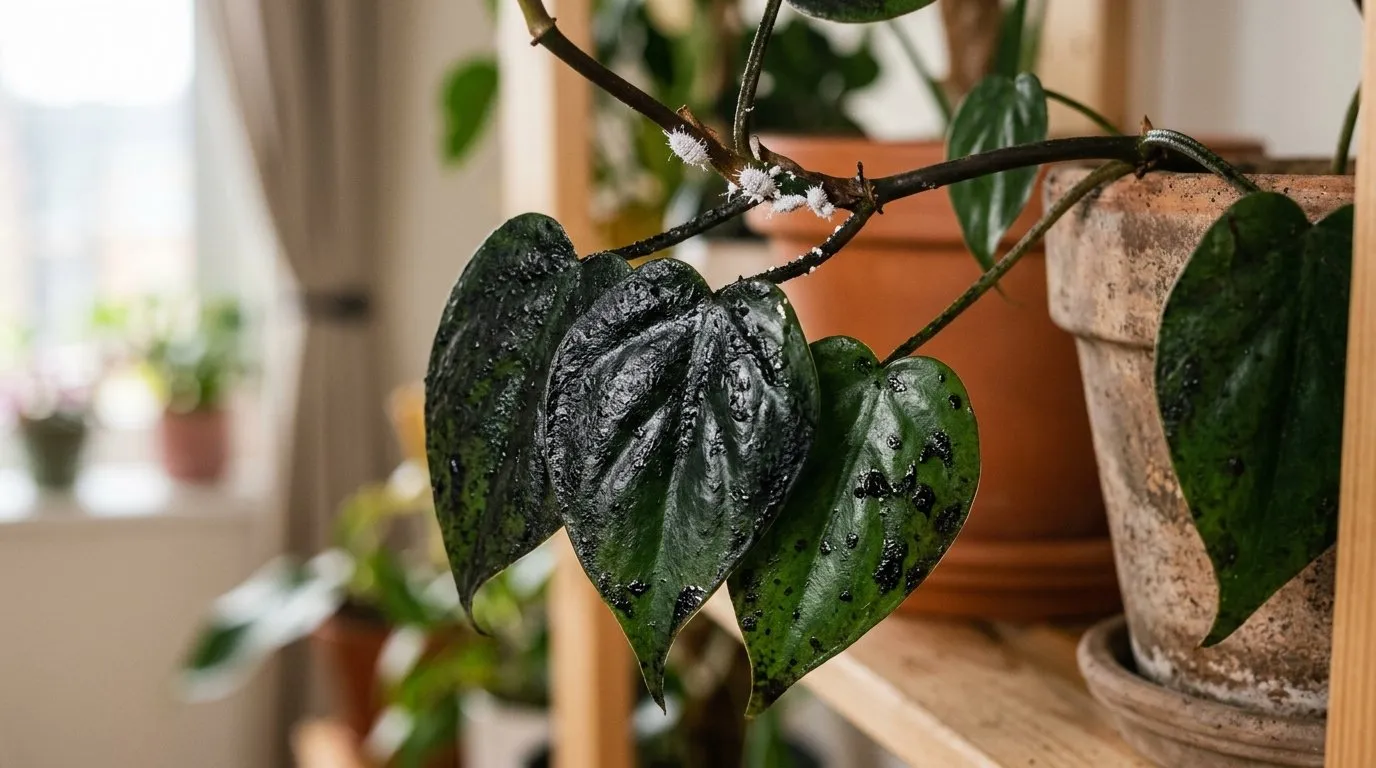
Ants are attracted to honeydew and will farm mealybug colonies, protecting them from predators. If you see ants running up and down plant stems, always check for mealybug or scale insects at the top.
Some mealybug species transmit plant viruses. Vine mealybug is a vector for grapevine leafroll-associated viruses, which is a concern for UK vine growers. On ornamental plants, virus transmission is less studied but mealybug feeding wounds can allow secondary fungal and bacterial infections to enter.
Root mealybugs cause wilting that mimics underwatering or root rot. Gardeners often overwater in response, creating waterlogged conditions that compound the problem. If a plant wilts despite adequate watering, always check the roots before assuming disease.
How to get rid of mealybugs naturally
Physical removal with methylated spirit is the most effective natural treatment for light to moderate mealybug infestations. Dip a cotton bud in methylated spirit and dab each mealybug individually. The alcohol dissolves the protective wax coating and kills the insect on contact. Work systematically through the entire plant, checking every leaf axil, stem junction, and leaf underside.
For larger plants or heavier infestations, mix a spray solution of neem oil (5ml cold-pressed neem per litre of water with a drop of washing-up liquid as an emulsifier). Spray all plant surfaces thoroughly, paying attention to the sheltered crevices where mealybugs hide. Repeat every 10-14 days for at least 6 weeks. Neem disrupts the mealybug’s feeding and reproductive cycle.
Horticultural soap sprays (such as SB Plant Invigorator) kill crawlers and young nymphs on contact. They work by suffocating the insect and dissolving the waxy coating. Soap sprays break down quickly in sunlight and leave no residue. They need direct contact to work, so thorough coverage is critical.
A strong jet of water knocks mealybugs off sturdy outdoor plants. This works well on fuchsia, citrus, and ornamental shrubs but is too rough for delicate houseplants. Outdoors, dislodged mealybugs rarely find their way back onto the same plant.
Pruning out heavily infested shoots is sometimes the fastest option. If a stem is encrusted with mealybugs, cut it back to clean growth and bin the prunings. Do not compost them. This reduces the population immediately and lets follow-up treatments work on smaller numbers.
Isopropyl alcohol (rubbing alcohol) at 70% concentration works identically to methylated spirit. Apply it the same way with cotton buds. Both evaporate quickly and do not damage most plant tissues, though test on a single leaf first with hairy-leaved plants like African violets.
Chemical treatments for mealybug
Synthetic insecticides offer faster knockdown than organic methods but carry risks to beneficial insects and may require repeated applications. Most products available to UK home gardeners are contact-action sprays that work only when they hit the mealybug directly.
Pyrethrin-based sprays (such as Bug Clear Ultra) kill mealybugs on contact. Spray in the evening to minimise harm to pollinators. Repeat after 7-10 days to catch newly emerged crawlers that the first application missed. Pyrethrin breaks down in sunlight within 24 hours.
Fatty acid sprays (insecticidal soaps) are approved for organic use and work on contact. Brands like Vitax Organic Pest & Disease Control and SB Plant Invigorator are widely available. They are safer for beneficial insects than pyrethrin but still need direct contact with the mealybug.
Systemic insecticides based on acetamiprid (Bug Clear Ultra Vine Weevil Killer, applied as a drench) are absorbed by roots and distributed through the plant’s vascular system. When mealybugs feed on treated sap, they ingest the insecticide. Systemics reach mealybugs hidden in crevices that contact sprays cannot penetrate. However, they also affect pollinators that visit treated plants. Never use systemics on flowering plants visited by bees.
Important: Neonicotinoid insecticides (imidacloprid, thiacloprid) are now banned for outdoor use in the UK and EU. Only acetamiprid remains available for amateur use. Check product labels carefully. The RHS mealybug guide provides further detail on approved treatments.
For root mealybugs, a soil drench is the only effective chemical treatment. Dilute an approved insecticide according to label rates and water it into the compost after repotting into clean soil. Repeat after 4 weeks.
Biological control with Cryptolaemus
The mealybug destroyer Cryptolaemus montrouzieri is the most effective biological control agent for mealybug in heated greenhouses and conservatories. This small ladybird beetle, native to Australia, feeds exclusively on mealybugs at both larval and adult stages. It was first introduced for mealybug control in Californian citrus orchards in 1891 and has been used in UK glasshouses since the mid-20th century.
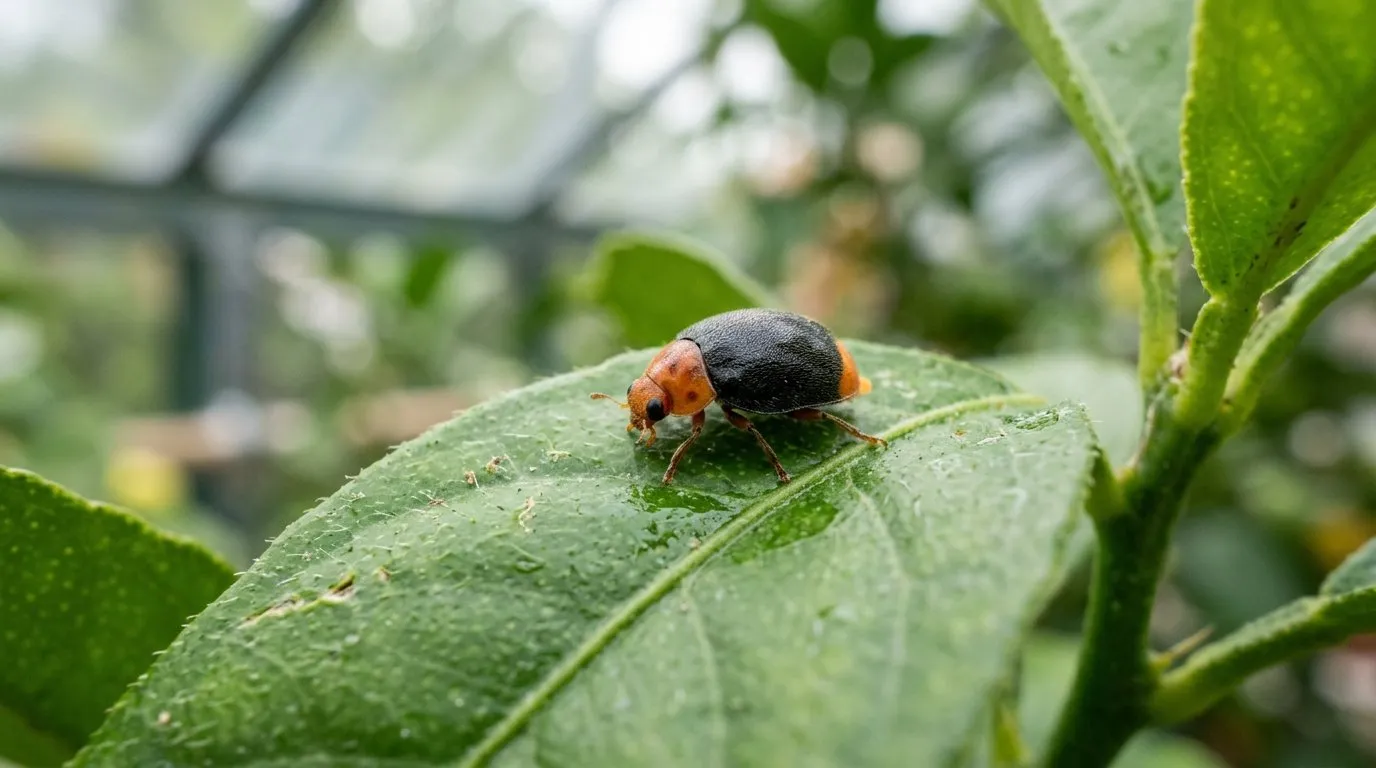
Adult Cryptolaemus beetles are 4mm long, black with an orange head and tail. They lay their eggs directly into mealybug colonies. Each female lays up to 400 eggs over her 2-month lifespan.
The larvae are the primary predators. They are covered in white waxy filaments and look remarkably like large mealybugs themselves, which confuses many growers. One larva consumes up to 250 mealybugs during its 3-week development. The larval stage is more voracious than the adult stage.
Order Cryptolaemus from biological control suppliers in the UK between May and September. Release rates are typically 5 adults per square metre for moderate infestations, or 10 per square metre for heavy ones. Release them in the evening near the worst-affected plants.
Cryptolaemus requires sustained temperatures above 20C and at least 16 hours of daylight (natural or supplemented) to breed. Below 16C, the beetles stop feeding. This limits their use to heated greenhouses, conservatories, and warm indoor environments. They do not survive UK winters outdoors.
Stop all chemical sprays at least 4 weeks before releasing Cryptolaemus. Even organic sprays like neem and insecticidal soap kill the beetles on contact.
Another biological option is the parasitic wasp Leptomastix dactylopii, which parasitises citrus mealybug specifically. The female wasp lays a single egg inside the mealybug, and the developing wasp larva consumes it from within. Parasitised mealybugs swell and turn brown, forming a hardened “mummy.” Leptomastix requires temperatures above 22C and works best alongside Cryptolaemus.
Which plants are most at risk?
Mealybugs attack over 200 plant species, but certain groups are disproportionately targeted in UK homes and greenhouses. Tropical and subtropical plants growing in warm, still air are most vulnerable. Plants in draughty, cool locations are rarely affected.
Houseplants at high risk: orchids (especially Phalaenopsis and Dendrobium), succulents, cacti, African violets, ferns, dracaena, palms, ficus, crotons, hoya, and stephanotis. These plants share the warm, humid, sheltered conditions that mealybugs prefer.
Greenhouse and conservatory plants: citrus trees (lemon, orange, kumquat), fuchsia, pelargonium, grape vines, tomatoes, peppers, aubergines, and bougainvillea. Greenhouse pest control should include routine mealybug checks from March onward.
Outdoor plants (southern England only): mealybugs occasionally infest hardy plants growing against warm south-facing walls. Wisteria, fig trees, and grape vines trained on walls can develop colonies during hot summers. They rarely survive UK winters outdoors except in the mildest coastal areas.
Root mealybugs are most commonly found on cacti, succulents, and containerised shrubs. They are particularly common in older compost that has broken down and become compacted. Any pot plant showing unexplained decline should have its rootball inspected.

Plants stressed by underwatering, overwatering, poor light, or nutrient deficiency are more susceptible to mealybug establishment. A healthy, vigorous plant resists colonisation better than a weakened one. Keeping plants in optimal growing conditions is genuine pest prevention.
How to prevent mealybug infestations
Quarantine all new plants for 3-4 weeks before placing them near your existing collection. This single step prevents more mealybug infestations than any treatment method. Inspect new arrivals carefully at purchase. Check leaf axils, stem junctions, and the underside of every leaf. Look beneath the pot rim and on the surface of the compost.
Mealybugs enter homes and greenhouses almost exclusively on infested plants. Garden centre stock, supermarket houseplants, gifts from other growers, and plants bought online are all common sources. The insects are often present in small numbers that are easy to overlook.
Keep houseplants well-spaced. Plants that touch each other allow crawlers to walk from one to the next. Good air circulation between plants also reduces the warm, still microclimate that mealybugs favour.
Clean pots and trays between uses. Mealybug eggs and crawlers survive in crevices of terracotta and plastic pots. Scrub used pots with hot soapy water before replanting. In greenhouses, clean staging and benches at the start of each growing season.
Inspect your plants fortnightly, especially from March to October when mealybugs are most active. A 2-minute check of the leaf axils and stem bases catches infestations early, when a cotton bud and methylated spirit can deal with 5 mealybugs rather than 500.
Avoid over-fertilising with high-nitrogen feeds. Lush, soft growth produced by excess nitrogen is more attractive to all sap-sucking pests, including mealybugs, aphids, and whitefly. Balanced feeding produces harder growth that is less palatable.
Remove dead leaves, spent flowers, and plant debris from pot surfaces and greenhouse benches. Mealybugs shelter in debris and dead material provides hiding spots for eggs and crawlers.
For greenhouse growers, consider a winter clean when the house is empty or at minimum stock. Wash all glass, staging, and framework with a horticultural disinfectant. This disrupts any overwintering mealybugs and reduces populations before the spring breeding season. See our vegetable pests and diseases guide for broader greenhouse hygiene advice.
If you discover fungus gnats or houseplant flies alongside mealybugs, address both simultaneously. Both thrive in overwatered conditions with organic debris on the compost surface.
For more on choosing and caring for beginner-friendly houseplants that resist common pests, start with tough species like pothos, spider plant, and snake plant that tolerate minor pest pressure without serious decline.
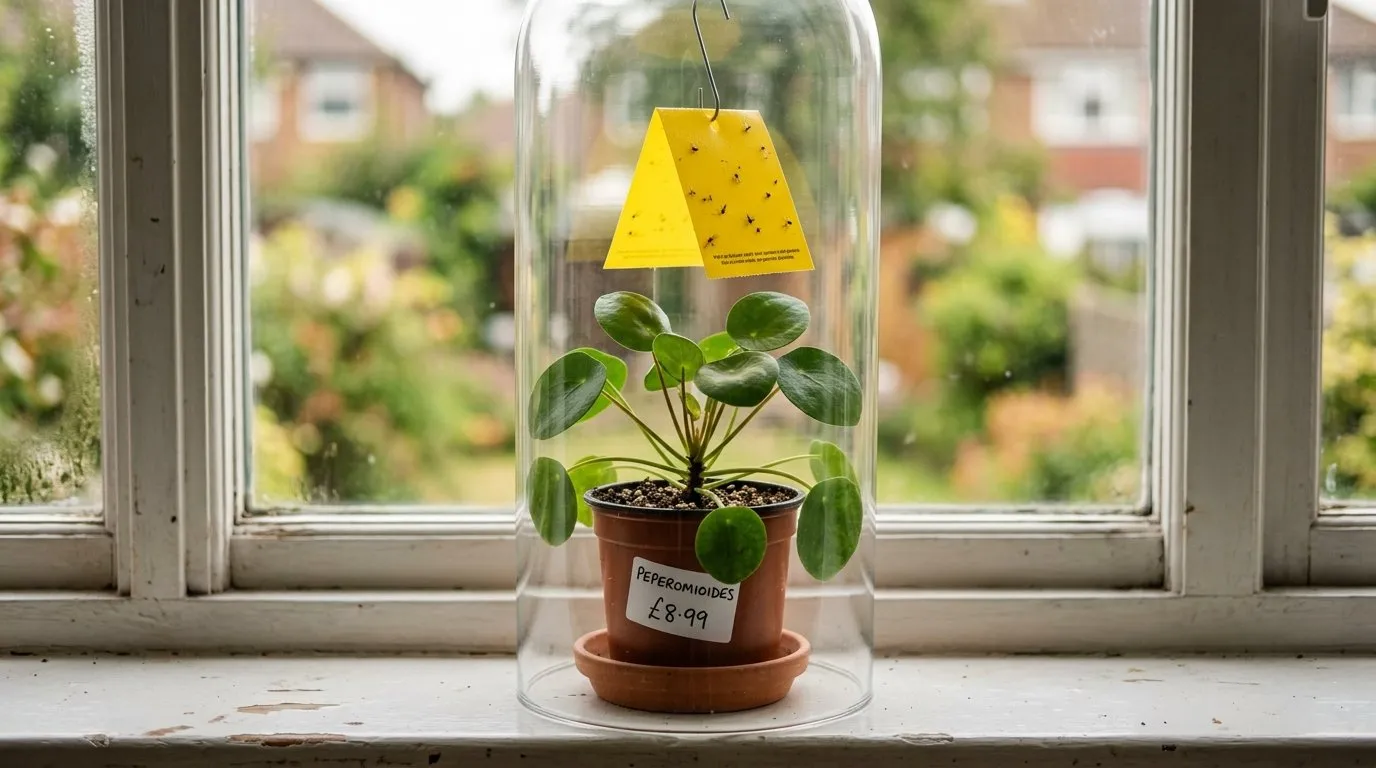 Quarantine new arrivals for 3-4 weeks on a separate windowsill with a sticky trap. Most mealybug introductions come from garden-centre plants — catching them in isolation prevents collection-wide outbreaks.
Frequently asked questions
What does mealybug look like on plants?
Mealybug appears as white cottony or waxy clusters on stems, leaf axils, and leaf undersides. Individual insects are 2-5mm long, oval, and covered in white powdery wax with short waxy filaments around the body margin. Colonies look like small tufts of cotton wool. The white wax distinguishes mealybug from scale insects, which appear as smooth brown or grey bumps. Crushing a suspected mealybug releases yellowish body fluid.
How do mealybugs spread between plants?
Mealybugs spread mainly through infested plants brought from garden centres or shared between growers. First-instar nymphs called crawlers are tiny and mobile, walking between plants that touch. Crawlers can also travel on clothing, tools, and pots. Male mealybugs have wings and fly short distances. In greenhouses, close plant spacing accelerates spread. Quarantine all new plants for 3-4 weeks before placing near existing collections.
Can mealybugs kill a plant?
Mealybugs can kill plants if left untreated for months. Heavy infestations drain sap faster than the plant can replace it, causing wilting, leaf drop, and branch dieback. Small houseplants in pots are most vulnerable. Large outdoor plants rarely die from mealybug alone but suffer reduced vigour and poor flowering. Secondary infections from sooty mould and feeding wounds compound the damage.
Does neem oil kill mealybugs?
Neem oil kills mealybug crawlers and young nymphs on contact and disrupts feeding in adults. Spray fortnightly, covering all leaf axils and stem junctions where mealybugs hide. Neem is less effective against adults protected by thick waxy coatings. For best results, combine neem sprays with physical removal using cotton buds dipped in methylated spirit. Neem alone gives 70-80% control on light infestations.
What is Cryptolaemus and how does it control mealybug?
Cryptolaemus montrouzieri is a predatory ladybird beetle from Australia that feeds exclusively on mealybugs. Both larvae and adults eat mealybug eggs, crawlers, and adults. One larva consumes up to 250 mealybugs during development. Release 5 beetles per square metre in greenhouses maintained above 20C. Cryptolaemus larvae are covered in white wax and resemble mealybugs themselves, which can cause confusion.
How do I treat root mealybugs?
Root mealybugs require complete removal of old compost during repotting. Wash all soil from roots under running water. Soak roots in a dilute neem oil solution (5ml per litre) for 15 minutes. Repot into fresh, sterile compost in a clean pot. Drench the new compost with neem solution after potting. Check again after 4 weeks. Root mealybugs are most common on cacti, succulents, and containerised shrubs.
Are mealybugs harmful to humans?
Mealybugs are completely harmless to humans and pets. They cannot bite, sting, or transmit diseases to people. The white waxy coating is not toxic. The only nuisance is the sticky honeydew they excrete, which can drip onto furniture and windowsills near infested houseplants. Wash it off with warm soapy water.
Our team produces practical UK gardening guidance from source research, contributor records and established horticultural practice. Editorial standards are overseen by Matt W.