Key takeaways
- Gymnosporangium sabinae needs both pear and juniper; it cannot complete its lifecycle on pear alone
- The fungus overwinters on juniper, never on pear, which is why autumn leaf-raking changes nothing
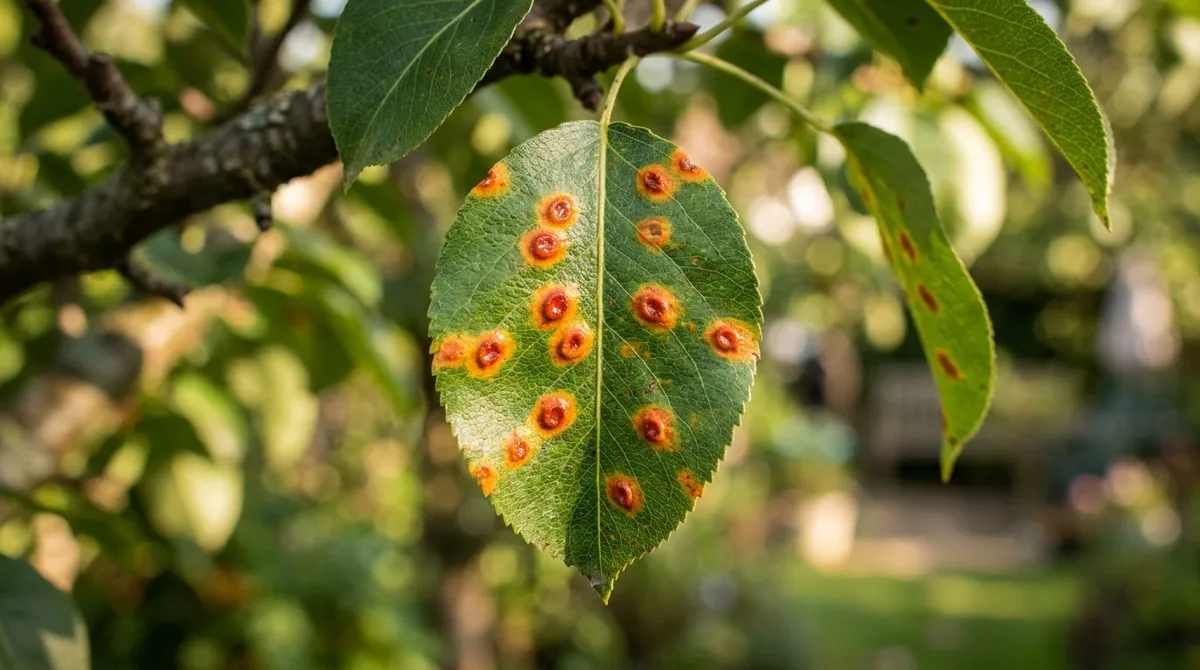
- Orange spots 3-8mm across appear on upper leaf surfaces from early July and peak through August
- Brown, fringed aecia with 3-5mm curled horns break out on the leaf underside from late August
- Basidiospores blow at least 1km from infected juniper, so the source is often several gardens away
- Mature pears carry 30-50% leaf infection with no measurable crop loss; defoliation rarely kills a tree
Pear rust turns pear leaves an alarming orange every August, and almost everything gardeners do about it is wasted. The spraying, the leaf-raking, the autumn clear-up: none of it touches the cause. That is not because pear rust is hard to beat. It is because the disease is not really happening on your pear tree at all.
Gymnosporangium sabinae needs two different plants to survive. It spends most of its life inside a juniper, and only visits pear for a few months a year. This guide covers how to identify pear rust from the leaf, the two-host lifecycle that explains why every conventional treatment fails, and the one job that actually ends it.
How to identify pear rust on the leaf
Pear rust is the easiest fruit tree disease in Britain to name. Nothing else on a pear looks remotely like it.
Look for bright orange to orange-red spots on the upper leaf surface, roughly 3-8mm across, with a slightly raised, glossy centre and a diffuse yellow halo. They are not subtle. On a bad year our Conference looked as if someone had flicked a paintbrush through it.
The spots appear from early July, build through the month, and peak in August. Look closely at the centre of an established spot and you will see a scatter of tiny black dots. These are spermogonia, the fungus’s fertilisation structures, and they confirm the diagnosis on their own.
The timing is a useful filter. Anything orange on a pear in April or May is not this, because the fungus needs six to eight weeks inside the leaf before it shows. Early-season orange usually means nutrient deficiency or pear scab starting badly.
Occasionally you will find infection on the fruit or on young twigs. Twig lesions swell into small cankers that can persist for several seasons and are the one genuinely damaging expression of this disease. They are uncommon on garden trees. If your pear has swollen, sunken bark lesions and you are unsure which problem you are looking at, our guide to canker in fruit trees works through the alternatives.
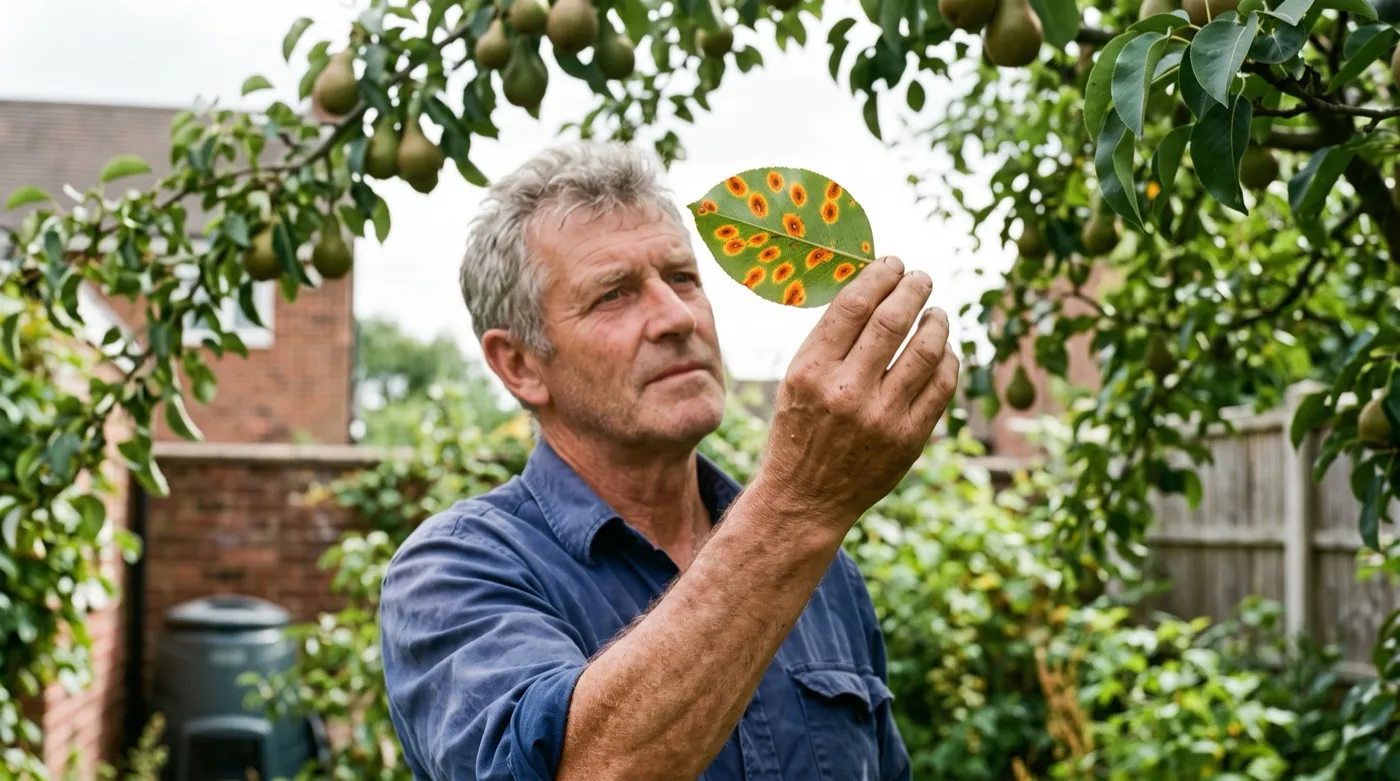 Checking a Conference leaf against the light in August. The spots run 3-8mm across, with a glossy centre and a diffuse yellow halo.
Turn the leaf over: the fringed horns that confirm it
Everything above is suggestive. What follows is conclusive, and hardly anyone looks for it because it means turning a leaf over.
From late August into September, the underside of each orange spot swells into a brown, blister-like growth sitting directly beneath the orange patch on top. These are the aecia, and on this fungus they carry a name of their own: roestelia.
As they mature they split open. The walls peel back and curl outward into a ragged fringe of horn-like projections, each roughly 3-5mm long, tan to pale brown, splayed like a tiny shuttlecock or a burst seed capsule. Under a hand lens they are genuinely strange, and once you have seen them you will never mistake pear rust for anything else again.
This structure is the diagnostic. Orange spots on top plus fringed brown horns underneath equals Gymnosporangium sabinae, with no laboratory needed. No other common pear problem produces them.
Those horns release aeciospores. Here is the fact that governs the whole article: aeciospores cannot infect pear. They can only infect juniper. The spores your tree is producing, in enormous quantity, in your garden, are aimed exclusively at a juniper somewhere else.
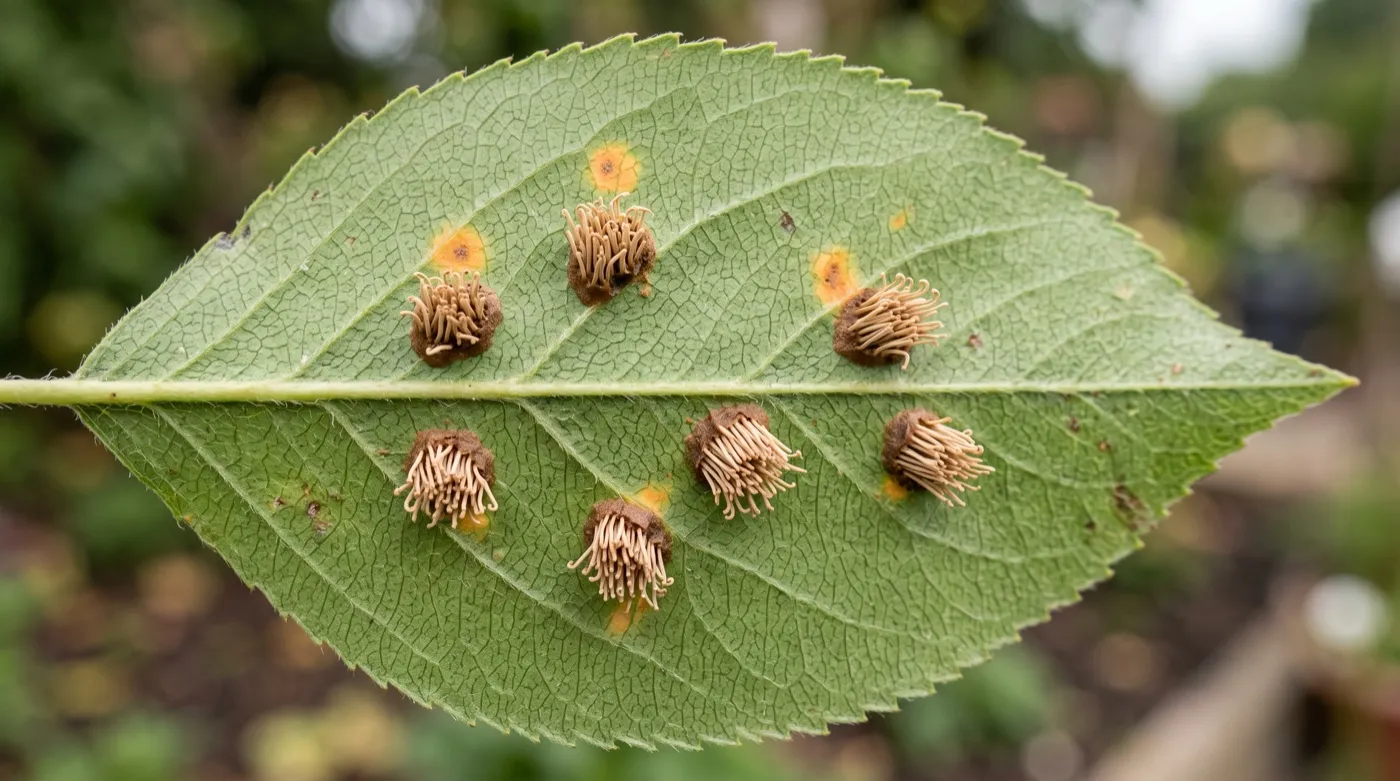 The confirming feature. Underneath each orange spot the aecia split into a fringe of 3-5mm curled horns.
Why pear rust needs a juniper to survive
Most rust fungi you meet in a garden spread from plant to plant all summer. Hollyhock rust jumps hollyhock to hollyhock. Rose rust jumps rose to rose. They manage that because they produce urediniospores, a repeating spore that reinfects the same host over and over.
Pear rust has no such stage. It is demicyclic, which means the repeating stage is simply absent. There are no urediniospores on pear. Not few: none.
The consequences are absolute, and they explain every failed treatment on this page:
- Pear rust cannot spread from pear to pear. Your neighbour’s infected pear is no threat to yours.
- Pear rust cannot spread from leaf to leaf on the same tree. Every infected leaf was infected individually, in spring, from outside.
- Pear rust cannot overwinter on pear. Not on the leaves, not on the wood, not in the soil beneath.
- Every single infection on your tree came from a juniper, in one wave, months before you noticed anything.
By the time you see orange in July, the infection event is already 6-8 weeks in the past and cannot be undone or contained. There is nothing left to stop. Understanding this is the difference between fixing pear rust and fighting it forever. Our broader guide to rust disease in plants covers the ordinary single-host rusts, which behave in the opposite way and genuinely do respond to sanitation.
The two-host lifecycle stage by stage
- Perennial mycelium in juniper (year-round, permanently). Once a juniper stem is infected it stays infected for life. The fungus lives inside the wood and raises swollen galls of 5-20mm on stems and branches. New galls take 18-20 months to mature before they produce anything.
- Galls swell (March to April). Warm, wet weather above roughly 10C makes the galls take up water and expand. On a dry spring they sit tight and do nothing.
- Telial horns emerge (April to May, rain required). The galls push out bright orange, gelatinous horns, 5-15mm long, that look like orange jelly on the stems. They need prolonged wetness to swell and are the only time of year an infected juniper is obvious.
- Basidiospores released (April to June). The horns produce teliospores, which germinate on the spot into basidiospores. These are the only spore in the entire lifecycle that can infect pear. They are fragile and short-lived, surviving hours to a day or two.
- Infection of pear (April to June). Basidiospores blow to pear and land on young leaves. They need a film of water on the leaf for around four hours and a temperature of roughly 10-25C to germinate and penetrate. No leaf wetness, no infection.
- Latent period (6-8 weeks). Nothing whatsoever is visible. The tree looks perfect through May and June.
- Orange spots and spermogonia (early July to August). Symptoms finally surface. This is the first moment you know anything happened.
- Aecia and aeciospores (late August to October). The fringed horns break out underneath and release aeciospores, which fly back to juniper and infect only juniper. They cannot touch your pear. The loop closes and returns to stage 1.
The first is removing or burning fallen pear leaves in autumn to stop the fungus overwintering. It never overwinters on pear. The effort is worth exactly zero, every year, forever.
The second is spraying the pear in late summer when the orange appears. By then infection happened months ago, and nothing is spreading on the tree because there is no repeating stage. You are spraying a symptom that has already finished developing. The only window in which a fungicide could theoretically protect anything is April to June, guarding new leaves against incoming basidiospores. As covered below, no product is approved for that use on an edible pear in Britain anyway.
| Month | Conditions needed | What is happening |
|---|---|---|
| March | Above 10C, wet | Juniper galls take up water and swell |
| April to May | Prolonged rain, 10-20C | Orange telial horns emerge; basidiospores released |
| April to June | 4+ hours leaf wetness, 10-25C | Basidiospores infect young pear leaves |
| May to June | Any | Latent: nothing visible on the pear |
| July | Any | Orange spots and black spermogonia appear |
| August to September | Any | Fringed aecia break out on the leaf underside |
| September to October | Damp, still | Aeciospores blow back and reinfect juniper only |
| November to February | Any | Fungus dormant inside juniper wood; pear is clean |
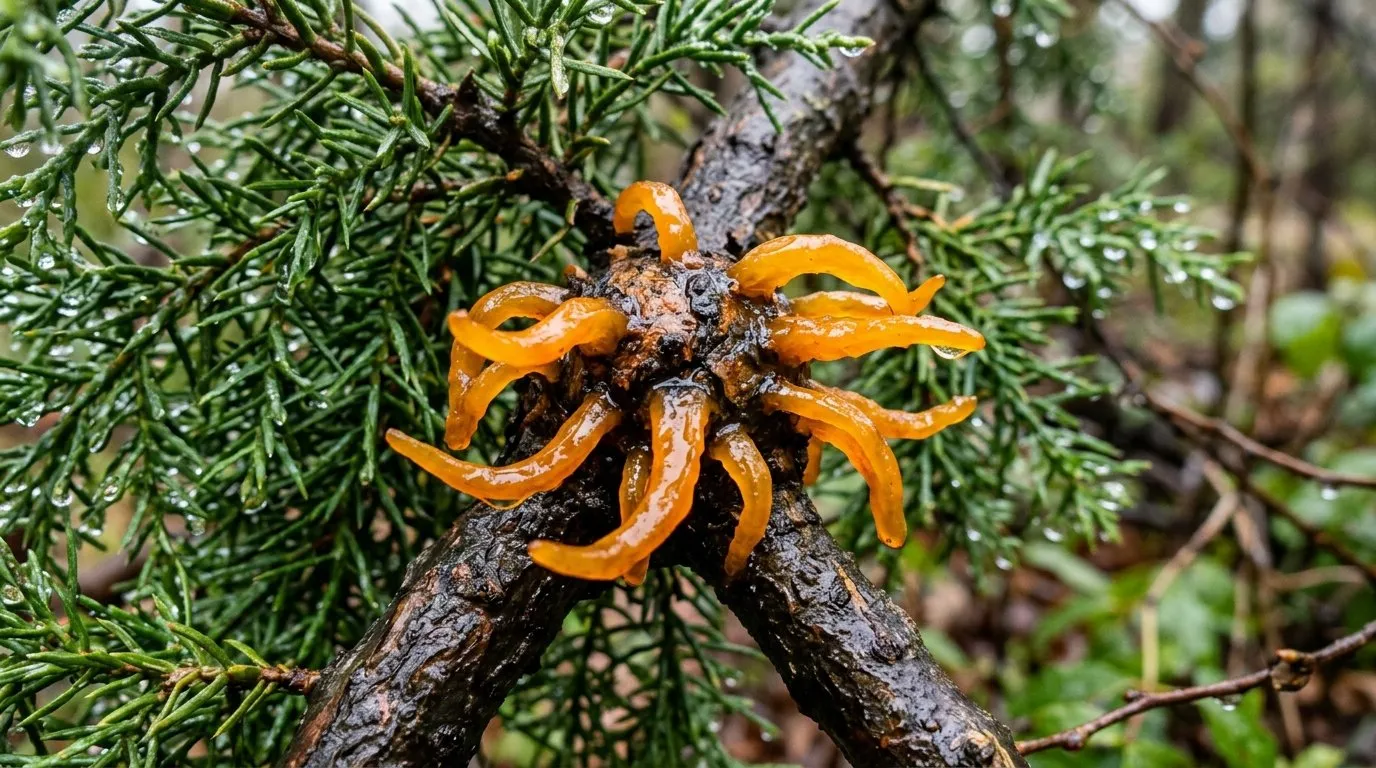 The source, in the last week of April. Swollen juniper galls push out orange gelatinous horns after rain.
Which junipers are the culprits, and which are safe
Not every juniper carries this. Knowing the difference decides whether you dig something out or leave it alone.
The main UK hosts are Juniperus sabina (savin juniper), J. chinensis (Chinese juniper) and J. scopulorum (Rocky Mountain juniper). Their cultivars carry it just as readily, and several are extremely common in British gardens: ‘Skyrocket’, ‘Blue Arrow’, ‘Blue Star’, and the low, spreading ‘Tamariscifolia’ that turned up in half the front gardens planted between 1975 and 1990.
Common juniper (Juniperus communis) is rarely affected and is treated as a safe alternative. That includes the narrow upright ‘Hibernica’ and the ground-hugging ‘Repanda’. Yew (Taxus baccata), thuja and chamaecyparis are not hosts and cannot carry this rust regardless of what they look like.
Identifying an infected juniper is easy in April and May and nearly impossible the rest of the year. Look for swollen, woody galls 5-20mm across on stems, often slightly cracked. In wet spring weather they erupt into unmistakable orange gelatinous horns. By July those horns have shrivelled away and the gall is just a lump. If you are searching in August, look for the lumps and accept you may miss them.
Gardener’s tip: Search for the juniper in the last week of April, after two days of rain. That is the only window when an infected juniper announces itself, with bright orange jelly on the stems that you can spot over a fence from ten metres away. Search in August and you are hunting for small brown lumps on a dense evergreen, and you will walk straight past them.
Finding the source juniper: how far to look
This is where people give up. They check their own garden, find no juniper, and decide the diagnosis must be wrong.
Basidiospores travel at least 1km, and further on a windy, wet spring day. The source can be several streets away, in a garden you have no access to and will never identify. That is an uncomfortable fact and there is no way around it.
Beyond about 200m, realism has to take over. You are not going to knock on eighty doors. What you can do is remove every host juniper you control or can influence, and accept that the residual infection is coming from somewhere unreachable. That is still a large win: our infection fell from 52% of tagged leaves in 2021 to 9% in 2023 after one juniper came out.
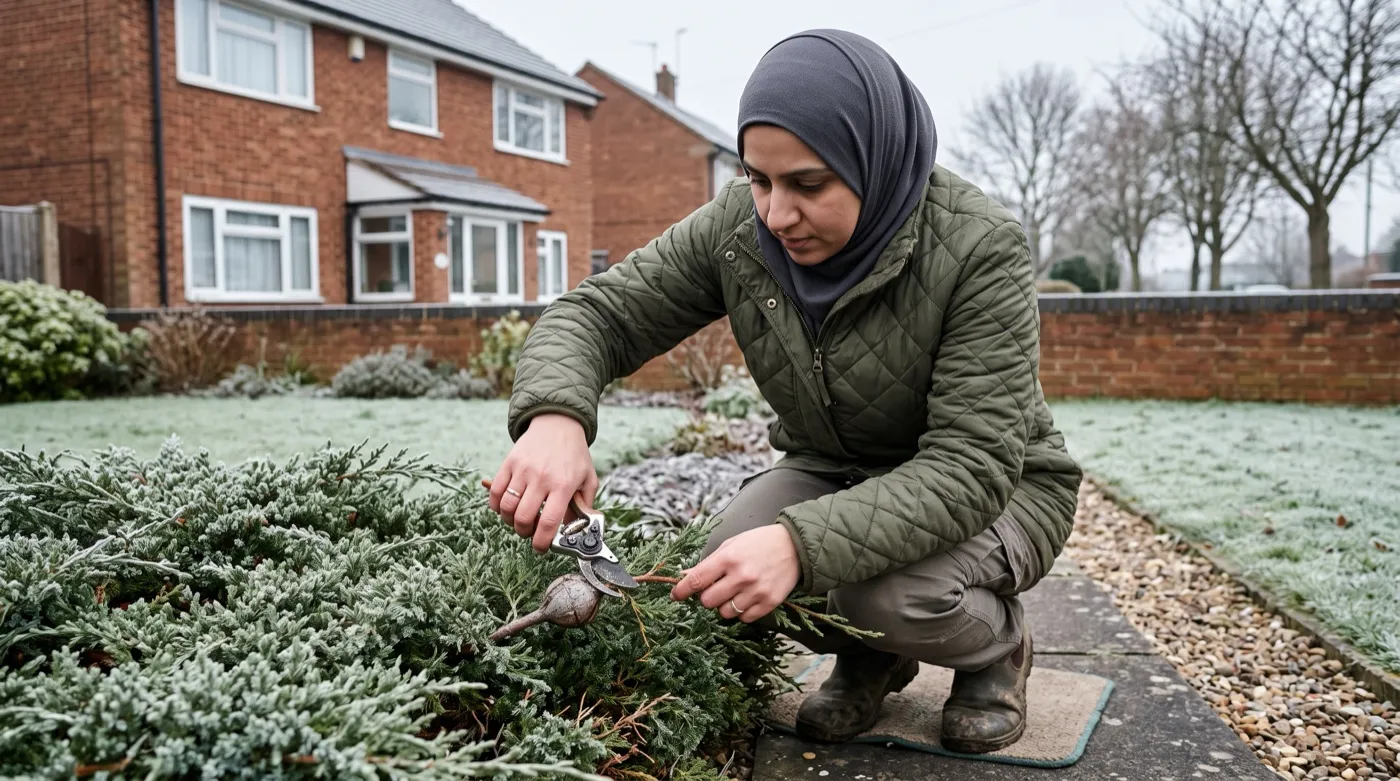 Cutting galled stems out of a Juniperus sabina in January. Removing the host junipers you control is the only permanent fix.
Pear rust or pear scab? Telling them apart
These two get confused constantly, and they call for completely different responses. One is fixed in a neighbour’s garden; the other is fixed by variety choice and sanitation on your own tree.
| Feature | Pear rust | Pear scab | Pear midge |
|---|---|---|---|
| Cause | Gymnosporangium sabinae | Venturia pyrina | Contarinia pyrivora, an insect |
| Colour | Bright orange to orange-red | Olive-green to sooty black | Blackened fruitlets, no leaf marks |
| Where | Upper leaf surface, spots 3-8mm | Leaves and fruit, feathery blotches | Inside fruitlets only |
| Underside | Brown fringed horns from late August | Nothing distinctive | Nothing |
| Fruit damage | Rare | Common: corky, cracked patches | Total: fruitlets swell, blacken, drop |
| First seen | July | April to May | May to June |
| Overwinters on | Juniper only | Fallen pear leaves | Cocoons about 5cm deep in soil |
| Leaf raking helps? | No, not at all | Yes, substantially | No |
| The actual fix | Remove the source juniper | Resistant variety plus sanitation | Remove affected fruitlets, fork the soil |
The overwintering row is the one that matters. Raking fallen leaves is genuinely effective against scab and completely useless against rust, which is precisely why the advice gets misapplied. Someone reads a sound scab article, applies it to rust, and works hard for ten years for nothing.
If your problem is blackened fruitlets dropping in June rather than orange leaves in August, you are looking at a different pest entirely, and our guide to pear midge control covers it.
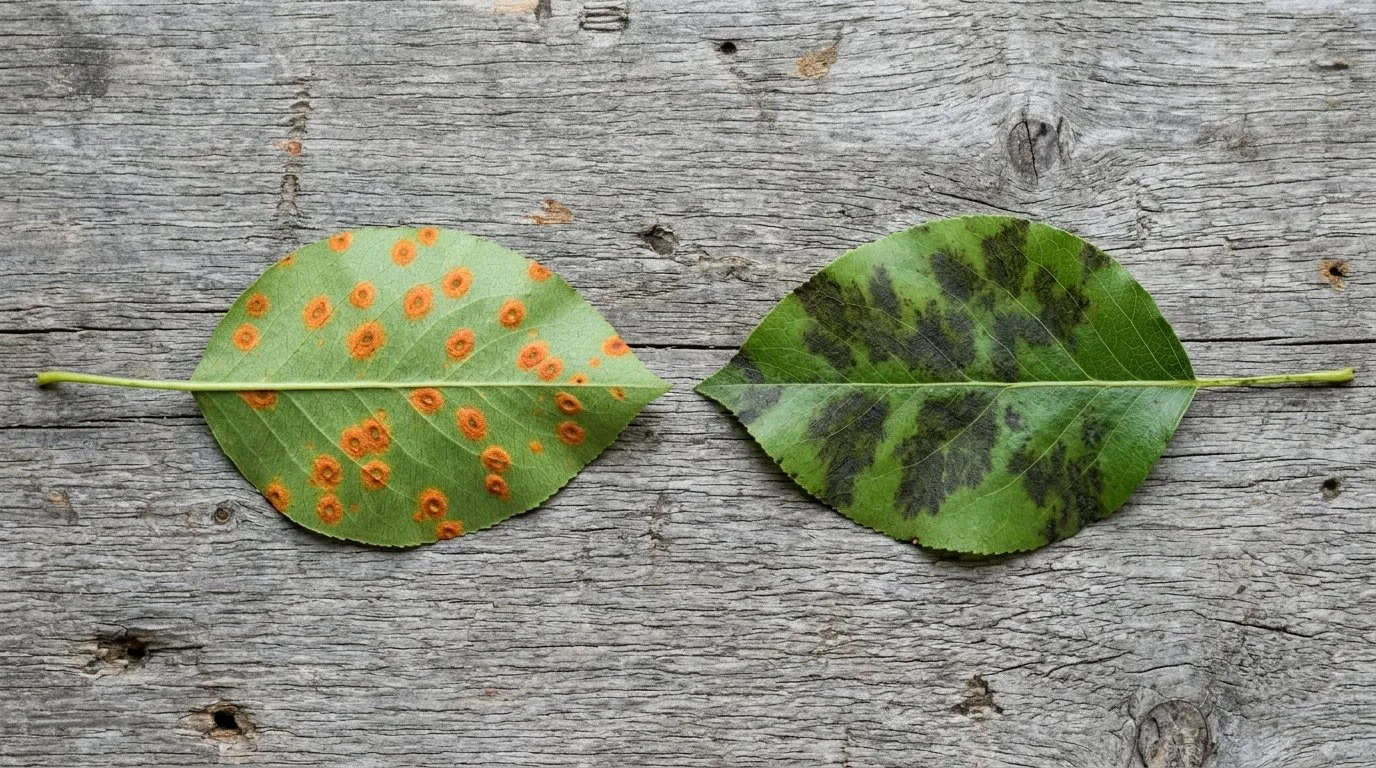 Rust left, scab right. Colour separates them instantly: bright orange against sooty olive-black.
What actually works against pear rust
Ranked by what each one achieves in a real garden, not by how satisfying it feels.
| Method | Effectiveness | Role | What it cannot do |
|---|---|---|---|
| Remove the source juniper | 80-90% drop in infection over 2 years | Primary, permanent | Cannot reach junipers beyond your influence; rarely gets you to zero |
| Fund a swap of a neighbour’s juniper for a non-host | 80-90% | Primary | Needs agreement; you should expect to pay |
| Cut galled stems from your own juniper in January | 50-70% | Maintenance | Misses hidden galls; regrows if the mycelium is in the main stem |
| Choose a less susceptible pear at planting | 20-40% reduction | Supplementary | No UK pear is immune; will not help a tree already in the ground |
| Picking off infected leaves in summer | Under 5% | Cosmetic only | Cannot stop reinfection; those leaves are not the source |
| Fungicide on an edible pear | No approved product exists | Not available | Cannot stop reinfection next spring even if applied |
| Raking and burning fallen pear leaves | 0% | Not recommended for rust | The fungus never overwinters on pear |
| Accepting it on a mature tree | 0% control, but near 0% crop loss | Monitoring | Cannot help a young tree or one with twig cankers |
The gold standard is removing or replacing the source juniper, and there is no close second. Everything else on that table is either cosmetic, unavailable, or aimed at a stage of the lifecycle that does not exist.
Does it actually damage the crop?
Worth being honest here, because the orange looks catastrophic and mostly is not.
Three situations are genuinely different. Young trees under about three years old have too little leaf area to spare and can be checked by severe infection. Repeated heavy defoliation across many consecutive seasons drains stored reserves, especially where the tree is already stressed by drought or poor soil. Twig cankers, uncommon but real, kill shoots outright and can persist for several years.
So the response scales to the tree. A big Conference in a lawn: note it, find the juniper if you reasonably can, otherwise leave it alone. A two-year-old maiden on dwarfing rootstock: take it seriously and hunt the juniper properly.
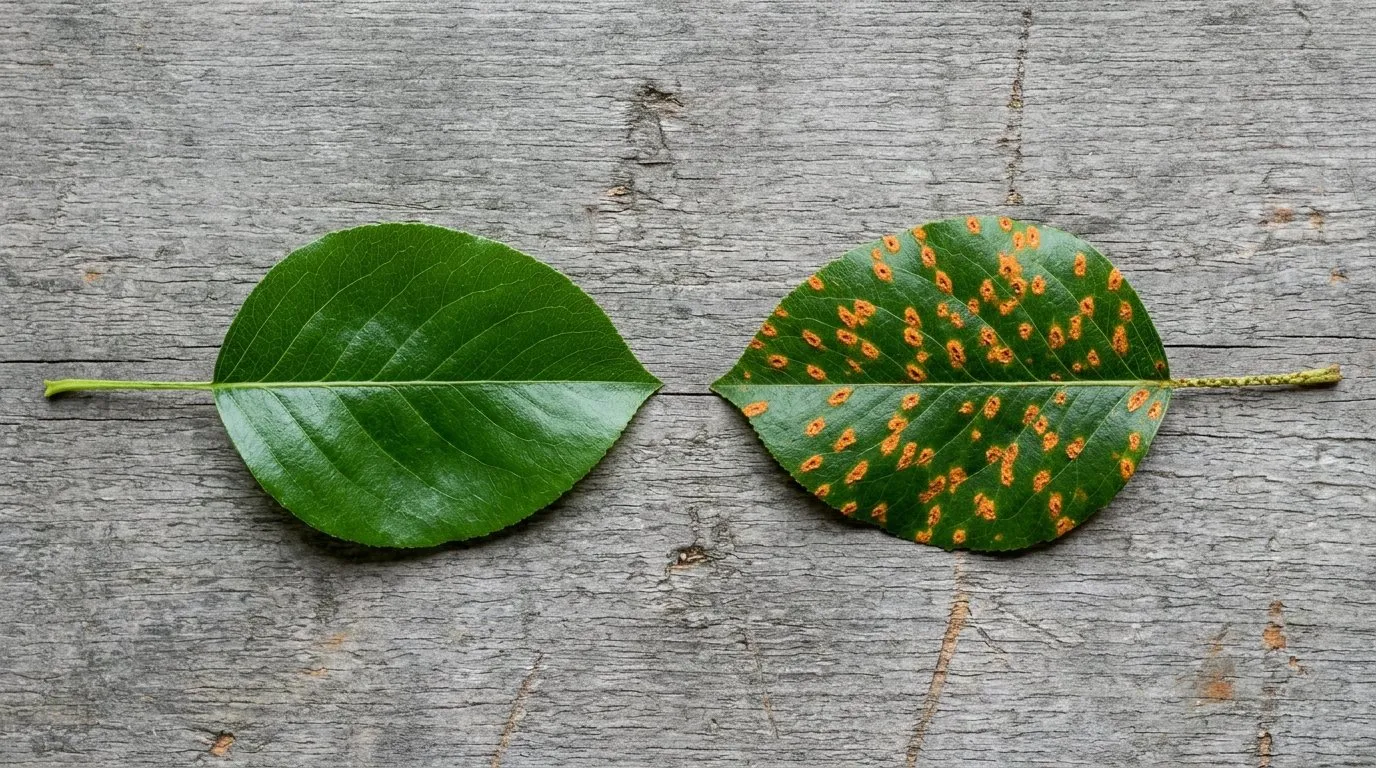 Clean leaf left, roughly 40% infection right. The tissue between the spots still photosynthesises, which is why the crop holds up.
The root cause everyone treats wrongly
The root cause of pear rust is not a susceptible pear, and it is not a wet summer. It is the presence of a host juniper within spore range of your tree. That is the whole of it.
The cause gets missed for three reasons, and they compound. First, the symptom and the source are in different places, often different gardens, and gardeners treat where they see damage. Second, an infected juniper is invisible for 47 weeks of the year, betraying itself only during a few wet weeks in spring. Third, the standard advice for every other rust is wrong for this one, so the harder you follow it the less happens.
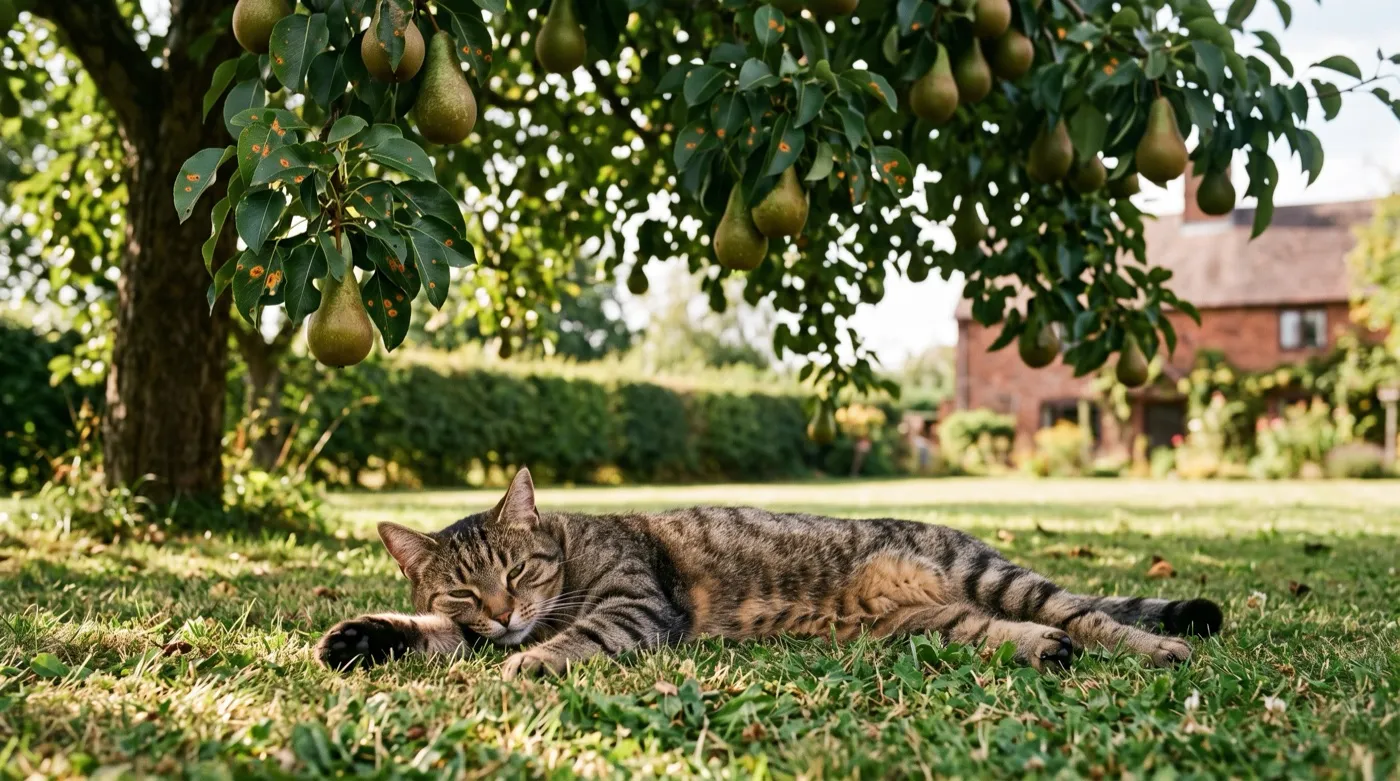 Our Conference in its sixth rust year. Heavy leaf infection, a full crop, and no treatment of any kind. The cat is unimpressed either way.
Permanent prevention is therefore about hosts, not chemicals. Remove or replace host junipers you control. Choose J. communis, yew, thuja or chamaecyparis when you want that evergreen shape. Talk to neighbours before reaching for a sprayer. Establishing a new pear well gives it the reserves to shrug rust off, so plant properly and feed it. The RHS profile on pear rust reaches the same conclusion on the juniper link.
Pear rust calendar month by month
| Month | What to do |
|---|---|
| January | Best month to cut galled stems out of your own juniper, or remove the plant entirely. |
| February | Plant replacement non-host evergreens. Order pear trees bare-root if replacing. |
| March | Galls begin swelling. Last practical month to remove an infected juniper before spore release. |
| April | Search for orange telial horns on juniper after rain. The one reliable ID window of the year. |
| May | Infection of pear happens now, invisibly. Nothing to see and nothing useful to do on the pear. |
| June | Latent period continues. Do not be reassured by clean leaves. |
| July | Orange spots appear. Note severity; count leaves if you want a baseline to measure against. |
| August | Peak symptoms. Turn leaves over and confirm the fringed aecia. Plan your juniper conversation. |
| September | Aeciospores fly back to juniper. Nothing you do on the pear affects this. |
| October | Leaves fall. Rake for tidiness or for scab, but understand it does nothing for rust. |
| November | Approach neighbours now, while the summer damage is fresh in everyone’s memory. |
| December | Order replacement junipers or evergreens for a January swap. |
Common mistakes that keep pear rust coming back
- Raking and burning fallen pear leaves. The single most common wasted job in British gardens. The fungus overwinters in juniper wood, not on your pear leaves. Rake for scab if you like, but it does nothing at all for rust.
- Spraying the pear in August. Infection happened in April or May, and nothing is spreading on the tree because there is no repeating stage. You are spraying a finished symptom.
- Only searching your own garden. Spores travel 1km or more. No juniper on your plot proves nothing. Ours was 70m away, four gardens back.
- Assuming any juniper is guilty. Common juniper (J. communis) is rarely affected, and yew, thuja and chamaecyparis are not hosts at all. Identify the plant before you ask anyone to remove it.
- Panicking about the crop. A mature pear at 30-50% leaf infection loses effectively nothing. Reserve real effort for young trees and for twig cankers.
- Removing a neighbour’s plant without asking. It is their property. Ask, explain, and offer to fund the replacement. That approach worked for us; a unilateral one would not have.
What pear rust is really teaching you
Pear rust is worth understanding well beyond pears, because it is a clean demonstration of a principle that applies right across the garden: treat the cause, in the place the cause actually lives. Almost every failed pear rust programme fails for the same reason, which is that people work on the plant showing the symptom.
Now you know why your pear turns orange, read our guide to growing pear trees in the UK for the planting, pruning and feeding that keep a tree strong enough not to care.
Frequently asked questions
What causes pear rust?
Gymnosporangium sabinae, a fungus that needs both a pear tree and a juniper. It cannot complete its lifecycle on pear alone. The fungus lives permanently in infected juniper stems, fires spores at pear each spring, and sends a different spore back to juniper each autumn. Break either half of that loop and the disease stops. Older books call the same fungus Gymnosporangium fuscum.
Will removing fallen leaves stop pear rust next year?
No. The fungus does not overwinter on pear leaves, pear wood or pear soil. Every spring infection arrives fresh from a juniper, so raking, burning or binning pear leaves has no effect on next year’s rust at all. It is the most common piece of wasted effort in UK gardens. Rake them for scab and tidiness if you like, but not for rust.
Which junipers cause pear rust?
Juniperus sabina, J. chinensis and J. scopulorum are the main UK culprits. Their cultivars carry it too, including common garden plants like ‘Skyrocket’, ‘Blue Arrow’ and the low, spreading ‘Tamariscifolia’. Common juniper (J. communis) is rarely affected and is treated as a safe alternative. Yew, thuja and chamaecyparis are not hosts and cannot carry this rust.
How far can pear rust spores travel?
At least 1km, and often further on a windy, wet spring day. This is why gardeners search their own plot, find no juniper, and conclude the diagnosis is wrong. The source is regularly several streets away, in a garden you will never see. Distance is also why removing one juniper reduces infection sharply but rarely takes it to zero.
Will pear rust kill my pear tree?
Rarely. A mature pear carries heavy leaf infection with no measurable crop loss. Trees under three years old, and any tree suffering repeated severe defoliation alongside twig cankers, can be genuinely weakened. On an established Conference or Comice, the honest answer is that pear rust looks far worse than it is. Treat it as disfiguring rather than dangerous.
How do I tell pear rust from pear scab?
Pear rust is bright orange; pear scab is olive-green to black. Rust spots sit on the upper leaf surface and develop fringed brown horns underneath by late summer. Scab makes sooty, feathery-edged blotches and goes on to mark the fruit with corky patches. Rust rarely touches the fruit at all, which is the quickest way to separate the two.
Do fungicides work on pear rust?
No fungicide is approved for rust control on edible pears in UK gardens. Products cleared for ornamental use may protect new foliage, but they cannot stop reinfection from a juniper the following spring, so you would spray every year forever. Spending the same money on removing or replacing the source juniper fixes the problem once.
Our team produces practical UK gardening guidance from source research, contributor records and established horticultural practice. Editorial standards are overseen by Matt W.