Key takeaways
- Potato blight is Phytophthora infestans, an oomycete, not a true fungus, so it spreads and kills fast
- The Hutton Criteria (two days of 10C-plus and 6 hours over 90% humidity) signals a high-risk period
- First and second earlies lifted by late July escape blight in most UK seasons
- Cut and remove blighted haulm within a day, then wait 2-3 weeks before lifting to protect the tubers
- Sarpo Mira and Sarpo Axona resist blight far longer than Maris Piper or King Edward
- No effective amateur fungicide remains, so control is now entirely cultural
If your potato foliage is developing brown-black watery patches in a muggy August and collapsing within days, that is potato blight. It is caused by Phytophthora infestans, a water mould that spreads on the wind and can strip an allotment of green in under a week. The hard truth first: there is no longer an effective fungicide a UK gardener can buy for it. The good news is that the two most powerful controls were never sprays anyway. They are the calendar and the seed packet, and both are still completely in your hands.
This guide is about potatoes specifically. It covers how to recognise blight, the free UK alert system that tells you when it is coming, the earlies-escape trick that dodges it entirely, how to save your tubers when the foliage goes down, and the resistant varieties that buy you weeks. For the disease across both potatoes and tomatoes together, see our overview of late blight on potatoes and tomatoes.
What potato blight looks like on the crop
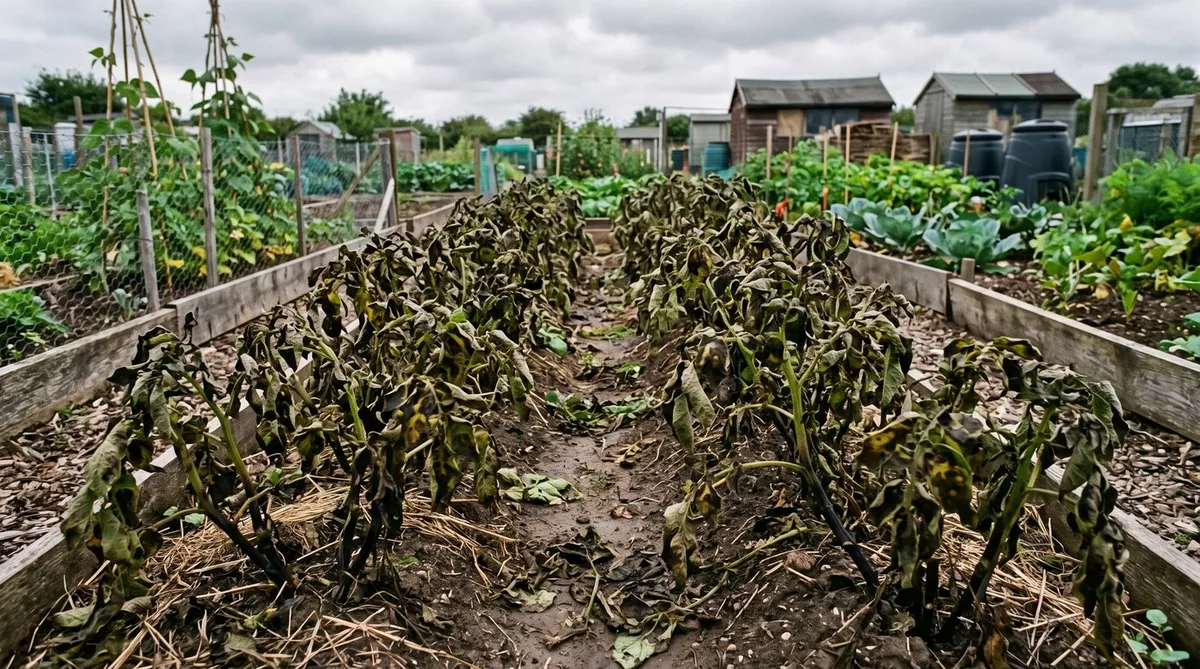
Potato blight shows first on the leaves. Look for brown to black patches, often starting at the leaf tip or edge, with a slightly water-soaked, greasy appearance rather than a dry spot. In humid weather, and especially early in the morning, the underside of the lesion carries a fine white mould at its margin, which is the fungus producing its spores. That white fringe is the confirmation.
From the leaves it moves to the stems, where it makes dark brown to black streaks and lesions that can girdle and kill the stem. Once blight is into the stems the plant is finished, and in warm, wet conditions the whole plot can go from green to a collapsed, blackened, foul-smelling mess in five to seven days. The smell is distinctive and unpleasant, a rotting, sour note that experienced growers recognise before they even see the lesions clearly.
The part you cannot see matters most. Spores wash off the foliage in rain, run down through the soil, and infect the tubers. A blighted tuber shows sunken, reddish-brown patches under the skin, and a rusty-brown marbling into the flesh when cut. Infected tubers rot in store and take sound ones with them. That is why the response to blight is as much about protecting what is underground as saving the tops.
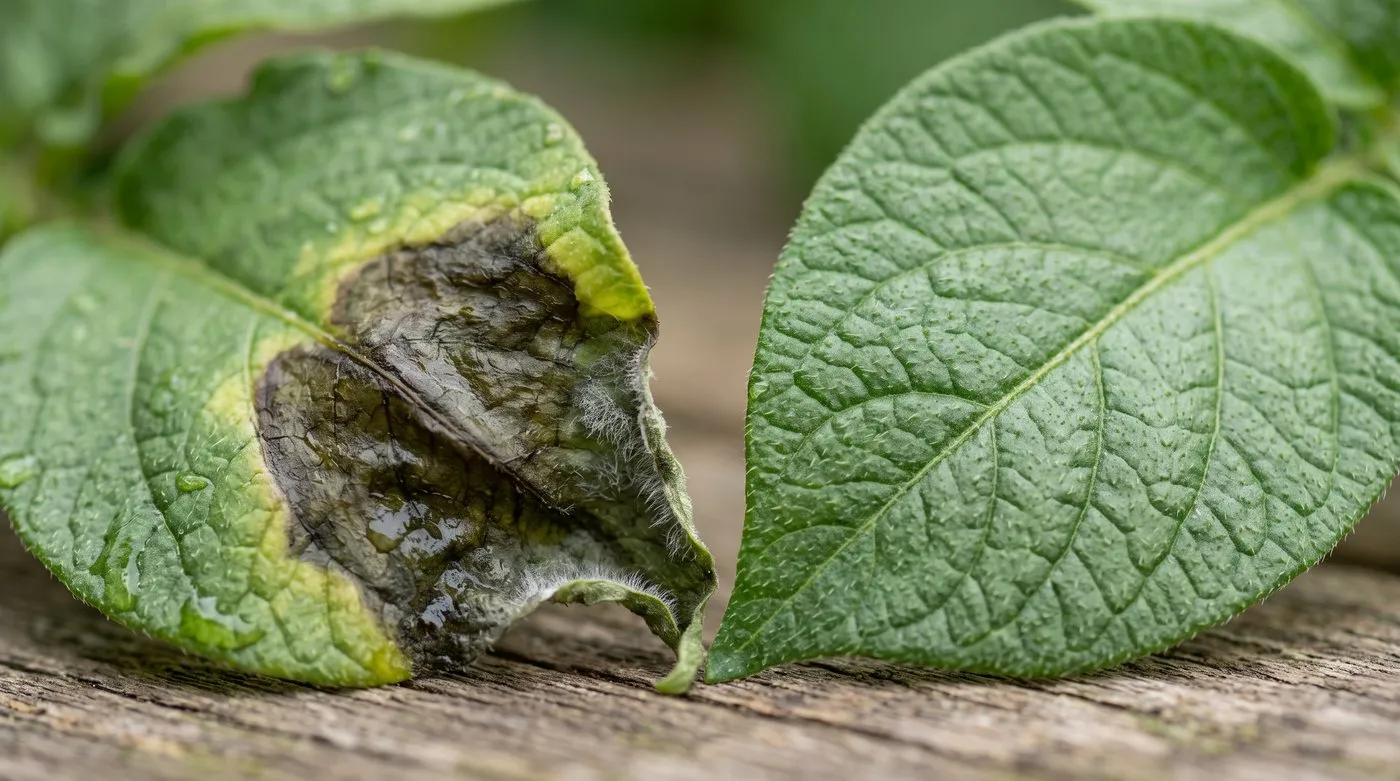 The tell: a greasy brown-black lesion with a fine white mould fringe underneath in humid air. A dry spot with a target ring is early blight, a different disease.
Why potato blight spreads so fast
Understanding what blight actually is explains why it moves at the speed it does, and why old fungicide advice fails.
Phytophthora infestans is not a true fungus. It is an oomycete, a water mould more closely related to algae than to mushrooms. This matters for a practical reason: many fungicides built for true fungi do nothing to it. The specific active ingredients that worked against it, chiefly mancozeb and copper, have now been withdrawn from the UK amateur market, which is why home growers no longer have a spray worth using.
The lifecycle is brutally quick:
- Spores arrive on the wind. Sporangia are produced on infected foliage anywhere within several kilometres and blow in. You cannot fence them out.
- They need the leaf wet. A spore landing on a dry leaf does nothing. On a wet leaf it germinates and penetrates the tissue within 4-6 hours.
- Warm and humid drives it. Growth is fastest in warm, muggy weather, the classic thundery UK August.
- A new generation in 4-7 days. From spore landing to a fresh crop of spores takes under a week in ideal conditions, so infection explodes exponentially.
- Rain carries it down. Spores wash off leaves into the soil and reach the tubers.
Here is the critical mistake most people make: they wait until they see blight before they think about it, and by then the exponential curve has already started. Blight does not build slowly. It doubles. The gardener who notices a few lesions on Saturday and plans to deal with them next weekend has, by next weekend, a collapsed plot. Speed of response is everything, and the only way to be fast is to be watching before it arrives.
The Hutton Criteria and free blight alerts
You do not have to guess when blight is coming. The UK has a national warning system, and it is free.
Blight risk is now measured by the Hutton Criteria: a high-risk period is flagged when there are two consecutive days, each with a minimum temperature of 10C and at least six hours of relative humidity at or above 90%. Those are the conditions the spores need to spread and infect. The Hutton Criteria replaced the older Smith Periods in 2017, because they better reflect modern, more aggressive blight strains.
The practical tool is Blight Watch (blightwatch.co.uk), a free service run for growers. You register your postcode and it emails you when your area meets, or is forecast to meet, the Hutton Criteria. When an alert lands, you know the next few days are dangerous and it is time to be vigilant, to consider lifting earlies early, and to be ready to cut haulm at the first sign.
Gardener’s tip: Sign up to Blight Watch for your postcode in spring, before you need it. An alert two days before a muggy spell gives you time to lift a row of second earlies that were nearly ready anyway, turning a potential loss into a clean early crop. The alert is only useful if you have already registered when it matters.
The earlies-escape trick: beat blight with the calendar
This is the single most effective thing a home grower can do, and it involves no chemicals and no resistant varieties. Grow early potatoes and lift them before the blight season.
Blight needs warm, humid weather, which in most of the UK means it arrives from mid-July onwards and peaks in August. First earlies planted in mid to late March are ready to lift from late June to mid-July. Second earlies follow through July. If your crop is out of the ground before the muggy weather sets in, the spores have nothing to infect. You have simply not been at the table when blight came to dinner.
This reframes the whole problem for anyone with limited space. If blight beats you every year, stop growing maincrops and grow more earlies and second earlies instead. You lose the big storage crop but you gain a reliable one. Our guide to when to plant potatoes covers the timings that make the escape work, and growing potatoes in the UK covers the basics of chitting and planting to hit those dates.
 First earlies lifted in July are out of the ground before the humid weather that carries blight. This is the most reliable control there is.
Cutting the haulm to save the tubers
When blight does strike a maincrop, the crop is not automatically lost. Your job switches instantly from saving the plant to saving the tubers, and the action is the same every time.
Cut off all the foliage at ground level as soon as blight appears, and take it off the plot. This does two things. It stops the leaves producing more spores, and it removes the source of the spores that wash down to the tubers. Cut low, gather every scrap, and bin or burn it. Never compost blighted haulm in a normal heap.
Then, and this is the step people skip, wait two to three weeks before lifting. The reason is that live spores sit on the soil surface after you cut the haulm, and lifting immediately drags the tubers up through that contaminated layer, infecting them at the last moment. Waiting lets those surface spores die and lets the tuber skins set firm, so they lift and store better. The tubers sit safely in the ground during that wait, because with no foliage there is no new infection reaching them.
When you do lift, sort ruthlessly. Use sound tubers soon, and bin any showing a reddish-brown patch, a soft spot or a smell. One blighted tuber put into store will rot its neighbours. Our guides to harvesting potatoes and storing potatoes cover curing and storage that keep a sorted, sound crop through winter.
Warning: Do not leave any blighted or missed tubers in the soil over winter. They are the main way blight survives to next year, sprouting as infected volunteers in spring that start the whole cycle again. Go back over the bed after lifting and remove every stray potato, however small.
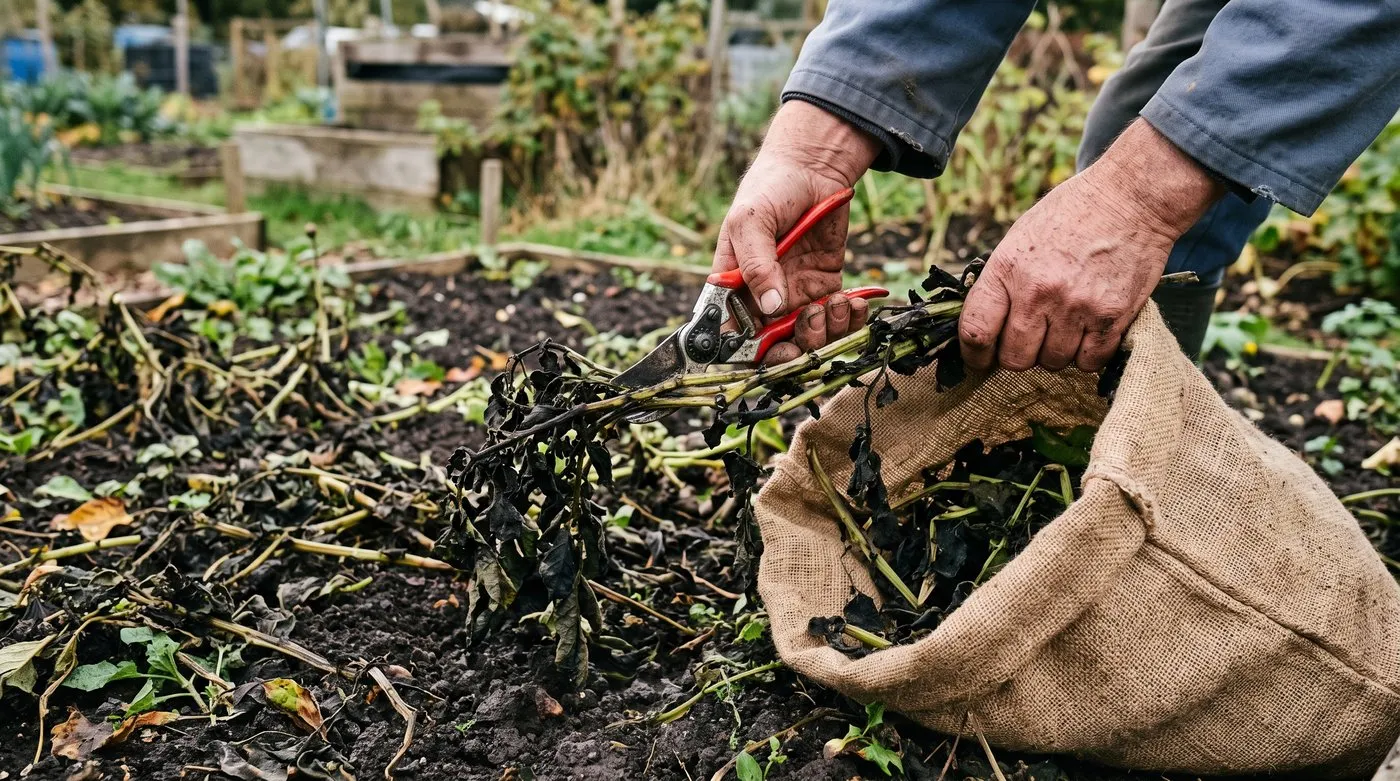 Cut the haulm to the ground the day blight appears and bag it off the plot. Then wait two to three weeks before lifting so surface spores die first.
Earthing up and spacing to protect the crop
Two cultural jobs done earlier in the season change how much damage blight can do when it arrives.
Earthing up matters more than most people realise for blight, not just for greening. Drawing soil up into a deep ridge over the developing tubers puts a physical barrier of 150mm or more of soil between the spores washing off the foliage and the tubers below. Tubers sitting near the surface catch blight far more readily than those buried deep in a well-built ridge. Earth up progressively as the haulm grows, and build a good high ridge. Our guide to earthing up potatoes covers the technique and timing.
Spacing and air flow shorten the time the leaves stay wet, which is the window blight needs. Crowded rows hold humidity and stay damp for hours after rain or dew. Give maincrops room, keep the rows aligned with the prevailing wind where you can, and keep weeds down so air moves through the crop. A drier canopy is a less infectible one.
Watering should go on the soil, never over the foliage, and in the morning so any splashed leaves dry quickly. Overhead watering in the evening leaves the canopy wet all night, which is exactly the germination window you are trying to deny the spores.
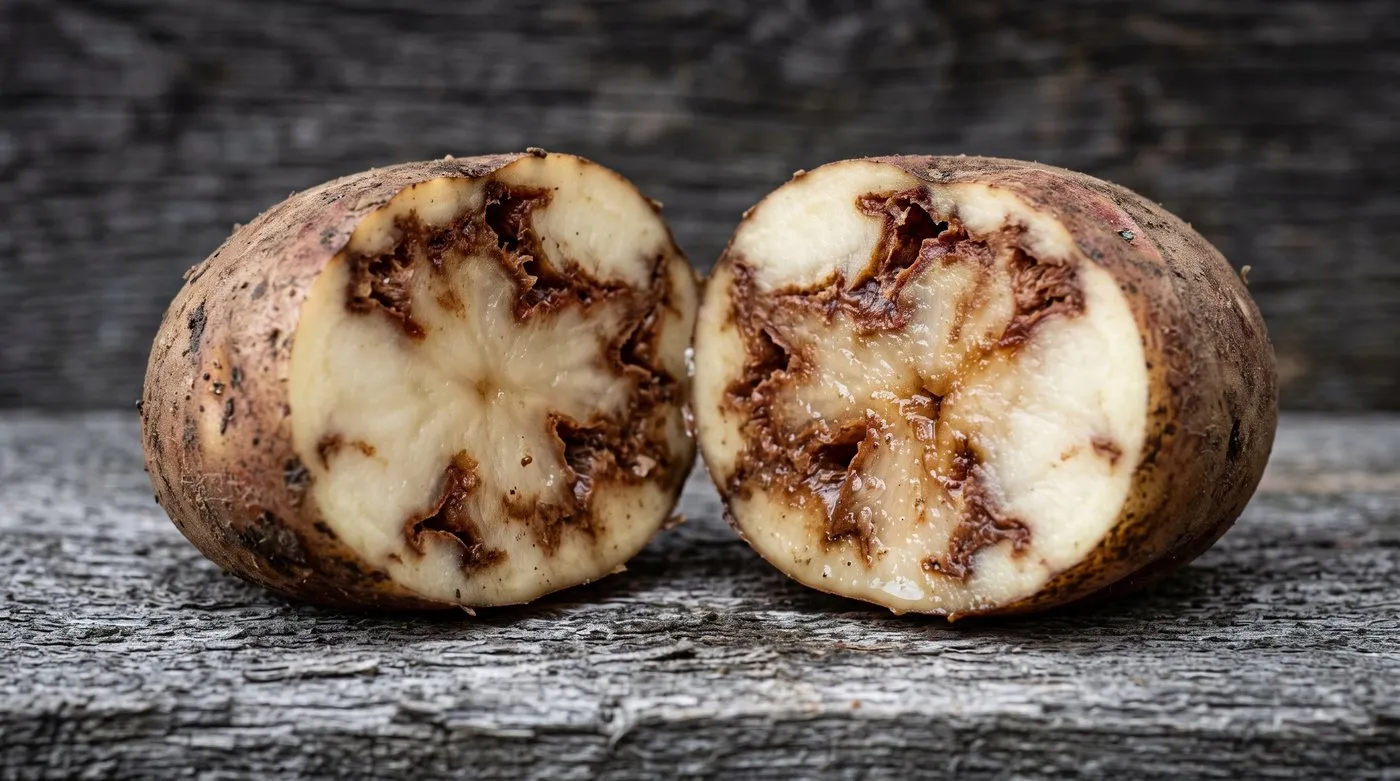 Tuber blight: sunken reddish-brown patches under the skin marbling into the flesh. One infected tuber in store rots the rest, so sort ruthlessly.
Resistant varieties: the seed-packet defence
If the calendar is one half of blight control, the seed packet is the other. Variety choice decides how long a maincrop stands once blight is in the air.
The standout resistant varieties in the UK are the Sarpo maincrops, bred by the Sárvári Research Trust in Wales specifically for blight resistance. Sarpo Mira and Sarpo Axona stand green weeks longer than traditional maincrops under blight pressure. Other varieties with useful resistance include Carolus, Setanta and, to a lesser degree, Cara. By contrast, old favourites like Maris Piper and King Edward have little foliar blight resistance and go down early.
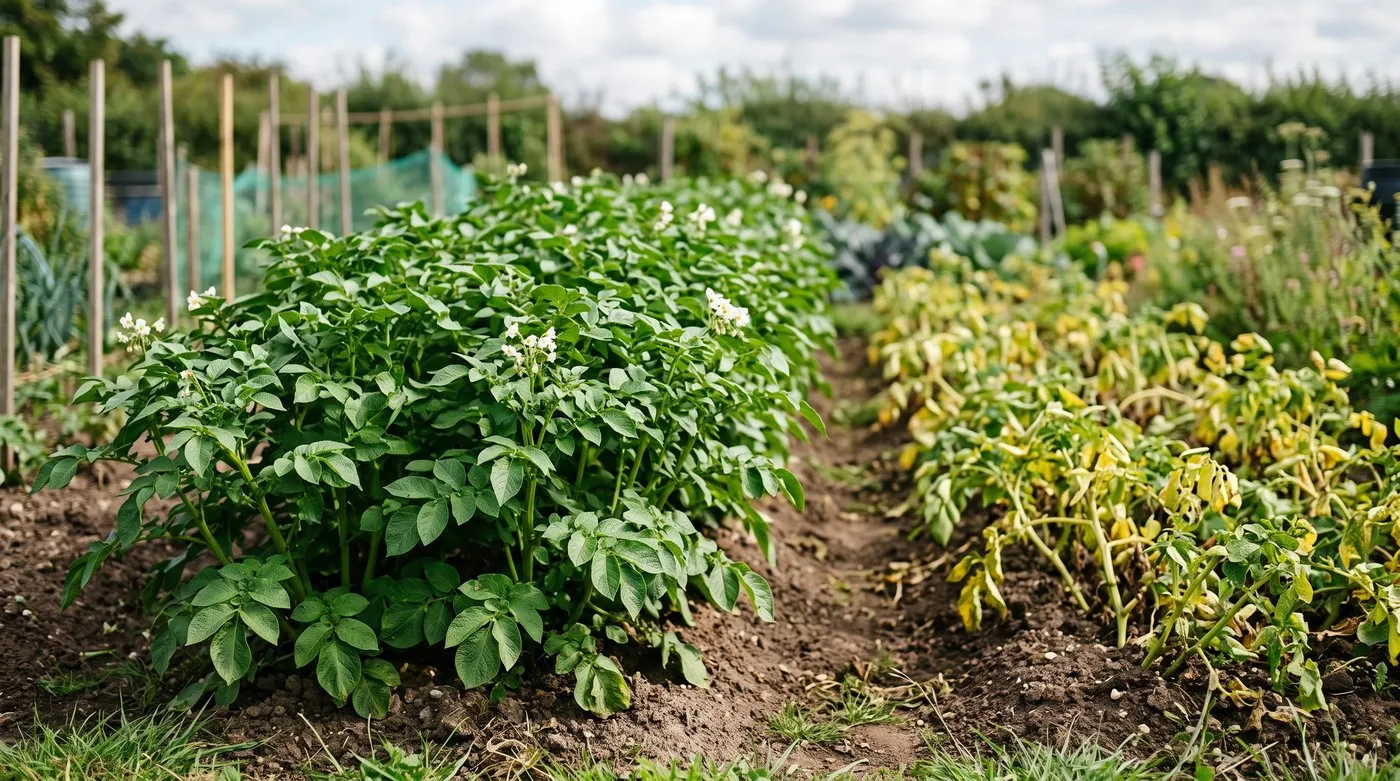 Sarpo Mira stands green weeks after traditional maincrops collapse. A resistant variety is the seed-packet half of blight control.
Control methods ranked by effectiveness
Treating these as equal is how people lose crops while fussing over the wrong thing. Ordered by what each actually delivers on a UK plot now that sprays are gone.
The gold standard is the top two rows working together: grow earlies to escape blight, and where you must grow a maincrop, grow a resistant one. Cutting haulm is the emergency that saves the tubers when prevention was not enough. Everything below is support. There is no spray at the bottom of this table for the simple reason that there is no longer a spray to put there.
Month-by-month potato blight calendar
| Month | What to do |
|---|---|
| February-March | Chit seed potatoes. Choose earlies to escape blight, or Sarpo maincrops if you want storage. |
| March-April | Plant. Register your postcode with Blight Watch now, before the season. |
| May | Earth up as the haulm grows. Build a deep ridge to protect tubers. |
| June | First earlies bulking. Keep earthing up. Watch the first Blight Watch alerts. |
| July | Lift first and second earlies before the humid weather. This is the escape window. |
| August | Peak blight risk. Check maincrops daily in muggy spells. Cut haulm the day blight shows. |
| September | Wait 2-3 weeks after cutting haulm, then lift. Sort ruthlessly, bin any rot. |
| October | Lift resistant maincrops. Remove every stray tuber and volunteer from the bed. |
| November-January | Rotate next year’s potato bed on a 3-4 year cycle. Check stored tubers monthly for rot. |
Common mistakes with potato blight
- Waiting to see blight before acting. Blight doubles, it does not creep. By the time you plan a response at the weekend, the plot has collapsed. Watch alerts and act on the first lesion, not the tenth.
- Lifting the moment you cut the haulm. Live spores sit on the soil surface for days. Lifting immediately drags tubers up through them. Wait two to three weeks.
- Composting blighted foliage. It keeps the disease alive and spreads it around the garden. Bin or burn every scrap of infected haulm.
- Leaving stray tubers in the ground. Missed and blighted tubers overwinter and sprout as infected volunteers that restart the cycle. Clear them all.
- Growing only late maincrops on a blight-prone plot. If blight beats you every year, switch to earlies and second earlies. A reliable early crop beats a maincrop that rots each August.
The short version on potato blight
Potato blight is fast, it is airborne, and you can no longer spray it. That sounds like bad news until you realise the two best defences were never sprays. Grow earlies and get them out of the ground before the muggy weather, and where you need a maincrop, grow a resistant Sarpo. Between them, most UK gardeners can have a reliable potato crop without a single chemical.
When blight does land, move fast. Cut the haulm the day you see it, take it off the plot, wait a couple of weeks, then lift and sort hard. Sign up to Blight Watch so you are never surprised, earth up deep so the spores cannot reach the tubers, and clear every stray potato in autumn so it cannot start again. For the disease across the whole family, the late blight overview sets potatoes and tomatoes side by side, and the wider garden problems section covers the rest. The AHDB Fight Against Blight programme is a sound second reference on current blight strains and the alert science.
Frequently asked questions
What does potato blight look like?
Brown-black watery patches on leaves, often with a pale ring, spreading fast in humid weather. Turn an affected leaf over in damp conditions and you may see a fine white mould around the edge of the lesion. Stems develop dark streaks, and the whole plant can collapse and rot within a week. Tubers show sunken, reddish-brown patches under the skin.
How do I stop potato blight?
You cannot stop the spores arriving, but you can dodge and limit them. Grow early varieties and lift them before the humid blight season, choose resistant maincrops like Sarpo, space plants for air flow, earth up deeply to protect tubers, and watch Blight Watch alerts. There is no effective amateur fungicide left, so timing and variety choice do the work.
Can you eat potatoes with blight?
Eat healthy tubers from a blighted crop, but discard any showing rot. Foliage blight does not automatically ruin the tubers if you act fast. Lift the crop, sort it, and use sound potatoes quickly. Any tuber with reddish-brown patches, a soft area or a smell is infected and must go in the bin, not into store, where it will rot the rest.
What are the Hutton Criteria for blight?
Two consecutive days each with a minimum temperature of 10C and at least six hours of relative humidity at or above 90%. When those conditions are met, blight spores can spread and infect, so it flags a high-risk period. The Hutton Criteria replaced the older Smith Periods in the UK in 2017 and drive the free Blight Watch alert service.
Which potato varieties are resistant to blight?
Sarpo Mira and Sarpo Axona are the most blight-resistant maincrops in the UK. Others with good resistance include Carolus, Setanta and Cara. No potato is fully immune, and resistance can erode as blight strains change, but a Sarpo maincrop typically stands weeks longer than Maris Piper or King Edward before it succumbs.
Should I cut the tops off potatoes with blight?
Yes, cut and remove all the haulm as soon as blight appears on the foliage. Removing the tops stops the disease reaching the tubers and halts spore production. Take the cut foliage right off the plot and bin or burn it. Then wait two to three weeks before lifting, so any spores on the soil surface die before the tubers are exposed.
Does potato blight stay in the soil?
Not usually in garden soil over winter, but it survives on living tissue. Phytophthora infestans overwinters mainly in infected tubers left in the ground, in cull piles and in self-sown volunteers. Remove every stray tuber and volunteer, never compost blighted material, and rotate your potato bed on a three to four year cycle to break the chain.
Our team produces practical UK gardening guidance from source research, contributor records and established horticultural practice. Editorial standards are overseen by Matt W.