Key takeaways
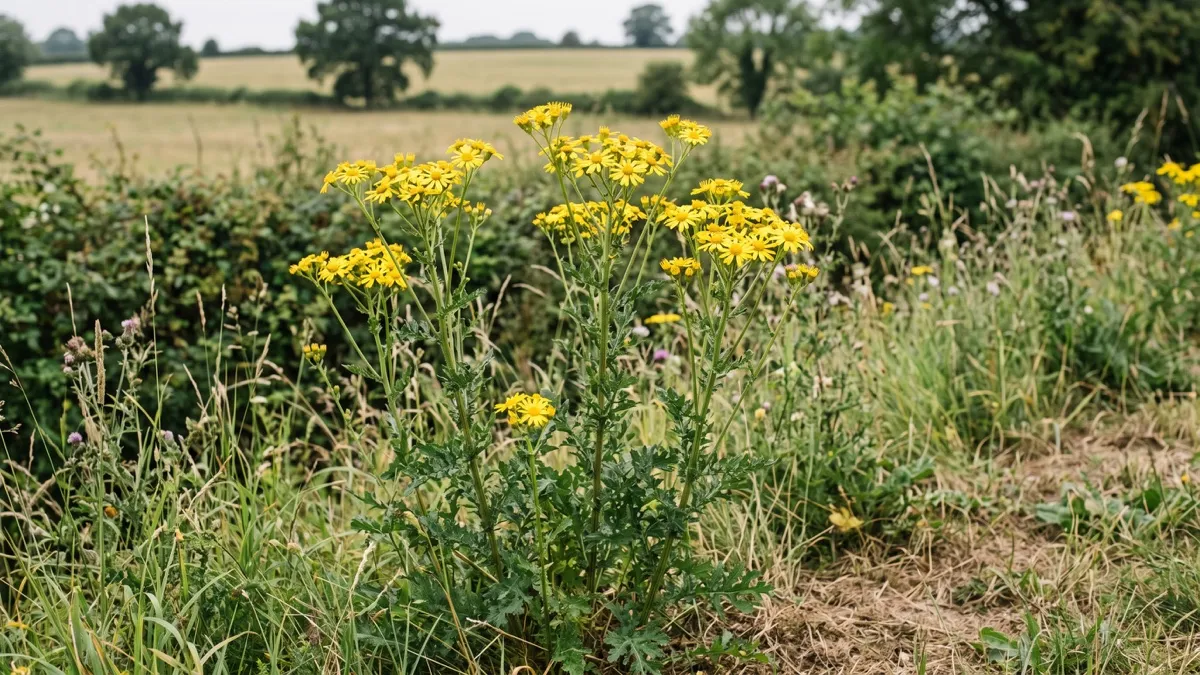
- Common ragwort has flat-topped clusters of bright yellow daisy flowers and ragged leaves, 30-100cm tall
- It contains alkaloids that cause irreversible liver damage in horses and cattle
- It is most dangerous dried in hay, where animals eat it without tasting the bitterness
- Wear waterproof gloves and cover your arms when handling live or dead ragwort
- Pull or dig the whole plant before it seeds, and never leave pulled plants where animals graze
- Away from grazing it is a vital native wildflower for pollinators and the cinnabar moth
Common ragwort has ragged leaves and flat-topped clusters of yellow flower heads. Common ragwort, Jacobaea vulgaris (also called Senecio jacobaea), is a native British wildflower. It is both a serious poison to grazing animals and a useful food source for insects. Sensible control depends on location. Remove it where animals or forage are at risk. Leave low-risk plants where their wildlife value outweighs any chance of spread.
This guide covers how to identify common ragwort, why it is toxic and to whom, the law around it, how to remove it safely, and the strong conservation case for tolerating it away from grazing.
How to identify common ragwort
Common ragwort is a biennial or short-lived perennial that grows 30-100cm tall in flower. In its first year it forms a flat rosette of dark green, deeply cut leaves. In its second year it sends up a tough, often red-tinged stem topped with the distinctive flowers.
The flowers are the clearest feature: dense, flat-topped clusters of bright yellow daisy-like flower heads, each about 15-25mm across with around 13 petals (ray florets), from June to November. The leaves are dark green and raggedly lobed, with a slightly frilly, dissected look that gives the plant its name.
Several yellow-flowered plants get confused with it. Groundsel is smaller with rarely-opening flowers. Oxford ragwort is a smaller, more sprawling relative. Tansy has flat clusters of button-like flowers without petals, and St John’s wort has five-petalled flowers, not daisies. The combination of flat-topped yellow daisy clusters and ragged leaves on a plant up to a metre tall is the reliable identification. Our guide to common UK garden weeds sets it alongside others.
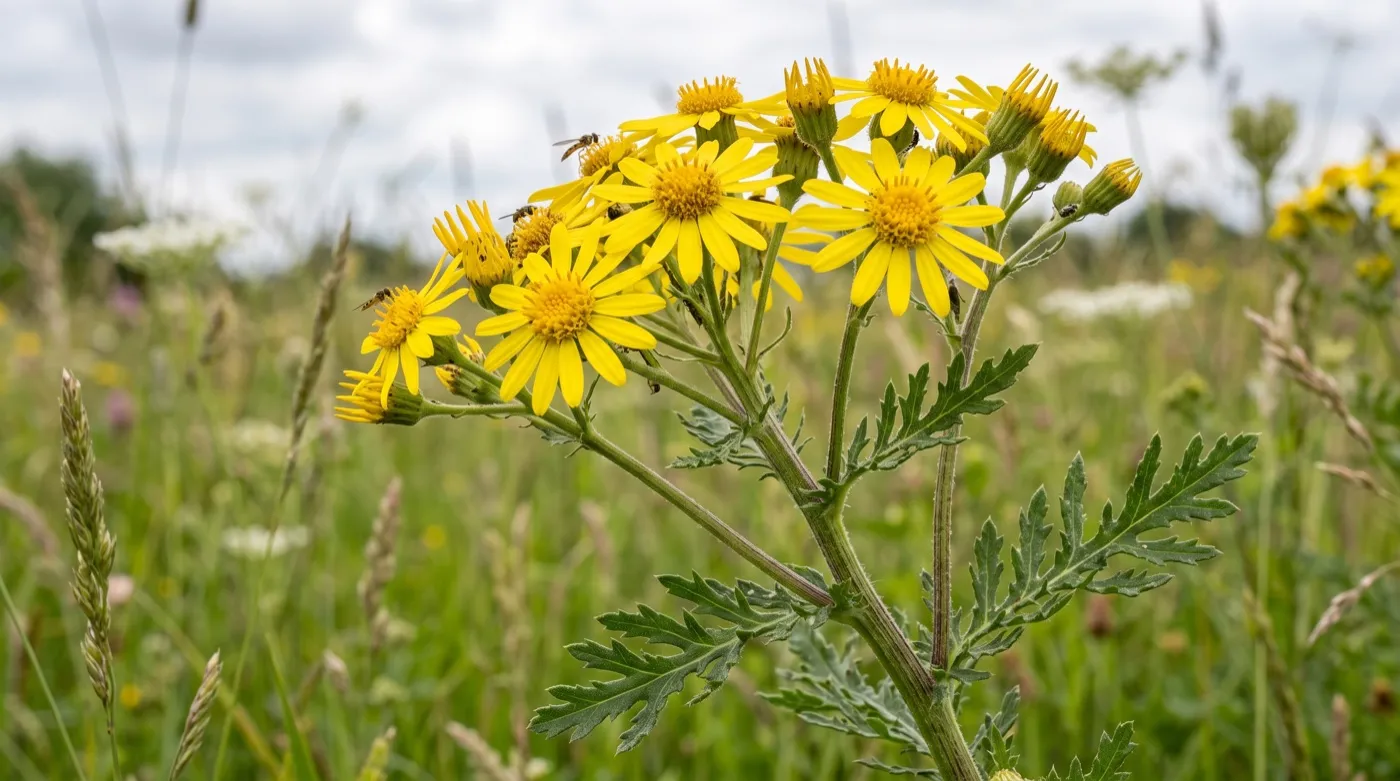 Common ragwort: flat-topped clusters of yellow daisy flowers with around 13 petals each, above dark green raggedly lobed leaves. The flat-topped head is key.
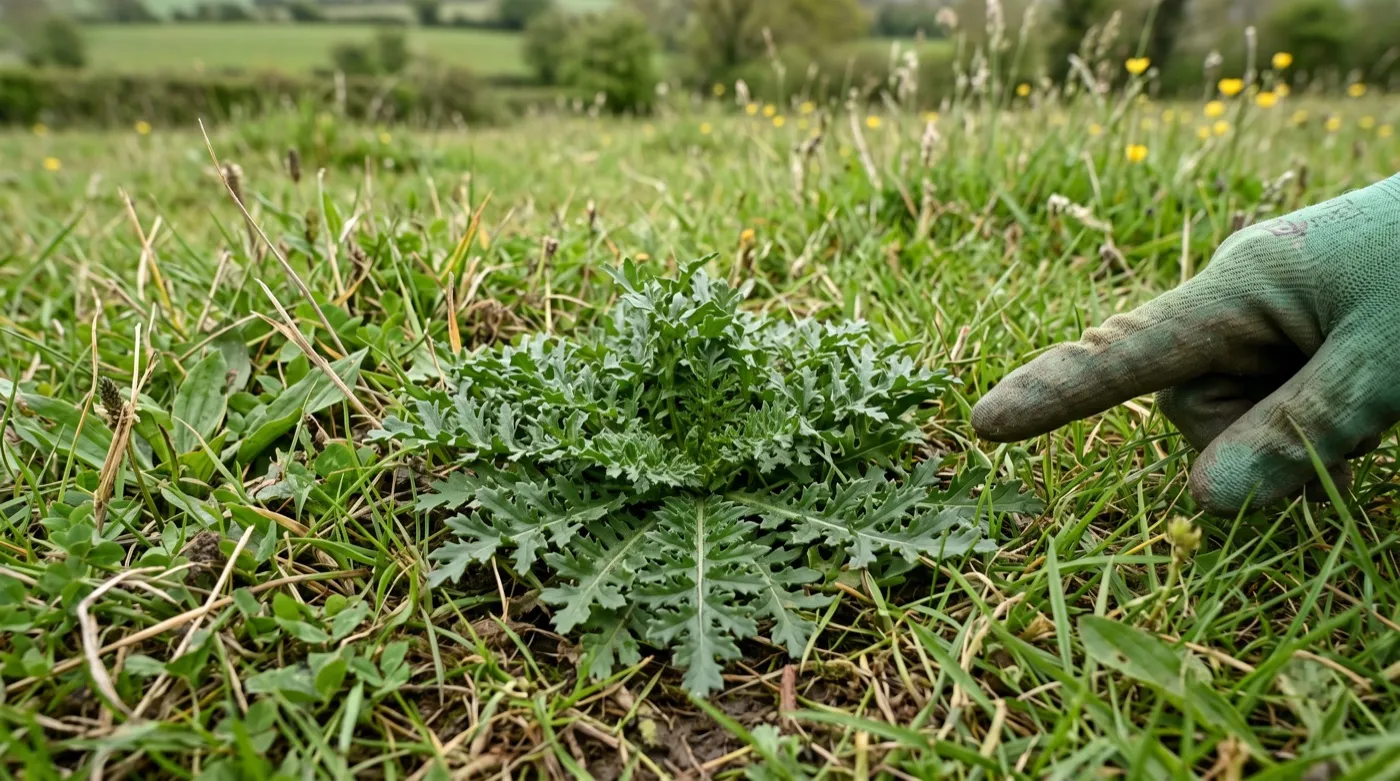 First-year ragwort stays as a low rosette. This stage is easier to lever out before the flowering stem develops.
Why ragwort is dangerous, and to whom
The toxicity of ragwort is real and worth understanding precisely, because it drives everything about how and where to control it.
Ragwort contains pyrrolizidine alkaloids, compounds that cause cumulative liver damage in animals that eat it. Horses, ponies, cattle and sheep are at risk. Repeated exposure can damage more liver cells before outward symptoms become obvious.
The critical and counter-intuitive point is that ragwort is most dangerous when dried in hay. The living plant is bitter, and grazing animals normally avoid it in a pasture where they have other grass to eat. But drying destroys the bitterness while leaving the alkaloids intact, so animals eat it readily in hay or haylage without any warning taste. This is why ragwort in a hay field is far more serious than the odd plant in a well-grazed, well-managed pasture, and why forage land must be kept clear.
For people, the official handling advice is clear. Use sturdy waterproof gloves, cover your arms and legs, and wash exposed skin. These precautions apply to live and dead plants. A ragwort plant growing away from livestock does not itself create a legal offence.
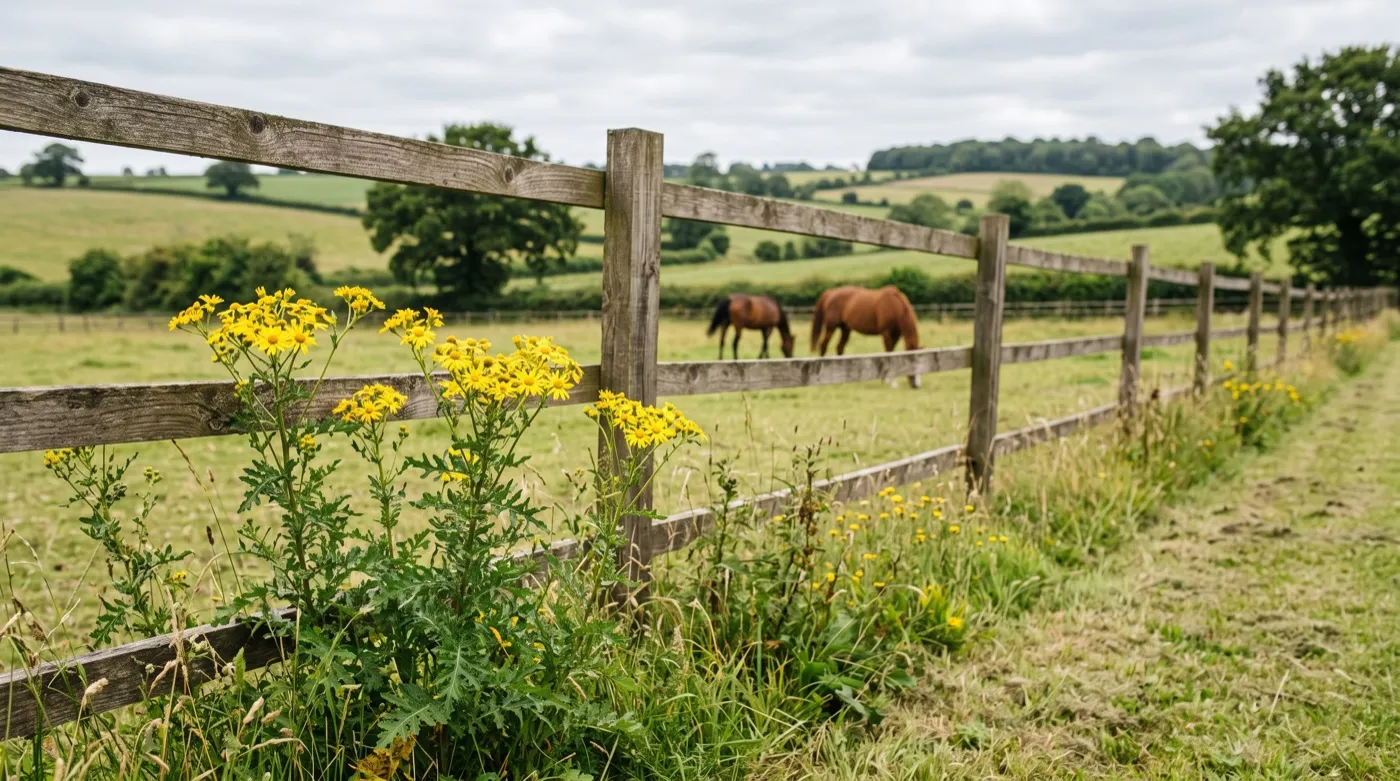 The reason ragwort control matters: horses and cattle suffer cumulative liver damage from it. Clear it from grazing and forage land before it seeds.
The law: an injurious weed and a code of practice
Ragwort’s legal position is often misunderstood. Common ragwort is one of the five injurious weeds in the Weeds Act 1959. The Ragwort Control Act 2003 gave England’s Code of Practice evidential status. Neither law bans the plant.
What this means in practice:
- It is not illegal to have ragwort growing on your land or in your garden.
- There is no duty to eradicate it everywhere.
- Natural England can serve a control notice where spread threatens agricultural land.
The law is risk-based, not a blanket order to destroy. England’s official ragwort Code of Practice calls flowering plants within 50m of grazing or forage land high risk. Plants 50-100m away are medium risk, while those beyond 100m are normally low risk. These distances are guidelines, not automatic legal boundaries. Wind, barriers and ground cover also matter. The same careful identification principle applies to giant hogweed.
How to remove ragwort safely
Where ragwort must go, near grazing or forage, safe removal comes down to a few firm rules. The aim is to remove the whole plant before it seeds, without poisoning yourself or leaving toxic material where animals can reach it.
Wear waterproof gloves. Cover your arms and legs, then wash any exposed skin with warm soapy water.
Pull or dig the whole plant, including the root. Ragwort regrows from the crown if snapped off, so use a ragwort fork or lever to get the full root. It comes out most cleanly on soft ground after rain. Levering the whole plant up vertically, as with dock, beats snapping it off at the base.
Do it before it seeds. One plant can produce many thousands of wind-dispersed seeds. Remove plants during early flowering, before yellow heads turn to fluffy seed.
Bag it at once. Never leave pulled ragwort lying on grazing. Wilting pulled plants stay fully toxic and become more palatable to animals, which is a classic and fatal mistake. Bag every plant as you pull it.
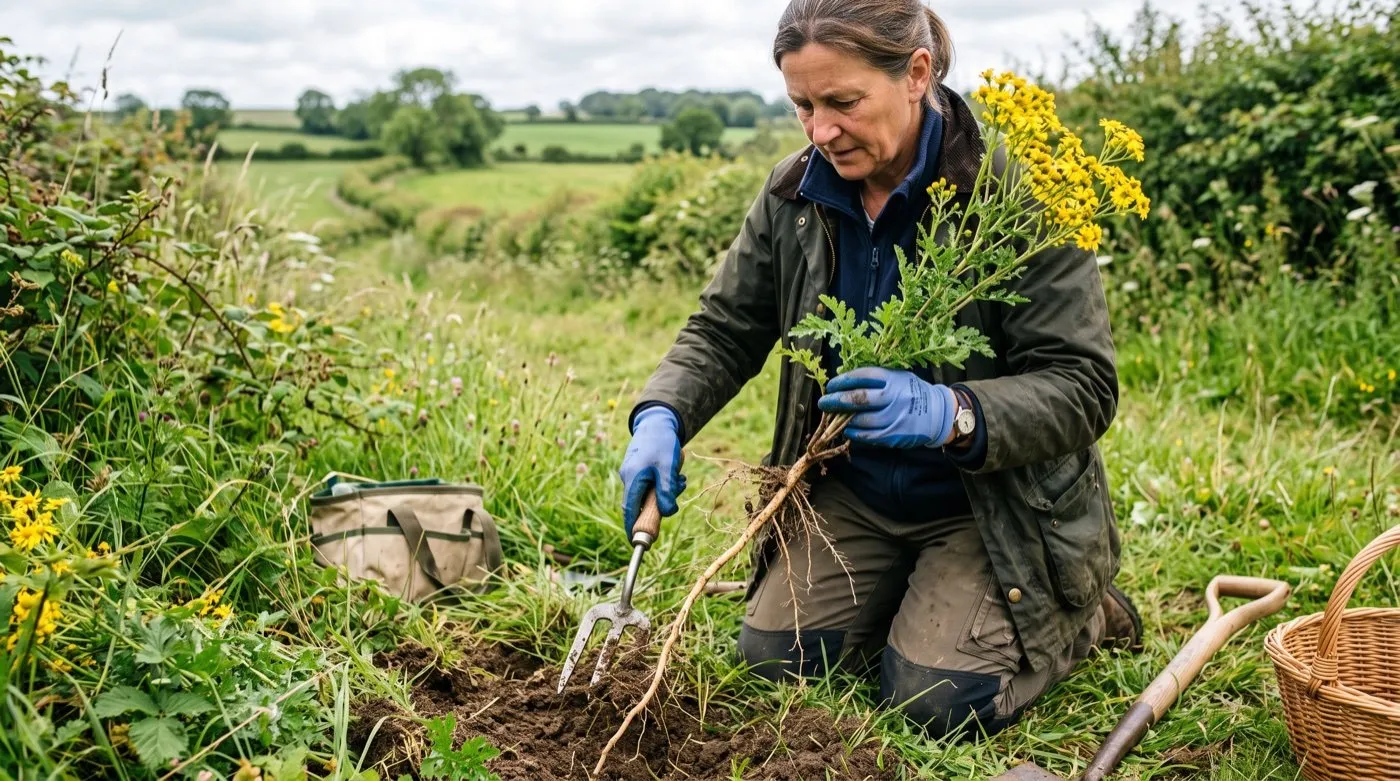 Safe removal near grazing: gloves on, and the whole plant levered out root and all with a ragwort fork before it seeds. Never handle ragwort bare-handed.
Disposing of ragwort without harm
Getting the plant out is only half the job. Disposal matters, because pulled ragwort stays toxic for a long time and dried plants are the dangerous ones.
The safe routes depend on quantity and local facilities:
- Small quantities can rot in a lidded container, away from grazing and with no route for seed escape.
- Off-site disposal needs a registered waste carrier and a facility that confirms it accepts ragwort.
- Council sites or green bins vary, so ask the local authority before using either route.
Do not compost flowering ragwort in an open home heap. Do not leave pulled or cut plants in a field. Cutting and leaving fragments creates toxic, wilted material that grazing animals may eat.
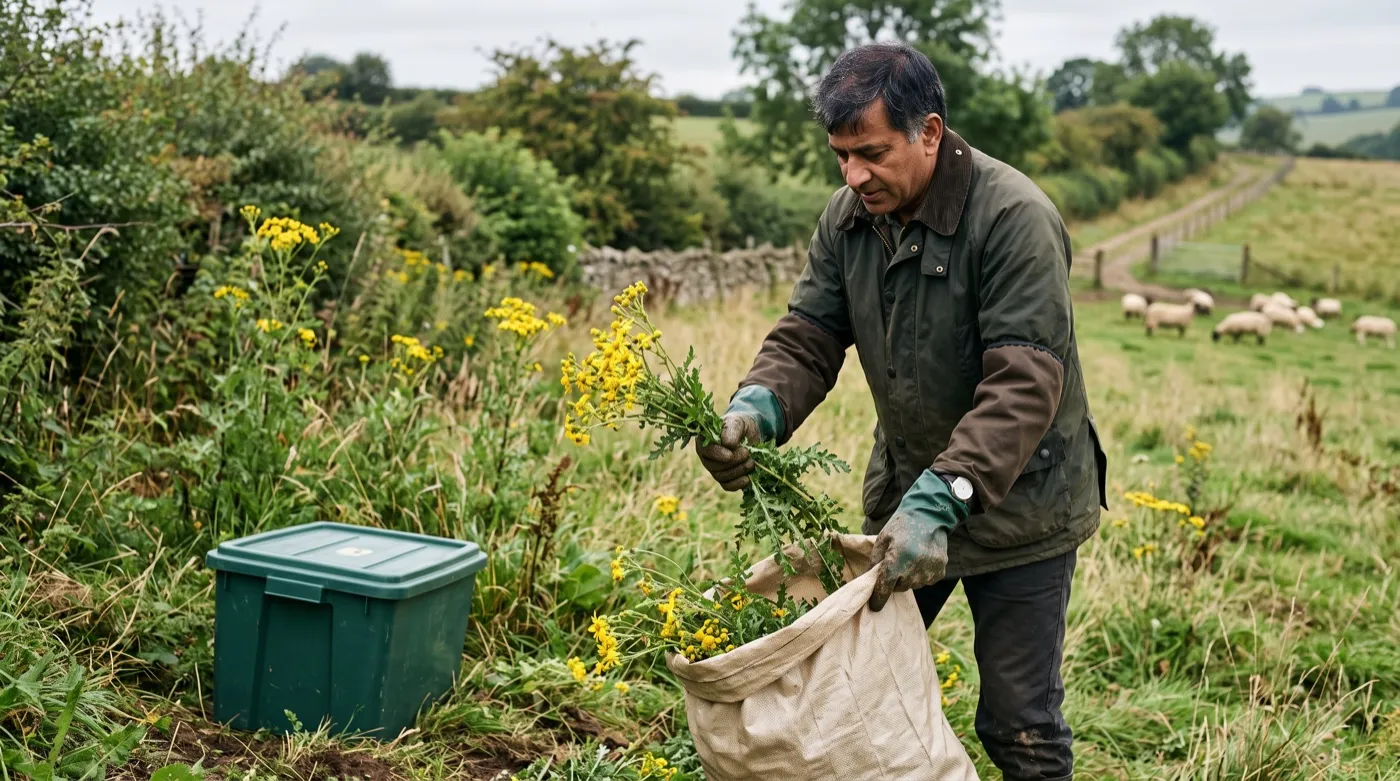 Bag every pulled plant on the spot. Wilting ragwort stays toxic and turns palatable, so it must be sealed and removed, never left lying on the grass.
Warning: Never leave pulled, cut or wilting ragwort where horses, ponies or cattle can reach it. Drying removes the bitter taste but not the poison, so a wilted plant an animal would never touch when fresh becomes something it will eat. More animals are poisoned by mismanaged, cut ragwort than by the standing plant.
The conservation case: why not to destroy it everywhere
Here is the part often lost in the alarm: away from grazing, common ragwort is one of the most valuable wild plants for British insects, and destroying it everywhere does real harm for no benefit.
Ragwort is the near-exclusive food plant of the cinnabar moth, whose striking black-and-yellow striped caterpillars strip the plants in summer and whose red-and-black day-flying adults depend on it entirely. Beyond the cinnabar, ragwort’s long flowering supports a huge range of insects: studies have recorded dozens of species of pollinators, including many hoverflies, solitary bees, butterflies and beetles, feeding on its nectar through late summer when other flowers fade.
So the responsible approach is zoning by risk, not blanket eradication:
- Act immediately within 50m of grazing or forage land when flowering or seeding plants create high risk.
- Monitor plants from 50-100m, where the Code treats the risk as medium.
- Tolerate low-risk plants beyond 100m where local conditions make spread unlikely.
This is the balance the official guidance itself supports. Pulling every ragwort plant from a garden with no animals nearby is a loss to wildlife, not a gain. Our guide to making a wildflower meadow covers managing such areas, and the elephant hawk-moth caterpillar guide covers another spectacular moth larva worth welcoming.
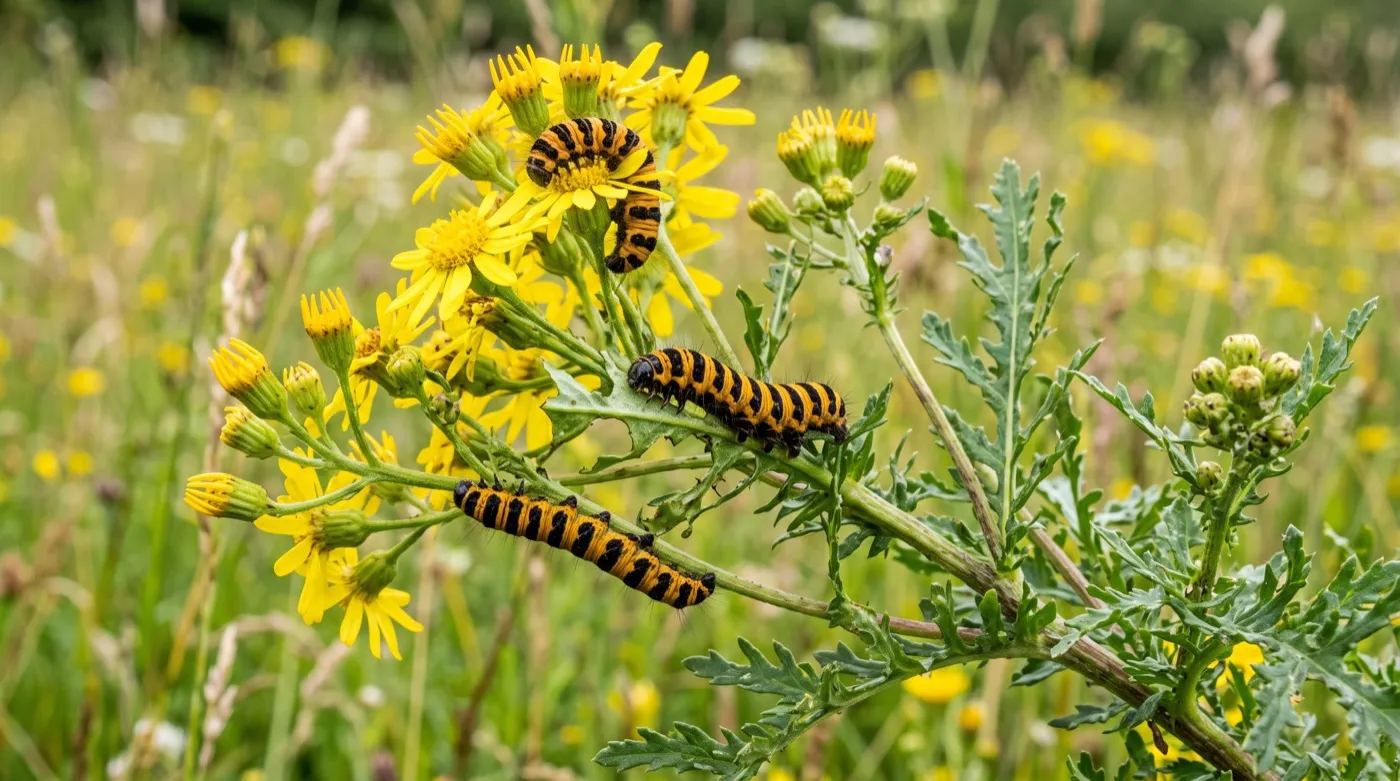 Cinnabar moth caterpillars feed almost only on ragwort. Away from grazing, a ragwort plant black and gold with these is a wildlife asset, not a weed to destroy.
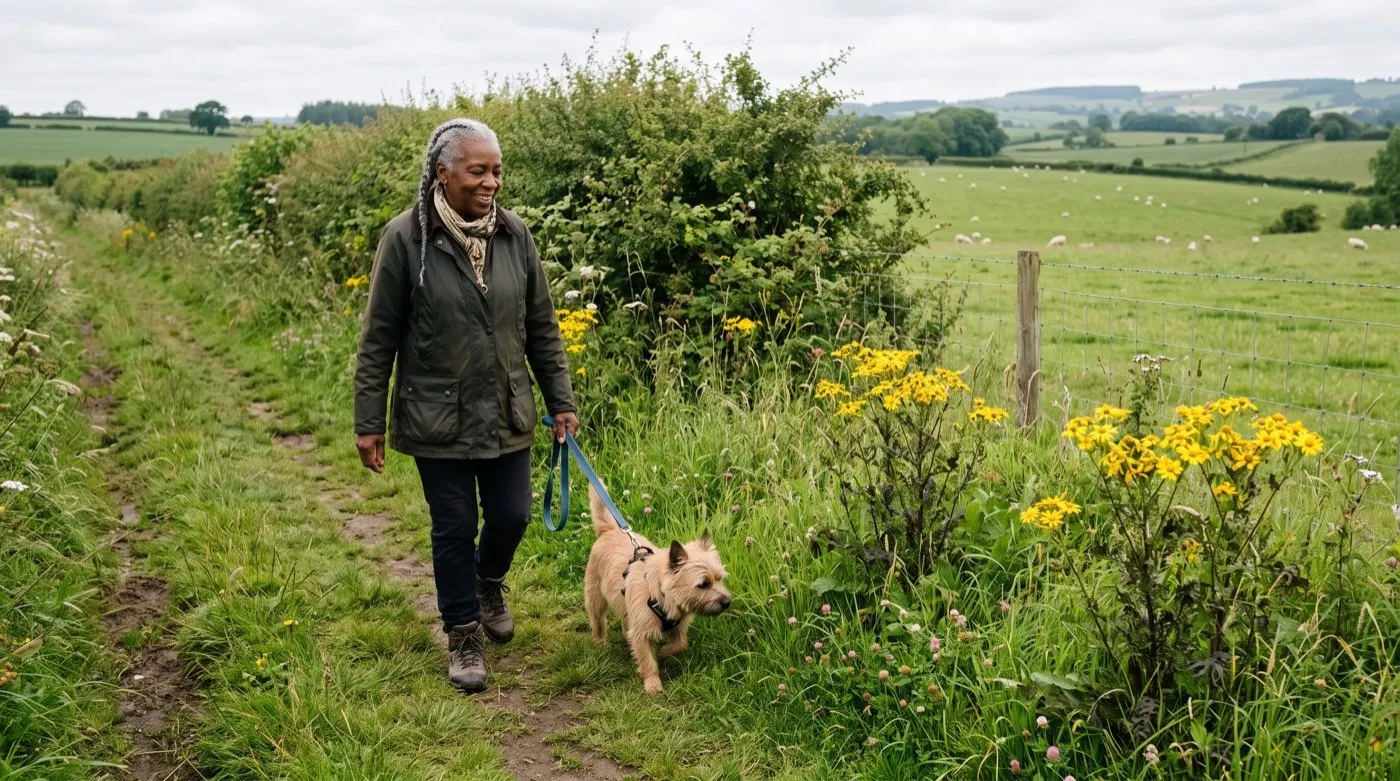 A verge can still be high risk where it borders grazing. Assess distance, barriers and seed spread before deciding what to remove.
Ragwort management ranked by situation
Ragwort is not one problem with one answer; the right action depends entirely on where it is growing. Ordered by situation.
| Situation | Action | Why | Note |
|---|---|---|---|
| In or beside grazing paddocks | Pull whole, with gloves, before seed | Direct poisoning risk to stock | Bag and dispose safely at once |
| On land cut for hay or forage | Remove completely before cutting | Dried ragwort in hay is the worst danger | Never let it enter the crop |
| Within 50m of grazing/forage | Immediate control where flowering or seeding | Code classifies this as high risk | Distance is guidance, not a fixed offence |
| 50-100m from grazing/forage | Monitor and plan control | Code classifies this as medium risk | Reassess wind and barriers |
| More than 100m from grazing/forage | Usually leave or monitor | Code classifies this as low risk | Act if local spread risk changes |
| Garden with no livestock nearby | Tolerate or manage lightly | Useful for wildlife, usually low risk | Wear gloves if removing it |
The single rule that ties the table together is risk-based control: act decisively where ragwort threatens animals, and let it be where it does not. That protects both the horses and the moths.
Month-by-month ragwort calendar
| Month | What to do |
|---|---|
| March-April | First-year rosettes visible. Dig them from grazing land while small, wearing gloves. |
| May | Stems rising on second-year plants. Plan removal from paddocks and hay fields. |
| June | Early flowering, the best time to pull whole plants from grazing before they seed. |
| July | Peak flowering. Continue pulling near stock. Watch for cinnabar caterpillars where you tolerate it. |
| August | Seed begins to form. Remove any missed plants near grazing before seed sets. |
| September-October | Late flowers and seed. Cut and bag any remaining seed heads near livestock land. |
| November-February | Rosettes overwinter. Spot and dig them from grazing on soft ground. |
Common mistakes with ragwort
- Handling it bare-handed. The alkaloids absorb through skin. Always wear gloves and cover your arms.
- Leaving pulled plants on the grass. Wilting ragwort stays toxic and becomes more palatable. Bag every plant at once.
- Mowing it in a paddock. Cutting wilts the plant into a palatable, still-poisonous form spread across the grazing. Pull, do not mow, near stock.
- Destroying it everywhere. Away from livestock, ragwort is a vital wildlife plant. Blanket eradication harms the cinnabar moth and pollinators for no gain.
- Letting it seed near grazing. A plant can shed many thousands of seeds. Remove high-risk plants before seed matures.
The short version on ragwort
Ragwort asks you to hold two truths at once. Near horses and cattle, and especially in anything destined for hay, it is a serious, cumulative poison that must be removed, whole plant and root, with gloves on, before it seeds, and disposed of where no animal can reach it. Cut it, wilt it, or leave it lying, and you make it more dangerous, not less.
But away from grazing, it is a native wildflower that feeds the cinnabar moth and a host of pollinators through late summer, and pulling every plant from a stock-free garden is a loss, not a tidy-up. So control by risk: clear it from paddocks, hay fields and their margins, and let it stand on the wild bank where it does only good. For the rest of the weeds and hazards worth knowing, work through the garden problems section.
Frequently asked questions
How do I identify common ragwort?
Look for flat-topped yellow flowers above deeply divided leaves. The plant is usually 30-100cm tall. Each flower head is about 15-25mm across and carries roughly 13 ray florets. Dense clusters appear from June into autumn. The dark green leaves have deep, irregular lobes.
Why is ragwort dangerous to horses?
It contains pyrrolizidine alkaloids that cause cumulative, irreversible liver damage. Horses and cattle are most at risk. The danger is worst in hay, because drying removes the bitter taste that makes animals avoid the living plant, so they eat it without knowing. The damage builds up over time, and by the time symptoms show, the liver is often beyond recovery.
Is it illegal to have ragwort in my garden?
No, owning land with ragwort is not automatically illegal. The Weeds Act 1959 lets authorities serve a control notice to prevent spread. England’s Code sets risk bands for land near grazing and forage production. It does not order blanket eradication.
How do I remove ragwort safely?
Wear gloves and remove the whole plant before it seeds. Use a ragwort fork on damp soil and cover your arms and legs. Remove as much root as possible because fragments can regrow. Bag pulled plants immediately and keep them away from grazing animals.
How do I dispose of pulled ragwort?
Seal pulled ragwort and keep it away from grazing animals. Small amounts can rot in a lidded container. For off-site disposal, confirm acceptance with your council or licensed facility. Never leave wilted plants on grazing or compost flowering plants in an open heap.
Should I kill all ragwort?
No, only control it where it threatens grazing animals or hay. Ragwort is one of the most important native plants for UK insects, supporting the cinnabar moth and many pollinators. The sensible approach is to remove it within about 50 metres of grazing or forage land, and tolerate it elsewhere. Blanket destruction of ragwort harms wildlife for no benefit.
What eats ragwort?
The cinnabar moth caterpillar feeds almost exclusively on ragwort. The black-and-yellow striped caterpillars strip the plants in summer, and the day-flying red-and-black adult moth depends on it. Dozens of other insects, including many hoverflies, bees and beetles, also use ragwort for nectar or food, which is why it is such a valuable native wildflower away from grazing.
Now you can assess ragwort by risk. Use our common UK garden weeds guide to identify the next plant safely.
Our team produces practical UK gardening guidance from source research, contributor records and established horticultural practice. Editorial standards are overseen by Matt W.