Key takeaways
- Dry soil at the root causes 60-80% flower drop and is the single biggest reason runner beans fail to set
- Night temperatures above 16C stop pod set even when the soil is perfectly moist
- Misting flowers does nothing: a split-row trial gave 4.9kg per metre misted against 5.1kg unmisted
- A 6m row needs 60-90 litres of water daily once flowering starts, delivered at the base
- The plant decides to drop a flower up to 7 days before it falls, based on water at the root
- Pods left past 20cm turn stringy and shut down new flowering within 7-10 days
If your runner beans are flowering hard and setting nothing, the answer is almost certainly in the soil, not in the flowers. Dry soil at the root causes 60-80% of flowers to drop, and warm nights above 16C stop pods forming even when watering is faultless. Those two causes between them explain most empty frames in a UK garden. Everything else, from bees to birds to blackfly, sits well behind them.
That matters because the flowers are where everyone looks and where nothing can be fixed. This guide ranks the real causes and covers blackfly, red spider mite, halo blight, root rots and pod problems. Runner-French crosses can reduce pollination failures. Compare them in our guide to the best runner bean varieties.
Why runner bean flowers fall without setting pods
Flower drop is normal up to a point. A healthy runner bean plant sheds perhaps 30-40% of its flowers even in a good year, simply because it produces more than it can fill. The problem arrives when that figure climbs past 80% and the frame turns into a display of red flowers and bare string.
These are the causes, ranked by how often they are actually to blame in a UK garden.
| Cause | How often it is the culprit | The tell |
|---|---|---|
| Dry soil at the root | Roughly 6 in 10 cases | Soil dry 100mm down; flowers fall whole and intact |
| Night temperature above 16C | Roughly 2 in 10 cases | Soil moist, plants healthy, drop follows a muggy spell |
| Too few pollinators | Roughly 1 in 10 cases | Cold, wet or windy fortnight; few bees on the flowers |
| Birds stripping flowers | Under 1 in 10 cases | Torn petals scattered below; sparrows on the frame |
| Day temperature above 28C | Occasional in the south | Drop in a heatwave despite moist soil |
The first two lines carry the guide. If you fix water and understand nights, you have dealt with roughly 80% of the problem.
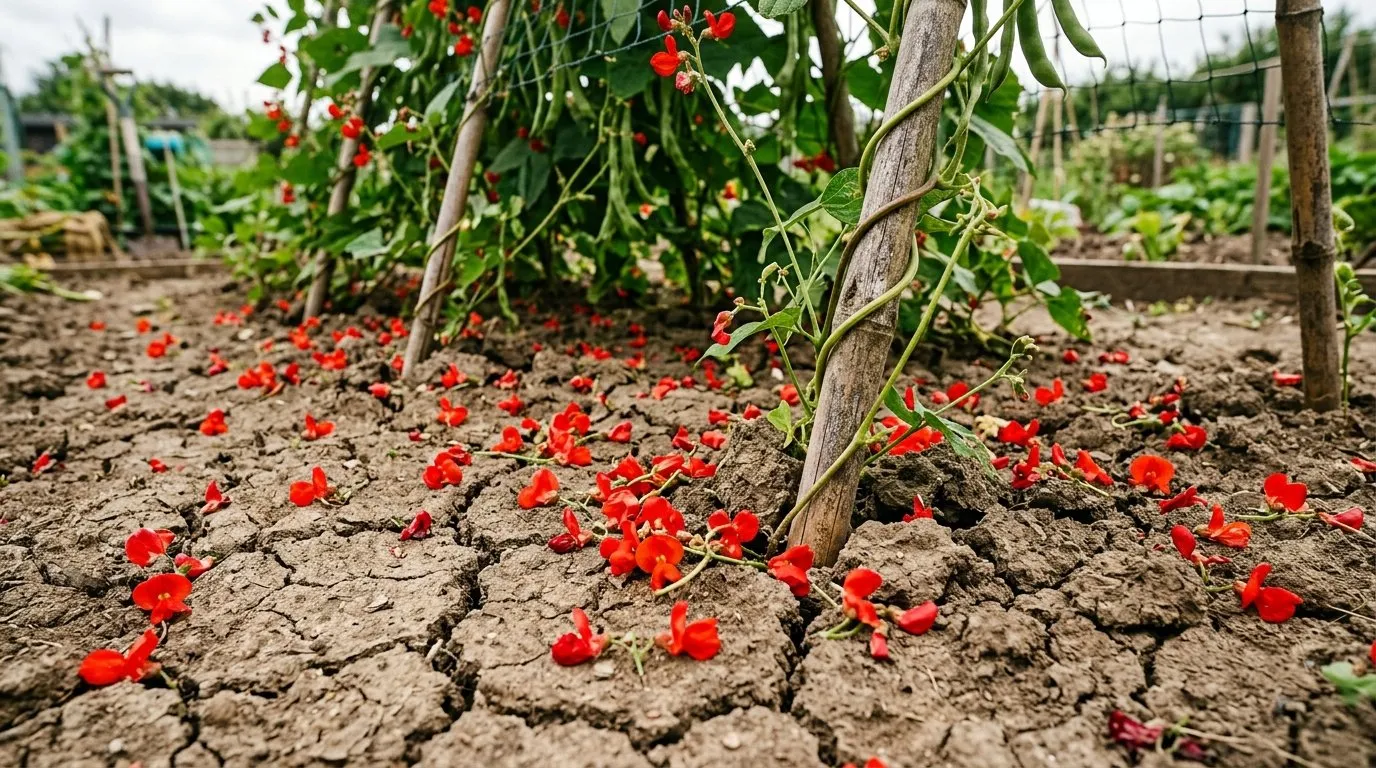 Flowers that fall whole and intact, like these, mean the plant shed them. Torn petals mean birds. The difference tells you which problem you have.
From flower to pod: the 16-day process
Understanding the sequence is what stops you wasting effort, because it shows the decision happens days before the evidence appears.
- Day -7 to 0, buds form on the truss. Water stress at this stage aborts buds before they ever open. The plant is already committing.
- Day 0, the flower opens. Runner beans are largely self-fertile, but the pollen sits locked inside a keel petal. A bee heavy enough to trip that keel has to land on it. Bumblebees do most of this work in the UK.
- Day 0-1, the pollination window. Pollen must germinate on the stigma within roughly 24 hours. This window is where night temperature does its damage.
- Day 1-2, fertilisation. If it fails, the plant forms an abscission layer at the base of the flower stalk, a corky plate of cells that cuts the flower off.
- Day 3-5, the verdict. The flower either drops or the ovary behind it visibly swells. This is when you find out what was decided a week ago.
- Day 5-16, the pod extends. At 15-20C a set pod reaches a pickable 15-20cm in about 11 more days.
Here is the critical mistake, and nearly everyone makes it. By the time you see flowers on the ground, you are watching a decision the plant made up to a week earlier. The abscission layer takes days to build. So the gardener who spots flowers falling on Saturday and starts misting on Saturday evening is treating a process that concluded the previous Tuesday, at the roots, where no mist will ever reach. The flowers falling this week are a report on last week’s soil moisture. That single fact explains why every remedy aimed at the flower fails.
Night temperature, the cause almost nobody checks
Night temperature is the reason well-watered, well-fed, bee-visited runner beans still fail some years. It is barely mentioned in most advice, and it catches out careful gardeners hardest, because they know their watering is right and cannot work out what else is wrong.
Runner beans (Phaseolus coccineus) came from the cool highlands of Mexico and Guatemala, at around 1,800-2,800m. They evolved with cold nights. When the night minimum stays above 16C, pollen tube growth and ovule viability both fall away, and flowers abort even in moist soil. The plant is not stressed. It simply cannot complete fertilisation.
This is separate from the daytime heat effect. Above 28C in the day, pollen itself becomes non-viable in older varieties. The two work independently, which is why a muggy overcast week with no heatwave can still empty a frame.
What to do about it is honest and short. You cannot change the weather. You can grow Firestorm, bred for pod set up to 30C, alongside an older variety so one of them is always in its window. You can site the frame where night air drains away rather than in a sheltered sun trap that holds heat. And you can stop tearing the plants out in a bad August, because they will set again in September when the nights cool.
Dry soil at the root, not dry air around the flowers
This is the root cause, and the reason it stays hidden is that it does not look like a water problem.
A runner bean in dry soil does not wilt dramatically. The leaves stay green and the plant keeps flowering, because flowering is cheap. Filling pods is expensive. Faced with a water deficit, the plant makes an economic decision: keep the foliage alive, abandon the crop. So the gardener sees healthy green plants covered in flowers and concludes water cannot be the issue. The plant looks fine because it sacrificed the beans to look fine.
Push a finger 100mm into the soil at the base of the canes. If it is dry at fingertip depth, you have your answer, whatever the leaves look like.
Permanent prevention is a winter job, not a July one:
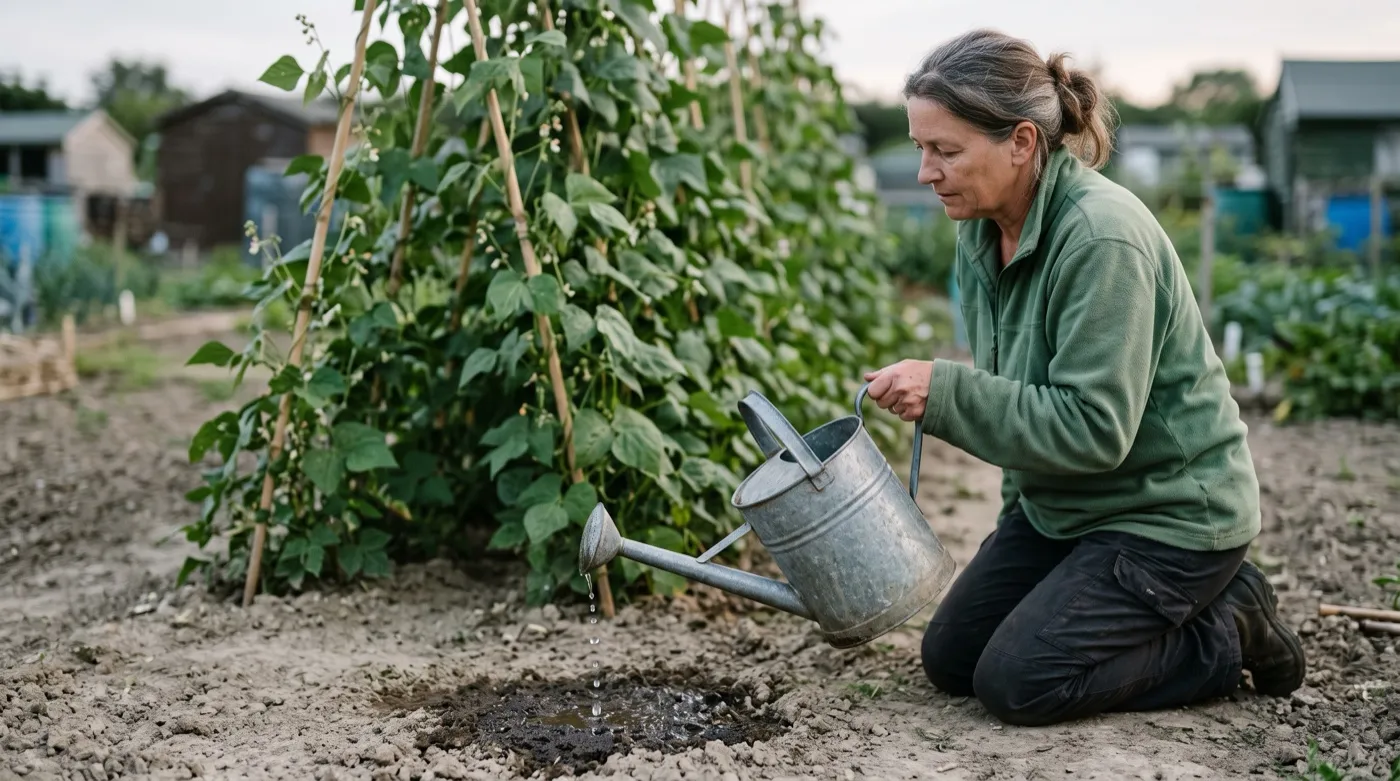 All of it goes at the base. The feeder roots that decide pod set sit 150-300mm down, and a can over the top reaches nowhere near them.
Does spraying the flowers with water work?
No. It is the most widely repeated runner bean tip in Britain, and it does not survive contact with a controlled row.
The theory sounds reasonable: mist the flowers, cool them, raise humidity, help the pollen. The problem is scale and duration. A fine mist on a petal on a warm evening evaporates in 2-5 minutes. Any cooling lasts about as long. Meanwhile the flower drop you are trying to prevent was set in motion days earlier by the water status at the root, and a hand sprayer delivers perhaps 0.1 litres per metre against the 10-15 litres those roots actually need.
Why does the myth persist? Because people mist during hot dry spells, and hot dry spells end. Beans start setting again when the nights cool and the rain returns, and the sprayer takes the credit. The tip also feels like doing something at the exact moment you feel most helpless, which is a powerful thing in a garden and a poor guide to what works.
Pollinators, sparrows and flowers that vanish overnight
Two very different problems get confused here, and the fallen petals tell you which you have.
Poor pollination matters in cold, wet or persistently windy weather when bumblebees stay home. Runner bean pollen needs a bee heavy enough to trip the keel petal, and honeybees often rob nectar through the side of the flower without pollinating anything. White-flowered varieties like White Lady draw fewer bees than red ones. The fix is to plant for pollinators near the frame and grow mixed flower colours. The Bumblebee Conservation Trust’s gardening advice lists species that pull bumblebees in reliably. In a genuinely cold fortnight, shaking the frame gently at midday moves some pollen, though the effect is modest.
House sparrows are the other story, and they are unmistakable once you know the sign. Sparrows tear the petals off runner bean flowers and drop them, leaving shredded red confetti under the frame. They do it most in dry weather, and nobody is certain whether they want moisture, nectar or simply the habit. The damage looks like catastrophic flower drop to anyone who has not looked closely.
Dropped flowers fall whole. Bird-damaged flowers are torn. That single check tells you whether to water or to net. Fine mesh netting over the flowering zone stops sparrows completely, and a few strands of black cotton stretched above the frame works nearly as well for less money. Netting a bean frame for a watering problem, on the other hand, achieves nothing at all.
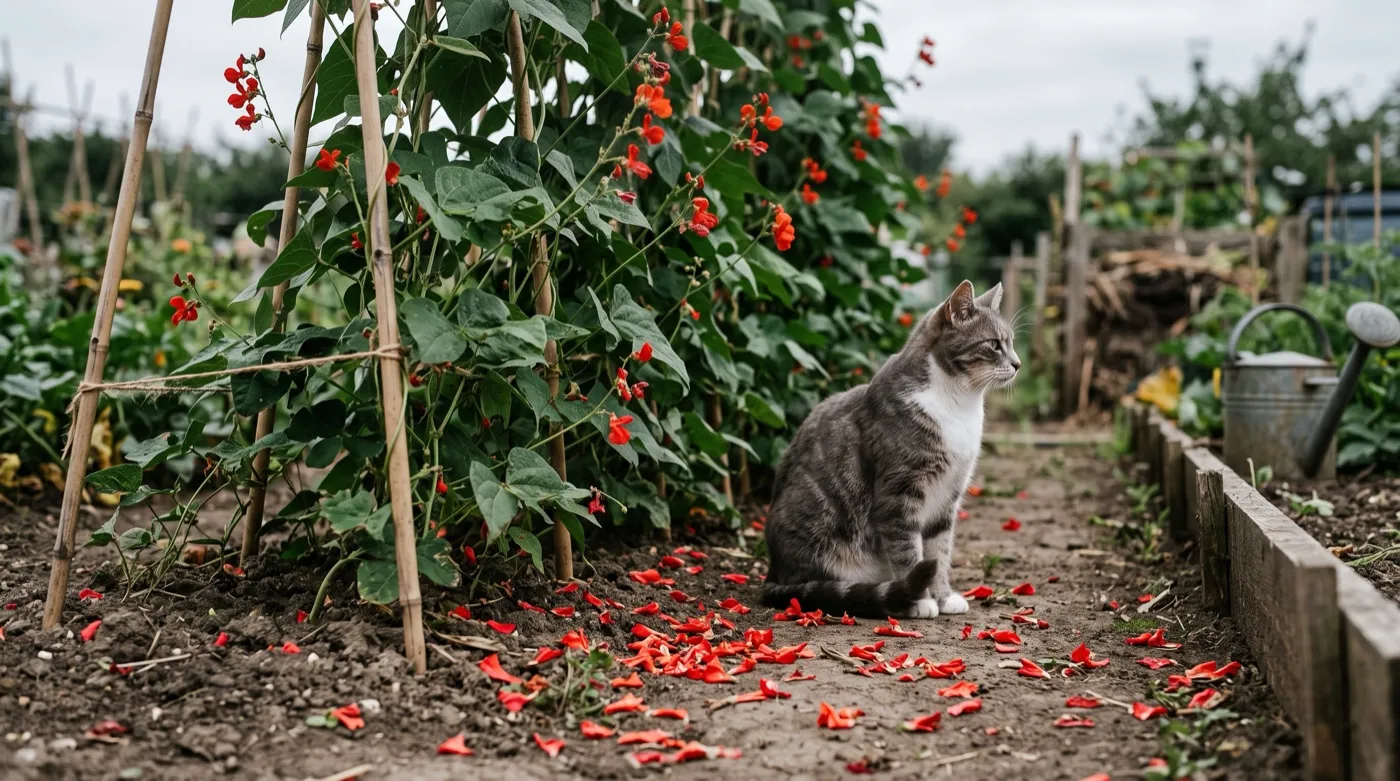 Torn petals mean sparrows. Whole fallen flowers mean water. The cat helps less than the netting does, but she keeps an eye on the frame.
Blackfly on the growing tips
Black bean aphid (Aphis fabae), universally called blackfly, is the pest every runner bean grower meets. Colonies appear on the softest 75mm of the growing tips from June, having overwintered on spindle (Euonymus europaeus) and viburnum.
They matter less than they look. A heavy colony distorts the growing tip and sticks the plant with honeydew, which then grows sooty mould. What blackfly rarely do is stop a healthy plant cropping. Gardeners reach for a spray because the colony is repulsive, not because the yield is threatened.
- Pinch out the infested tip and drop it in a bucket, not on the soil. This is a job you were doing anyway once the plant reaches the top of the frame.
- Knock them off with a jet of water. Aphids that fall rarely climb back.
- Leave the ladybirds to it. A single ladybird larva eats several hundred aphids before pupating. Spraying kills them alongside the aphids and hands you the next outbreak.
- Insecticidal soap, only on colonies that keep rebuilding.
Our guide to black bean aphid identification and control covers the full lifecycle and the overwintering hosts worth removing.
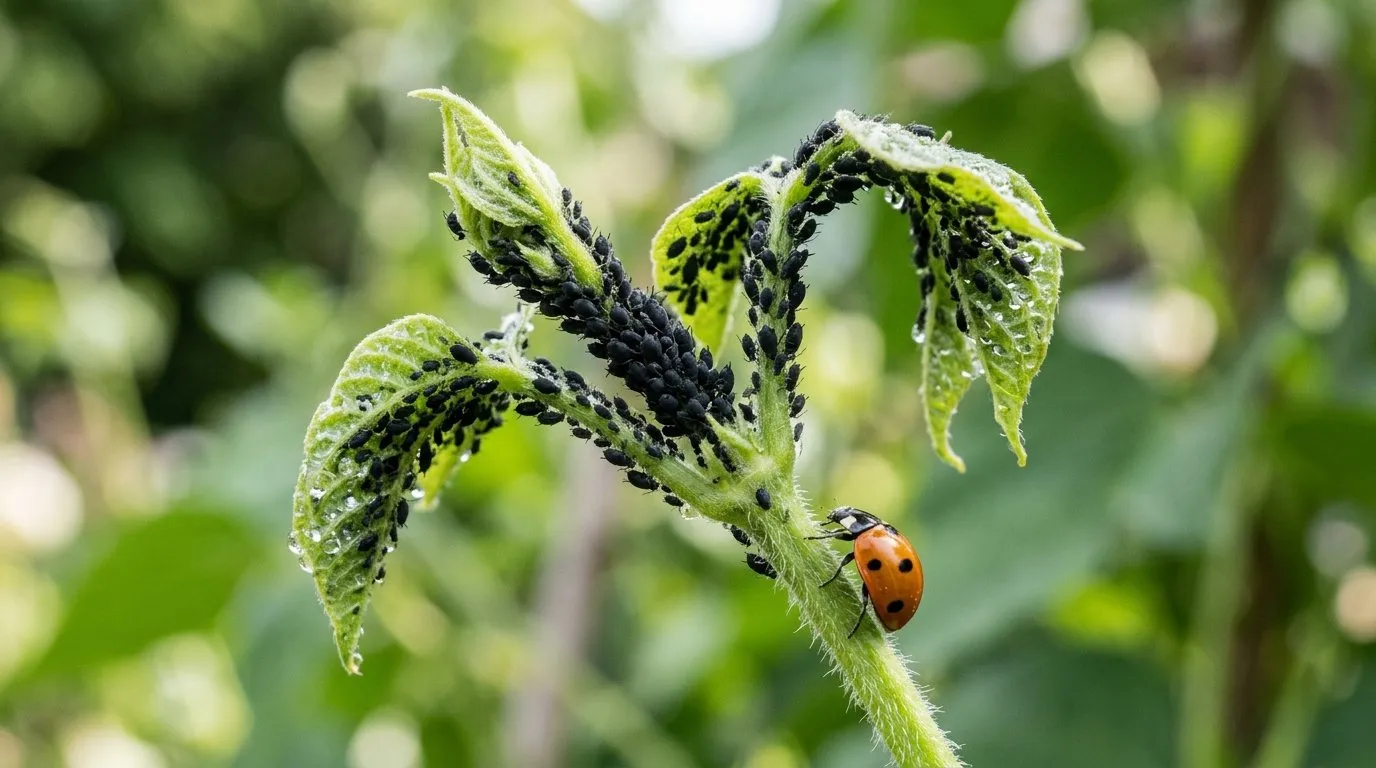 Blackfly colonise the softest 75mm of the growing tip. Pinch it out and bin it, which is a job the plant needs at frame height anyway.
Red spider mite in a hot dry summer
Red spider mite (Tetranychus urticae) turns up outdoors in the UK only in hot, dry summers, and it is a straightforward indicator that the growing conditions have gone wrong.
The early sign is fine pale mottling on the upper leaf surface, like someone dusted it with sand. As numbers build the leaves bronze, dry and fall, and fine webbing appears between the leaf and the stem. That webbing is the confirmation.
The mites thrive in warm dry air and stall in humidity. They breed fastest above 27C, completing a generation in about 7 days, against nearer 30 days at 15C. That tenfold difference is why a heatwave produces a plague from nothing.
Outdoors on a well-watered row they seldom cause real damage, which is the useful part of the diagnosis. Persistent red spider mite on runner beans is usually telling you the plants are dry and stressed rather than presenting an independent problem. Fix the watering and the mites generally fade. Where they persist, our guide to spider mite control covers the biological options, though those suit a greenhouse better than an open frame.
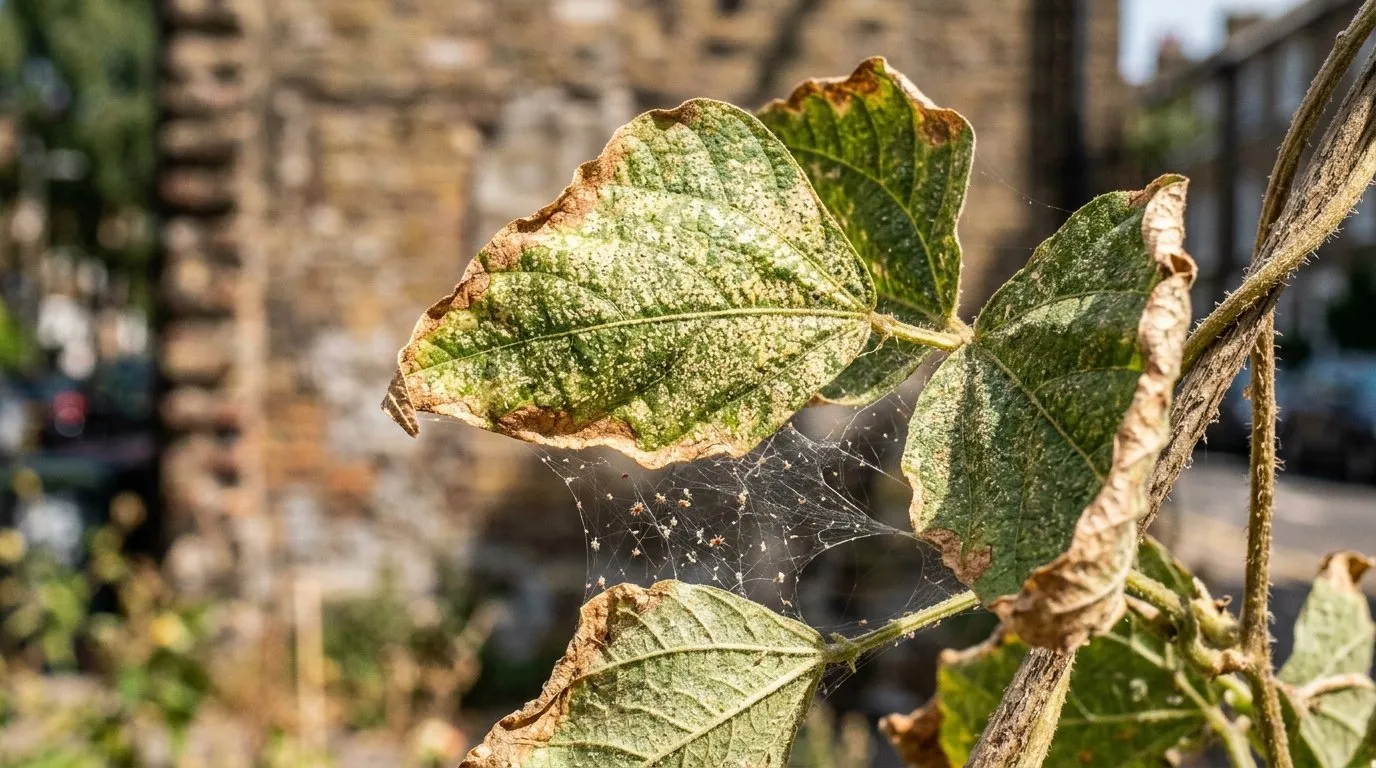 Bronzed, mottled leaves with fine webbing between leaf and stem. On an outdoor row this usually means the plants are dry rather than diseased.
Halo blight, anthracnose and chocolate spot
Three leaf diseases get muddled constantly. They look different once you know what separates them.
Halo blight (Pseudomonas savastanoi pv. phaseolicola) is a bacterium and the most serious of the three. It makes small brown spots ringed by a distinct yellow-green halo, and in bad cases the whole plant yellows and stunts. It is seed-borne, which is the fact that matters: it arrives in the beans you sowed, then splashes plant to plant in wet weather. Never save seed from an infected row, however good the pods looked.
Anthracnose (Colletotrichum lindemuthianum) makes dark, sunken lesions with reddish-brown margins, and unlike halo blight it attacks the pods as well as the leaves. Sunken dark patches on pods mean anthracnose. It is also seed-borne, and worst in cool wet seasons.
Chocolate spot (Botrytis fabae) makes reddish-brown spots without any halo. It is largely a broad bean disease and only occasionally troubles runner beans, so if you have spots with a halo on a runner bean, it is halo blight.
None of the three has an amateur chemical control worth using. The management is the same for all: remove and bin marked leaves as they appear, never compost them, avoid overhead watering that splashes spores, space plants for air movement, buy fresh certified seed rather than saving from a marked row, and rotate the bean patch on a 3-4 year cycle. Our guide to common bean diseases sets them out side by side.
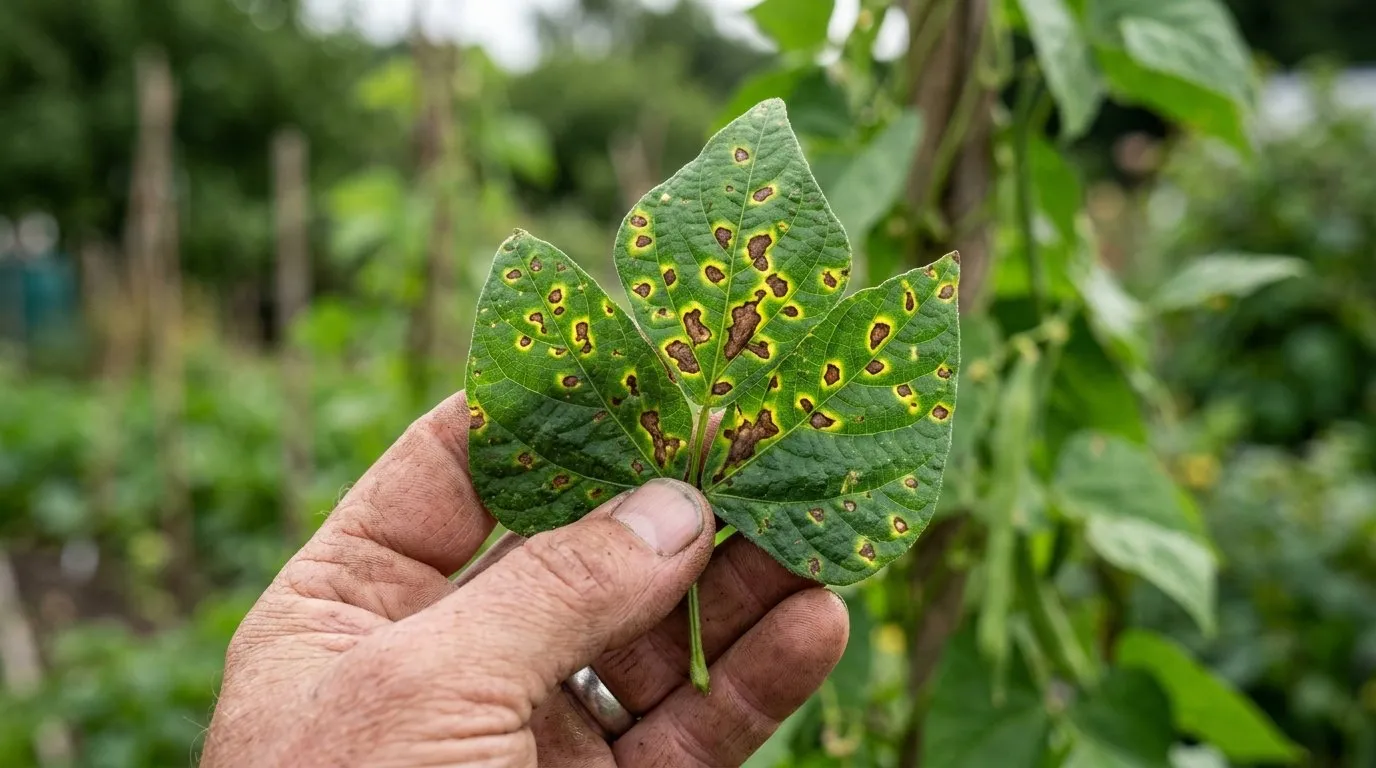 Halo blight: brown spots each ringed with a yellow-green halo. It arrives in the seed, so never save beans from a row that shows it.
Bean seed fly, root rots and slug damage on young plants
Failures before the plants ever reach the frame have their own short list of causes.
Bean seed fly (Delia platura) lays into recently disturbed, moist soil rich in decaying organic matter. The maggots eat the germinating seed, so nothing comes up, or a shoot emerges with the growing point already chewed away, called a snakehead. It is worst on beans sown directly into cold wet soil or into a trench topped with fresh material. The reliable fix is not a treatment. Sow in 9cm pots indoors from mid-April and plant out established seedlings, which the maggots cannot touch. Direct sowing into warm soil in late May largely dodges it too.
Root rots, chiefly Fusarium and Rhizoctonia, produce plants that start well then yellow from the bottom and stall. Pull one up and the roots are brown and reduced rather than white and branching. Both build up where beans follow beans. Rotation on a 3-4 year cycle is the whole answer, along with the drainage work that stops the soil staying saturated.
Slugs take young plants at ground level within days of planting out, and a plant severed at the stem does not recover. The fortnight after planting out is the only period runner beans are genuinely vulnerable to them. After that the stems toughen and slugs lose interest. Check at dusk during those two weeks and the problem largely disappears. For the wider picture on other crops, see the garden problems section.
Pod problems: tough, curled and rusty
The plant set pods and something still went wrong. These three account for nearly all of it.
Tough, stringy pods
Pods left on the plant too long. A runner bean pod goes from tender to stringy in about 4 days in August heat, and the window is narrower than most people expect. Pick at 15-20cm, every 2-3 days.
The cost is not only the tough pod. A pod allowed to mature signals the plant that it has achieved seed, and flowering shuts down within 7-10 days. Every overgrown pod you leave costs you a future flush. Pick the tough ones off and bin them even though you will not eat them. Modern stringless varieties buy a little more latitude, but not much.
Warning: Do not eat mature runner bean seeds raw or lightly cooked. Like other Phaseolus beans, the developed seeds contain lectins that cause vomiting and stomach cramps. If you shell beans out of pods that grew too big, boil them hard for at least 10 minutes before any slow cooking. A slow cooker on its own does not always reach a high enough temperature to break the lectins down. Young pods sliced and cooked in the normal way are not a concern.
Curled and distorted pods
Irregular watering during pod development is the usual cause. A pod that swells, dries out, then swells again grows unevenly and curls into a hook. The bean row that gets 60 litres on Saturday and nothing until Wednesday produces this reliably.
Patchy pollination causes a similar look for a different reason: only some ovules were fertilised, so the pod fills in sections with flat gaps between. Neither pod is harmful. Both are perfectly good in a chutney. Consistent daily water fixes the first, and there is little to do about the second.
Rust late in the season
Bean rust (Uromyces appendiculatus) shows as rusty orange pustules on the undersides of older leaves, usually from late August. It looks alarming and is mostly harmless at that point, because the plant has already made its crop. Rust in July is a different matter and worth acting on by removing affected leaves and improving air flow. Our guide to bean rust identification and treatment covers the distinction. Clear all debris at the end of the season, since the spores overwinter on it.
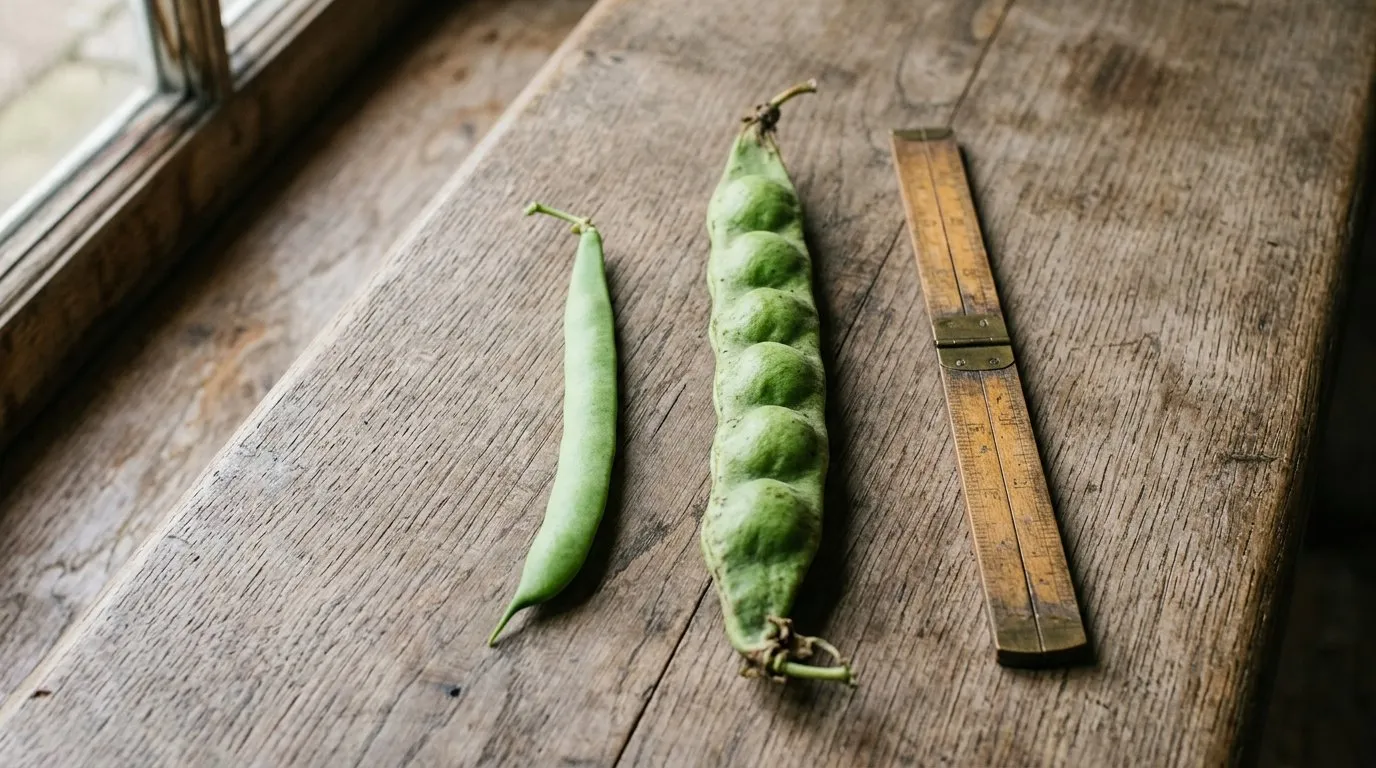 Four days apart. The pod on the left is at picking size. The one on the right is stringy and has already told the plant to stop flowering.
Pod set fixes ranked by effectiveness
Treating these as equal is exactly how people end up misting flowers while the roots sit dry. Ordered by what each one delivers on a real row.
| Fix | Role | Effectiveness | What it cannot do |
|---|---|---|---|
| Daily base watering, 10-15 litres per metre | Primary | Cuts flower drop from 60-80% to under 15%; 5.1kg per metre against 2.6kg under-watered | Cannot beat night temperatures above 16C |
| Bean trench plus 60mm straw mulch | Primary prevention | Raised yield to 6.4kg per metre; holds moisture 3-4 days longer | Cannot replace watering in a long drought |
| Leaky hose on a tap timer | Primary, delivery | Removes the skipped evenings that cause next week’s drop | Cannot fix compacted or shallow soil |
| Heat-tolerant variety such as Firestorm | Supplementary | Sets pods to 30C where older varieties fail at 28C | Cannot do anything about dry soil |
| Pollinator planting near the frame | Supplementary | Worth most in cold, wet or windy spells | Cannot set pods if heat has already killed the pollen |
| Netting against sparrows | Targeted | Stops flower stripping completely where birds are the cause | Useless if flowers are dropping rather than being torn |
| Shaking the frame or hand pollinating | Supplementary | Marginal, and only in persistently cold weather | Cannot compensate for water stress |
| Misting the flowers | Not recommended | No measurable effect: 4.9kg per metre misted against 5.1kg unmisted | Cannot put water where the plant makes the decision |
The gold standard is the first row and there is no argument about it. Water at the base, daily, in the volume the plant actually needs, and 8 in 10 pod set problems never happen. Every row below is either insurance or a fix for a narrower problem. The bottom row is on the list only because it is the thing most people try first.
Month-by-month runner bean problem calendar
| Month | What to watch for |
|---|---|
| April | Bean seed fly attacks seed sown into cold wet soil or fresh organic matter. Sow in pots indoors instead. |
| May | Slugs take young plants at ground level within days of planting out. Check at dusk for a fortnight. |
| June | Blackfly arrive on the soft growing tips. Pinch out the top 75mm. |
| July | First flowers. Start daily watering now, not when drop begins. Log the night minimum. |
| August | Peak flower drop. Check soil 100mm down before blaming the weather. Red spider mite in dry spells. |
| September | Halo blight and anthracnose spread after wet weather. Remove marked leaves. Rust on older foliage. |
| October | Late rust is harmless. Final pick before the first frost. Clear all debris off the plot. |
| November | Dig next year’s bean trench. Fill it over winter with peelings and cardboard. |
| December to March | Trench settles. Move the bean site to break halo blight and root rot cycles on a 3-4 year rotation. |
Common mistakes when beans stop setting
- Treating the flowers. Misting, spraying and shaking all target the one part of the plant where the problem is only being reported, not caused. The decision was made at the roots up to a week earlier.
- Watering the surface and calling it watered. A can over the top wets 30-40mm. The roots that matter are at 150-300mm. Push a finger in before you decide the plants have had enough.
- Judging water by how the plant looks. Runner beans in dry soil stay green and keep flowering. They drop the crop to save the foliage. Healthy green plants covered in flowers can be badly short of water.
- Ripping the row out in a bad August. A run of nights above 16C stops pod set temporarily, not permanently. Keep watering and the same plants usually crop well in September.
- Saving seed from a row with halo blight. The disease travels in the bean. Saving from a marked row plants next year’s outbreak, however good this year’s pods looked.
The short version on runner beans that will not set
Runner beans are not difficult. They are thirsty, and they are fussy about nights, and almost everything that goes wrong with them traces back to one of those two facts. The plant tells you nothing useful by looking at it, because a bean short of water looks green and healthy and covered in flowers right up until it gives you nothing.
So ignore the flowers. Push a finger 100mm into the soil at the base of the canes. Put 10-15 litres per metre in every evening, at the base, under a mulch, ideally through a hose that does not depend on you remembering. Then check the night minimum before you blame yourself for a bad week. The rest of the list on this page, the blackfly and the blight and the mites, is real but secondary. None of it costs you a crop the way a dry fortnight in July does.
Now you know why pods fail to set, read our guide to growing show runner beans for what it takes to push the same plants to 12-inch pods on the bench. The RHS runner bean guidance is a sound second reference on soil temperature at sowing.
Frequently asked questions
Why are my runner beans flowering but not setting beans?
Dry soil at the root, or night temperatures above 16C. Those two causes account for most failures. Push a finger 100mm into the soil before blaming anything else: if it is dry at that depth, you have found the problem. Water at the base with 10-15 litres per metre of row daily, and mulch to hold it there.
Does spraying runner bean flowers with water help them set?
How much water do runner beans need when flowering?
10-15 litres per metre of row, every day, applied at the base. A 6m row therefore needs 60-90 litres daily from first flower until the last pick. Water in the evening so the roots have all night to take it up. A 60mm straw mulch cuts how fast that moisture disappears again.
Why are birds eating my runner bean flowers?
House sparrows strip the flowers, usually during dry spells. They tear the petals off and leave them scattered under the frame, which looks nothing like natural flower drop. Dropped flowers fall whole and intact. Torn petals mean birds. Fine netting or a few strands of black cotton above the flowering zone stops it.
What is the black stuff on my runner bean growing tips?
Black bean aphid, usually called blackfly. Colonies build on the softest 75mm of the growing tip from June. Pinch out the tip and drop it in a bucket, or knock the colony off with a jet of water. Ladybird and hoverfly larvae clear light infestations without any help from you.
Why are my runner bean pods tough and stringy?
They were left on the plant too long, past about 20cm. Pods pass from tender to stringy in roughly 4 days at the height of summer. Pick every 2-3 days at 15-20cm. Any pod you let mature also tells the plant to stop flowering, so tough pods cost you the next flush as well.
Why are my runner bean pods curled and misshapen?
Irregular watering during pod development, or patchy pollination. A pod that swells, dries out, then swells again grows unevenly and curls. Only some of the ovules being fertilised produces the same effect, with gaps where no bean formed. Neither pod is harmful to eat. Consistent watering fixes the first cause.
Our team produces practical UK gardening guidance from source research, contributor records and established horticultural practice. Editorial standards are overseen by Matt W.