Key takeaways
- One mature sycamore sheds over 10,000 winged samaras each autumn
- Seedlings germinate from March once the soil reaches about 8C
- Pull or hoe at the two-leaf stage before the taproot sets, under six weeks
- Cut a sapling alone and it resprouts; dig the root out or use cut-stump glyphosate
- Regular mowing kills seedlings in lawns; a 10cm mulch cut our border germination by 85 percent
- Sycamore seeds and seedlings cause atypical myopathy in horses, often fatal
Sycamore seedlings are the plant most UK gardeners pull by the hundred every spring. If a mature sycamore stands within 200m, expect a carpet of them across borders, gravel, lawns and even gutters. The seeds arrive on spinning helicopters in autumn, sit through winter, then germinate in a rush once the soil warms. Left a few weeks, each one drives down a taproot that snaps when you pull it, and the plant comes straight back. Caught young, they lift out with a fingertip. This guide covers how to get rid of sycamore seedlings for good: identifying them, killing the spring flush, dealing with established saplings, and stopping the seed rain behind the problem. Paddock owners get a specific horse-safety warning too, because sycamore is more than a nuisance around grazing.
Why every UK garden gets sycamore seedlings
Sycamore (Acer pseudoplatanus) is one of the most prolific self-seeding trees in Britain. It is not a native. It was introduced several centuries ago, probably by Tudor times, and has since naturalised across the whole country. A mature tree reaches 20 to 30m and lives for 300 years or more.
The seeds are the reason your borders fill up. Each pair of winged fruits is a samara, the spinning “helicopter” children love to throw. A single mature tree can shed over 10,000 samaras in a good year. The wings slow the fall and let the wind carry them a long way, commonly up to 200m from the parent tree. They land on soil, gravel, compost heaps, guttering and lawns without discrimination.
Viability is high. A large share of those seeds are capable of germinating, so even a neighbour’s tree two gardens away seeds your plot heavily. This is why control is a yearly job wherever a mature sycamore stands nearby. The Woodland Trust notes how readily sycamore colonises new ground, which is exactly what you see in a border every April.
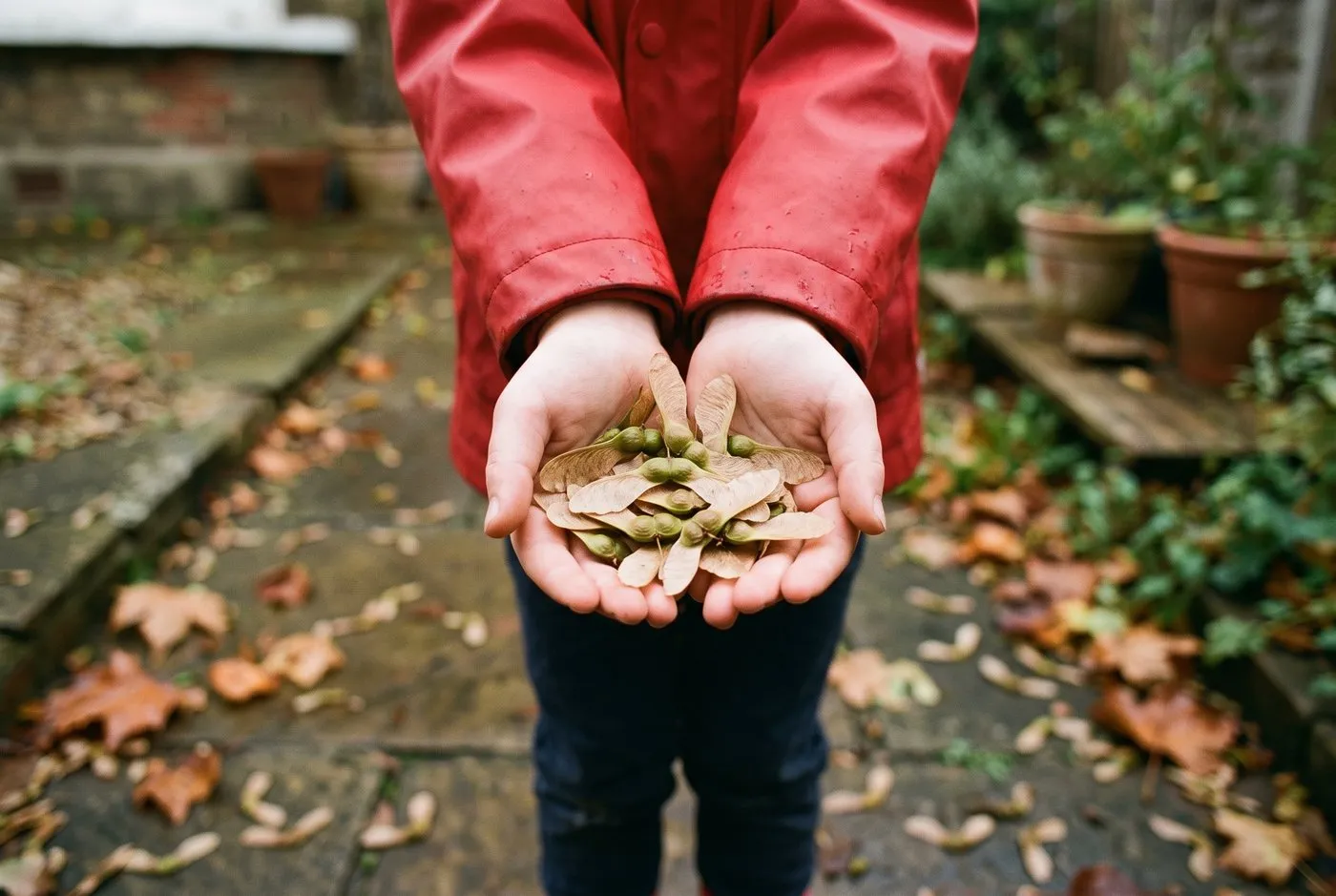 Every helicopter is a pair of seeds. A single mature tree drops more than 10,000, which is why the seedlings arrive by the hundred each spring.
How sycamore seeds germinate: the six-week window
Understanding the timing tells you exactly when to act. Sycamore germination runs through five clear stages, and the easy-kill window is short.
- Seed fall. September to November. The samaras spin down and settle on soil, gravel and leaf litter.
- Winter stratification. December to February. The seeds need a cold, damp spell near 0 to 4C to break dormancy. This is why they wait until spring.
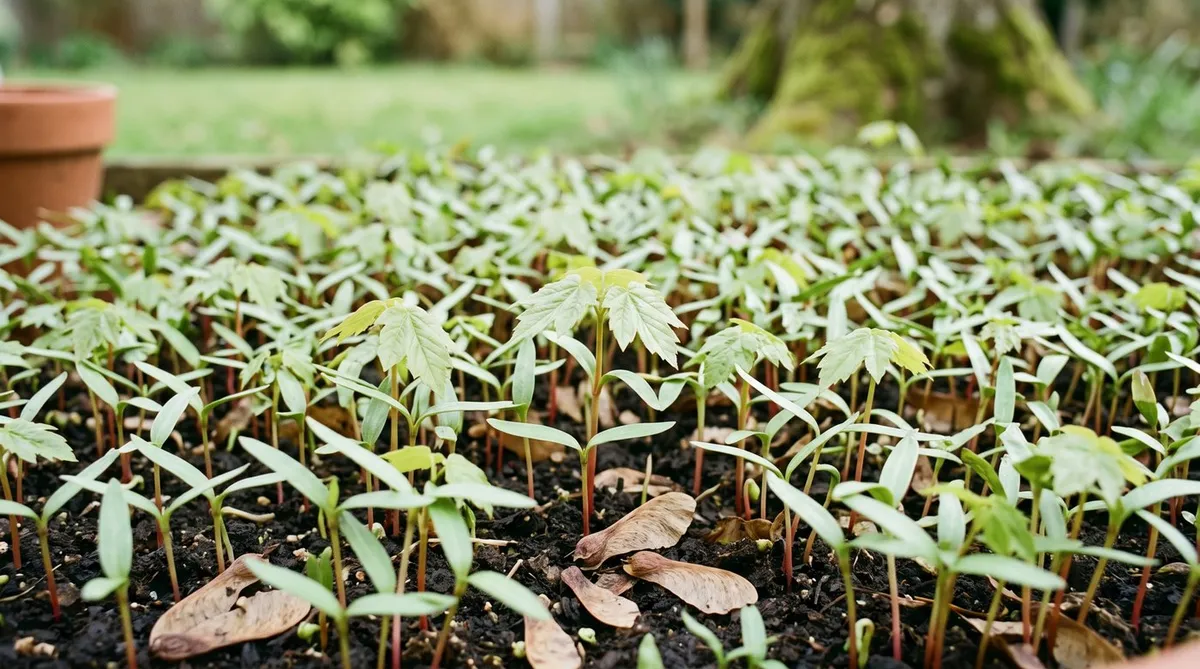
- Germination. March to April, once the soil reaches about 8C. Two strap-shaped seed leaves, the cotyledons, push up. They are 2 to 3cm long and narrow, nothing like a maple leaf.
- First true leaves. April to May. The familiar five-lobed palmate leaf appears, eventually 7 to 16cm across. Now it looks like a small tree.
- Taproot dive. By weeks four to six the taproot is already 10 to 15cm deep, often deeper than the shoot is tall.
The critical mistake almost everyone makes is waiting until the seedling “looks like a weed worth pulling”. By the time the true leaves show, the taproot has set. Pull it and the top snaps off at soil level while the root stays behind and resprouts. Kill them at the cotyledon stage instead.
| Stage | Timing | What you see | Your action |
|---|---|---|---|
| Seed fall | Sep to Nov | Winged helicopters on the ground | Clear gutters and paths |
| Stratification | Dec to Feb | Nothing above ground | Mulch bare soil |
| Germination | Mar to Apr | Two narrow seed leaves | Hoe or pull now |
| First true leaf | Apr to May | Five-lobed maple leaf | Pull whole, soil moist |
| Taproot set | May onward | Woody stem, deep root | Dig or cut-stump |
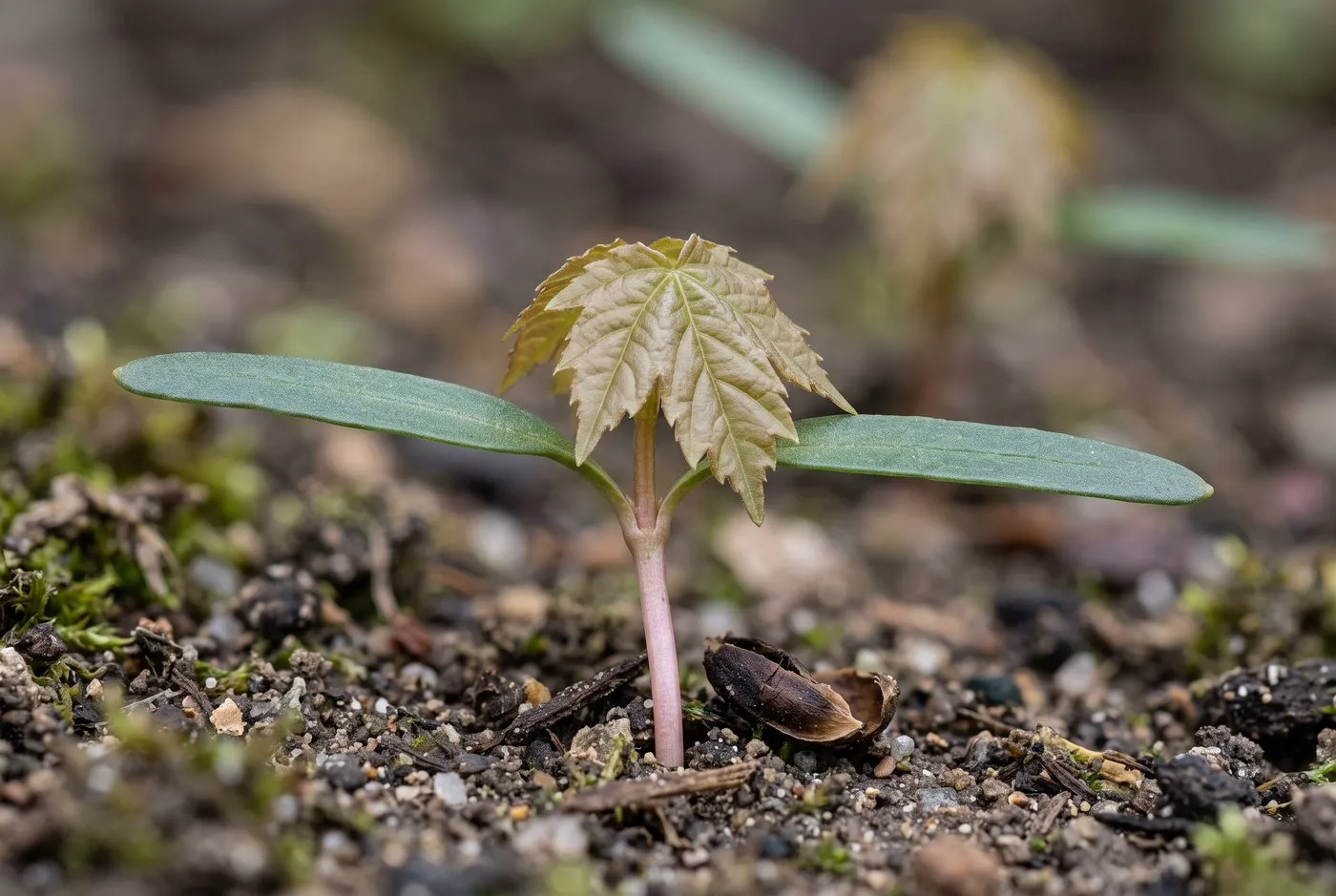 The cotyledon stage in a Midlands cottage border: two narrow seed leaves with the first five-lobed sycamore leaf just unfolding. This is the moment to hoe.
Telling sycamore seedlings apart from ash, field maple and Norway maple
Get the identification right before you pull, because field maple is a native worth keeping. Four seedlings often come up together under mixed trees.
Sycamore (Acer pseudoplatanus) has a five-lobed palmate leaf with toothed edges and pointed lobe tips. The leaf reaches 7 to 16cm, and the leaf stalk is often flushed red. Its paired seeds sit at a wide angle of roughly 90 degrees.
Field maple (Acer campestre) is the native maple and much smaller, with leaves 4 to 7cm and rounded, blunt lobes. Its seed wings sit almost in a straight line, close to 180 degrees. Field maple supports plenty of wildlife, so leave a seedling in a hedge line if you have room. Our Japanese maple care guide covers the ornamental Acers you would never want to weed out by mistake.
Norway maple (Acer platanoides) has sharper lobes ending in fine bristle points, and the leaf stalk bleeds a milky white sap when snapped. Ash (Fraxinus excelsior) is completely different: a compound leaf with paired leaflets down a central stalk, and single-winged keys, not pairs. If you are checking a hedge for ash, our ash dieback identification guide shows the healthy seedling and the diseased one side by side.
At the cotyledon stage all the maples look near-identical. If in doubt, let the first true leaf open before you decide what to remove.
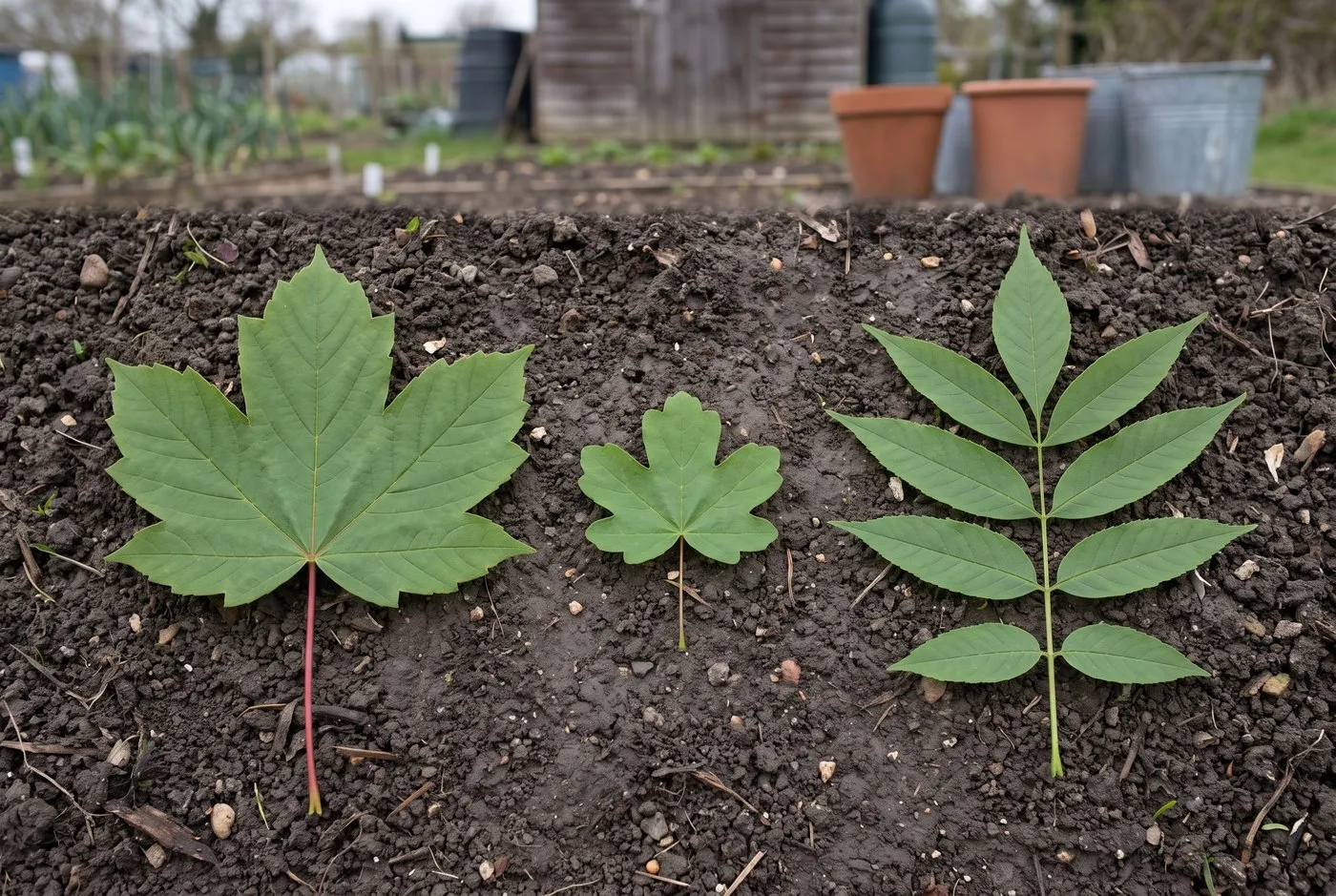 Identification on the allotment: the broad five-lobed sycamore leaf next to a smaller, blunt-lobed field maple and the paired leaflets of ash.
Sycamore seedling removal methods ranked
Not all methods work equally, and the best one depends on the seedling’s age. Hoeing at the cotyledon stage is our gold-standard method for the spring flush, because it is fast, free and near-total when the timing is right. Cutting alone is the worst option, because sycamore resprouts hard.
| Method | How it works | Best for | Effectiveness | Role |
|---|---|---|---|---|
| Hoe or pull at cotyledon stage | Severs or lifts seedling before taproot sets | Spring flush in borders | 98% | Primary for young seedlings |
| Dig out whole root | Removes root collar and taproot entirely | Single woody saplings | 95% | Primary for established plants |
| Regular mowing | Repeated cutting exhausts the growing point | Seedlings in lawns | 90-95% | Primary in turf |
| Cut-stump glyphosate | Herbicide carried into roots via fresh cut | Thick self-sown saplings | 90% | Best for large saplings |
| Thick mulch, 7 to 10cm | Blocks light and buries incoming seed | Cleared borders | ~85% suppression | Prevention |
| Cutting or strimming alone | Removes top growth only | Emergency knock-back | ~20% | Temporary only |
The ranking makes the choice easy. For the mass of small seedlings, hoe or pull. For a lawn, keep mowing. For a woody sapling, dig it or cut-stump it. Never rely on cutting alone.
Hoeing and hand-pulling the spring flush
For the annual flush of seedlings, a hoe is the fastest tool there is. Work on a dry, breezy morning so the severed seedlings dry out and die rather than re-rooting in damp soil. A Dutch or oscillating hoe skims just below the surface and cuts hundreds in minutes. Our border hoeing guide covers the technique and which hoe to buy.
Hand-pulling suits gravel, pots and tight spots where a hoe cannot reach. Pull when the soil is moist so the whole seedling lifts, root and all. On dry ground the top snaps off. Aim to clear the flush between March and May, and expect to repeat every two to three weeks as later seeds germinate.
You do not need weedkiller for seedlings at this stage. Hoeing and pulling are both chemical-free, which matters near ponds, edibles and wildlife areas. For the wider chemical-free toolkit, see our organic weedkillers guide, though for young sycamore the hoe beats every spray on speed and cost.
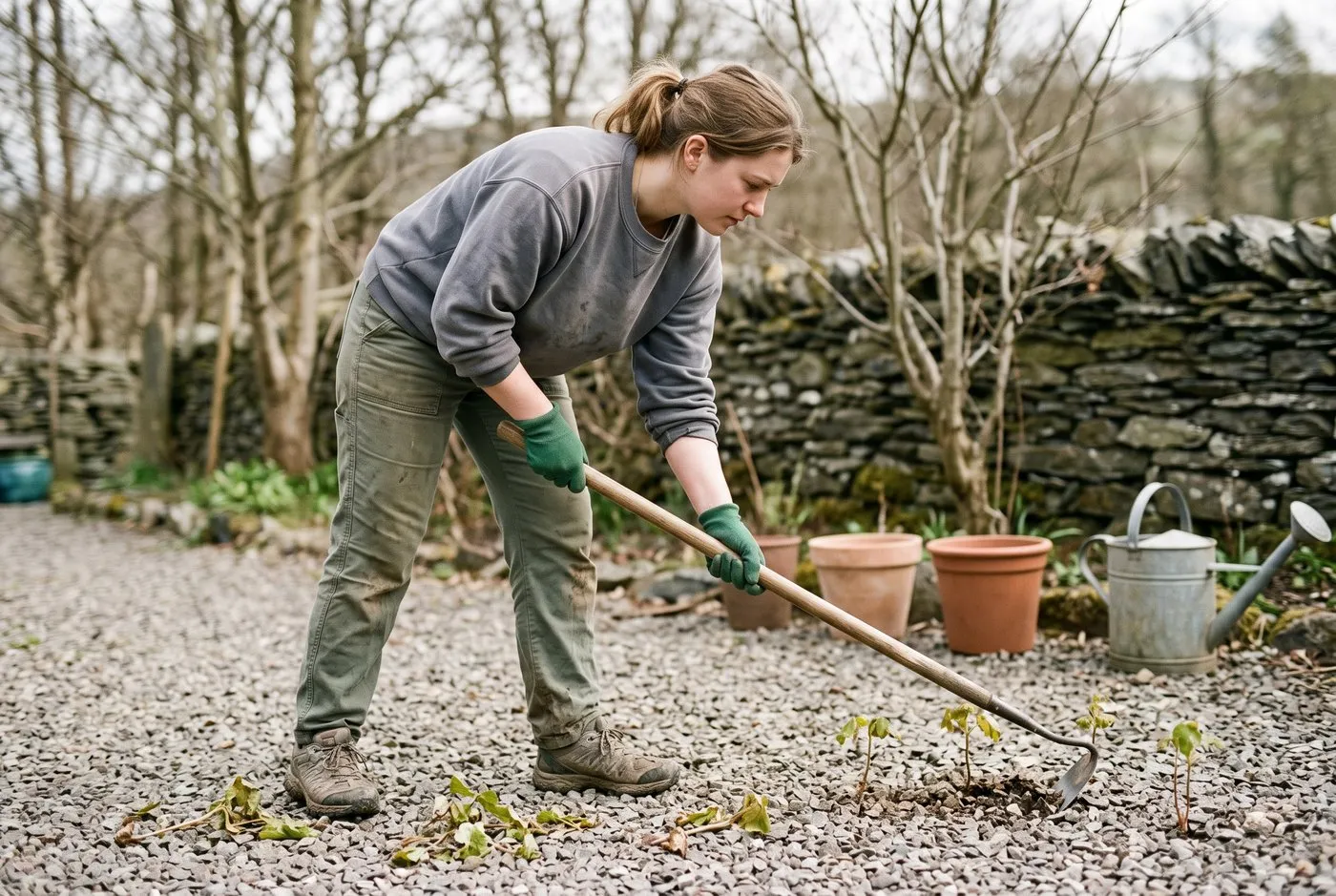 Hoeing a gravel drive on a dry morning. Skimming just below the surface lifts young sycamore seedlings before they root into the sub-base.
Clearing seedlings from lawns, gravel and gutters
Where sycamore seedlings land changes how you tackle them. Each surface has its own trick.
In a lawn, do nothing special. Your normal mowing kills them. Sycamore seedlings cannot survive repeated cutting at the growing point, so a spring flush in turf vanishes within a season on a standard mowing schedule. This is the one place the problem solves itself.
On a gravel drive or path, hoe or pull them before the taproot reaches the sub-base below the stones. Once rooted into the base, they hold firm and need digging. A landscape membrane laid under gravel stops most seedlings anchoring, so retro-fitting one where you can is worth the effort.
In gutters and downpipes, clear the seeds and seedlings by hand each autumn and again in spring. Sycamore germinates readily in the leaf litter that collects in guttering. Left alone, the roots block downpipes and can lift roof tiles. A quarterly gutter clear-out is cheaper than a blocked, overflowing gutter in winter.
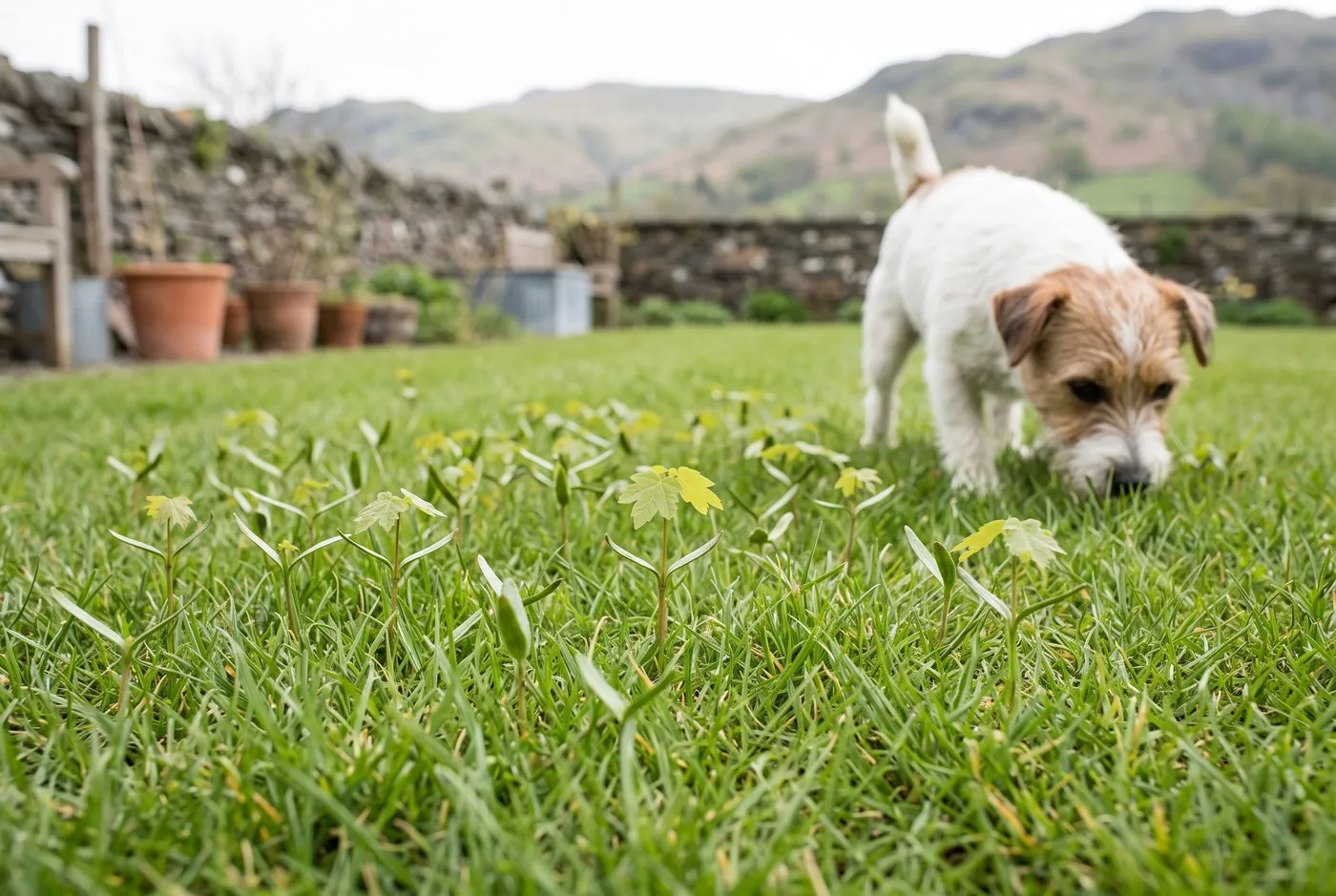 Seedlings scattered through a lawn. Left to a routine mow, they disappear within a season without any hand-weeding.
Digging out and cut-stump treatment for saplings
Once a seedling has become woody, a year or more old and pencil-thick, pulling no longer works. You have two reliable options.
Digging suits one or two saplings. Fork out the entire root, including the swollen collar at the base. Any root fragment left behind can resprout, so lift the lot. On heavy clay this is hard work past the first year, which is another reason to catch them young.
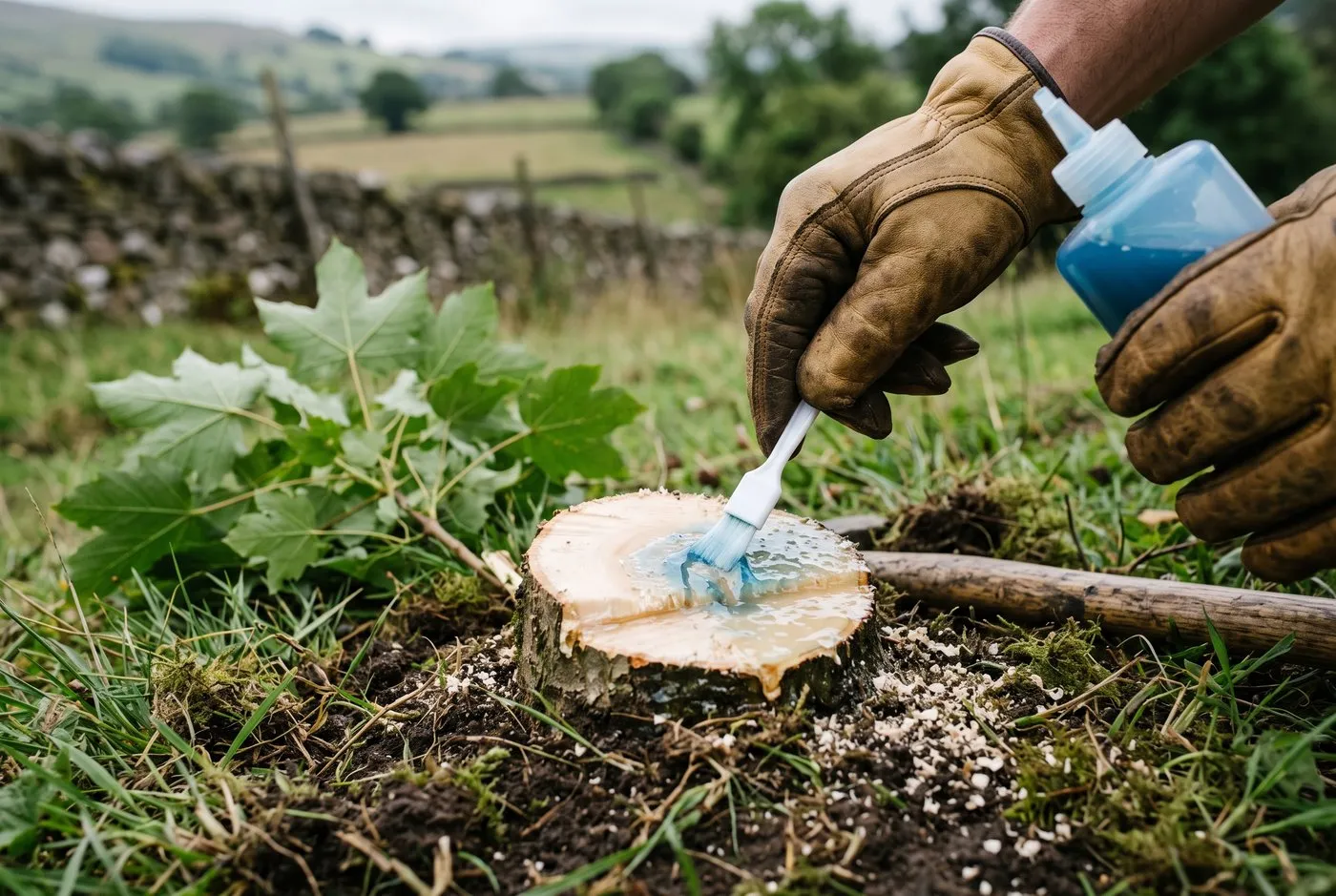 Cut-stump treatment on a self-sown sapling. Painting glyphosate onto the fresh cut within seconds is what stops it resprouting.
Glyphosate is not for the seedling flush. Young seedlings are quicker and cheaper to hoe. Reserve the gel for stems too woody to pull, where cutting alone would just trigger a thicket of regrowth from the base.
Stopping sycamore seedlings coming back
Treating seedlings every spring is symptom control. The root cause is bare soil under a seed source, and there are only two permanent fixes.
The first is fewer seeds landing. If the tree is yours and genuinely unwanted, removing or pollarding it ends the seed rain. Check first whether it carries a Tree Preservation Order or sits in a conservation area, because both restrict what you can do. If the tree belongs to a neighbour, you cannot fell it, so you are left managing the fallout each year.
Gardener’s tip: Hoe on a dry, breezy morning, never after rain. Severed seedlings left on damp soil re-root within a day. On a dry day they wilt and die by lunchtime, and you can leave them where they fall as a thin mulch.
Month-by-month sycamore seedling calendar
| Month | Task |
|---|---|
| January | Fully dormant. Clear any seed and seedlings from gutters and downpipes while quiet. |
| February | Mulch bare borders 7 to 10cm deep before germination starts. Order stump gel if needed. |
| March | First flush germinates. Hoe or pull seedlings at the cotyledon stage on dry days. |
| April | Peak germination. Hoe borders and paths weekly. Keep mowing lawns to knock out turf seedlings. |
| May | Later seedlings appear. Hoe again. Hand-pull any that reached the first true leaf, soil moist. |
| June | Growth slows. Dig out any woody first-year saplings you missed while soil is workable. |
| July | Quiet month. Check gravel drives for rooted seedlings and lift them before they anchor. |
| August | Cut-stump season starts. Treat thick self-sown saplings; sap is beginning to move to roots. |
| September | Seeds start to fall. Prime cut-stump window. Fence horses away from any sycamore. |
| October | Heavy seed fall. Cut-stump the last saplings. Clear samaras from paddocks and grazing. |
| November | Seed fall ends. Rake and remove fallen helicopters from borders and paths to cut next year’s flush. |
| December | Dormant. Clear gutters of trapped seed. Top up thin mulch on exposed borders. |
Sycamore and horses: the atypical myopathy risk
This is the part paddock owners must not skip. Sycamore seeds and seedlings are toxic to horses. They contain hypoglycin A, a toxin that causes atypical myopathy, also called seasonal pasture myopathy. It attacks the muscles, including the heart, and it is frequently fatal.
The risk peaks twice a year: in autumn when the seeds fall, and in spring when seedlings emerge in grazing. Horses on bare, overgrazed pasture near a sycamore are most at risk, because they eat what they would normally ignore. The British Horse Society provides current guidance on prevention and the warning signs.
Warning: Never turn a horse onto a paddock strewn with sycamore seeds or seedlings. Fence off any sycamore within reach of grazing, clear fallen seeds and emerging seedlings from paddocks, and provide extra forage so horses are not tempted to graze bare ground. Symptoms include muscle stiffness, dark urine and reluctance to move. Call a vet immediately if you suspect poisoning.
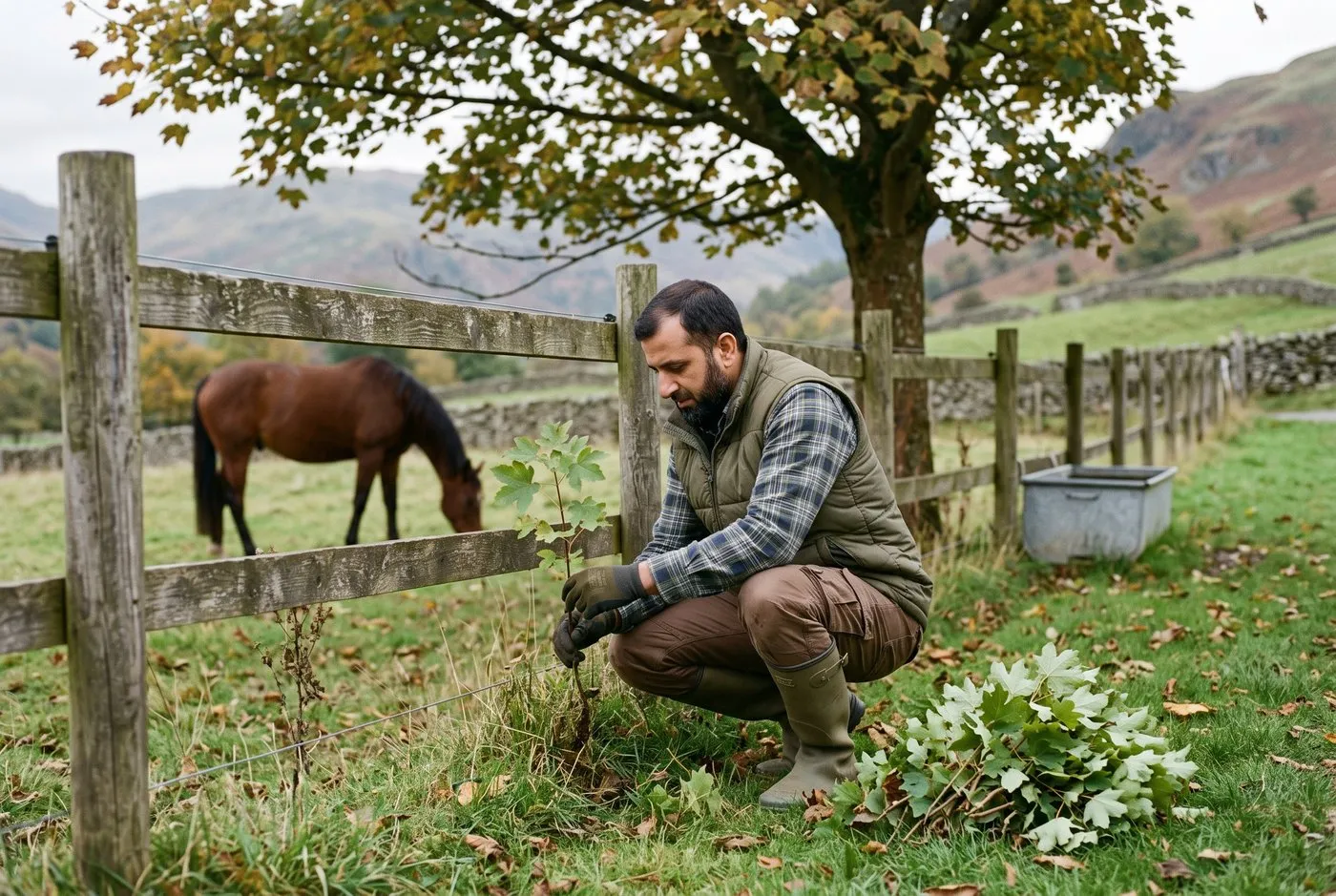 Seedlings along a paddock fence line. Sycamore seeds and seedlings cause atypical myopathy in horses, so clear grazing thoroughly in autumn and spring.
When a sycamore sapling is worth keeping
Not every sycamore is a problem. In the right place, a single tree earns its keep. Sycamore supports a large weight of insect life, including the sycamore aphid that feeds birds and ladybirds in huge numbers. It tolerates wind, salt and air pollution better than most broadleaves, which makes it valuable as a coastal or exposed-site windbreak. It also casts fast, dense shade and grows in poor, compacted ground where fussier trees sulk.
If you have space away from paddocks, small borders and boundaries, and you want a quick, tough tree for a hard spot, one well-placed sycamore is a reasonable choice. The Woodland Trust rates its wildlife value highly despite its non-native status. The trouble is only its fertility, so keep any tree you allow well clear of grazing and manage its seedlings elsewhere. For the leaf problems that can affect maples, including this one, our Acer leaf scorch guide explains why the foliage crisps in summer.
Common mistakes when removing sycamore seedlings
- Waiting until they look like proper weeds. By the time the true leaves show, the taproot has set. Hoe at the cotyledon stage instead, before the first true leaf opens.
- Cutting saplings and hoping. Sycamore resprouts hard from a cut stump and root. Cutting alone gives you a thicket. Dig the root out or cut-stump treat it.
- Pulling from dry soil. On dry ground the stem snaps and the root stays. Pull only when the soil is moist, or hoe on a dry day and let the tops die.
- Leaving seedlings in horse grazing. Sycamore seedlings are toxic to horses. Clear them from paddocks in spring and autumn without fail.
- Ignoring gutters. Seedlings root in gutter debris, block downpipes and lift tiles. Clear guttering each autumn and spring.
Frequently asked questions
How do you get rid of sycamore seedlings?
Hoe or hand-pull them at the two-leaf stage, before the taproot sets. Mow seedlings in lawns, dig out woody saplings whole, and use cut-stump glyphosate on thick self-sown ones. A deep mulch stops most new ones germinating in borders.
Why do I have so many sycamore seedlings?
A mature sycamore within about 200m is shedding thousands of seeds. One tree drops over 10,000 winged samaras each autumn, and the wind carries them across gardens. High viability means a dense flush every spring until the seed source is removed or the ground is mulched.
Will sycamore seedlings grow back if I cut them?
Yes, once woody they resprout from the stump and root. Sycamore coppices vigorously, so cutting or strimming a sapling only knocks it back. Dig the whole root out, or cut it low and treat the fresh stump with glyphosate within 30 seconds to kill it for good.
Are sycamore seedlings poisonous to horses?
Yes, sycamore seeds and seedlings can cause fatal atypical myopathy. They contain the toxin hypoglycin A, dangerous in autumn when seeds fall and spring when seedlings emerge. Fence horses away from sycamores, clear seedlings from grazing, and never turn horses onto seed-strewn paddocks.
How do you tell a sycamore seedling from ash or field maple?
Sycamore has a five-lobed palmate leaf; ash has compound leaves with paired leaflets. Field maple leaves are smaller with rounded lobes, and its seeds sit in a straight line. At the seed-leaf stage the maples look alike, so wait for the first true leaf if unsure.
Does mowing get rid of sycamore seedlings?
Yes, regular mowing kills sycamore seedlings in a lawn within a season. They cannot tolerate repeated cutting at the growing point. Keep mowing on your normal schedule from March and the spring flush disappears without any need for weedkiller or hand-pulling.
What kills sycamore saplings for good?
Digging the entire root out, or cut-stump glyphosate applied in autumn. Any root fragment left in the ground can resprout. For a thick self-sown sapling, saw it low and paint the fresh cut with glyphosate gel while the wound is still wet.
When is the best time to remove sycamore seedlings?
Hoe seedlings in March to May at the cotyledon stage. This is the easy-kill window before the taproot deepens. Treat woody saplings by cut-stump in August to October, when sap flows down to the roots and carries the herbicide with it.
Our team produces practical UK gardening guidance from source research, contributor records and established horticultural practice. Editorial standards are overseen by Matt W.