Key takeaways
- Red, blistered, puckered spring leaves on a peach or nectarine mean leaf curl, caused by Taphrina deformans
- The fungus only infects buds while they are wet, so keeping rain off from late January is the whole game
- Copper sprays are withdrawn for UK amateurs, so shelter and variety choice have replaced them
- Avalon Pride is a peach-leaf-curl resistant variety that crops in the open unsheltered
- Pick off infected leaves, feed and mulch, and the tree pushes a healthy second flush of leaves
If your peach or nectarine leaves are emerging red, thickened and blistered each spring, then curling and dropping, that is peach leaf curl. It is caused by the fungus Taphrina deformans, and it infects the swelling buds in late winter and early spring, but only while they are wet. That single fact is the key to beating it. Keep the rain off the buds from late January, and the disease has no way in. Copper sprays, the old answer, are no longer available to UK amateurs, so shelter and variety choice have taken over.
This guide covers how to recognise peach leaf curl, the wet-bud infection window that decides everything, why a rain shelter beats any spray, how to nurse an infected tree back to a healthy second flush, and the resistant variety that lets you skip the whole problem. It applies to peaches, nectarines and, more mildly, almonds and apricots.
What peach leaf curl looks like
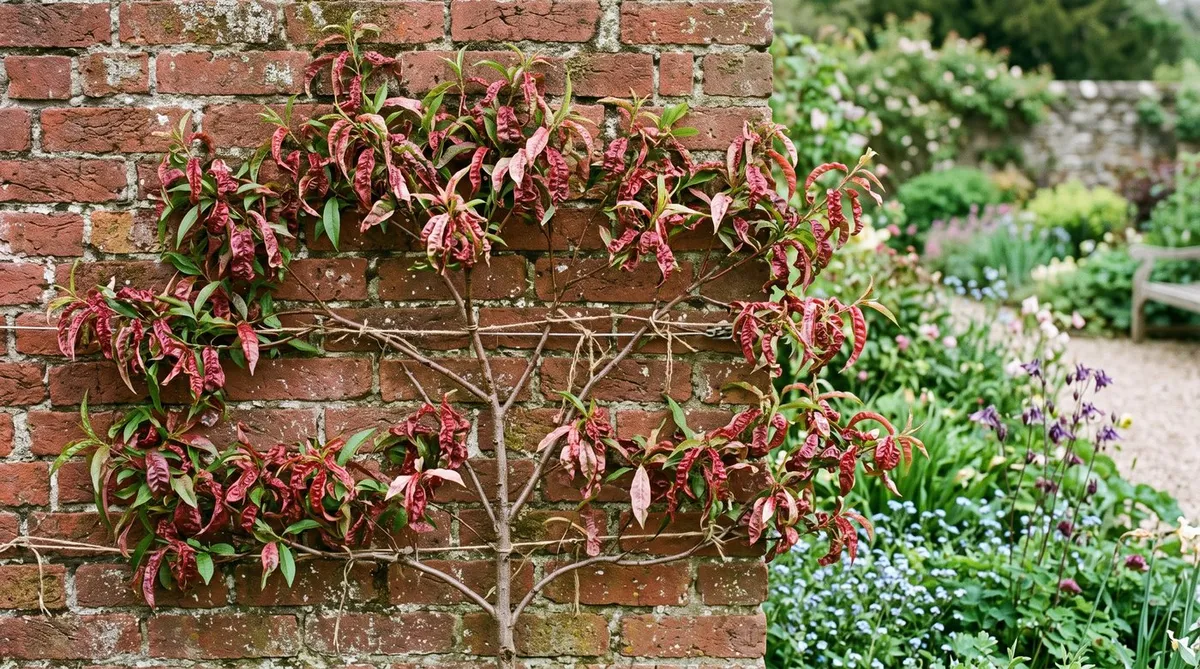
Peach leaf curl is unmistakable once you have seen it. As the new leaves unfold in April, patches of the leaf thicken, pucker and turn a vivid red or purple. The blistered areas swell and distort so the leaf curls and crumples rather than lying flat. A badly hit tree looks as though someone has gone over it with a blowtorch and then dipped it in raspberry juice.
The colour fades as the season goes on. The blisters lighten, then develop a greyish-white bloom on the surface. That bloom is the fungus fruiting, a coat of spore-bearing cells, and it is the point at which the leaf becomes infectious to next year’s buds. Finally the leaves turn brown, shrivel and fall, and the tree can lose most of its first canopy by early summer.
The damage is not just cosmetic. A tree that defoliates has to spend stored energy pushing a whole second set of leaves, which weakens it and reduces the crop, both this year and next. Fruit on a badly curled tree is smaller and sparser. A single bad year is survivable. Several in a row are what pull a tree downhill.
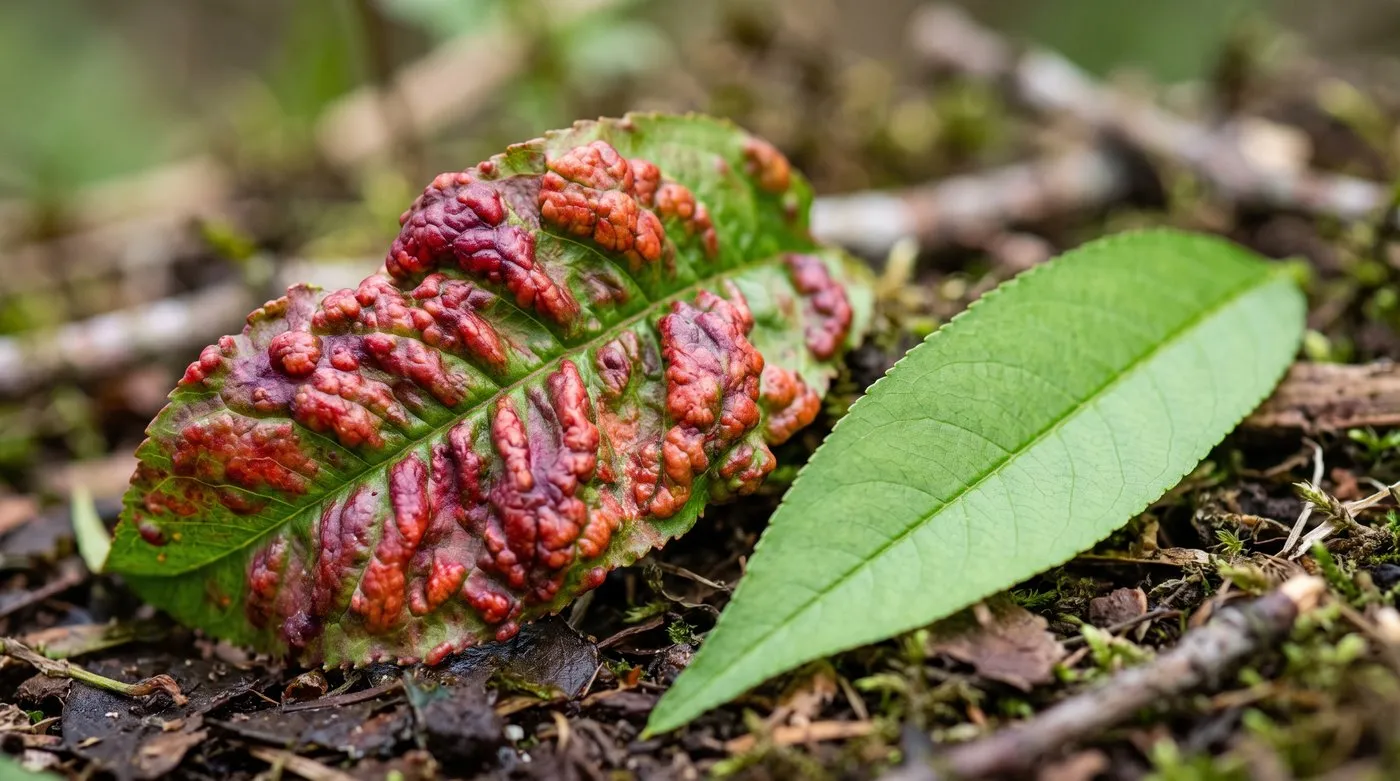 The classic sign. Thickened, puckered, red-purple blistering on the new leaf. The healthy leaf beside it shows how far the tissue has distorted.
The wet-bud infection window that decides everything
Understanding when infection happens is what turns leaf curl from an annual misery into a solved problem, because the window is narrow and predictable.
The spores of Taphrina deformans overwinter on the bark, twigs and around the bud scales of the tree itself. They do not need to blow in from elsewhere. They are already there, sitting on the wood through winter, waiting.
Infection happens in a specific sequence:
- Late January to March, buds begin to swell. The overwintering spores are activated by moisture.
- The wet requirement. Spores can only germinate and infect while the swelling bud and emerging leaf tissue are physically wet, from rain or heavy dew, for a number of hours.
- The temperature requirement. Infection is favoured by cool conditions, below about 16C. Warm, dry springs see far less disease. Cold, wet ones see epidemics.
- Entry before the leaf opens. The fungus gets into the leaf while it is still tiny and forming inside or just out of the bud. By the time the leaf is fully open, the damage is already done inside it.
- April, symptoms appear. The blistering and reddening you see is the result of an infection that took place weeks earlier, at the bud.
Here is the critical mistake, and it is the reason so many people spray and still get curl. They act when they see the red blisters in April. By then the infection is complete and inside the tissue. Nothing you spray on a blistered leaf reverses it. The battle was lost back in February, at the wet bud. Every effective control targets that wet-bud window, not the visible symptom. Get the timing right and you barely need to do anything else.
Why a rain shelter beats every spray
Since the fungus can only infect a wet bud, the most reliable control in Britain is simply to keep the rain off the buds through the infection window. For a wall-trained tree this is straightforward and it costs a few pounds.
Fix a lean-to shelter of clear polythene over the fan from the last week of January until mid-May. A batten along the top of the wall, a couple of arms projecting 30-45cm, and a sheet of polythene stapled over them is all it takes. The point is to throw the rain clear of the buds. Leave both ends open so air moves through and, crucially, so pollinating insects can reach the blossom, which opens inside this same period. Take the shelter down in mid-May once the leaves are fully out and the infection risk has passed.
Wall-trained fans make this easy, which is a strong argument for training a peach flat against a wall in the first place. Our guide to fan-training a fruit tree covers the framework, and the general guide to growing peach trees in the UK sets out siting and pruning that make sheltering practical.
Gardener’s tip: Do not seal the shelter into a closed box. A fully enclosed cover traps humidity and cooks the blossom on warm March days, and it shuts out the bees you need for fruit set. Open ends, throwing the rain clear, is all you want. The tree should feel sheltered from rain but still out in the moving air.
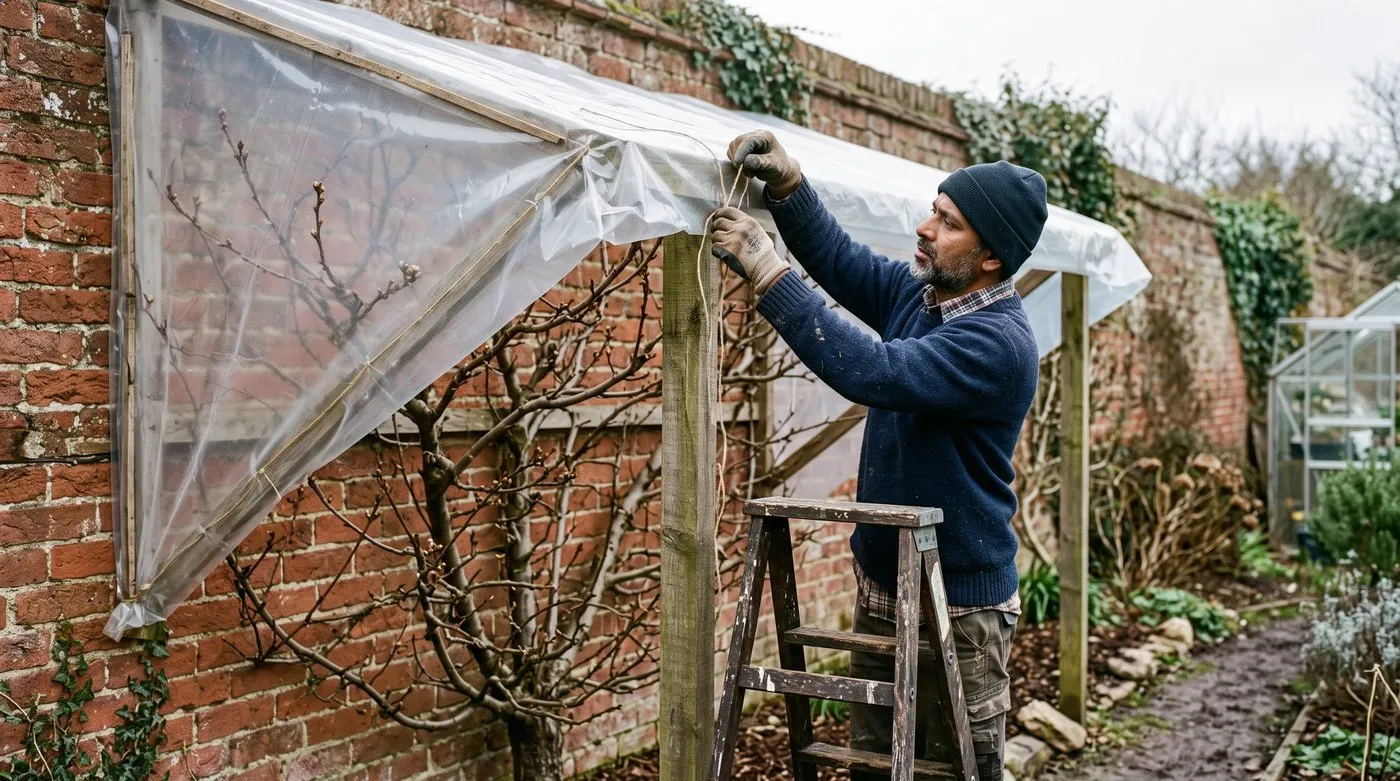 A simple clear polythene lean-to, open at both ends, keeps rain off the swelling buds from late January to mid-May. This is the control that works.
Growing a peach under cover
The logical extension of keeping buds dry is to grow the tree under permanent cover. A peach in a greenhouse or conservatory almost never gets leaf curl, because the buds stay dry all spring and the spores never get their wet window.
A tree in a large pot can be moved into an unheated greenhouse, porch or car-free garage from January to May, then stood back outside for summer. This suits smaller gardens and gives complete protection. The trade-offs are that you must hand pollinate the blossom under glass, since insects are shut out, and you must ventilate on sunny days to stop the temperature spiking. Our guide to winter care for potted fruit trees covers moving trees under cover and back out again without shocking them.
Hand pollination is a two-minute job with a soft brush, dabbing pollen from flower to flower around midday when the pollen is loose. Do it every couple of days while the blossom is open. A potted peach under cover, hand pollinated, is the most disease-proof way to grow one in a wet region.
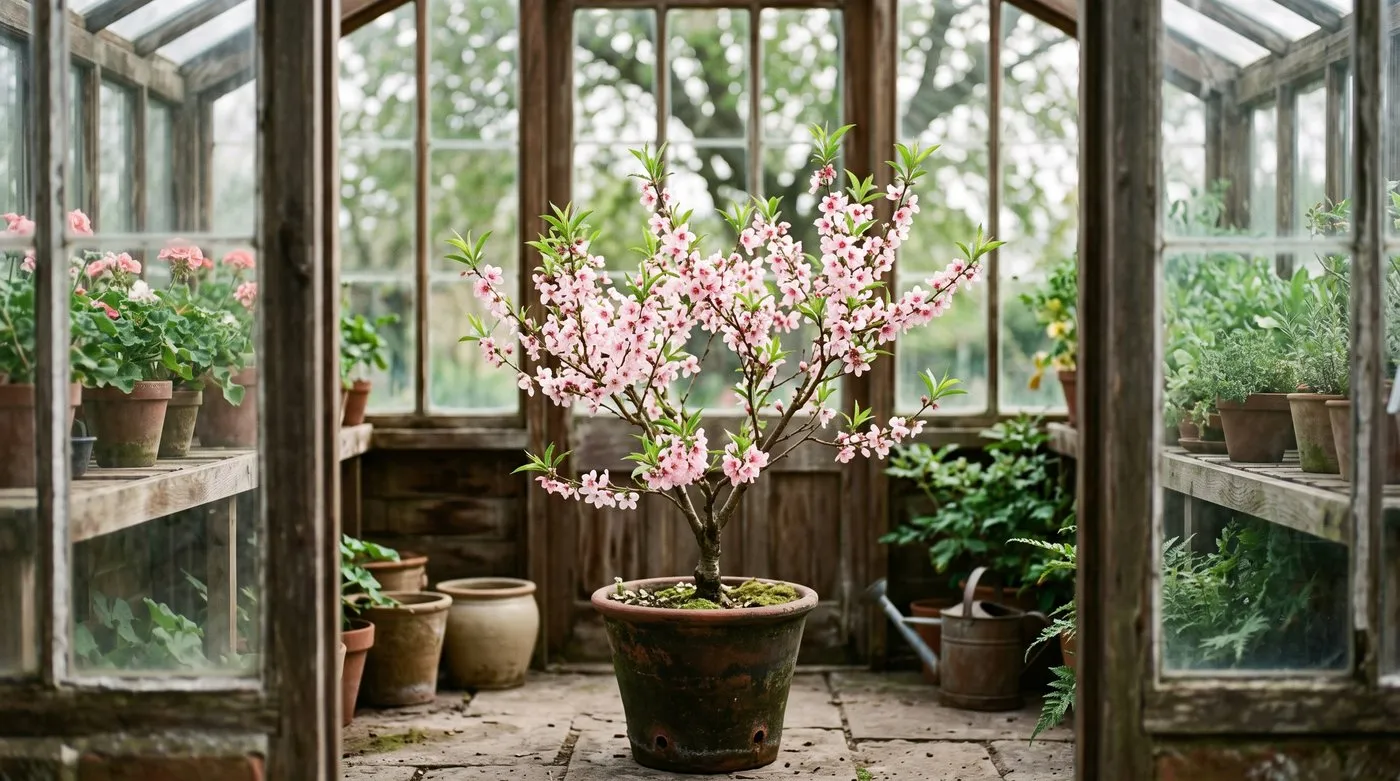 A peach kept under glass from January to May never gets its buds wet, so leaf curl cannot take hold. Ventilate on sunny days and hand pollinate the blossom.
Nursing an infected tree back
If your tree is already curled this spring, the year is not lost. An established peach recovers well from a single bad attack, provided you help it push its replacement canopy.
Remove the infected leaves before they develop the white spore bloom. Picking off blistered leaves as they appear does two things: it tidies the tree and, more importantly, it removes the spores before they can mature and overwinter to reinfect next year. Do not compost them in a cool heap, where the spores survive. Bin or burn them.
Feed and mulch. A defoliated tree needs energy to releaf. Apply a balanced fruit-tree feed and a 50-75mm mulch of compost or well-rotted manure over the root area, keeping it clear of the trunk. Water in dry spells. The tree will then push a second flush of leaves within a few weeks, and that flush is almost always clean, because the infection window has closed.
Thin the crop if the tree is struggling. A weakened, defoliated tree cannot ripen a heavy crop and carry itself through to next year. Removing some fruit lets it recover. For the wider run of stone-fruit troubles it can face alongside leaf curl, the guides to brown rot on stone fruit and canker on fruit trees cover the two other problems most likely to turn up on a stressed tree.
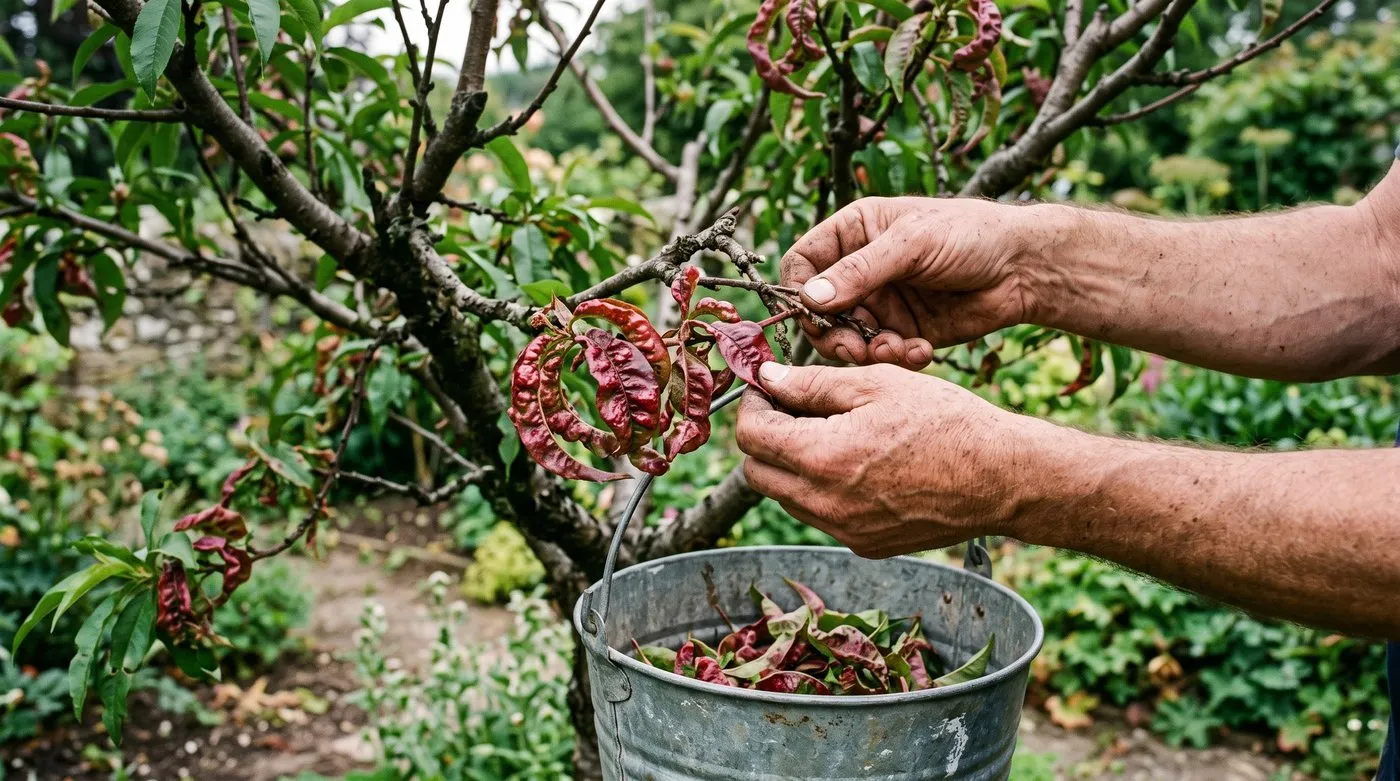 Pick off the blistered leaves before they turn white and shed spores. The tree replaces them with a clean second flush once the wet window closes.
Copper fungicides and why the old advice is out of date
A great deal of published advice on peach leaf curl still tells you to spray a copper fungicide, such as Bordeaux mixture, at leaf fall in autumn and again as the buds swell. That advice is out of date for UK home gardeners.
Copper-based fungicides have been withdrawn from the amateur market in the UK. You cannot legally buy Bordeaux mixture or copper oxychloride for garden use here any more. Any article recommending them is either old or written for a different country. This is precisely why the emphasis has shifted so firmly onto the non-chemical controls: the rain shelter, growing under cover, hygiene and resistant varieties. They are not the fallback. They are now the whole toolkit, and the shelter in particular is more reliable than copper ever was.
Warning: Do not buy copper products marketed abroad or old stock from unofficial sellers to spray your peach. Beyond the legal issue, copper accumulates in soil and harms soil life and aquatic organisms. The withdrawal was not arbitrary. The rain shelter does the job better and leaves nothing behind.
Resistant varieties: the low-effort route
If sheltering a tree sounds like more than you want to take on, choose a variety that resists the disease. Avalon Pride is a peach selected for good leaf-curl resistance, and it crops in the open, unsheltered, in UK conditions that would badly curl an older variety.
Nectarines are generally more susceptible than peaches, so if you are set on a nectarine in a wet region, plan to shelter it. Our guide to growing nectarine trees covers variety choice, and the apricot growing guide covers a stone fruit that suffers leaf curl far less but has troubles of its own.
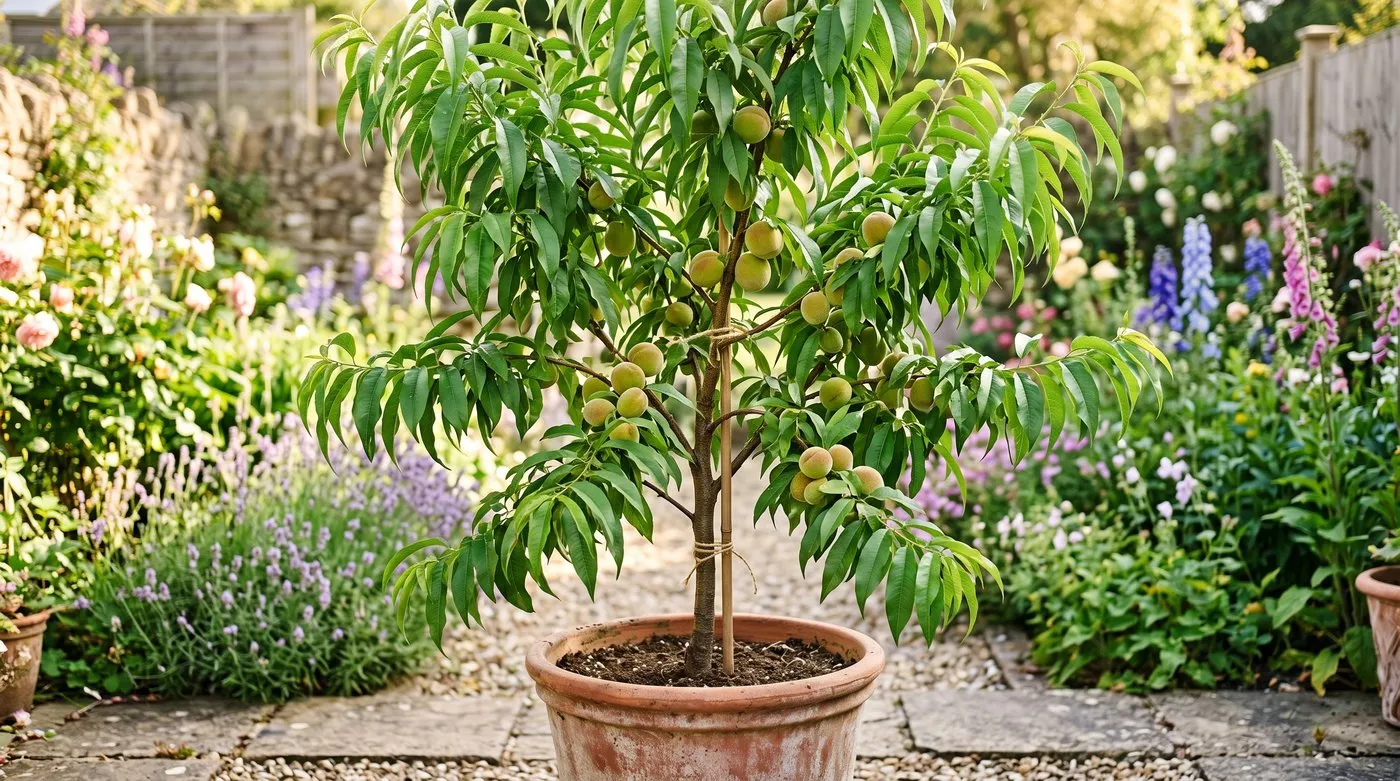 Avalon Pride resists leaf curl and crops in the open. Clean, flat foliage like this with no shelter is what a resistant variety buys you.
Control methods ranked by effectiveness
Treating these as equal is how people end up spraying nothing useful while the buds sit out in the rain. Ordered by what each one actually delivers.
The gold standard for a wall-trained tree is the rain shelter, and for a garden that cannot shelter, the resistant variety. Between those two, nearly every UK gardener has a route to a curl-free peach without a single spray. Everything else on the list is recovery work for when prevention was missed.
Month-by-month peach leaf curl calendar
| Month | What to do |
|---|---|
| January | Fix the rain shelter over wall-trained trees before the buds swell. Move potted trees under cover. |
| February | Shelter stays up. Buds swelling, this is the infection window. Keep them dry. |
| March | Blossom opens under the open-ended shelter. Hand pollinate trees under glass. |
| April | First curl symptoms show on any unprotected growth. Begin removing blistered leaves. |
| May | Take the shelter down mid-month once leaves are fully out. Feed and mulch any defoliated tree. |
| June | Second flush of clean leaves appears on recovered trees. Thin a heavy crop on weak trees. |
| July-August | Normal summer care. Water well. Watch for brown rot on ripening fruit. |
| September-October | Harvest. Clear fallen infected leaves from earlier in the year off the ground. |
| November-December | Winter prune stone fruit only in dry weather to limit canker. Plan next year’s shelter. |
Common mistakes with peach leaf curl
- Acting when the blisters appear in April. By then the infection is weeks old and inside the leaf. Nothing sprayed on a blistered leaf reverses it. Prevention happens at the wet bud in February.
- Sealing the shelter into a closed box. A fully enclosed cover traps humidity, cooks the blossom and shuts out pollinators. Leave the ends open so air and bees move through.
- Relying on copper sprays. They are withdrawn for UK amateurs. Advice naming Bordeaux mixture is out of date. Shelter and variety choice have replaced them.
- Composting infected leaves in a cool heap. The spores survive and reinfect. Bin or burn the blistered leaves before they develop the white spore bloom.
- Giving up on a defoliated tree. An established tree recovers from one bad year. Feed, mulch and let it push its clean second flush rather than pulling it out.
The short version on peach leaf curl
Peach leaf curl looks alarming and is genuinely simple to beat, because the fungus can only get in through a wet bud in late winter. It is already living on your tree’s bark, so it does not blow in and you cannot avoid it by isolation. What you can do is keep the buds dry from late January to mid-May, and that is the whole solution.
For a wall-trained tree, a sheet of clear polythene does it. For a pot, a move under cover does it. For a garden that can do neither, plant Avalon Pride and grow it in the open. If a tree curls this year, pick off the leaves, feed it and let it releaf. Forget the copper sprays, which you cannot buy anyway, and stop trying to treat the red blisters, which are a report on a battle that finished in February. For the rest of the fruit-tree problems worth knowing, work through the garden problems section. The RHS guidance on peach leaf curl is a sound second reference on the fungus and its timing.
Frequently asked questions
What causes peach leaf curl?
The fungus Taphrina deformans, which infects wet buds in spring. Spores overwinter on the bark, twigs and around the buds. As the buds swell in late winter, rain and dew let the spores germinate and enter the emerging leaves. It needs the leaf wet and temperatures below about 16C, which is why it is a cool, damp spring disease.
How do I stop peach leaf curl without spraying?
Keep rain off the buds from late January to mid-May with a shelter. The spores can only infect a wet bud, so a simple polythene lean-to over a wall-trained tree, or moving a potted tree under cover, stops nearly all infection. Leave the ends open for pollinating insects. This is now the main control, since copper fungicides are no longer sold to UK amateurs.
Will a peach tree recover from leaf curl?
Yes, an established tree recovers well from a single bad year. Pick off the blistered leaves before they turn white and shed spores, then feed and mulch. The tree pushes a fresh, usually healthy, second flush of leaves within weeks. Repeated severe attacks year after year weaken the tree and cut cropping, so persistent leaf curl needs the shelter or a resistant variety.
Should I remove leaves with peach leaf curl?
Yes, pick off infected leaves before they develop the white bloom. That white coating is the spore stage, and removing leaves earlier stops those spores overwintering to reinfect next year. Bin or burn them, never compost cool. The tree will replace the lost leaves, so removing them costs you little and lowers next year’s attack.
Is there a peach variety resistant to leaf curl?
Yes, Avalon Pride is a peach bred with good leaf-curl resistance and crops in the open in the UK. It is the standard recommendation for anyone who cannot shelter a tree. No peach is completely immune, but Avalon Pride shrugs off the disease in conditions that would curl an older variety like Rochester or Peregrine badly.
Do nectarines get leaf curl worse than peaches?
Yes, nectarines are generally more susceptible than peaches. Both are the same species and both catch it, but nectarines tend to blister harder and defoliate faster. The same shelter and hygiene rules apply. If you grow nectarines outdoors in a wet region, sheltering the tree matters even more than it does for a peach.
Can I grow a peach under glass to avoid leaf curl?
Yes, a peach grown in a greenhouse or conservatory almost never gets leaf curl. Under cover the buds stay dry through spring, so the spores cannot germinate on them. Greenhouse peaches need hand pollination and careful ventilation, but they dodge the disease entirely. A potted peach moved under cover from January achieves the same protection.
Our team produces practical UK gardening guidance from source research, contributor records and established horticultural practice. Editorial standards are overseen by Matt W.