Key takeaways
- The caterpillar is completely harmless: no sting, no toxins, no bite, and no real threat to garden plants
- It grows up to 85mm long and thumb-thick, grey-brown with four eye spots and a small tail horn
- The trunk-like snout it can retract gives the moth its elephant name
- When alarmed it pulls in its head and swells the eye-spot segments to mimic a snake
- Caterpillars feed July to September on rosebay willowherb, bedstraws and garden fuchsias
- The adult is a spectacular pink and olive hawk-moth, an important night pollinator, flying May to July
- It overwinters as a brown pupa in loose soil or leaf litter, so avoid autumn digging where you find them
This guide answers the fear question first, then shows you how to identify it, what it eats, what it turns into, and exactly what to do if you find one. None of it involves reaching for a spray.
Is the elephant hawk moth caterpillar dangerous?
No. The elephant hawk moth caterpillar is completely harmless to people, pets and plants worth keeping. It has no sting, no venom, no irritating hairs and it cannot bite. You can handle it with bare hands and come to no harm at all.
The alarm it causes is down to size and theatre, not danger. At up to 85mm long and as thick as an adult thumb, it looks formidable. Add the four staring eye spots and the way it rears up, and it is easy to see why people panic. All of that is bluff.
Gardener’s tip: If a child or nervous visitor finds one, use it as a teaching moment rather than a scare. Let them watch it pull in its head and swell the eye spots. It is one of the best natural demonstrations of animal bluff you will find in a British garden.
What is the huge brown caterpillar with eyes in my garden?
It is the caterpillar of the elephant hawk moth, Deilephila elpenor, one of Britain’s most widespread hawk-moths. It is the commonest large caterpillar people find in UK gardens from July to September, so if you have spotted a monster grub with eyes, this is almost always the culprit.
The name comes from the front of the caterpillar. When feeding it can stretch and taper its head end into a trunk-like snout, then retract it into the swollen segments behind. That trunk gave the species its elephant name, coined long before anyone worried about the eye spots.
Most are a matte grey-brown, though a green form turns up too, especially in younger caterpillars. Both forms carry the same markings. The species is found across England, Wales, much of Scotland and Ireland, in gardens, waste ground, hedgerows and woodland edges. It is not rare, protected or invasive. It is simply a native moth going about its business.
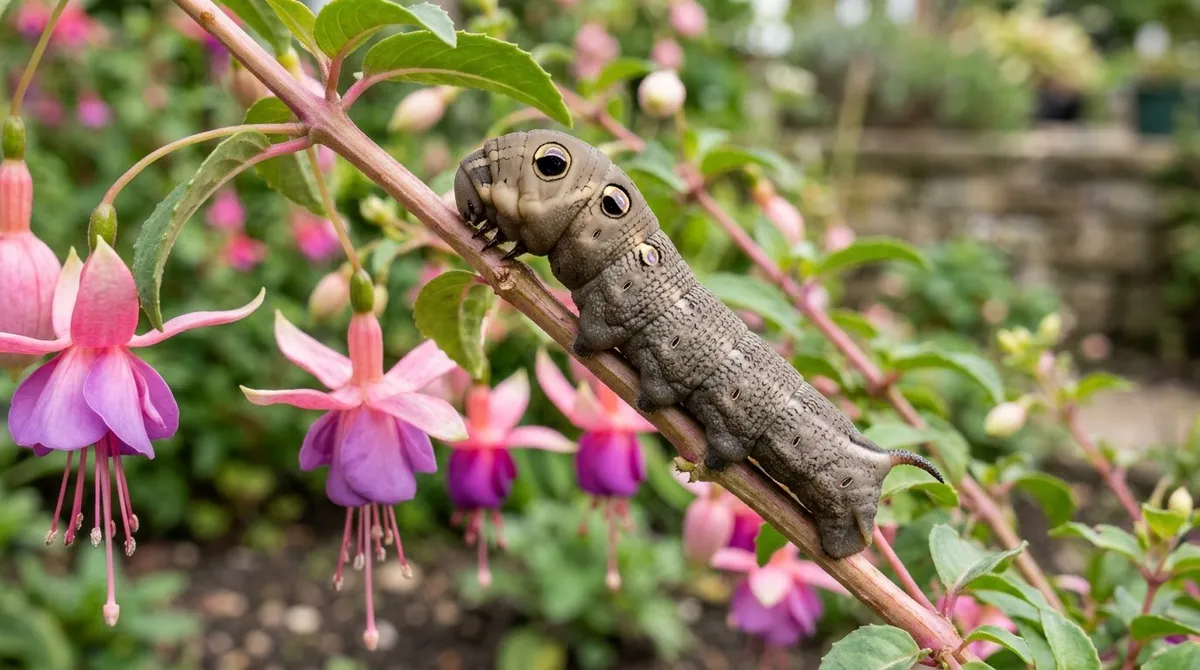
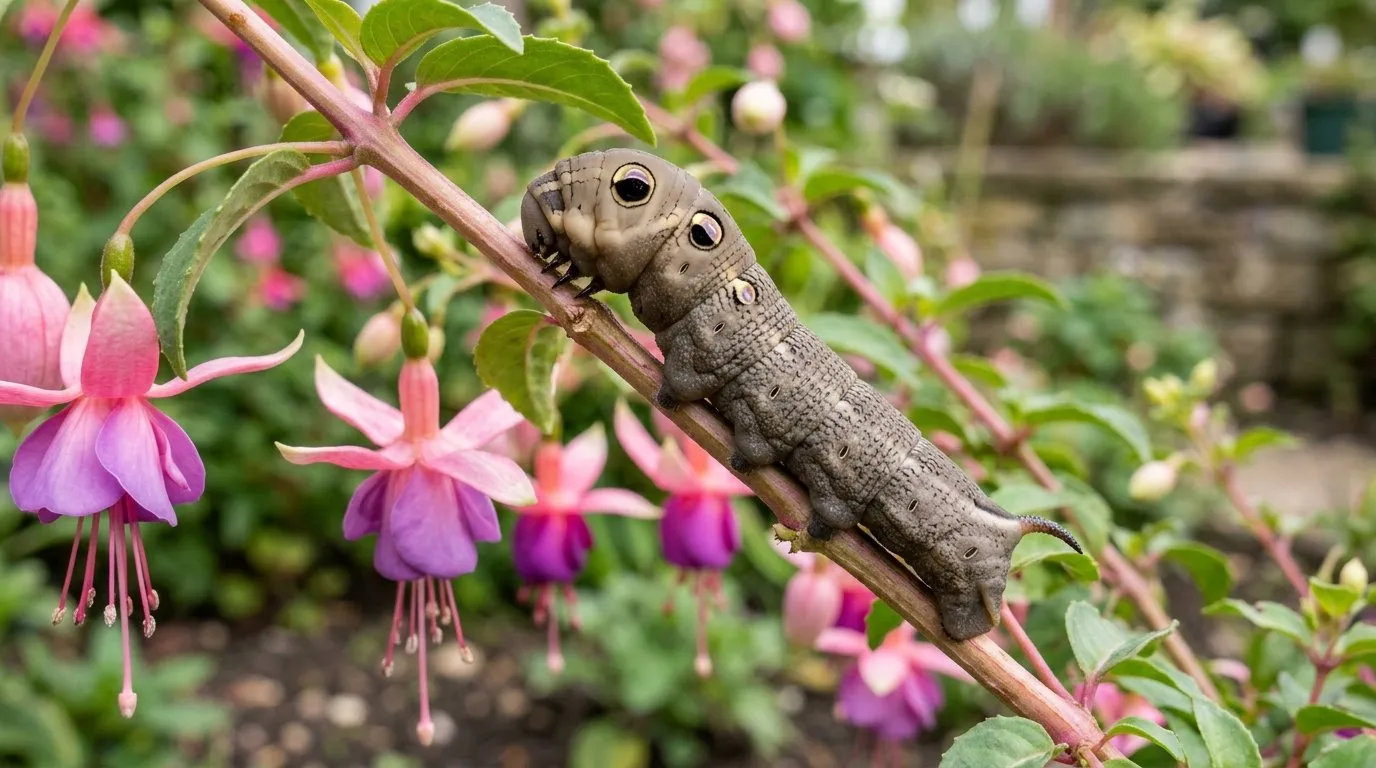 A full-grown elephant hawk moth caterpillar on a garden fuchsia. Thumb-thick, grey-brown, and completely harmless.
How do you identify an elephant hawk moth caterpillar?
Look for a thumb-thick grey-brown caterpillar up to 85mm long with four eye spots behind the head and a small curved horn on its tail. Those four features together are unmistakable. Nothing else in a UK garden matches all of them.
Work through the markings one at a time.
Size and colour. Full-grown it reaches 85mm, the length of a house key and about 15mm thick. Most are grey-brown with fine black speckling. The green form is a soft olive-grey. Newly hatched caterpillars are small, around 5mm, and bright green.
The four eye spots. Behind the head sit two pairs of large eye spots, black centres ringed with cream and lilac. They are the caterpillar’s main defence. They are not eyes and not a warning of poison. They simply make a bird think twice.
The tail horn. A short, backward-curving horn about 5mm long sits at the rear end. In this species it is blunt and glossy, not a sting. Every hawk-moth caterpillar carries one, and none of them can hurt you.
The snout. The tapering, retractable head end is the giveaway detail once you know it. Watch a feeding caterpillar and you will see it extend and pull in.
The famous snake-mimic display clinches the identification. Touch or disturb it and the caterpillar retracts its small head into the body, swells the front segments, and holds the eye spots forward. Some sway gently. To a hunting bird it reads as a small snake, and the bird moves on.
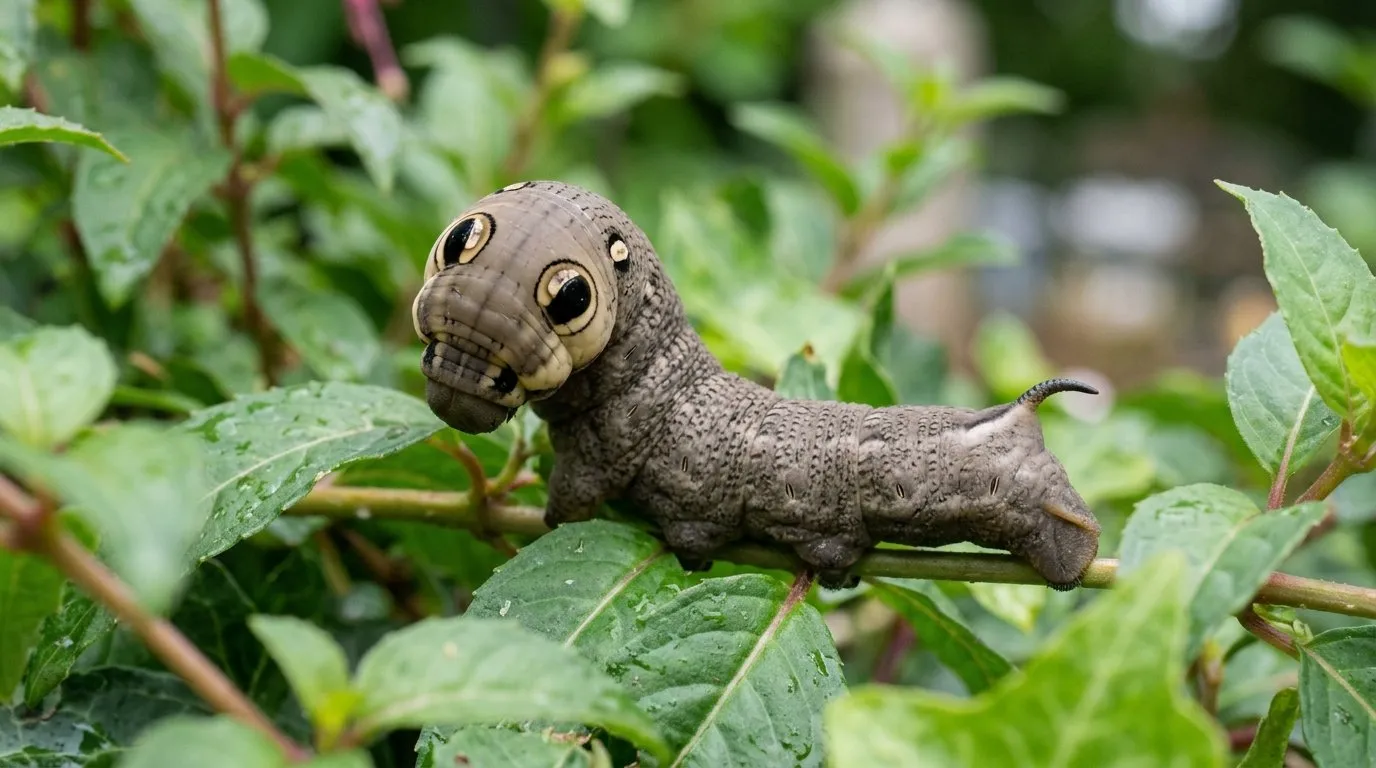 The snake display in close-up: head retracted, front segments swollen, eye spots forward. Pure bluff, and it works.
Elephant hawk moth caterpillar vs other hawk-moth caterpillars
Several large hawk-moth caterpillars turn up in UK gardens, and it helps to tell them apart. The elephant hawk moth is the one with eye spots on a grey-brown body. The table below covers the four you are most likely to meet.
| Caterpillar | Length | Colour | Eye spots | Tail horn | Main food plant |
|---|---|---|---|---|---|
| Elephant hawk moth | Up to 85mm | Grey-brown or green | Four, large | Short, blunt | Willowherb, fuchsia, bedstraw |
| Small elephant hawk moth | Up to 60mm | Grey-brown | Four, smaller | Tiny or absent | Bedstraws |
| Privet hawk moth | Up to 85mm | Bright green | None | Long, black and yellow | Privet, lilac, ash |
| Eyed hawk moth | Up to 80mm | Blue-green | None | Blue, curved | Willow, apple, sallow |
The small elephant hawk moth (Deilephila porcellus) is the easiest to confuse. It is shorter at up to 60mm, its eye spots are less bold, and it feeds mainly on bedstraws. The privet and eyed hawk moths are both bright green with no eye spots and a prominent tail horn, so a grey-brown body with staring spots rules them straight out. For a broader look at which garden insects earn their keep, our good and bad bugs guide is worth a read, though the elephant hawk moth sits firmly on the good side.
What do elephant hawk moth caterpillars eat?
They feed mainly on rosebay willowherb, bedstraws and garden fuchsias. In the wild, rosebay willowherb is the primary food plant, which is why they thrive on waste ground, railway banks and woodland clearings where it grows in drifts.
In gardens the story is different, and it is the reason most people meet the species at all. Elephant hawk moth caterpillars are famous for stripping fuchsias. The classic discovery is a favourite fuchsia reduced to bare stems overnight, with one or two giant caterpillars sitting there unrepentant. They will also take bedstraws, and occasionally Godetia, busy Lizzie and grapevine leaves.
Here is the part that matters. The damage looks dramatic but does almost no lasting harm. A fuchsia stripped in August puts out fresh growth and flowers normally the following summer. A garden fuchsia costs around £5 to £8 to replace, but you will rarely need to. Two or three caterpillars on one plant is the usual maximum, and they finish feeding within weeks.
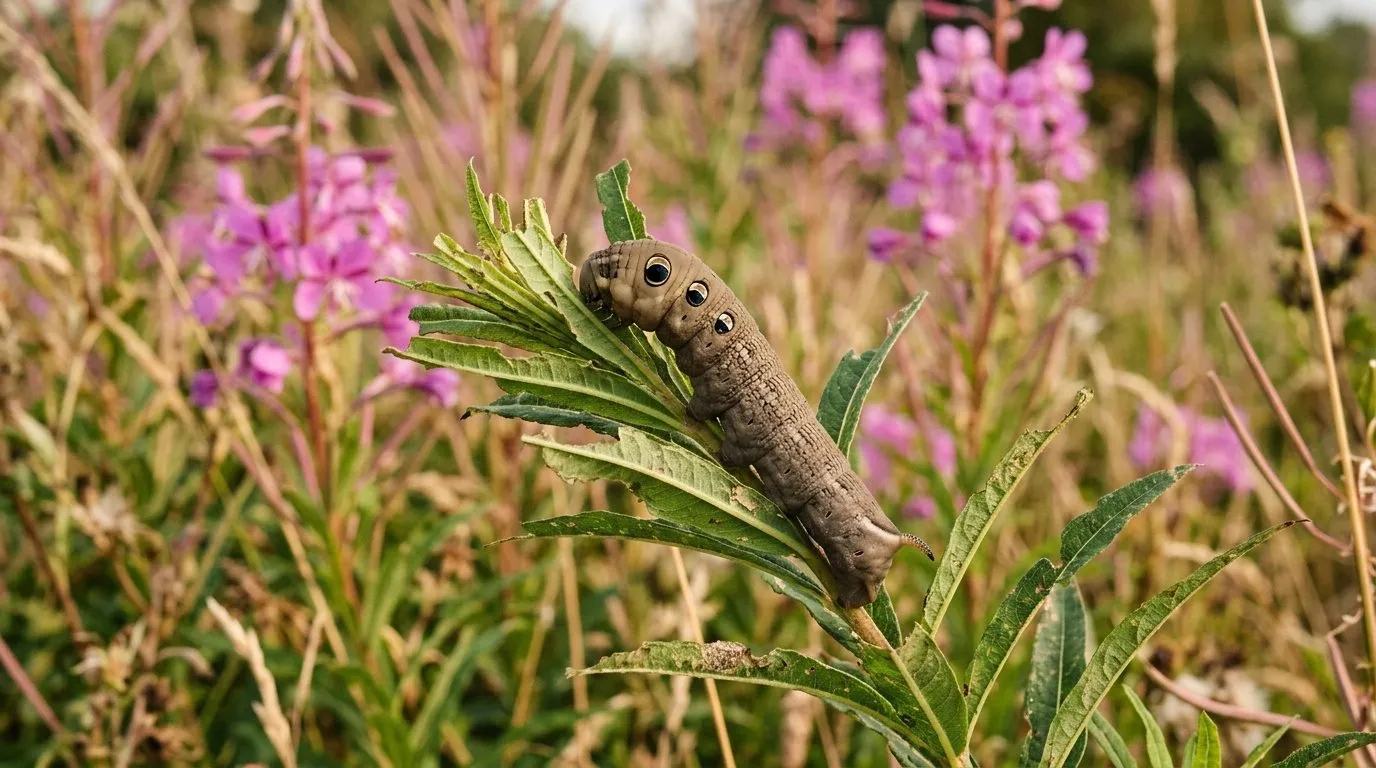 On rosebay willowherb, the main wild food plant. In gardens they switch happily to fuchsias.
What does the elephant hawk moth caterpillar turn into?
It turns into a pink and olive-green hawk-moth, one of the most beautiful insects you can see in a British garden. The lifecycle runs on a clear yearly cycle, and knowing it explains everything the caterpillar does.
The adult moth flies May to July. It has a wingspan of 45 to 60mm, olive-green forewings and body washed with bright rose-pink, and it flies at dusk and after dark. It feeds on the wing at tubular flowers, and it is an important night pollinator of honeysuckle, valerian and other evening blooms.
Eggs are laid in June and July. The female lays her small, round, glossy-green eggs singly or in pairs on the leaves of willowherb and fuchsia. Each is about 1mm across.
Caterpillars feed July to September. They hatch small and green, then grow through five stages over four to six weeks, darkening to the familiar grey-brown as they go.
It overwinters as a pupa. Once full-grown the caterpillar leaves its food plant, burrows into loose soil or leaf litter, and forms a mottled brown pupa. It spends around eight to nine months there before the adult emerges the next spring. Butterfly Conservation’s elephant hawk-moth page has the flight and distribution detail if you want to check records for your area.
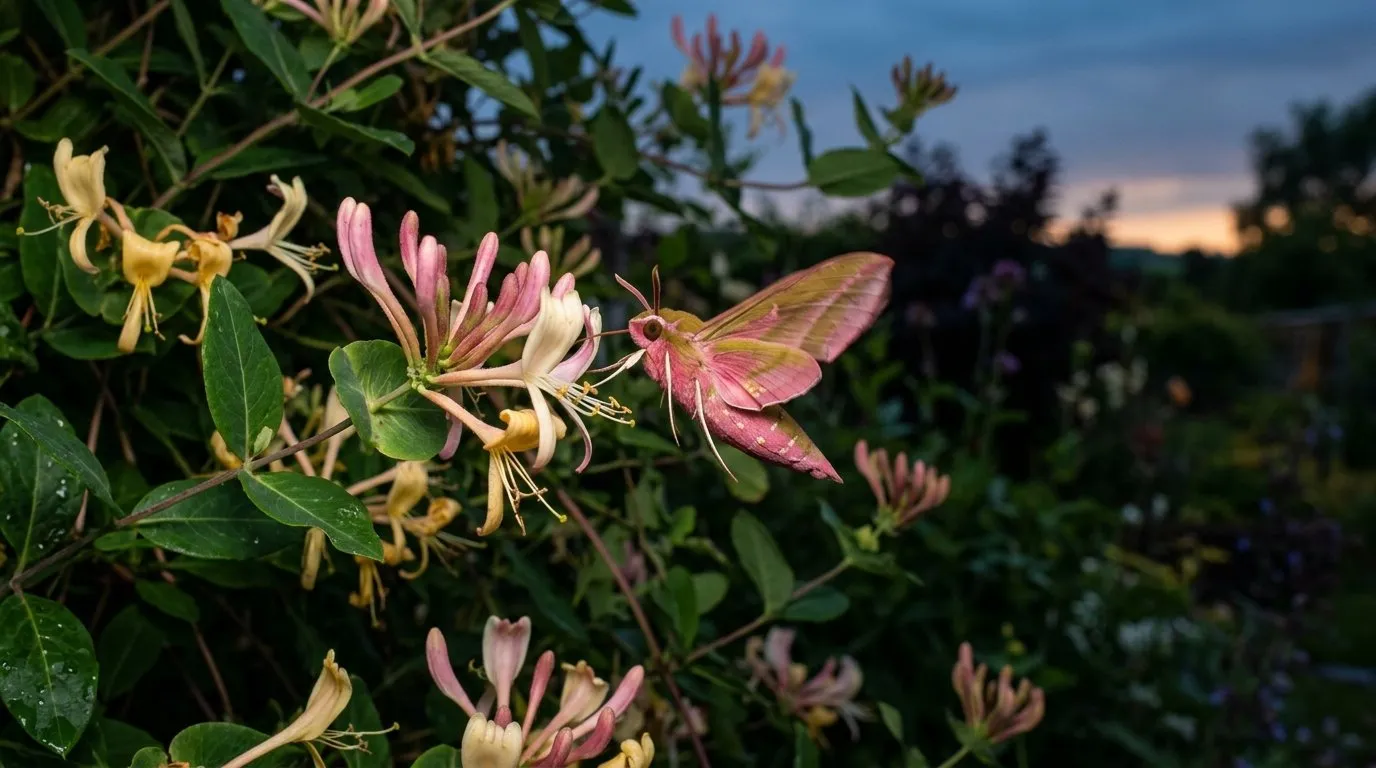 The adult on honeysuckle at dusk. Rose-pink and olive-green, and a genuine pollinator of night-scented flowers.
Why is the caterpillar crawling across my lawn or path?
A caterpillar crossing open ground in September is a fully grown one searching for somewhere to pupate. This wandering behaviour worries people, but it is completely normal and needs no intervention.
Once it has finished feeding, the caterpillar leaves its plant and travels, sometimes several metres, looking for loose soil or leaf litter to burrow into. It may cross a lawn, a patio or a gravel path in broad daylight. It is not lost, sick or in danger.
The best thing you can do is nothing. If it is heading somewhere risky, a busy path or a road edge, nudge it onto a leaf and set it down at a quiet border. Do not take it indoors to “rescue” it. A warm house disrupts the pupation trigger and it needs the cold of a British winter to develop properly. The Wildlife Trusts’ elephant hawk-moth guide confirms the same advice: leave wandering caterpillars to find their own way.
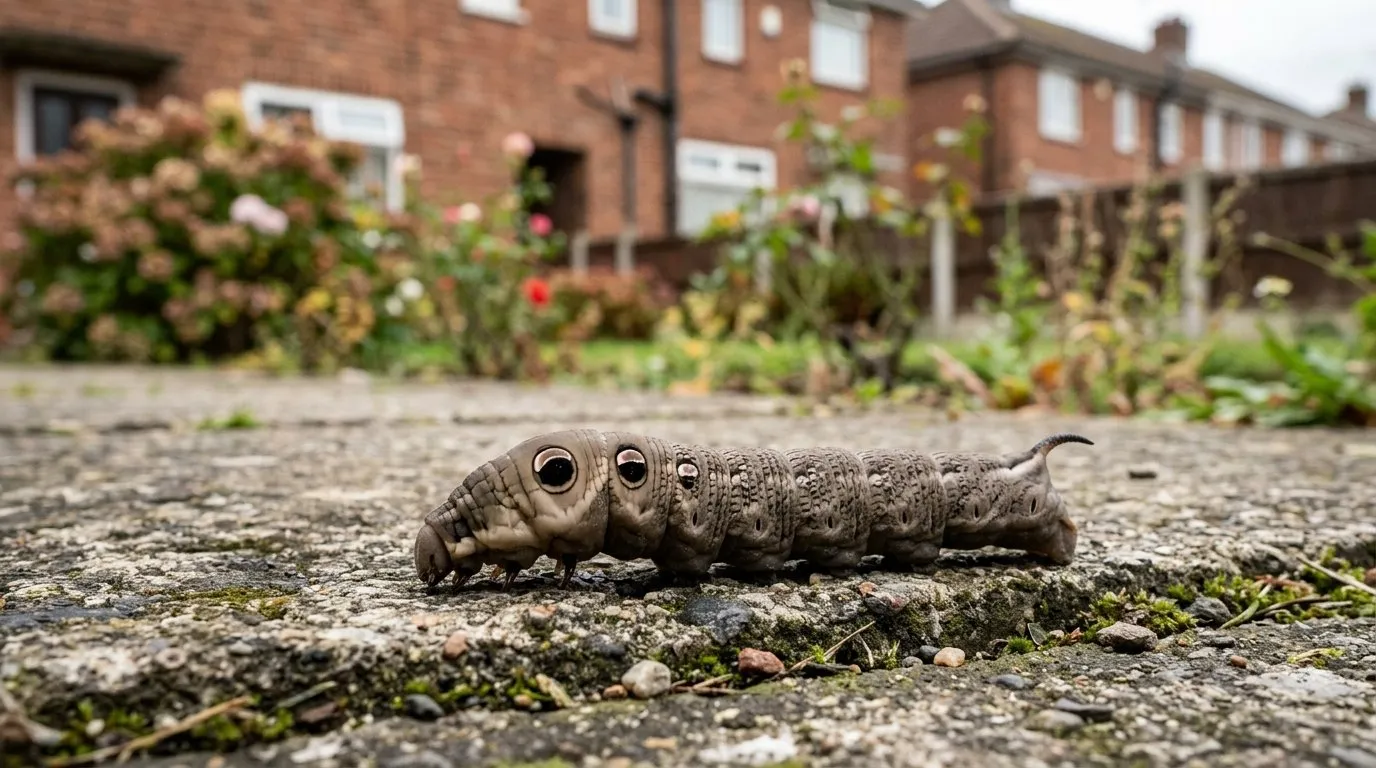 A full-grown caterpillar crossing a path in September, hunting for a pupation site. Let it carry on.
What should I do if I find an elephant hawk moth caterpillar?
Leave it alone, or move it a short distance to safety. That is the whole answer. There is no need to kill it, spray it or call anyone.
If it is on a fuchsia you would rather protect, lift it gently with a leaf and carry it to a patch of rosebay willowherb or a bedstraw-rich corner. It will settle within minutes. If you have no willowherb, another fuchsia or a quiet border edge will do. If it is wandering in September, only move it if it is somewhere genuinely dangerous.
 A safe close encounter. Watching the display is one of the best natural lessons in a garden.
How to help elephant hawk moths in your garden
Encouraging elephant hawk moths takes almost no effort and fits any wildlife-friendly plot. The species needs three simple things: food plants for the caterpillars, nectar for the adults, and undisturbed ground to pupate in.
Leave a patch of willowherb. A wild corner with rosebay willowherb is the single best thing you can offer. It is the main caterpillar food plant and it doubles as nectar for bees. A wildlife-friendly garden with a deliberate wild patch supports the whole lifecycle.
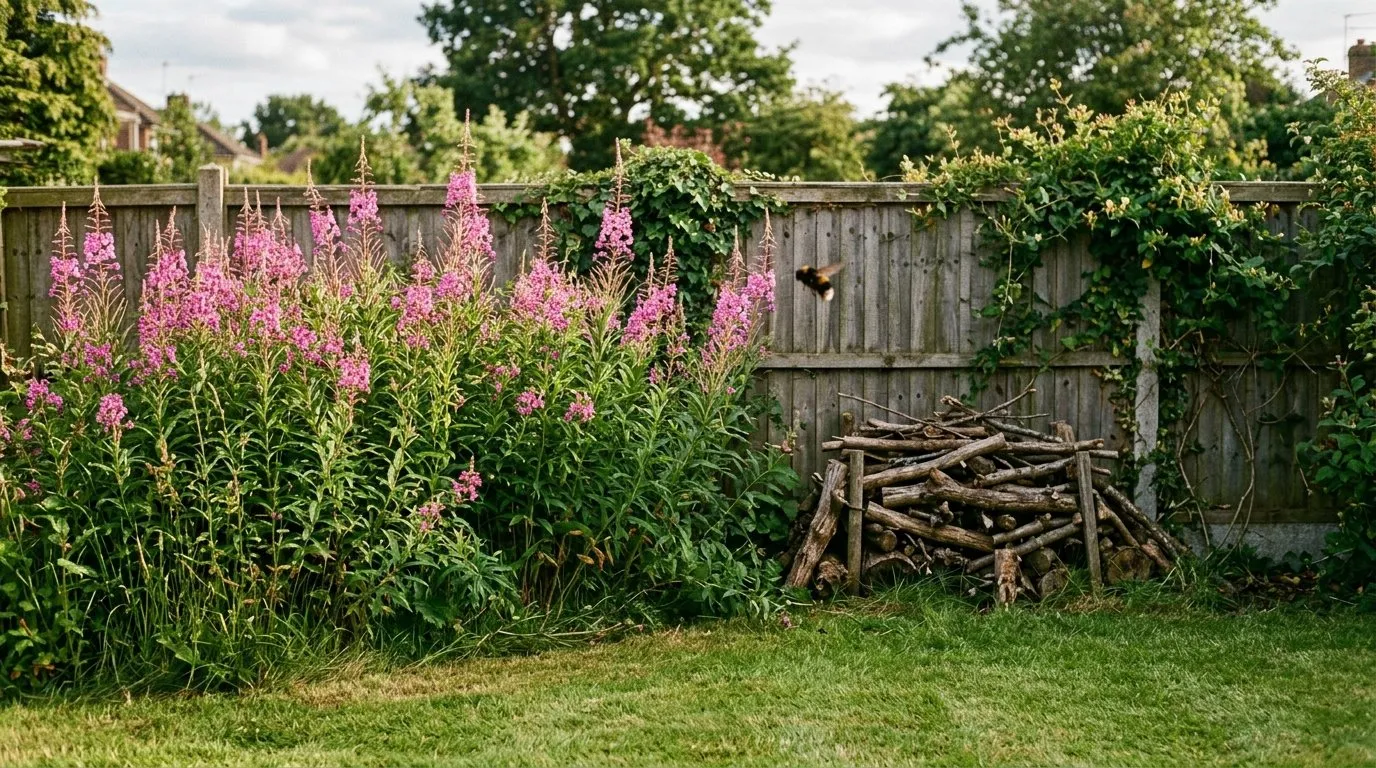 A wild willowherb patch in a garden corner: the main caterpillar food plant and nectar for bees.
Grow night-scented nectar. Honeysuckle, valerian and tobacco plant feed the adults at dusk. A habitat-first garden design works these in from the start.
Keep loose leaf litter and soft ground. The pupa spends winter in leaf litter or the top few centimetres of loose soil. A leaf mould heap or an undisturbed border edge is ideal, and a log pile adds cover nearby.
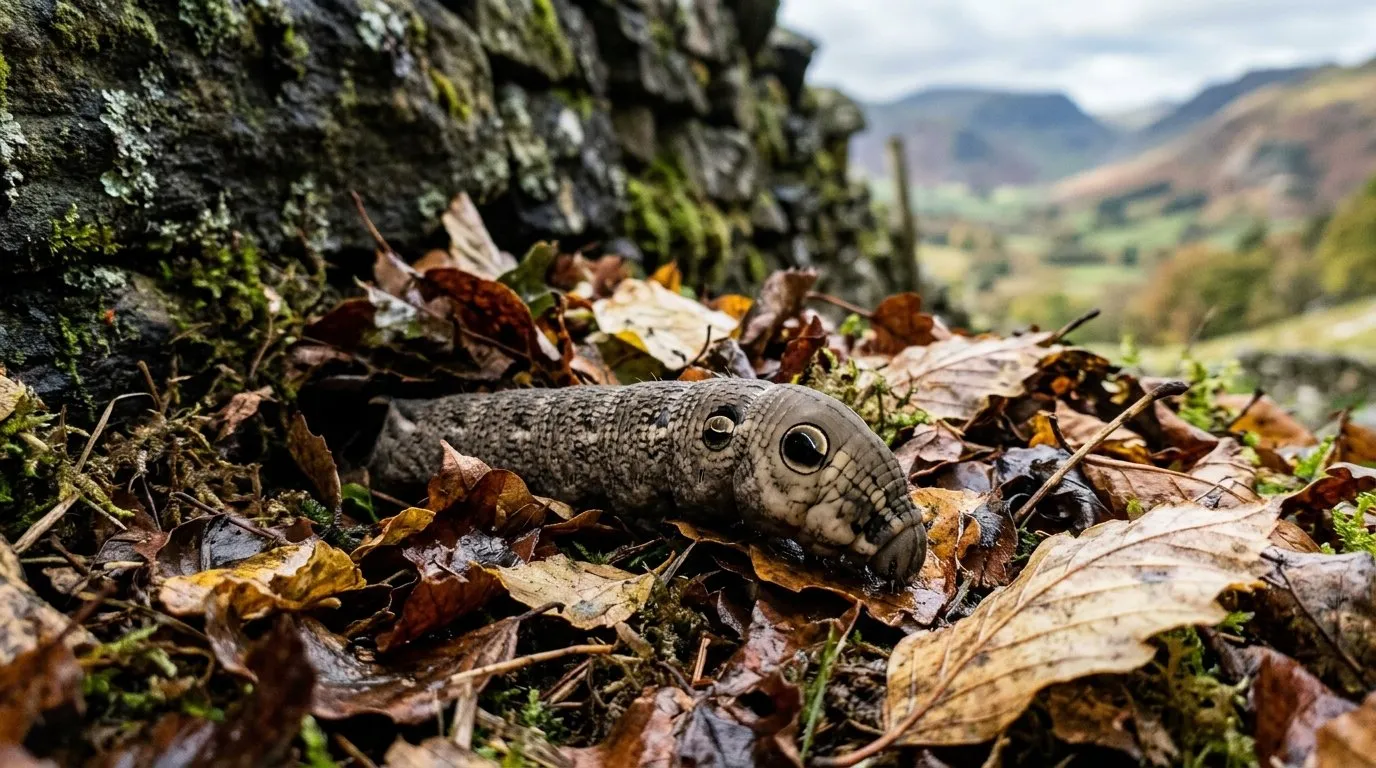 Full-grown caterpillars burrow into leaf litter or loose soil to pupate. Leave that ground undisturbed over winter.
Frequently asked questions
Is the elephant hawk moth caterpillar dangerous?
No, it is completely harmless to people, pets and plants. It has no sting, no venom and no irritating hairs. It cannot bite you. The snake-like display it makes when touched is pure bluff to scare off birds. You can pick it up safely, though it is kinder to move it by nudging it onto a leaf.
What is the huge brown caterpillar with eyes in my garden?
It is almost certainly an elephant hawk moth caterpillar. This grey-brown grub reaches 85mm long and has four eye spots behind its head. It is the commonest large caterpillar found in UK gardens in late summer, usually on fuchsias or willowherb. The eye spots are a harmless defence, not a warning of poison.
What do elephant hawk moth caterpillars eat?
They mainly eat rosebay willowherb, bedstraws and garden fuchsias. In the wild, rosebay willowherb is the main food plant. In gardens they are famous for stripping fuchsias, which is how most people first meet them. The damage looks alarming but the fuchsia almost always recovers and reflowers the next year.
Should I kill the caterpillar eating my fuchsia?
No, please leave it alone or move it. The elephant hawk moth is a valued native species and a pollinator. A fuchsia stripped in August recovers by the following summer. If you cannot bear the damage, lift the caterpillar gently and move it to a patch of willowherb rather than harming it.
Why is the caterpillar crawling across my lawn or path?
It is a fully grown caterpillar looking for somewhere to pupate. In September they leave their food plant and wander over lawns, paths and patios searching for loose soil or leaf litter. This is normal and healthy. Do not rescue it indoors. Just let it carry on, or move it to a quiet border edge.
What does the elephant hawk moth caterpillar turn into?
It becomes a pink and olive-green hawk-moth. After overwintering as a brown pupa in soil or leaf litter, the adult emerges the following May to July. It has a wingspan of 45 to 60mm and feeds at dusk on honeysuckle and other tubular flowers, making it an important night pollinator.
How long do elephant hawk moth caterpillars live before pupating?
They feed for about four to six weeks from July to September. Newly hatched caterpillars are small and green, darkening to grey-brown as they grow through five stages. Once full-grown at up to 85mm they stop feeding, empty their gut, and go underground to pupate for the winter.
Our team produces practical UK gardening guidance from source research, contributor records and established horticultural practice. Editorial standards are overseen by Matt W.