Key takeaways
- The common green shield bug (Palomena prasina) is native, 12-14mm, and largely harmless
- It turns from bright green in summer to bronze-brown before overwintering as an adult
- Shield bugs are stink bugs: they release a smell when handled, which deters predators
- The invasive southern green stink bug (Nezara viridula) is the one that damages crops
- Nezara is spreading in southern England and can spot beans, tomatoes and peppers
- In most UK gardens no control is needed: the green shield bug is part of the wildlife
If you have found a bright green, shield-shaped bug on your beans or fruit and wondered whether to worry, the short answer is almost certainly no. That is the common green shield bug, Palomena prasina, a native UK insect around 12-14mm long that is a friend rather than a foe in the garden. It feeds lightly on plant sap but causes no real damage, and it is food for the birds. The one shield bug worth knowing about is a different, invasive species spreading in the south, and telling them apart is easy once you know the marks.
This guide covers how to identify the green shield bug, its curious colour change through the year, its lifecycle from barrel-shaped egg to adult, the honest friend-or-foe verdict, and how to tell the harmless native from the invasive southern green stink bug that genuinely damages crops.
What a green shield bug looks like
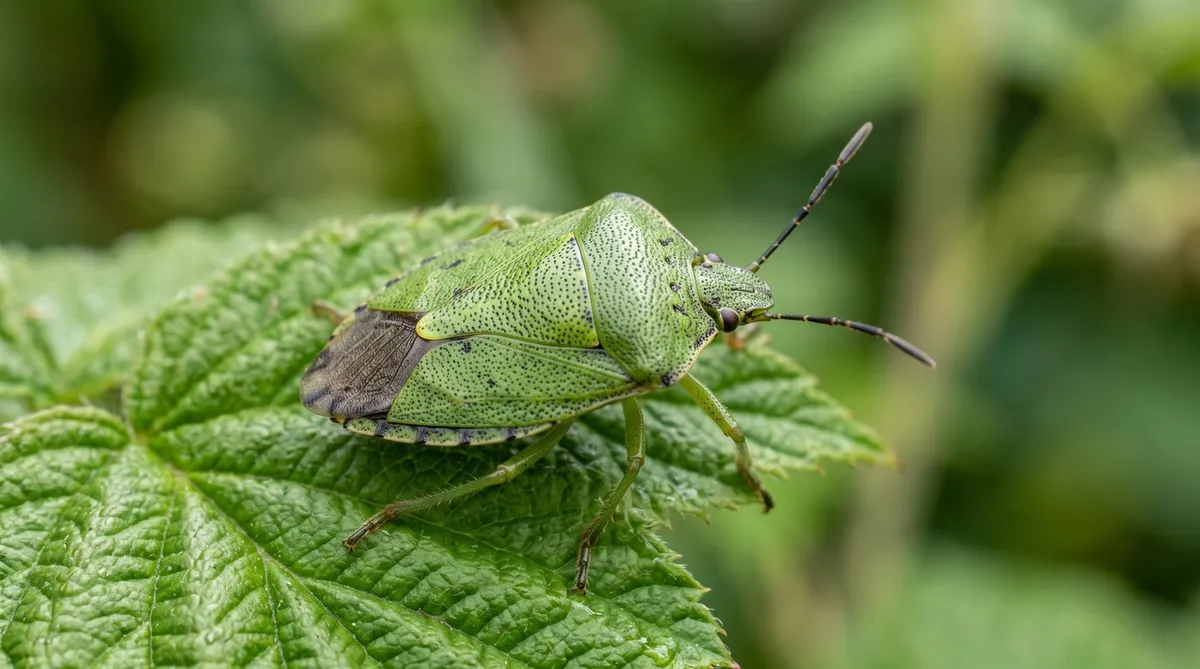
The common green shield bug is unmistakable once you have the key features. It is a flat, broad, shield-shaped insect, 12-14mm long, with a bright green body finely dotted with dark punctures. The tips of the folded wing membranes, which lie over the back, are a translucent brown, giving a small dark patch at the rear of the shield. The antennae are long and green with darker tips.
Its most curious feature is that it changes colour with the season. Through spring and summer it is a fresh, bright green that blends with foliage. In autumn, before it hibernates, it darkens to a bronze or brownish shade that camouflages it among dead leaves and bark. It overwinters as an adult, tucked into leaf litter or a sheltered crevice, and turns green again in spring when it becomes active. A brown shield bug in October and a green one in June can be the very same insect.
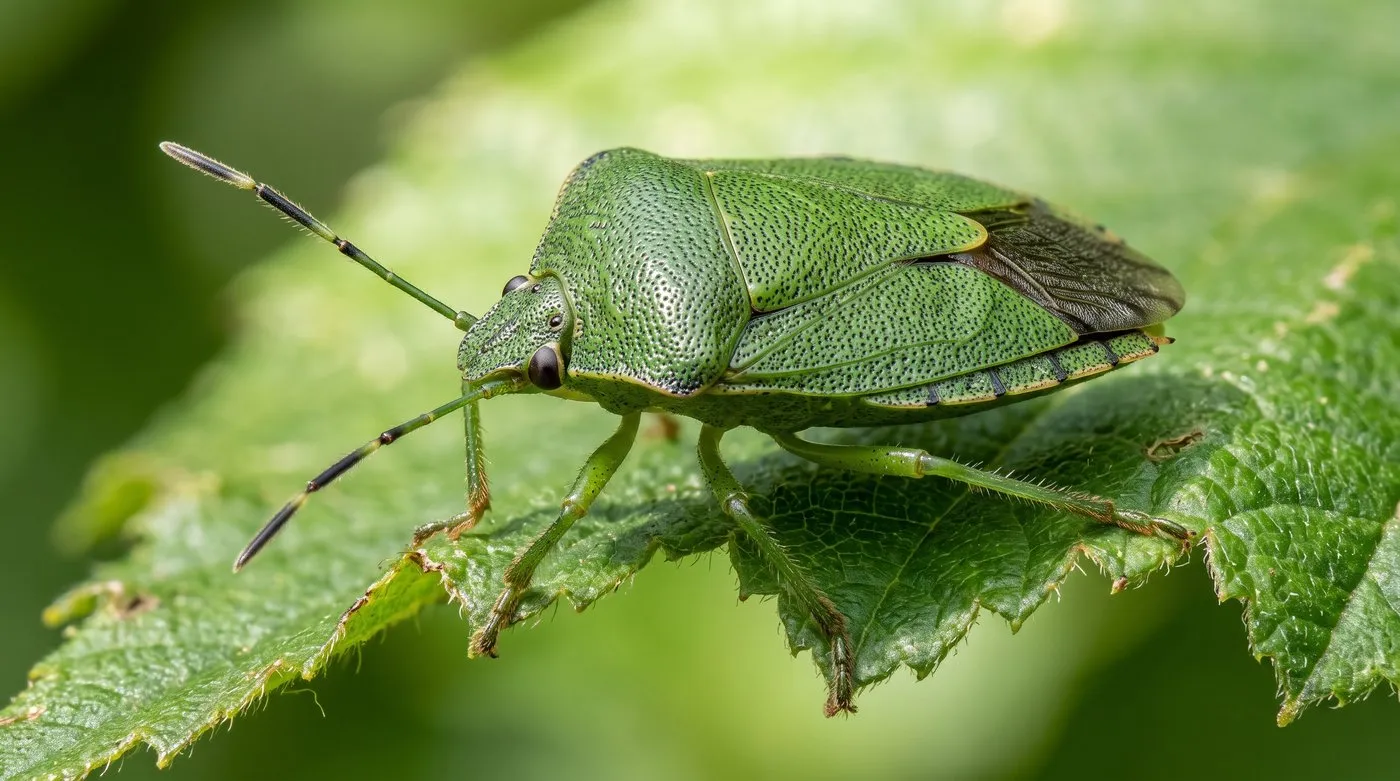 The common green shield bug, around 12-14mm, with its broad shield outline, fine dark punctures and dark-tipped wing membranes at the rear.
The lifecycle: egg, nymph, adult
Understanding the lifecycle explains the odd-looking bugs you find alongside the familiar green adult, because the young stages look nothing like their parents.
- Overwintering adults, autumn to spring. Bronze-brown adults hibernate through winter in leaf litter and sheltered spots. They emerge and turn green in April-May.
- Eggs, early summer. After mating, females lay neat clusters of barrel-shaped eggs, often a couple of dozen at a time, on the undersides of leaves. The eggs are pale and geometrically arranged.
- Nymphs, summer. The hatchlings are nymphs, rounder than the adults and wingless, and often boldly patterned in black, green, red and cream. They pass through five instars, moulting and changing pattern at each, over several weeks.
- New adults, late summer. By August-September the nymphs reach the adult stage, feed to build reserves, and darken to bronze for winter.
- One generation a year. In the UK the green shield bug completes a single generation annually, so the cycle repeats each year.
The practical point is that the patterned nymphs are not a different pest. Gardeners who recognise the green adult sometimes panic at the black-and-red juveniles on a leaf underside, but they are the same harmless species growing up. No stage needs controlling.
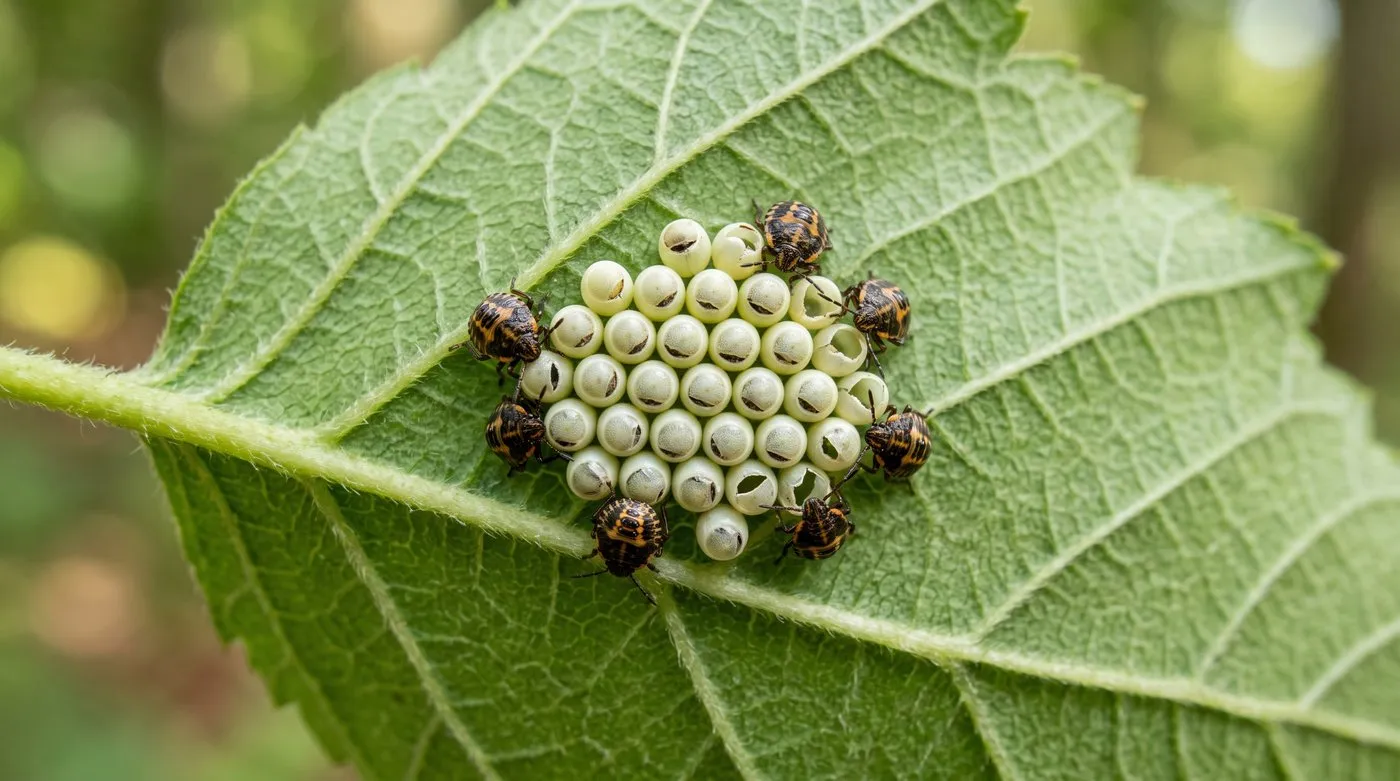 Barrel-shaped eggs and early nymphs on a leaf underside. The boldly patterned young look nothing like the green adult but are the same harmless species.
Friend or foe: the honest verdict
The genuine question is whether the green shield bug damages your plants, and the honest answer is: almost never enough to matter.
Set against that trivial cost is a real benefit: shield bugs are part of the food web. They are eaten by birds, spiders and other predators, and they are simply part of a healthy garden’s biodiversity. Killing them achieves nothing useful and removes a link in that chain.
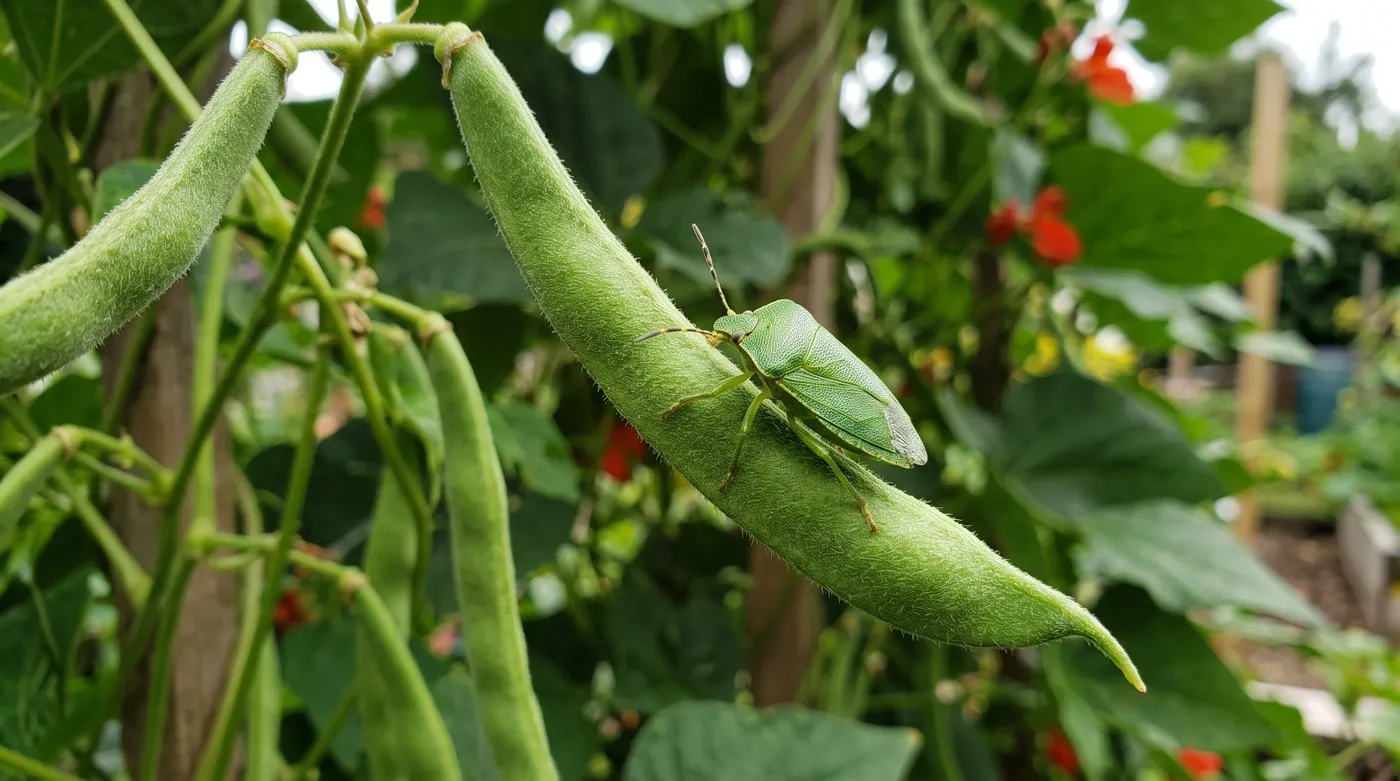 Green shield bugs turn up on beans and fruit but feed lightly. In normal garden numbers the native species causes no damage worth acting on.
The one to watch: southern green stink bug
There is a single shield bug that genuinely earns the label pest, and telling it from the native is the most useful skill in this guide.
The southern green stink bug, Nezara viridula, is an invasive species that established in London around 2003 and has been spreading north and west across southern England since, helped by warmer conditions. Unlike the native, it is a recognised crop pest that damages beans, tomatoes, peppers, sweetcorn and soft fruit, causing spotting, distortion and hard patches on fruit where it has fed.
The two look similar at a glance, both being green shield bugs of about the same size, but the marks separate them:
- Small pale spots on the thorax. Nezara usually shows a row of three to five small pale dots along the front edge of the pronotum, just behind the head. The native Palomena lacks these.
- No autumn colour change. Nezara stays a clean, uniform bright green and does not turn bronze in autumn the way the native does.
- Wing membrane. The native has those brownish, dark-tipped wing membranes at the rear; Nezara is more uniformly green.
If you garden in southern England and find a green shield bug with the pale thoracic dots that stays green into late autumn, it may be Nezara, and it is worth removing by hand and reporting to a recording scheme. North of the Midlands it is still unlikely. Records help track the spread, and hand-picking is the sensible response, since there is no call for insecticides against it in a garden.
Gardener’s tip: Do not reach for a spray on any shield bug. Even the invasive Nezara is best dealt with by hand-picking the few you find, because a broad insecticide kills the ladybirds, lacewings and predators doing useful work far more reliably than it controls a large, mobile bug.
Common UK shield bugs at a glance
Several shield bugs turn up in UK gardens, and most are harmless natives. This table sorts the ones you are most likely to meet.
| Shield bug | Size | Look | Garden impact |
|---|---|---|---|
| Common green shield bug (Palomena prasina) | 12-14mm | Bright green, bronze in autumn, dark wing tips | Harmless native, no control needed |
| Southern green stink bug (Nezara viridula) | 12-15mm | Clean green, pale dots on thorax, stays green | Invasive pest of beans, tomatoes, peppers in the south |
| Hawthorn shield bug (Acanthosoma haemorrhoidale) | 15-17mm | Green with red-brown triangular markings | Harmless, feeds on hawthorn and trees |
| Forest bug (Pentatoma rufipes) | 11-14mm | Dark brown with orange legs and shoulders | Harmless, mostly on trees, minor on fruit |
| Gorse shield bug (Piezodorus lituratus) | 10-13mm | Green, purplish band in spring | Harmless native of gorse and legumes |
The single row that matters for control is the second one, and only in the south. Everything else on this list is a native you can enjoy and ignore. If you are unsure which you have, the pale thoracic dots and the autumn colour test settle the common green pair.
 Shield bugs are harmless to handle. A close look at the thorax and the autumn colour tells the native from the invasive southern green stink bug.
What to do about green shield bugs
For the native green shield bug, the answer is refreshingly short: nothing. No control is needed or justified. Enjoy them as part of the garden’s life, show the patterned nymphs to any children about, and let the birds have their share.
 Harmless and slow-moving, shield bugs are perfect for showing children the garden’s wildlife up close. No stage of the native species bites, stings or needs control.
If you specifically want fewer shield bugs on a prized crop, the only sensible measures are physical: fine mesh netting over vulnerable beans or fruit excludes them, and hand-picking removes the odd one. Neither is really necessary for the native. A tidy autumn clear-up reduces overwintering shelter, but since the bug is harmless, there is little reason to bother on its account.
Common misunderstandings about shield bugs
- Assuming any green shield bug is a pest. The common native does no real harm. Only the invasive southern green stink bug, in the south, is worth acting on.
- Panicking at the patterned nymphs. The black, green and red young look alarming but are the same harmless species growing up. No stage needs control.
- Thinking the brown autumn bug is a different insect. It is the same green shield bug, darkened for winter camouflage. It greens up again in spring.
- Reaching for a spray. Insecticides kill the ladybirds and lacewings doing useful work more reliably than they control a large, mobile shield bug. Hand-pick if you must act.
- Ignoring the ID that matters. In southern England, the pale dots on the thorax and a bug that stays green into late autumn are worth a second look for Nezara.
The short version on the green shield bug
The bright green shield bug on your beans is a native, it is harmless, and it is a friend to a healthy garden more than a foe to your crop. It changes from green in summer to bronze in autumn, lays neat barrel-shaped eggs, and raises boldly patterned young that look nothing like the adults. None of it needs controlling. Leave them for the birds.
The only shield bug worth a second glance is the invasive southern green stink bug in southern England, told apart by the pale dots on its thorax and its refusal to turn bronze in autumn. Hand-pick and report that one, but spray nothing. For more of the garden’s useful and harmless residents, browse the wildlife section, and the RHS guidance on shield bugs is a sound second reference on the UK species.
Frequently asked questions
Are green shield bugs harmful to my garden?
No, the common green shield bug is largely harmless to a UK garden. It feeds lightly on plant sap but rarely causes damage worth acting on. You will find them on beans, fruit and many other plants in summer without any real harm to the crop. They are a native part of the garden’s insect life, not a pest to control.
How do I identify a green shield bug?
A bright green, flat, shield-shaped insect about 12-14mm long. The common green shield bug (Palomena prasina) has a broad shield outline, green body with fine dark punctures, and dark-tipped wing membranes. In autumn it turns bronze-brown before hibernating. It changes back to green in spring. Handle one and it releases a faint smell.
Do green shield bugs bite or sting?
No, green shield bugs do not bite or sting people. They feed only on plants, using a slender mouthpart to suck sap, and cannot pierce skin. They are completely harmless to handle. Their only defence is the smell they release when disturbed, which is why the family is also called stink bugs. They pose no danger to people or pets.
What is the difference between a green shield bug and a stink bug?
They are the same thing: shield bugs are stink bugs. The name stink bug comes from the smelly fluid they release when handled. In the UK the common green one is the native Palomena prasina. The term stink bug is often used for the invasive Nezara viridula, the southern green stink bug, which is a genuine crop pest.
Should I kill green shield bugs?
No, there is no need to kill the native green shield bug. It does no meaningful damage and is food for birds and other wildlife. Simply leave it be. The only shield bug worth removing is the invasive southern green stink bug (Nezara viridula) in southern England, where it can damage beans, tomatoes and peppers.
Why is my green shield bug brown?
It is the same species changing colour for winter. The common green shield bug turns bronze-brown in autumn before it overwinters as an adult in leaf litter or sheltered spots. This darker colour camouflages it among dead leaves. In spring it turns bright green again as it becomes active. A brown autumn shield bug is not a different insect.
Are shield bug eggs a problem?
No, shield bug eggs are harmless and interesting to spot. The green shield bug lays neat clusters of barrel-shaped eggs on the undersides of leaves in early summer. The nymphs that hatch are rounder and often patterned black, green and red, changing as they grow. None of these stages causes damage worth controlling in a UK garden.
Our team produces practical UK gardening guidance from source research, contributor records and established horticultural practice. Editorial standards are overseen by Matt W.