Key takeaways
- Red mason bees and leafcutter bees use them; both are solitary, non-aggressive and don't sting or swarm
- Drill untreated hardwood with 6mm and 8mm holes, 15cm deep, smooth-bored and sealed at the back
- Bamboo, reed or cardboard tubes work too, but they must be removable for cleaning
- Site it 1-1.5m up, south or south-east facing, in full morning sun, fixed firm near flowers
- Avoid plastic tubes; they sweat and grow mould that kills the larvae
- Clean or replace tubes every autumn; never build a giant uncleaned 'bee hotel' wall
A UK bee house is one of the few wildlife projects you can build in an afternoon and have occupied within weeks. The trick is in the detail: hole size, smooth bores, the way it faces, and whether you ever clean it. Get those right and you raise dozens of red mason bees a year. Get them wrong and you build a parasite trap.
After 6 seasons of running two bee houses at Staffordshire, the lessons are clear. Small and clean beats big and neglected. Siting matters more than the build. The bees that move in never sting you.
Which Bees Actually Use a Bee House
Bee houses are for solitary bees, not honeybees or bumblebees. Two species do nearly all the work in a UK garden.
The red mason bee (Osmia bicornis) is the main resident. It is a stocky, ginger-brown bee active from late March to June. The female fills each tube with pollen, lays an egg, and seals the cell with mud. She works alone, with no queen and no colony.
The leafcutter bees (Megachile species) arrive later, from June into August. They line their cells with neat discs cut from rose and shrub leaves. The semi-circular notches in your rose foliage are their signature, and the plant is unharmed.
They are also superb pollinators. A single red mason bee does the pollination work of many honeybees, because she carries dry pollen on her belly and visits flowers fast and untidily. For a fruit garden, they are worth far more than their size suggests. The solitary bees garden guide covers the wider species you can support beyond a bee house.
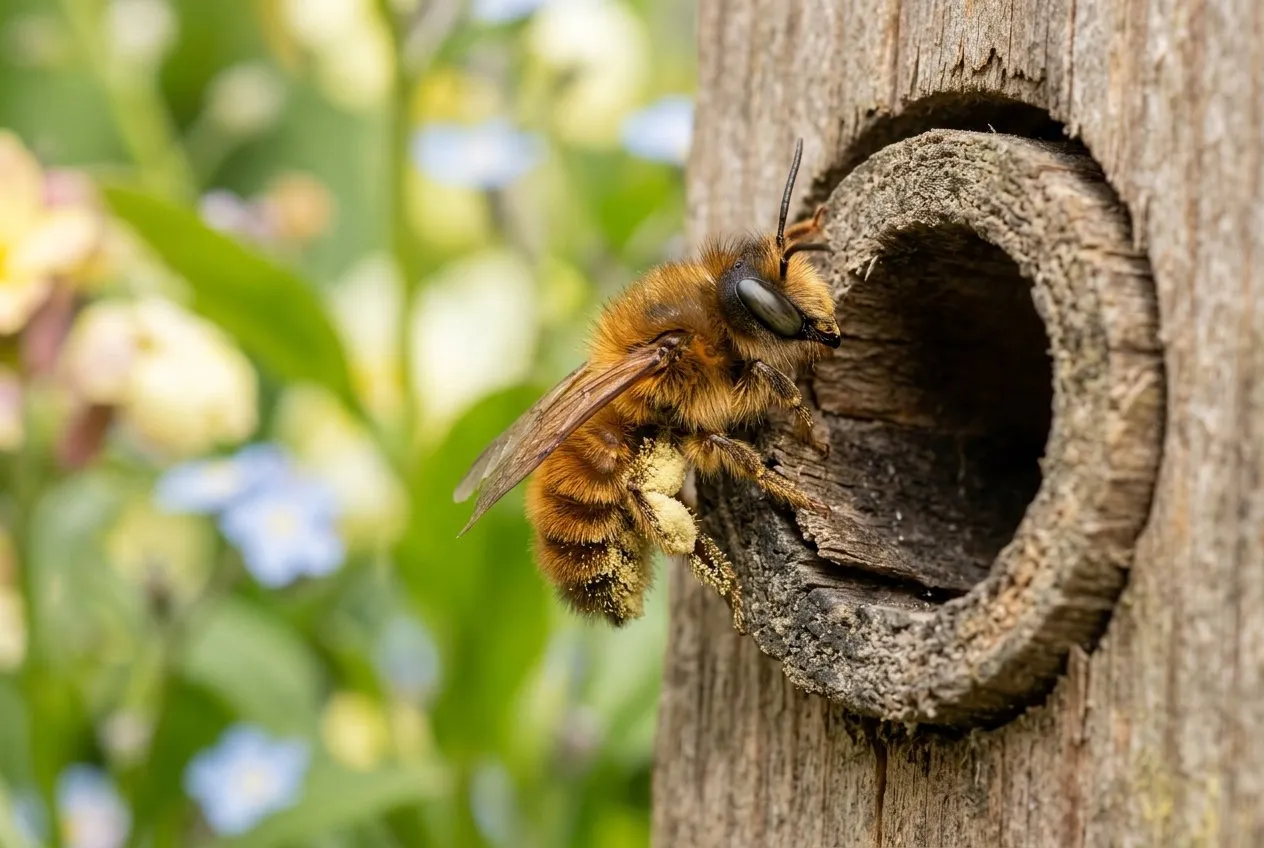
How to Build a Bee House From a Hardwood Block
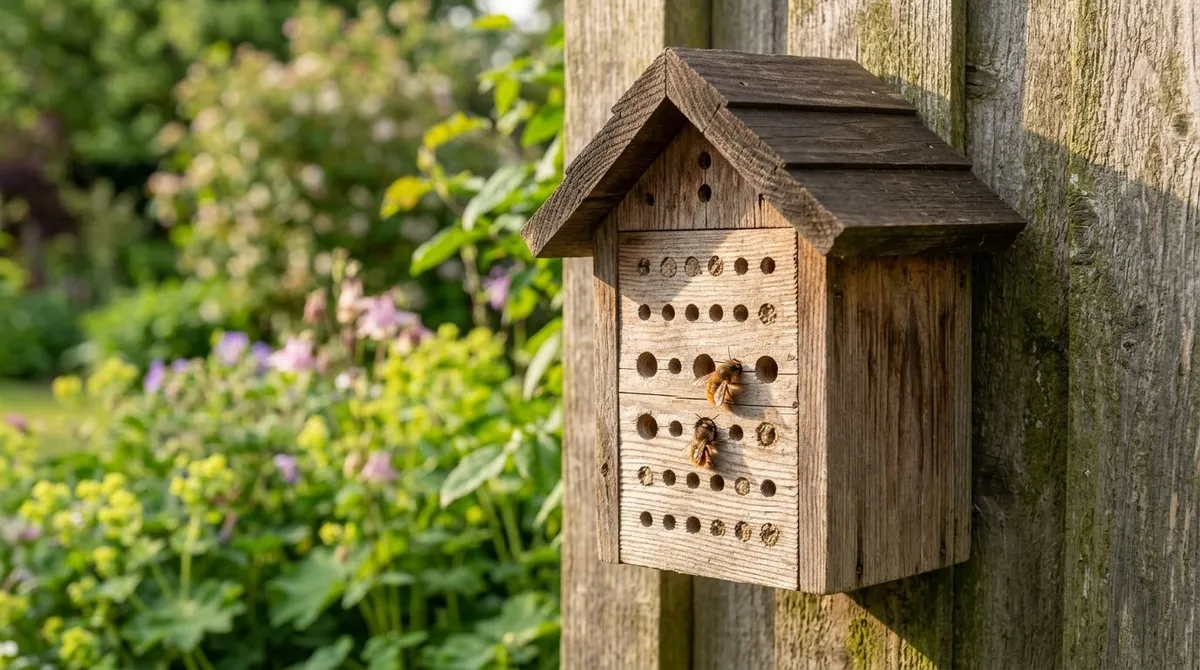
The most durable bee house is a single drilled block of untreated hardwood. It lasts years and you can scrub it clean.
Start with seasoned, untreated hardwood: oak, beech or ash, at least 18cm deep. Never use treated, painted or pressure-preserved timber, because the chemicals harm the larvae. Avoid soft, resinous softwood too; it splinters as it dries and the bees reject it.
Drill a mix of 6mm and 8mm holes, the two sizes solitary bees use most. Make them about 15cm deep, spaced 15-20mm apart. Importantly, do not drill all the way through. The back of every hole must be sealed, so the bees have a dark dead-end to nest against. Keep the bores dead horizontal, or angled very slightly upward, so rain drains out rather than pooling inside.
Then smooth every bore. Run a round file or rolled sandpaper through each hole to strip out splinters. This step is the one most people skip and it is the one that decides occupancy. Solitary bees will not nest in a rough tunnel, because the splinters tear their wings as they back in and out.
Building a Bundle From Bamboo or Reed Tubes
If you would rather not drill, bundle hollow stems instead. Bamboo canes, reed, teasel or cardboard tubes all work, and a bundle is quick to make.
Cut each stem to about 15cm, sawing just behind a node so the back end stays sealed. Aim for inner diameters in the 4-10mm range, with a mix of sizes to suit different species. Pack the tubes tightly into an open-ended tin, length of drainpipe or timber frame, cut ends facing forward. Sand any sharp or split rims smooth.
One material to avoid entirely: plastic tubes. They look tidy but they sweat. Condensation builds inside the smooth plastic, mould grows, and the developing larvae rot. Glass test tubes have the same fault. Natural stems and cardboard breathe, so the nests stay dry.
The Design Rules That Actually Matter
Most failed bee houses fail on the same handful of details. Get these right and the rest is forgiving.
| Design feature | Get it right | Get it wrong |
|---|---|---|
| Hole diameter | 4-10mm, mostly 6mm and 8mm | Over 10mm; mostly ignored |
| Hole depth | About 15cm, sealed back | Too shallow; skews sex ratio to males |
| Bore finish | Smooth, splinter-free | Rough; bees reject it |
| Tube material | Wood, bamboo, reed, card | Plastic or glass; sweats and moulds |
| Tubes | Removable for cleaning | Fixed; cannot be cleaned |
| Roof | 4-5cm overhang | None; rain floods entrances |
Two rules carry the most weight. First, removable or replaceable tubes are essential, because a house you cannot clean becomes a disease trap. Second, add a roof with a real overhang. A 4-5cm sloping roof keeps rain off the entrance face, and a dry face means no mould. A bee house that gets wet inside is finished within a season.
Where to Site a Bee House for Maximum Use
Siting matters more than the build. The same house empty on a shaded north wall fills up fast on a sunny south one.
Face it south or south-east, so it catches the full morning sun. Solitary bees are cold-blooded and need to warm up early to fly, so the morning warmth gets them working sooner each day. Mount it 1-1.5m off the ground, and fix it firm so it cannot swing. A house that sways in the wind unsettles the bees and they leave.
Keep it sheltered from driving rain and the prevailing south-westerly. Tuck it under an eave or a fence overhang if you can. Site it near flowers, because the bees forage close to home. And for red mason bees, leave a patch of bare, damp clay or mud nearby. They build their cell walls from mud, and a dry garden with no exposed soil starves them of building material. A shallow tray of clay soil kept damp does the job.
The Bee House Year, Month by Month
Knowing the cycle tells you when to leave the house alone and when to act. The bees fill tubes in spring and summer, the young overwinter inside, and the next generation emerges the following spring.
| Month | What’s happening | Your job |
|---|---|---|
| March | Red mason bees emerge | House out, sun-facing, flowers ready |
| April | Mason bees nesting; tubes filling | Leave it; keep mud patch damp |
| May | Peak mason bee activity | Watch; do not disturb |
| June | Leafcutter bees start nesting | Leave it; note filled tubes |
| July | Leafcutters lining cells with leaf discs | No action |
| August | Last cells sealed | No action |
| September | Larvae feeding inside cells | No action |
| October | Larvae spinning cocoons | Harvest mason cocoons or store the house |
| November | Cocoons dormant | Clean tubes; store cold and dry |
| December | Full dormancy | Block stored; tubes cleaned or replaced |
| January | Dormancy continues | Plan next season’s flowers |
| February | Pre-emergence | Scrub block, ready fresh tubes |
The filled tubes you see capped with mud in June are sealed mason bee nests. Each cap hides a row of cells, each with an egg, a ball of pollen, and a future bee. Leave them be. They are doing exactly what you built the house for.
Cleaning and Maintenance: The Step Most Guides Skip
This is the part that separates a useful bee house from a harmful one. Bee houses concentrate bees, so they concentrate the bees’ enemies too. Pollen mites, parasitic wasps and mould all build up year on year in a house that is never cleaned.
For drilled blocks and bamboo, the gold-standard method is to harvest the cocoons in autumn. Around late October, open the tubes or split paper liners, lift out the mason bee cocoons, and gently wash them to rinse off the pollen mites. Store the clean cocoons in a ventilated box in a cold shed or the fridge over winter, then release them by the cleaned house in March. It sounds fiddly, but it lifts survival rates sharply.
If that is too much, the simpler rule is to replace cardboard tubes every year and scrub drilled blocks before reuse. Either way, the tubes or bores must not carry old debris into a new season.
And the single biggest rule: do not build a giant bee hotel wall. Those impressive multi-tier hotels with hundreds of tubes look generous, but they are disease factories. The denser the nests, the faster mites and parasitic wasps spread between them. Keep your house small, around 100 holes, and clean it every year. A small clean house out-breeds a big dirty one every time.
Common Mistakes With UK Bee Houses
Mistake 1: never cleaning it. A neglected house breeds mites and parasitic wasps. Clean or replace tubes yearly.
Mistake 2: buying a giant bee hotel. Big dense walls concentrate disease. Keep it small, around 100 holes.
Mistake 3: using plastic tubes. They sweat, grow mould and rot the larvae. Use wood, bamboo, reed or card.
Mistake 4: rough, splintered bores. Bees reject them. Smooth every hole before mounting.
Mistake 5: a shaded or swinging site. Cold or unstable houses stay empty. South-facing, firm, full morning sun.
Mistake 6: no mud nearby. Mason bees need wet clay for cell walls. Keep a damp clay patch within reach.
To round out a bee-friendly garden, the autumn-flowering plants for bees guide keeps forage going late, and the bumble bee species guide covers the colony bees that nest in the ground instead.
For the wider garden, a wildlife log pile shelters the beetles and other insects that share the patch, and a wildlife pond build gives bees and birds a drinking source through summer.
Frequently asked questions
What bees use a bee house in the UK?
Solitary bees, mainly red mason bees and leafcutter bees. These bees nest alone in tubes, not colonies. They are non-aggressive, rarely sting and never swarm. Honeybees and bumblebees do not use bee houses; they nest elsewhere.
Which way should a bee house face?
South or south-east, in full morning sun. Solitary bees need warmth early in the day to fly. Fix it 1-1.5m off the ground, firm and not swinging, sheltered from rain and prevailing wind. Site it near flowers and bare clay or mud.
What size holes does a bee house need?
Holes between 4mm and 10mm wide, with 6mm and 8mm the most used. Drill them about 15cm deep, smooth-bored with no splinters, and sealed at the back. Mixed sizes attract more species. Avoid holes wider than 10mm, which mostly go unused.
Do you need to clean a bee house?
Yes, every year, or it breeds mites, mould and parasitic wasps. Use removable tubes or a block that opens. Harvest mason bee cocoons in autumn, clean off the mites, and store them cold. Replace cardboard tubes yearly. Never leave it uncleaned.
Are bee houses good or bad for bees?
Good, if kept small and cleaned each year. A neglected bee hotel does more harm than good. It concentrates bees, so it concentrates their parasites and diseases too. Pair a small, clean house with flowers and a patch of bare mud for the best result.
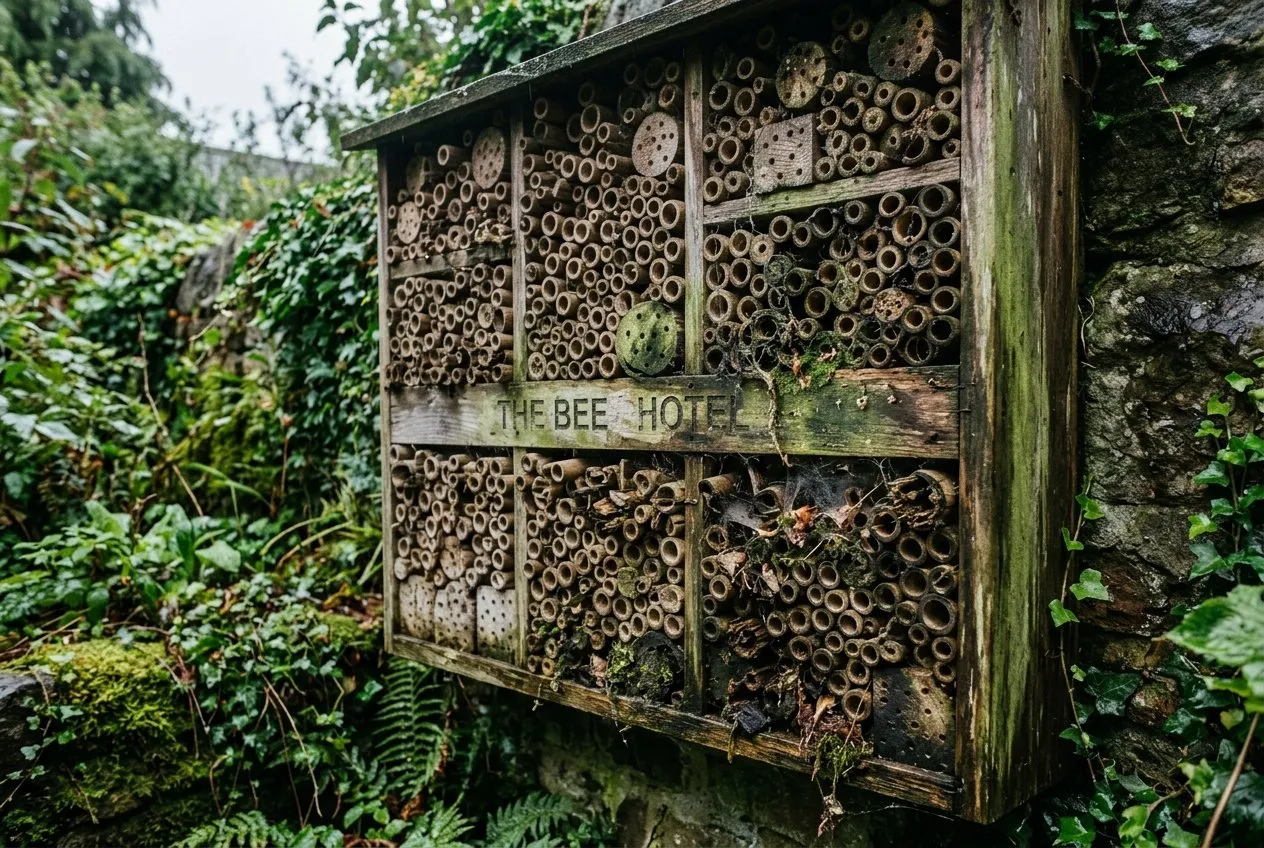 An oversized “bee hotel” wall in a shaded corner, the kind to avoid. Hundreds of densely packed tubes, never cleaned, with mould and old debris visible. Dense nests spread mites and parasitic wasps faster than the bees can breed.
Now plan the wider wildlife garden
A bee house is one piece of a bee-friendly garden. The Wildlife Trusts have good background on supporting solitary bees and other pollinators, and Buglife covers the invertebrate side in depth. To go further at home, the solitary bees garden guide widens the species you can help, while attracting birds to the garden and keeping track of the good and bad garden bugs round out a garden that works with nature rather than against it. If a bee house gives you the bug, our beekeeping for beginners guide covers the honeybee step up.
Our team produces practical UK gardening guidance from source research, contributor records and established horticultural practice. Editorial standards are overseen by Matt W.