Key takeaways
- Weight-activated feeders (£25-50) close under a grey squirrel's 450-600g weight and work in any position
- Grey squirrels jump about 1.5m straight up and 3m across, so feeder placement matters as much as the feeder
- Caged feeders (£12-25) stop adult squirrels but also shut out great spotted woodpeckers, starlings and parakeets
- Chilli-treated seed works because birds cannot taste capsaicin; expect to pay around £8 per kilo over plain seed
- Never grease the pole: it fails within days and wrecks the waterproofing on any feathers it touches
- Releasing a trapped grey squirrel is a criminal offence in England and Wales, so deter rather than trap
A squirrel proof bird feeder is the difference between feeding your garden birds and running a free grey squirrel canteen. One grey can strip 500g of sunflower hearts in a morning. A pair working in shifts will cost you \u00a315-20 a month in stolen seed, and the tits and finches keep their distance while it happens.
This guide rates every method with real UK prices, explains the placement geometry that makes or breaks a baffle, and covers the legal position if you are tempted to trap. It deals with grey squirrels. If you are lucky enough to have reds, feed them and enjoy the show.
What makes a bird feeder genuinely squirrel proof?
A genuinely squirrel proof bird feeder has to defeat an animal that jumps 1.5m straight up, leaps 3m sideways and hangs upside down by its back feet while it eats. Grey squirrels weigh 450-600g, watch and copy each other, and will work at a puzzle for hours across several days. A determined grey also chews: plastic ports, wooden trays and cheap zinc mesh all give way to teeth that never stop growing.
Those numbers are the test every product and every placement has to pass. An ankle joint that rotates through 180 degrees lets a grey walk head-first down a pole. A body that squeezes through a 60mm gap makes a mockery of loosely spaced cage bars.
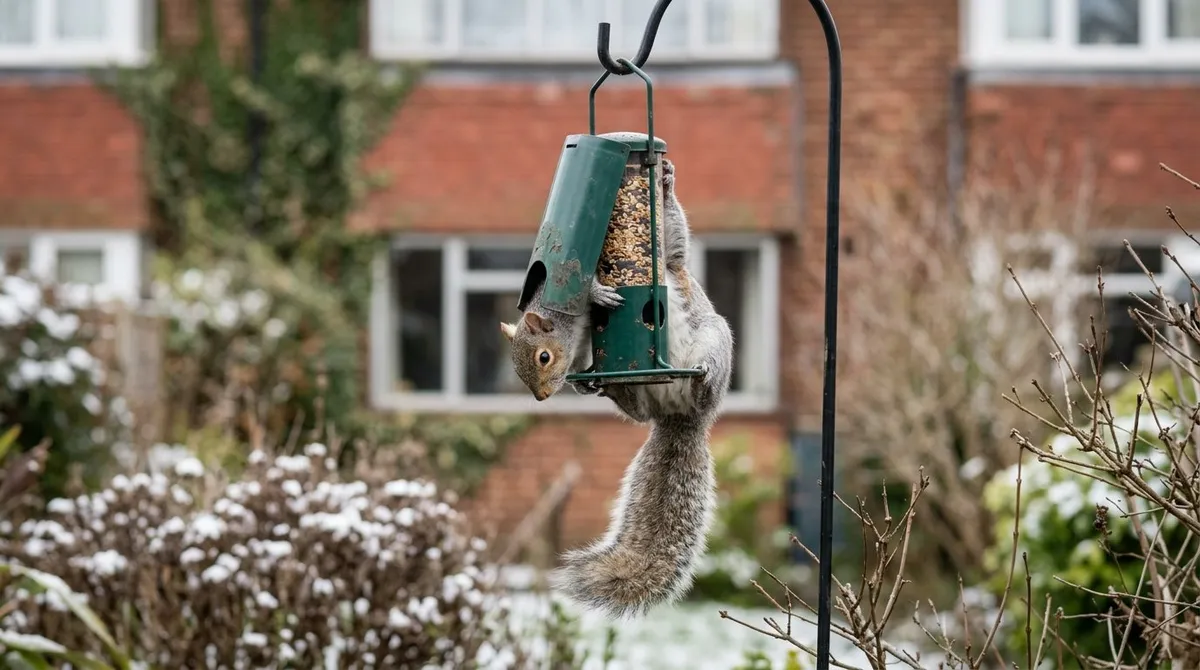
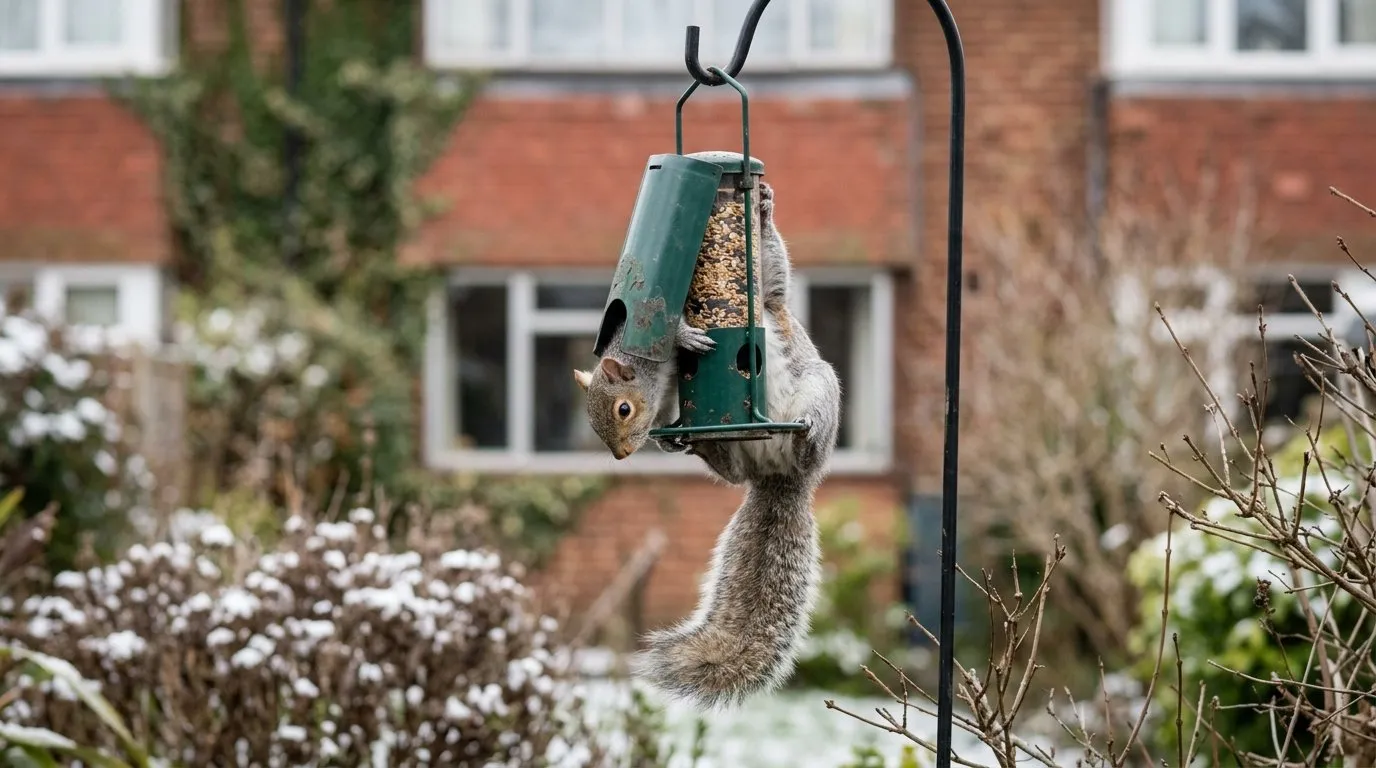 A weight-activated feeder doing its job. The shroud has dropped, the ports are shut, and the squirrel hangs there for nothing.
Which squirrel proof bird feeder types actually work?
Weight-activated feeders work everywhere, caged feeders work with a catch, and baffles work only when the geometry is right. Here is the full field, rated.
| Method | Typical UK cost | Does it work? | The catch |
|---|---|---|---|
| Weight-activated feeder | \u00a325-50 | Yes, reliably | Cheap copies have weak springs; buy the branded type |
| Caged feeder | \u00a312-25 | Yes | Excludes great spotted woodpeckers, starlings and parakeets |
| Pole baffle | \u00a310-20 | Yes, if placed right | Needs 1.5m of clear pole and 3m from launch points |
| Chilli-treated seed | \u00a38/kg over plain | Yes | Ongoing cost; must be factory-coated, not home-dusted |
| Spinning feeder | \u00a320-35 | Sometimes | Flings squirrels off; a welfare problem, not a fix |
| Greased pole | \u00a32 | No | Fails in days and damages birds’ feathers |
Weight-activated feeders are the ones that genuinely work. The Squirrel Buster type carries a spring-loaded outer shroud. A goldfinch at 16g or a great tit at 18g feeds normally. Anything over roughly 70g drags the shroud down and steel ports close over every hole. The squirrel can hang there all afternoon and starve. Good models have adjustable springs, chew-proof metal ports and a 10-year guarantee, which is why they cost \u00a325-50 rather than \u00a312.
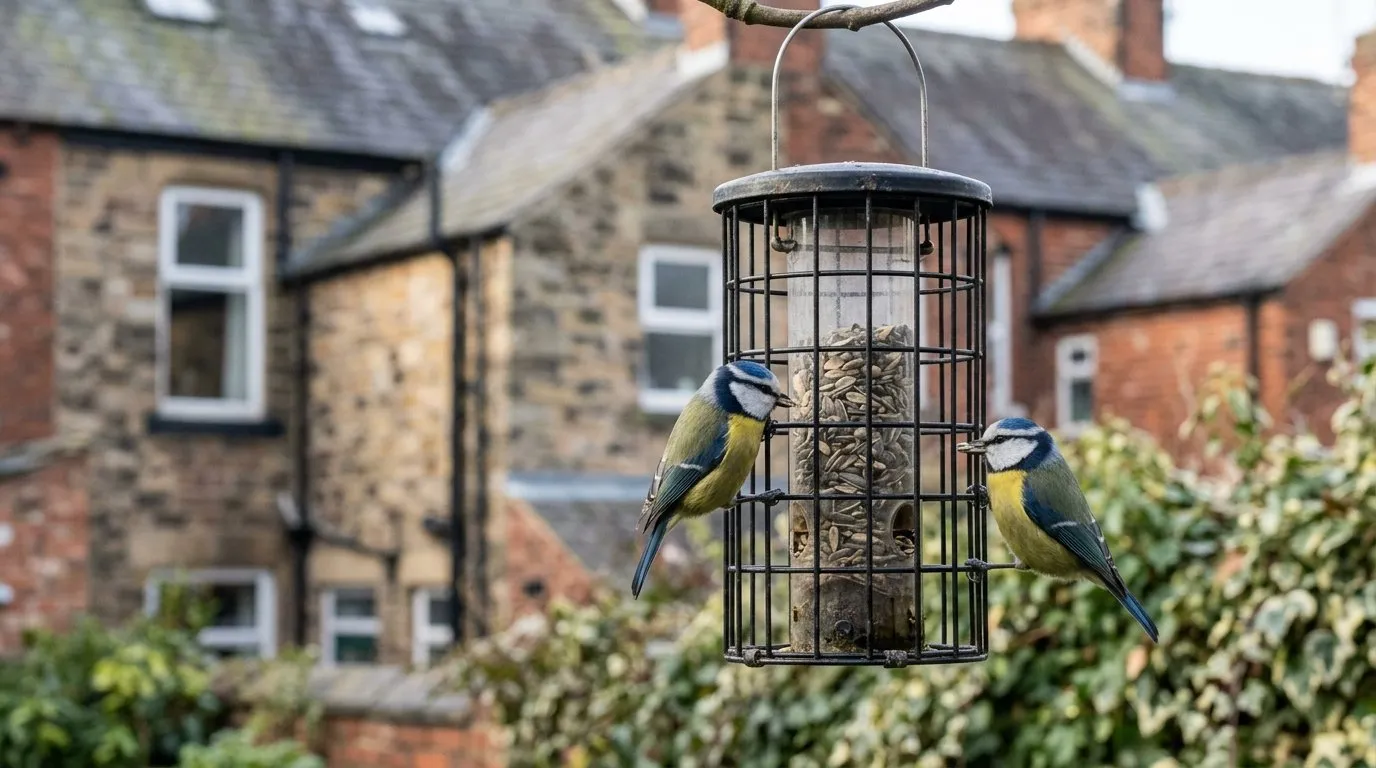 A \u00a315 caged feeder in a terraced yard. Tits and finches pass straight through the 50mm bars; adult greys stay outside.
How do you place a baffle? The 1.5m and 3m rule
A baffle only works when the feeder pole has 1.5m of clear height and stands 3m from every launch point. That pair of numbers is the whole game. A grey squirrel jumps about 1.5m straight up from the ground, and about 3m horizontally from a fence top, shed roof, washing line or branch. Miss either measurement and the squirrel simply goes over or around your baffle, however good it is.
Walk out with a tape measure before you buy anything. Fences, trees, sheds, bin stores, trellis and garden furniture all count as launch pads. In a small garden the honest answer is sometimes that no spot qualifies, in which case skip the baffle and spend the money on a weight-activated feeder instead.
If you have the space, the set-up is cheap and permanent. Fit a 30-40cm dome or cone baffle on the pole with its top at least 1.2m off the ground, leaving no climbable pole above it. Under \u00a320 buys a steel baffle that outlasts the pole. Check it stays centred and tilts freely; a jammed baffle becomes a step.
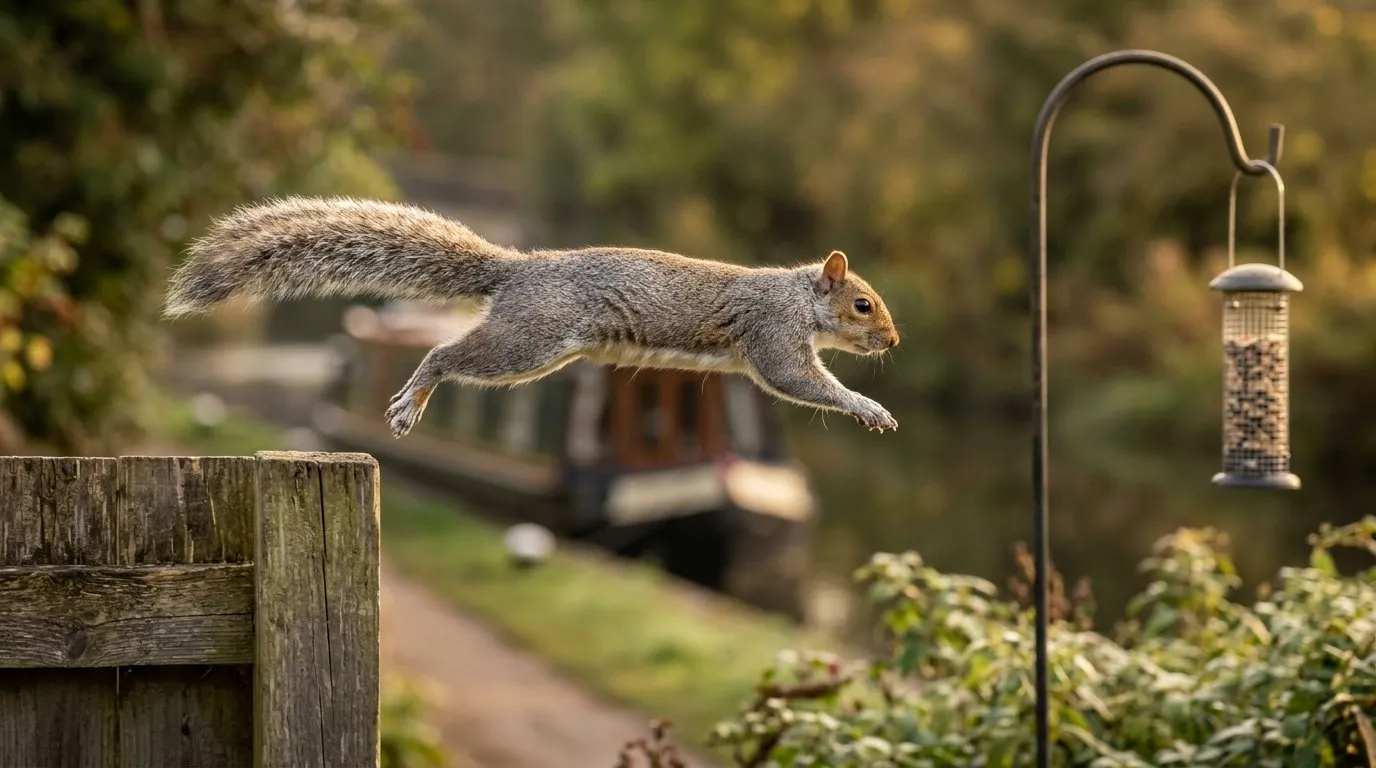 The 3m rule in action. From a fence top a grey covers up to 3m in one leap, clearing any baffle on a badly placed pole.
One more placement job while the tape measure is out: rake or sweep under the feeder weekly. Spilt seed on the ground feeds squirrels, rats and disease in equal measure, and a dirty station undoes the good work. Our bird feeder cleaning guide covers the routine in full.
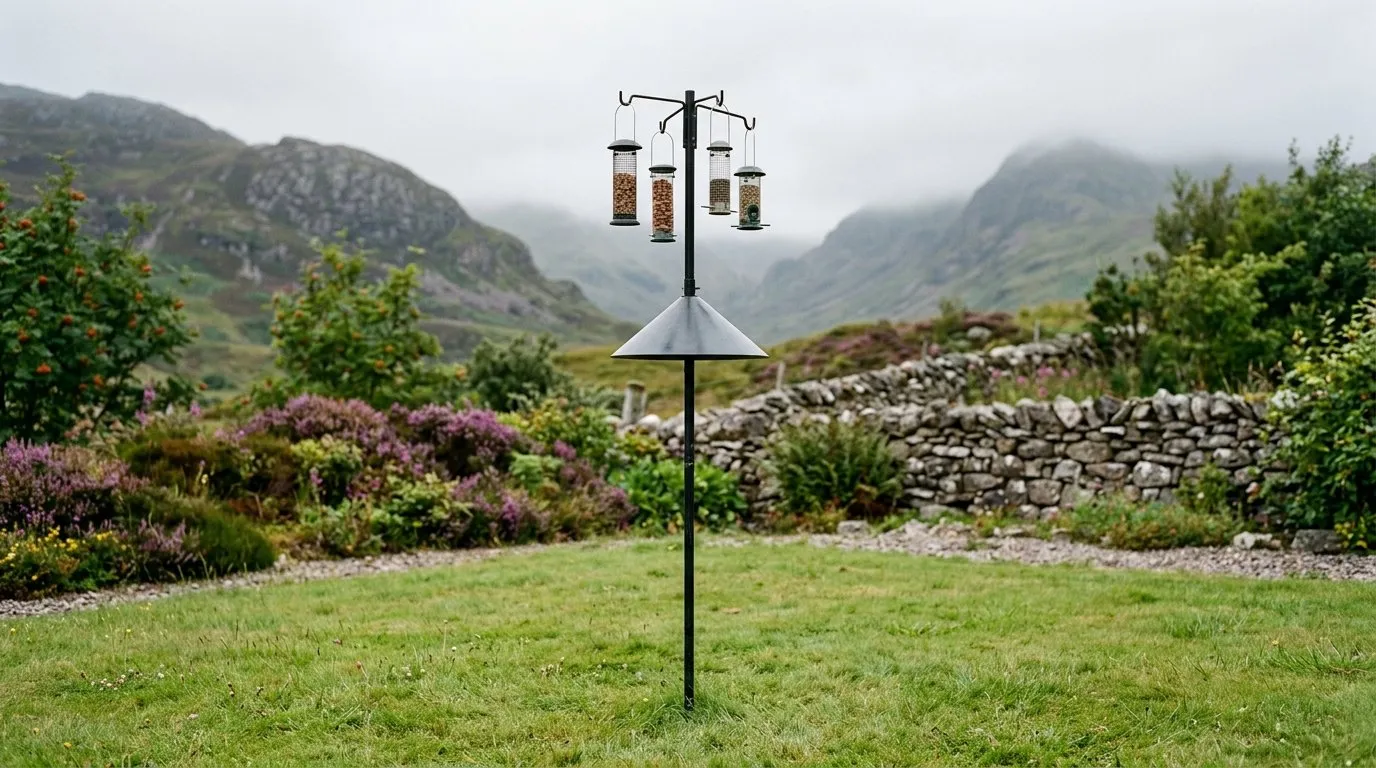 A \u00a314 cone baffle at 1.2m on a clear pole. With 3m of open ground around it, this feeder has not been raided since.
Does chilli-treated seed work as a squirrel deterrent?
Chilli-treated seed works, and it is the one squirrel deterrent that needs no hardware at all. The science is tidy. Capsaicin, the heat in chillies, fires a pain receptor called TRPV1 in mammals. The bird version of that receptor does not respond to capsaicin, so birds cannot taste the heat at any concentration. A robin eats treated seed as if nothing has changed. A squirrel gets a mouthful it will not repeat many times.
Commercial “hot” sunflower hearts and fat balls are coated with capsaicin oleoresin during manufacture. Expect to pay a premium of about \u00a38 per kilo over plain seed, which is real money across a winter. Most people use it tactically: hot seed in the one feeder the squirrels favour, plain seed in the protected ones.
What you feed still matters more than what you coat it with. Our seasonal bird feeding guide covers what to offer month by month, hot or otherwise.
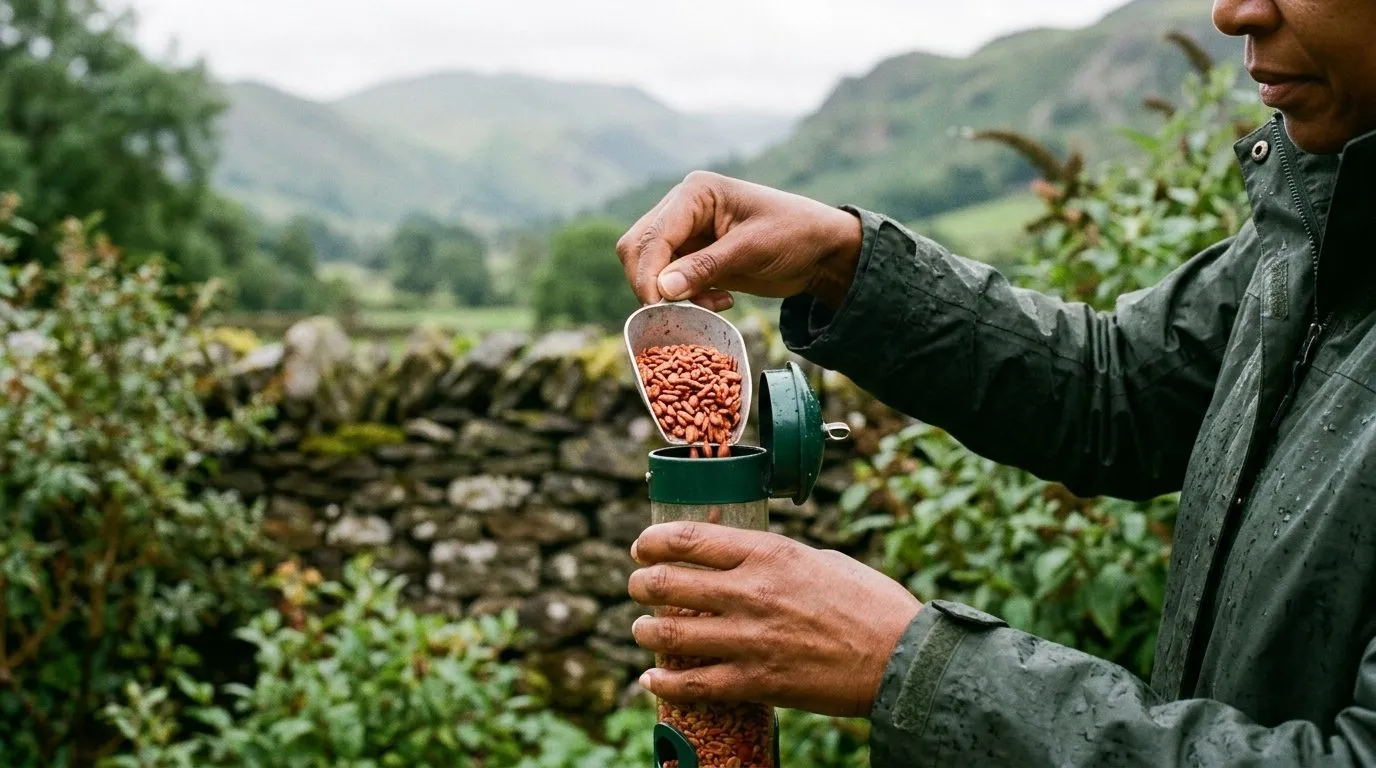 Factory-coated chilli seed going into a tube feeder. Birds cannot taste capsaicin; squirrels give up within a handful of visits.
Which squirrel deterrents fail or cause harm?
Spinning feeders, greased poles and ultrasonic boxes all fail the test, and two of them raise welfare problems. It is worth being blunt about these, because they are heavily advertised.
Greased poles are worse than useless. Vaseline, WD-40 and cooking oil all appear in online tips. The squirrel defeats the grease within days, usually by jumping past the slick section. Meanwhile every bird that brushes the pole picks up grease, and grease destroys the waterproofing and insulation of feathers. A greased great tit can die of chill in a wet week. Never do it.
The pattern is simple. Fixes that change the physics work. Fixes that try to frighten or inconvenience a clever mammal do not, and the welfare thinking behind garden feeding applies to squirrels too. Our summary of the RSPB bird feeding rules is worth a read before you buy any gadget.
Should you feed grey squirrels as a decoy instead?
Decoy feeding calms some gardens and escalates others, so treat it as a trial with an exit plan. The idea is straightforward. Give the squirrels their own station, stocked with food they prefer, far enough from the bird feeders that the two operations do not overlap. A fed squirrel spends less time working on your defences.
Set the decoy at least 10m from the bird station, ideally with the squirrel-proofed feeders out of sight of it. Stock it with whole maize at about \u00a31.20 per kilo and the odd handful of hazelnuts in shell. Both hold a grey’s attention far longer than loose seed, because shelling takes work. A lidded box feeder the squirrel must lift adds more delay and keeps the food dry.
Run it for three or four weeks, count squirrels, and stop if numbers climb. Nothing about a decoy is permanent, which is its one great virtue.
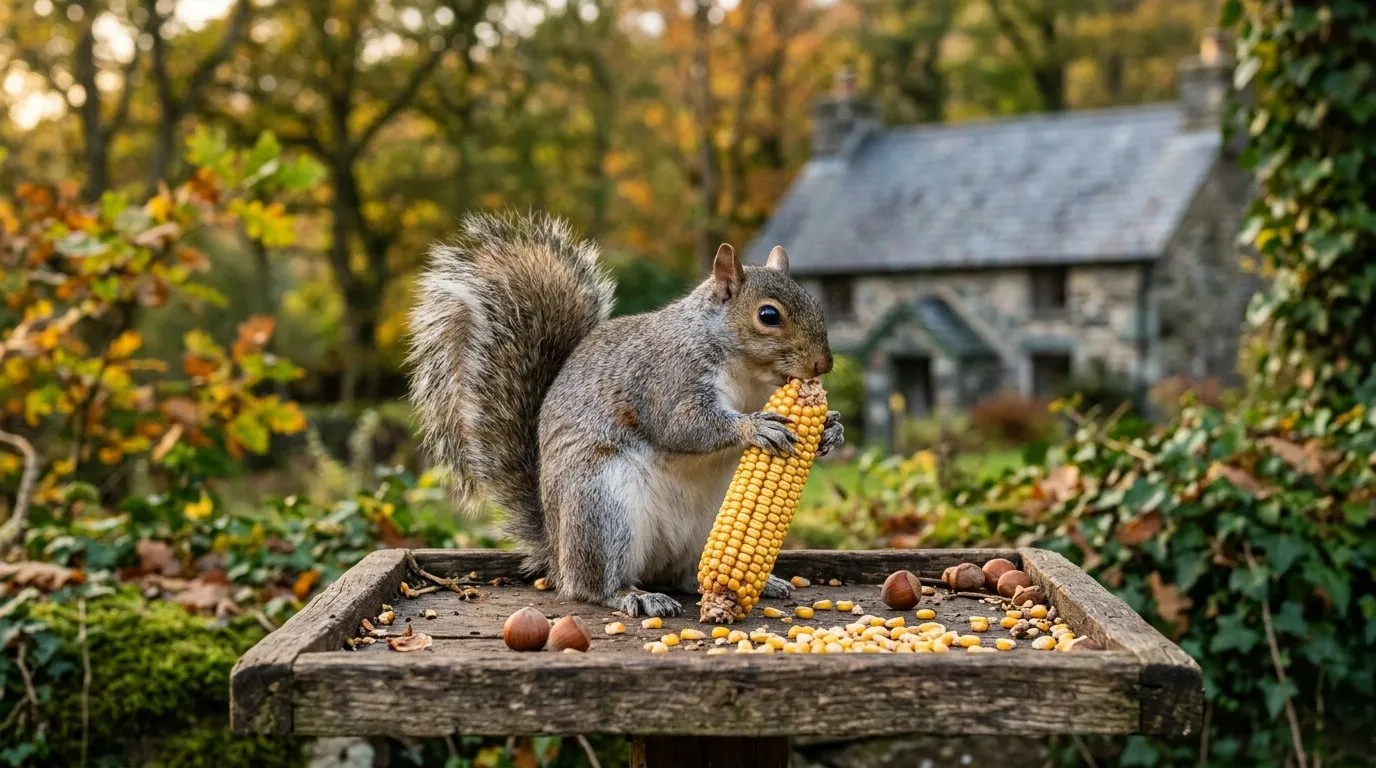 A decoy table of whole maize, 10m from the squirrel proof bird feeders. Shelling each kernel keeps a grey busy for an hour.
How do you stop squirrels digging up bulbs and pots?
Chicken wire pinned over the compost stops bulb theft completely, and it costs about \u00a36 for a 5m roll. Squirrels treat freshly planted pots as a larder: the disturbed compost signals buried food, and tulip and crocus bulbs are both worth eating. Autumn planting season is when the damage happens, often within 48 hours of planting.
Cut the wire a little larger than the pot, dome it over the compost and pin it at the rim with wire pegs or bricks. Shoots grow through the 25mm mesh in spring while paws cannot get in. Lift the wire once growth is 5cm tall, or leave it and let the foliage hide it. In open beds, lay the mesh flat over the planting area and peg the corners.
Two planting tricks help as well. Daffodils, snowdrops, alliums and fritillaries are distasteful or toxic to squirrels, so they go unprotected while the tulips get the wire. And plant tulips deep, at 15-20cm, where the digging effort stops being worth it. Timing matters too; the later you plant, the less time pots sit as targets, and our guide on when to plant tulip bulbs makes the case for November.
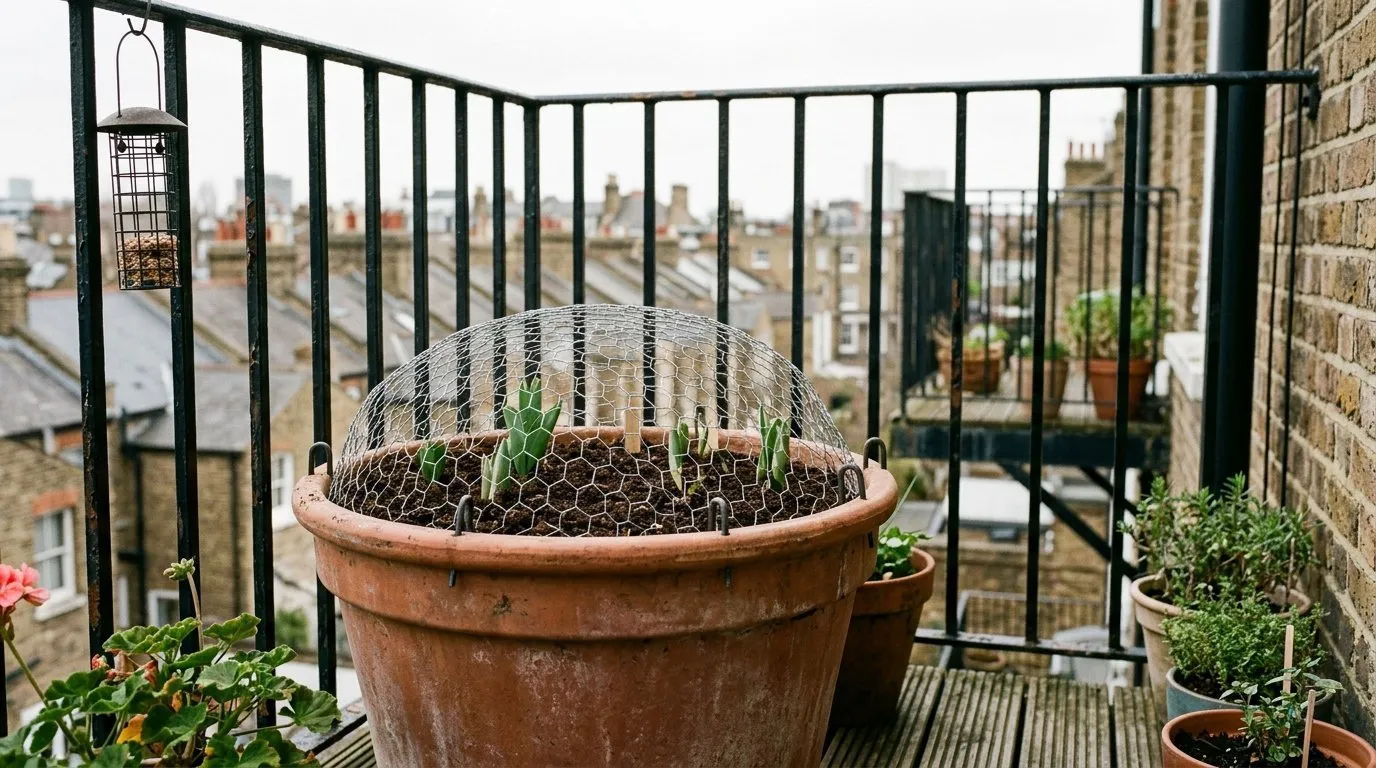 A 25mm chicken wire dome over freshly planted tulips. Shoots grow through in spring; digging paws never get started.
Red squirrels, grey squirrels and the law on trapping
Trapping a grey squirrel commits you to killing it, because releasing one is illegal in England and Wales. That single fact should shape every gardener’s approach, so here is the background.
Grey squirrels are North American. They were first released in Britain at Henbury Park, Cheshire, in 1876, and the population now stands at roughly 2.7 million. Our native red squirrel has fallen to about 140,000, pushed out by competition and by squirrelpox, which greys carry and survive while reds die. Reds now hold out mainly in Scotland, Northumberland, Cumbria, Anglesey, the Isle of Wight and Brownsea Island, plus Northern Ireland. The Wildlife Trusts’ grey squirrel profile covers the ecology in more depth.
Because of that history, the grey squirrel is listed as an invasive alien species of special concern. Under the Invasive Alien Species (Enforcement and Permitting) Order 2019, it is an offence in England and Wales to release a trapped grey back into the wild, even at the end of your own street. A trapped grey must be humanely dispatched, and doing that lawfully and competently is beyond most households.
So the practical advice is short: deter, do not trap. A \u00a330 feeder solves the problem the trap only relocates onto your conscience. If you live in a red squirrel area, the calculation changes and your local red squirrel group will gladly advise; everywhere else, physics beats the trap.
 A native red in Highland pine. Around 120,000 of Britain’s 140,000 reds live in Scotland, where feeding them is a joy, not a battle.
What does squirrel proofing actually cost?
A working squirrel proof set-up costs between \u00a315 and \u00a370 depending on how many feeders you defend. Here are three realistic builds.
| Set-up | What you buy | Total cost |
|---|---|---|
| Budget terraced yard | Caged seed feeder \u00a315, chicken wire for two pots \u00a36 | \u00a321 |
| Woodpecker-friendly garden | Weight-activated feeder \u00a332, pole baffle \u00a314 | \u00a346 |
| Full station, heavy pressure | Weight-activated feeder \u00a340, baffle \u00a314, hot seed premium \u00a38/kg | \u00a354 plus seed |
Set that against the losses. Two squirrels taking 100g of sunflower hearts a day eat \u00a310-15 of seed a month at 2026 prices, so the dearest option pays for itself inside the first winter. Every price in the table is a mid-range figure from UK garden retailers as of July 2026; you can pay more for stainless fittings and rarely need to.
Frequently asked questions
What is the best squirrel proof bird feeder?
Weight-activated feeders of the Squirrel Buster type work best, at \u00a325-50. A spring-loaded shroud drops over the feeding ports under anything heavier than about 70g, so a 500g grey squirrel gets nothing. Unlike cages they still admit great spotted woodpeckers, and unlike baffles they work in any position.
How high should a bird feeder be to stop squirrels?
The feeder needs 1.5m of clear height and 3m of clear space around it. Grey squirrels jump roughly 1.5m straight up from the ground and 3m sideways from a fence, shed or branch. Add a baffle below the feeder and the geometry finally holds.
Does chilli in bird seed harm the birds?
No, birds cannot taste capsaicin, so chilli-treated seed does not bother them. The receptor that registers chilli heat in mammals does not respond to it in birds. Squirrels feel the full burn and stop raiding within a few visits. Buy ready-coated seed rather than dusting your own, which rubs off.
Do caged bird feeders keep squirrels out?
Yes, a cage with gaps of roughly 50mm keeps adult grey squirrels off the seed. The catch is that great spotted woodpeckers, starlings and ring-necked parakeets are shut out too, and juvenile squirrels sometimes squeeze in. At \u00a312-25 they are the budget option for tit and finch feeding.
Is it illegal to release a grey squirrel in the UK?
Yes, releasing a trapped grey squirrel is illegal in England and Wales. Grey squirrels are listed as an invasive alien species, and enforcement rules from 2019 make releasing one back to the wild an offence. A trapped grey must be humanely dispatched, so most gardeners should deter rather than trap.
Does grease or vaseline on the pole stop squirrels?
No, greased poles fail within days and put birds at real risk. Squirrels learn to leap past the slippery section, and grease that transfers onto feathers ruins their waterproofing and insulation. Wildlife organisations advise against it. Fit a proper baffle for \u00a310-20 instead.
Should I just feed the squirrels instead?
A separate squirrel feeding station works in some gardens and backfires in others. Whole maize and hazelnuts in a dedicated feeder 10m from the bird station can hold their attention. It can equally pull in more squirrels from neighbouring gardens, so treat it as an experiment, not a fix.
Our team produces practical UK gardening guidance from source research, contributor records and established horticultural practice. Editorial standards are overseen by Matt W.