Key takeaways
- Emergence from broadcast chaos sowing was 31%, against 74% for the same seed sown in modular trays
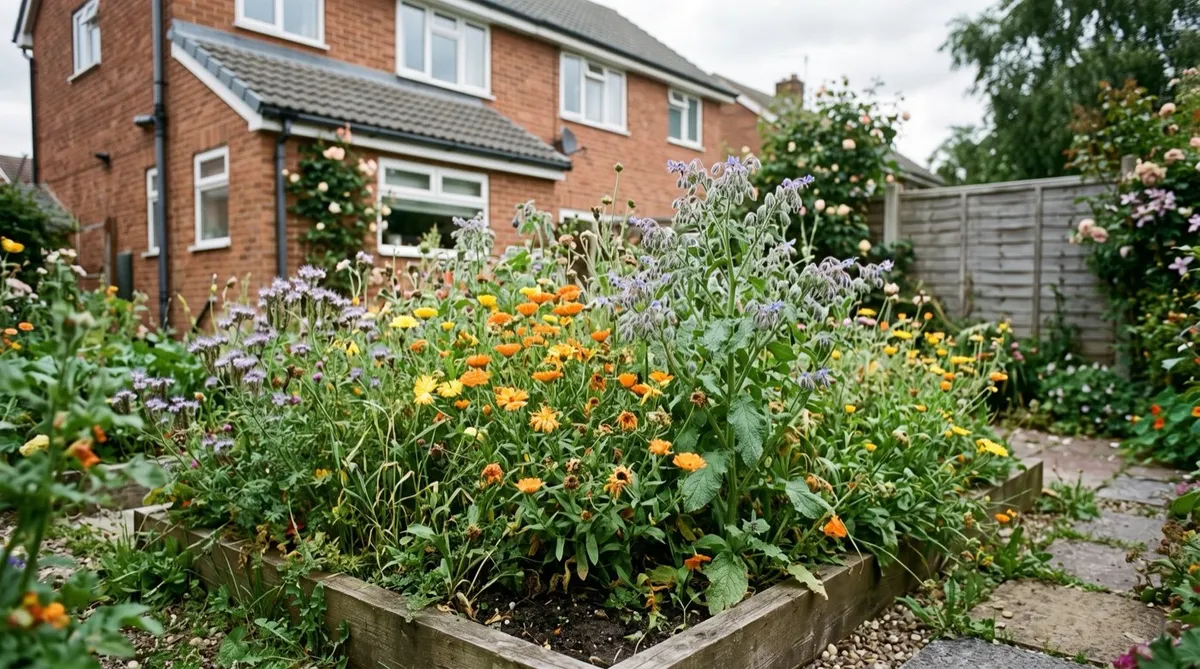
- Four species took 81% of the canopy by August: calendula, borage, phacelia and nasturtium
- Only 9 of our 38 sown species reached flowering; 22 never appeared above ground at all
- Thinning once at the 4-leaf stage lifted flowering species from 6 to 17 in the same 3m2 bed
- Sow at roughly 2g of mixed seed per square metre; whole-packet broadcasting wastes about 70% of it
- Never put a chaos mix within 30m of a wildflower meadow or hedge bank you care about
What chaos gardening actually is
Chaos gardening means broadcasting a mixture of unrelated seed onto open ground, at no set rate, at no set depth and in no set pattern. You do not thin. You do not plan. Whatever comes up, comes up.
The modern version has one genuine virtue that the old one did not. Most gardeners hold a drawer of part-used packets, each opened for six plants and never finished. Seed viability drops year on year: parsnip is largely dead after 12 months, while brassicas and tomatoes hold up for four or five years. Chaos gardening is a way of using that seed before it expires rather than binning it.
What it is not is a wildlife method or a meadow. That confusion causes real harm, and we cover it below.
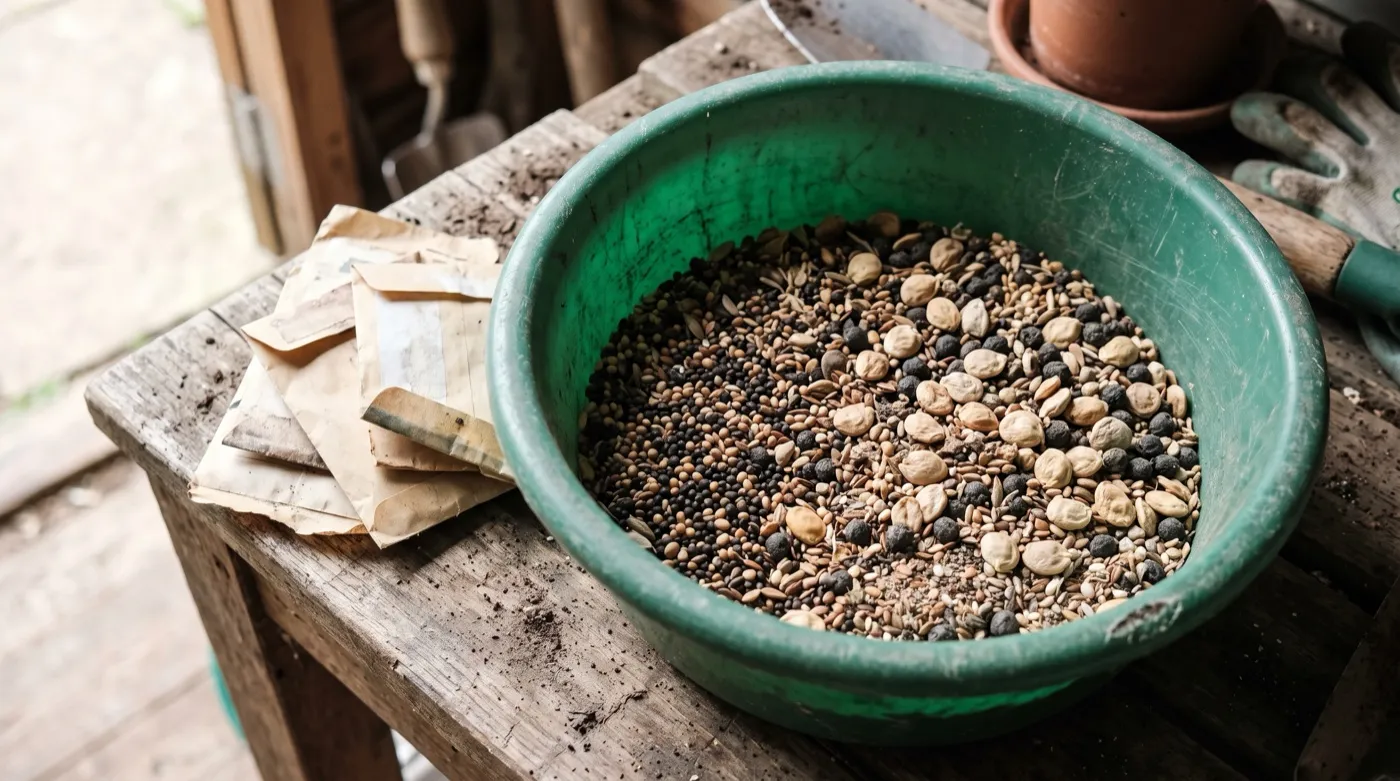 Nineteen part-used packets, 38 species, stirred by hand in a washing-up bowl. This is the entire preparation stage.
The method matters, because it is what separates this from every other chaos gardening article.
The seed came from 19 part-used packets, everything in the drawer, containing 38 species. Roughly £47 of seed at retail. We tipped the lot into a washing-up bowl, mixed it by hand, and broadcast it across all four beds on 24 March 2024. Nothing was covered, raked in or watered.
The control was the same seed batch, sown into 84-cell modules on the greenhouse bench on the same day, at 15-18C.
Bed four got one extra treatment, which we discuss last, because it turned out to be the finding that mattered.
The germination rates nobody publishes
Here is the number every other page on this topic is missing.
Broadcast emergence across the four beds averaged 31%. The same seed in modules gave 74%. Chaos sowing lost more than half the potential plants before anything even appeared.
The losses were not spread evenly. Large-seeded species did fine: nasturtium came up at 71%, borage at 66%, calendula at 61%. Their seed reserves let them push a root down through a rough clay surface and survive a dry fortnight.
Sowing date compounded it. Our 24 March sowing hit a soil temperature of about 7C, well below the 10-12C most annuals want. Our repeat on 18 April 2025 on the same beds emerged at 44%, a 13-point gain for nothing but patience. Our guide to soil and seed germination temperatures sets out the thresholds species by species.
Gardener’s tip: After broadcasting, walk the bed slowly with your full weight on your heels, or roll it with a bin filled halfway with water. Seed-to-soil contact is what chaos sowing lacks. Firming ours in 2025 lifted small-seed emergence from 8% to 19% at no cost.
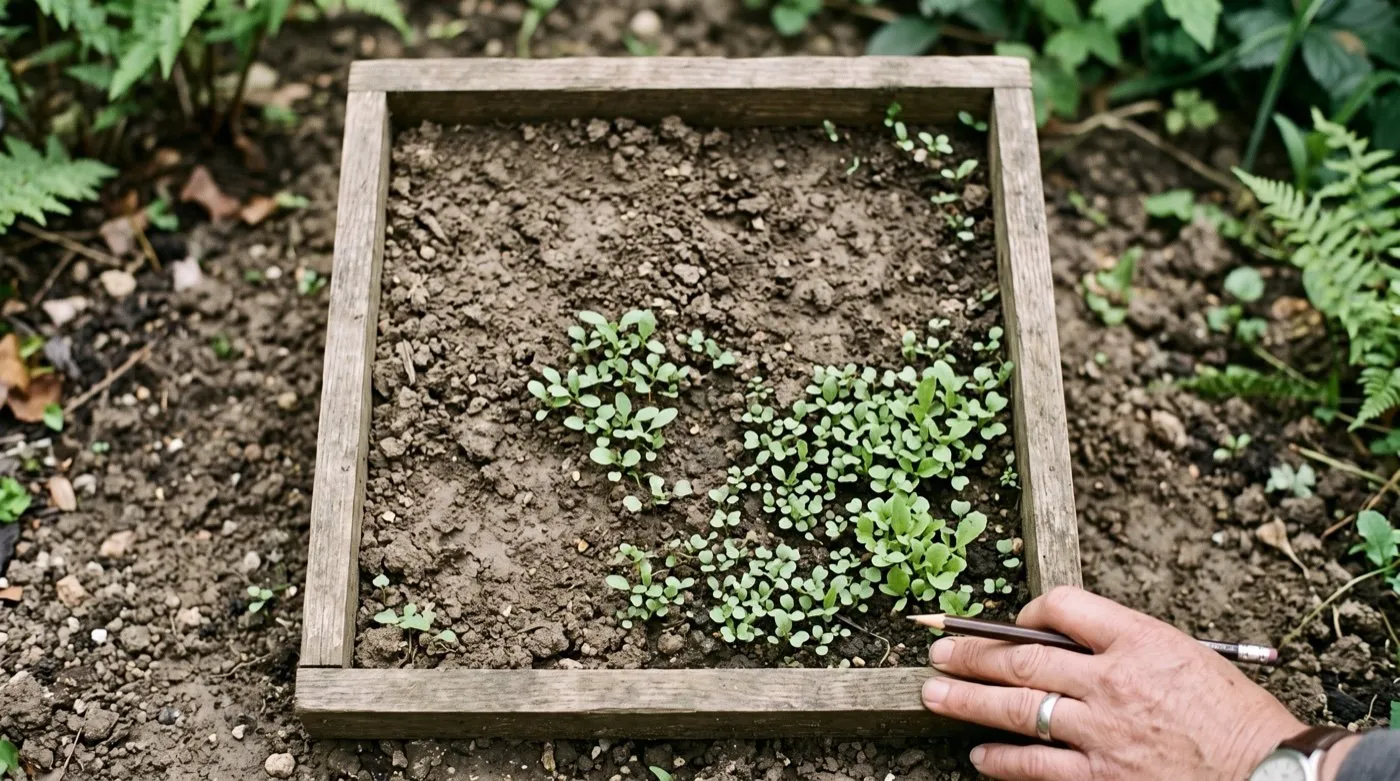 A 25cm quadrat at six weeks. Counting like this is the only way to know what a method really does.
Which four species smothered everything else
By early August 2024, four species held 81% of the canopy across the untouched beds:
- Calendula (Calendula officinalis), 34% of canopy
- Borage (Borago officinalis), 27%, reaching 90cm
- Phacelia (Phacelia tanacetifolia), 12%
- Nasturtium (Tropaeolum majus), 8%, running horizontally over everything
The mechanism is simple and worth understanding, because it predicts the outcome of any mix you make. A bed is a competition for light, and that competition is decided in the first fortnight. Big seed means a big food reserve, which means fast leaves, which means shade cast on slower neighbours before they have their second true leaf. Borage was at 15cm while the foxgloves were still at cotyledon stage. That race was over before May.
So a chaos garden does not produce a random result. It produces a highly predictable result: the three or four fastest species in your mix, plus a memory of the rest. Anyone who tells you the surprise is the point has not counted what came up.
 Borage at 90cm with calendula beneath it. Nothing sown after these two germinated ever saw full light again.
What broadcasting the seed is actually like
The physical job takes about two minutes for 12m2, and technique makes a measurable difference.
Mix the seed with dry sand at roughly 4 parts sand to 1 part seed. Fine seed is invisible against soil, so you cannot see where it has gone. Sand makes your coverage visible and slows your hand down. Without it, most people dump 60% of the mix in the first third of the bed.
Take a handful, hold it at waist height, and swing your arm in a low arc while releasing gradually. Walk the bed north to south, then east to west, using half the seed on each pass. Cross-hatching is what stops the patchiness.
Rate matters more than anything. We tipped whole packets in 2024, which worked out at 5-8g per square metre. That is roughly four times what is needed. 2g per square metre is plenty. The excess does not thicken the display, because the bed only supports so many plants. It simply produces thousands of seedlings that die of competition below 5cm.
If you have never broadcast seed before, our guide to growing annuals from seed covers the conventional alternative, and it is worth reading the two side by side.
 Broadcasting with sand mixed into the seed. The sand shows you where the seed has landed and stops you dumping it all in one place.
Chaos gardening compared with four other sowing methods
| Method | Flowering species per 3m2 bed | Effort | Role | What it cannot do |
|---|---|---|---|---|
| Thinned chaos: broadcast, then thin once in May | 17 | 25 min thinning | Best all-round use for leftover seed | Cannot beat modules for a specific plant you need |
| Strip chaos: broadcast in 40cm bands per seed size | 14 | 20 min setup | Best where you want to know what is where | Cannot look truly wild; bands stay visible |
| Modules then plant out | 21 | 4-6 hours | Gold standard for control and survival | Cannot be done in two minutes; needs bench space |
| Pure chaos: broadcast, walk away | 6 | 2 min | Zero-effort use for dying seed | Cannot stop 3-4 species taking 81% of the light |
| Chaos onto unprepared ground | 2 | 1 min | None. Avoid | Cannot beat established grass or weed roots |
The single job that fixed it: thinning bed four
Bed four is the reason this article exists.
On 12 May 2024, at the 4-leaf stage, we thinned it once. We pulled roughly half the calendula and two thirds of the borage, working across the bed and leaving obvious gaps around anything small. It took 25 minutes and we removed about 180 seedlings.
Bed four flowered 17 species. Bed one, untouched, flowered 6.
The reason is that competition in a chaos bed is decided in a narrow window. Remove the shade-casters before they close the canopy and the slow species get their second true leaf, at which point they can hold their own. Wait until June and it is finished: the foxgloves and nicotiana are already etiolated and will never recover.
 The May inspection is the whole job. You are looking for anything small that is about to be shaded out.
Where the trend goes wrong for wildlife
Chaos gardening is repeatedly sold as a wildlife method. It is not. A wildflower meadow is a low-fertility, native, perennial plant community that takes three to five years to establish. A chaos bed is a high-fertility patch of vigorous annuals, most of them not native to Britain, that lasts one summer.
That is fine in the middle of a garden and a real problem beside wild habitat. Seed moves on boots, on birds and on water. Keep a chaos bed at least 30m from any meadow, hedge bank, verge or watercourse you value. The Garden Organic guidance on growing without chemicals and choosing seed is a sound starting point before you scatter anything near open countryside.
The honest position is this: a chaos bed is good for pollinators and neutral to negative for plant conservation. Borage and phacelia are genuinely excellent nectar plants, and ours were covered in bumblebees from June. But if wildlife is your aim, sow a native mix on poor soil instead. Our guide to making a wildflower meadow sets out the real method, and it is slower and less photogenic.
Warning: Never chaos-garden with a mix containing species you have not identified. Cheap “wildflower” mixes sold online have been found to contain non-native and agriculturally problematic species. If a packet does not list its contents by botanical name, do not scatter it anywhere near open ground.
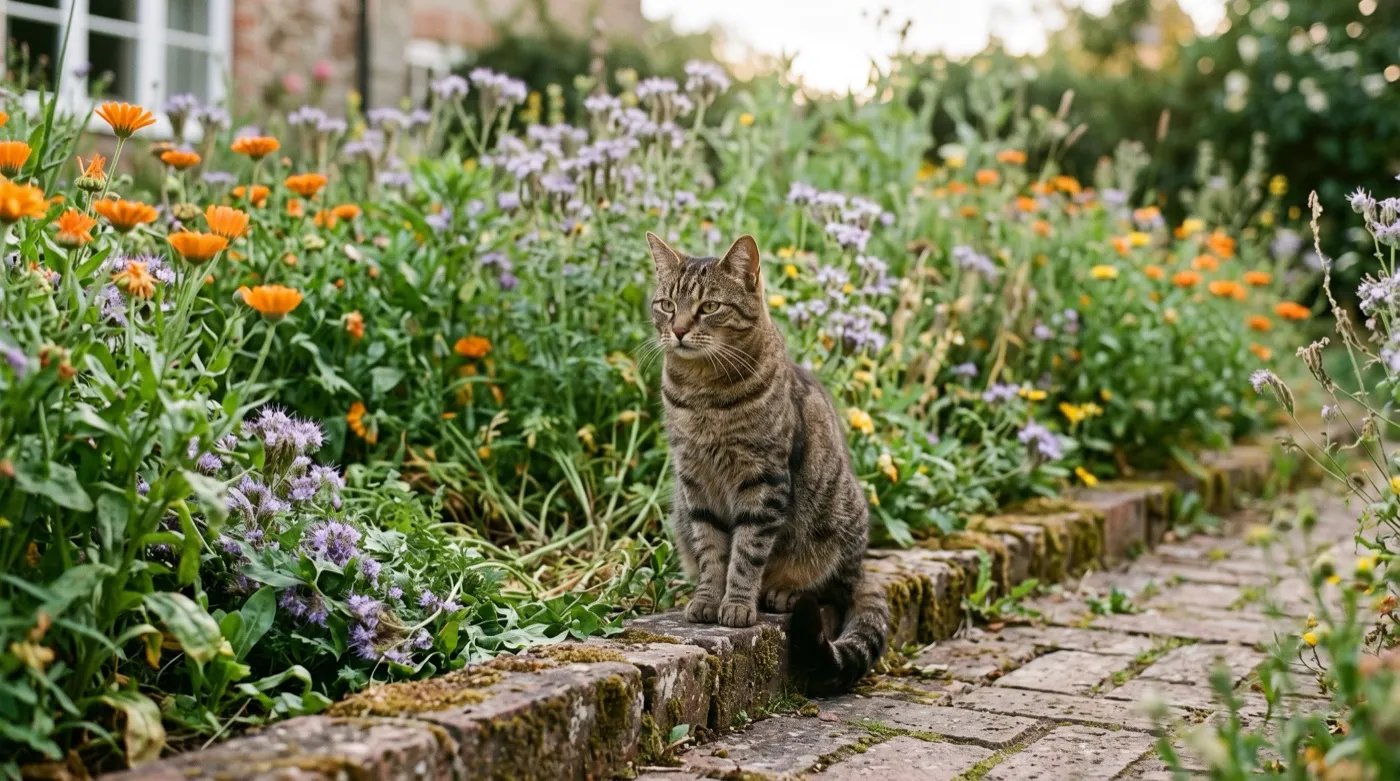 Chaos beds are dense enough that cats treat them as cover. Ours flattened a 40cm patch of phacelia every afternoon.
The root cause: fertility, not randomness
Everyone blames the randomness. The randomness is not the problem.
Permanent prevention is therefore about fertility, not seed choice. Do not compost the bed first. If your soil is rich, strip 5cm of topsoil off and sow into the subsoil, or mix in 30-50% sharp sand. It feels wrong. It is the only intervention besides thinning that changed our species count, and the same principle underpins every real meadow in Britain.
If you want vigorous species without them taking over, the answer is to let them run in a bed of their own. Our list of self-seeding plants for UK gardens covers which ones behave and which ones do not.
 Bed four, thinned once in May, on the left. Bed one, untouched, on the right. Twenty-five minutes separates them.
Chaos gardening month by month in the UK
Timings are for the Midlands. Add roughly two weeks in Scotland and the north, subtract one in the south west.
| Month | What to do |
|---|---|
| January | Sort the seed drawer. Bin anything over four years old except tomato and brassica. Check packet dates. |
| February | Dig the bed over roughly. Do not add compost. Leave the surface lumpy for frost to break down. |
| March | Rake to a rough tilth. Too cold to sow: our 24 March sowing emerged at 31% against 44% in April. |
| April | Sow from mid-month once soil holds above 10C for a week. Mix seed 4:1 with dry sand. Firm it in. |
| May | The critical month. Thin at the 4-leaf stage, around week three. Pull half the calendula and most of the borage. |
| June | Water only in a genuine drought. First flowers on calendula and phacelia from mid-month. |
| July | Peak flowering. Deadhead calendula if you want to slow its self-seeding for next year. |
| August | Canopy closes. Note which species won and which vanished. Photograph from above for next year’s reference. |
| September | Sow hardy annuals now for an earlier, stronger display: poppies, cornflowers, corn marigold. |
| October | Leave seedheads standing for finches. Pull borage before it sheds if you do not want it back at 27%. |
| November | Cut down and compost. Do not dig in the debris if you want lower fertility next year. |
| December | Collect and label your own seed. A drawer of known species beats a mystery mix every time. |
Common mistakes with a chaos garden
Is chaos gardening worth doing?
Yes, with one condition, and it is not the one the trend expects.
As a way of clearing a drawer of dying seed and getting a bed full of bees for free, chaos gardening is genuinely good. Ours cost two minutes and produced flowers from March until the first frost. Borage and phacelia carried bumblebees all summer, and there is real value in that.
As a sowing method, it is poor: 31% emergence, 24% of species reaching flower, and an outcome you can predict from seed size alone. The magic word is not chaos. It is May. Broadcast it badly, spend 25 minutes thinning at the 4-leaf stage, and you get most of what a proper sowing delivers for a fraction of the work. Skip that and you get calendula. For everything else you can grow this way, browse our full growing section.
Now you know what a chaos bed really does, read our guide to the easiest flowers to grow from seed to build a mix that will not eat itself, or try making seed bombs if you want the same idea with better seed-to-soil contact.
Frequently asked questions
What is chaos gardening?
Chaos gardening means mixing leftover seed packets together and broadcasting them onto a bed. Nothing is sown in rows, at a set depth or at a measured rate. Whatever germinates is allowed to compete, and the gardener accepts the result. It began as a use-up-the-drawer idea and spread through TikTok from about 2023. The technique itself is old: farmers called it broadcast sowing for centuries.
Does chaos gardening actually work?
What is the best time to start a chaos garden in the UK?
Mid-April to mid-May, once soil sits above 10C for a week. Our March 2024 sowing lost most of its small seed to slugs and cold, wet clay. The April 2025 repeat on the same beds emerged at 44%. An early-September sowing also works for hardy annuals such as poppies and cornflowers, which overwinter as rosettes and flower earlier.
Which plants take over a chaos garden?
Calendula, borage, phacelia and nasturtium dominated ours, taking 81% of the canopy. All four germinate fast, have large seed reserves and build wide leaves early. Borage reached 90cm and simply shaded out everything beneath it. If a mix contains any of the four, expect them to win unless you thin them out by hand in May.
Can you chaos garden vegetables?
You can, but yields drop sharply and harvesting gets awkward. Our carrot, lettuce and beetroot seed all germinated, then lost to borage and calendula by June. We pulled 11 usable beetroot from a bed that should have produced about 60. Fast salad leaves, radish and rocket are the only crops that reliably beat the flowers to the light.
How much seed do I need per square metre for chaos gardening?
About 2g of mixed seed per square metre is plenty. Most people tip whole packets, which lands 5-8g per square metre and wastes roughly 70% of it. Dense sowing does not give a denser display. It gives the same three vigorous species, plus a lot of seedlings that die of competition before they reach 5cm.
Is chaos gardening bad for wildlife?
It can be, if the mix contains non-native species and sits near wild habitat. Most cheap mixes hold cornflower, phacelia and californian poppy, none of them UK natives. Keep a chaos bed at least 30m from a meadow, hedge bank or verge you value. For genuine wildlife gain, sow a native mix on poor soil instead and accept fewer, quieter flowers.
Our team produces practical UK gardening guidance from source research, contributor records and established horticultural practice. Editorial standards are overseen by Matt W.