Key takeaways
- Aeoniums are tender, hardy only to 3-5C, so they need frost-free winter shelter in every UK region
- They grow from October to May and go semi-dormant in summer, the opposite of most succulents
- Water during the autumn-to-spring growth phase and keep nearly dry in summer dormancy
- Give 5-6 hours of bright light a day or rosettes stretch and lose colour within 3-4 weeks
- 'Pink Witch' and 'Schwarzkopf' need the most light to keep their pink and near-black colour
- Stem cuttings root in 2-3 weeks and are the cheapest way to build a collection
Aeoniums are among the most striking succulents you can grow in the UK, prized for their neat rosettes of waxy leaves in colours from lime green to near-black. The key to growing aeonium well in Britain is understanding two things most guides skip: these plants are tender, not hardy, and they grow in winter while resting in summer. Get those right and varieties like ‘Pink Witch’ and ‘Schwarzkopf’ will thrive for years.
This guide covers choosing varieties, the unusual winter-growth cycle, watering, light, compost, overwintering, propagation, and the pests and mistakes that catch UK growers out. Everything here is built around our wet, cool climate, not a Mediterranean one.
What Aeoniums Are and Why They Behave Differently
Aeoniums are rosette-forming succulents in the Crassulaceae family, native mainly to the Canary Islands, Madeira, and parts of North Africa. They form flat, symmetrical rosettes of fleshy leaves on top of woody stems. A mature plant can reach 60-90cm tall with a branching, almost shrubby habit.
The trait that confuses people is their growth cycle. Most succulents grow in summer and rest in winter. Aeoniums do the reverse. In their island home, summers are hot and rainless. To survive, aeoniums go semi-dormant above 25C, curling their leaves inward into a tight ball to cut water loss. Cooler, wetter autumn and winter weather is their active growing season.
This single fact governs everything: when you water, when you feed, and when leaf drop is normal. A UK grower who waters heavily in July and lets the plant dry in December has the cycle exactly backwards. The plants also grow well outdoors here in summer for shape and colour, but they cannot survive a British winter outside.
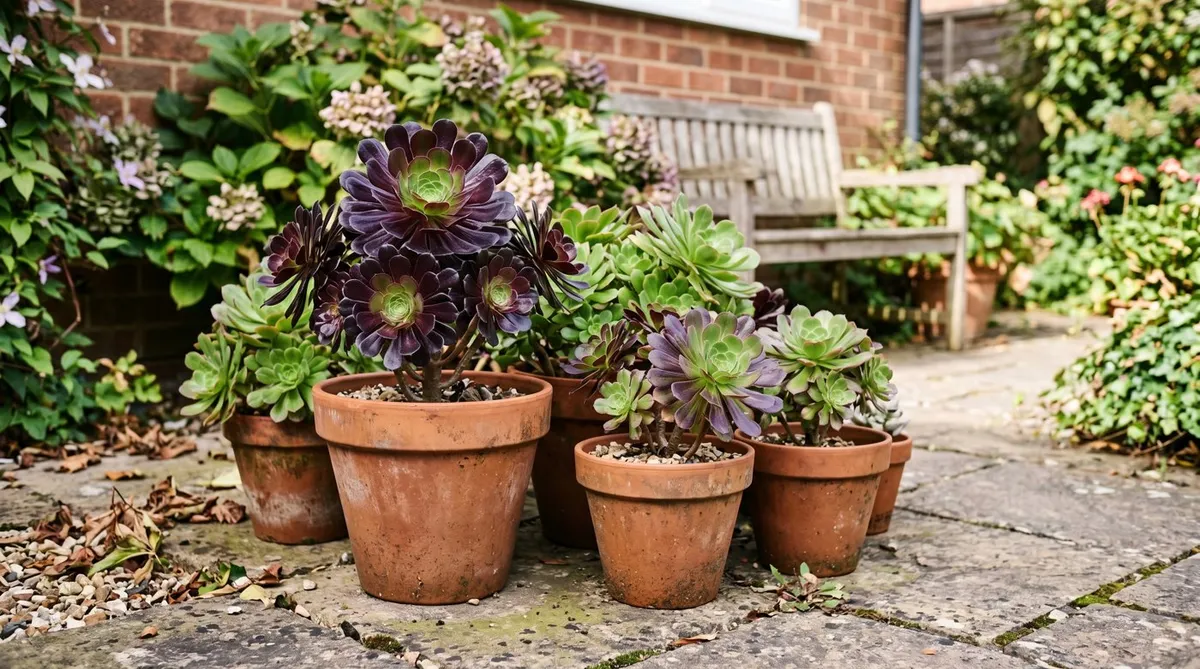
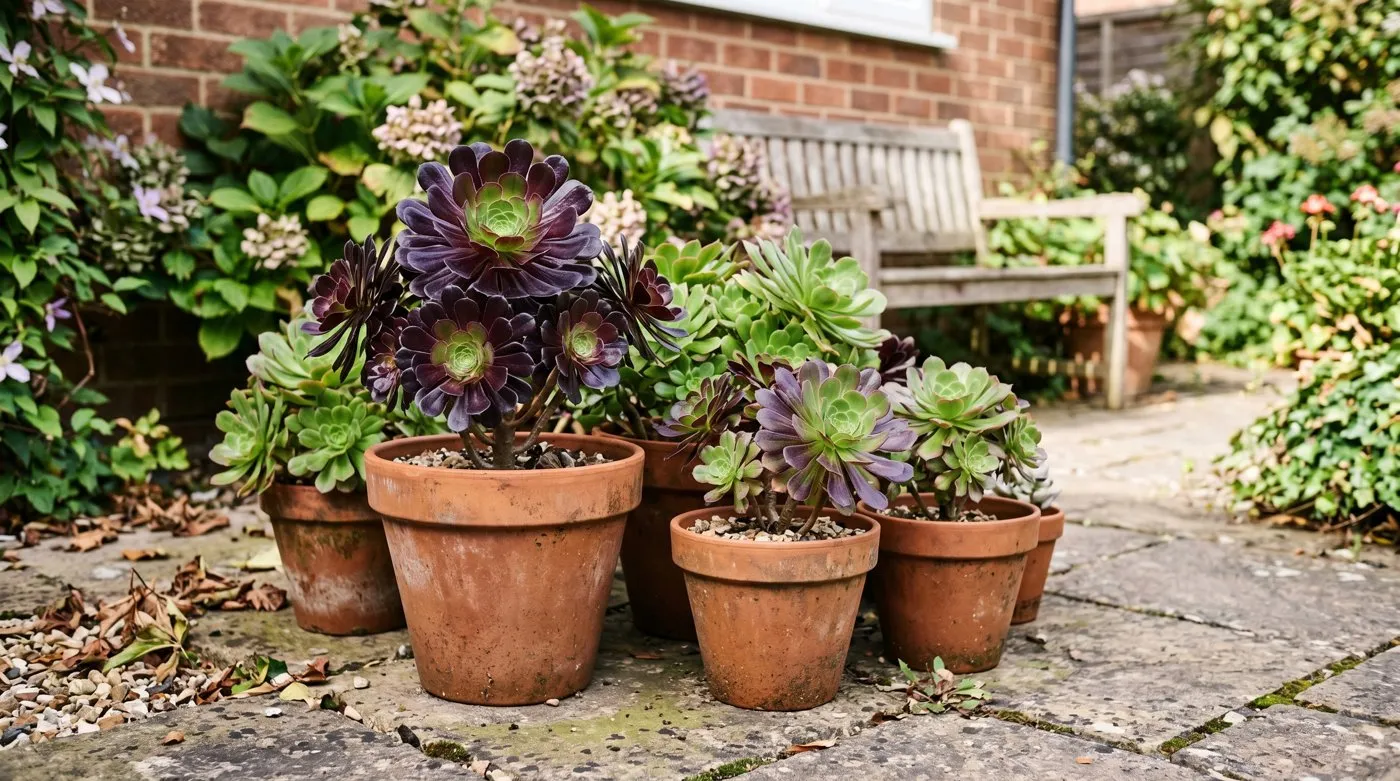 Aeoniums grown the UK way: in terracotta pots that can be moved frost-free before the first hard frost.
Choosing Aeonium Varieties Including Pink Witch and Schwarzkopf
Variety choice decides how much light you need to keep the colour and how big the plant gets. The most popular types in UK garden centres range from compact variegated forms to tall black-leaved show plants.
‘Pink Witch’ is the variety drawing most new growers in. Its leaves carry a soft blend of cream, pink, and pale green, with the pink strongest in high light. In a dim room it reverts to mostly green, so it needs your brightest spot. ‘Schwarzkopf’ (also sold as ‘Zwartkop’) is the famous near-black aeonium. Its glossy dark-burgundy rosettes sit on tall stems and reach 1m. The black colour deepens in full sun and washes out to green in shade.
Other strong choices include ‘Sunburst’ with cream-and-green stripes and pink edges, ‘Mardi Gras’ with red, green, and yellow variegation, the velvety ‘Velour’, the rosette-within-a-rosette ‘Kiwi’, and the plain green species Aeonium arboreum, which is the toughest and easiest to start with.
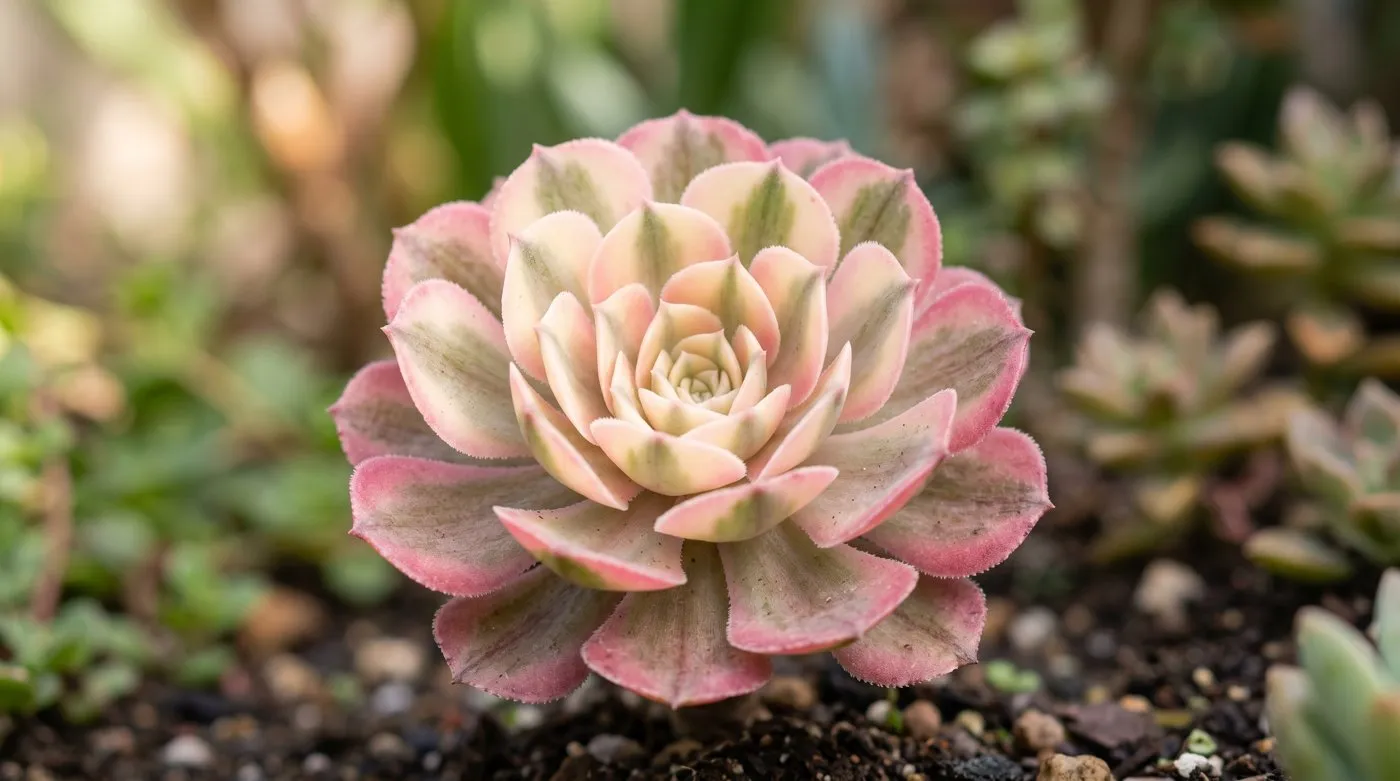 ‘Pink Witch’ shows its cream and pink variegation only when given strong light. In shade it fades to green.
Aeonium variety comparison
| Variety | Colour | Mature height | Light for best colour | Notes |
|---|---|---|---|---|
| ’Pink Witch’ | Cream, pink, green | 30-45cm | Very high | Reverts to green in low light |
| ’Schwarzkopf’ / ‘Zwartkop’ | Near-black burgundy | Up to 100cm | Full sun | Tall, branching, dramatic |
| ’Sunburst’ | Cream, green, pink edge | 30-50cm | High | Slow, monocarpic single crowns |
| ’Mardi Gras’ | Red, green, yellow | 30-45cm | High | Brightest in cool autumn light |
| ’Velour’ | Bronze-purple | 40-60cm | High | Matte velvety leaf surface |
| ’Kiwi’ | Yellow, green, red edge | 30-40cm | Medium-high | Easiest variegated type |
| A. arboreum (green) | Plain green | 60-90cm | Medium | Toughest, best beginner plant |
If you are new to succulents in general, our guide on how to care for succulents indoors covers the wider group, while aeoniums sit apart because of their winter-growth habit.
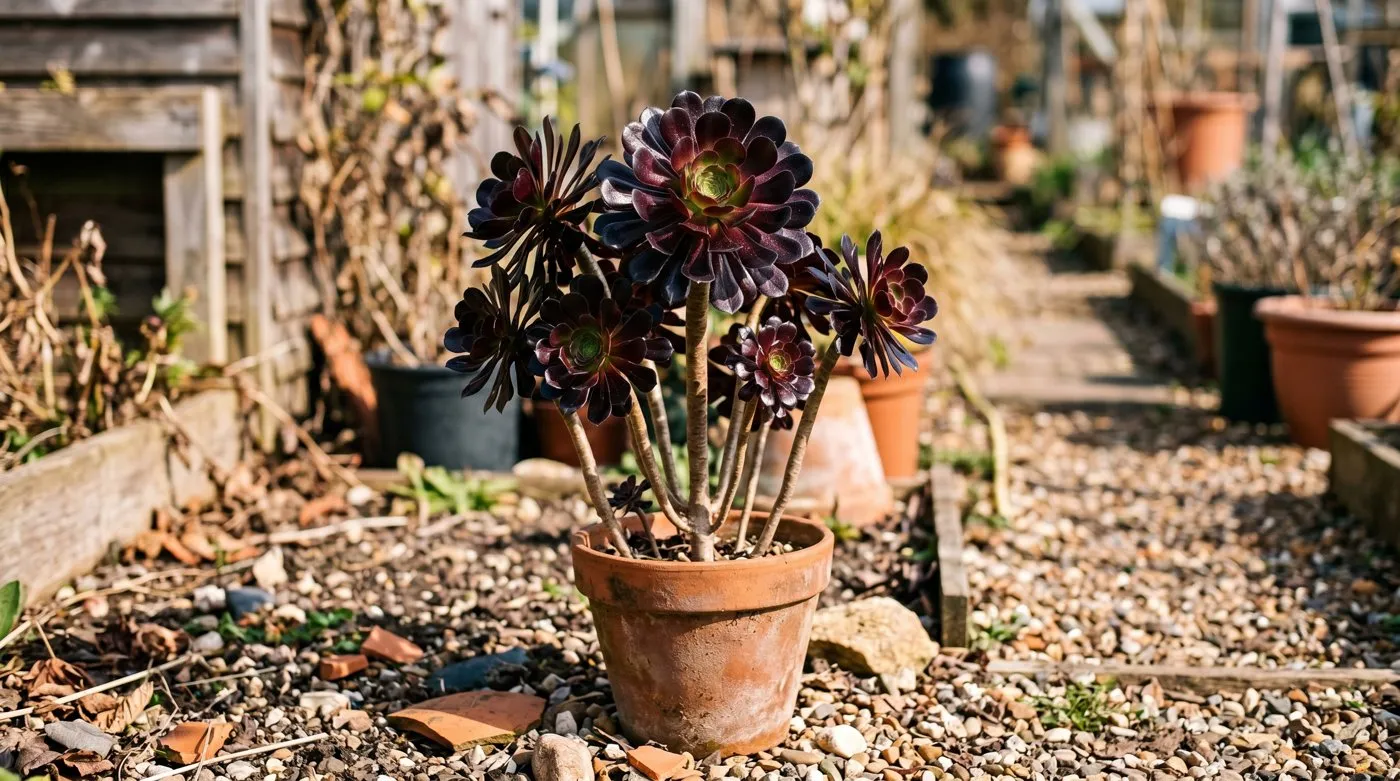 ‘Schwarzkopf’ holds its near-black colour only in strong direct sun. The colour fades to green in shade.
The Winter Growth Cycle and How to Water Around It
Watering aeoniums correctly means watering against your instinct. The rule is simple: water during active growth from autumn to spring, and keep the plant nearly dry through summer dormancy.
From roughly October to May, aeoniums are growing. Water when the top 3-4cm of compost has dried out, which in a cool bright spot is usually every 10-14 days. The compost should dry between waterings but never stay bone dry for weeks. This is when the rosette plumps up, the colour intensifies, and new leaves unfurl.
From June to September, the plant rests. Above 25C it pulls its leaves inward and stops growing. Water sparingly now, perhaps a small drink every 3-4 weeks if the rosette looks shrivelled, and never a full soak. Wet warm compost in summer is the fastest route to basal rot, the soft brown collapse at the stem base that kills more aeoniums than cold does.
Always water at the base, not over the rosette. Trapped water in the centre of the rosette encourages rot and, outdoors, can scorch leaves in bright sun. For the wider principles of dry-season care, our notes on drought-tolerant plants explain how succulents store and ration water.
Light Needs and How to Stop Leggy Etiolated Growth
Light is the difference between a compact, colourful aeonium and a pale, stretched one. Aeoniums need at least 5-6 hours of bright light daily. The brighter the light, the tighter the rosette and the stronger the colour.
You cannot reverse a stretched stem. The fix is to behead the rosette, let the cut callus over, and re-root it as a cutting. Indoors, use a south or west windowsill. Outdoors in summer, a sheltered spot with morning sun and light afternoon shade suits most varieties. Acclimatise plants gradually when moving them outside to avoid sudden scorch.
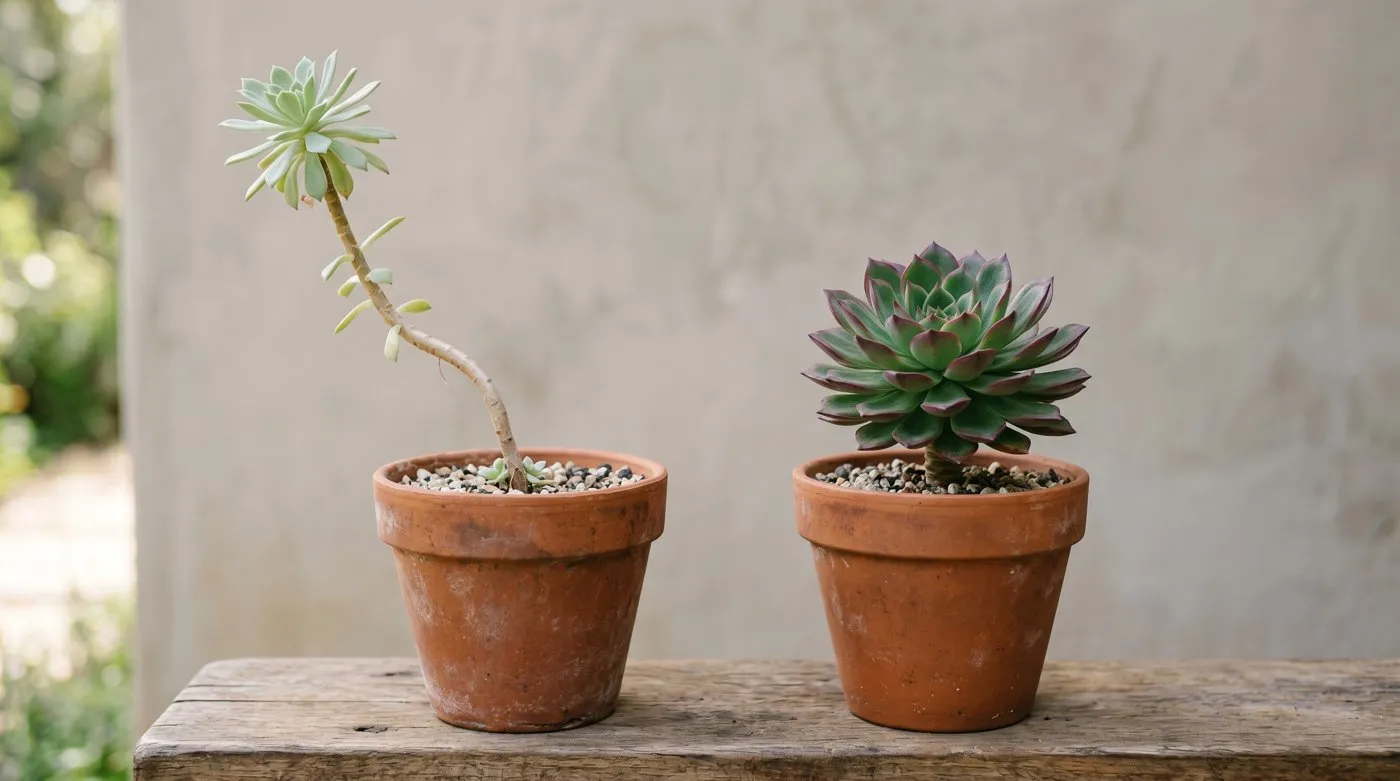 Left: an etiolated aeonium stretched by low light. Right: a compact, well-coloured rosette grown in bright light.
The Free-Draining Gritty Compost Aeoniums Need
Compost choice prevents most aeonium deaths. These plants rot in dense, water-retentive mixes. They need a gritty, fast-draining medium that drains within seconds of watering.
Mix two parts peat-free multipurpose compost with one part horticultural grit or perlite. A 2:1 ratio gives roughly 33% drainage material, which suits our damp climate. In a wet winter, push that towards 50:50 for varieties prone to rot. Avoid pure cactus compost sold in tiny bags, which is often too fine. Coarse 2-4mm horticultural grit is ideal.
Terracotta pots beat plastic for aeoniums. The porous clay wicks moisture out of the rootball, drying it faster between waterings. Always use a pot with drainage holes and never leave the pot standing in a saucer of water. A 2cm grit mulch on the surface keeps the stem base dry and discourages rot.
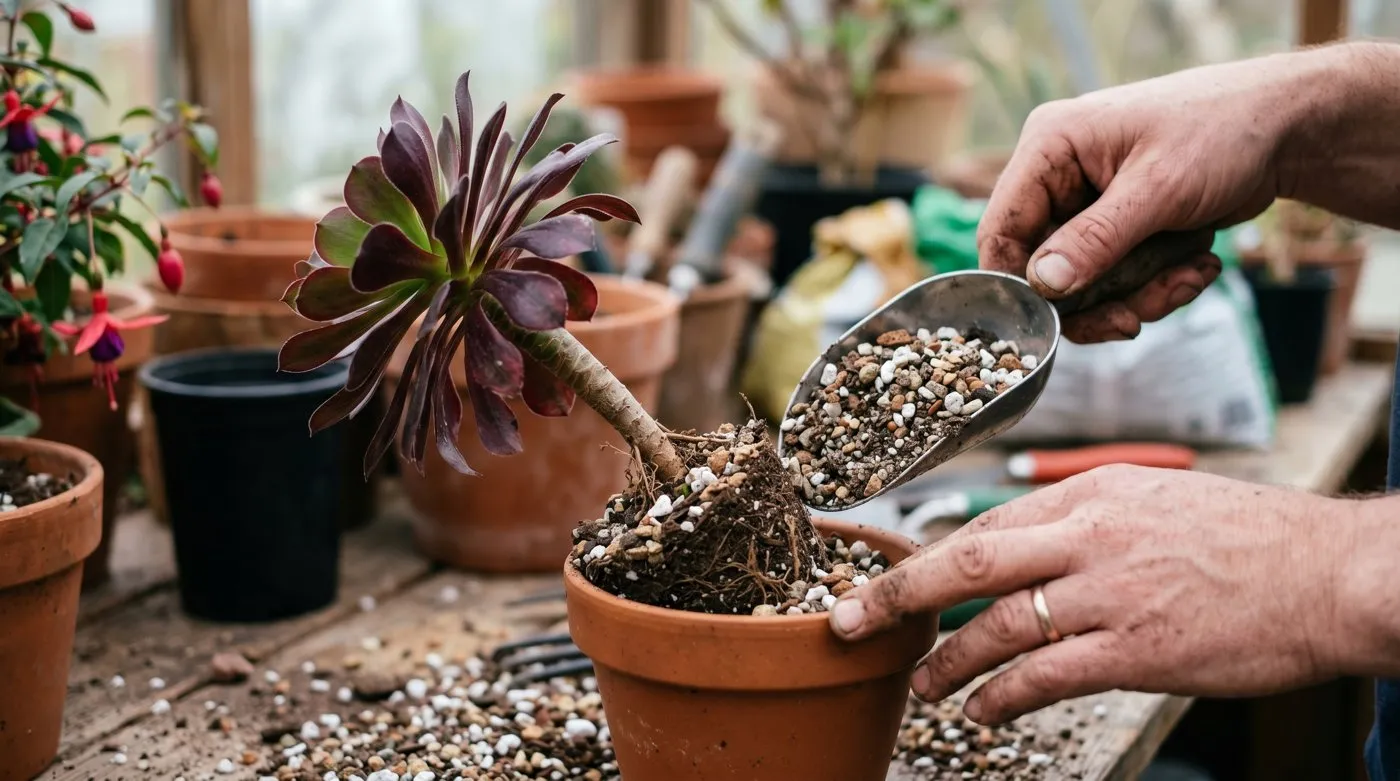 A free-draining mix of peat-free compost, grit, and perlite is the single best defence against aeonium rot.
Why Pots Beat the Ground in the UK
Aeoniums should be grown in pots, not borders, anywhere in Britain. The reason is frost. A plant in the ground cannot be moved when the first frost threatens, and a single cold night below -1C turns the rosettes to mush.
Pots let you follow the seasons. Stand them outdoors from June to September for the best colour and shape, then carry them under cover before mid to late October. A plastic-lined trolley or a few pot feet make moving heavy plants easier. Grouping pots together in summer also creates a sheltered microclimate.
Feeding Aeoniums Without Overdoing It
Feed aeoniums only during their autumn-to-spring growth phase. A light feed supports the rosette and colour, but too much nitrogen makes soft, weak growth that rots and flops.
Use a balanced or low-nitrogen liquid feed at half strength, applied once a month from October to April. A tomato feed diluted to half rate works well because its higher potassium supports firm growth and good colour over leafy excess. Never feed in summer dormancy, when the plant is not growing and cannot use the nutrients.
Plants in fresh compost rarely need feeding in their first six months. Overfeeding shows as overly lush, pale, oversized leaves and weak elongated stems that fall apart. If in doubt, feed less. For the wider principles of feeding container plants, our guide on how to feed houseplants applies the same restraint to indoor displays.
Overwintering Aeoniums Frost-Free
Overwintering is where most UK aeoniums are won or lost. The plants must come under cover before frost and need a bright, cool, frost-free spot at a minimum of 5C.
Move pots indoors when night temperatures drop towards 5C, usually mid to late October in most of England, earlier in Scotland and the north. A frost-free greenhouse, an unheated conservatory, a porch, or a cool bright windowsill all work. The key is light. A warm dark garage will keep frost off but cause severe etiolation by spring, because aeoniums are still actively growing all winter.
Keep them on the cool side, ideally 5-12C. Warm centrally heated rooms push soft growth and dry the air, which invites pests. Water sparingly through winter, just enough to stop the compost going bone dry, since growth is slower in low winter light even though the plant is technically active. For the broader routine, our guide on how to overwinter plants covers tender plants across the garden, and a frost-protection plan helps for the few mild nights you can risk leaving them out.
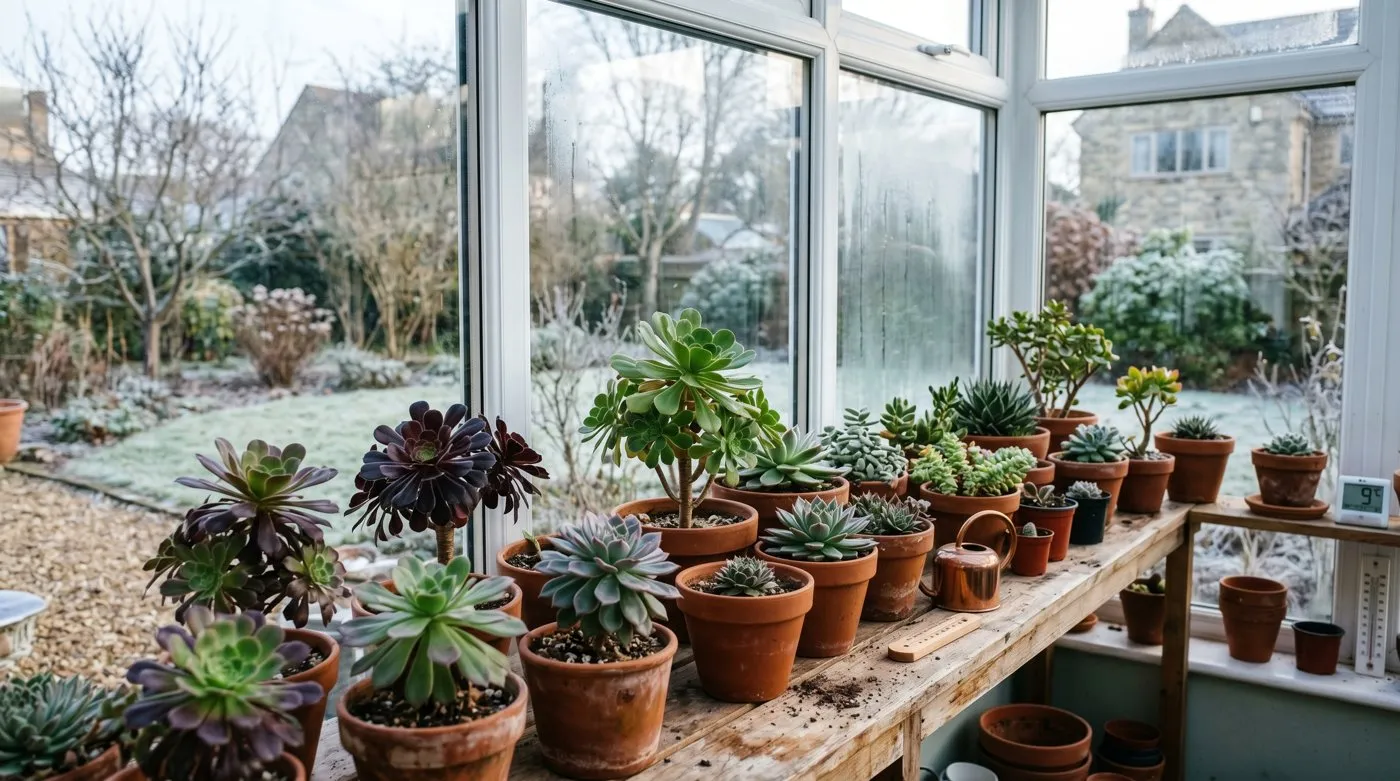 A bright, cool, frost-free shelf keeps aeoniums growing steadily through winter without stretching.
If you have a glazed room to spare, our guide to conservatory houseplants lists companions that enjoy the same cool, bright winter conditions.
Propagating Aeoniums From Stem Cuttings
Aeoniums root from stem cuttings more easily than almost any other succulent. This is the cheapest way to build a collection and to rescue a leggy plant.
Cut a rosette with 5-10cm of stem using clean, sharp secateurs. Take cuttings in spring or autumn during active growth for the fastest results. Strip the lowest leaves, then leave the cutting somewhere dry and shaded for 3-5 days so the cut surface forms a dry callus. Skipping this step is the main reason cuttings rot instead of root.
Push the calloused stem into gritty cutting compost, water lightly, and keep it in bright but not scorching light. Roots form in 2-3 weeks. Do not water heavily until you feel resistance when you tug gently, which signals roots have taken. Leaf cuttings rarely work for aeoniums, unlike echeverias, so always use stems.
A single tall, leggy plant can yield several cuttings, turning one stretched specimen into a fuller display. For a wider look at the technique, our guide on plant propagation by cuttings covers the principles across many plant groups.
 Take a 5-10cm stem cutting, let it callus for 3-5 days, then root it in gritty compost. Roots form in 2-3 weeks.
Flowering, Monocarpic Death, and Leaf Drop
Two natural events alarm new aeonium growers: summer leaf drop and the death of a flowered rosette. Both are normal.
Summer leaf drop is the plant entering dormancy. From June onward it sheds lower leaves to cut water loss, leaving a tight rosette on a bare stem. This looks dramatic but the plant is healthy and re-flushes from autumn. Only soft, mushy collapse signals a real problem, which is rot from overwatering.
Aeoniums are monocarpic, meaning a rosette dies after it flowers. A mature rosette sends up a tall cone of small yellow or pink flowers, often after a cold winter. Once flowering finishes, that rosette will not regrow. Branching varieties like ‘Schwarzkopf’ usually survive because their other rosettes carry on. Single-crown types can die outright. Take cuttings from healthy side shoots before flowering ends to keep the variety going. Cut the spent flower stem off once it browns.
Pests That Target Aeoniums
Aeoniums are tough but a few pests find them, especially in warm winter rooms with still air.
Aphids gather in the centre of the rosette and on flower stems, sucking sap and leaving sticky honeydew. Blast them off with water or wipe with diluted insecticidal soap. Mealybugs are the worst offenders, hiding as white woolly clusters in leaf joints and at the stem base. Dab them with a cotton bud dipped in surgical spirit and check weekly, as they spread fast. Our mealybug treatment guide covers heavier infestations.
Vine weevil is the hidden threat. The adults notch leaf edges, but the white C-shaped grubs eat roots in the compost and can fell a plant before you notice. Check the rootball when repotting and use biological nematode controls if you find grubs. Good airflow, careful watering, and quarantining new plants prevent most pest problems before they start.
Month-by-Month UK Aeonium Care Calendar
This calendar follows the winter-growth cycle, so the busy months are autumn and spring, not summer.
| Month | Task |
|---|---|
| January | Active growth. Water every 10-14 days. Keep cool, bright, and frost-free at 5-12C |
| February | Growth continues. Check for mealybugs in warm rooms. Light feed at half strength |
| March | Strong growth. Increase watering slightly. Begin acclimatising to brighter light |
| April | Repot if rootbound into fresh gritty compost. Final winter feed |
| May | Move outdoors once frosts pass. Acclimatise gradually over 10-14 days to avoid scorch |
| June | Dormancy begins as heat rises. Reduce watering sharply. Expect lower leaf drop |
| July | Full summer rest. Water only if rosettes shrivel, roughly every 3-4 weeks. No feed |
| August | Continued dormancy. Keep nearly dry. Shade from the fiercest midday sun |
| September | Growth resumes as nights cool. Resume regular watering. Take cuttings |
| October | Bring under cover before frost, before nights fall below 5C. Start monthly feed |
| November | Active winter growth. Water every 10-14 days. Maximise light to prevent stretching |
| December | Growth slows in low light. Water sparingly. Watch for rot in cold, damp spells |
Warning: Never leave aeoniums outdoors once night temperatures approach 5C. A single frost below -1C turns rosettes to mush overnight, and there is no recovery. Bring them under cover in good time rather than gambling on a mild forecast.
Root Cause of Most Aeonium Failures
Most aeonium deaths trace back to one root cause: growing them on a summer-succulent schedule. New owners assume all succulents behave alike, so they water heavily in summer, ease off in winter, and keep plants in dim rooms because succulents are sold as low-light tolerant.
For aeoniums, that routine is precisely wrong. Summer water rots the dormant roots. Winter neglect starves the plant during its real growing season. Low light stretches and fades it year-round. The symptoms look like separate problems, soft stems, faded colour, leggy growth, but they share one cause: a care calendar built for the wrong plant.
The permanent fix is to flip your mental model. Treat aeoniums as winter growers that rest in summer. Water from autumn to spring, keep them dry and shaded from fierce heat in summer, give them the brightest light you can year-round, and never let frost touch them. Build the routine around the calendar above and the plants look after themselves.
Common Mistakes When Growing Aeoniums
These are the errors that cost UK growers their plants most often.
Watering through summer dormancy
The most damaging mistake. Watering a dormant aeonium in July leaves the roots sitting wet in warm compost, the perfect condition for basal rot. Keep them nearly dry from June to September and resume watering only as growth restarts in autumn.
Leaving plants out in frost
Aeoniums are tender. Gardeners gamble on mild forecasts and lose whole collections to one cold night. Bring pots under cover before nights drop below 5C, with no exceptions for a forecast that might hold.
Growing in too little light
A dim windowsill produces a stretched, pale, leggy plant within weeks. Bright varieties lose their colour first. Always use your brightest spot, and move plants outdoors for summer where practical.
Using dense, water-retentive compost
Standard multipurpose compost holds too much water and rots aeonium roots. Always cut it with at least one-third grit or perlite, and use terracotta pots with free drainage.
Expecting summer growth
New growers panic when leaves drop and growth stalls in July. This is normal dormancy, not decline. Do not respond by watering or feeding more, which only causes rot. Let the plant rest.
Frequently asked questions
Are aeoniums hardy in the UK?
No, aeoniums are tender and survive only to about 3-5C. They are not frost hardy anywhere in the UK. Even in mild coastal Cornwall they need protection in a hard winter. Grow them in pots so you can move them into a frost-free greenhouse, conservatory, or cool bright room from late October to April.
Why does my aeonium grow in winter and stop in summer?
Aeoniums are winter growers, the opposite of most succulents. In their native Canary Islands summers are hot and bone dry, so they go semi-dormant above 25C to save water. Cooler, damper autumn and winter conditions trigger growth. This is why you water them from autumn to spring and keep them nearly dry through summer.
Why is my aeonium leggy and losing its colour?
Too little light causes both problems. In low light the rosette stretches, the stem grows long and bare, and bright varieties fade to plain green. This is called etiolation. Move the plant to your brightest spot, ideally 5-6 hours of direct light daily. You cannot reverse a stretched stem, but you can behead it and re-root the rosette as a cutting.
How do you keep Pink Witch aeonium pink?
Give ‘Pink Witch’ as much bright light as possible. Its cream, pink, and green variegation only develops strongly in high light. In a dim room the leaves revert to mostly green and the pink fades. A south or west windowsill, a conservatory, or a sheltered sunny patio in summer keeps the colour vivid. Some leaf scorch in very strong glass-filtered sun is normal.
Why are the lower leaves of my aeonium falling off?
Summer leaf drop is normal and expected. As aeoniums enter summer dormancy they shed lower leaves to reduce water loss, leaving a tight rosette on a bare stem. This alarms new growers but the plant is healthy. Leaves re-flush from autumn. Only worry if the rosette itself goes soft or mushy, which points to rot from overwatering.
Do aeoniums die after they flower?
Yes, the flowered rosette dies because aeoniums are monocarpic. A rosette that produces a tall cone of yellow flowers will not regrow. Most branching varieties survive because their other rosettes carry on. Single-rosette types like some arboreum forms can die outright. Take cuttings from side shoots before flowering finishes to keep the plant going.
What compost do aeoniums need?
Use a free-draining gritty cactus mix. Combine two parts peat-free multipurpose compost with one part horticultural grit or perlite. Aeoniums rot in dense, water-retentive compost. The mix should drain within seconds when watered. Terracotta pots help further because they wick moisture away from the rootball faster than plastic.
Can you grow aeoniums outside all year in the UK?
No, not reliably anywhere in the UK. They tolerate summer outdoors from June to September, which improves colour and shape. But the first frost will kill exposed rosettes. Bring them under cover before night temperatures drop below 5C, usually mid to late October in most of Britain, earlier in Scotland and the north.
Mixed aeonium displays look superb massed in a wide bowl, where contrasting rosette colours play off each other. Group several varieties with matching dry, bright needs for the strongest effect.
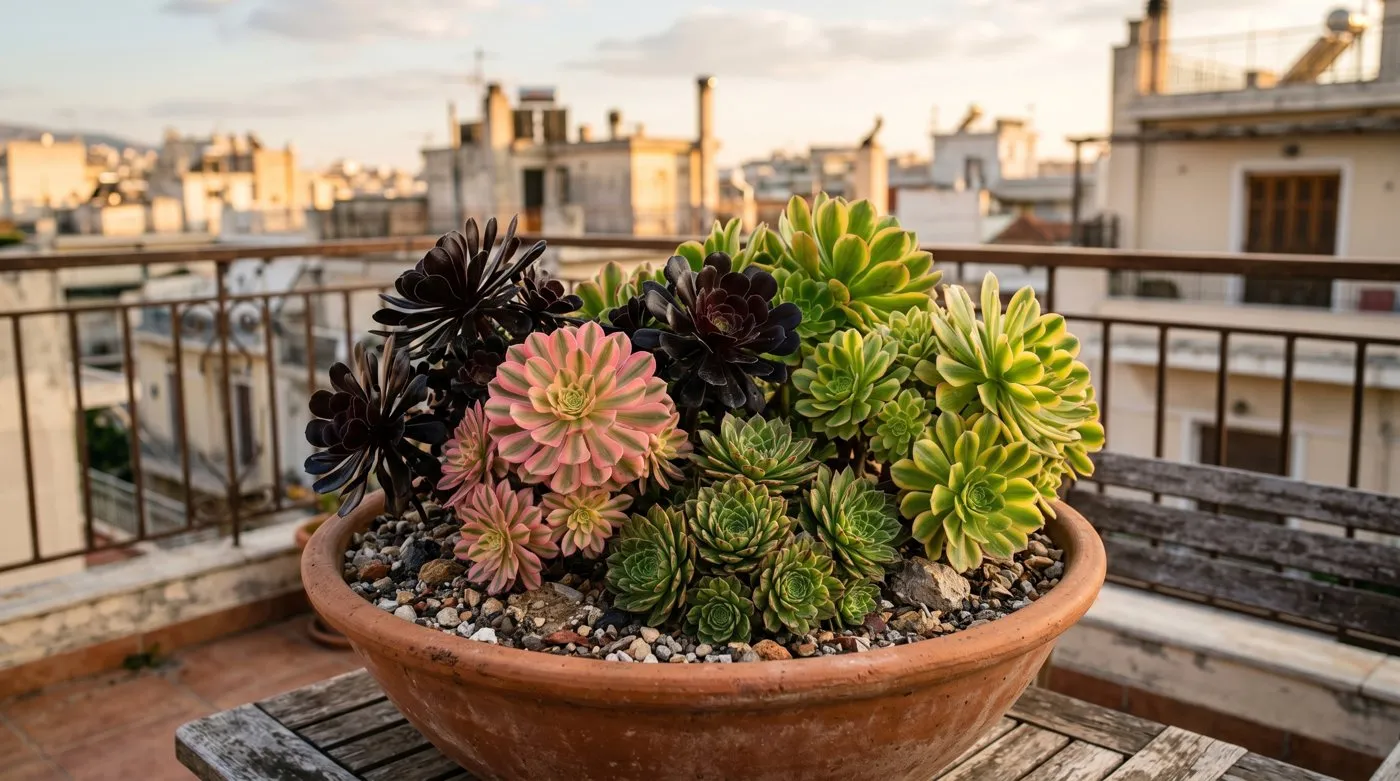 A shallow bowl of mixed aeoniums: green, black, variegated, and yellow rosettes thrive together in one free-draining display.
Aeoniums reward you the moment you stop treating them like ordinary succulents. Water them in their autumn-to-spring growth phase, rest them dry in summer, give them all the light you can, and never let frost reach them. Now you understand the winter-growth cycle, build the rest of your display with our guide to the best indoor plants for UK homes, and consider pairing aeoniums with hardy cacti and succulents for outdoors that can stay out all year. For authoritative botanical detail, the Royal Horticultural Society aeonium guidance is a useful reference.
Our team produces practical UK gardening guidance from source research, contributor records and established horticultural practice. Editorial standards are overseen by Matt W.