Key takeaways
- Sanguisorba is fully hardy, rated RHS H7, and survives to -20C once established
- Moisture-retentive soil is the one rule: it scorches and wilts on dry sand
- Seven types cover every garden, from 50cm 'Tanna' to 2m 'Cangshan Cranberry'
- The see-through bobble flowers float above grasses, the core of prairie-style planting
- Grown lean in full sun, most types stand unstaked; rich soil makes them flop
- Slug-resistant and deer-resistant, so it survives where hostas and tulips vanish
- Expect £8-12 for a 2-litre pot, or £12-15 for 'Lilac Squirrel'
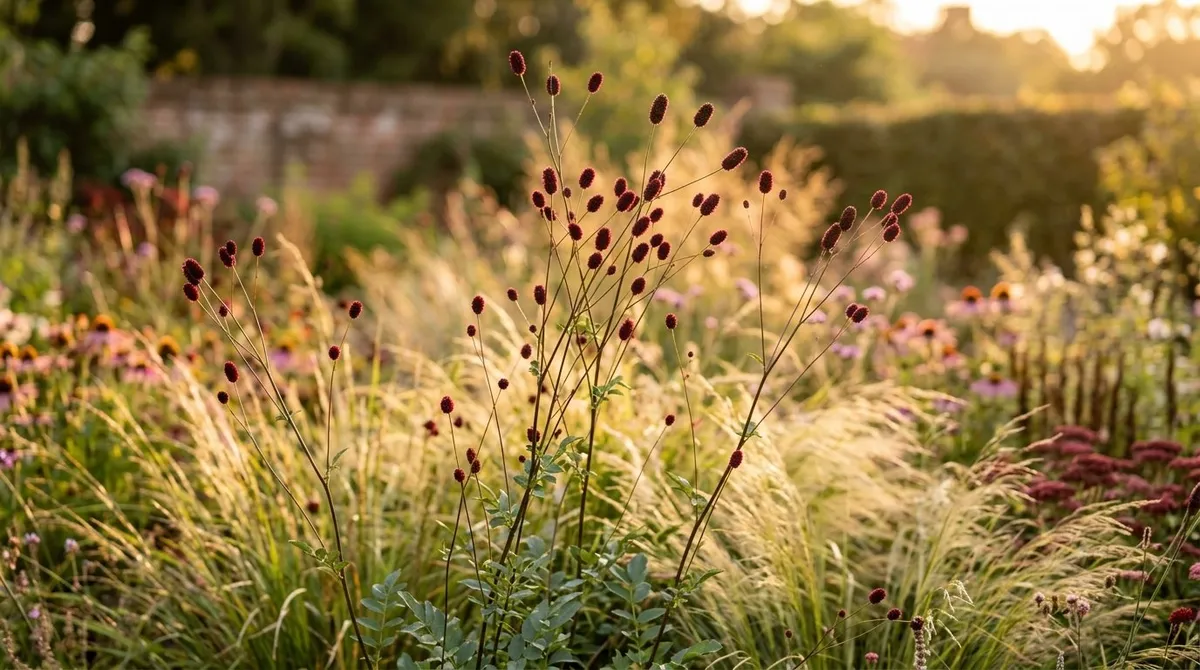
Sanguisorba is the plant designers reach for when they want flowers that float, and once you have seen a drift of it you understand why. The small bobble heads sit on wiry, branching stems so thin they seem to hover, bobbing at head height above a haze of grasses. This is the see-through effect at the heart of Piet Oudolf-style planting, and sanguisorba does it better than almost anything.
Gardeners call it burnet. There are border cultivars a metre or more tall, a compact one for small spaces, a native British wildflower, and one grown almost entirely for social media. This guide covers seven of the best, the single rule that keeps them happy, and the honest problems that catch people out.
What is sanguisorba and why do designers love it?
Sanguisorba is a hardy herbaceous perennial grown for airy bottlebrush flowers held on thin, see-through stems. The RHS describes it as a rhizomatous perennial with pinnate leaves and branched stems carrying terminal spikes of small fluffy flowers. In plain terms, you get neat blue-green foliage low down and a cloud of little bobbles on wire up top.
The appeal is movement. Because the stems are so fine, the flowers seem to drift free of the plant. Designers layer them through grasses so the bobbles hang suspended in mid-air, giving months of gentle motion that a solid block of colour never can.
It is fully hardy too. The RHS rates most types H7, hardy to around -20C, so British winters hold no fear for it. Add slug resistance and deer resistance, and you have a plant that thrives where fussier perennials fail.
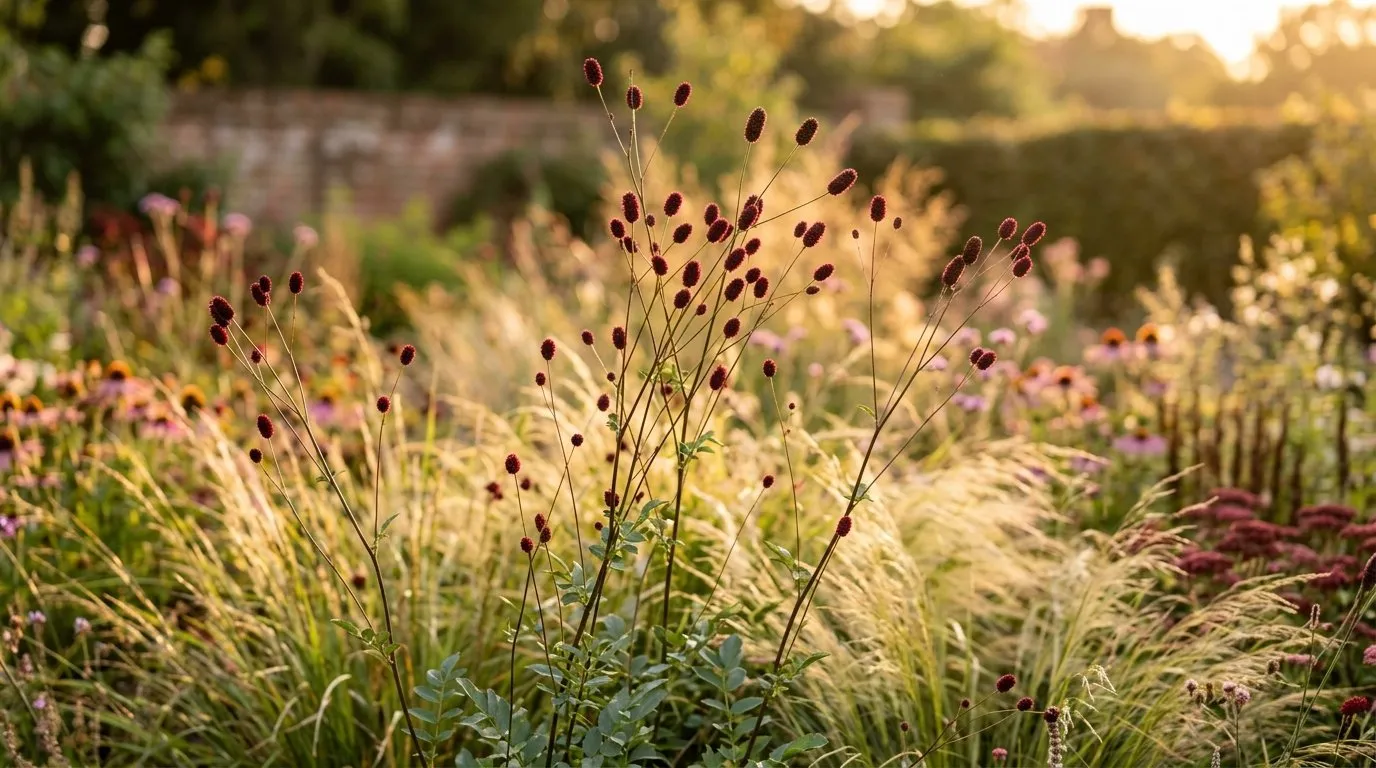 Sanguisorba ‘Red Thunder’ at dusk, the crimson bobbles floating on wiry stems above ornamental grasses. This see-through quality is why designers plant it.
The flower shape varies by species. Some carry short, dark, oval bobbles like tiny bottlebrushes. Others produce long, soft, drooping tails like caterpillars. That range is why one plant covers so many jobs in a border.
Which sanguisorba is best for UK gardens?
The best sanguisorba depends on your space, but ‘Red Thunder’ is the safe designer default. Below are seven types worth growing, from a native wildflower to a 2-metre giant. Match the height and flower form to your garden rather than chasing the trendiest name.
Sanguisorba officinalis (great burnet) is the native British species. It carries small, dark crimson oval bobbles on branching stems to 1 to 1.2m, and it grows wild in damp meadows and floodplains across the UK. It brings genuine wildflower credentials and pairs beautifully with meadow grasses.
Sanguisorba officinalis ‘Red Thunder’ is the designer staple, and the one most planting plans specify. It reaches about 1.2m, with darker, richer crimson bobbles than the wild plant and stronger, self-supporting stems. If you buy one sanguisorba, make it this.
Sanguisorba ‘Tanna’ is the compact choice at 50 to 60cm. It forms a tidy mound of foliage topped with short dark-red bobbles, ideal for small gardens, courtyards and the front of a border where the taller types would loom.
Sanguisorba obtusa breaks the mould with fluffy pink caterpillar flowers rather than tight bobbles. On plants to around 1m, the soft rose plumes arch and nod, a gentler look than the crimson officinalis types.
Sanguisorba hakusanensis ‘Lilac Squirrel’ is the one you see all over Instagram. It sends out long, drooping, fluffy lilac-pink tails like squirrel tails, hanging from wiry stems. It is shorter and looser than the border types, and the most photographed sanguisorba there is.
Sanguisorba ‘Cangshan Cranberry’ is the giant, topping 2m in a good spot and flowering late into autumn when others fade. It needs room and a little support, but nothing else gives you dark cranberry bobbles at that height so late in the year.
Sanguisorba menziesii is the early bird, flowering weeks ahead of the rest with reddish-purple bobbles. It holds an RHS Award of Garden Merit, a reliable, well-behaved plant to start the burnet season.
Gardener’s tip: Buy sanguisorba as a plant, not seed. Named cultivars like ‘Red Thunder’ and ‘Lilac Squirrel’ do not come true from seed, and a 2-litre pot at £8-12 flowers the same summer. Seed-raised officinalis is fine for a wild meadow, but for the border, buy the named clone you actually want.
The 7 best sanguisorba types compared
| Type | Flower | Height | Best for |
|---|---|---|---|
| S. officinalis (great burnet) | Dark crimson oval bobbles | 1-1.2m | Wildlife and meadow planting |
| ’Red Thunder’ | Deep crimson bobbles | 1.2m | The designer border default |
| ’Tanna’ | Short dark-red bobbles | 50-60cm | Small gardens and courtyards |
| S. obtusa | Fluffy pink caterpillars | 1m | A softer, gentler look |
| ’Lilac Squirrel’ | Drooping lilac tails | 60-80cm | Close-up drama and photos |
| ’Cangshan Cranberry’ | Cranberry bobbles | 2m+ | Height and late-autumn colour |
| S. menziesii (AGM) | Reddish-purple bobbles | 1m | Early flowering, reliability |
What soil and position does sanguisorba need?
Sanguisorba needs moisture-retentive soil in full sun to light shade, and moisture is the one rule you cannot break. Great burnet is a native of damp meadows and floodplains, so the plant is built for ground that never dries out. On dry sand it wilts by midday and scorches brown at the leaf edges within a fortnight of drought.
Full sun gives the best flowering and the strongest stems. Light or dappled shade is fine, especially in the drier south, where it keeps the roots cool and moist. Deep shade is too dark, and the plants stretch and flop.
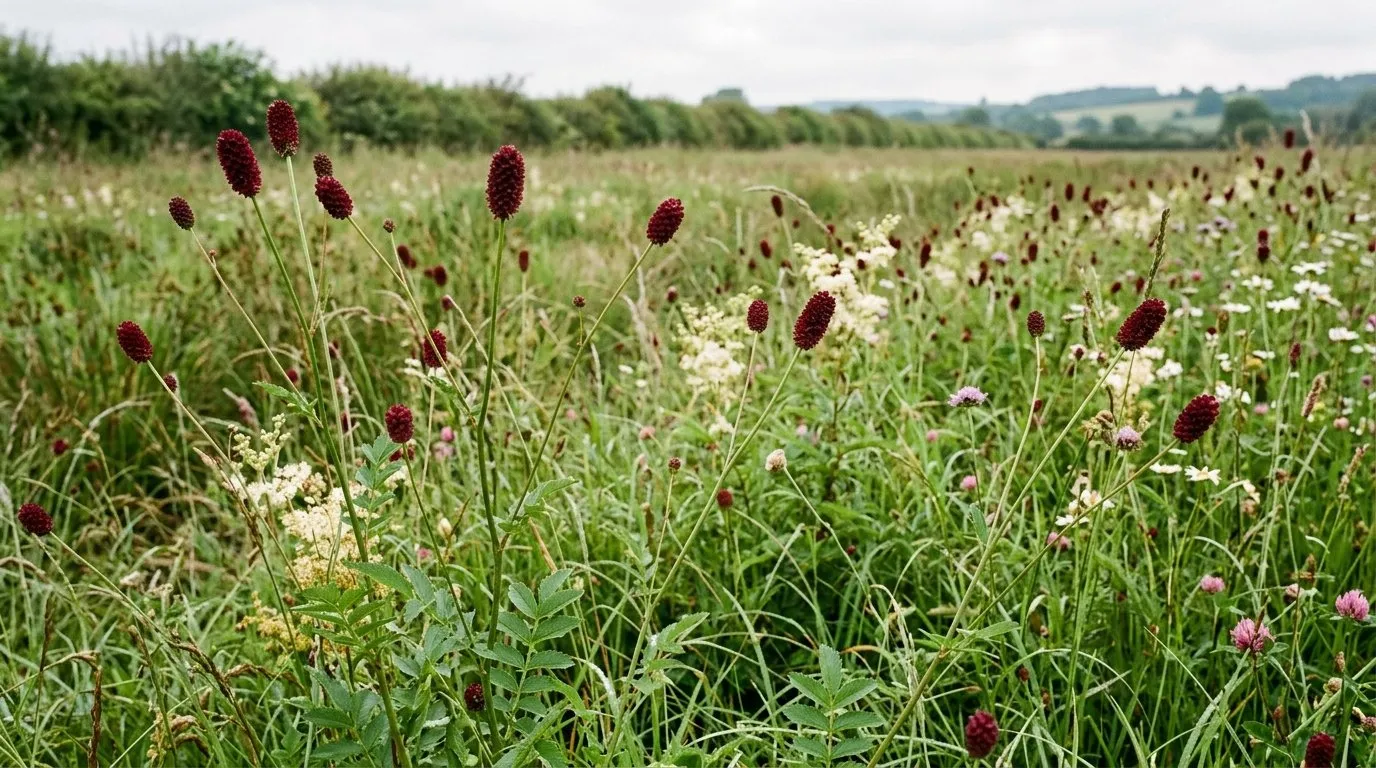 Native great burnet in a damp meadow, its natural home. The crimson bobbles and toothed pinnate leaves show why it reads as a wildflower first.
There is one caution the RHS flags: the rhizomes can spread readily and become a nuisance in the right conditions. In a border this is rarely a problem, but do not plant it where it can escape into a small pond margin or a neighbour’s damp lawn unchecked. If your ground is genuinely wet, our guide to plants for wet, boggy soil puts sanguisorba in context with other moisture-lovers.
When and how do you plant sanguisorba?
Plant sanguisorba in spring or autumn, when the soil is warm and reliably moist. Autumn planting, from September to November, lets the roots settle before the next summer, which suits a plant that hates drought. Spring planting, from March to May, works well on cold, wet clay that sits sodden over winter.
Dig a hole twice the width of the pot. Fork a couple of handfuls of garden compost into the backfill, then set the plant at the depth it sat in the pot. Firm gently and water in well, even if rain is forecast.
Spacing depends on the type. Give border cultivars like ‘Red Thunder’ about 45cm each way, compact ‘Tanna’ around 30cm, and the giant ‘Cangshan Cranberry’ a full 60cm. Planting in groups of three or five reads far better than dotting singles about.
The critical job is watering through the first summer. A young sanguisorba that dries out once often never bulks up properly. Keep the ground damp for the whole first season, and mulch around the plants with 5cm of compost to hold that moisture in.
 Sanguisorba threaded through echinacea, rudbeckia and grasses in a suburban prairie border. Groups of three or five give the drift effect.
Does sanguisorba need staking?
Most sanguisorba stands unstaked if you grow it lean in full sun, and this is the honest troubleshooting point people miss. The plant flops for one reason above all: too rich a soil. Overfeeding pushes soft, sappy, over-tall growth that collapses in the first summer downpour.
The exceptions are the giants. ‘Cangshan Cranberry’ at 2m and a few of the tallest officinalis selections benefit from a discreet support ring or a few pea sticks pushed in during spring, before the stems reach full height. Put supports in early and the plant hides them completely.
If a clump does start to sprawl, resist the urge to feed it back to health. Feeding makes flop worse. For the tall types that genuinely need help, the methods in our guide to staking tall perennials keep them upright without the props showing.
The takeaway is simple. Water, not fertiliser, is what sanguisorba wants. Keep it lean and damp and it earns its keep with almost no propping.
How do you use sanguisorba in naturalistic planting?
Sanguisorba is a keystone of prairie and naturalistic planting because its see-through flowers let you layer colour at height without blocking the view. The trick is to weave it through grasses so the bobbles appear to float in a haze rather than sit in a solid clump.
The classic partners are ornamental grasses. Deschampsia cespitosa and Molinia caerulea give the airy golden veil that sanguisorba loves to rise through. Both enjoy the same moisture-retentive soil, so they grow happily side by side. Our ornamental grasses guide helps you pick the right ones.
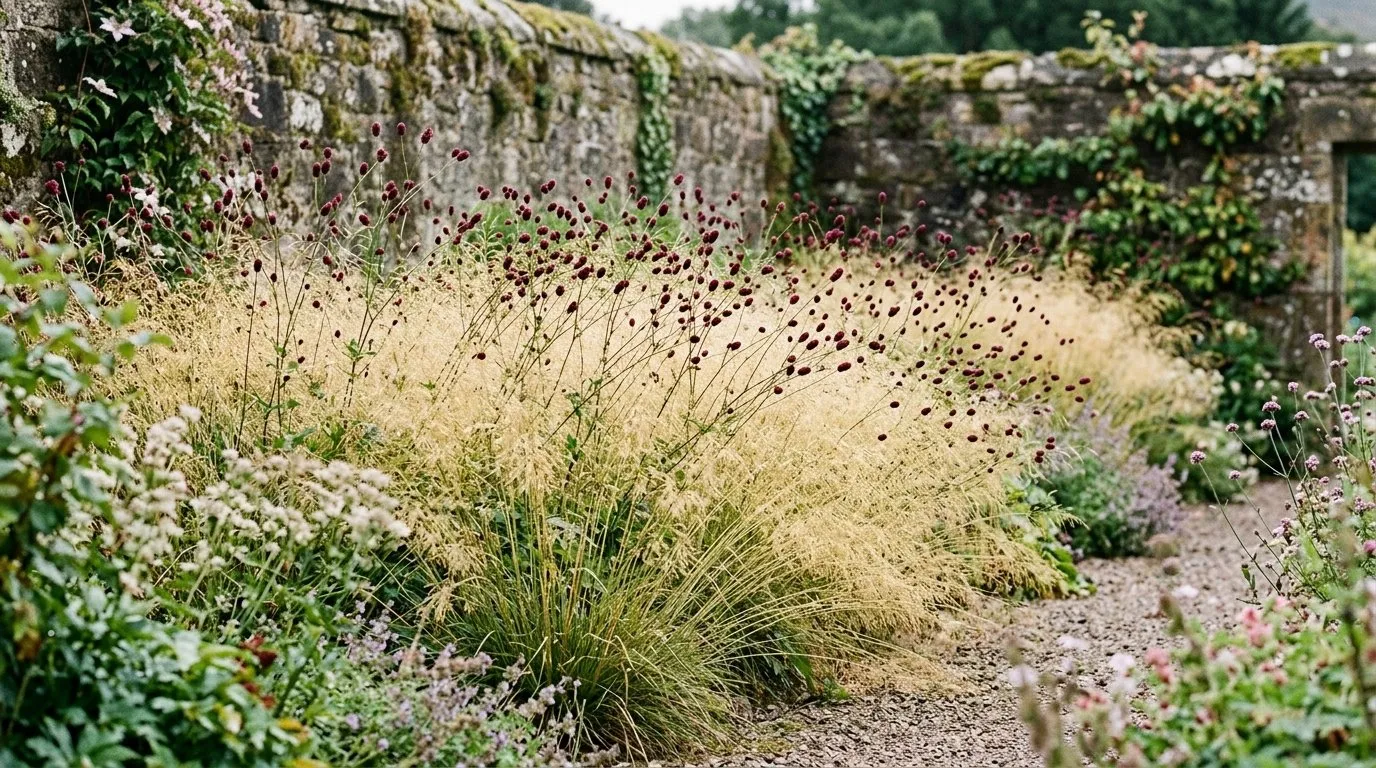 Sanguisorba rising through a golden haze of Deschampsia in a Scottish walled garden. The two share the same damp soil and flower together.
For a stronger contrast, plant it behind Stipa gigantea or a low mound of hakonechloa. The oat-like flowers of stipa play off the tight bobbles beautifully; our Stipa gigantea guide covers that pairing. Beyond grasses, sanguisorba mixes with echinacea, rudbeckia, veronicastrum and late asters for a full prairie scheme.
Repetition is the secret. Rather than one clump, run a ribbon of sanguisorba through the border, dropping a group every few metres. The eye follows the repeated bobbles and the planting reads as one flowing drift.
In smaller gardens, compact ‘Tanna’ does the same job at a fraction of the height. A short row of it edging a raised bed brings the see-through effect down to courtyard scale.
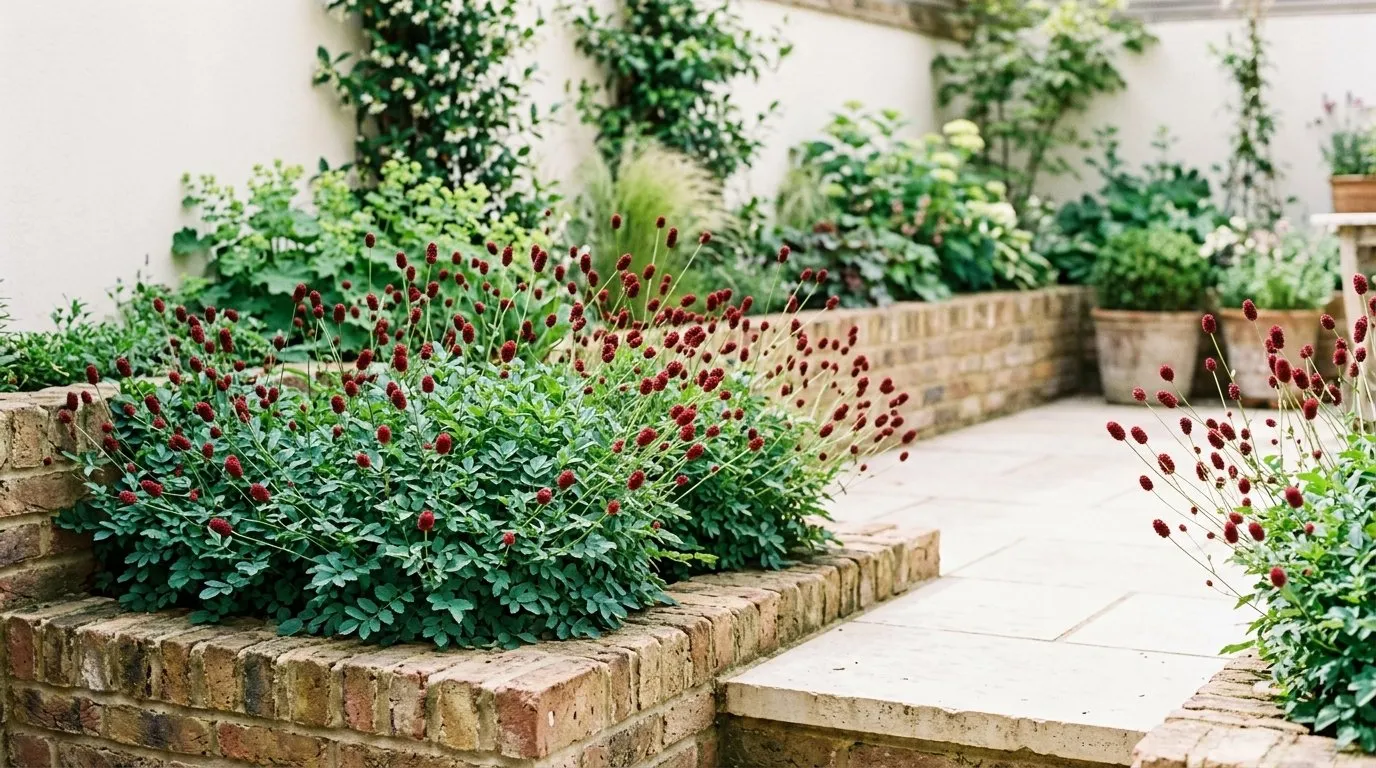 Compact ‘Tanna’ at 50-60cm edging a raised bed in a city courtyard. The small-space burnet for gardens with no room for the giants.
Is sanguisorba good for wildlife?
Yes, sanguisorba earns its place for wildlife on several counts. The small flowers carry accessible pollen and nectar that bees and hoverflies work over through summer, and the late-flowering types feed insects when little else is left.
Native great burnet is a plant of damp UK meadows, riverbanks and floodplains, part of a habitat that has shrunk drastically in Britain. Growing it in the garden echoes that lost meadow flora and supports the same web of insects. If you want the full effect, our guide on making a wildflower meadow shows how to establish it in grass.
There is a striking overseas connection worth knowing. In mainland Europe, great burnet is the sole larval food plant of the rare dusky large blue and scarce large blue butterflies. Those species do not occur in Britain, so growing it here will not bring them, but it shows how central this modest plant is to a fragile insect community.
The seed heads matter too. Left standing through autumn and winter, the dried bobbles feed finches and other small birds, and give frost-catching structure to the border. That is reason enough to leave the cutting back until late winter.
How do you care for sanguisorba through the year?
Sanguisorba needs very little once established: water in drought, cut back in late winter, and divide every few years. The plant does most of the work itself if the soil stays moist.
Through summer, the only regular job is watering in dry spells. A sanguisorba that wilts has usually run short of water, so soak it well and mulch. Skip the feed, because rich conditions cause flop.
Leave the stems standing in autumn. The seed heads hold their shape, catch frost and feed birds from October onward. Cut everything to the base in late winter, around February, before the new shoots push through. That single cut is the whole tidy-up.
 Sanguisorba seed heads rimed with frost in a Lake District garden. Leaving them standing feeds birds and gives winter structure until the February cut.
Divide clumps every three to four years in spring to keep them vigorous and to make new plants for free. Congested clumps flower less and the centre can die out, so division renews them. The RHS confirms spring or autumn division works, and spring is easiest on wet ground. Our guide to dividing perennials covers the timing across the border.
To divide, lift the whole clump with a fork on a mild spring day. Push two forks back to back into the middle and lever the clump apart, then split each half again if it is large. Replant the vigorous outer sections at once, water them in, and compost the tired centre.
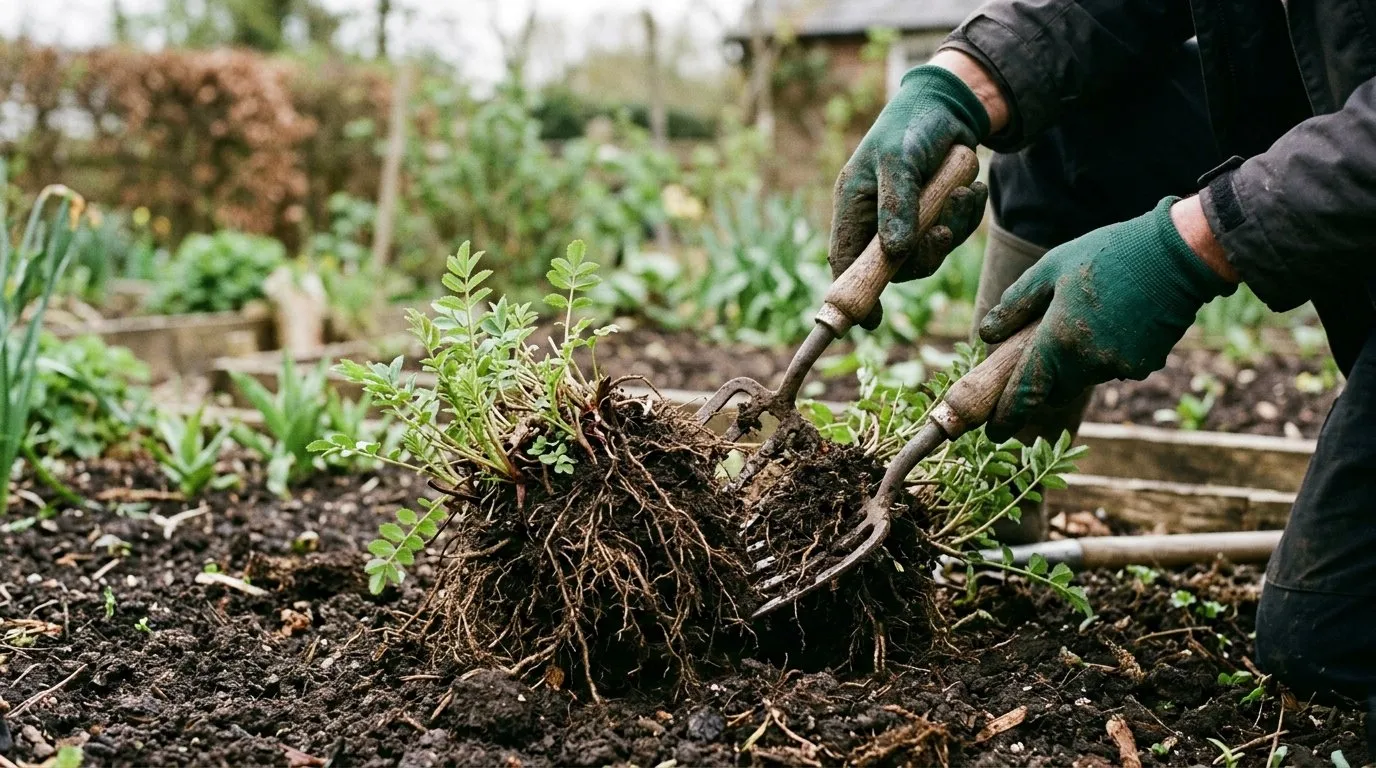 Splitting a clump with two forks back to back in spring. Replant the strong outer pieces and discard the worn-out middle.
Can you grow sanguisorba as a cut flower?
Sanguisorba is a lovely, if underused, cut flower that brings airy movement to arrangements. The wiry bobble stems last around a week in a vase and mix well with grasses, dahlias and other late-summer flowers from the cutting patch.
Cut the stems when the bobbles have just coloured up but before they go over. Take them in the cool of the morning, strip the lower leaves, and plunge them straight into deep water for a few hours before arranging. The conditioning routine in our cut flower vase-life guide applies to sanguisorba too.
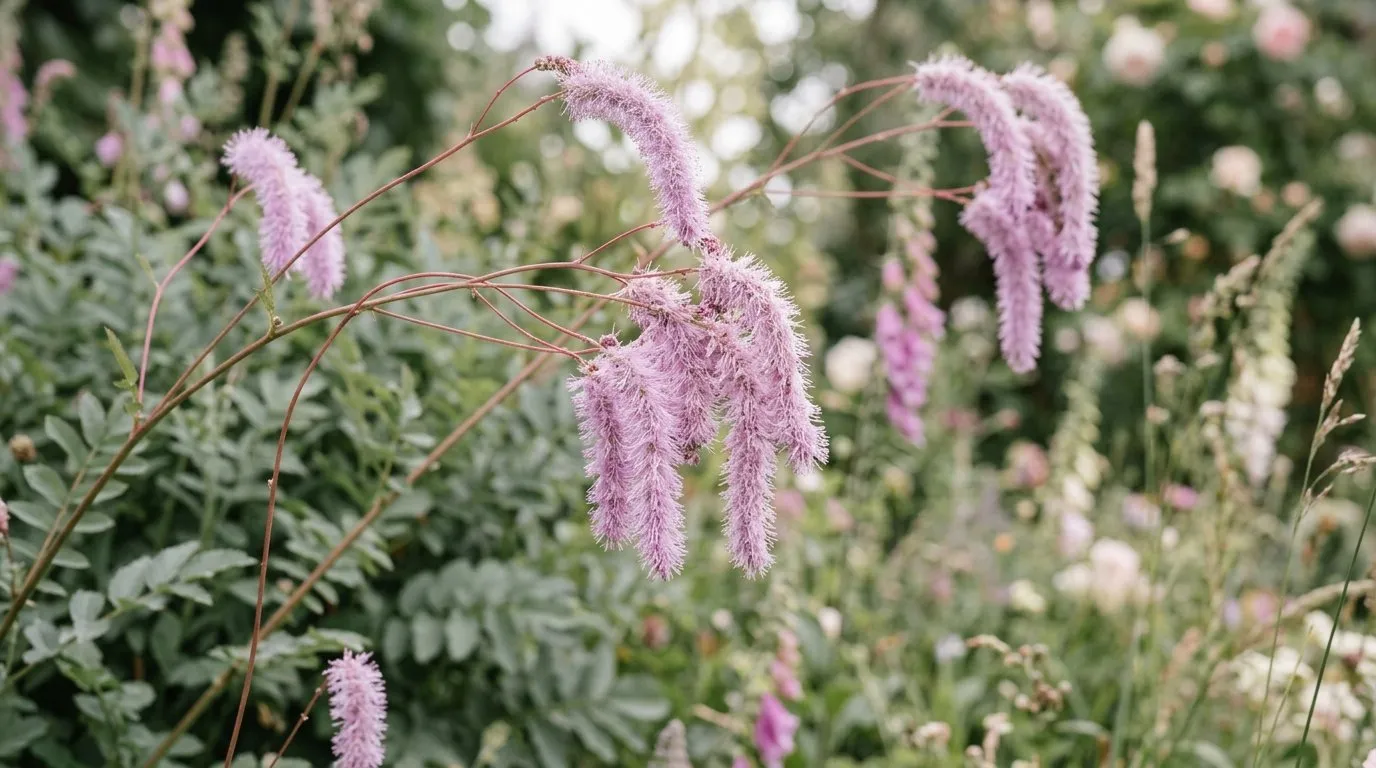 ‘Lilac Squirrel’ up close, its soft drooping tails the most photographed of all the burnets and a striking cut stem.
It dries well, which extends the value further. Hang small bunches upside down in a warm, airy place out of direct sun, and the seed heads hold their shape and colour for months. ‘Lilac Squirrel’ and the officinalis types both dry reliably.
If you are planning a dedicated patch, sanguisorba slots neatly into the tender-and-hardy annual rotation. Our full guide on growing cut flowers shows how to build a season of stems, with burnet adding the see-through texture that solid blooms lack.
Frequently asked questions
Is sanguisorba hard to grow?
No, sanguisorba is easy given one thing: soil that stays moist. It is fully hardy, rated RHS H7, and shrugs off slugs and deer. The only common failure is dry ground, which scorches the leaves and wilts the plant. Give it a damp spot in sun or light shade and it needs almost nothing else.
Does sanguisorba need staking?
When should I plant sanguisorba?
Plant sanguisorba in spring or autumn, when the soil is warm and moist. Autumn planting lets roots settle before summer heat, which suits this moisture-loving plant. Spring works well too, especially on cold, wet clay. Water new plants through their first summer, because a young sanguisorba that dries out rarely recovers well.
Is sanguisorba good for wildlife?
Yes, sanguisorba flowers feed bees and hoverflies, and the seed heads feed finches through autumn. Native great burnet is a plant of damp UK meadows and floodplains. In mainland Europe it is the sole larval food of rare large blue butterflies, though those species do not occur in Britain. Its pollen and late nectar still earn it a place.
How do you look after sanguisorba in winter?
Leave the stems standing, then cut to the base in late winter. The dried bobble seed heads give structure and frost interest from October, and birds pick them over. Cut everything to ground level in February before new shoots appear. Divide congested clumps every three to four years in spring to keep them vigorous.
What grows well with sanguisorba?
Ornamental grasses are the classic partners for sanguisorba. Deschampsia, molinia and stipa create the see-through haze that lets the bobbles float. It also mixes with echinacea, rudbeckia, veronicastrum and asters in prairie-style borders. Choose partners that enjoy the same moist soil, and avoid drought-lovers like lavender that want the opposite conditions.
Can you use sanguisorba as a cut flower?
Yes, sanguisorba is a fine cut flower and dries well too. The wiry bobble stems last around a week in a vase and add airy movement to arrangements. Cut when the flowers have just coloured up. For drying, hang small bunches upside down in a warm, airy place, and the seed heads hold their shape for months.
Once your sanguisorba is settled, keep building the prairie look with grasses and late perennials, and you will have movement and colour in the border from midsummer to the first hard frosts.
Our team produces practical UK gardening guidance from source research, contributor records and established horticultural practice. Editorial standards are overseen by Matt W.