Key takeaways
- Flaming Katy (Kalanchoe blossfeldiana) flowers for 8 to 10 weeks per flush
- Keep it above 10C; below about 7C the leaves blacken and rot
- Water only when the top 3cm of compost is dry, then soak and drain fully
- To rebloom, give 14 hours of total darkness nightly for 6 weeks from October
- Leaf and stem cuttings root in 2 to 3 weeks at 18 to 20C
- Kalanchoe is toxic to cats and dogs, so keep it out of their reach
Kalanchoe care confuses more houseplant owners than almost any plant we know. The Flaming Katy (Kalanchoe blossfeldiana) arrives from the supermarket covered in flower, then fades after two months and never blooms again. Most people give up and throw it out. That is a shame, because the plant is a tough Madagascan succulent that can live and flower for years. The secret nobody explains on the label is simple. It is a short-day plant, and it needs long nights to set buds. Get the light, water and darkness right and one cheap plant flowers every winter. This guide covers watering, light, temperature, reblooming and free plants from cuttings.
Why supermarket Flaming Katy stops flowering
Supermarket kalanchoe stops flowering because your home has too much light at night, not too little. This is the single fact that makes sense of the whole plant. Kalanchoe blossfeldiana is a short-day plant. It only forms flower buds when nights are long and unbroken, the same trigger that makes a poinsettia colour up for Christmas. Growers force it into bloom under blackout screens, then ship it to the shops in full flower.
Once it reaches your windowsill, the long days of a lit room keep it in leafy mode. It grows perfectly well but sets no buds. People blame themselves, or feed and water harder, which only makes leggy green growth. The plant is not sick. It is simply waiting for a signal that a modern home never sends.
The root cause is photoperiod, the length of uninterrupted darkness each night. Kalanchoe needs around 14 hours of total dark to flip back into flower. A table lamp, a hallway bulb or even street light through thin curtains resets the clock. Understand that, and reblooming becomes a job you can plan, not a matter of luck. We cover the exact method below.
The Flaming Katy, a succulent from Madagascar
Kalanchoe blossfeldiana is an evergreen succulent from the rocky hills of Madagascar, where it grows in bright sun and shrugs off drought. It reaches about 30 to 45cm tall as a houseplant, with thick, glossy, scallop-edged leaves that store water. Those fleshy leaves are the key to its care. The plant survives dry spells by drawing on the water banked in its foliage.
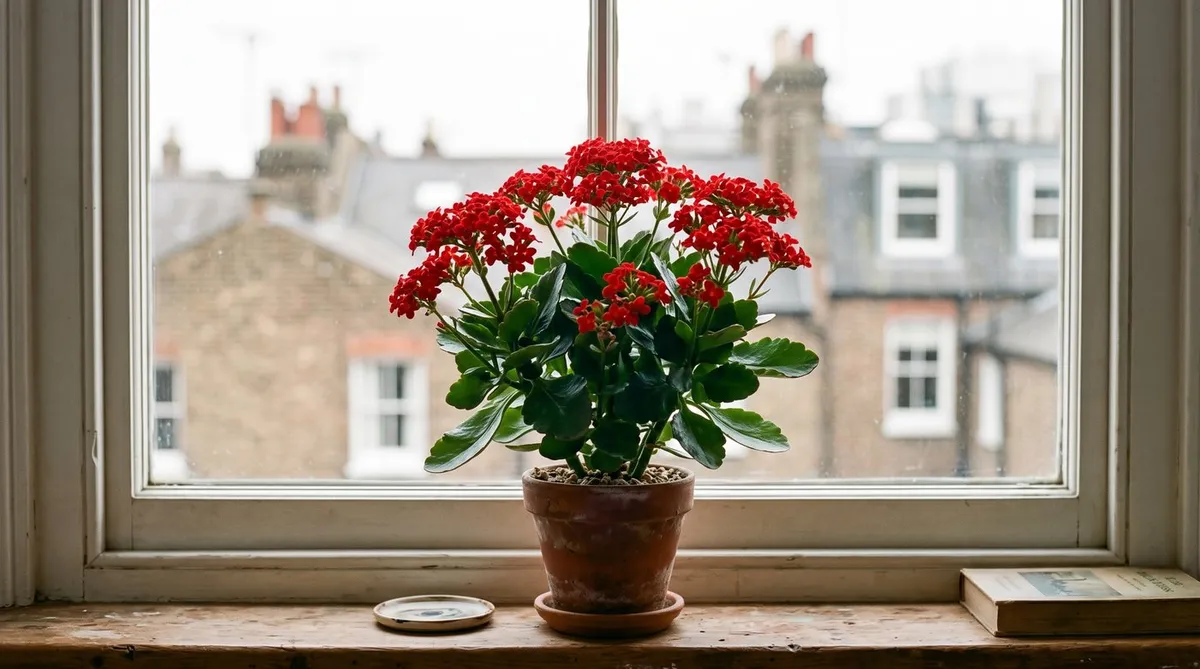
The flowers sit in dense clusters on stems held above the leaves. Wild plants are scarlet, but breeders have produced red, orange, pink, yellow, salmon and white, plus double-flowered types sold as Calandiva. Each flush lasts a long time. In our Staffordshire kitchen a single plant held colour for eight to ten weeks from late winter into spring.
It belongs to a big and varied genus. Two relatives turn up as houseplants: the fuzzy grey panda plant (K. tomentosa), grown for its felted leaves, and the fast-breeding mother of thousands (K. daigremontiana), which sprouts tiny plantlets along every leaf edge. Flaming Katy is the one grown for flowers, and it treats you to a proper winter show if you learn its rhythm. It shares the wider succulent basics of bright light, gritty compost and restraint with the watering can.
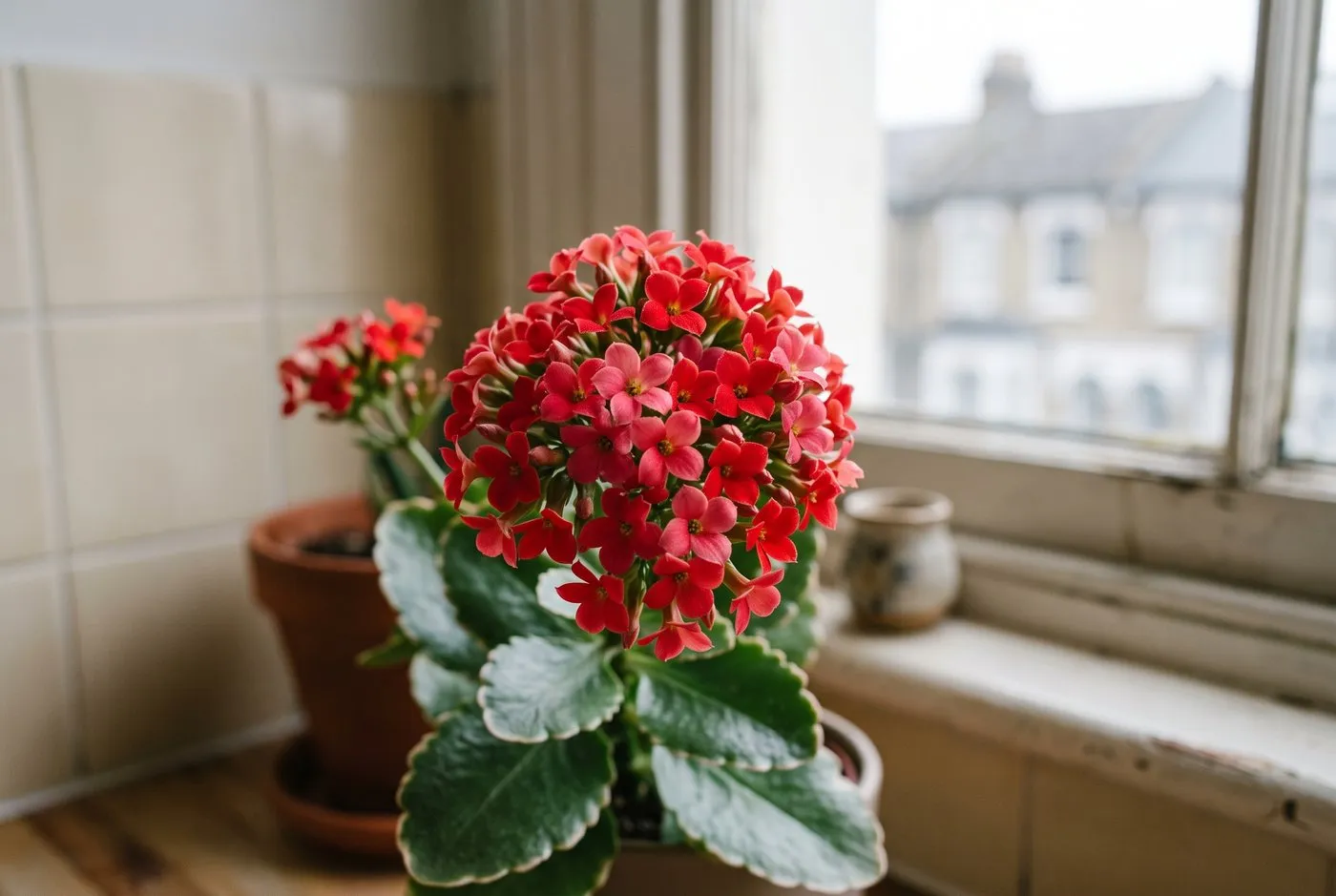 The signature Flaming Katy show: dense clusters of small four-petalled flowers held above thick, glossy, scallop-edged leaves. This plant held colour for ten weeks on our kitchen sill.
How to water kalanchoe using the soak and dry method
Water kalanchoe only when the compost has dried out, then soak it thoroughly. This is the soak and dry method, and it suits every succulent. The plant stores water in its leaves, so it copes far better with drought than with a soggy pot. Overwatering, not underwatering, kills most kalanchoe.
Check the compost with a finger. When the top 3cm feels dry, water generously until it runs from the drainage holes. Then tip away anything left in the saucer. Let the pot dry out again before the next drink. In a warm summer room that cycle often falls every 7 to 10 days. In a cool winter room it can stretch to every 3 to 4 weeks.
Signs are easy to read. Firm, plump leaves mean the plant is happy. Soft, wrinkled leaves mean it is thirsty and will recover within a day of watering. Yellow, mushy lower leaves mean the opposite: too much water and the start of rot. When in doubt, wait. A kalanchoe forgives a missed week far more readily than a wet fortnight. The same watering discipline applies to its cousin, and our jade plant care guide shows the classic tell-tale of a plump versus a shrivelled succulent leaf.
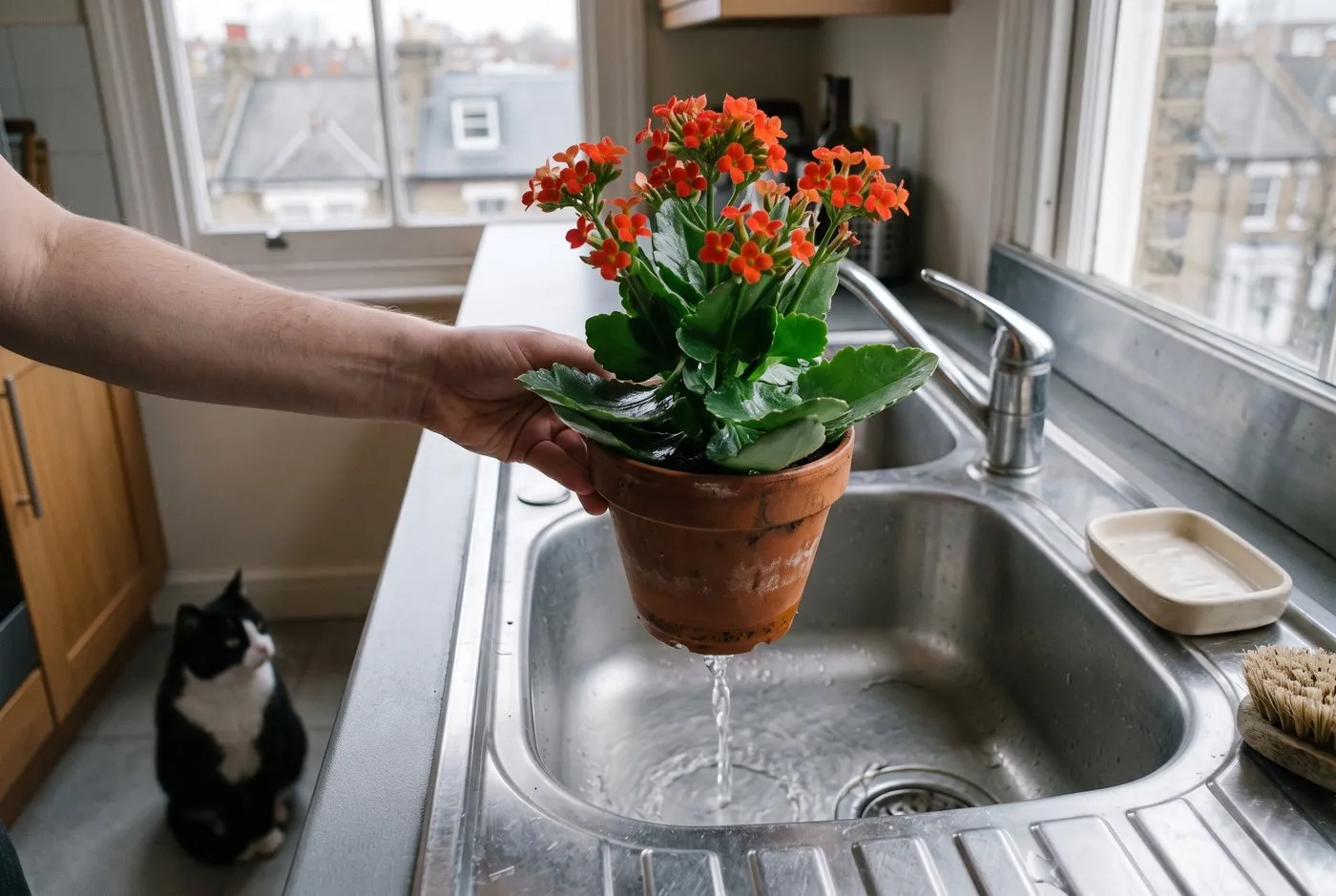 Soak and dry in practice: water at the sink until it runs from the base, drain fully, then wait until the top 3cm dries before the next drink.
Light, warmth and the gritty compost it needs
Kalanchoe wants the brightest spot you can give it, short of scorching summer glass. A south, east or west-facing windowsill with at least six hours of light keeps growth compact and colours strong. In poor light the stems stretch, the leaves space out, and flowering fails. If your plant looks pale and leggy, it needs more light before anything else.
Warmth matters just as much. Keep it in the range of 15 to 24C through the year, and never let it drop below about 10 to 13C for long. Below 7C the soft leaves blacken and collapse. That makes a cold porch or an unheated conservatory a risk in winter. Keep the plant clear of cold glass on frosty nights, and away from radiators that dry it to a crisp.
The pot and compost seal the deal. Kalanchoe hates wet feet, so use a free-draining, gritty mix: we blend roughly two parts peat-free houseplant compost to one part horticultural grit or perlite. Choose a pot barely bigger than the rootball, ideally terracotta, which breathes and dries faster than plastic. Feed monthly from May to September with a diluted high-potash feed, such as a tomato feed at half strength, to fuel flowering rather than soft leaf. Our houseplant feeding plan sets out the year-round rhythm of when to feed and when to stop.
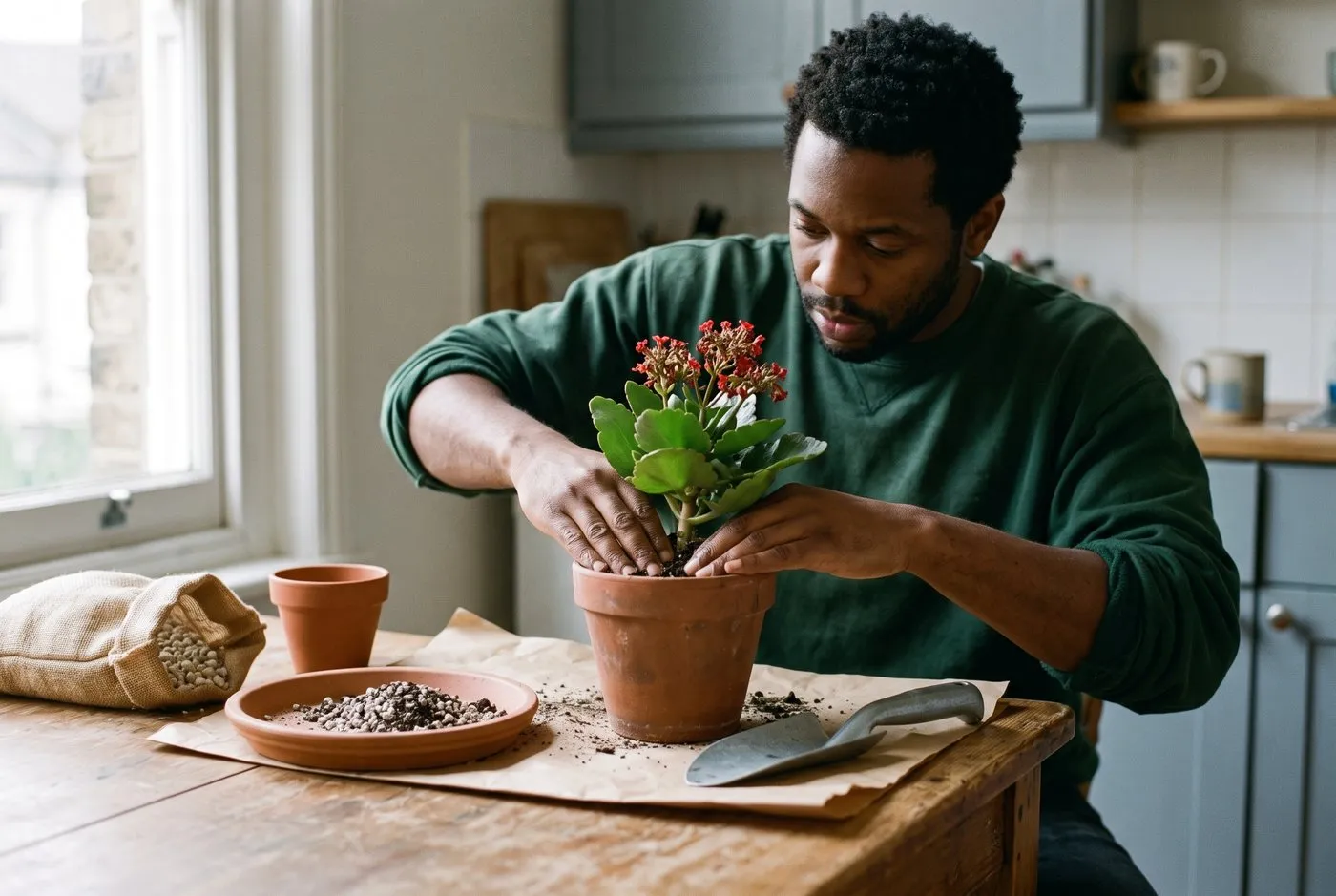 Repotting into a gritty, free-draining mix of two parts peat-free compost to one part grit. Firming the mix by hand around the rootball keeps the crown clear of standing moisture.
How to make kalanchoe rebloom with 14 hours of darkness
Making a kalanchoe rebloom is the part everyone gets wrong, and it is the reason we wrote this guide. The plant will not flower again by itself indoors. You have to give it a spell of short days and long nights to trigger buds. The process is reliable once you know the stages, and it costs nothing.
The science is straightforward. Kalanchoe measures the length of unbroken darkness with a leaf pigment. When nights run past about 12 hours, and ideally 14 hours, for several weeks, the plant reads it as autumn and switches to flowering. Any light during the dark period, even a brief flash, breaks the count and delays buds. This is exactly how growers and Christmas cactus owners force winter colour.
Run it in clear stages:
- Weeks 0 to 6, the dark treatment. From late September or October, give the plant 14 hours of total darkness each night. Move it into a cupboard, a wardrobe or under an upturned cardboard box from about 5pm to 7am. Total dark, no gaps.
- Each day, bright light. During the 10 daytime hours, return it to a bright windowsill. It still needs strong light by day to build energy for the flowers.
- Keep it warm and on the dry side. Hold the room at 15 to 20C through the treatment. Water sparingly, only when the top of the compost dries.
- Weeks 5 to 6, buds appear. Tiny flower buds show in the leaf tips after about five weeks. Once you can see them clearly, stop the dark treatment.
- Weeks 6 to 14, flowering. Grow the plant normally on a bright sill. Buds swell and open over the following weeks, giving another eight to ten weeks of colour.
The critical mistake is giving up too soon, or letting light leak in. A single lit evening in the middle of the six weeks can reset the whole cycle. People try it for a fortnight, see nothing, and quit. The buds simply have not had enough long nights yet. Commit to the full six weeks of clean darkness and the plant nearly always responds. The Christmas cactus care guide uses the same short-day principle, so if you run both plants you can treat them together on one autumn schedule.
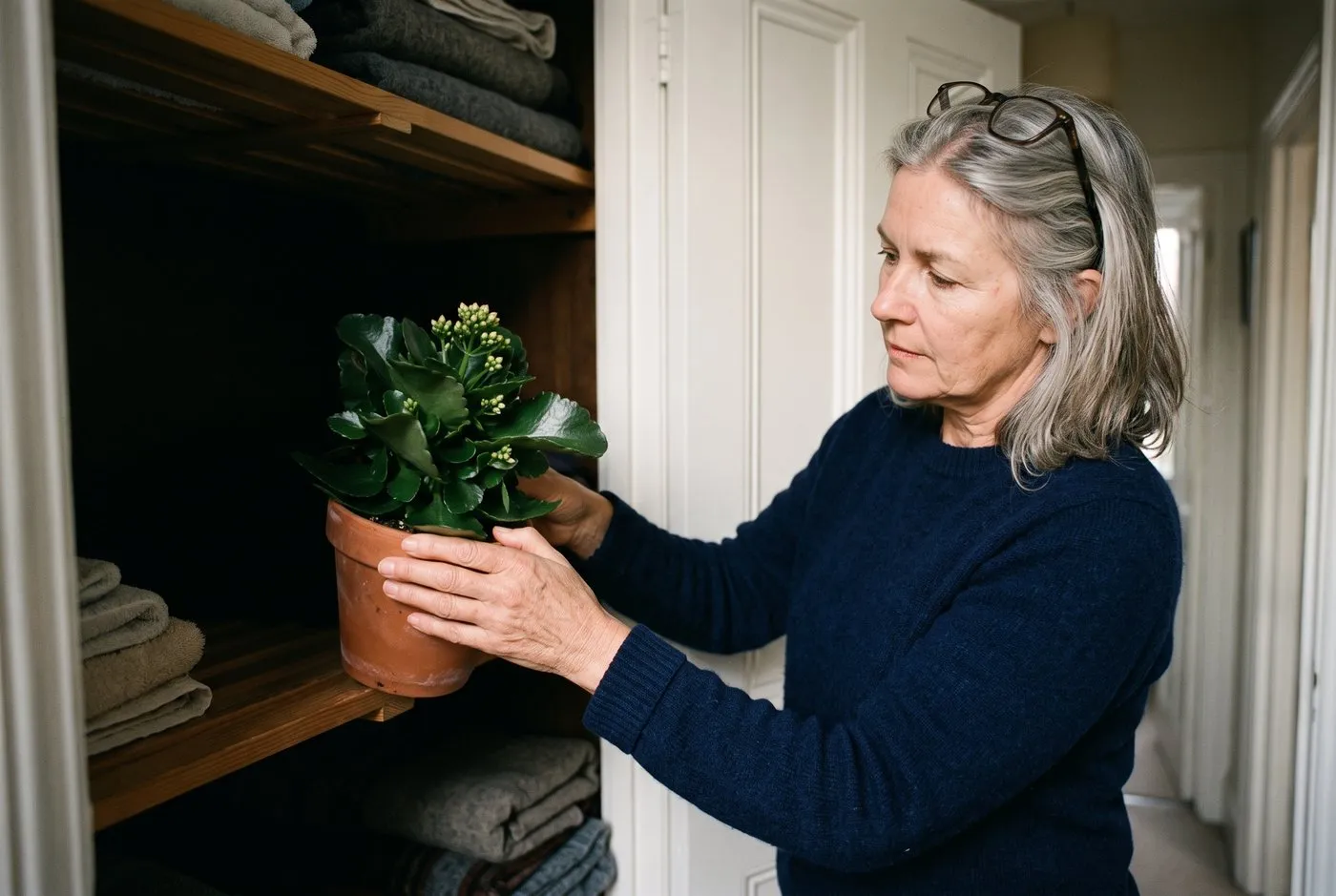 The rebloom trigger in action: into a dark cupboard each evening for 14 hours, back to bright light by day. Six weeks of clean darkness sets a fresh flush of buds.
Kalanchoe species and types compared
K. blossfeldiana is the one to grow for a winter flower show, and it is our top pick because the dark treatment makes it repeat year after year. K. tomentosa is the toughest of the group and thrives on neglect, but it is a foliage plant that seldom flowers indoors. K. daigremontiana is fascinating but produces so many plantlets that it colonises nearby pots, so keep it contained.
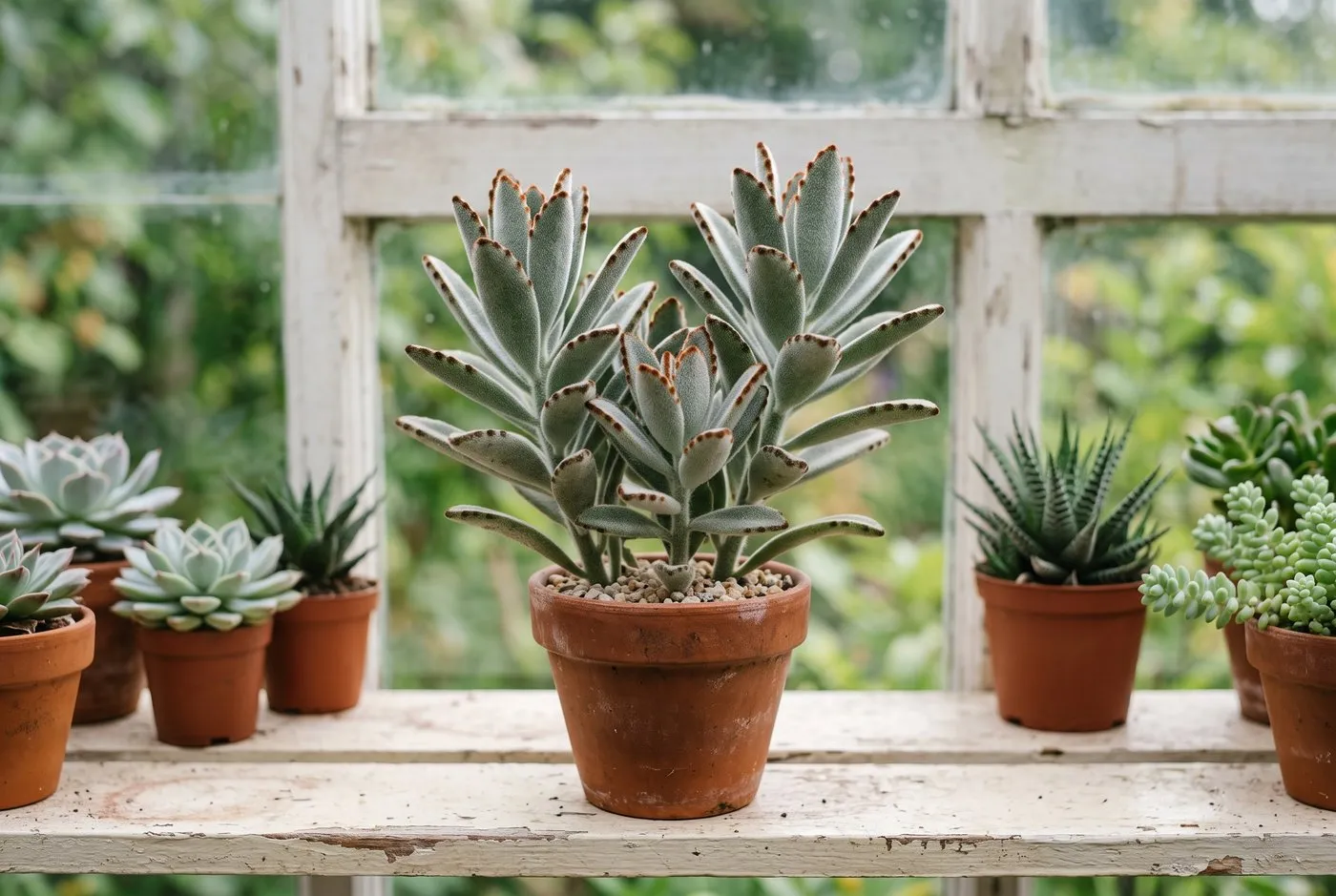 Kalanchoe tomentosa, the panda plant, grown for its felted grey leaves rather than flowers. It is the most drought-proof member of the group and near impossible to kill.
Month-by-month kalanchoe care calendar
| Month | Task |
|---|---|
| January | Peak flowering for treated plants. Water sparingly, only when dry. Keep above 12C and off cold glass at night. |
| February | Flowering continues. Deadhead spent flower heads to keep the plant tidy and to save its energy. |
| March | Flowers fade. Cut back the old flower stems to a pair of leaves. Growth restarts as days lengthen. |
| April | Start watering a little more freely. Repot now if roots fill the pot, into gritty compost one size up. |
| May | Begin monthly high-potash feeding at half strength. Take leaf and stem cuttings from any pruning. |
| June | Move pots outside to a sheltered, sunny spot once nights stay above 10C. Water as the compost dries. |
| July | Keep outdoors in full growth. Water in warm spells and feed monthly. Watch for soft, leggy growth in shade. |
| August | Continue feeding. Pinch leggy stems to keep plants bushy. Check leaf axils for white mealybug fuzz. |
| September | Bring plants back indoors before nights turn cold. Stop feeding. Clean leaves and inspect for pests. |
| October | Start the 14-hour dark treatment for reblooming. Dark from 5pm to 7am, bright light by day, warm room. |
| November | Continue the dark treatment. Buds should appear towards month end. Water very sparingly through the spell. |
| December | Stop the dark treatment once buds show. Grow on a bright sill. First treated plants come into flower. |
The reason this works comes back to drainage. Kalanchoe roots need air as much as water. A dense, water-holding compost suffocates them in the cool months when the plant is barely drinking. Grit opens the mix, lets excess water drain and dry, and mimics the free-draining rocky ground the plant evolved on. When you repot, our houseplant repotting guide walks through easing out the rootball without breaking the brittle succulent stems.
Taking kalanchoe cuttings for free plants
Kalanchoe is one of the easiest houseplants to propagate, so one supermarket plant becomes many. Both stem cuttings and leaf cuttings work, and both root within 2 to 3 weeks. The best time is late spring to summer, from May to August, when growth is active and light is strong.
For a stem cutting, snip a healthy, non-flowering shoot tip about 5 to 8cm long. Strip the lowest leaves, then leave the cutting on a windowsill for 24 hours so the cut end dries and seals. This callusing step stops the stem rotting when you plant it. Push the dried end into gritty compost, keep it barely moist at 18 to 20C, and roots form quickly.
Leaf cuttings are just as simple. Pull off a whole, firm leaf, let it callus for a day, then lay it on gritty compost with the base touching the surface. Tiny plantlets and roots grow from the leaf base over a few weeks. Pot them on once they have their own roots. For the full range of houseplant methods, our guide to propagating houseplants covers water rooting, division and more.
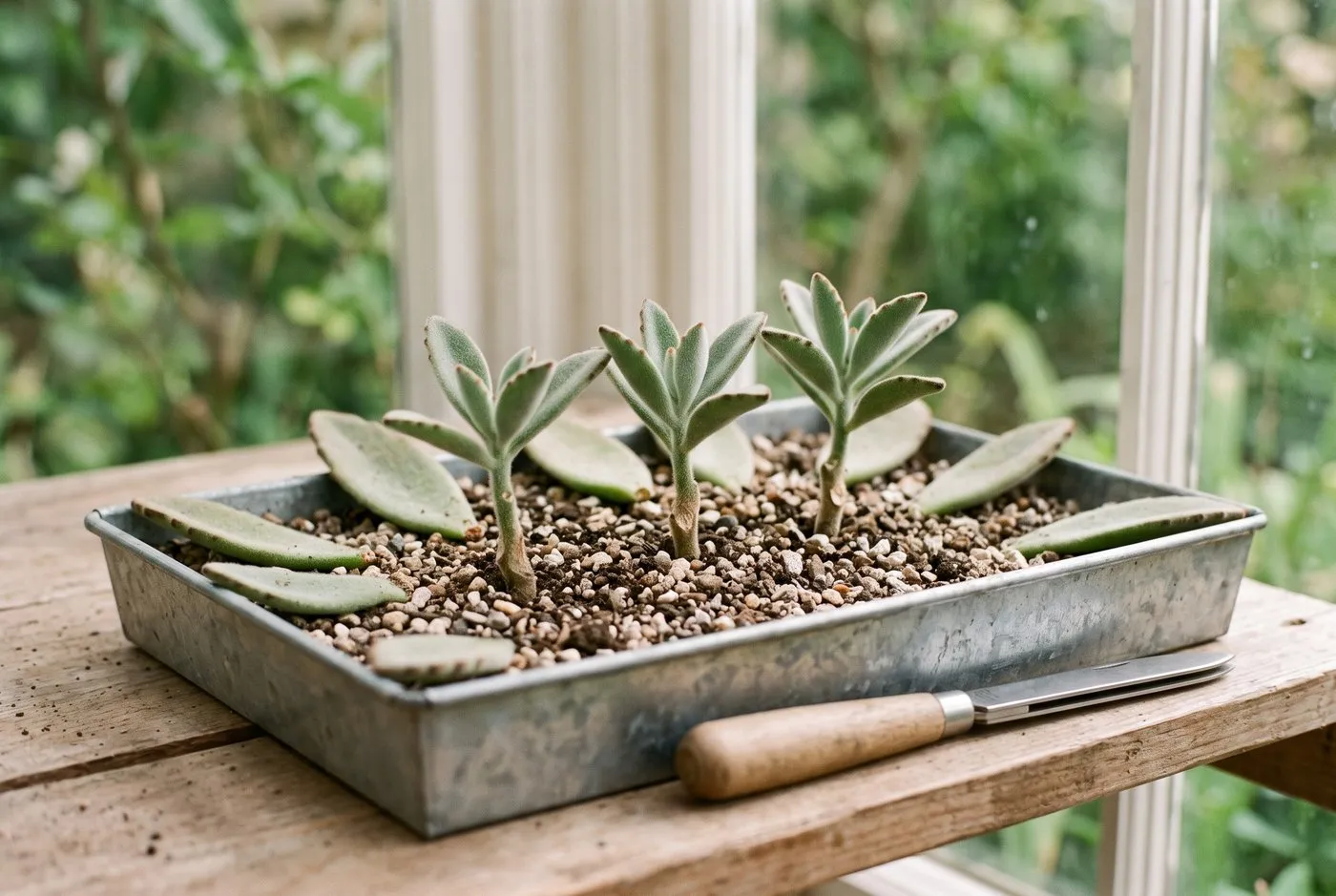 Stem cuttings pushed into gritty compost and whole leaves laid flat on the surface after a day of callusing. Kept warm at 18 to 20C, most root within two to three weeks and flower the next winter.
Mealybug and the other problems that hit kalanchoe
Kalanchoe stays healthy in the right conditions, but a few problems recur. The most common indoor pest is mealybug, a sap-sucking insect that hides in the leaf axils and looks like small blobs of white cotton wool. Adults are about 3 to 4mm long. They weaken the plant, leave sticky honeydew, and spread fast between succulents on the same shelf.
Deal with mealybug early. Dab each insect with a cotton bud dipped in surgical spirit, which dissolves their waxy coat on contact. For a heavier attack, spray fortnightly with a horticultural soap or a fatty-acid spray, and check every crevice, because the egg sacs sit deep in the joints. Our detailed guide to treating mealybug sets out the full control plan and how to stop them coming back.
The other problems trace back to watering and light. Basal rot, a soft brown collapse at the stem base, comes from wet compost in cold conditions. Leggy, pale growth means too little light. Dropped buds usually follow a move, a draught, or dry air near a radiator during the flowering spell. Fix the underlying condition and the plant recovers. Kalanchoe rarely dies of anything but overwatering.
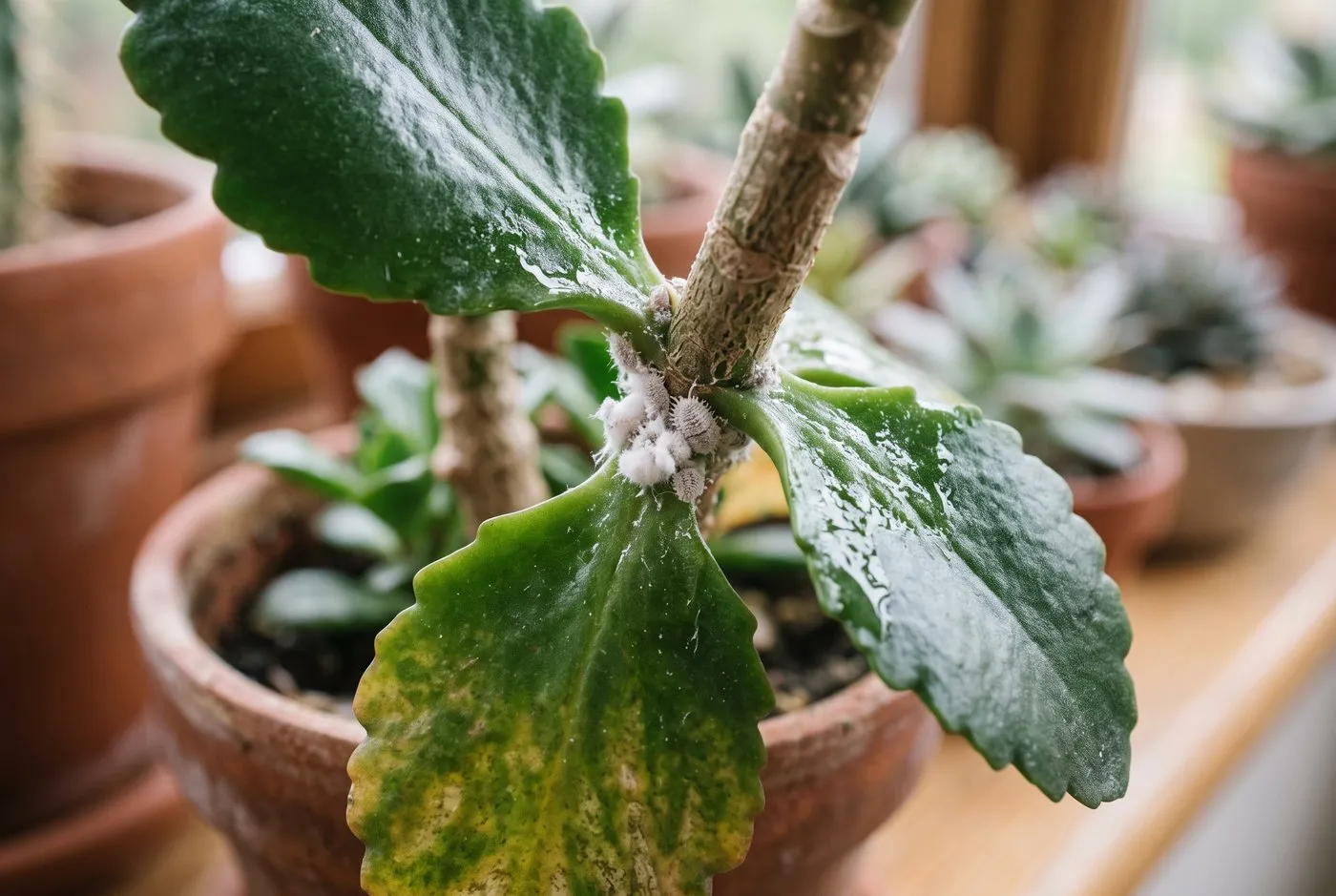 Mealybug hides in the leaf axils as white, cotton-wool clumps, leaving sticky honeydew. Spotting it early and dabbing with surgical spirit stops it spreading across a shelf of succulents.
Warning: Kalanchoe is toxic to cats and dogs. All parts contain bufadienolides, compounds that can upset the stomach and, in quantity, affect the heart. Keep plants on a high shelf out of a pet’s reach, and contact your vet at once if a cat or dog chews the leaves or flowers.
Common mistakes when growing kalanchoe
- Overwatering. The number one killer. People treat a succulent like a leafy houseplant and keep the compost moist. That rots the roots. Water only when the top 3cm is dry, and never leave the pot in a full saucer.
- Expecting it to rebloom on its own. A kalanchoe in a lit room will not flower again. It needs the 14-hour dark treatment from October. Without it, you get healthy leaves and no colour, year after year.
- Too little light. Kalanchoe on a dim shelf grows pale and stretched, and never flowers well. Give it the brightest windowsill you have, with six or more hours of light.
- Letting light leak into the dark treatment. Even a hallway bulb or a phone screen at night resets the flowering clock. The darkness must be total for the full six weeks, or the buds will not form.
- Cold, wet winters. A plant kept below 7C, or wet and cold together, collapses. Keep it warm, above 10 to 13C, and on the dry side through the coldest months.
Now you know how to keep a Flaming Katy alive and flowering, read our guide to caring for succulents indoors for the wider group of easy houseplants that thrive on the same bright light and careful watering. You can also browse more of our growing guides for plants to grow alongside it.
Frequently asked questions
How do you care for a kalanchoe (Flaming Katy)?
Give it bright light, water only when dry, and keep it above 10C. Stand it on a sunny windowsill, let the compost dry between waterings, and feed monthly in summer. It is a succulent, so it stores water in its leaves and hates sitting wet. Deadhead spent flower heads to keep it tidy.
Why has my kalanchoe stopped flowering?
Lengthening days stop it setting buds; it needs long nights to reflower. Kalanchoe is a short-day plant, triggered into flower by long periods of darkness. Once spring days grow past about 12 hours, it switches to leafy growth and will not rebloom on its own. You have to recreate short days by hand.
How do you make a kalanchoe flower again?
Give it 14 hours of total darkness each night for six weeks. From October, move it into a dark cupboard or cover it with a box each evening, then return it to bright light by day. Keep it above 15C during this time. Buds appear after five to six weeks, then flower normally.
How often should you water a kalanchoe?
Water only when the top 3cm of compost is dry. In summer that is often every 7 to 10 days, in winter every 3 to 4 weeks. Soak the compost, let it drain fully, and never leave the pot standing in water. Wet roots in cold conditions are the main cause of rot.
Is kalanchoe poisonous to cats and dogs?
Yes, kalanchoe is toxic to cats and dogs if eaten. All parts contain compounds that upset the stomach and, in larger amounts, can affect the heart. Signs include drooling, vomiting and lethargy. Keep the plant on a high shelf away from pets, and ring your vet if you suspect a pet has chewed it.
Can you grow kalanchoe from cuttings?
Yes, leaf and stem cuttings root easily in 2 to 3 weeks. Take a healthy stem tip or a whole leaf, let the cut end dry for a day, then push it into gritty compost. Keep it warm at 18 to 20C and barely moist. Most cuttings root within a fortnight and flower the following year.
Can kalanchoe live outside in the UK?
Only in summer; it is tender and dies below about 7C. Stand pots outdoors from June to September in a sheltered, sunny spot. Bring them back inside well before the first frost. Kalanchoe cannot survive a UK winter outdoors, so treat it as an indoor plant that holidays outside.
Our team produces practical UK gardening guidance from source research, contributor records and established horticultural practice. Editorial standards are overseen by Matt W.